



Content Curator
Heat Transfer by Convection transfers heat by mass motion of a fluid like air or water when heated fluid is moved away from source of heat, carrying energy with it. Heat convection above the hot surface occurs as hot air expands and becomes less dense. Hot water is less dense as compared to cold water and rises creating convection currents that transport energy.
Read more: Heat Transfer
Key Terms: Heat, Heat transfer, conduction, convection, radiation, temperature difference, buoyancy, thermal expansion
Mechanism of Convection
[Click Here for Sample Questions]
Convection is the most complex form of a type of heat transfer which takes place only in case of liquids and gases. It is a mechanism where heat moves from one place to another through fluid currents which depend on fluid properties and body forces acting on the fluid such as gravity and buoyancy. The rate of heat transfer in convection is faster compared to conduction.
Convection depends upon the fluid properties like
- Density (Ï)
- Dynamic viscosity (µ)
- Thermal conductivity (k)
- Velocity (v)
- Specific heat (Cp)
- Type of fluid flow (laminar/turbulent)
The rate of thermal convection can be measured by the following equation-
Q = hc · A · (Ts – Tf)
Where,
Q is the rate of heat transfer per unit time
hc is the convective heat transfer coefficient
A is the surface area of heat transfer
Ts is the surface temperature
Tf is the fluid temperature
Convective heat transfer takes place via two mechanisms: Diffusion and Advection. Diffusion is movement of molecules from a higher concentration to lower concentration. Advection is movement of matter by bulk motion of currents within the fluid.
The video below explains this:
Heat Transfer Formula Detailed Video Explanation:
Convection Current
[Click Here for Sample Questions]
Convection involves bulk movement of fluid. Both gases and liquids fall in the category of fluids. When a fluid is heated from below, the molecules present near heat gain energy and start to move faster and begin to expand. This makes the fluid at bottom lighter and less dense. Whereas, the fluid at top layer is comparatively cooler and denser, so the heavier molecules at top start to sink and the lighter molecules at bottom start rising.
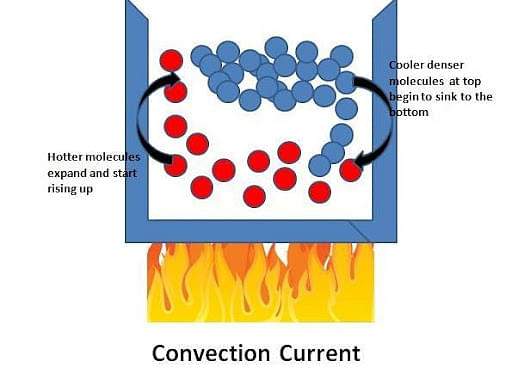
Convection Current Diagram
The fast moving hot molecules when they reach the cool top surface of the fluid, they lose heat, condense and slow down. This causes them to start descending again as they become more compact and heavy, thus the cycle repeats forming a current or flow of fluid, this is called the convection current.
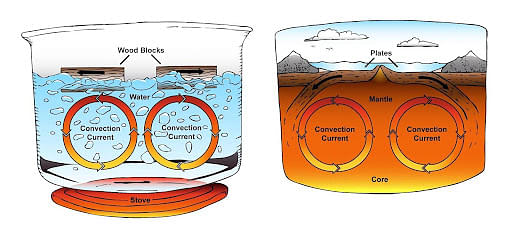
Example of Convection Current
Convection currents of the molten rocks in the mantle of the Earth are responsible for the movement of Tectonic Plates.
Types of Convection
[Click Here for Sample Questions]
There are two types of convection processes:
- Natural Convection
- Forced Convection
Natural Convection
Natural convection takes place in gravitational fields where fluid movement is generated due to difference in densities caused by temperature gradients. This causes gravity to pull down the heavier cold fluid layer on top and thereby causing the lighter hot fluid to rise up to take its place.
Cold layer pulled down gets heated and becomes lighter and again rises up to replace the colder top layer because of buoyancy. This process continues to form a current. Natural convection plays a major role in the earth’s atmosphere, oceans, mantle, and stellar physics.

Natural Convection
Forced Convection
It is the process of heat transfer in which the motion of fluid is forced by an external source like a pump, fan, suction device, etc. to increase the heat transfer. Forced convection is commonly used in applications such as to heat or cool a home efficiently using a fan or air conditioner, cooling of electronic components using fans, cooling of oil and coolants in vehicles using externally forced air, refrigeration, etc.
Some other applications of Forced Convection are:
- Heat Exchanger Simulation
- Computer case cooling
- Heat removal
- Cooling/heating system design
- Fan or water cooled central processing unit (CPU) design
- Electric fan simulation
- Heat sensitivity studies
- Thermal optimization
- Heat sink simulation
- Printed Circuit Board (PCB) simulation
Things to Remember
[Click Here for Sample Questions]
- The rate of heat transfer i.e. conductivity is higher for metals (solids) and lower for gases.
- The rate of heat transfer in convection is faster compared to conduction.
- Radiation is the fastest mode of heat transfer
- Conduction indicates transfer of heat between objects in direct contact
- Convection indicates transfer of heat through liquids and gases
- Radiation indicates transfer of heat through vacuum or air through waves and it does not heat up the intervening medium.
- The faster the fluid moves the quicker the rate of convection.
- Currents produced by difference in density of fluids caused by natural factors is called Natural Convection whereas currents caused due to external factors such as fan or pump are called Forced Convection.
- Although liquids and gases are generally not very good conductors of heat, they can transfer heat quite rapidly by convection.
- The rate of convection is higher in forced convection because the velocity of fluid is more in case of forced convection as compared to natural convection.
Also read:
Sample Questions
Ques. What is the slowest and fastest mode of heat transfer? Why? (2 Marks)
Ans. Conduction is the slowest and Radiation is the fastest mode of heat transfer. In conduction, the heat transfer takes place from particle to particle whereas in radiation the heat is transferred from origin or source to the surroundings through electromagnetic waves without the requirement of direct contact or medium.
Ques. What is the difference between natural and forced convection? (2 Marks)
Ans. Current produced by difference in density of fluids caused by natural factors is called Natural Convection whereas currents caused due to external factors such as fan or pump are called Forced Convection.
Ques. What is the mechanism of Convection? (2 Marks)
Ans. Convective heat transfer take place via two mechanisms:
Diffusion
It is the movement of molecules from a higher concentration to lower concentration
Advection
It is the movement of matter by bulk motion of currents within the fluid.
Ques. What is heat and how does it get transferred? (2 Marks)
Ans. Heat is a form of energy that is created due to the motion of atoms and molecules in a matter. The faster the molecules or atoms move inside the matter, the more heat energy or thermal energy the matter has.
Heat gets transferred from one system to another due to temperature difference. Heat travels from higher temperature to lower temperature. The system at lower temperature absorbs the heat from the system at higher temperature and becomes warmer.
Ques. Explain the three types of heat transfer processes. (4 Marks)
Ans. There are three types of heat transfer processes:
Convection
Convection is a type of heat transfer which takes place by actual movement of matter. When fluids are heated from below, the heated fluid at the bottom, which becomes lighter due to expansion, rises up and the comparatively cool heavier fluid at top sinks below to displace the hot lighter fluid.
Conduction:
Conduction is a type of heat transfer that takes place from one body to another when they are directly in contact with each other. The heat gets transferred from a high temperature molecule to a low temperature molecule. When two objects at different temperatures come in contact, the molecules of the object at higher temperature move faster than the molecules of the object at lower temperature. When high temperature molecules collide with the cooler molecules, heat gets transferred to the cooler molecule.
Radiation
Radiation is the type of heat transfer that is carried out by electromagnetic heat waves and it does not involve the movement of matter. In this process, there is no requirement of medium or direct contact of objects. When the heat waves emitted by a hot object hit or reach the cooler object, they warm up the cooler object. Example, you feel the heat of the sun without actually touching it.
Ques. Compare the three types of heat transfers. (3 Marks)
Ans.
| Comparison of Types of Heat Transfer Convection | ||||
| Particulars | Mode of heat transfer | Speed | Cause of heat transfer | Depends on |
| Conduction | Heat transfer between objects in direct contact | Slow | Collision of molecules due to difference in temperature | Conductivity of objects |
| Convection | Heat transfer within the fluid | Faster | Motion of matter due to difference in density | Gravity, density |
| Radiation | Heat transfer from origin to the space surrounding | Fastest | No involvement of motion of matter, energy emits from all objects and travels through electromagnetic waves | Surface properties like color, orientation, reflection, refraction |
Ques. Which properties of fluid affect the rate of convection? (2 Marks)
Ans. The rate of convection depends upon the fluid properties like
-
- Density
- Dynamic viscosity
- Velocity
- Specific heat
- Type of fluid flow (laminar/turbulent)
Also read:



Comments