



Exams Prep Master
In mathematics, we utilize the cross multiplication approach to solve two-variable linear equations. This is the simplest approach to solving them because it provides us with the exact values of the two variables. The approach of cross multiplication, on the other hand, is only useful when we have a pair of two-variable linear equations. The solution of the simultaneous linear equation can be classified into two broad categories, Graphical Method and Algebraic method. Moreover, the algebraic method can be sub-divided into three categories: Substitution method, Elimination method, and cross-multiplication method. Here, we will be discussing about the cross multiplication method for pair of linear equations in two variables, along with some important questions.
| Table of Content |
KEY TAKEAWAYS: linear equation, variability, fractions
Also read: Differential Equation
What is Cross Multiplication?
[Click Here for Sample Questions]
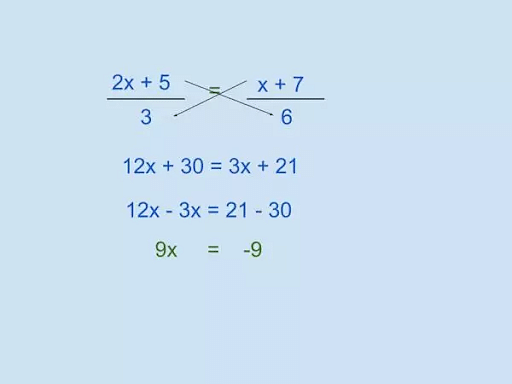
In arithmetic operations, cross multiplication is used to solve equations or discover the value of a variable. The numerator of one side is multiplied by the denominator of the other side in this operation. The numerator and denominator of one fraction must be multiplied by the denominator of the second fraction. Secondly, we have to multiply the denominator from the first fraction by the numerator and the denominator from the second fraction. This will assist in obtaining an answer to the query.
Consider the equations a1x + b1y + c1 = 0 and a2x + b2y + c2 = 0 that must be solved. We would determine the values of the x and y variables using the cross-multiplication approach.
x = b1c2 − b2c1b2a1−b1a2, and y = c1a2−c2a1b2a1−b1a2
Here, b2a1 - b1a2 ≠ 0
The final solution is,
xb1c2 − b2c1 = yc1a2 − c2a1 = 1b2a1 − b1a2
This approach is regarded as the 'Cross-Multiplication Method,' since it is extremely effective for simplifying the answer. The graphic below is useful for learning the method of cross-multiplication and solving the linear equation in two variables.

The multiplication of the numbers connected by the arrow is indicated by the arrows in the picture. The second product is then deducted from the first, as can be seen. As can be seen above the arrow, the result is substituted as the denominator of the specified variables and 1. The acquired values are then equated to produce an equation, as shown below.
xb1c2 − b2c1 = yc1a2 − c2a1 = 1b2a1− b1a2
We may calculate the values of x and y from here, as long as b2a1 - b1a2 ≠ 0. As a result, we refer to this technique as cross-multiplication. The requirement for the consistency of the supplied pair of linear equations in two variables must be tested using this approach. The following are the conditions:
- If a1a2 ≠ b1b2 is true, then the solution is unique, and the provided set of linear equations in two variables is known to be consistent.
- There would be infinite solutions if a1a2 = b1b2 = c1c2, and the lines would be coinciding and hence consistent and dependent.
- There would be no solution if a1a2 = b1b2 ≠ c1c2, and the pair of supplied linear equations in two variables would be inconsistent.
Read more:
Derivation of Cross Multiplication
[Click Here for Sample Questions]
Consider any pair of linear equations to further comprehend this strategy (that is, with any coefficients)
a1x + b1y + c1= 0
a2x + b2y + c2 = 0
Let's express the coefficients in the original pair of equations in a grid format as follows.
a1 b1 c1 a2 b2 c2
We'll just disregard the coefficients of now x in our grid, and remove the coefficients from the remaining two columns by cross-multiplying them:

As a result, equality becomes the first aspect of our answer.
xb1c2 − b2c1
The equation below negative y is then considered.
To write this, we disregard the y-coefficients column and cross-multiply and remove the coefficients in the remaining two columns:

As a result, the second element of our answer equals,
- ya1c2 − a2c1
Finally, we take into account the expression below 1, which is a1b2−a2b1. To write this, we disregard the constants column and cross-multiply and remove the coefficients in the remaining two columns:

As a result, the final component of our solution, equality, becomes
1a1b2 − a2b1
When we combine all three pieces, we get the following complete solution to the pair of linear equations:
xb1c2 − b2c1 = -ya1c2 − a2c1 = 1a1b2 − a2b1
Read also:
Things To Remember
- In arithmetic operations, cross multiplication is used to solve equations or discover the value of a variable. The numerator of one side is multiplied by the denominator of the other side in this operation.
- Consider the equations a1x + b1y + c1 = 0 and a2x + b2y + c2 = 0 that must be solved. We would determine the values of the x and y variables using the cross-multiplication approach.
- x = b1c2−b2c1b2a1−b1a2, and y = c1a2−c2a1b2a1−b1a2
- The acquired values are then equated to produce an equation, xb1c2−b2c1 = yc1a2−c2a1 = 1b2a1−b1a2.
Read also:
Sample Questions
Ques: Determine the variable values that satisfy the following equation: 2x + 5y = 20 and 3x + 6y = 12. (2 Marks)
Ans: Determine the variable values that satisfy the following equation:
2x + 5y equals 20 and 3x+6y equals 12.
Provided,
20 = 2x+5y
12 = 3x + 6y
We are aware of the cross multiplication approach;
As a result of inserting the values in the equation above, we get:
x/[(5).(12)-(6).(20)] = y/[(20).(3)-(12).(2)] = 1/[(5).(3)-(6).(2)]
x/(60-120) = y/(60 – 24) = 1/(15-12)
x/(-60) = y/36
Now,
x/-60 = 1/3
x = - 20
And
y/36 = 1/3
y = 12
As a result, the place where the above equations cross is x = -20 and y = 12.
Ques: Solve the given two variables linear equation: (2 Marks)
8x + 5y = 11
3x – 4y = 10
Ans: On transposition, we get
8x + 5y – 11 = 0
3x – 4y – 10 = 0
Writing the coefficient in the following way, we get:
By cross-multiplication method:
x/ (5) (- 10) – (- 4) (- 11) = y / (- 11) (3) – (- 10) (8) = 1 / (8) (- 4) – (3) (5)
x / - 50 – 44 = y / -3 3 + 80 = 1 / - 32 – 15
x/ - 94 = y / 47 = 1 / - 47
x/-2 = y / 1 = 1 / - 1 [multiplying by 47]
or, x = - 2 / - 1 = 2 and y = 1 / - 1 = - 1
Now, the required solution is x = 2, y = - 1
Ques: What is the definition of a cross multiplication method? (2 Marks)
Ans: The cross multiplication method can simply be defined by the process in which the numerator of a fraction will be multiplied by the denominator of the other, and the denominator of the first term will be multiplied by the numerator of the other..
Ques: What is the need for the cross multiplication method in linear algebra? (2 Marks)
Ans: We utilise the cross multiplication approach to get the solution to a pair of linear equations. This approach may be used to obtain the values of x and y if a1x + b1y + c1 = 0 and a2x + b2x + c2 = 0 are two linear equations.
Ques: How can you use cross multiplication to determine the answer to a two-variable linear equation? (2 Marks)
Ans: The following equation may be used to obtain the answer for linear equations in two variables using cross-multiplication:
xb1c2 − b2c1 = – ya1c2 − a2c1 = 1a1b2 − a2b1
Ques: What are the requirements for obtaining a unique solution? (2 Marks)
Ans: If a1 / a2 b1 / b2 is true, then we have a unique solution and a set of linear equations in two variables that are consistent.
Ques: Write the mathematical rule of three? (2 Marks)
Ans: The mathematical rule of three is a way for determining a solution using proportions. The greatest example is cross multiplication, where we may write in a percentage to determine the values of unknown variables.
Mathematics Related Links:



Comments