



Content Curator
Instantaneous Velocity is the speed of a moving object at a given time, maintaining a specific direction. The velocity of an object changes with change in time. Instantaneous velocity is the measurement of velocity as the difference in time reaches zero on the other hand velocity is the ratio of change in position and change in time. In the following sections, we will discuss the instantaneous velocity formula with solved examples.
Read Also: Motion in a Straight Line
| Table of Content |
Instantaneous Velocity
[Click Here for Sample Questions]
Instantaneous velocity is the velocity of an object in motion at a specific point in time.It is a vector quantity and has both magnitude and direction. Instantaneous velocity is expressed in m/s.

X is the given function concerning the time t.
Where,
- Δt is the small-time interval.
- V(t) is the instantaneous velocity at time t
- x is the displacement.
- t is the time.
Motion in a Straight Line Video Explanation
Also Read:
Concept of Instantaneous Velocity Formula
[Click Here for Sample Questions]
The rate of change of a position for a negligible time interval is known as instantaneous velocity. Instantaneous velocity is similar to instantaneous speed with only one difference that instantaneous speed has no direction. Thus, instantaneous velocity can be defined as the velocity of a moving object at a specific point in time.
The needle of the speedometer which shows the speed of the car every hour fluctuates. This fluctuation along with the direction of the car in a particular period is known as instantaneous velocity.
Also Check:
Formula for Instantaneous Velocity
[Click Here for Sample Questions]
It is determined as the average velocity with a minimum period. The average velocity can be calculated as the ratio of total displacement and total time.
The time interval is directly proportional to the displacement. Thus, when displacement reduces to zero, the time interval also becomes the same. But there is a value to the limit of the ratio between time and displacement which is known as instantaneous velocity.
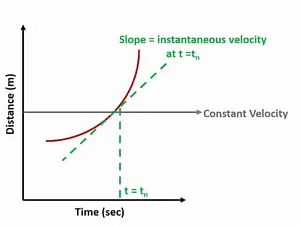
It can also be represented by taking the slope of the distance-time graph or x-t graph. The formula of instantaneous velocity is:
V(t) = dx(t)/ΔT
Also Read More:
Derivation of the formula
[Click Here for Sample Questions]
Instantaneous velocity is the velocity between the two points in a time limit where the time between the two points gradually becomes zero. X(t) is the position of x in respect to the function of t. The equation for average velocity between the two points is:
V= [x(t2) – x(t1)]/(t2-t1)
Let, t1 = t and t2 = t + \(\Delta\)t
To calculate instantaneous velocity, the \(\Delta\)t needs to be zero.
Taking the limit as \(\Delta\)t -> 0 and inserting the expressions in the equation,
Instantaneous velocity or v(t) = Lim [x(t+\(\Delta\)t) – x(t)]/\(\Delta\)t
Thus, v (t) = dx(t)/dt
Also Check More:
Things to Remember
[Click Here for Sample Questions]
- Instantaneous velocity is the velocity of an object in motion at a specific point in time. The SI unit of instantaneous velocity is m/s.
- It is a vector quantity and has both magnitude and direction.
- The formula of instantaneous velocity is- V= [x(t2) – x(t1)]/(t2-t1)
- Instantaneous velocity can be calculated and represented graphically as well as numerically
- At all instants or time intervals, average velocity and velocity is the same in the case of uniform motion
- Instantaneous speed affects the intensity of instantaneous velocity.
- Instantaneous velocity is a vector quantity
- Average velocity = \(\Delta\)S/\(\Delta\)T where, \(\Delta\)S = distance covered and \(\Delta\)T = the time interval
Important Questions
Ques: A specific object is moving in a straight line for time (t) = 3s with a function x = 5t2 + 2t + 3. Calculate the instantaneous velocity. (2 Marks)
Ans: vinst = dx/ dt
= d(5t2+2t+3)/dt
Vinst = 10t +2
t = 3s ,
Instantaneous velocity v (t) = 10t +2
v(3) = 10(3) +2
v(3) = 32m/s
Ques: Calculate the instantaneous velocity at t= 2.0s when the position of the given particle is x(t)=3.0t + 0.5t3m. (2 Marks)
Ans: x(t)=3.0t + 0.5t3m
V(t) = dx(t)/dt = 3.0 + 1.5t2 m/s
Given t= 2.0s,
V(2.0s ) = [3.0 + 1.5(2.0)2] m/s
= 9.0 m/s
Ques: The equation of motion of a bullet travelling in a straight line is S(t)=4t + 6t2 which travels for 15 seconds before crushing. Calculate the instantaneous velocity at the time interval of 10th second. (3 Marks)
Ans: S(t)=4t + 6t2
ds/dt = d(4t + 6t2)/dt
=4 +12t
Therefore, vinst at (t=10) = 4 + (12x10)
= 124 m/s
Ques: The approximate equation of motion of a body under gravity is S(t)= 4.9t2. calculate the instantaneous velocity at 5 seconds after the release. (2 Marks)
Ans: S(t)= 4.9t2
Instantaneous velocity at 5 seconds,
Vinst = [ds/dt]t=5 = 4.9 x 2 x5
= 49m/s
Ques: The maximum height of a rocket in the first 30 mins of its launch is given by x=bt2 when b is constant with the value of 2.9m/s2. Calculate the general expression for the velocity of the rocket as a function of time and from it the instantaneous velocity at the given time (t) = 20 seconds. (3 Marks)
Ans: velocity (v) = dx/dt
Here, x = bt2
V = dx/dt = d(bt2)/dt = 2bt
General expression for the velocity of rocket (V) = 2bt …… (i)
instantaneous velocity at t = 20 secs ,
2bt = 2 x 2.9 x 20 = 116m/s …..(ii)
Instantaneous velocity = 116m/s
Ques: X= a + bt2 is the position of an object moving along the x-axis where a= 8.5m, b = 2.5ms-2. Calculate the velocity at t= 0s and t= 2.0s. also calculate the average velocity between t= 2.0s and t = 4.0s. (3 Marks)
Ans: velocity (v) = dx/dt = d(a +bt2)/ dt
= 2bt
= 5.0 tms-1
At t = 0s, v = 0ms-1 and at t = 2.0s, v = 10ms-1
Average velocity = x (4.0) – x(2.0)4.0-2.0
= a+16b-a-4b2.0 = 6.0 x b
= 6.0 x 2.5
= 15ms-1
Ques: The position of a moving car is given by the function x = 4t2 + 10t + 6. Calculate the instantaneous velocity at the time (t) = 5 s (3 Marks)
Ans: x = 4t2 + 10t +6
Vinst = dx/dt
= d (4t2+ 10t + 6)/dt
Given, t= 5s
V(t) = 8t+10
V(5) = 8(5) +10
V(5) = 50m/s
Ques: The position of an object is given by x(t) = 3.0t + 0.5t3m. calculate the instantaneous velocity at t=2.0s and the average velocity between 1.0s and 3.0s (3 Marks)
Ans: v(t) = dx(t)/dt = 3.0 + 1.5t2 m/s
Given t=2.0s
V(2.0s) = [3.0 + 1.5(2.0)2 ] m/s
= 9.0m/s
Average velocity between 1.0s and 3.0s , we calculate the values of x(1.0s) and x(3.0s):
X(1.0s) = [(3.0)(1.0) + 0.5 (1.0)3 ] m = 3.5m
X(3.0s) = [(3.0)(3.0) + 0.5(3.0)3]m = 22.5m
The final average velocity is,
V = x3.0s-x(1.0s)t3.0s-t(1.0s) = 22.5-3.5m3.0-1.0s
= 22.5-3.5m3.0-1.0s
= 9.5 m/s
Read More



Comments