



Content Writer
Key Highlights
- Newton’s law of cooling is an important concept of heat transfer.
- According to the law, the amount of heat dissipation by the body is proportional to the temperature difference between the system and its surroundings.
- Newton’s law of cooling is expressed as dT/dt = k (Tt—Ts).
- The law measures the temperature of a liquid placed inside a freezer after a particular timeframe.
- The main limitation of Newton’s law of cooling is that the temperature of the surroundings has to stay constant in the course of cooling.
Newton's law of cooling explains the charge at which a body exchanges its temperature while exposed to radiation. The law states that the rate of loss of heat from a body is directly proportional to the difference between the body's temperature and its environment.
- The law can be used to determine the exact time of death by comparing the temperature of the body at the moment with the present body temperature.
Key Terms: Newton’s Law of Cooling, Temperature, Radiation, Heat Transfer, Heat, Newton’s Law of Cooling Formula
What is Newton’s Law of Cooling?
[Click Here for Sample Questions]
Newton’s law of cooling states that the rate of loss of heat from a body is directly proportional to the difference between the temperature of the object and its surroundings.
- Using the law, we can calculate how fast a substance at a selected temperature might cool in any particular surroundings.
- Furthermore, it also tells us how the charge of cooling an item relies on the cooling constant of the substance.
- The law is based on the heat transfer.
- It is a special case of Stefan-Boltzmann’s Law.
- Newton’s law of cooling determines that the coefficient of heat transfer, controlling temperature change and level of heat dissipation, is fixed.
- The law explains why milk kept on a table for a longer duration cools faster than a little warm water or milk left on the table.
Newton’ law of Cooling is given by,
dT/dt = k (Tt - Ts)
Where,
- Tt → Temperature of the body at time t
- Ts → Temperature of the surrounding
- k → Positive constant that depends on the region and nature of the surface of the body under consideration.
Newton’s Law of Cooling Formula
[Click Here for Sample Questions]
The heat transfer rate increases depending upon the difference in temperature of the system and surroundings. According to Newton’s law of cooling, the rate of loss of heat (– dT/dt) is directly proportional to the difference between the temperature [ΔT =(T0—Ts)] of the body and the surroundings.
It can be represented as,
– dT/dt ∝ (T0 – Ts)
– dT/dt = k(T0 – Ts)
- where, k is a proportionality constant
After solving the differential equation we will get Newton’s law of cooling formula as:
T(t) = Ts + (To – Ts) e - kt
- t → time
- T(t) → Temperature of the body at time t.
- Ts → Surrounding temperature
- To → Initial body temperature
- k → Constant
Example of Newton’s Law of Cooling FormulaExample. Water is heated to 50 ºC for 10 min. How much would be its temperature in degrees Celsius, if k = 0.056 per min and the surrounding temperature is 20 ºC? Ans. Given,
According to Newton’s law of cooling, T(t) = Ts + (T0 – Ts) e-kt Substituting the value T(t)= 20 + (50 – 20)e-(0.056×10) T(t) = 20 + 30 e-(0.056×10) T(t) = 84.5 |

Newton’s Law of Cooling
Newton’s Law of Cooling Derivation
[Click Here for Sample Questions]
For small temperature distinctions among a body and its surroundings, the charge of cooling of the body is directly proportional to the temperature distinction and the surface region exposed. It is given by,
dQ/dt ∝ (q – qs)
Where, q and qs are temperatures corresponding to objects and surroundings.
From the above expression
dQ/dt = -k[q – qs] . . . . . . . . (1)
The expression represent Newton’s law of cooling
k = [4eσ × θ3o / mc] A . . . . . (2)
Now,
dθ/dt = -k[θ – θo]
![d?/dt = -k[? – ?o]](https://images.collegedunia.com/public/image/a2388aac53e5f44bb8f516dd1c94de6f.jpeg)
Where,
qi → Initial temperature of object
qf → Final temperature of object
ln (qf – q0)/(qi – q0) = kt
(qf – q0) = (qi – q0) e-kt
qf = q0 + (qi – q0) e -kt . . . . . . (3)
Methods to Apply Newton’s Law of Cooling
[Click Here for Sample Questions]
If we need only approximate values from Newton's law of cooling, we can assume a constant rate of cooling. It is same as the rate of cooling corresponding to the body temperature between the body at rest
dθ\dt = k(qi – q0)
If qi and qf is the initial and final temperature of a body then average temperature of the body is given as
(qi + qf)/2
Limitations of Newton’s Law of Cooling
[Click Here for Sample Questions]
The limitations of Newton’s law of cooling are as follows:
- The difference in temperature between the body and the environment should be small.
- The heat from the body should be dissipated only through radiation.
- The main limitation of Newton’s law of cooling is that the temperature of the surroundings has to stay constant.
Applications of Newton’s Law of Cooling
[Click Here for Sample Questions]
The important applications of Newton’s law of cooling are as follows:
- Newton's law of cooling calculates the amount of time required for a heated item to lower its temperature to a specified degree.
- It calculates how long it will take for a warm object to cool down to a specific temperature.
- The law determines the temperature of a drink kept in a refrigerator after a particular timeframe.
Sample Questions
Ques. A body at temperature 40ºC is kept in a surrounding of constant temperature 20ºC. It is noteworthy that its temperature drops to 35ºC in 10 minutes. Find out how long it will take for the body to reach a temperature of 30ºC? (3 marks)
Ans. From Newton's law of cooling, qf = qi e-kt
Now, for the interval in which temperature falls from 40 to 35oC.
(35 – 20) = (40 – 20) e-k.10
e-10k = 3/4
k = [ln 4/3]/10 . . . . (a)
Now, for the next interval;
(30 – 20) = (35 – 20)e-kt
e-kt = 2/3
kt = ln 3/2 . . . . (b)
From equation (a) and (b);
t = 10 × [ln(3/2)/ln(4/3)]= 14.096 min.
Ques. What is Newton’s Law of cooling? (2 marks)
Ans. Newton’s law of cooling explains the charge at which a body exchanges its temperature while it is exposed via radiation. When we use Newton's law of cooling formula, we can calculate how fast a substance at a selected temperature might cool in any particular surroundings.
Ques. The oil is heated to 70°C. It cools to 50°C after 6 minutes. Calculate the time taken by the oil to cool from 50°C to 40°C given the surrounding temperature Ts = 25°C? (3 marks)
Ans. given temperature of oil after 6 minutes
- T(t)=50°C
- To = 70°C,
- t = 6 min
In inserting the data provided in Newton’s cooling formula rule, we find;
T(t) = Ts + (Ts – To) e-kt
[T(t) – Ts]/[To – Ts] = e-kt
ln = [ln T(t) – Ts]/To – Ts
-kt = [ln 50 - 25] / 70 - 25 = ln 0.555
k = – (-0.555/6) = 0.092
If T(t) = 45oC (average temperature as the temperature decreases from 50oC to 40oC)
Time taken is -kt ln e = [ln T(t) – Ts]/[To – Ts]
- (0.092) t = ln 45 - 25 / [70 - 25]
-0.092 t = -0.597
t = -0.597/-0.092 = 6.489 min.
Ques. Water is heated to 80°C for 10 min. How much would be the temperature if k = 0.56 per min and the surrounding temperature is 25°C? (2 marks)
Ans.
- s = 25°C,
- To = 80°C,
- t = 10 min,
- k = 0.56
Now, to include the above data in Newton's cooling formula rule,
T(t) = Ts + (To – Ts) × e-kt
= 25 + (80 – 25) × e-0.56 = 25 + [55 × 0.57] = 56.35°C
The temperature cools down from 80°C to 56.35°C after 10 min.
Ques. What is the physical meaning of Newton’s Law of Cooling? (2 marks)
Ans. The body heats up above the environment and cools down depending on how high its temperature is around the environment. Thus, a hot body cools down faster than a warm body. The same body cools faster at first and then moves more slowly.
Ques. A pan filled with hot food cools from 94 °C to 86 °C in 2 minutes when the room temperature is at 20 °C. How long will it take to cool from 71 °C to 69 °C? (3 marks)
Ans. Using Newton’s law of cooling method
8/2=k(94+86/2−20)
4=70k4=70k -(1)
second temperature decrease
2t=k(71+69/2−20
2t=50k2t=50k -(2)
From (1) and (2), we have
t = 7 min
Ques. The temperature of a body falls from 90°C to 70°C in 5 minutes when placed in a surrounding of constant temperature 20°C. Find the time taken for the body to become 50°C? (3 marks)
Ans. Integrate the differential equation of Newton's law of cooling from time t = 0 and t = 5 min to get
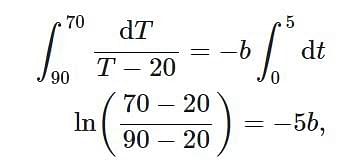
which gives b=(1/5)ln(7/5). Now, repeat the same for the time interval t=5 min to =τ in which temperature decreases from 70°C to 50°C.

Substitute b and simplify to get τ =12.6 min. The time taken to cool from 70°C to 50°C is 12.6 − 5 = 7.6 min.
Ques. The temperature of a body falls from 40°C to 36°C in 5 minutes when placed in a surrounding of a constant temperature of 16°C. Find the time taken for the temperature of the body to become 32°C? (3 marks)
Ans. We solve this problem by an approximation method that makes use of mean temperature. The approximation errors are small because temperature differences are not large.The mean temperature of the body as it cools from 40°C to 36°C is
Tm=(40+36)2=38°C.
Newton's law of cooling can be written as
ΔT/Δt = -b(tm - ts)
(36-40)/5 = -b(38-16)
which gives b=0.8/22/min. Note that ΔT/Δt is negative.
Let the time taken for the temperature to become 32°C be t. During this period, Tm=(36+32)/2=34°C. Substitute in the above equation to get
(32-46)/t = -b(34-16)
→ -4/t = -(0.8/22)(18)
which gives t=6.1 min.
Ques. A solid sphere of copper of radius R and a hollow sphere of the same material of inner radius r and outer radius R is heated to the same temperature and allowed to cool in the same environment. Which of them starts cooling faster? (3 marks)
Ans. Both the spheres have the same surface area A, same emissivity e, same temperature T, and same ambient temperature T0. The net rate of heat radiation by both the spheres is equal to
dQ /dt = σeA(T4−T40)
The rate of heat radiation is equal to the rate of heat loss due to a decrease in temperature i.e.,
dQ/dt=mS(−dT/dt)
where m is the mass of the sphere and S is the specific heat. From above equations, the rate of cooling is given by

Since the mass of the hollow sphere is less than that of the solid sphere, the rate of cooling of the hollow sphere is more than that of the solid sphere.
Ques. What are the limitations of Newton’s law of cooling? (2 marks)
Ans. The limitations are as follows:
- The difference in temperature between the body and the environment should be small.
- The loss of heat from the body needs to be by radiation.
- The main limitation of Newton’s law of cooling is that the temperature of the surroundings has to stay constant in the course of the cooling of the body.
Ques. Water is heated to 100 ºC for 10 min. How much would be its temperature in degrees Celsius, if k = 0.056 per min and the surrounding temperature is 50 ºC? (3 marks)
Ans. Given,
- Ambient Temperature Ts = 50 ºC
- Temperature of water T0 = 100 ºC
- Time for which Water is heated (t) = 10 min
- Value of constant k = 0.056.
According to Newton’s law of cooling,
T(t) = Ts + (T0 – Ts) e-kt
Substituting the value
T(t)= 50 + (100 – 50)e-(0.056×10)
T(t) = 50 + 50 e-(0.056×10)
T(t) = 132.5
Read More:



Comments