



Content Curator
Krypton was discovered by Sir William Ramsay and Morris Travers while they were trying to find a lighter chemical element to fill the gap in Periodic Table between argon and helium. It was found in residue left from evaporating nearly all the components of liquid air. This new element they found was not lighter but heavier than argon.
| Table of Contents |
Key Terms: Krypton, noble gas, fluorescence, isotope, hidden gas, non-reactive, radioactive
What is Krypton?
[Click Here for Sample Questions]
Krypton is a rare inert noble gas. It is colorless, odorless and tasteless. It exists in gaseous state at room temperature. It is characterised by its brilliant green and orange spectral lines. Noble gases are known for being chemically non-reactive and don’t naturally bond with other atoms to form molecules.
Krypton is inert (non-reactive) to other elements due to a full outer shell of electrons. However, it reacts to fluorine gas to form a compound called krypton difluoride (KrF2) which is colorless in its solid form and is stable only below -22 degree F.
Krypton
Properties of Krypton
[Click Here for Sample Questions]
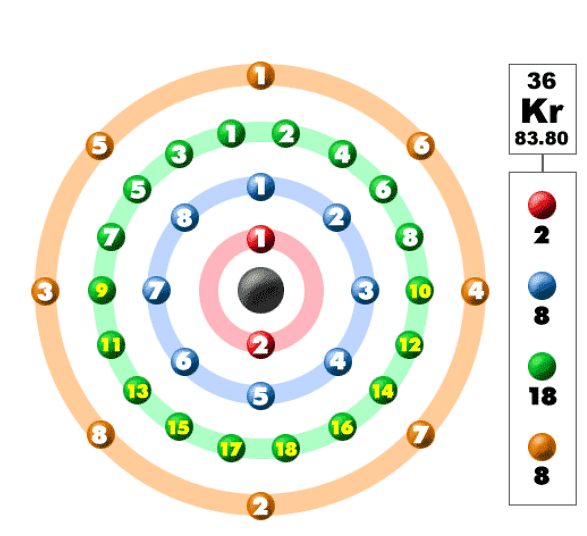
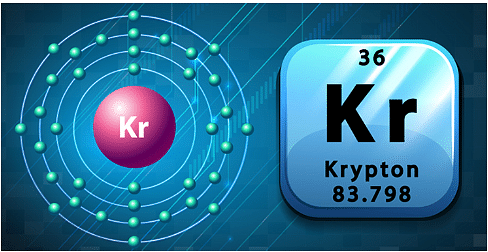
Solid krypton is a white crystalline face-centered cubic structure, which is a common property of the noble gases. Krypton has 36 protons, 48 neutrons, and 36 electrons. It has 4 shells because it is in the 4th period and the first shell has 2 electrons, second shell has 8 electrons, third shell has 18 electrons and the fourth shell has a full valence layer because it is a noble gas.
Properties of Krypton
| Physical Properties | |
|---|---|
| Appearance | Colorless, odorless, tasteless |
| Density | 2.16 g/mL |
| Crystal structure | face-centered cubic (fcc) |
| Chemical Properties | |
| Atomic number (Z): | 36 |
| Density | 0.003733 grams per cubic centimeter |
| Melting point | minus 157.36 C |
| Boiling point | minus 153.22 C |
| Period number | 4 |
| Group number | 18 |
| Atomic weight | 83.798 |
| Electrons per shell | 2, 8, 18, 8 |
| Number of isotopes | 37 |
| Most common isotopes | Kr-84, Kr-81, Kr-82, Kr-83, Kr-80 and Kr-78 |
| Phase at room temperature | Gas |
Occurrence of Krypton
[Click Here for Sample Questions]
Krypton is one of the rarest noble gases found on earth. It’s concentration in the earth’s atmosphere is approximately one particle per million (1 ppm). The noble gases do not react with any other element of the periodic table. Most chemical elements readily share electrons with other elements to make molecules, but noble gases normally don’t. Indeed, no one has ever seen any naturally occurring noble gas molecules on Earth. Krypton can be extracted from liquid air by fractional distillation.
Recently, astronomers accidentally discovered one of these inert elements in molecules in space. Although the amount of Krypton in space is uncertain, some of the first measurements suggest its abundance there. In interstellar space, where extreme temperatures and densities are the rule, noble gases behave differently than they do on Earth. That includes forming molecules.

Krypton Isotopes
Krypton has six stable isotopes namely K-84,K-86, K82, K-83, K-80 and K-78. It also has 11 major radioactive isotopes, but all are short lived (with a half-life of three hours or less) except K-81 and K-85. They are one of the by-products of the nuclear fission of Uranium and Plutonium.
Read about: Neon
Uses of Krypton
[Click Here for Sample Questions]
Krypton is very rare as its presence in the atmosphere is only 0.0001% which makes it very expensive and hence, has limited use. Some of its uses are:
- Liquid Krypton is used to construct Calorimeters used in experimental particle physics.
- Krypton-83 used in Magnetic Resonance Imaging(MRI) helps the radiologist to distinguish between hydrophobic and hydrophilic surfaces containing an airway.
- Krypton was used as propellant for an electric propulsion system by SpaceX Starlink.
- It is used to make Neon lights
- It is used as filling gas for energy saving fluorescent light bulbs
- It is used in high-speed flash photography.
- It is used in airport runway lights and lighthouse lamps
- It is combined with mercury to make luminous signs.
- It is sometimes used to seal the glass of double-paned windows to help them trap heat, but argon gas is a cheaper alternative and hence more popular.
- Krypton-81, a radioactive isotope, has been used for dating the oldest ice in Antarctica and old ground water in the Sahara Desert.
- It is used by astronomers to measure nuclear synthesis in regions of interstellar space.
- Krypton-fluoride lasers are used in advanced research on nuclear fusion.
- Krypton-85 is also used in plasma displays, spark gaps, and leak detection systems.
Read about:
Things to Remember
- Krypton is one of the rarest gases found on earth.
- It’s concentration in the earth’s atmosphere is approximately one particle per million (1 ppm)
- Krypton's atomic structure is very stable.
- Krypton is colorless, odorless and non-toxic noble gas.
- Krypton is inert (non-reactive) to other elements due to a full outer shell of electrons.
- Although it is inert to other elements, it reacts only to fluorine gas to form a compound called krypton difluoride (KrF2) which is colorless in its solid form and is stable only below -22 degree F.
- Krypton gas lights up like neon when it is exposed to an electric current under low pressure.
- Krypton Fluoride lasers can produce a pulse of energy 500 times as strong as the entire U.S. electrical grid in just four-billionths of a second. They have entered the Guinness book of world records.
- In 2014, the Krypton-Fluoride lasers were registered in Guinness Book of World records for being responsible for accelerating plastic foils to speeds of 1,000 kilometers per second (more than 2.2 million mph) in less than a millimeter of distance.
- In the period: 1960-1983, Krypton was briefly used to define the length of a meter as 1,650,763.73 times the wavelength of the orange-red light emission by Krypton-86.
Read about: Isomerism in Coordination Compounds
Sample Questions
Ques. Why is Krypton called the hidden gas? (2 Marks)
Ans. Krypton was discovered accidentally by William Ramsay and Morris Travers while they were trying to find a lighter chemical element to fill the gap in the Periodic Table between argon and helium. It was found in the residue left after evaporating most of the components of liquid air. This new element they found was not lighter but heavier than argon. They named it Krypton, derived from the Greek word Kryptos which means hidden.
Ques. Why is Krypton dangerous? (3 Marks)
Ans. Krypton is an inert gas classified as a simple asphyxiant that has narcotic effects over the human body. Krypton has a very stable atomic structure which has just enough electrons to fill its outer shell, so it doesn’t tend to combine with other elements. Due to its non-reactive nature, it doesn’t burn, cause corrosion, or do other chemical-like things. It can, however, prove to be harmful as it can cause an Oxygen Deficiency Hazard.
Inhalation in excessive concentrations can result in dizziness, nausea, vomiting, loss of consciousness, and death. Death may result from errors in judgment, confusion, or loss of consciousness which prevent self-rescue. At low oxygen concentrations, unconsciousness and death may occur in seconds without warning. Krypton-85 is highly toxic and may cause cancers, thyroid disease, skin, liver or kidney disorders.
Ques. State some uses of Krypton. (3 Marks)
Ans. Some popular uses of Krypton are listed below:
- It is used to make Neon lights.
- It is used as filling gas for energy saving fluorescent light bulbs.
- It is used in high-speed flash photography.
- It is used in airport runway lights and lighthouse lamps.
- It is combined with mercury to make luminous signs.
- It is sometimes used to seal the glass of double-paned windows to help them trap heat, but argon gas is a cheaper alternative and hence more popular.
Ques. State some applications of Krypton Isotopes. (3 Marks)
Ans. Some applications of Krypton isotopes are as follows:
- Krypton-81, a radioactive isotope, has been used for dating the oldest ice in Antarctica and old ground water in the Sahara Desert.
- Krypton-85 is used to detect leaks from sealed containers.
- Krypton-85 is also used in plasma displays, spark gaps, and leak detection systems.
- Krypton-83 used in Magnetic Resonance Imaging(MRI) helps the radiologist to distinguish between hydrophobic and hydrophilic surfaces containing an airway.
Read about:



Comments