



Content Curator
Lead (ll) Nitrate is an inorganic compound with the chemical formula of Pb(NO3)2.It's a white crystalline substance that is quite water soluble. Lead dinitrate is a non-combustible compound but it can enhance an explosion, if it is exposed to heat for a long time. Nitrate is a polyatomic ion and lead is a transition metal and nitrate is a group of nonmetals. Therefore, lead (ll) nitrate is a fusion of a metal and nonmetals. In lead (ll) nitrate, (ll) tells that lead has a charge of ‘2+’ and nitrate has a charge of ‘-1’. To neutralize the charge, by the crisscross method, the formula of lead (ll) nitrate becomes Pb(NO3)2 .
| Table of Content |
Keywords: Lead II nitrate formula , lead, nitrate, lead II nitrate, lead metal, nitric acid, distilled watre
Preparation of Lead (II) Nitrate
[Click Here for Sample Questions]
Lead ll Nitrate is very easily synthesized by the action of Nitric acid on lead metal.
Materials required:
- Lead metal – 19g
- Nitric acid 67% - 25ml
- Distilled water
Step 1: Measure out 19g of lead metal.
Step 2: Add the lead metal to 25ml of concentrated Nitric acid.
After approximately 2 minutes, the reaction takes place and we will see some brownish discoloration and some fumes will be released. The reaction which will take place can be seen as specified below-:
Pb + 4HNO3 → Pb(NO3)2 + 2NO2 + 2H2O
To induce the reaction faster, one can heat the beaker and then the reaction will start getting vigorous.
Step 3: Add 10ml distilled water.
The reaction will grow vigorous and a lot of nitrogen dioxide gas (brown in color) will be released. Nitrogen dioxide gas is toxic, so avoid inhaling the vapors. Do the above stated process in a well-ventilated area.
Step 4: After sometime, the reaction will stand still and you will find unreacted lead metal and nitric acid, that is because the lead metal pieces were buried by the precipitated lead dinitrate. So, add more amount of distilled water to dissolve the lead (ll) nitrate salt and stir the mixture to ensure that lead pieces are not buried by the salt.
The reaction will proceed well after this step.
Step 5: After all the lead pieces have reacted, a clear solution with some undissolved lead (ll) nitrate will be left, which can be dissolved by adding a few more milliliters of distilled water.
Step 6: Heat the beaker to dissolve all the lead (ll) nitrate salt.
Step 7: Now, take it down from the heating source and let the mixture cool.
After cooling, crystals of lead (ll) nitrate will start to separate out.
Approximately 26 g of lead (ll) nitrate will be obtained by following the above steps, which corresponds to the percent yield of 85.
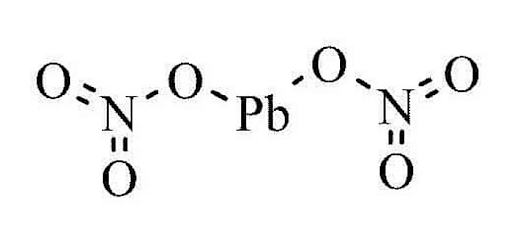
Lead II Nitrate
Physical Properties of Lead (II) Nitrate
[Click Here for Sample Questions]
- Lead (ll) nitrate is a white crystalline solid and is highly soluble in water forming an almost clear solution.
- The solubility of lead (ll) nitrate is 376.5 g per liter at 0 degree Celsius, 597 g per liter at 25 degree Celsius and 127g per liter at 100 degree Celsius.
- Molar mass: 331.2 g/mol
- Appearance: colorless or white
- Soluble in: in water
- Melting point: decomposes
- Density: 4.53 g/cm3
- Ph level: 6.5
- Melting point: 470 degree Celsius
Chemical Properties of Lead (II) Nitrate
[Click Here for Sample Questions]
- Lead (ll) nitrate reacts with sodium hydroxide forming a white precipitate of lead (ll) hydroxide.
Pb(NO3)2 + 2NaOH → Pb(OH)2 + 2NaNO3
Initially, lead (ll) hydroxide precipitate will be formed, which gets dissolved due to excess of sodium hydroxide to form a colorless solution which is called sodium plumbate.
- Lead (ll) nitrate reacts with potassium iodide solution to give a bright yellow precipitate of lead iodide.
Pb(NO3)2 + 2KI → PbI2 + 2KNO3
This is usually demonstrated as the classical golden rain experiment, where lead iodide is dissolved in hot water and on cooling it crystallizes out in a beautiful golden yellow color.
- Lead (ll) nitrate reacts with potassium chromate giving a yellow precipitate of lead (ll) chromate.
Pb(NO3)2 + K2CrO4 → 2KNO3 + PbCrO4
- Lead ii nitrate also reacts with ammonium sulfate, which is a displacement reaction, forming lead sulfate, which is a white precipitate.
- Thermal decomposition of lead (ll) nitrate
Take 1g of lead (ll) nitrate in the test tube and heat the test tube on the Bunsen burner flame, holding the test tube in the slanting position. After sometime, you will be able to hear the characteristic popping sound and soon some brown colored fumes will be released.
2Pb(NO3)2 → 2PbO + 4NO2 + O2
Lead (ll) nitrate is getting thermally decomposed to form lead oxide, nitrogen dioxide which is the brown gas and oxygen gas.
Uses of Lead (II) Nitrate
[Click Here for Sample Questions]
- Lead (ll) nitrate is used in making matches and special explosives.
- Lead (ll) nitrate is also used in the dye and photography industries.
- Lead (ll) nitrate is also used in the process of engraving.
- Lead (ll) nitrate can also be used in the gold cyanidation process to improve the leaching process.
Things to remember
- Lead dinitrate is a white crystalline inorganic compound highly soluble in water, unlike the other lead compounds.
- Lead (ll) nitrate can be easily formed using the reaction of nitric acid on the lead metal.
- It is a non-combustible compound with the potential to enhance an explosion, when exposed to heat for a long time.
- Lead (ll) nitrate is toxic and its ingestion may lead to some acute lead poisoning.
Sample Questions
Ques. State two relevant observations of Lead nitrate crystals heated in a hard glass tube. (2 marks)
Ans. 2Pb(NO3)3 → 2PbO + 4NO2 + O2
When lead nitrate crystals are heated, it decrepitates and lead oxide is formed which is yellow in color and nitrogen dioxide is released which is reddish brown in color.
Ques. What is the product when lead nitrate is strongly heated? (3 marks)
Ans. 2Pb(NO3)2 → 2PbO + 4NO2 + O2
The above reaction is a decomposition reaction where lead (ll) nitrate is getting decomposed. Lead nitrate on strong heating decomposes to form lead oxide, nitrogen oxide and oxygen. This reaction is also utilized for the production of nitrogen dioxide gas and can also be used as a rodenticide. The oxygen gas released is colorless and the nitrogen dioxide released is brown in color.
Ques. A student took some lead nitrate compound in a boiling tube and heated strongly. The gas/gases evolved on heating this compound is/are:
(1) NO2
(2) NO2 + CO2
(3) NO2 + O2
(4) N2 + O2 (2 marks)
Ans. c) NO2 + O2
Explanation: 2Pb(NO3)2 → 2PbO (s) + 4NO2 (g) + O2 (g)
The above reaction is a decomposition reaction where lead (ll) nitrate will be decomposed and then lead oxide will be released in the form of a yellow precipitate; nitrogen oxide is a brown colored gas and oxygen gas released will be colorless.
Therefore, the correct answer will be option ‘c’.
Ques. State one relevant observation for the following:
Lead nitrate solution is treated with sodium hydroxide solution drop wise till it is in excess. (3 marks)
Ans. Pb(NO3)2 + 2NaOH → Pb(OH)2 + 2NaNO3
When sodium hydroxide is added drop by drop, then the lead hydroxide is formed as a white precipitate and when sodium hydroxide is added in excess, this white precipitate gets dissolved.
Pb(OH)2 + 2NaOH → NaPbO2 + 2H2O
(excess) (sodium plumbite)
Ques. How many moles of lead (ll) chloride will be formed from a reaction between 6.5g of PbO and 3.2g of HCl? (5 marks)
Ans. PbO + 2HCl → 2PbCl2 + 2H2O
(1mole) (2mole) (1mole) (2mole)
Moles of PbO = 6.5/223 = 0.029 mol.
Moles of HCl = 3.2/365 = 0.087 mol.
Moles of PbCl2 = 0.029 mol. PbO ×\({1 mol.PbCl_2 \over 1 mol.PbO}\)= 0.029 mol. PbCl2
Moles of PbCl2 = 0.087 mol. HCl × \({1 mol.PbCl_2 \over 1 mol.HCL}\) = 0.044 mol. PbCl2
Therefore, PbO will be the limiting reactant. Therefore, the answer will be 0.029 mol.
Ques. The freezing point of 1% of lead nitrate solution in water will be-;
(1) 2oC
(2) 1oC
(3) 0oC
(4) Below 0oC (3 marks)
Ans. d) Below 0oC
Explanation: When we add a solute to the water to make a solution, then there is a depression in the melting point and aqueous solution of a substance which is non-volatile freezes below 0oC because the vapor pressure of the solution becomes lower than that of the pure solvent. and we know that the freezing point is 0oC. Therefore, the answer will be ‘below 0oC’.
Ques. Give a reaction where lead iodide is formed as one of the products. (3 marks)
Ans. Pb(NO3)2 (aq) + 2KI (aq) →PbI2 (s) + 2KNO3 (aq)
(yellow solid)
When lead nitrate (aqueous) is mixed with potassium iodide, iodide ion displaces nitrate from lead nitrate and nitrate combines with potassium to form Potassium nitrate and lead combines with iodine to form lead iodide. Therefore, two products that are lead iodide which is a yellow solid and potassium nitrate are formed.



Comments