



Exams Prep Master
The Lewis dot structure was named after the great American chemist Gilbert Newton Lewis. If the Molecular formula of a compound is known, one can draw its electron dot structure or lewis dot structure and can define the nature and position of its bond and molecules respectively. Here we will discuss more about the concept with some solved examples and questions.
Lewis dot structures or electron dot structures describe the chemical bonding amongst atoms inside a molecule with help of diagrams. Each of the atoms inside a molecule has lone pairs inside them, with the help of the lewis dot structure their total number can be displayed. Lewis dot structures are also known as electron dot or Lewis structures. Lewis explained a base and an acid as an electron pair donor and as an electron pair acceptor respectively.
Definition of Lewis Dot Structure
[Click Here for Sample Questions]
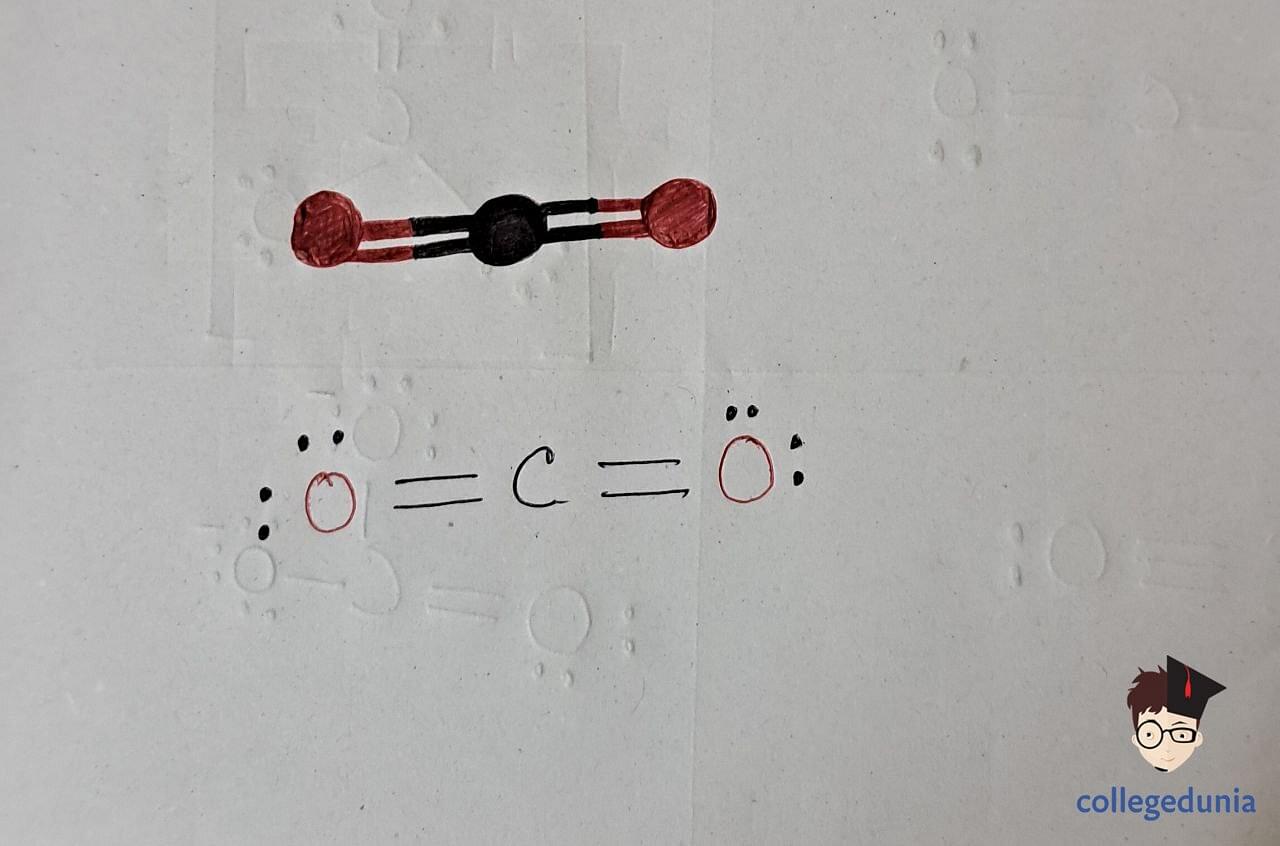
Lewis Dot Structure
Lewis dot structures show how the electrons are paired in an element. They help to sum up details about bonding and can also be described as something like electron bookkeeping. The geometry of the molecule can be easily understood with such dot structures. Each electron is represented by a dot in the diagram and a bond is represented by a pair of dots for atoms between chemical symbols. It is basically a visual representation of the electron distribution revolving around an atom.
Read More: Concentration Cell
How to Draw Electron Dot Structures?
[Click Here for Sample Questions]
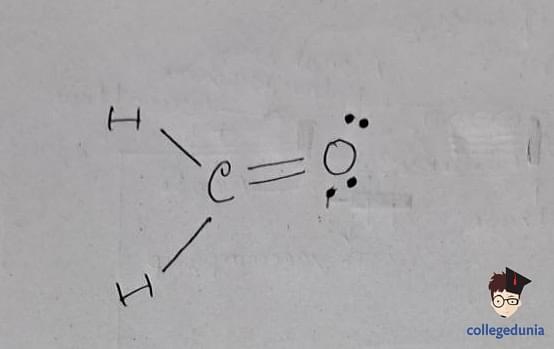
For every valence electron, a Lewis electron dot formula consists of one dot. Stages to enunciate the electron dot formula are mentioned below:
- Display a comprehendible bonding pattern utilizing only the element symbols.
- Collect valence electrons from all atoms and keep an account of their total amount.
- Calculate the number of bonds using the N – A = S equation.
- N is equal to the sum of the number of valence electrons
- A is equal to the total amount of valence electrons collected aside.
- S is the total no. of the shared electrons in a molecule.
- Distribute the collected aside valence electrons to calculate the total bonds.
- Distribute the rest of the electrons.
How to Draw Lewis Dot Structure?
[Click Here for Sample Questions]
Lewis electron dot structure expresses the bonding atoms, the number of bonds in the molecule and the lone pairs that remain in the bonding atom.
While drawing a Lewis structure, the following steps must be followed:
- Individual valencies of each atom are added up to calculate the total amount of valence electrons present in the molecule.
- Extra electrons are added to the lewis dot structure of the molecule if it appears to be an anion. As added electrons equal the magnitude of negative charges.
- Electrons are subtracted from the total count to make up for the positive charge if the molecule is cationic.
- The central atom is adjusted to be the least electronegative atom of the ion or molecule.
- All the atoms are now connected through single bonds.
- Now, each atom belonging to the molecule is assigned the lone pairs of electrons. Commonly, the most electronegative atoms get paired with these lone pairs of electrons.
- After assigning the lone pairs, the octet valency of each atom must be satisfied with a double or triple bond, but only if every atom does not have an octet configuration
- If required, The octet rule for two atoms can also be satisfied by converting a lone pair into a bond pair.
- Now check which bond has the lowest formal charge, and in turn, you will get the most stable one.
- To calculate the formal charge, use the following formulae accordingly:
- Formal charge = (Total no. of valence electrons in a free state) - (Total no. of electrons assigned in Lewis structure).
- Formal charge = (Total number of valence electrons in a free state) - ( Total number of nonbonding pair of electron lone pair) - ½ (total number of bonding electrons).
- Some of the bonding electrons are shared between two atoms, therefore a Factor ½ is attached to them.
- Furthermore, it should be noted that you must only consider the valence electrons while drawing Lewis dot structures and ignore the electrons that do not belong to the outermost shell.
Read More: Types of Titration
Examples of Lewis Dot Structure
[Click Here for Sample Questions]
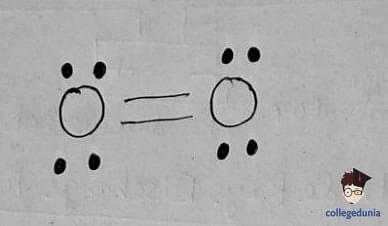
- Lewis Structure of O2
- There are almost 6 electrons in the valence shell of an atom of oxygen.
- The oxygen atom must participate in two single bonds or one double bond to attain an octet configuration because four of the valence electrons exist in lone pairs.
- The atoms form a double bond because there are only two oxygen atoms in an O2 molecule, and its Lewis Dot structure looks like this:
- Lewis Structure of CO2
- The central atom of this molecule is Carbon.
- Only one carbon atom is bonded to Oxygen-containing 6 valence electrons which form 2 lone pairs and thus, it must form a double bond.
- Carbon is doubly bonded to each oxygen atom as it has four valence electrons, which results in zero lone pairs.
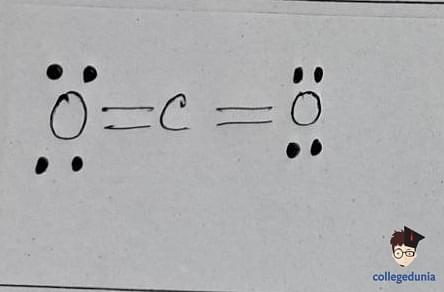
Lewis Structure of CO2
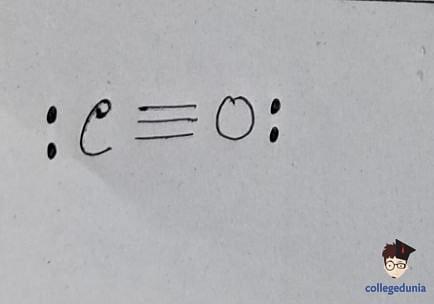
- Lewis Structure of Carbon Monoxide (CO)
- There is one carbon atom and one oxygen atom in a molecule of Carbon monoxide.
- The carbon atom requires four electrons to obtain an octet configuration whereas the oxygen atom requires two.
- Therefore, the oxygen atom bonds with a lone pair of donated electrons to satisfy the valency.
- A triple bond connecting a carbon and an oxygen atom with each holding a lone pair of electrons from the Lewis Dot structure diagram given below.
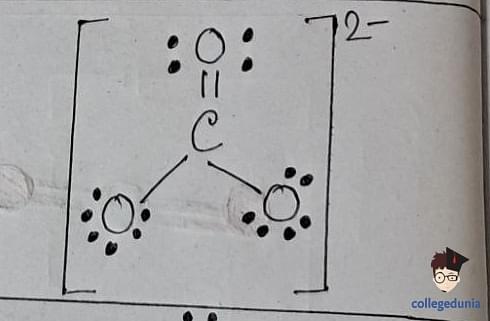
- Lewis dot structure of the carbonate ion CO32-
- Carbon-oxygen bonds are likely to be equal.
- One electron pair is delocalized over the region of all three carbon-oxygen bonds.
- The electron structure in resonance terms is shown above.
- Lewis Dot structure of Cyclopentane.
- Five carbon atoms are connected through single bonds of cyclopentane in a cyclic form.
- The molecular formula of cyclopentane is C5H10.
- The Lewis dot structure of cyclopentane is shown below.
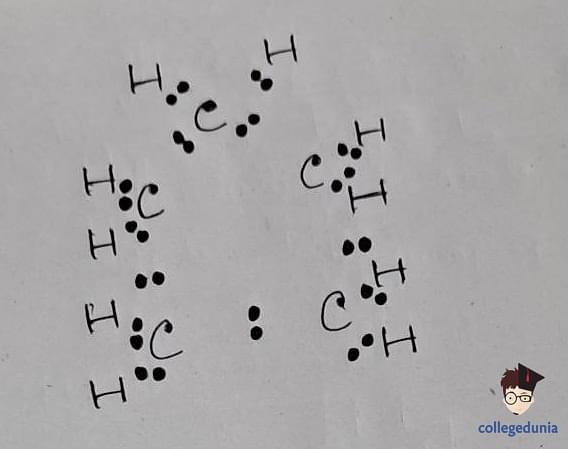
Lewis Dot structure of Cyclopentane
Read More: Unsaturated Solution
Solved Examples based on Lewis Dot Structures
[Click Here for Sample Questions]
- Define the electron structure of the carbonate ion CO32- in terms of electron dot formulas.
Solution. One potential electron dot formula for the carbonate ions is:

As all the carbon-oxygen bonds are almost equal, over the region of all three carbon-oxygen bonds, one electron pair is delocalized.
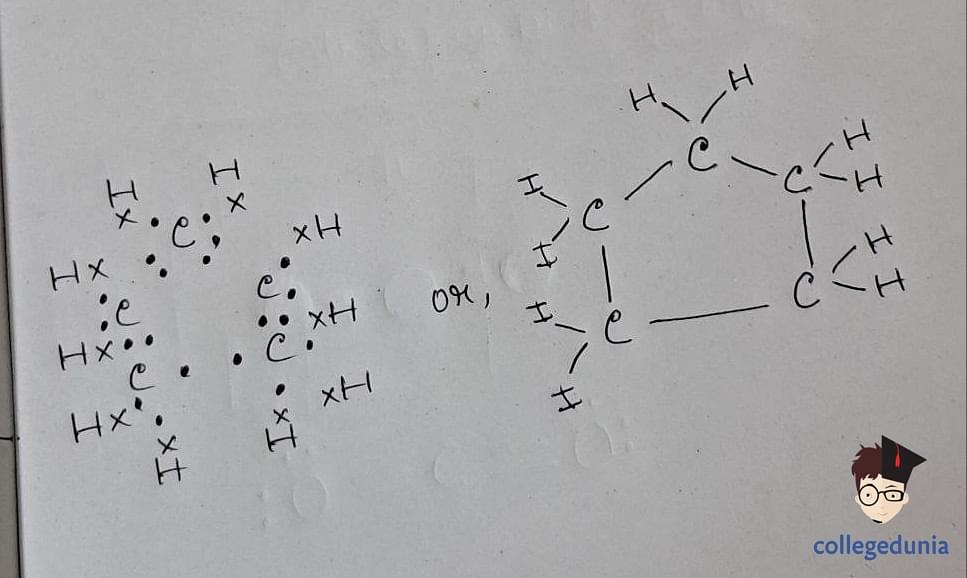
- What will be the formula and electron dot structure of cyclopentane?
Solution. In cyclopentane, single bonds connect five carbon atoms of cyclopentane in a cyclic form whose molecular formula is C5H10. The electron dot structure and the structural formula of cyclopentane are shown below:
Read More: Difference between Cations and Anions
Things to Remember
- Lewis Dot Structures is covered in Chapter 4 i.e, Chemical Bonding and Molecular Structure of NCERT Class 11 Chemistry.
- The chapter will carry a weightage of 14 periods and 4-5 marks in the exam.
- When it comes to reality, there are many exceptions to their structure. In general, atoms try to fill half or full of their valence electron shell.
- The atoms can do all this and also form molecules that are not stable.
- In some cases, more than other atoms can also be formed and connect to the central atom.
- The number of valence electrons can sometimes be higher than 8 electrons. Usually, it’s the higher atomic numbers that are observed in this case.
- Lewis structures are helpful when we talk about lighter elements and rather unhelpful when we talk about transition metals such as actinides and lanthanides.
Sample Questions
Ques. What is the purpose of the Lewis structure? (2 marks)
Ans. The purpose of Lewis dot structure is to provide a simple way for chemists to view molecules that allows accurate predictions regarding the actual molecules, structures and properties to be made.
Ques. What electrons are shown by Lewis structures? (2 marks)
Ans. The outermost central level of energy containing electrons is the level of valence that includes electrons of valence. Lewis symbols are diagrams that show the number of valence electrons of a specific element with dots indicating lone pairs.
Ques. What is the Lewis structure of ammonia? (2 marks)
Ans. Ammonia has the NH3 equation which is extremely water soluble as it is a polar material. The Lewis structure for a molecule is a total valence electron in the molecule. Ammonia has eight valence electrons.
Ques. Define Lewis dot structure in chemistry. (3 marks)
Ans. Lewis dot structures show how the electrons are paired in an element. They help to sum up details about bonding and can also be described as something like electron bookkeeping. The geometry of the molecule can be easily understood with such dot structures. Each electron is represented by a dot in the diagram and a bond is represented by a pair of dots for atoms between chemical symbols. It is basically a visual representation of the electron distribution revolving around an atom.
Ques. Why are Lewis structures significant? (3 marks)
Ans. In order to predict geometry, polarity, and reactivity of (in)organic compounds, Lewis structures play an important role. The Lewis structure is drawn for individual atoms by putting a dot for all the available valence electrons around the atom.
Ques. Write the Lewis dot symbols for atoms of the following elements: Mg, Na, B, O, N, Br. (3 marks)
Ans. 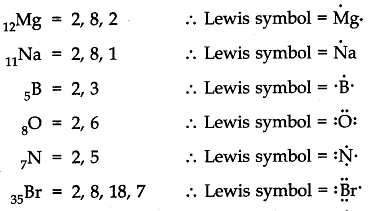
Ques. Draw Lewis structures for the following molecules and ions: H2S, SiCl4, BeF2, C032-, HCOOH. (3 marks)
Ans.
Ques. Write the Lewis symbols for the following atoms and ions: S and S2-; Al and Al3+; H and H-. (3 marks)
Ans. 
Ques. Show electron transfer between the following atoms to form cations and anions (a) K and S, (b) Ca and O, (c) Al and N. (3 marks)
Ans. 

Ques. The skeleton structure of CH3COOH as given below is correct but some of the bonds are shown incorrectly. Draw the correct Lewis structure for acetic acid. (2 marks)

Ans. 
Ques. Explain why the BeH2 molecule has a zero dipole moment even though the Be-H bonds are polar. (3 marks)
Ans. The Lewis structure for the BeH2 molecule is:
H: Be: H
There is no lone pair at the central atom (Be) and there are two bond pairs. Thus, BeH2 is of the type AB2 which has a linear structure:

Here, the dipole moments of each H-Be bond are equal and are in opposite directions. Thus, they nullify each other and therefore BeH2 has zero dipole moment.
Also check:



Comments