



Content Writer
Molecules are defined as the group of atoms of similar and dissimilar elements converted into small recognizable units. It is composed of one or more atoms that are bonded together by chemical bonds. They are the smallest unit of a compound and are made up of a group of atoms.
- A molecule retains the properties of its substance.
- A few examples of molecules are H2O water, N2 (nitrogen), NaCl (common salt), and CaO (calcium oxide).
- They can be classified into Molecules of Elements and Molecules of Compounds.
- Molecules are also referred to as polyatomic ions.
- It is said to be homonuclear when it consists of only one element.
- The chemical properties and composition remain the same after conversion.
Read More: Valence Electrons
Key Terms: Molecule, Compound, Atom, Elements, Atomicity, Nucleus, Monatomic Molecules, Diatomic molecules, Triatomic Molecules, Molecular Structure
Types of Molecules
[Click Here for Sample Questions]
Molecules are formed by a combination of atoms that can belong to the same element or different elements. It can be classified into three different categories, which are as follows:
Molecule of Elements
In a molecule of an element, two or more atoms belonging to the same element are chemically bonded together. For example, oxygen, chlorine, nitrogen, etc.
Molecule of Atom
In the molecule of an atom, only a single atom in a molecule of atoms will take up the properties of the required chemical compound. Molecules of noble gases are monoatomic in nature. They are chemically unreactive compounds and do not combine easily. For example, argon, and helium.
Read More: Difference Between An Atom And A Molecule
Molecule of Compounds
In molecules of a compound, two or more atoms belonging to different elements are chemically bonded together. For example, hydrogen chloride, methane, ammonia, carbon dioxide, etc.
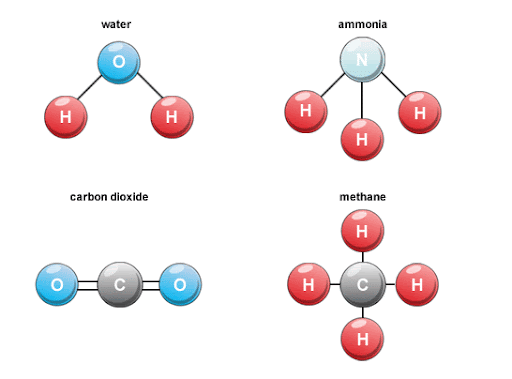
Molecules of Elements and Compounds
Read More: Atoms and Molecules
Molecules of Elements
[Click Here for Sample Questions]
In molecules of elements, two or more atoms of the same element are chemically bonded. For example, a nitrogen molecule is made of two nitrogen atoms (N2), and a hydrogen molecule consists of two hydrogen atoms.
- Molecules of elements is defined by the atomicity of a number.
- Atomicity refers to the number of atoms that are bonded together in a molecule of an element.
- The atomicity of an element is indicated by the number of atoms present in a molecule.
- It is written on the bottom right corner in its symbol.
- Molecules of elements can be classified into different groups based on the number of atoms in the molecule.
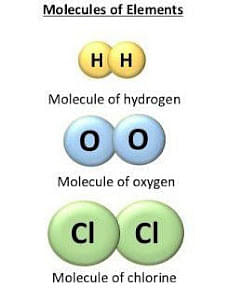
Molecules of Elements
Read More: Difference Between Molar mass and Molecular mass
Classification of Molecules of Elements
[Click Here for Sample Questions]
Molecules of elements can be classified into monoatomic, diatomic, triatomic, and polyatomic. This classification is based on the number of atoms in the molecule.
Monoatomic Molecules of Elements
A molecule that is composed of only one atom is known as a Monoatomic molecule of elements. For example, argon, helium, etc.
Diatomic Molecules of Elements
A molecule that is composed of two atoms is known as a diatomic molecule of elements. For example, hydrogen, oxygen, fluorine, bromine, iodine, chlorine, etc. Every diatomic molecule has the atomicity of 2.
Triatomic Molecules of Elements
Molecules composed of three atoms of the same element are known as triatomic molecules of elements. For example, ozone. Every triatomic molecule has an atomicity of 3.
Polyatomic Molecules of Elements
A molecule that is composed of four or more atoms is known as a polyatomic molecule of elements. For example, boron, sulphur, phosphorus, fullerene, etc.
Read More: Isotopes and Isobars
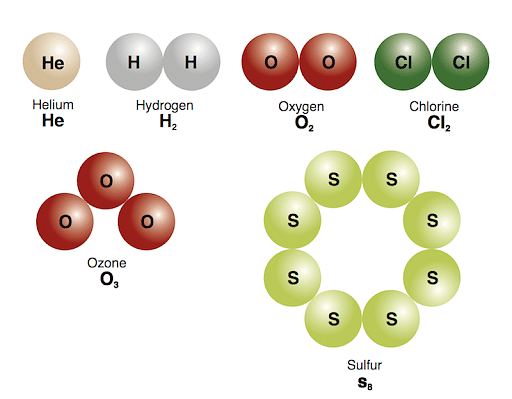
Molecules of Elements
Example of Molecules
[Click Here for Sample Questions]
The various examples of molecules are as follows:
- N2 (nitrogen)
- O3 (ozone)
- H2 (Hydrogen)
- CaO (calcium oxide)
- NaCl (table salt)
- C6H12O6 (glucose, a type of sugar)
Read More: Writing Chemical Formulae
Things to Remember
- Molecules are composed of one or more atoms that are bonded together by chemical bonds.
- A molecule is the tiniest substance.
- It can be split into two without compromising any chemical or physical properties of substance.
- Two or more atoms belonging to the same element are chemically bonded together.
- Atomicity refers to the number of atoms that are bonded together in a molecule of an element.
- Molecules of elements can be classified into monoatomic, diatomic, triatomic, and polyatomic.
- This classification is based on the number of atoms in the molecule.
Read More:
Sample Questions
Ques. What is an ion? (1 Mark)
Ans. A charged atom or a molecule can be called an ion. An ion is charged when there is an imbalance in the ratio of electrons and protons. Ions can be categorized as Cations or Anions. Ions can bond with each other.
Ques. What is Atomic Mass? (3 Marks)
Ans. Atomic mass is the mass of an atom in an element. The electrons have negligible weight, so it is almost equal to the mass of protons and neutrons present in the nucleus. The unit of atomic mass is Dalton, symbolized as Da or u. For example, the atomic mass of carbon is 12.011 and the atomic mass of hydrogen is 1.0079. The atomic mass of an element is always mentioned in the periodic table, under the element.
Ques. Write a note on Atom? (5 Marks)
Ans. Atoms are the smallest part of an element. Atoms always play a part in the chemical reaction regardless of their ability to exist independently. Atoms cannot be destroyed or created. When atoms rearrange, chemical reactions take place. Every element has a different kind of atom. An atom comprises electrons, neutrons, and protons.
- Protons are positively charged, an electron carries a negative charge, and a neutron doesn’t have a charge.
- Nucleus is the center of the atom.
- The nucleus of the atom is positively charged as it only contains neutrons and protons.
- The weight of the electrons is negligible.
- Most of the mass of an atom is at the nucleus as electrons are around the nucleus.
- Every atom has an atomic number and the atomic number depends on the number of protons in the nucleus.
Ques. What is a Molecule? How can molecules be classified? (3 Marks)
Ans. Molecules are composed of one or more atoms that are bonded together by chemical bonds. Molecules are formed by a combination of atoms. These atoms can belong to the same element or different elements. Molecules can be classified into three types:
- Molecule of Elements: In a molecule of an element, two or more atoms belonging to the same element are chemically bonded together.
- Molecule of Compounds: In molecules of a compound, two or more atoms belonging to different elements are chemically bonded together.
- Molecule of atom: In this only a single atom in a molecule of atoms will take up the properties of the required chemical compound.
Ques. Write a note on Molecules of compounds? (4 Marks)
Ans. In molecules of a compound, two or more atoms belonging to different elements are bonded together. Molecules of compounds can be classified as diatomic, triatomic, tetraatomic and polyatomic. As molecules of compounds contain atoms from different elements, they are heteroatomic. For example, carbon dioxide is a compound as it comprises two types of atoms, carbon atoms and oxygen atoms. Hydrogen chloride is also a compound as it comprises two types of atoms, hydrogen and chlorine.

Molecules of Compounds
Ques. What is the difference between Molecules and Atoms? (3 Marks)
Ans. Difference between molecules and atoms are:
| Atoms | Molecules |
|---|---|
| Atom is the smallest part of an element. An atom comprises electrons, neutrons, and protons. | Molecules are composed of one or more atoms that are bonded together by chemical bonds. |
| Atoms may or may not exist independently. | Molecules can exist independently. |
| A few examples of atom are neon, argon, iron, calcium, etc. | A few examples of Molecules are oxygen, carbon dioxide, calcium oxide, etc |
Ques. What is the difference between Molecules of Elements and Molecules of Compounds? (3 Marks)
Ans. Difference between Molecules of Elements and Molecules of Compounds:
| Molecules of Elements | Molecules of Compounds |
|---|---|
| In molecules of elements, two or more atoms belonging to the same element are chemically bonded together. | In molecules of a compound, two or more atoms belonging to different elements are bonded together. |
| Molecules of elements can be classified into monoatomic, diatomic, triatomic, and polyatomic. | Molecules of compounds can be classified into diatomic, triatomic, tetra-atomic and polyatomic. |
| A few examples of molecules of elements are sulphur, oxygen, hydrogen, bromine, Byron, chlorine etc. | A few examples of molecules of compounds are carbon dioxide, hydrogen chloride, sulphur dioxide, etc. |
Ques. What are Molecules of Elements and how are they classified? (4 Marks)
Ans. When two or more atoms belonging to the same element are chemically bonded together, they are called molecules of elements. Molecules of elements have an atomicity. Classification of molecules of elements is based on the number of atoms in the molecule.
Molecules of elements can be classified as:
- Monoatomic molecules of Elements: Molecule that is composed of only one atom is known as Monatomic molecule of elements.
- Diatomic molecules of Elements: Molecule that is composed of two atoms is known as a diatomic molecule of elements. Every diatomic molecule has the atomicity of 2.
- Triatomic Molecules of Elements: Molecules that are composed of three atoms of the same element are known as triatomic molecules of elements. Every triatomic molecule has the atomicity of 3.
- Polyatomic Molecules of Elements: Molecules composed of four or more atoms are known as polyatomic molecules of elements.
Ques. What is the difference between molecular mass and atomic mass? (3 marks)
Ans. The difference between atomic mass and molecular mass are as follows:
| Atomic Mass | Molecular Mass |
|---|---|
| Atomic mass is defined as the mass of an individual atom of an element. | Molecular Mass is defined as the sum of all the atomic masses of an atom. |
| It is not equivalent to atomic weight. | It is equivalent to atomic weight. |
| One atomic mass is equivalent to 1/ 12 of the mass of a carbon-12 atom. | Molecular mass is equivalent to mass of a substance divided by number of moles in a substance. |
Ques.What is the molar mass of sulfur trioxide SO2, an atomic compound? (3 marks)
Ans. By definition, the molar mass of SO2 equals its atomic mass in grams. Hence, the calculation of the molar mass of SO2 is needed first.
The molecular mass (also called formula mass) of a compound refers to the total atomic masses of the apparent multitude of atoms in the molecule. The molecular mass of SO2 with 4 atoms in its molecule, is given by,
1S = 1 x 32.07 amu
= 32.07amu
2O = 2 x 16.00 amu
= 32.00amu
Therefore, the molecular mass of SO2 is 64.07 amu.
Ques.What is the molar mass of carbon dioxide CO2, an atomic compound? (3 marks)
Ans. By definition, the molar mass of CO2 equals its atomic mass in grams. Hence, the calculation of the molar mass of CO2 is needed first.
The molecular mass (also called formula mass) of a compound refers to the total atomic masses of the apparent multitude of atoms in the molecule. The molecular mass of CO2 with 4 atoms in its molecule, is given by,
1S = 1 x 12.011 amu
= 12.011amu
2O = 2 x 16.00 amu
= 32.00amu
Therefore, the molecular mass of CO2 is 44.011 amu.
Ques. Why are the atomic number and mass number of carbon equivalent to six and twelve, respectively? (3 marks)
Ans. The mass number is defined as the sum of protons and neutrons found in the nucleus of an atom. The atomic number is equal to number of protons. So, in the case of a carbon atom, the number of protons is equal to six. Similarly, the mass number is the sum of proton and neutron; in the case of a carbon atom, the number of neutrons equals six. So, the number of protons plus the number of neutrons, which is six plus six, is equal to twelve. Hence, the atomic and mass numbers of carbon are equivalent to six and twelve, respectively.
Ques. What is nucleus of an atom? (2 marks)
Ans. The nucleus of an atom is defined as the arrangement of protons and neutrons in a molecule. It was discovered by Ernest Rutherford in 1911. The diameter of the nucleus is calculated to be around 1.70 fm. The protons and neutrons are held together by strong nuclear forces. The residuum force between protons and neutrons is generally weaker as most molecules are neutralized.
Ques. Determine the molecular masses of the following compounds:
(A) Methane, CH4
(B) Ethane, C2H6
(C) Ethene, C2H4
(D) Ethyne, C2H2 (4 marks)
Ans. (A) Methane, CH4:
Molecular mass = (no. of atoms x atomic mass of atom) + (no. of atoms x atomic mass of atom)
Molecular Mass = (1 x 12) + (4 x 1)
Molecular Mass = 12 + 4
Molecular Mass = 16u
(B) Ethane, C2H6: Molecular mass = (no. of atoms x atomic mass of atom) + (no. of atoms x atomic mass of atom)
Molecular Mass = (2 x 12) + (6 x 1)
Molecular Mass = 24 + 6
Molecular Mass = 30u
(C) Ethene, C2H4: Molecular mass = (no. of atoms x atomic mass of atom) + (no. of atoms x atomic mass of atom)
Molecular Mass = (2 x 12) + (4 x 1)
Molecular Mass = 24 + 4
Molecular Mass = 28u
(D) Ethyne, C2H2: Molecular mass = (no. of atoms x atomic mass of atom) + (no. of atoms x atomic mass of atom)
Molecular Mass = (2 x 12) + (2 x 1)
Molecular Mass = 24 + 2
Molecular Mass = 26u
Check-Out:



Comments