



Content Curator
Lewis electron dot structures are the diagrammatic representation of covalently bonded atoms in a molecule. They also show lone pairs of electrons that may exist in the molecule. They are used in the case of covalently bonded molecules as well as coordination compounds. This system was introduced by Gilbert Lewis in 1916. Hence the diagrams are called Lewis structures or Lewis electron dot structures or electron dot arrangement.
| Table of Content |
Read More: Lewis acids
Lewis Electron Dot Structures
A covalent bond involves valence electrons of atoms interacting with each other. Gilbert Lewis proposed simplified notations taking into account the role of valence electrons. This representation involves representing the atom by its chemical symbol and valence shell electrons by dots around the atomic symbol. Thus it gives a simplified picture of the overall chemical bond.

Lewis Electron Dot Structure
An atom is represented by its chemical symbol. Lines representing bonds between atoms are drawn. Lone pairs are drawn as dots. Instead of a line to represent a bond a pair of dots (2 electrons) can also be used. By placing dots or crosses around the chemical symbol of the atom valence shell electrons are represented. One thing must be noted: one dot = one electron, two dots = Bond. However, to represent a bond in most cases straight lines are used.

CO2 Lewis Dot Diagram
This is the Lewis electron dot structure for Carbon dioxide.
Steps to Draw Lewis Electron Dot Structures
Following steps are followed to draw lewis structures:
Step 1: For the molecule under consideration, calculate the total number of valence electrons, for this add up the valency of all the atoms in the molecule. This gives the total number of electrons for the Lewis structure.
Step 2: For an anionic molecule add one electron for one negative charge to the valency of the respective atom. Similarly, for cations subtract one electron for one positive charge from the valency of the respective atom.

Fluorine with Valence Electrons
Step 3: Keeping the most electronegative atom in the centre, single bond pairs are assigned first.
Step 4: After assigning the single bond pairs, lone pairs and multiple bond pairs are distributed in accordance with the octet rule.
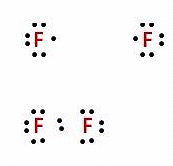
Formation of Covalent Bond
Step 5: According to the octet rule, each atom which is in the bond must have 8 electrons and for this criteria, a lone pair can be converted to a bond sharing pair.

Fluorine Molecule
Step 6: For molecules where more than one lewis structure exists then the one with the least formal charge is selected. The formal charge can be checked by the formula:
FC = V - L - ½ S
Where,
FC → Formal Charge on the atom
V → Total number of electrons
L → Total number of lone pairs
S → Total number of shared electrons.
Read Also:
Examples Of Lewis Electron Dot Structures
Lewis Electron Dot Structure for O2 molecule
- An oxygen atom has 6 valence electrons in the valence shell and so it needs 2 more to complete the octet.
- So both the atoms contribute two atoms each for the bond. Hence a double bond is formed.

Lewis Electron Dot Structure for the molecule: CO2
- An oxygen atom has 6 valence electrons and a carbon atom has 4.
- So carbon shares 2 with one oxygen atom and 2 with the other oxygen atom. Hence two double bonds are formed.

Lewis Electron Dot Structure of the molecule: CO (carbon monoxide)
- The carbon atom has a valency of 4. Hence it needs 4 more to complete the octet.
- The bonding oxygen atom needs two more to fill its octet.
- So to satisfy the octet structure we get a triple bond between C and O atoms.

Lewis Electron Dot Structure for the molecule: HCOOH (Formic Acid)
- In the first step use four electron pairs to form single bonds between neighbouring atoms.
- Except for hydrogen, complete the octet of each atom by adding two lone pairs on each oxygen atom and one oxygen atom gets double-bonded between C and O.

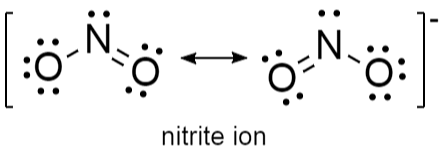
Lewis Electron Dot Structure for the molecule: NO2- (nitrite ion)
- First, count all the valence electrons of one nitrogen and two oxygen atoms and the additional one negative charge for which we will add 1 electron (anionic case).
- So total valence electrons = 5 + 12 + 1 = 18.
- First, draw single bonds between the atoms. Try to complete the octet of electrons on all the atoms. For nitrogen to have its octet complete we give a double bond between N and one of the two oxygen atoms.
Limitations Of Lewis Electron Dot Structures
- Lewis structures do not give any idea about the release of energy during the formation of a covalent bond.
- The same molecule can have different lewis structures thus leading to ambiguity.
- Lewis structures do not give any information about the geometrical shapes of molecules.
- No information could be known about bond angles and bond lengths.
- The lewis electron dot structures do not give any information about lone pair-bond pair interaction.
Read More: Thermochemistry
Things To Remember
- For molecules where more than one lewis structure exists then the one with the least formal charge is selected. The formal charge can be checked by the formula: FC = V - L - ½ S
- Lewis electron dot structure representation involves representing the atom by its chemical symbol and valence shell electrons by dots around the atomic symbol.
- They are used in the case of covalently bonded molecules as well as coordination compounds.
- The lewis electron dot structures do not give any information about lone pair-bond pair interaction.
- According to the octet rule, each atom that is in the bond must have 8 electrons and for this criteria, a lone pair can be converted to a bond sharing pair.
- Lewis structures do not give any information about the geometrical shapes of molecules.
Read More: Structure of Glucose and Fructose
Sample Questions
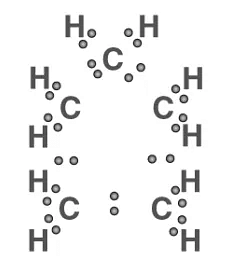
Ques. Draw the lewis electron dot structure for cyclopentane. (2 marks)
Ans.
- Five carbon atoms are connected through single bonds of cyclopentane in a cyclic form.
- The molecular formula of cyclopentane is C5H10.
- The Lewis dot structure of cyclopentane is shown below.
Ques. What is meant by Lewis Electron dot structure? How do these structures show shared electrons? (2 marks)
Ans. Lewis electron representation involves representing the atom by its chemical symbol and valence shell electrons by dots around the atomic symbol. Thus it gives a simplified picture of the overall chemical bond.
Whereas valence electrons are represented by dots around the chemical symbol. Those electrons which have been shared for the formation of a covalent bond can be represented by lines connecting the chemical symbol of atoms as well. For an example:

Ques. Calculate the formal charge on each given atom in the molecule. (2 marks)
Ans. 
We know that the formal charge can be checked by the formula: FC = V - L - ½ S: Here FC is the formal charge on the atom, V is the total number of electrons, L is the total number of lone pairs, S is the total number of shared electrons.
Therefore,
Formal charge on S atom : 6 - 2 - ½ (6) = + 1
Formal charge on double bonded O atom = 6 - 4 - ½ (4) = 0
Formal charge on single bonded O atom = 6 - 6 - ½ (2) = - 1
So we may write the Lewis Structure as = 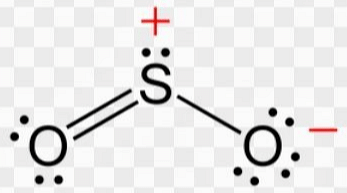
Ques. Define the octet rule. Write its significance and limitations. (3 marks)
Ans. Atoms combine either by transfer of electrons from one atom to another ( gaining or losing) or by sharing electrons in order to complete their octet in the valence shell. This is called the octet rule.
The octet rule helps to explain why different atoms combine with each other via ionic or covalent bonds. There are some limitations to this theory :
- The octet rule does not give any information about the shape of the molecule.
- It can not explain the relative stability of the molecule in terms of energy.
- Incomplete octet of the central atom: This rule can not explain the formation of certain molecules of Lithium, beryllium, boron, aluminium, etc (LiCl2, BeCl2, BeH2 ) in which the central atom has less than 8 atoms in the valence shell.
- There are many stable molecules that have more than 8 electrons in their valence shell, for example, PF5 has 10, SF6 has 12, IF7 has 14 electrons around the central atom. These are hypervalent compounds that cannot be explained by the octet rule.
Ques. What are the disadvantages of Lewis structures? (2 marks)
Ans. Following are some limitations of the lewis structures :
Lewis structures do not give any idea about the release of energy during the formation of a covalent bond.
The same molecule can have different lewis structures thus leading to ambiguity.
Lewis structures do not give any information about the geometrical shapes of molecules.
No information could be known about bond angles and bond lengths.
The lewis electron dot structures do not give any information about lone pair-bond pair interaction.
Ques. The skeleton structure of CH3COOH as given below is correct but some of the bonds are shown incorrectly. Draw the correct Lewis structure for acetic acid. (2 marks)
Ans. 
The correct representation is as follows:

Ques. Explain why the BeH2 molecule has a zero dipole moment even though the Be-H bonds are polar. (3 marks)
Ans. The Lewis structure for the BeH2 molecule is:

Here, the dipole moments of each H-Be bond are equal and are in opposite directions. Thus, they nullify each other and therefore BeH2 has zero dipole moment.
Ques. Explain why CO32- cannot be represented by a single Lewis structure. How can it be best represented? (3 marks)
Ans. A single structure of carbonate cannot explain all the properties of the ions. It can be represented as a resonance hybrid of the following structures

According to a single structure, there are two types of bonds, one double carbon-oxygen bond and two single carbon-oxygen bonds. But actually, all the bonds are identical with the same lengths and bond strengths. This can be explained by resonance.
Ques. Calculate the formal charge on the carbonate ion. (3 marks)
Ans. First, we write the lewis structure of the carbonate ion CO32- :

We know that the formal charge can be checked by the formula: FC = V - L - ½ S: Here FC is the formal charge on the atom, V is the total number of electrons, L is the total number of lone pairs, S is the total number of shared electrons.
So FC on C atom = 4 - 0 - ½ (8) = 0
FC on double bonded O atom = 6 - 4 - ½ (4) = 0
FC on single bonded O atoms = 6 - 6 - ½ (2) = - 1
Read Also:



Comments