



Exams Prep Master
Formulas are extremely important in the field of linear speed. A moving object's linear speed is the distance traversed. Linear speed is the rate at which an item travels in a straight line. In layman's terms, the linear speed is defined as the distance travelled by a body in a particular time interval. Let's figure out what this linear speed is and answer a few problems while we're at it! Linear speed is the measurement of a moving object's physical distance travelled. Linear speed is the rate at which an item travels in a straight line. In simple words, we can say that it is the distance travelled by a linear path in a particular amount of time.
| Table of Content |
Key Takeaways: speed, velocity, angular speed, circular motion, angular motion, centripetal force, average speed,
Also read: Differential Equation
What is the Linear Speed Formula?
[Click Here for Sample Questions]
Linear speed refers to the change in distance with regard to time. This transformation might occur immediately or over a period of time. Instantaneous linear speed is defined as linear speed recorded over a very short interval, whereas average linear speed is defined as linear speed observed over a longer period of time. When the linear speed is measured over a short time span, however, it is more precise.
Linear Speed Formula
[Click Here for Sample Questions]
V ( linear speed ) = ΔS / ΔT
The average linear speed formula is shown above. It is a measurement of the change in linear speed with respect to time over a set length of time.
The letter ΔS stands for the shift in distance.
And, ΔT denotes the amount of time it takes for the body to go the specified distance.
V ( linear speed ) = ds / dt
The formula for instantaneous linear speed is shown above. This gauges the change in distance over the course of a fraction of a second.
The instantaneous change in distance is denoted by dS, while the fraction of a second it takes for the change to occur is denoted by dT. Because the time taken into account while calculating the instantaneous linear speed is substantially shorter, the instantaneous speed is more precise.
Also read:
Concept of Linear Speed Formula
[Click Here for Sample Questions]
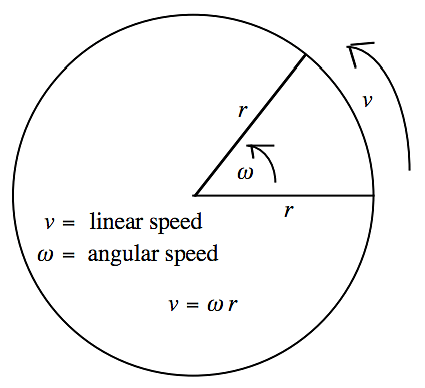
We may calculate the linear speed of a point on a spinning object, by finding the distance between a point on a spinning object and the centre of rotation. The angular speed of an item corresponds to the angle it moves through in a particular time. The unit for the angular speed is radians per second.
In a complete circle, it has 2pi radians. At a distance of r, or radius, from the rotation's centre. The linear speed of a point on the object is thus equal to the angular speed multiplied by the distance r. Metres per second and metre per second are the units of measurement.
Derivation of Linear Speed Formula
[Click Here for Sample Questions]
The formula for linear speed, v = r w, may be proved using calculus
ω= dtdθ
Consider a body travelling in a circular route with a radius of r and a uniform velocity of v. Assume that a body travels a linear distance x in a brief amount of time Δt and forms an angle Δθ at its centre. The length of the arc is now equal to the product of the radius and the angle.
Δ x = r × Δθ
Limits t tends to 0 which is a small-time interval are obtained by dividing by Δt.
lim t→0 = Δx / Δt =r ( lim t→0 Δθ / Δt )
But, lim t→0 Δx / Δt =v
and,
lim t→0 Δθ / Δt =ω
Therefore, v = r ω
Also read: Differentiation and Integration Formula
Linear Speed Formula in Circular Motion
[Click Here for Sample Questions]
When a body moves in a circular motion, it might move at two distinct speeds.
- Angular Speed
- LInear Speed
The speed of a body moving in a circular motion is made up of both linear and angular speed. On a circular motion, linear speed pushes the body ahead, but angular speed is created by the centripetal force, which forces the body to continue in a circular path. Because the centripetal force provides an inward pull, the motion is limited to a circular direction.
The linear speed is what propels the body forward. And the circular motion will stop if the linear speed is not there. The circular motion would be disturbed without the angular speed, and the motion would continue in a tangential direction. Both components have an equal role in keeping the body on a circular route.
The Angular Linear Speed
[Click Here for Sample Questions]
Rotational motion has two types of speeds, as we saw before. The acceleration that propels the body ahead and maintains it travelling in a circular direction causes the angular speed of a body in rotational motion. The following is the formula for the angular linear speed of the.
V = r w
Where v is the body's linear velocity, r is the circular path's radius, and w is the omega, the angular speed of the body travelling along the circular path.
Things to Remember
- Linear speed refers to the change in distance with regard to time. This transformation might occur immediately or over a period of time. Instantaneous linear speed is defined as linear speed recorded over a very short interval, whereas average linear speed is defined as linear speed observed over a longer period of time.
- V ( linear speed ) = ΔS / ΔT
The letter ΔS stands for the shift in the distance.
And ΔT denotes the amount of time it takes for the body to go the specified distance.
- We may calculate the linear speed of a point on a spinning object, by finding the distance between a point on a spinning object and the centre of rotation. The angular speed of an item corresponds to the angle it moves through in a particular time.
- When a body moves in a circular motion, it might move at two distinct speeds. Angular Speed, Linear Speed.
- The acceleration in rotational motion that propels the body ahead and maintains it travelling in a circular direction causes the angular speed of a body in rotational motion. The following is the formula for the angular linear speed of the, V = r w.
Also read: Difference between Sequence and Series
Sample Questions
Ques: A body begins at rest and moves in a circle with a radius of 5m at a speed of 10 Rad s-2. After 6 seconds, calculate the body's linear speed. (3 marks)
Ans: Acceleration a = 10 rad s-2
Radius r =5 m
Time t = 6 s
The angular velocity is given by
ω = ω0 + at
= 0 + 10(6)
= 60 rads-1
The linear speed is given by
v = r ω
= 5 m × 60 rad s-1
v= 300 m/s.
As a result, the provided body's linear speed is 300m/s. If the centripetal force is removed from the body, the body will continue to travel in a tangential direction.
Ques: Find the Linear Speed of a Body Moving at 30 RPM in a 5 m Radius Circular Path? (3 marks)
Ans: Provided
Angular velocity = 30 rpm
= 30 (π/30)
= 1 rad/s
Radius r = 2 m
The formula for linear speed is:
v = r ω
v = 2 m × 1 rad / s
v = 2 m / s
Ques: A boy spins a yoyo in a 5-metre radius. Find the Angular Speed of the Yoyo if the Linear or Tangential Speed is 6 m/s. (3 marks)
Ans: Provided
R = 5 m
V = 6 m / s
The formula for Linear Speed is
v = r ω
ω = v / r
ω = 6 / 5
ω = 1.2
Ques: At 10.0 rotations per second, a power wheel starts spinning. The wheel has a diameter of 4 metres. In metres per second, what will be the linear speed of a wheel point on the surface? (3 marks)
Ans: ω = 10.0 rev / s
r= 4 / 2 = 2 m
Using the formula
v = ω × r,
Linear speed of a point on the surface of the wheel can be given by:
v = ( 62.8 rad / s ) × ( 2m )
v = 125.6 m per s
The required linear speed of a point of the wheel is approximately 125.6 m per s
Ques: Under an automobile wheel, a sensor that monitors linear speed is linked. The sensor is 0.080 m from the rotation's centre. The wheel's linear speed is roughly 8.00 m per s at that time, according to the sensor. So, what is the linear speed on the outside edge of the wheel if the radius is 0.220 m? (3 marks)
Ans: The linear speed varies depending on how far you are from the centre of rotation, but the angular speed is consistent across the wheel. The first step in solving this problem is to calculate the angular speed using the linear speed at the sensor's position, which is 0.080 m.
To find the angular speed, v = w x r can be rewritten as follows:
v = ω × r
v = ( 100 rad / s ) × ( 0.220 m )
So,
v = 22.0 m
The outside edge of the automobile wheel has a linear speed of 22.0 m / s .
Ques: Derive the linear speed formula. (3 marks)
Ans: The formula for linear speed, v = r w, may be proved using calculus
ω= dtdθ
Consider a body travelling in a circular route with a radius of r and a uniform velocity of v. Assume that a body travels a linear distance âΔ3x in a brief amount of time âΔ3t and forms an angle âΔ3θ at its centre.
The length of the arc is now equal to the product of the radius and the angle.
Δx = r × Δθ
Limits t tends to 0 which is a small time interval are obtained by dividing by â?³t.
lim t→0 = Δx / Δt =r ( lim t→0 Δθ / Δt )
But, lim t→0 Δx / Δt =v
and
lim t→0 Δθ / Δt =ω
Therefore, v = r ω
Ques: State the physical significance of linear speed. (3 marks)
Ans: Following are some significance of linear speed:
- The slowness of the body's fastness is measured by linear speed.
- It's the physical amount that informs you how fast a body is travelling, hence it's important.
- There is just one type of speed for bodies travelling in a straight line: linear speed.
- In a circular motion, however, the body's speed is determined by two things. There are two types of speed: angular and linear.
- The linear speed is in charge of keeping the body moving, while the angular speed is in charge of maintaining the route constrained to a circle.
- As a result, it is critical to investigate a body's linear speed.
Ques: Find the linear speed of a point on a wheel with a diameter of 2 m and a speed of 5 RPS. (3 marks)
Ans: ω = 5 RPS
or 31.42 radians per second
r = 2 / 2 = 1 m
Since, V = ω × r
= 31.42 × 1
V = 31.42 m/s
Ques: Find the linear speed of a point on a wheel with a diameter of 80 m and a speed of 19 RPS. (3 marks)
Ans: ω = 14 RPS
or 1.9897 radians per second
r = 80/2 = 40 m
Since, V = ω × r
= 1.9897 × 40
V = 79.588 m / s
Ques: Find the linear speed of a point on a wheel with a diameter of 4 m and a speed of 14 RPS. (3 marks)
Ans: ω = 14 RPS
or 87.96 radians per second
r = 4/2 = 2 m
Since, V = ω × r
= 87.96 × 2
V = 175.92 m / s
Physics Related links:



Comments