



Content Writer
Metamorphosis is one of the most fascinating biological processes, and the phenomenon is known as metamorphosis, which is characterized by the drastic transformation of one form or structure to another. These transformations are observed after the birth of an organism. So, metamorphosis is composed of cell growth, differentiation, change in the structure and form of one life stage to another. There are several organisms that undergo metamorphosis during their life cycles, they are frogs, toads, mosquitos, butterflies, fishes, etc.
| Table of Content |
Keywords: Metamorphosis, Stages of metamorphosis, Ametabolous, Hemimetabolous, Holometabolous, Frogs, Insects, tadpoles, eggs, larvae, etc.
What is metamorphosis?
[Click Here for Sample Questions]
Metamorphosis is one of the most fascinating biological processes, and the phenomenon is known as metamorphosis, which is characterized by the drastic transformation of one form or structure to another. Metamorphosis is composed of cell growth, differentiation, change in the structure and form of one life stage to another.
Metamorphosis is carried out by several hormones in the organisms, they are known as the juvenile hormones. These hormones are synthesized by the endocrine glands, which are located in the anterior portion of the body.
Metamorphosis in any organism can be divided into four stages. These 4 stages are:
- Egg: It is the first stage in the metamorphosis cycle of organisms. It contains all the genetic information needed to develop an organism. The egg is characterized by the presence of imaginary discs, chorions, aerophiles, and plastron networks. The imaginal discs are the segments present in the eggs which lead to the development of various biological structures later. They form eyes, abdomen, exoskeleton, etc. Chorion is the hard-shell present on the eggs, which protects them from the harsh external environment. Aerophiles and plastron networks are present in the egg to ensure the exchange of gases between the egg and the environment.
- Larva: This is the second stage of development. This stage is characterized by excess consumption of energy to ensure its growth and development. The larva is also characterized by the presence of imaginary discs, which grow to form different structures. The larva is characterized by the larval stage, where there is shedding of skin. The shedding of skin is preceded by separation of the cuticle, known as apolysis, and then shedding of the skin, ecdysis.
- Pupal Stage: This stage is followed by the larval stage. Here there is a series of cell growth, proliferation, and death. Here the imaginary discs result in the formation of different parts of the organism. Cell death generates a large amount of energy. The pupal stage is enclosed in a hard shell, called the pupa. This protects the pupal from all the harsh conditions. At the end of this stage, the pupa softens, and the adult emerges out of the shell.
- Adult: The adult organism has a well-developed body with several functional parts. These are the broadly classified phases of metamorphosis; however, they vary in different types of metamorphosis which is explained below.
Types of metamorphosis
[Click Here for Sample Questions]
Metamorphosis is of three types depending on the stages of development, they are:
Ametabolous: Here there are no well-defined developmental stages that can be identified. The egg keeps growing into a young, which further grows into an adult till the structures are developed. This occurs in organisms such as silverfish, springtails, etc.
Hemimetabolous: This is also known as the gradual metamorphosis. Here the growth is divided into 3 stages, egg, nymph, and adult. The nymph is the same as the adult but is smaller in size. They both have the same eating habits, but different color patterns. It is present in organisms, grasshoppers, termites, etc.
Holometabolous: This is known as the complete metamorphosis. Here the growth is divided into 4 stages, egg, larval, pupal, and adult. It is observed in butterflies, beetles, moths, etc.
Lifecycle of Frog
[Click Here for Sample Questions]
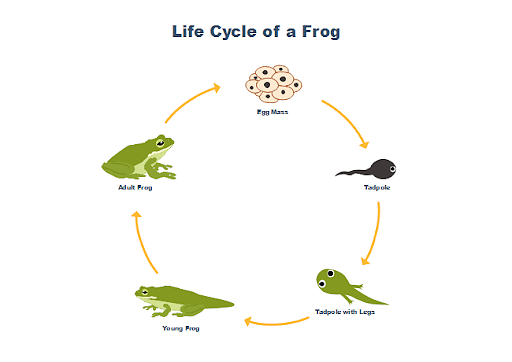
Frogs are amphibians in nature, and they also undergo metamorphosis. Their lifecycle can be divided into three parts, egg, larva, and adult.
Stage 1, The Egg: The female frog lays several eggs that often group together, these groups are known as spawn. The fertilized eggs grow and undergo cell division to form the later stages of metamorphosis. This stage usually takes one to three weeks.
Stage 2, The Larva (Tadpole): They are formed by cell division in the eggs. The larva of a frog is known as the tadpole. The tadpole has rudimentary gills, a mouth, and a long tail. During the initial days, the tadpole takes up nutrition from the remaining part of the egg after hatching. The tadpoles feed on algae.
Stage 3, Adult Frog: The adult frog is the final stage of development. The tadpole while growing develops hind limbs, elongates, gills develop, and tail shortens. Almost in 12 weeks, a full frog has been developed.
Lifecycle of Insects
[Click Here for Sample Questions]
The life cycle of insects can be divided into 4 stages, egg, larvae, pupal stage, and adult insect. Let us take the example of a butterfly.
Stage 1, Egg: It is the first stage in the metamorphosis cycle of organisms. It contains all the genetic information needed to develop an organism. The egg is characterized by the presence of imaginary discs, chorions, aerophiles, and plastron networks. Butterflies lay their eggs at the bottom of the leaves.
Stage 2, Larva Stage: This is the second stage of development. This stage is characterized by excess consumption of energy to ensure its growth and development. The larva is also characterized by the presence of imaginary discs, which grow to form different structures. This happens after two to three weeks of eggs hatching.
Stage 3, Pupal Stage: This comes after the larval stage. Here there is a series of cell growth, proliferation, and death. Here the imaginary discs result in the formation of different parts of the organism. And this stage is enclosed in a hard shell, called the pupa.
Stage 4, Adult: At the end of the larval stage, the pupa softens, and the adult emerges out of the shell. The lifespan of adult insects varies from species to species.

Things to Remember
- Metamorphosis is characterized by the drastic transformation of one form or structure to another. Metamorphosis is composed of cell growth, differentiation, change in the structure and form of one life stage to another.
- Metamorphosis in any organism can be divided into four stages. These 4 stages are eggs, larva, pupal, and adult organisms.
- There are three types of metamorphosis, ametabolous, hemimetabolous, holometabolous.
- Certain organisms are further characterized by a series of larval stages, this phenomenon is called hyper metamorphosis.
- The stage between larva and adult insects is called a pharate. The pharate is enclosed in a hard shell, called the pupa.
Sample Questions
Ques: What is metamorphosis? (2 Marks)
Ans: Metamorphosis is characterized by the drastic transformation of one form or structure to another. Metamorphosis is composed of cell growth, differentiation, change in the structure and form of one life stage to another. Metamorphosis in any organism can be divided into four stages. These 4 stages are eggs, larva, pupal, and adult organisms. There are three types of metamorphosis, ametabolous, hemimetabolous, holometabolous.
Ques: What are the different stages of metamorphosis? ?(3 Marks)
Ans: Metamorphosis in any organism can be divided into four stages. These 4 stages are eggs, larva, pupal, and adult organisms.
- Stage 1, Egg: It is the first stage in the metamorphosis cycle of organisms. It contains all the genetic information needed to develop an organism. The egg is characterized by the presence of imaginary discs, chorions, aerophiles, and plastron networks.
- Stage 2, Larva Stage: This is the second stage of development. This stage is characterized by excess consumption of energy to ensure its growth and development.
- Stage 3, Pupal Stage: This comes after the larval stage. Here there is a series of cell growth, proliferation, and death. Here the imaginary discs result in the formation of different parts of the organism.
- Stage 4, Adult: At the end of the larval stage, the pupa softens, and the adult emerges out of the shell. The lifespan of adult insects varies from species to species.
Ques: What are the functions, or significance of metamorphosis? ?(2 Marks)
Ans: One of the major advantages or significance of metamorphosis is the elimination of competition amongst organisms. The different organisms at different stages of the lifecycle have different food patterns and consume different resources. Moreover, their different shapes or sizes also avoid competition.
Ques: What are the different types of metamorphosis? ?(3 Marks)
Ans: Metamorphosis is of three types depending on the stages of development, they are:
- Ametabolous: Here there are no well-defined developmental stages that can be identified. The egg keeps growing into a young, which further grows into an adult till the structures are developed. This occurs in organisms such as silverfish, springtails, etc.
- Hemimetabolous: This is also known as the gradual metamorphosis. Here the growth is divided into 3 stages, egg, nymph, and adult.
- Holometabolous: This is known as the complete metamorphosis. Here the growth is divided into 4 stages, egg, larval, pupal, and adult. It is observed in butterflies, beetles, moths, etc.
Ques: Write a short note on the larval stage and the nymph stage of insects. ?(3 Marks)
Ans: Larval stage is the second stage of development. This stage is characterized by excess consumption of energy to ensure its growth and development. The larva is also characterized by the presence of imaginary discs, which grow to form different structures. The larva is characterized by the larval stage, where there is shedding of skin. The shedding of skin is preceded by separation of the cuticle, known as apolysis, and then shedding of the skin, ecdysis.
The nymph is the same as the adult but is smaller in size. They both have the same eating habits, but different color patterns. It is present in organisms, grasshoppers, termites, etc.
Ques: What are viviparous, and oviparous animals? ?(2 Marks)
Ans: The animals which give birth to organisms, and do not lay eggs are called viviparous animals. For example, Human beings, elephants, mammals, etc. Those animals which lay eggs are called oviparous animals. For example, birds, amphibians, etc.
Ques: What is external fertilization, explain with an example. ?(2 Marks)
Ans: External fertilization is the phenomenon when the sperm and the egg fuse outside the body, in the external environment or medium. This mainly occurs in aquatic animals, fishes, amphibians, etc. For example, in frogs, the male and the females come together, the females lay the eggs in the water, then the males lay their sperm in the water, the sperm flows to the eggs. They then fertilize the eggs in the water.
Ques: What is internal fertilization, explain with an example. ?(2 Marks)
Ans: Internal fertilization is the phenomenon when the sperm and the egg fuse inside the body, and not in the external environment or medium. This mainly occurs in Human beings, elephants, mammals, etc. For example, in humans, the sperm fuses the egg inside the uterus.



Comments