



Education Journalist | Study Abroad Lead
Biotic and Abiotic components together form an ecosystem, and multiple ecosystems create an environment, which provides habitat, nutrition and space for development and growth. Biotic and abiotic components shape the ecosystem, according to the presence of factors. Biotic components refer to living beings or organisms present in the environment like humans, animals and plants. Abiotic components involve physical conditions -pH, humidity, salinity, sunlight, temperature, etc and chemical agents such as gases, minerals, etc. Additionally, both of these aspects are interdependent. As if one of the components is eliminated or altered, the ecosystem as a whole will be affected.
| Table of Content |
Key Terms: Ecosystem, Biotic Factors, Abiotic Factors, Environment, Climate, Plants, Animals, Soil, Terrestrial Ecosystem, Aquatic Ecosystem
What is an Ecosystem?
[Click Here for Sample Questions]
An ecosystem is a geographic area where plants, animals, and other living organisms interact with each other as well as non-living components. Sir Arthur Tansley coined the term Ecosystem. The ecosystem may be large, or very small.
There are two types of ecosystem:
- Terrestrial Ecosystem– Forests, Grassland, Dessert etc.
- Aquatic Ecosystem– Sea, Ocean, Pond, Estuaries, lakes etc.
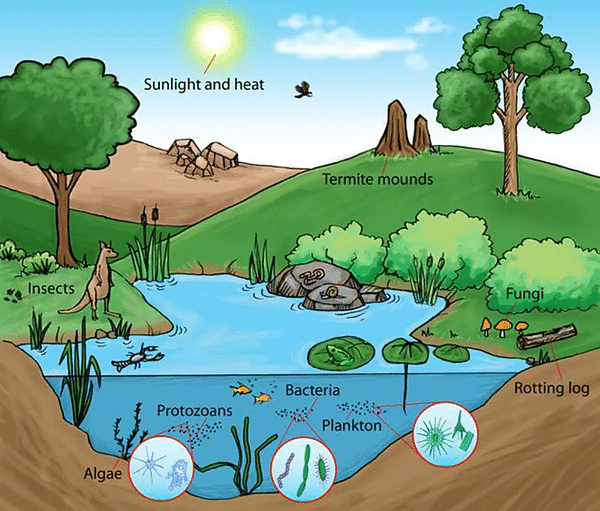
Ecosystem
Biotic Factors
[Click Here for Sample Questions]
Biotic components are the living factors, which shape the ecosystem. They exhibit life processes– respiration, reproduction, digestion and excretion. They have a genetic material like DNA, which is involved in the transfer of information from one generation to the other. They are sensitive to pH, temperature changes and all stimuli. Interaction and co-dependency are essential between different biota for survival and reproduction.
Some examples of biotic factors are Producers (autotrophs), Consumers (Primary, secondary and tertiary), decomposers and detritivores.

Biotic Components
Read More: Decomposition
Abiotic Factors
[Click Here for Sample Questions]
Abiotic factors refer to all the non-living factors present in an ecosystem, which do not show life processes. Abiotic factors play a significant role in the survival and reproduction of species in an ecosystem.
Light, temperature, pH, and water are abiotic components of an ecosystem. Climate, soil, and topography are some other abiotic components.

Abiotic Factors
Difference Between Abiotic and Biotic Factors
[Click Here for Sample Questions]
The main points of distinction between abiotic and biotic factors are tabulated below:
| Parameters | Biotic Factors | Abiotic Factors |
|---|---|---|
| Definition | Biotic components are the living part of an ecosystem. | Abiotic components are the non-living part of the ecosystem, physical conditions and chemical factors. |
| Dependence | They depend on non-living factors for survival. | It doesn’t depend on biotic factors. |
| Origin | They originate from the biosphere. | They are made up of Hydrosphere, Lithosphere and Atmosphere. |
| Life Processes | They perform life processes- reproduction, respiration, digestion, and excretion. | They don’t perform life processes. |
| Examples | Flora, Fauna, Humans, Birds, Plants, Microbes etc. | Soil, Water, Temperature, Turbidity, Oxygen content etc. |
Read More: Four Spheres of Earth
Things to Remember
- Ecosystem is a geographic area where plants, animals, and other living organisms interact with each other as well as non-living components.
- Biotic components are the living factors, which shape the ecosystem.
- Biotic components of an ecosystem are involved in life processes such as respiration, reproduction, digestion and excretion.
- Biotic components contain genetic material of any form– DNA or RNA.
- An abiotic component of an ecosystem is a non-living part, which does not show life processes.
- Light, temperature, pH, and water are abiotic components of an ecosystem.
Sample Questions
Ques. Define Ecosystem. List some examples of biotic and abiotic components of an ecosystem. (3 Marks)
Ans. An ecosystem is a geographic area where plants, animals, and other living organisms interact with each other as well as non-living components.
Some examples of biotic components are
- Plants
- Animals
- Fungi
- Bacteria
Some examples of non-biotic components are
- Climate
- Humidity
- Precipitation
- Wind
- Altitude
Ques. Classify the types of ecosystems. (3 Marks)
Ans. The ecosystem is classified into two major types:
- Territorial Ecosystem– It is further classified into the forest, grassland, tundra and desert ecosystem.
- Aquatic Ecosystem– Marine, Estuaries, Pond and lake ecosystems fall under the aquatic ecosystem.
Ques. What is the Biotic component of an ecosystem? (2 Marks)
Ans. Biotic components are the living factors, which shape the ecosystem and perform various life processes. Examples are Humans, Plants, Birds, bacteria etc.
Ques. What is an abiotic component of an ecosystem? (2 Marks)
Ans. Abiotic components in an ecosystem is a non-living part, which does not show life processes and doesn’t respond to any external stimulus. Examples are Temperature, Climate, Light intensity etc.
Ques. On the basis of nutrition, classify biotic components. (3 Marks)
Ans. On the basis of nutrition biotic components are classified as–
- Autotrophs– they make their own food by photosynthesis or chemosynthesis. Plants are an example of autotrophs.
- Heterotrophs– They are dependent on autotrophs for food and energy. In the food chain, they are classified as primary, secondary and tertiary consumers.
- Detritivores– They extract energy from dead and decaying organic matter. Examples are Vultures, microbes etc.
Ques. Differentiate between bioaccumulation and biomagnification. (3 Marks)
Ans. The difference between bioaccumulation and biomagnification is as follows:
| Biomagnification | Bioaccumulation |
|---|---|
| Accumulation of toxins in the tissue of a particular organism. | An increased concentration of a toxic chemical, the higher an animal is on the food chain. |
| It takes place between two given trophic levels. | It takes place or occurs within a given trophic level. |
| An increase in the level is seen as one moves higher in the food chain. | An increase in the concentration of a substance inside an organism |
Ques. How are biotic and abiotic components interdependent? (3 Marks)
Ans. Both biotic and abiotic components have codependency on each other. Autotrophic organisms may not be able to survive without sufficient solar radiation. When these creatures ultimately die, primary consumers will face a food shortage. This influence spreads across the food chain, harming all living things. As a result, there is an imbalance in the ecology.
Check-Out:



Comments