



Content Curator
Newton's first law of motion is also known as the law of inertia. It states that a body continues to remain in the state of rest or motion until an external force is applied. If no external force is applied to the object, it continues to move at a uniform speed. The external force is responsible for bringing any change in the speed and direction of the body.
| Table of Content |
Also check: Potential Energy
Newton’s First Law of Motion
[Click Here for Sample Questions]
Newton’s first law of motion states that there must be a total external force or a cause acting on the object to bring any change in the velocity which can be the magnitude or direction. Friction is considered to be one of the causes of the net external force of Newton's first law of motion. If we eliminate friction, the object would not be able to slow down. It is also known as the law of inertia as inertia is the property of the body which keeps the body in rest or motion with uniform velocity. The equation of newton’s first law of motion is:
F = dpdt = d (mv)dt
Where, v = velocity
t= time
F = force
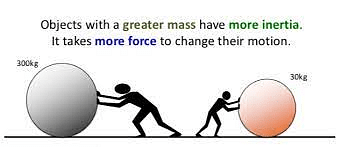
Figure: Newton’s first law of motion
Application of Newton’s First Law
[Click Here for Sample Questions]
The first law of motion applies to many day-to-day activities. Some of the applications are :
- A kite flying in the sky: The weight, aerodynamic lift and drag, and tension in the control line are the different forces acting on the kite. When the kite is at a constant velocity, the balanced force holds the kite at a fixed height.
- Ball at rest: In order to get it thrown or hit, it needs an external force. The applied external force determines the distance the ball traveled.
- Car airbags: Airbags in the car prevent a person from the accident. In a sudden exposure to an accident, the speed is controlled leading to the operation of an electrical switch where a gaseous substance fills up an airbag to protect the head of a driver
- The launch of a rocket from the launch pad: The velocity of a resting rocket is zero before the ignition of the engine. When the engine is started, the thrust of the engine produces an extra force that is opposite to the weight. The rocket begins to rise when weight is less than the thrust and the total external force is equal to the thrust without the weight.
- Opening a ketchup bottle: To empty the ketchup bottle, it is often turned upside down to apply thrust from the downward direction at high speed and then bring it to rest suddenly.
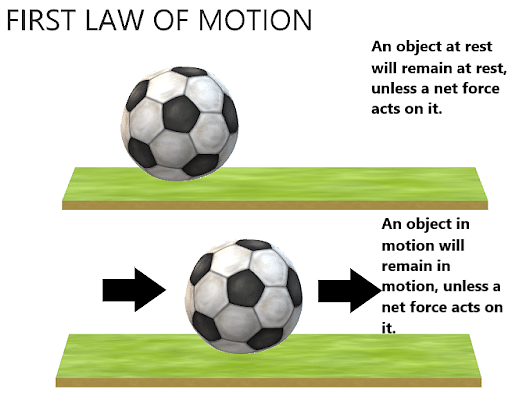
Figure: Example of Newton’s First law of motion
Things to Remember
- The amount of inertia of the body differs according to the body. It is measured by its mass.
- The tendency of a body to remain in the state of rest or motion is known as inertia.
- A body continues to remain in the state of motion or rest until an external force is acted on it.
- The motion of the objects is always the opposite of the force of friction.
- The amount of matter in a substance is known as a mass which is measured in kilograms.
- A car parked on the hill and a parachutist jumping from an airplane are examples of Newton's first law of motion.
- There are three types of inertia- the inertia of rest, the inertia of motion, and inertia of direction.
- The 3 laws of Newton deal with the science of kinematics. They establish a relationship between the motion and force of an object.
Also check:
Sample Questions
Ques. Calculate the net external force to keep a body of 500kg in motion. The constant velocity is 10m8. (2 Marks)
Ans: Newton's first law of motion states that an object continues to stay in the state of motion or rest until it is affected by a net force. To keep the body in motion, friction is the net external force to keep the body moving or to change the direction of the body. The body of 500kg is moving at a constant velocity and there is a negligible net force acting on the body.
Ques. A spaceship of 1000kg travels in a vacuum at a uniform speed of 500ms. Calculate the net external force, not considering the gravitational forces. (2 Marks)
Ans: Air resistance creates no friction in a vacuum. The spaceship will continue to travel at a uniform speed or zero acceleration of 500 m/s and the net force is zero.
F = ma
F = (1000kg) (0m/s2)
= 0 N
Ques. The constant speed of a moving airplane is 650mph. The constant speed of a car is 650mph. Which vehicle has the larger acceleration? (2 Marks)
Ans: the acceleration of both vehicles is zero because both of them maintain a constant speed. None of the vehicles experience acceleration.
a= ∆v∆t
As the acceleration is zero, there is no change in the velocity. The net force and acceleration, both are zero.
Ques. The mass of a skydiver is 92kg and has reached the ultimate velocity at 52m/s. Calculate the force of wind resistance. (3 Marks)
Ans: the acceleration is 0 at the ultimate velocity.
According to newton’s second law ,
F = ma
Net force = 0
F net = 0
F net= 0 = mg + Fwind
Fnet = 0 = 92* -9.8 +Fwind
Fwind = 901. 6N
Ques. A passenger in the elevator experiences a downward force of 100N and also he experiences an upward force of 120N. What is the direction and rate of his acceleration? (3 Marks)
Ans: the mass of the body and the net force determines the amount of acceleration. The net force is 20N in an upward direction.
F = mg
m= 100N/ (10m/s2)
= 10kg
We calculate the net force from newton’s second law
F=ma
a = 20N/10kg
=2m/s2
Ques. What is the net force exerted by a car of 1675kgs which is moving at a constant velocity of 25m/s? (2 Marks)
Ans: according to Newton's first law of motion, an object continues to remain in the state of motion and rests until an external force is applied to it. as the car is moving with a constant velocity, there is no external force acting on it.
Ques. if 0.5 ms-1 velocity is required to stop a ball of mass 70kg. The time taken is 0.5 sec. calculate the force exerted by the player to stop the ball. (3 Marks)
Ans: m = 70gm = 0.070kg
u = 0.5 ms-1
v = 0
t = 0.5s
F = m(v-u)/t
= 0.070 (0 -0.5)/0.5
=- 0.07 newton
Ques. Calculate the acceleration of a 5 kg body moving with a force of 200N. (2 Marks)
Ans: m = 5kg
F = 200N
F = ma
a = F/m
= 200/5 = 40ms-2
a = 40ms-2
Also check:



Comments