



Content Curator
Newton’s second law of motion is proposed to highlight what happens when the net external force acts to accelerate a body. Developed in 1666, the 3 laws of motion of Sir Issac Newton were discovered to observe the object's motion in an inertial reference frame. He found that in motions of an inertial frame where, during the absence of an external force, objects either stay in rest or stay in motion. The second law, in particular, is only restricted to the inertial frame. Newton’s laws of motion have a huge contribution to Modern physics.
| Table of Content |
Newton’s Second Law
The statement of the second law of motion expressed by Newton is as follows.
“The rate of change of momentum of a body is directly proportional to the applied force & takes place in the direction in which the force acts.”
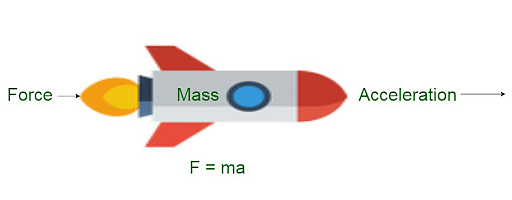
Illustration of Newton’s Second Law
In simple terms, the second law states that the acceleration of an object depends upon the force that acts on the object and the mass of the said object. Here, the acceleration is directly proportional to the acting force while it is inversely proportional to the mass of the object. Now let us understand what momentum is.
Laws of Motion Video Lecture
Read More:
What is Momentum?
Momentum of a body is formulated by the product of its mass and its velocity. It is a vector quantity since it has both the magnitude(|mv|) and direction due to velocity. Momentum can be represented as,
p = mv
Where,
m → Mass
v → Velocity
A common example of momentum is,

Momentum Example
Imagine a heavy-loaded and a light-weighted truck parked on the road.
While moving at the same speed, the heavy-loaded truck needs more external force than the light-weighted to bring them to the same speed. Similarly,the heavy-loaded truck needed greater stopping force due to its greater momentum.
Read More: Radius of Gyration
Newton’s Second Law Formula and Derivation
The formula for Newton’s second law of motion is given by,
F = ma
Where,
F → External Force
m → Mass
a → Acceleration
Analysing the statement of the second law,
If an external force F is acting on a body of mass m. Say, its velocity changes from v to (v+Δv) in a time interval Δt.
The momentum also changes from mv to mΔv.
∴ F∝ pt
or,
F=c.\(\frac{\bigtriangleup p}{\bigtriangleup t}\) [c is a constant]
If we take the limit Δt → 0, \(\frac{\bigtriangleup p}{\bigtriangleup t}\) becomes \(\frac{dp}{dt}\)
Now,
F = c.\(\frac{dp}{dt}\)= c.\(\frac{d(mv)}{dt}\)= c.m.\(\frac{d(v)}{dt}\)= c.m.a
Where,
\(\frac{d(v)}{dt}\) → a → acceleration (rate of change in velocity)
Thus, we derived,
F∝ ma
or
F = ma [c=1]
Note: It is possible to derive from the rate of change in momentum of a body and vice-versa.
Read More:
Units of Measurement
The SI unit of force is newton(N). As force is the product of mass and acceleration, we can derive its unit as follows.
Unit of mass kg (kilogram)
Unit of accelerationmeter/second² (m/s²)
1N = 1kg.m/s2
The CGS unit of force is dyne. It is expressed as,
1dyn(dyne) = 1g.cm/s2
The Dimensional formula of Newton’s Second law is given by,
F = ma = MLT-2
It is important to note that force moves along the direction of acceleration of the body.
Read More: Difference between Force and Pressure
Conditions of Second Law
- For being a vector, there are 3 equivalent equation,
Fx=max ; Fy=may ;Fz=maz
- When force isn’t parallel with the velocity of the body and makes an angle θ with each other,
- The horizontal component of velocity changes.
- Normal or perpendicular(?) remains the same.
- When F=0 then a=0. It proves the first law of motion.
- The law is applicable for a single point particle. But for a rigid body or system of particles in general, we have to calculate the acceleration of the center of mass.
- The second law is an instant relation between F and a.
Read More:
Real-life applications of Second Law of Motion
- While riding a bicycle, when we peddle, we provide an external force to it. This force creates momentum in the bicycle and it moves in the same direction.
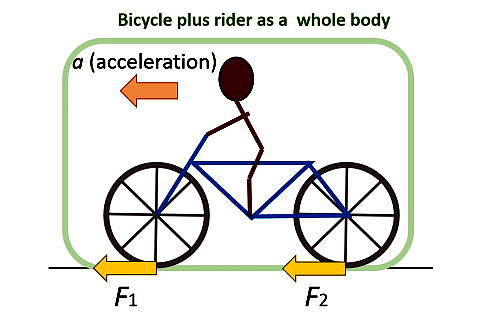
Example of Newton’s second law
- In race cars, the mass of a car is kept low. Due to the low mass, the momentum becomes less and the acceleration increases. Thus, it helps to increase the chance of winning a race with high acceleration.
- In a football match, when a player kicks the ball, he exerts a force in a specific direction. The stronger he kicks, the further it will go.
- While catching a ball, cricketers hold their hands back. It gives the ball time to decrease its speed. Thus, by applying less force, they can catch the ball easily.
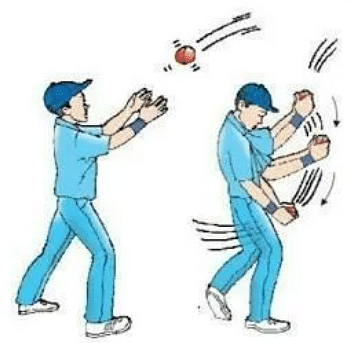
Cricketer catching the ball
- If two people walk together. If one of them weighs lighter, he will walk faster. Though both of them are walking with the same force, the momentum of the lighter person is less.
Read More: Displacement Vector
Things to Remember
- Newton’s second law of motion is only applicable for an inertial frame.
- The formula to ponder on for Newton’s second law of motion is F = ma [where F=external force, m=mass, a=acceleration]
- As of Newton's second law, external force on a body is equal to the rate of change of momentum of a body.
- Momentum is a vector quantity.
- We can prove the first law using the second law.
- For a system of particles or rigid bodies, take the acceleration of the centre of mass.
Read More:
Sample Questions
Ques. A ship of mass 3x10⁷kg initially at rest is pulled by a force of 5x10⁴ N through a distance of 3 m. Assuming that the resistance due to water is negligible, the speed of the ship is? [3 marks]
Ans: F=ma
Or, a=\(\frac{F}{m} = \frac{5 \times 10^4}{3 \times 10^7}\)=1.67 x 10⁻³m/s2
∴v=\(\sqrt{2as}\)
or, v=\(\sqrt{ 2 \times 1.67 \times 10^{-3}} \) ≈ 0.1m/s2
Ques. A particle moves in X-Y plane under the influence of a force such that its linear momentum is p(t)=\(\overrightarrow{p} (t) = A[ \hat{i} sin (kt) - \hat{j}(kt)]\),where A and K are constants. The angle between the force and the momentum is [CBSE 2007] [3 marks]
Ans: As per the second law of motion,
The force on a particle is proportional to the rate of change in momentum.
∴F=\(\frac{d \overrightarrow{p} (t) }{dt} = A.k.(- \hat{i} sin (kt) - \hat{j}(kt))\)
So, \(\overrightarrow{F} . \overrightarrow{p}\)=0
or,|\(\overrightarrow{F} . \overrightarrow{p}\)|.cos=0
or,=90°
Ques. What is the maximum value of F such that the block in the arrangement doesn’t move? [g=10ms-2] [2003] [2 marks]

Ans: Let, f is the max. The amount of force acting on the block of m=\(\sqrt{3}\) kg doesn’t move on the rough surface.

R= Fsin60° + mg
F = frictional force
∴\(\mu\)R=Fcos60°
or,\(\mu\)(Fsin60° +mg)=Fcos60°
or,\(\mu\)Fsin60°+\(\mu\)mg=Fcos60°
Or,
F=\(\frac{\mu mg}{cos 60^o - sin 60^o}\)
= 20N [\(\mu = \frac{1}{2\sqrt{3}}\), m =\(\sqrt{3}\)kg, g = 10m/s2
Read More:
Ques. A block of mass 0.1 kg is held against the wall applying a horizontal force of 5N on the block. If the coefficient of friction between wall & block is 0.5, the magnitude of the frictional force on the block is? [2 marks]

Ans: The force acting on the block is in the vertical direction.
∴force(f) =\(\mu\)R=0.5 x 5
∴force(f) =0.25 N
Ques. A block of mass 2 kg rested on a rough inclined plane making an angle of 30° with the horizontal. The coefficient of static friction between block & plane is 0.7. The frictional force on the block is? [2 marks]

Ans: As of components in the figure, R=mg cos30°
and F=mg sin30°
F = \(2 \times 9.8 \times \times \frac{1}{2}\) = 9.8N
Ques. 2 blocks (masses are m1 and m2) connected with a light spring on a horizontal surface.Both the masses are pulled and then released.Calculate the ratio of their acceleration. [3 marks]
Ans: Due to m1 and m2, the forces F1 and F2acts opposite of each other.
F1 + F2= 0
Or, m1 .a1+ m2.a2= 0
Or, m1 .a1= -m2.a2
or,\(\frac{a_1}{a_2} =\frac{m_1}{m_2}\)
Read More:
Ques. Two forces 14N and 12N are acting on a body of 200kg in mutually perpendicular directions. Find the magnitude of acceleration. [3 marks]
Ans: Total force acting on the body,
F=\(\sqrt{F_1^2 + F_2^2 +2F_1 F_2 cos\theta}\)
Since, both the forces are perpendicular to each other,cos = 0
F=\(\sqrt{F_1^2 + F_2^2}\)=\(\sqrt{14^2 + 12^2}\)=18.439N
∴a=\(\frac{F}{m}\)=0.0921m/s2
Ques. Mention 2 significance of Newton's law of motion. [2 marks]
Ans: 2 significance of Newton’s law of motion are-
i)With Newton’s law of motion, we can calculate acceleration when force is applied to a body or a system.
ii)This law gives the idea of an inert mass of the body.
Ques. A bullet fired against a glass windowpane makes a hole in it, and the glass pane is not cracked. But on the other hand, when a stone strikes the same glass pane, it gets smashed. Why is it so? [2 marks]
Ans. When the bullet strikes the glass pane, the part of the glass pane which comes in contact with the bullet immediately shares the large velocity of the bullet and makes a hole, while the remaining part of the glass remains at rest and is therefore not smashed due to inertia of rest.
Ques. Why does a cricket player move his hand backwards while catching the ball? [2 marks]
Ans. A fast-moving cricket ball has a large momentum. In stopping or catching this ball, its momentum has reduced to zero. Now, when a cricket player moves back his hands on catching the fastball, then the time taken to reduce the momentum of the ball to zero is increased. Due to more time taken to stop the ball, the rate of change of momentum of the ball is decreased and hence a small force is exerted on the hands of the player. So, the hands of the player do not get hurt.
Ques. When a small boy is trying to push a heavy stone, mention various forces acting on the stone. [2 marks]
Ans. The various forces acting on the stone are:
- The gravitational force exerted by the earth pulls the stone downwards.
- The force of reaction is exerted by the ground on the stone vertically upwards.
- The force of pushing exerted by the boy.
- The force of friction exerted by the stone.
Read More:



Comments