



Content Curator
Angle Relationships between Parallel and Transversal Lines occur when two lines are being extended to infinity and never meet each point afterwards. These lines are termed coplanar lines and are considered parallel lines. “||” is the sign for “parallel to” between any two simple lines. The crossing point is called a transversal if we have 2 lines (they shouldn't have to be parallel), which is a third line that divides them. One can evaluate angles and their correlations with each angle in addition to the determination of degrees or radians.
Angle relationships refer to the comparison of the position, magnitude, and congruence of two or more sectors. When two lines or line sections collide, 2 sets of vertical angles get formed. Complex angle connections such as alternate internal angles, matching angles, and so on, emerge when two parallel lines are crossed by a transversal. You’ll be a stronger geometry learner if you can recognise angle relationships and reliably find congruent angles where lines intersect by going through the below-curated sections.
Check About: Transversal & Angle Introduction
Key Terms: Parallel Lines, Transversal lines, Transversal Angles, Corresponding Angles, Alternative Angles, transverse, Intersect, and Opposite angles.
Parallel Lines
[Click Here for Sample Questions]
Parallel lines are defined as two or multiple lines that reside in the same plane but never overlap. They have about the same slope and are distant from each other. Parallel lines are linear that, no matter how far they are extended, never meet. Take a look at the diagram below, which depicts parallel lines. Lines 'a' and 'b' are parallel, while lines 'p' and 'q' are parallel.
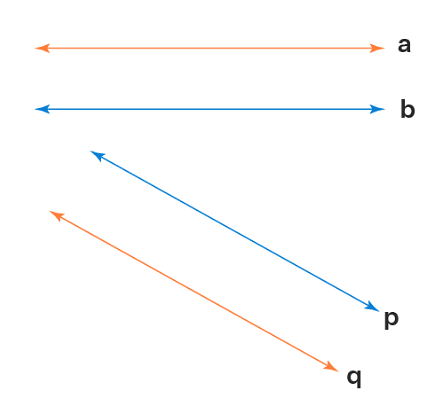
Two sets of Parallel Lines
Transversal Lines
[Click Here for Sample Questions]
Many sets of angles are created when any two parallel lines are crossed by a transversal line. While certain angles are complementary (equal), others will be congruent (equal). Look at the parallel lines labelled L1 and L2 that are split by a transversal in the diagram below. The two parallel lines and a transversal have created eight different angles. An alphabet has been used to mark each angle.
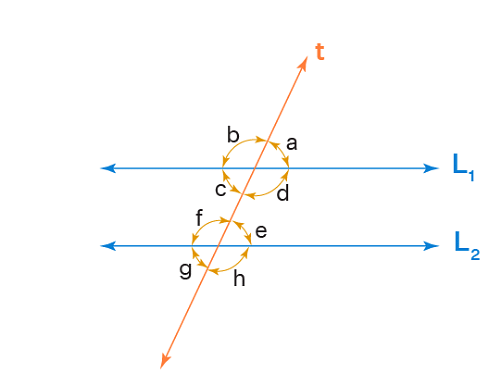
Parallel separated by a transversal
Read more: Logic of Parallel and Transversal Lines
Construction of Transversal on Parallel Lines
[Click Here for Sample Questions]
A transversal is simple to construct. To begin, we'll draw two parallel lines. On its first line, we create the angle (upon which we want to generate the transversal) (say x).
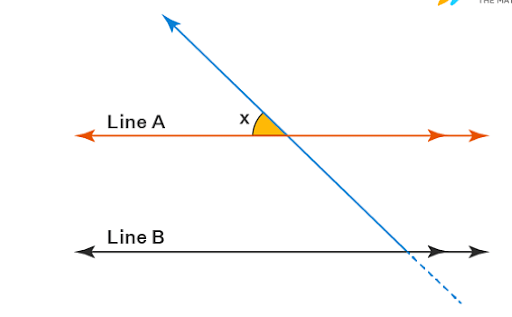
Transversal Angle on ‘A’ & ‘B’ Parallel Lines
We also stretch this formed angle up to the point where it encompasses both parallel lines, as seen here. What we obtain is as follows: At the required angle, a transverse on the two parallel lines (x).
Read more: Construction of Transversal
Transversal Angles Formed
[Click Here for Sample Questions]
Whenever a transversal intersects two parallel lines, the two crossings form many angles. Transversal angles are what they're called. The following are examples of transversal angles:
- Corresponding Angles- We get comparable angles whenever a transversal crosses two additional lines. The tighter our intersecting lines become, the tighter their angle relationships become. A completely new level of angle relationships emerges when a line intersects two parallel lines (a transversal).
- Alternate Interior Angles- Alternate interior angles occur when the internal angles are on opposing sides of the transversal. They subject themselves to the Alternate Interior Angles Principle, which stipulates those parallel lines must have congruent alternate interior angles (more like the Alternate Exterior Angles principle).
- Alternate Exterior Angles- In that they must be opposite angles, alternate exterior angles are comparable to vertex angles (on any side of the transversal). Beyond the parallel lines (that's the external part) are alternate exterior angles on opposite ends of the transversal (that's the variant part).
- Co-Interior Angles- Consecutive interior angles, also referred to as co-interior angles or same side interior angles, are created on the interior sides of the transversal. Many angles are formed when a transversal intersects any two parallel lines, including substitute interior angles, matching angles, alternating exterior angles, and consecutive interior angles.
Also Read: Transversal Angles
Examples of Transversal Angles formed
[Click Here for Sample Questions]
When a transversal meets two or more parallel lines, several angle pairs are formed. Let's go over the angle relationships for parallel lines sliced by a transversal again fast. As illustrated in the diagram, a and d are two parallel lines crossed by the transversal l at the points P and Q.

Transversal Angles present at different degrees
Corresponding Angles
∠1 and ∠6
∠4 and ∠8
∠2 and ∠5
∠3 and ∠7
If there is a transversal intersection between two parallel lines, then each set of corresponding angles will be equal. Thus,
∠1 = ∠6
∠4 = ∠8
∠2 = ∠5
∠3 = ∠7
Alternate interior angles
∠4 and ∠5
∠3 and ∠6
Nonetheless, if a transversal line intersects two parallel lines, then each set of alternative interior angles is equal.
∠4 = ∠5
∠3 = ∠6
Alternate exterior angles
∠1 and ∠7
∠2 and ∠8
If two parallel lines get split by a transversal line, then the concluding alternate exterior angles will be congruent.
∠1 = ∠7
∠2 = ∠8
Co-Interior Angles
∠3 and ∠5
∠4 and ∠6
If a transversal line makes an intersection between two parallel lines, each set of interior angles on a similar side of the transversal will be supplementary, i.e., they will add up to 180°.
∠3 + ∠5 = 180°
∠4 + ∠6 = 180°
Things to Remember
[Click Here for Sample Questions]
- Where two lines cross, the opposite angles created as a result of the intersection are known as vertical degrees or vertically opposite angles. A sequence of vertical angles is always congruent as well.
- Whatever line that overlaps two straight lines at different locations is called a transversal.
- The transversal line is a transverse that divides the lines L1 and L2.
- In the Euclidean plane, transversals help to establish the symmetry of two or more other straight lines. It crosses two lines at different points.
- The expression of a straight line is usually expressed in the slope-intercept form, as y = mx + b, where 'm' represents the slope and 'b' represents the y-intercept.
Sample Questions
Ques. What are the properties of parallel lines? (5 marks)
Ans. The qualities of parallel lines are as follows:
- The angles that are vertically opposite each other are equal.
- The related angle pairs are equivalent.
- The outside angles of the alternate pairs are equivalent.
- The internal angles of the alternate pairs are similar.
- Additional is a pair of internal angles on the identical side of the transversal.
Ques. How to evaluate the parallelism between lines? (5 Marks)
Ans. The Following qualities of any two parallel lines split by a transversal can be used to identify them:
- If the angles created by any two lines are equal, they are said to be parallel.
- If the Alternative Interior Angles formed by two lines are equal, they are said to be parallel.
- If the Substitute Exterior Angles formed by two lines are equal, they are said to be parallel.
- If the internal angles on the identical side of the transversal are supplemental, any two lines are shown to be parallel.
Ques. What do you understand by ∠1 and ∠2? (4 Marks)
Ans. 1 and 2 are on opposite sides of the transversal and are in the middle of the two lines sliced by the transversal. As a result, they're known as the alternative interior angles. They are not, however, equal since the edges on which they are formed are not parallel.

Ques. What is Euclid’s Formation of Parallel Postulates in Relation to transversal? (3 Marks)
Ans. The parallel postulate can be expressed as follows of a transversal in Euclid's version. Lines must meet if the interior ratios on the identical side of the transversal are smaller than two right angles. According to Euclid's Theorem 27, two points are connected if a transversal connects them with alternate inner angles that are equivalent. If the sides are not parallel, they must cross, forming a triangle, as Euclid proves by argument.
Ques. What is Parallel Line Equation? (3 Marks)
Ans. The estimation of a straight line is usually expressed in the slope-intercept notation, as y = mx + b, where 'm' represents the slope and 'b' represents the y-intercept. The steep or gradient of the line is determined by the value of 'm,' which informs us how sharp the line is.
It's worth noting that the inclination of any two parallel lines is the same. If the gradient of a line with the formula y = 4x + 3 is 4, for example. As a result, any line parallel to y = 4x + 3 will have the same slope, i.e., 4, as y = 4x + 3. Parallel lines share no points and have distinct y-intercepts.
Ques. What are the Applications of Parallel Lines in Reality? (3 Marks)
Ans. Lines that are parallel to one another can be seen in real life as well if one has the skills such as the ability to notice them. Take, for example, railroads. The rail lines go in a straight line. The train's tyres are supposed to go along the two lines or tracks. The distinction between mathematics' parallel lines and those who actually build railway tracks is that mathematicians may conceive parallel lines on solid surfaces and paper, whereas trains run across a variety of terrain, including hills, slopes, hills, and bridges.
Ques. What is the Difference between Parallel Lines & Perpendicular Lines? (3 Marks)
Ans. If two non-vertical lines are identical until the end of limitless lengths and have the same slope, they are seen to be parallel. Parallel lines are defined as lines that are equally distanced from each other in all of their portions and will never cross in geometry. It is impossible for lines to always be identical. When two converging lines produce four equal and right-angled angles at their junction locations, the lines are said to be perpendicular to one another. When two lines overlap at right angles, they will be perpendicular.
Ques. What are linear pairs of Angles? (2 Marks)
Ans. When two lines cross, they generate a pair of neighbouring angles known as a linear pair of angles. Whenever two angles share a common vertex and arm but do not cross, adjacent angles are generated. Because they form on a straight line, the linear pair of angles is always additional. In another sense, in a linear pair, the total of two angles is always 180 degrees. Supplementary angles are observed in all linear pairs.



Comments