



Education Journalist | Study Abroad Lead
The basic idea of a transversal can be explained with an example of the two or more roads which cross each other or railway lines crossing each other at some point. Transversal lines can be elaborated as “two or more lines which are parallel in a Euclidean plane.
The sub-topic “Transversal” has been taken from chapter 6- “Lines & Angles”. The sub-topic lines and angles carries 3-4 marks and the overall chapter carries 6-8 marks in the CBSE final examinations.
Read Also: Properties of Parallel Lines
What is a Transversal Line?
A Transversal Line can be described as a line that passes through two other lines at two different points in one same plane. This intersection creates different types of angles like alternate angles, consecutive interior angles &, and corresponding angles. 8 angles are produced in a transversal as we can see in the given figure below. Here, Line n is the transversal of two parallel lines m and l.

The definition of a Transversal line can be said as – “A line which intersects two or more lines at distinct points is known as a transversal line.”
Also Read:
Transversal: Prallel Lines
The lines are called parallel when two lines are equidistant, remain constant and do not meet at any point. These lines are known as parallel lines. Parallel lines move in the same direction.

Transversal Lines and Angles
The Transversal angles are formed in cases when angles are formed by the transversal lines with other lines:
- Transversal Angles
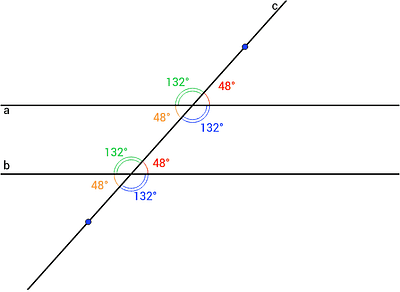
Several types of angles in pairs are produced by a transversal like exterior angles, interior angles, alternate angles & corresponding angles. These angles are indentified in both cases whether the lines are parallel or non - parallel. Four pairs, eight angles are made due to the transversal.
Read Also: Distance between Two Points
- Corresponding Angles
In geometry, corresponding angles are illustrated as the angle which at each intersection occupies the same positions of the transversal lines. These angles are equal. In cases where the transversal intersects two or more lines, these angles are produced equally. In such cases, ∠x = ∠y..... [In parallel lines]

- Vertically Opposite Angles
In geometry, vertically opposite angles exist in pairs. Opposite angles are angles formed opposite to each other and occur in case when a transverse line crosses parallel lines. Opposite angles are equal in value. In such case, ∠x = ∠y. Here, ∠x & ∠y are pair of the opposite angles.

Read Also: Class 10 Similarity of Triangles
- Alternate Angles
The pairs of angles formed in the parallel lines which are formed in the interior sides and the opposite sides of the transversal line. These angles are equal to each other. Similar to the interior angle, the exterior angles are also formed in pairs in the exterior part of the parallel lines in the alternate sides of transversal lines.

- Interiors Angles on same side of Transversal Line
The angles which are formed on the same side of transversal line towards the inner side are called interior angles formed on the same side of the Transversal Line.
In these case the summation of the two angles, say ∠x & ∠y is 180° & are supplementary in nature.

If AB & CD are parallel lines in the given diagram and intersected by transversal PQ at L & M, and if ∠CMQ = 60°, Find the other angles.

∠CMQ= ∠ALM = 60 ° [corresponding angles]
We also know that the vertically opposite angles are always equal hence,
∠CMQ= ∠LMD =60°
Also, ∠ALM = ∠PLB = 60°
Hence, being a linear pair
∠CMQ + ∠QMD = 180 °
Then, ∠QMD = 180° - 60° = 120 °
As the corresponding angles are also equal
∠QMD= ∠CML = 120 ° [vertically opposite angles]
∠MLB = ∠ALP = 120 ° [vertically opposite angles]
Read Also: Heights and Distances
Points To Remember
- Pair of corresponding angles are formed when a transversal line intersects two parallel lines
- There is no particular symbol present for representing transversal in geometry
- If the transversal line cuts two parallel lines, then the pair of alternate angles, interior angles, corresponding angles formed will be equal
- Two lines which are equidistant and never meets or intersect each other at any point is what we call parallel lines
- Tranversal when cuts two or more parallel lines, forms various types of angles in pairs- Corresponding angles, vertically opposite angles, alternate interior & exterior angles & co-interior angles
- The non-common arms of the angles form a line when the sum of two adjacent angles is 180°
- Two angles which have the sum of 180° are called supplementary angle which is in the case of the co-interior angles.
Also Check:
Sample Questions
Ques. How many angles are created by a transversal line intersecting two parallel lines? (2 marks)
Ans. The angles created when transversal line intersecting two parallel lines are:
- Vertically opposite angles
- Composite Angles
- Transverse Angles
- Alternate Interior & Exterior Angles
Ques. How do we label a Transversal? ( 1 mark)
Ans. To label a transversal which is similar to the other lines in geometry, we can do it using English alphabet. Like PQ is transversal of the two lines AB & CD.
Ques. If Lines AB & CD, in the figure, intersect at point O. Then, if ∠AOC + ∠BOE = 70° & ∠BOD = 40°. Find reflex ∠COE & ∠BOE. (3 marks)

Read Also: Some Applications of Trigonometry
Ans. From the above figure, we get
∠AOC + ∠BOE = 70°
∠BOD = 40°
∠AOC, ∠BOE, ∠COE and ∠BOE, ∠BOD, ∠ BOE each is forming straight line that is,
∠AOC+ ∠BOE+ ∠COE = ∠BOE+∠BOD+ ∠ BOE = 180°
Now if we substitute the values of ∠AOC + ∠BOE = 70° & ∠BOD = 40°, we will get
70° + ∠COE = 180°
∠COE = 110°
In the same way, 110° + 40° + ∠BOE = 180°
∠BOE = 30°
Ques. Find c, if a: b = 2:3.Lines XY and MN intersects at O. If ∠POY = 90°. (5 marks)

Ans. The sum of linear pair = 180°
So, ∠POY + a +b = 180°
Substituting ∠POY = 90° in the above equation,
90° + a +b = 180°
So, a + b = 90°
It is given that a: b = 2 :3. Then, we can consider
a be 2x and b be 3x
then, 2x +3x = 90°
So, 5x = 90°
X = 18°
So, a = 2 x 18° = 36° and b = 3 x 18° = 54°
From the above diagram, c + b is also forming a straight line,
Hence, b + c = 180°
Then, c +54° = 180°
Hence the value of c is, c= 126°
Read Also: Class 11 Pascal’s Triangle
Ques. In the figure, l is parallel to m and is cut by transversal t. Find the values of ∠3, ∠5 & ∠6, if ∠1= 70°. (3 marks)

Ans. Here ∠1= 70°. [Given]
As ∠1 & ∠3 are vertically opposite angles
∠3 = 70°
∠1 & ∠5 are corresponding angles
So, ∠5 = 70 °
Now, ∠3 & ∠6 are co-interior angle and their summation is 180°
∠3 + ∠6 = 180 °
Therefore, ∠6= 180 ° - 70 ° = 110 °
Read More: Class 11 Sequence and Series
Ques. In the given figure, AB || ED, ED || FG, EF || CD Also, ∠1 = 60°, ∠3 = 55°, then find ∠2, ∠4, ∠5. (5 marks)

Ans. Since, EF \(\parallel\) CD cut by transversal ED
Therefore, ∠3 = ∠5 we know, ∠3 = 55°
Therefore, ∠5 = 55°
Also, ED \(\parallel\) XY cut by transversal CD
Therefore, ∠5 = ∠x we know ∠5 = 55°
Therefore,∠x = 55°
Also, ∠x + ∠1 + ∠y = 180°
55° + 60° + ∠y = 180°
115° + ∠y = 180°
∠y = 180° - 115°
Therefore, ∠y = 65°
Now, ∠y + ∠2 = 1800 (Co-interior angles)
65° + ∠2 = 180°
∠2 = 180° - 65°
∠2 = 115°
Since, ED \(\parallel\) FG cut by transversal EF
Therefore, ∠3 + ∠4 = 180°
55° + ∠4 = 180°
Therefore, ∠4 = 180° - 55° = 125°
Read Further: Class 10 Algebra Formulas
Ques. In the given figure PQ || XY. Also, y : z = 4 : 5 find. ( 5 marks)

Ans.
Let the common ratio be a
Then y = 4a and z = 5a
Also, ∠z = ∠m (Alternate interior angles)
Since, z = 5a
Therefore, ∠m = 5a [RS \(\parallel\) XY cut by transversal t]
Now, ∠m = ∠x (Corresponding angles)
Since, ∠m = 5a
Therefore, ∠x = 5a [PQ \(\parallel\) RS cut by transversal t]
∠x + ∠y = 180° (Co-interior angles)
5a + 4a = 1800
9a = 180°
a = 180/9
a = 20°
Since, y = 4a
Therefore, y = 4 × 20
y = 80°
z = 5a
Therefore, z = 5 × 20
z = 100°
x = 5a
Therefore, x = 5 × 20
x = 100°
Therefore, ∠x = 100°, ∠y = 80°, ∠z = 100
Mathematics Related Links:



Comments