



Content Curator
Percent error is the difference between the experimentally obtained or estimated value (or number) and the actual or real value (or number) when compared to the actual value and expressed value in a percentage format. In other words, the difference between the real answer and the guessed (our calculated) answer is taken and divided by the real answer, and then turned into a percentage format.
| Table of Content |
Also Read: How to Calculate Percentage
Key Takeaways: Percent error; Absolute error; Relative error; Statistics
Percentage Error
[Click Here for Sample Questions]
Percentage error is the error that shows the discrepancy between an observed value and a true or accepted value. While measuring data, the result often deviates from the true value. The error can arise due to multiple reasons. It usually occurs due to human error or can be due to estimations and limitations of devices used in the measurement. To find percentage error, absolute error is calculated first, which is simply the difference between the observed and the true value. This absolute error is then divided by the true value, which gives us the relative error. And then this relative error is multiplied by 100 to get the percentage or percent error.
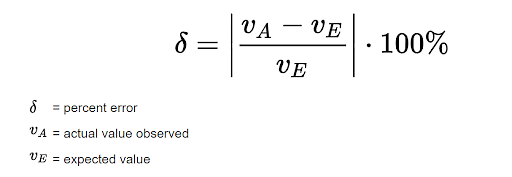
The video below explains this:
Percentage Error Formula Detailed Video Explanation:
Also Read: Plane
Steps to calculate percentage error
[Click Here for Sample Questions]
Percent Error Calculation Steps
- Subtract one value from the other. The order does not matter if we are dropping the sign This value is "error."
- Divide the error by the exact or true or ideal value (not our experimental or measured value). This will yield a decimal number.
- Convert the obtained decimal number into a percentage by multiplying it with 100.
- Add a percent or % symbol to report our percent error value at the end.
Example: Percent Error Example Calculation
Ques: In a lab, Sam Bahadur was given a block of tin. Sam Bahadur measured the dimensions of the block and measured its displacement in a container having a known volume of water. He calculated the density of the block of tin to be 2.68 g/cm3. He looked up the density of a block of tin at room temperature and found it to be 2.70 g/cm3. Calculate the percent error in Sam Bahadur’s measurement.
Ans:
- Subtraction of one value from the another: 2.68 - 2.70 = -0.02
- Discard any negative sign (taking the absolute value): 0.0 This is the error. Since the absolute error is negative, it’s below the real value.
- Divide this absolute error value by the real value: 0.02/2.70 = 0.0074. This is the relative error.
- Multiply this value of 0.0074 by 100 to obtain the percent error:
0.0074 x 100 = 0.74%
So, the percent error in Sam Bahadur’s measurement was 0.74%.
Also Read: Sets
Percentage Error Vs Absolute and Relative Error
[Click Here for Sample Questions]
Percent error, absolute error and relative error are related. The difference between an experimental and known (real or ideal) value is the absolute error. When we divide that absolute error by the known (real) value we get a relative error. Percent (or percentage) error is relative error multiplied by hundred percent (100%).
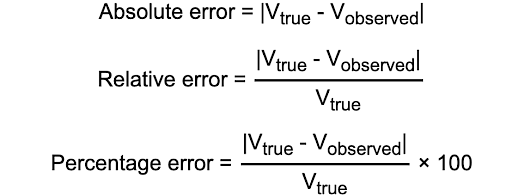
Vtrue = Actual Value
Vobserved = Measured Value
Things to Remember
- The purpose of a percent error calculation is to gauge how close we measured the value to the true value.
- Percent error can be either a positive or negative value. The sign is to determine whether estimated values fall above or below real or true values.
- Percent error calculation is part of comprehensive error analysis. The other two are absolute and relative error calculations.
- The key to reporting percent error is to know the percent error is above or below the real value, thereby adding negative and positive signs.
Also Read: Conic sections
Sample Questions
Ques: The accepted distance between Earth and the moon is 238,855 miles. Partha measured the distance as 249,200 miles. What is the percent error? (2 marks)
Ans: Percent Error = {| (real value – experimental value) |/real value}x 100%
= [(|238,855 miles – 249,200|) / 238,855 miles] x 100%
= (10345 / 238,855 miles) x 100%
= 0.0433 x 100%
= 4.33%.
Ques: A boy measured the area of a rectangle plot to be 448 cm2. But the actual area of the plot has been recorded as 450 cm2. Calculate the percent error of his measurement. (2 marks)
Ans: Percent Error = {| (real value – experimental value) |/real value}x 100%
= [(|450 cm2 – 448 cm2|) / 450 cm2] x 100%
= (2 / 450 cm2) x 100%
= 0.0044 x 100%
= 0.44%.
Ques: Koel got a traffic penalty notice for police overspeeding, for travelling 70 mph in a 60-mph zone. Koel claimed her speed to be 60 mph, not 70 mph. What could Koel claim as her percent error? (2 marks)
Ans: Absolute Error = |70−60| = 10
Percent Error = 10/60=0.1667
= 0.1667×100 = 16.67%
Koel can claim 16.67% as her percent error
Ques: Shilpi's maths class had 20 pupils yesterday. She somehow miscounted the class total and recorded it as 15 pupils. What is Shilpi's percent error? (2 marks)
Ans: The actual number of students: 20 and Recorded number of students: 15
Now, the absolute Error = 20-15 = 5
Thus, the Percent Error = 5/20 = 0.25 = 0.25 × 100 = 25%
Shilpi's percent error is 25%
Ques: What does a Percent Error tell you? Is High Percent Error Good or Bad? (2 marks)
Ans: Percent error expresses to how much extent few unavoidable errors affect our experimental results. Small percent errors indicate that our experimental value is close to the accepted or real value.
Percent errors help us gauge how big our errors are when we measure something in an experiment. A 3 % error indicates that we got very close to the ideal value, while 40 % means that we were quite far from the actual value. So, a high percent error is not considered good.
Ques: Can we have a Negative Percent Error? Can the Percent Error be over 100? (2 marks)
Ans: If the experimentally obtained value is less than the accepted ideal value, then the percent error is negative. Usually, the error is calculated as the absolute difference to negate the negative sign and avoid confusion.
Secondly, yes, a percent error of over 100% is possible. A percent error of 100% is obtained when the experimentally observed value is twice the true or ideal value. In experiments, one can get way greater values, even twice or lesser than the true value due to human or experimental errors.
Ques: The practical book of Chemistry and Physics lists the density of a certain liquid to be 0.7988 units. Divesh experimentally finds this liquid to have a density of 0.7925 units. The teacher allows up to +/- 0.500% error to make an “A” grade in the lab. Did Divesh make an “A”? Prove your answer. (3 marks)
Ans: Given, Theoretical value of density of a liquid: 0.7988 units and Divesh's Experimental value of the density: 0.7925 units
Percent Error = {| (real value – experimental value) |/real value}x 100% =(0.7988−0.7925)/0.7988 × 100
= 0.0063/0.7988 × 100
= 0.788%
Divesh got a 0.788% error. But the teacher allows only a 0.5% error.
So, Divesh could not make an "A".
Ques: Manish measured his height and found it to be 5 feet. But later on careful observation, he found his actual height to be 4.5 ft. Find out the percent error he made in measuring his height. (2 marks)
Ans: The information: - Actual value: 4.5 ft and Estimated value: 5 ft.
Now,
1: Subtraction of one value from others to obtain the absolute value of error.
Error = |4.5 − 5| = 0.5
2: Division of the error by actual value.
0.5/4.5 = 0.111
3: Multiplication of that value by 100 and attachment of the % symbol to express the answer as a percentage.
0.111 × 100 = 11.1
Percentage error by Manish in measuring his height = 11.1%
Read More:



Comments