



Education Journalist | Study Abroad Lead
Perpendicular lines are formed by the intersection of two lines at right angles. When the two lines bisect each other at right angles, it forms perpendicular lines. This property is known as perpendicularity. Perpendicular lines are situated in the same plane. Hence, they are known as coplanar which are intersected with each other to form an angle of 90°. When two lines bisect each other at right angles, then the angle formed by them will be 90°. When a perpendicular bisector is made then the line segment shows equal measurement from both of the sides. The perpendicular line has the symbol ‘⊥‘.
Read Also: NCERT Solutions For Class 11 Mathematics Chapter 10: Straight Lines
Key Terms: Perpendicular Lines, Perpendicular Bisector, Coplanar, Intersecting Lines, Right Angles
What is a Perpendicular Line?
[Click Here for Sample Questions]
When two lines bisect each other, then the angle formed in the middle of the two lines will be 90 degrees. The lines are called perpendicular lines. When they lie in the same plane then they are known as coplanar. In mathematical terms, it is represented as AB ⊥ CD, where AB and CD are the two lines.

Perpendicular Lines
One thing to remember is that all perpendicular lines intersect each other but all intersecting lines are not perpendicular to each other.
Read Also:
Construction of Perpendicular Lines
[Click Here for Sample Questions]
In the construction of perpendicular lines the materials needed are compass and scale. The
steps for the construction of perpendicular lines are given below:
- Firstly, draw a horizontal line.
- Then, keep the compass at the center O and draw an arc in a way that it intersects the line at two points. The points should have equal distance from O. Let the two points be A and B.
- At points A and B, draw an arc in the interior side, so that the two arcs can intersect with each other at the top and bottom of the line.
- Now join the two points where both the arcs intersect with each other.
- A line is formed. This line is perpendicular to the horizontal line.

Also Read:
Construction of Perpendicular Lines through an External Point
[Click Here for Sample Questions]
The steps for the construction of perpendicular lines through an external point are explained below:
Given: Consider any line segment ‘Ab’ and any point ‘P’ lying outside AB.
To construct: A line which is perpendicular or normal to the line AB passing through point M
Steps for Construction:
1. Taking ‘M’ as a centre and a radius, construct an arc intersecting the line segment PQ at two different points ‘X’ and ‘Y’ as shown in the figure below.
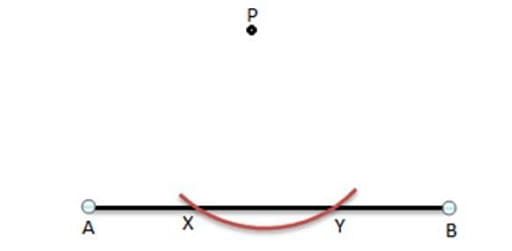
2. Taking ‘X’ as the centre, draw an arc opposite to the point ‘P’. Similarly, taking ‘Y’ as the centre, draw a similar arc opposite to the point ‘P’. Cut the arc drawn through point ‘X’ at ‘M’ as shown below .

3. Now join the point ‘P’ and ‘M’, here the line segment ‘PM’ is perpendicular or normal to the line segment ‘AB’ passing through the external point ‘P’.
Note: It can also be checked whether the given line segment is normal or perpendicular to ‘Ab’ or not by joining ‘M’ and ‘P’ to ‘X’ and ‘Y’ respectively as shown in the figure below.

Also Read:
Things to Remember
- The perpendicular lines are those lines which intersect with each other and form an angle of 90° i.e. right angle.
- When the two lines are right-angled to the same plane, then they are parallel to each other. In this case, the lines cannot intersect.
- If two lines lie in the same plane, they are said to be coplanar.
- The two lines are said to be perpendicular when the product of the slope of both lines is equal to minus of unity. Formula for this (m1.m2 = -1)
Also Read:
Sample Questions
Ques. What is the perpendicular of a point? (2 Marks)
Ans. A line is said to be perpendicular to another line if two lines intersect with each other at a point to form a right angle. Explicitly, a first line is said to be perpendicular to the second line if only two lines meet at a point and at the intersection point of the straight line.
Ques. What is the perpendicular distance between a point and a line? (2 Marks)
Ans. The perpendicular distance is the shortest distance between a point and a line. The distance between two parallel lines can be calculated by finding the perpendicular distance between any point on one line and on the other line.
Ques. What is the slope of two perpendicular lines? (2 Marks)
Ans. The slopes of two perpendicular lines are negative reciprocals of each other. Thus, we can say if a line is perpendicular with another line that has a slope called m, then the slope of the other line will be -1/m.
Ques. A line passes through the equation of the line 2x - y/3 = 7 at point (k, 6). Find the value of k? (3 Marks)
Ans. It is given that the equation of a line 2x - y/3 = 7 is passed through (k, 6).
Then, substituting the value of x and y in the given equation, we get;
2 × k - 6/3 =7
2k - 2 = 7
2k = 7 + 2
2k = 9
k = 9/2
Hence, the value of k is equal to 9/2. Therefore, the point through which line passes is (9/2,6).
Ques. Calculate the value of k if the point (3, -k) lies on the line 9x + 4y = 3? (3 Marks)
Ans. The equation of the line is 9x + 4y = 3
Substituting the value of x = 3 and y = -k, we have
9(3) + 4(-k) = 3
27 - 4k = 3
4k = 27-3 = 24
k= 6
Hence, the value of k is 6.
Ques. If the equation of line 3x/5 - 2y/3 + 1 = 0 contains the points (m, 2m - 1) then find the value of m? (3 Marks)
Ans. As we know, the equation of line 3x/5 - 2y/3 + 1 = 0. Substituting the value of x = m, y = 2m - 1, we get;
3m/5 - 2 (2m-1)/3 +1 = 0
3m/5 - 4m - 2/3 +1 = 0
9m - 20m + 10/15 = -1
9m - 20m + 10 = -15
-11m = -15 -10
-11m = -25
m = 25/11
Ques. Let a line passes through a point (a,2a) and (−2,3) and is perpendicular to a line 4x+3y+5=0, then calculate the value of a? (5 Marks)
Ans. Let m1 be a slope of a line joining the points A (a,2a) and B (−2,3).
Then, m1 = 2a - 3/a + 2.
and let m2 be a slope of the line 4x+3y+5 = 0.
Then, m2 = -4/3.
Since the given lines are perpendicular, so
m1 × m2 = -1
2a-3/a + 2 × -4/3 = -1
8a - 12 = 3a + 6
a = 18/5
Hence the value of a is 18/5.
Ques. Calculate the value of k if the point (3, -k) lies on the line 4x + 6y = 3? (3 Marks)
Ans. The equation of the line is 4x + 6y = 3
Substituting the value of x = 3 and y = -k, we have
4(3) + 6(-k) = 3
12 -6k = 3
6k = 12-3
6k = 9
k = 9/6
k = 3/2
Hence, the value of k is 3/2.
Read Also:



Comments