



Content Curator
Petroleum, also known by the term, crude oil and oil, is a naturally occurring, yellowish-black liquid. It is found in geological formations that exist beneath the Earth's surface. It is mostly refined into different types of fuels.
| Table of Content |
What is Petroleum?
Petroleum is also known by the name crude oil, which is termed as the "mother of all commodities". The reason being, it is used to make a wide range of products, including pharmaceuticals, plastics, gasoline, synthetic fabrics, and so on. Since the 1950s, petroleum, also known as oil, has been the world's leading source of energy.
Petroleum is a natural liquid found in rock formations. This is made up of a complex mixture of hydrocarbons of various molecular weights, as well as other organic compounds. Some chemical compounds produced by petroleum can also be obtained from other fossil fuels.

Sample of Petroleum
Read More: Saturated Hydrocarbon
History of Petroleum
Only a few manufacturing sites around the world produce petrochemicals! As a result, using petroleum as a raw material is extremely valuable. It's also worth noting that the word petroleum is essentially a synonym for 'rock oil.' This word is a combination of the Greek words 'petra' and 'oleum.'
When petroleum is drilled directly from the ground, it is referred to as crude oil. Despite the fact that humans have been on the planet for over 4000 years, crude oil was first extracted from the ground in China around 2500 years ago. Students should remember that in 1859, the world's first crude oil well was drilled in Pennsylvania, United States of America (USA).
Formation of Petroleum
Given below are the steps for formation of petroleum:
- Petroleum is made up of the remains of plants and animals that have died.
- Plants and animals that die sink to the seabed and settle.
- These decomposed dead wildlife and vegetation were mixed with sand and silt millions of years ago.
- Certain bacteria aided in the decomposition of this organic matter, causing chemical changes in the process.
- Carbon and hydrogen-based matter was largely left behind. However, because there isn't enough oxygen at the bottom of the sea, the matter can't completely decompose.
- The partially decomposed matter resided on the seabed for a very long time before being covered by multiple layers of sand and silt.
- This burying took millions of years, and the organic matter finally decomposed due to high temperature and pressure, forming oil.
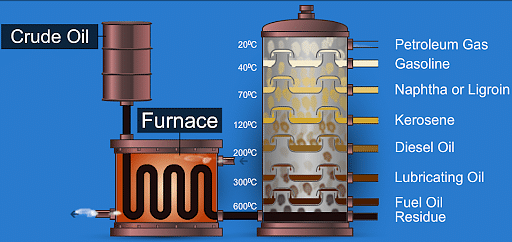
Separation of Petroleum or Crude Oil
Petroleum Refining
Petroleum refineries, according to several sources, are massive industrial complexes that require numerous processing units and auxiliary installations, such as storage tanks and utility units. We'll go over the process of petroleum formation in this section.
Petroleum refineries have their own unique set of arrangements and processes that are required for refining. This process is also heavily influenced by the refinery's location, economic considerations, and the target products.
An oil refinery, also known as a petroleum refinery, is a factory that extracts crude oil and refines it into more valuable products like petroleum kerosene, petroleum naphtha, heating oil, jet fuel, asphalt foundation, gasoline, and liquefied gas.
Sprawling industrial complexes with extensive pipelines crisscrossing the facility, oil refineries are typically large, carrying fluid streams in between.
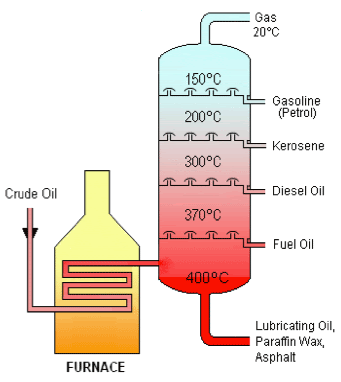
Petroleum Refining
- Petroleum is made up of a variety of substances, including gas, kerosene, lubricating oil, paraffin wax, petrol, diesel, and so on.
- Because these components serve different purposes, it's critical to separate them, or refine the crude oil. Petroleum refining is the process of separating the numerous components of petroleum.
- In oil refineries, this is done. It's a three-part procedure.
- The crude oil is separated into various components through the distillation process in the first step. Lighter constituents rise up as vapour or remain liquid, while heavier constituents settle at the bottom.
- Following that, these still-heavy constituents are converted into gasoline, gas, and diesel. As a result, conversion is the next step.
- Because these contain impurities, the final step is to treat them in order to obtain pure forms of various products.
Uses of Petroleum
The refined products made from crude oil can be used in a variety of ways.
- Petroleum Liquefied Gas, also known as LPG, is used in both households and industry.
- Vehicles run on diesel and gasoline as fuel. For heavy vehicles, diesel is usually preferred.
- Petrol is also used as a dry cleaning solvent, while diesel is used to power electric generators.
- Stoves and jet planes both use kerosene as a fuel.
- Machine wear and corrosion are reduced by using lubricating oil.
- Candles, crayons, ink, ointments, and other items are made with paraffin wax.
- Bitumen, also known as asphalt, is primarily used to pave roads.

Uses of Petroleum Products
Read More: Corrosion
Things to Remember
- Petroleum is also known as ‘Black Gold.’
- Petroleum is made up of the remains of plants and animals that have died.
- Petroleum is made up of a variety of substances, including gas, kerosene, lubricating oil, paraffin wax, petrol, diesel, and so on.
Sample Questions
Ques. What is the primary goal of oil refining? (1 Mark)
Ans. The primary goal of petroleum refining is to convert crude oil into useful products such as LPG, jet fuel, diesel oil, gasoline, and fuel oils.
Ques. Mention uses of petroleum. (1 Mark)
Ans. Heating oil, electricity-generating oil, road tar, aviation fuel, and asphalt are all examples of petroleum products. It also aids in the manufacture of additives, plastics, and other industrial materials that are required by everyone.
Ques. How is coal and petroleum formed? (1 Mark)
Ans. Coal and petroleum are created as a result of the annihilation of ancient plant life millions of years ago. This decomposing plant matter began to accumulate, eventually forming peat. Heat and pressure from geological processes transformed these materials into coal over time.
Ques. Where is petroleum found? (1 Mark)
Ans. Petroleum is now found in vast underground reservoirs where ancient seas once existed. Petroleum reserves can be found both on land and underwater. They use massive drilling machines to extract crude oil.
Ques. Define Refining of Petroleum. (2 Marks)
Ans. Oil refining, or petroleum refining, is a highly automated process. Crude oil is extracted from the earth and converted into a variety of useful products in this process. Cooking oil, diesel, heating oil, kerosene, jet fuel, and asphalt foundation are just a few of the items. This is the process by which petroleum is created.
Ques. What is the chemical formula of petrol? (2 Marks)
Ans. CnH2n+2 is the basic chemical formula for petrol. When it comes to alkanes, this petrol chemical formula also applies. This is primarily due to the presence of several chemical bonds in this formula. It's also worth noting that the chemical formula for gasoline can be altered. As a result, the question of how to define petrol can be answered in a variety of ways.
Ques. What is the purpose of a petroleum refinery? (2 Marks)
Ans. Petroleum refineries turn crude oil into petroleum products for use as transportation fuel, cooking fuel, road paving fuel, and electricity production fuel, as well as chemical feedstocks. The refining process breaks down crude oil into its constituent parts, which are then gradually reassembled into new products.
Ques. Why is Petroleum called ‘Black Gold?’ (3 Marks)
Ans. Petroleum is typically found beneath the earth's crust in geological formations. Crude oil refers to petroleum that has been drilled from the ground in a liquid state. The name "black gold" implies that it is extremely valuable to humans. People refer to it as gold because of its oil and value. Petroleum is extremely difficult to come by these days.
Petroleum is a liquid form of a naturally occurring element. Petroleum can be extracted in two colours: yellow and black.



Comments