



Education Journalist | Study Abroad Lead
Types of Natural resources include exhaustive and non-exhaustive resources. Natural resources are the type of resources that are present in the environment naturally. Some of the well known examples of natural resources include air, water, soil, minerals, forests, and wildlife. Natural resources vary from region to region like in the Middle East where oil is an important resource and some other places have an abundant amount of ores, minerals, and metals. In other places, dense forests and precious trees are very important resources.
- The extinction of animals and natural biodiversity is also another important resource.
- Resources should be used in a sustainable manner.
- Plants and other animals can also be non-exhaustive type natural resources.
- They can increase their number by reproduction but the huge amount of hunting, logging, and cutting trees can make them disappear forever.
Key terms: Natural Resources, Soil, Biosphere, Earth, Exhaustive Resources, Carbon dioxide, Fossil Fuel
Types of Natural Resources
[Click Here for Sample Questions]
Natural resources can be classified based on various categories like biotic resources or abiotic resources (the source is from organic or inorganic) or the human consumption of resources. Types of Natural Resources consist mainly of 3 things.
- Water bodies that occupy 75% of sea, river, and groundwater is called Hydrosphere.
- The upper crust of the earth is called the lithosphere which covers the entire earth.
- The atmosphere which covers the entire earth like an umbrella
These 3 things make life possible on earth. The whole system of combining 3 is called the biosphere. Natural resources are classified mainly into two categories. This categorization is purely based on sustainability.
- Exhaustive Resources
- Non-Exhaustive Resources
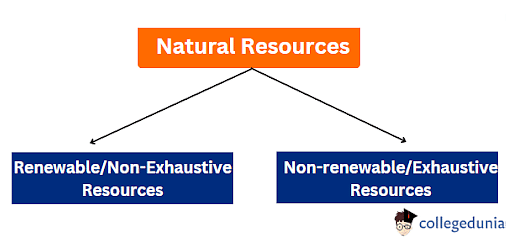
Types of Natural Resources
Exhaustive-Resources
Exhaustive Resources, as the name suggests are resources which can not be used for a long time as they can be exhausted by overuse by humans.
- The world population is now 7.4 billion and it is also increasing so the demand for electricity, land, and food will also increase.
- The main source of electricity is coal which will run out one day soon.
- Lands can’t be reproduced again so it’s very difficult to accommodate all the people.
- Examples of exhaustive resources are land, Fossil Fuels, mineral ores, and soil.
If the people on earth can not maintain or use these types of resources sustainably, one day they can’t get them from nature. These precious resources will run out from earth forever so humans need to go for the replacement of these resources.
Read More: Sustainability of Natural Resources
Read more:
Non-Exhaustive Resources
The non-exhaustive resources do not get exhausted but include air, water, sunlight, etc. These resources can also be used in replacement of Exhaustive resources. The sunlight can be used for solar energy.
Key Components of Natural Resources
[Click Here for Sample Questions]
The biosphere is constituted of 3 main sources: Hydrosphere, Lithosphere, and the Atmosphere.
Hydrosphere
Hydrosphere is one of the 3 pillars of life. Every living organism from single-cell bacteria to large animals like Elephants requires a significant amount of water.
- 97% of the total water on earth is available by sea which is not for drinking. The other sources of water are rivers and underground water.
- Some water is available in the frozen state on two poles.
- Water is very important because every single chemical process can not happen without water.
- Water acts as a carrier medium in our body.
- Many vitamins and other important minerals are dissolved in water, thus transportation can happen.
- Excessive amount of dissolved salt in seawater cannot be tolerated by humans.
- Our kidneys can fail if we drink sea water which can also be a cause of death.

Hydrosphere
Lithosphere
The topmost part of the earth's mantle is covered with soil. Soil is another pillar of the biosphere. The soil is one of the most precious resources in the world. The soil is composed of various things. It contains many organic materials, water, sand, rock particles, and various types of minerals. Soil can be made mainly of 3 causes
- By rock: Rocks can break into small particles by the difference in heat absorption of the outer and inner parts of it. This difference can create a heat strain in the rock which converts into a crack.
- By water: Water acts as a catalyst of the process. The water can break the rock into small particles by entering a small crack and continuously damaging it.
- By Air: Air can break the rocks by friction. As air contains some small particles like sand which can break big rocks into small particles.
Soil is very precious because it is the main cause of living and it can not be regenerated. Soil making process is not a one-day process. Without soil, food can not be produced and trees can not live. Soil is itself a home of very small insects, bacteria, and animals.
Atmosphere
Air is another key source of earth. Without air, no living creature can survive. The air constitutes 78% of nitrogen and 28% of oxygen and the other small percentage is Carbon dioxide, another gas. The value of Carbon dioxide should be fixed as its value has a great impact on earth’s weather.
Read More: Natural Resource Management
Things to Remember
- There are mainly two types of natural resources: Exhaustible and Non-Exhaustible resources.
- Exhaustible resources are those that run out or refill after a few hundred years.
- A resource is said to be inexhaustible if it never runs out or is exhausted.
- Natural resources are further divided into the Hydrosphere, atmosphere, and Lithosphere.
- A layer (or layers) of gasses that surround a planet and are held in place by the gravity of the planetary body is known as an atmosphere.
Read More:
Sample Questions
Ques. Why are natural resources important? (5 marks)
Ans: Resources are important to any country’s development. For example, to generate energy, fossil fuels are needed, and mineral resources are needed for industrial development. Natural resources are needed for the following reasons:
- Natural resources are essential for the survival and well-being of living beings. For example, water is necessary for drinking and irrigation, and forests provide habitats for wildlife and help regulate the Earth's climate.
- Natural resources are also a vital part of many industries and economies. For example, timber is used in construction and furniture-making, and oil is a key component in the production of plastics, fuels, and other products.
- Natural resources can be renewable or nonrenewable. Renewable resources, such as wind and solar energy, can be replenished over time, while nonrenewable resources, such as fossil fuels and minerals, are finite and will eventually be depleted.
- The management and conservation of natural resources is important in order to ensure that they are used sustainably and do not become depleted. This includes measures such as responsible forestry practices, clean water management, and the protection of endangered species.
- The responsible use of natural resources can also have economic benefits, such as the creation of jobs and the generation of revenue through resource extraction and trade.
- Natural resources also have cultural and recreational value, as many people enjoy activities such as hiking, camping, and fishing in natural areas. These resources can also be important for cultural practices and traditions.
Ques. How do humans depend on natural resources? (5 marks)
Ans: Humans depends on the natural resources in the following ways:
- Humans rely on natural resources for basic needs such as food, shelter, and clothing. For example, crops and livestock provide nourishment, wood is used for construction and fuel, and natural fibers such as cotton and wool are used to make clothing.
- Natural resources are also used to produce a wide range of products and materials that are essential for modern life. These include medicines, cosmetics, fuels, plastics, and many other items that are used in daily life.
- Natural resources are also used for recreational purposes, such as hiking, camping, and fishing, and for cultural practices and traditions.
- The use of natural resources has enabled humans to build and develop societies and economies, and has contributed to advances in technology and industry.
- However, the reliance on natural resources also carries risks and can have negative impacts on the environment. For example, the overuse or mismanagement of resources can lead to depletion, pollution, and habitat destruction. It is important for humans to use natural resources responsibly and sustainably in order to minimize these negative impacts.
Ques. Is soil a natural resource? (5 marks)
Ans: Yes, Soil is a kind of natural resource. The reason of soil being a natural resource are as follows:
- Soil is a natural resource that is essential for the growth of plants and the production of food. It is a mixture of minerals, organic matter, water, and air that is found on the surface of the Earth.
- Soil is formed over time through the weathering of rocks and the decomposition of organic matter. It is a vital component of the ecosystem, as it supports the growth of plants, which provide food and oxygen for other living beings.
- Soil is also a key factor in the health and productivity of agricultural lands. It is used to grow crops and raise livestock, which are important sources of food, fiber, and other products.
- In addition to its agricultural value, soil also has environmental and cultural significance. It plays a role in water filtration, carbon sequestration, and the regulation of temperature and moisture in the atmosphere. Soil is also home to a diverse range of microorganisms and other living creatures, and is often seen as a source of spiritual and cultural connection to the land.
- Like other natural resources, soil can be depleted or degraded through overuse or mismanagement. It is important to use soil sustainably and to take steps to protect and conserve this valuable resource.
Ques. What makes natural resources valuable? (5 marks)
Ans: Natural resources are valuable due to the following reasons:
- Natural resources are valuable because they are essential for the survival and well-being of living beings. For example, water is necessary for drinking and irrigation, and forests provide habitats for wildlife and help regulate the Earth's climate.
- Natural resources are also valuable because they can be used to produce a wide range of products and materials that are essential for modern life. These include medicines, cosmetics, fuels, plastics, and many other items that are used in daily life.
- The value of natural resources is often determined by their rarity, usefulness, and demand. For example, certain minerals and fossil fuels may be valuable because they are difficult to extract or are in high demand for industrial and commercial purposes.
- Natural resources also have cultural and recreational value, as many people enjoy activities such as hiking, camping, and fishing in natural areas. These resources can also be important for cultural practices and traditions.
- The value of natural resources can also be influenced by environmental and economic factors, such as the cost of extraction and the impact on the environment.
- The value of natural resources can change over time due to shifts in demand, technological advances, and other factors. It is important to consider the long-term value of natural resources and to use them sustainably in order to ensure their continued availability and benefit to society.
Ques. Why is freshwater an important natural resource? (2 marks)
Ans: Freshwater is vital for life. Water supports human life and the ecosystem. Humans use freshwater for food production, drinking, power generation, and sanitation. All living things like humans and animals cannot live without drinking water and if the water is not clean, health will be affected.
Ques. How is the soil made? (2 marks)
Ans: Soil is made mainly by the erosion of rocks. It is caused by water, Air, and sunlight. The sunlight creates a strain on rocks which can create cracks and break them into small pieces. The water can increase the sizes of cracks and can break the rocks into small particles. Then for many years the organic materials, minerals, water, and other organic and inorganic particles combine to make soil.
Ques. Write a short note on the biosphere. (5 marks)
Ans: The areas of Earth where life is present are referred to as the biosphere.The biosphere encompasses all three of these domains since life can be found there. Almost all life can be found between 500 meters (1,640 feet) below the ocean's surface and six kilometers (3.75 miles) above sea level, despite the biosphere's 20 kilometers (12 miles) from top to bottom.
Origin of the Biosphere: Over 3.5 billion years have passed since the beginning of the biosphere. The earliest form of life on the earth is known as Prokaryotes. Single-celled creatures such as bacteria and archaea were among the earliest prokaryotes.
- Some prokaryotes have evolved a special chemical reaction. They were able to use photosynthesis, often known as sunshine, to convert water and carbon dioxide into simple sugars and oxygen. The biosphere was altered by the abundance of these photosynthetic creatures. The atmosphere evolved over a lengthy period of time into a mixture of oxygen and other gasses that might support new life forms.
- More complex living forms were able to evolve since the biosphere now included oxygen. Countless varieties of plants and other photosynthetic organisms emerged. Animals have evolved to consume both plants and other animals. Bacteria and other creatures have developed to break down or decompose dead plants and animals.
Biological Reserves: People are essential to preserving the biosphere's energy cycle. However, occasionally, people obstruct the flow. For instance, when people cut forests or burn fossil fuels like coal and oil, the levels of oxygen and carbon dioxide in the atmosphere change.
Ques. Why should humans shift towards Non-Exhaustive resources? (2 marks)
Ans: It is a well-known fact that the main sources of energy like coal, petroleum, and mineral ores will be exhausted one day. Humans will lose these resources forever. As these resources are used extensively and when the resources are exhausted humans can’t sustain so a step should be taken toward a sustainable future.
Ques. Why is it important to conserve natural resources? (5 marks)
Ans: The Conservation of Natural resources is important due to the following reasons:
- It is important to conserve natural resources because they are essential for the survival and well-being of living beings. For example, clean water is necessary for drinking and irrigation, and forests provide habitats for wildlife and help regulate the Earth's climate.
- Natural resources are also a vital part of many industries and economies. For example, timber is used in construction and furniture-making, and oil is a key component in the production of plastics, fuels, and other products.
- Many natural resources are finite and will eventually be depleted if they are not used sustainably. For example, fossil fuels are nonrenewable and will eventually run out, and overfishing and habitat destruction can lead to the extinction of certain species.
- The conservation of natural resources can also have economic benefits, such as the creation of jobs and the generation of revenue through resource extraction and trade.
- The responsible use of natural resources can help to minimize negative impacts on the environment, such as pollution and habitat destruction.
- Natural resources also have cultural and recreational value, and their conservation can help to preserve these values for future generations.
Ques. What are the examples of Exhaustive and Non Exhaustive natural resources? (2 marks)
Ans: Some examples of Exhaustive and Non Exhaustive natural resources are,
- Exhaustive natural sources: oil, gas, minerals, coal, metal, sand, stone, and other almost extinct animals
- Non Exhaustive sources: Sunlight, air, water
Read More:



Comments