



Content Curator
Phosphorus pentachloride, also known as Phosphorus (V) chloride, is a yellowish-white solid with the formula PCl5. It is a colorless, water-sensitive, and moisture-sensitive substance. The chemical has a white to pale yellow color with a pungent odor. It is used to produce other chemicals, in aluminum metallurgy, and in the pharmaceutical industry.
Also, read: Oxoacids of Phosphorus
| Table of Content |
Preparation of Phosphorus Pentachloride
When a slow stream of chlorine is passed over white phosphorus, phosphorus trichloride is formed. It can also be obtained by treating white phosphorus with thionyl chloride. After PCl3 is formed, when PCl3 is treated with excess chlorine, phosphorus pentachloride (PCl5) is obtained.
P4 + 6Cl2 → 4PCl3
Or
P4+ 8SOCl2→ 4PCl3 + 4SO2+ 2S2Cl2
PCl3 + Cl2 → PCl5
Physical Properties of Phosphorus Pentachloride
Phosphorus pentachloride is a yellowish-white crystalline solid. It sublimes on heating at 439.9 K and melts at 318 K under pressure. Key properties of phosphorus pentachloride are tabulated below:
| Formula | PCl5 |
| IUPAC name | Phosphorus(V) chloride |
| Another name | Pentachlorophosphorane |
| Molecular Weight | 208.24 g/mol |
| Density | 2.1 g/cm3 |
| Melting Point | 160.5 \(^{\circ}\)C (~320K) |
| Boiling Point | 166.8 \(^{\circ}\)C (Sublimes at 439.9 K) |
| Shape | Trigonal bipyramid shape |
| Appearance | Yellowish white crystals |
| Color | Pale yellow to white |
| Odor | Pungent |
Also, read: Electronegativity
Chemical Reactions of Phosphorus Pentachloride
Reaction with Heat
On heating phosphorus pentachloride, it decomposes into phosphorus trichloride and chlorine. The chemical reaction is given below:
PCl5 (g)→ PCl3(g) + Cl2(g) (Excess)
Reaction with Water
It is violently hydrolyzed by water giving phosphorus oxychloride (POCl3 - phosphoryl chloride) and hydrogen chloride (HCl) or phosphoric acid (H3PO4) and hydrogen chloride (HCl) depending upon the quantity of water.
The chemical reactions are given below:
PCl5 + H2O→ POCl3 + 2HCl (Insufficient water)
POCl3+ 3H2O→H3PO4 + 3HCl (Excess of water)
Overall Reaction:
PCl5 + 4H2O→H3PO4 + 5HCl
Reaction with Metals
Since Phosphorus pentachloride is a better chlorinating agent than phosphorus trichloride, it reacts with metals (Silver, Zinc, Tin, Copper) to give metal chlorides.
The chemical reactions are given below:
2Ag + PCl5→2AgCl + PCl3
Zn + PCl5 → ZnCl2 + PCl3
Sn + 2PCl5→SnCl4+ 2PCl3
2Cu +PCl5→ 2CuCl + PCl3
Reaction with Sulfur Dioxide
Phosphorus pentachloride reacts with sulfur dioxide to form Phosphoryl chloride and Thionyl chloride. The chemical reaction is given below:
SO2 + PCl5 → POCl3 + SOCl2
Reaction with Phosphorus Pentoxide
Phosphorus pentachloride reacts with phosphorus pentoxide to form Phosphoryl chloride. (Unstable compound)
The chemical reaction is given below:
6PCl5 + P4O10 → 10POCl3
Reaction with Nitrogen Dioxide
PCl5 chlorinates nitrogen dioxide to form unstable nitryl chloride.
The chemical reaction is given below:
PCl5 + 2 NO2 → PCl3 + 2 NO2Cl
2 NO2Cl → 2 NO2 + Cl2
Reaction with Lithium Fluoride
PCl5 is a precursor for lithium hexafluorophosphate( LiPF6). LiPF6 is produced by the reaction of PCl5 with lithium fluoride, with lithium chloride as a side product.
The chemical reaction is given below:
PCl5 + 6 LiF → LiPF6 + 5 LiCl
Reaction with Organic Compounds
Phosphorus pentachloride also chlorinates organic compounds similar to phosphorus trichloride. It reacts with compounds containing hydroxyl groups forming chloro derivatives. In all these cases, the hydroxyl group is replaced by chlorine.
The chemical reactions are given below:
C2H5OH + PCl5→C2H5Cl + HCl + POCl3
C2H5COOH (Ethyl Alcohol) + PCl5 → C2H5COCl (Ethyl Chloride) + HCl + POCl3
Structure of Phosphorus pentachloride (PCl5) :
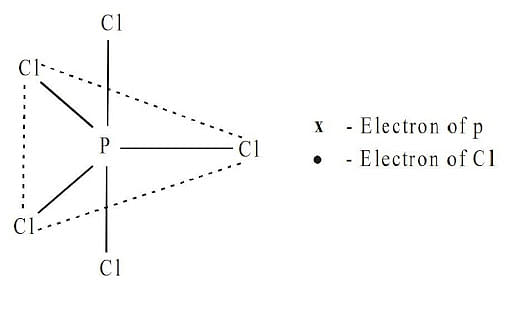
Phosphorus pentachloride (PCl5) molecule has a trigonal bipyramidal shape in vapor and liquid state which arises from sp3d hybridization of a phosphorus atom. It has two axial P−Cl bonds and three equatorial P−Cl bonds.

Structure of PCl5
Structure of PCl5
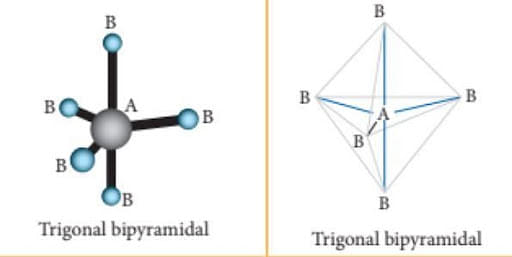
Trigonal Bipyramidal
In the figure, ‘A’ is ‘P’ and ‘B’ is ‘Cl’
Uses of Phosphorus Pentachloride
- Phosphorus pentachloride is a chlorinating agent and is useful for replacing hydroxyl groups with a chlorine atom.
- It is used for the manufacture of penicillin and cephalosporin in the pharmaceutical industry.
Harmful Effects of Phosphorus Pentachloride
- PCl5 is a dangerous substance as it reacts violently with water, making it an explosion hazard.
- Phosphorus pentachloride is a caustic chemical (Corrosion hazard) that can irritate and burn the skin and cause eye damage if it comes into contact with it. Phosphorus Pentachloride can irritate the nose and throat when inhaled.
- Phosphorus Pentachloride inhalation can irritate the lungs, resulting in coughing and/or shortness of breath. Higher levels of exposure can lead to pulmonary edema, a medical emergency characterized by acute shortness of breath. Repeated exposure can even lead to the development of bronchitis with cough, phlegm, and/or shortness of breath.
- Exposure to Phosphorus Pentachloride can cause headaches, dizziness, weakness, nausea, and vomiting. Phosphorus Pentachloride may damage the liver and kidneys.
Things to Remember
- Phosphorus pentachloride has a trigonal bipyramidal shape because of sp3d hybridization.
- Phosphorus pentachloride is a chlorinating agent that chlorinates even metals, used in heavy industries and pharmaceutical industries.
- Phosphorus pentachloride is a reactive and caustic agent which reacts violently with water and causes corrosion. Exposure to human skin and inhalation causes physical damage.
- Long-term exposure can lead to lung diseases like Pulmonary edema, bronchitis, and liver damages.
- PCl5 is a nonpolar symmetrical molecule.
- PCl5 is an exception to the octet rule.
- Phosphorus pentachloride is more unstable when compared to PCl3.
Sample Questions
Ques. Draw the structure of a) PCl5. (3 Marks)
Ans.

PCL5 Structure
Ques. Why PCl5 has Trigonal Bipyramidal Shape whereas IF5 is the Square Pyramidal in shape? (4 Marks)
Ans. The shapes are different because of the absence of the lone pair in phosphorus pentoxide and the presence of the lone pair in IF5. This is because, In this IF5 molecule, both lone pair and bond pairs of electrons are present. The lone pair is localized on the central atom, and bonded pairs are shared between two atoms.
Consequently, the lone pair electrons in a molecule occupy more space as compared to the bonding pair electrons. This causes greater repulsions between lone pairs of electrons (lp -lp) as compared to the lone pairs of electrons to the lone pair (lp) - bonding pair (bp) and bonding pair-bonding pair (bp-bp) repulsions. So the descending order of repulsion is as follows:
lp - lp > lp - bp > bp – bp
These repulsion effects cause deviations from idealized shapes and alterations in the predicted bond angles in a molecule. This is the reason why IF5 has a different shape than PCl5.
Ques. Is PCl5 Polar or Nonpolar molecule? (3 Marks)
Ans. From the Lewis Structure for Phosphorus Pentachloride (PCl5), we can infer that it is symmetrical. To determine, we have to know what results in a polar molecule. An unequal/unsymmetrical sharing of valence electrons results in a polar molecule.
While individual bonds may have unequal electron sharing, in a molecule like PCl5, these bonds are uniformly distributed and cancel out. Because the molecule of phosphorus pentachloride is symmetrical and has no net dipole, it is a nonpolar molecule.
Ques. What is the reaction of PCl5 with heavy water?
Ans. When PCl5 is treated with heavy water i.e., D2O, phosphorous oxychloride is formed with deuterium chloride as a by-product. The reaction involved is:
PCl5 + D2O → POCl3 + 2DCl
Ques. Is PCl5 stable?
Ans. PCl5 is unstable because phosphorus forms 5 bonds with chlorine atoms out of which the two axial bonds have more bond length than the length of the three equatorial bonds. That has resulted in repulsion and thereby making the axial bonds weak and easily removable when it is heated. And it is more unstable when compared with PCl3.
Ques. Is PCl5 a symmetrical molecule?
Ans. To determine the symmetricity of the molecule, we have to use the lewis structure and the polarity of the individual bonds in PCl5 based on the electronegativity difference between atoms. The shape of the molecule will then be determined using VSEPR. From all that, PCl5 appears to be symmetrical.
Ques. Why does PCl5 exist and not NCl5?
Ans. It’s because nitrogen has no vacant 2d-orbitals (i.e., d orbitals in the 2nd energy level). Hence there is no way to arrange five pairs of bonding electrons around a nitrogen atom. But PCl5 forms five bonds by using the d-orbitals to "expand the octet" (an exception to the octet rule) and have more places to put bonding pairs of electrons.
Ques. Is PCl5 a covalent compound?
Ans. P is a non-metal and Cl is a non-metal. When we have a nonmetal and a nonmetal the compound is usually considered covalent. Because PCl5 contains a non-metal and a non-metal, the electronegativity difference between P and Cl will be smaller than 2.0. As a result of this disparity, the non-metals share an electron(s). Hence PCl5 is a covalent compound.
Ques. An element ‘A’ occupies group number 15 and period number 3 reacts with chlorine to give B which further reacts with chlorine to give C at 273 K. Both B and C are chlorinating agents for organic compounds. C is a better chlorinating agent because it chlorinates metals also. B reacts with SO3 and reduces it to SO2 .B has a pyramidal shape. C has trigonal bipyramidal shape by sp3d hybridization. Identify the element A and the compounds B and C. Write the reactions.
Ans.
- The element which occupies group number 15 and period number 3 is phosphorus. Therefore, A is phosphorus. Phosphorus reacts with chlorine 80 to give PCl3. Therefore compound B is phosphorus trichloride and it has a pyramidal shape.
P4 + 6Cl2 → 4PCl3
- PCl3 further reacts with Cl2 to give PCl5. Therefore, compound C is phosphorus pentachloride and it has a trigonal bipyramidal shape.
PCl3 + Cl2 → PCl5
- PCl3 and PCl5 are chlorinating agents for organic compounds. So, both react with C2H5OH gives C2H5Cl.
PCl3 + 3C2H5OH → 3C2H5Cl+ H3PO3
PCl5 + C2H5OH → C2H5 Cl + POCl3 + HCl
- PCl5 is a better chlorinating agent. So it chlorinates copper.
PCl5 + 2Cu → 2CuCl + PCl3
- PCl3 reacts with SO and reduces it to SO2.
PCl3 + SO3 → POCl3 + SO2
So the answer is,
A- Phosphorus (P)
B- Phosphorus trichloride (PCl3)
C- Phosphorus pentachloride (PCl5)



Comments