



Education Journalist | Study Abroad Lead
Plastic Pollution is a type of pollution that is caused as a result of accumulation of plastic in the environment. Pollution can be defined as the release of harmful substances into the environment causing adverse changes to the environment. The contaminants of the environment can be in the form of chemicals, noise, heat, or light. The different types of pollution caused by the different pollutants are as Air Pollution, Water Pollution, Land Pollution, Noise Pollution, Radioactive Pollution, Plastic Pollution, Thermal Pollution, and Light Pollution. Plastic takes approximately 450 years to decompose and another 50 years in order to decay. Plastic Pollution is really harmful for the environment as well as the living creatures as it affects our aquatic biodiversity. The consumption of plastic also clogs the animals’ inner stomach lining thus choking their respiratory system. In this article, we will understand the causes of plastic pollution, its effect on the environment, land and humans, and the preventive measures.
Read More: Plastic
| Table of Content |
What is Plastic Pollution?
Pollution in the Earth’s environment caused by the accumulation of plastic objects is called Plastic pollution. Plastic pollution causes an imbalance in the Earth’s ecological system as it affects the wildlife and human habitat adversely. Plastic products are widely used as they are inexpensive, durable, and convenient to use. However, they are non-biodegradable and take around 500 years to decompose causing pollution of the environment. Plastic pollution affects land and water bodies.
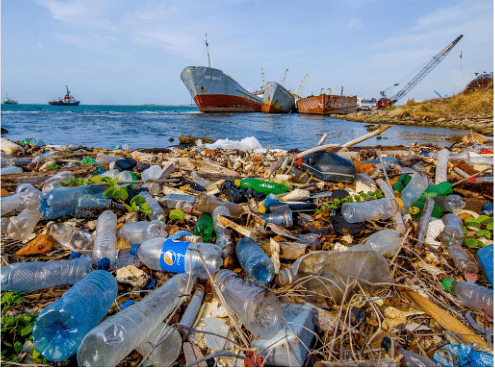
Plastic Pollution
Structure of Plastic
The term plastic is synonymous with polythene which indicates it is a polymer of ethene. Polythene, also known as Polyethylene can be classified into two groups based on the arrangement of monomers:
- Linear Polyethylene
Linear Polyethylene is a linear structure formed by carbon atoms and hydrogen atoms.
- Branched Polyethylene
Branched Polyethylene is a branched structure of carbon and hydrogen atoms wherein the substituent carbon atoms are joined to the main carbon atom chain.
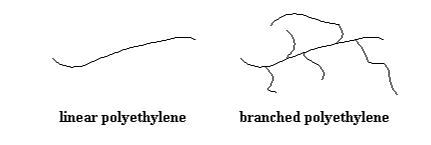
Linear and Branched Polyethylene
Based on the chemical properties of the polymer, plastic can be divided into two types:
- Thermoplastic: Polymers that are deformed repeatedly be deformed when heat is applied to them are known as thermoplastic polymers. They can be bent easily.
- Thermosetting: Polymers that don’t change their shape once they are set, even on application of heat, are known as thermosetting plastics. Example: Melamine and Bakelite. Bakelite is commonly used in the making handles that are heat resistant, cooking utensils, switches, etc.

Thermoplastic and Thermosetting polymers
Read More: High Density Polyethylene
Causes of Plastic Pollution
Nature has the power to decompose all types of wastes. However, plastic is a man-made waste that does not decompose for years thus polluting the environment. Some of the causes of plastic pollution are:
- Use of Single-Use Plastic
- About half of the plastic used in the world is in the form of single-use plastic which is littered all around and cannot be recycled easily. Plastic bags, trays, bottles, and food packaging are all items that are used once and disposed of carelessly causing pollution. Single-use plastic is one of the biggest contributors to plastic pollution of the environment.
- Pollution through Microplastics
People often unknowingly cause plastic pollution. A few such scenarios are as follows:
- Car tires are made of rubber and plastic and the constant friction of the tires with the road releases microplastic particles into the atmosphere.
- Machine wash of synthetic clothes results in the release of plastic microfibers into the drainage system.
- Cosmetics and paints contain microplastics that are washed away into the drain.
- Cigarette filters and chewing gums also consist of certain types of plastic which make them unhealthy for people consuming them as well as to the environment.
- The plastics are transported to the seas and oceans by rivers and by the wind. As a result, the ocean water gets polluted endangering the lives of the water animals.
Types of Plastics
There are three types of plastics that contribute to pollution of the environment. They are
- Microplastics
- Macro plastics
- Mega plastics
Micro and mega plastics are accumulated in higher quantities in cities and on the banks of rivers and lakes. Mega and macro plastics are mostly found on the shores of the sea and in landfills. These plastic wastes are referred to as micro debris, meso debris, and macro debris.
- Micro debris
- Plastic debris of size in the range of 2mm to 5mm is called micro debris. The bigger plastic items, when degraded, form micro debris. Micro debris is also known as nurdles. Cosmetics and household products contain microplastics known as scrubbers which are released into the water bodies.
- Meso debris
- Plastic debris of size in the range of 5mm to 20mm is called meso debris.
- Macro debris
- Plastic debris of a size more than 20mm is classified as macro debris. Macro debris mostly consists of plastic grocery bags and fishing nets accumulated in the seas and oceans.
Effects of Plastic Pollution
Some of the effects of plastic pollution are as mentioned below:
- Effects on environment
Plastic debris gets deposited across different areas of the globe due to several factors like ocean currents, the geography of the coastline, trade routes, and urban regions. Most of the plastic distribution in different regions including remote areas is caused by humans. Plastic pollution is a cause of climate change as harmful gases and chemicals are released during the production and transport of plastic items.
- Effects on land
Plastic pollution on land largely impacts plants, animals, and human lives. The overall plastic used and disposed of is higher and more concentrated on land than in water. Plastic waste which is not managed well is a major cause of concern as it eventually reaches the water and pollutes it as well. Chlorinated plastic is another cause of concern as it affects the soil by releasing harmful chemicals which further seep into the groundwater and contaminate the water ecosystem.
- Effects on humans
Chemicals released during the manufacturing of plastics pollute the environment and the compounds used in the process are very harmful to humans. Due to the wide use of plastic in our day-to-day life, health issues related to human fertility and reproduction have been on the rise. Plastic contains BPA which can cause hypothyroidism.
- Effects on oceans
The plastic waste accumulated in the ocean water is increasing every year. This waste is getting into the oceans through the water bodies as smaller fragments. This plastic waste is harmful to the well-being of water animals.
- Effects on animals
Plastic deposition on land as well as in the water bodies is hazardous to animal lives which in turn impacts human food. Large quantities of plastics are being discovered in the stomachs of marine animals like whales, sharks, and even turtles. Such incidents are attributed to the increasing plastic pollution in oceans.
Ocean Pollution
Ocean pollution can be described as pollution of the ocean waters due to several factors like plastics, chemicals released from factories, pesticides, fertilizers, toxic metals, urban wastes, sewage, etc. Most of the contaminants originate from the land and get washed off into the ocean. Plastic waste constitutes a major portion of ocean pollution.
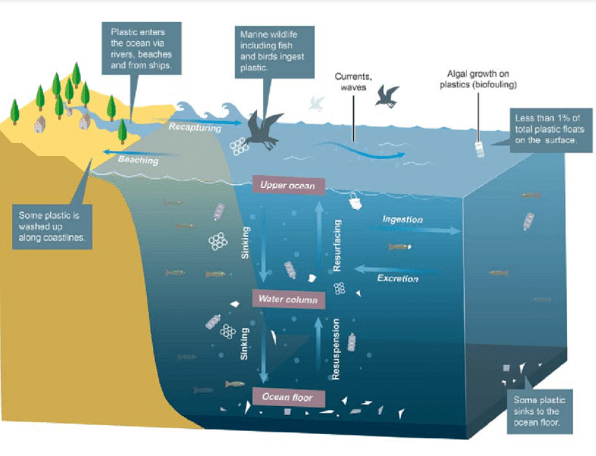
Ocean Pollution
Reduction of Plastic Pollution
Efforts are being made to create awareness among the people, to reduce the use of plastic, to reduce mismanagement of plastic waste, and to encourage the recycling of plastic goods. Reducing the use of plastic can help in saving our environment.
Things to Remember
- Pollution caused by the accumulation of plastic waste in the environment is called plastic pollution.
- Plastics can be categorized into two groups based on their structure: Linear Polyethylene and Branched Polyethylene.
- Plastics can be classified into two types based on their chemical properties: Thermoplastics and Thermosetting plastics.
- Plastic debris can be classified as micro debris, meso debris, and macro debris.
- Plastic pollution has adverse effects on the environment, land, oceans, animals, and humans
- Ocean pollution can be defined as a mixture of plastics, industrial waste, chemicals, pesticides, fertilizers, and other factors which pollute the ocean water.
- Plastic pollution can be reduced by reducing the use of plastic, recycling plastic waste, and managing plastic waste effectively.
Read About: Thermosetting Polymer
Sample Questions
Ques. What is the problem with plastic pollution? (2 marks)
Ans. Plastic pollution is hazardous to human and animal health, causes climate change, and impacts the safety and quality of food and water.
Plastic can also clog the respiratory system of animals if they consume it.
Ques. How does plastic cause global warming? (1 mark)
Ans. The process of creating single-use plastics emits large amounts of greenhouse gases as single-use plastic is made of fossil fuels. This in turn results in global warming.
Ques. Which items from our daily life release microplastics? (2 marks)
Ans. Cosmetics, paints, cigarette filters, tires are some of the items which release microplastics into the environment.
Ques. Define the three types of plastic debris? (3 marks)
Ans. The three types of plastic debris are micro debris, meso debris, and macro debris.
- Micro debris
Plastic debris of size in the range of 2mm to 5mm is known as micro debris.
- Meso debris
Plastic debris of size in the range of 5mm to 20mm is known as meso debris
- Macro debris
Plastic debris of a size more than 20 mm is classified as macro debris.
Ques. How is chlorinated plastic a cause of concern? (1 mark)
Ans. Chlorinated plastic is a cause of concern as it affects the soil by releasing harmful chemicals which further seep into the groundwater and contaminate the water ecosystem.
Ques. What are the commercial pollutants? (2 marks)
Ans. Commercial pollutants are the plastic pollutants from consumer goods such as:
- Plastic bags,
- Sachets,
- Plastic bottles,
- Food packaging items, etc.
Ques. What are some of the health issues linked with the use of plastic? (2 marks)
Ans. The health issues related to the use of plastic are:
- Hypothyroidism,
- Issues related to human fertility and reproduction
Ques. Explain the classification of plastic based on chemical properties. (3 marks)
Ans. Plastic is classified into two types based on its chemical properties:
- Thermoplastics
These polymers can be molded repeatedly by the application of heat.
- Thermosetting plastics
These polymers cannot be molded repeatedly even by the application of heat. They can be molded only once.
Ques. Explain the structure of polymers in brief. (3 marks)
Ans. Polyethylene or commonly known as polymers can be classified into two groups depending on the arrangement of monomers.
- Linear Polyethylene
Linear Polyethylene is a linear structured polymer wherein the carbon and hydrogen atoms are arranged in a linear manner.
- Branched Polyethylene
Branched Polyethylene is a branched polymer wherein the carbon and hydrogen atoms are connected in a criss-cross manner and the substituent carbon atoms are connected to the main carbon atom chain.



Comments