



Education Journalist | Study Abroad Lead
Precipitation is defined as any process of condensation of atmospheric water vapor that falls beneath the gravitational attraction of clouds in meteorology. Drizzling, rain, sleet, snow, ice pellets, graupel, and hail are the most common types of precipitation. It is a type of chemical reaction wherein the mixing of a precipitate (a solid ionic substance) and two solutions of two different ionic substances takes place. Precipitation is an important part of the water cycle process. In this article, we will have a look at the meaning of precipitation, the many types of precipitation, the method, the categorization, and detailed examples of precipitation.
| Table of Content |
What is Precipitation?
Precipitation is defined as any liquid or frozen water that exist in the atmosphere and falls to the Earth's surface. It's a chemical reaction in which two ionic material solutions are combined to generate a solid ionic substance (a precipitate).
Precipitation, for example, occurs when a portion of the atmosphere becomes saturated with water vapor, which then condenses and precipitates when the temperature is just perfect. The cooling of air molecules and the addition of water vapor are the two processes that cause the air to become saturated.
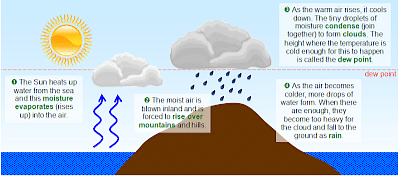
Precipitation
Precipitation includes both heavy and mild rain, as well as snow, drizzle, and hail. Fog and dew, on the other hand, do not come within the category of precipitation. It's because they're both instances of water condensing. Dew condenses on objects and fog condenses in the air.
Furthermore, certain forms of precipitation are associated with summer and others with winter. Snow and graupel are the ones that are linked with winter. Summer, on the other hand, brings rain and hail. Furthermore, other forms of precipitation such as drizzle, sleet, and fog drip are not seasonal.
Types of Precipitation
Precipitation brings in the deposit of freshwater on our Earth, hence it plays a major role in the water cycle. Depending on the form the water takes place, it is divided into three categories such as:
- Ice
The frozen forms of the water that is precipitated include:
- Graupel
- Hail
- Sleet
- Snow
- Ice Needles
- Liquid Water
In liquid form, the precipitation occurs in the form of:
- Drizzle
- Rain
- Freezing Liquid water when it contacts the surface
When the liquid forms come into contact with the air mass in the freezing temperature, it transforms into:
- Freezing Drizzle
- Freezing Rain
Classification of Precipitation
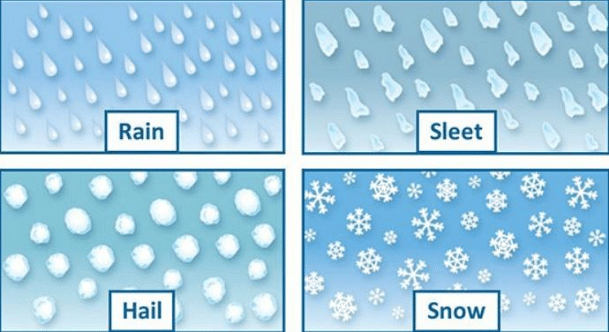
Rain, fog drip, snow, sleet, hail, ice palette, and graupel are the different types of precipitation. They're as discussed below-
Rain
Rain is the most prevalent type of precipitation. It is made up of little water droplets that get heavy enough in the clouds to fall to the earth's surface.
Raindrops can grow up to 6mm in diameter. The process of coalescence occurs when water droplets unite to produce larger water droplets and when water droplets freeze onto an ice crystal. As larger drips fall to the Earth's surface, they break up into smaller drops.
The amount of rain falls in a wide range of sizes, both temporally and spatially. Watershed extremes such as floods and droughts are caused by this fluctuation.
Classification of Precipitation
Snowflakes
Snow is made up of flaky ice crystals with an average density of 0.1g/cc. As the water vapor forces the droplets to evaporate, the crystals might grow in size at the expense of the droplets.
As snowflakes, these drops descend from the atmosphere due to their mass. Temperatures below freezing from the clouds to the ground are favorable for snowfall.
Fog Drip
Water dripping on the ground during fog is known as fog drip. It happens when fog droplets stick to tree needles, leaves, or other objects, consolidate into larger drops, and then fall to the earth. It is a cloud of water vapor that is condensed and suspended in the air near the earth’s surface level.
Hail and Sleet
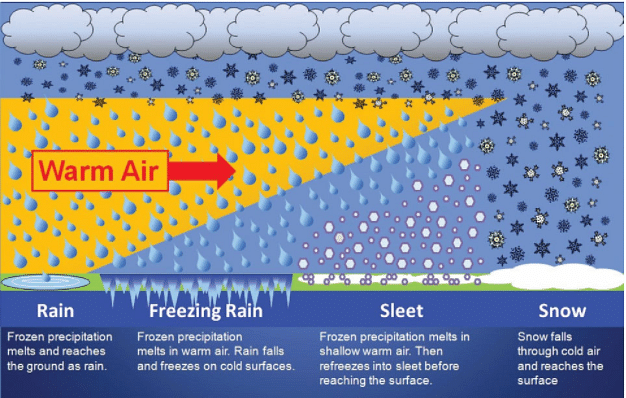
All of these types of precipitation are extremely similar. Hail is frequently associated with thunderstorms or hot weather. While sleet precipitation is a possibility in cold weather. Sleet is effectively ice balls, while hail is partly frozen rain.
Halt and Sleet
Ice Pellets and Graupel
Ice pellets are microscopic, transparent ice balls that are a form of precipitation. Ice pellets are distinct from graupel, which is a frosty white rime, and a slushy liquid or semisolid mixture of rain and snow.

Ice pellets
In contrast to the dull splat of liquid raindrops, ice pellets typically bounce when they hit the ground or other solid surfaces, and emit a higher-pitched "tap" when impacting objects like jackets, windshields, and dried leaves. Pellets do not form a solid mass unless they are exposed to freezing rain.

Graupel
Graupel, also known as soft hail, corn snow, hominy snow, or snow pellets, is created when supercooled water droplets condense and freeze on falling snowflakes.
Process of Precipitation
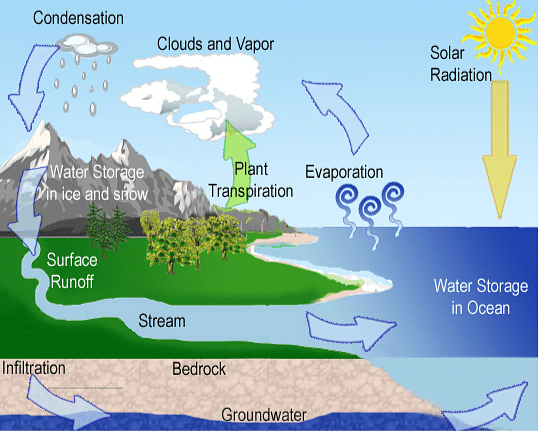
Condensation of water vapors in the air mass causes precipitation. Due to adiabatic cooling, the rising air mass containing a significant number of water vapors becomes saturated. Clouds are formed by the condensation of water vapors. There are updrafts and downdrafts in every cloud.
- The updraft determines the formation and height of the clouds. The higher the cloud rises, the stronger the updraft. The strength of the updraft reduces as the liquid water level rises, whereas the downdraft rises. Precipitation is created as a result.
- Although all clouds contain water, some generate precipitation and others do not. Precipitated moisture drips from the clouds in some situations, but it evaporates in the atmosphere before reaching the earth's surface.
- Precipitation happens only when cloud droplets or ice crystals become large enough to overcome the atmosphere's updrafts. It means that in a cloud from which precipitation falls, some unique mechanisms are in action.
- Although all clouds contain water, some generate precipitation and others do not. Precipitated moisture drips from the clouds in some situations, but it evaporates in the atmosphere before reaching the earth's surface.
- Precipitation happens only when cloud droplets or ice crystals become large enough to overcome the atmosphere's updrafts.
Process of Precipitation
Precipitation Mechanisms
The mechanisms inside the cloud can be explained by two different processes:
- The Bergeron Process- It involves a mixture of ice crystals and super-cooled water droplets in the clouds. An ice crystal colliding with a droplet of super-cooled water causes the droplet to freeze. This method is based on water qualities.
- Collision: Coalescence Procedure- This process is appropriate to clouds with a base that does not extend above the freezing point. Warm clouds are the name given to these clouds. These clouds are made up of a vast number of cloud droplets of various sizes. Large drops expand at the expense of smaller ones. As a result, they crash with the caught smaller droplets and become a part of it.
Categorization of Precipitation
When a moist air mass undergoes the condensation process, precipitation happens. When the air is cooled and saturated with the same amount of moisture, this process occurs. Only when the air mass rises to greater altitudes does this cooling process take place. The air mass can be pushed to higher elevations largely in three ways, each of which produces three distinct types of precipitation: Cyclonic, Convective, and Orographic Precipitation.
- Cyclonic Precipitation- A cyclone is an atmospheric zone with a substantial low pressure and a circular wind motion. The movement of moist air mass to this location is induced by the difference in pressure, resulting in cyclonic precipitation.
There are two forms of cyclonic precipitation: frontal and non-frontal precipitation.
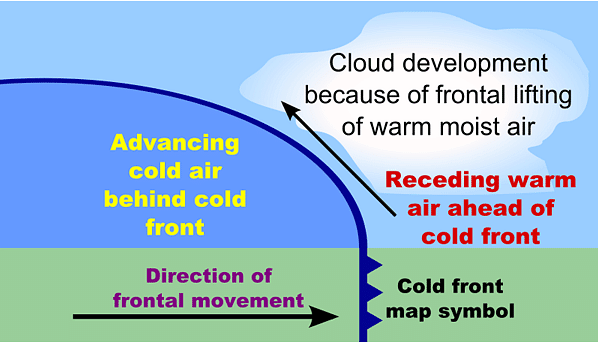
- Frontal Precipitation- The hot wet air mass boundary is referred to as a frontal. The expansion of air at the frontal surface causes this precipitation.
- Non-Frontal Precipitation- This is a moving cold wet air mass boundary that causes precipitation.
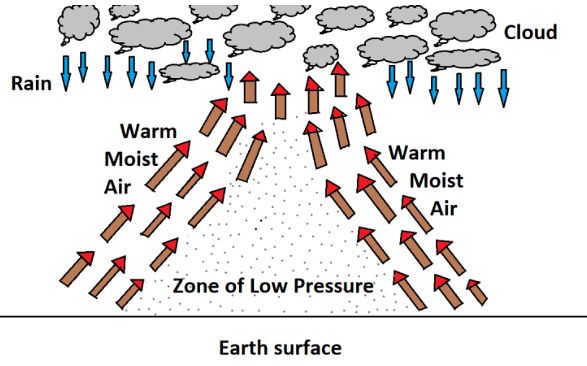
Non-Frontal Precipitation
- Convective Precipitation- Some reasons cause the air above the land region to become heated. The majority of this hot air rises cools, and precipitates. Convective precipitation is typically showery. The intensity of this sort of precipitation varies.
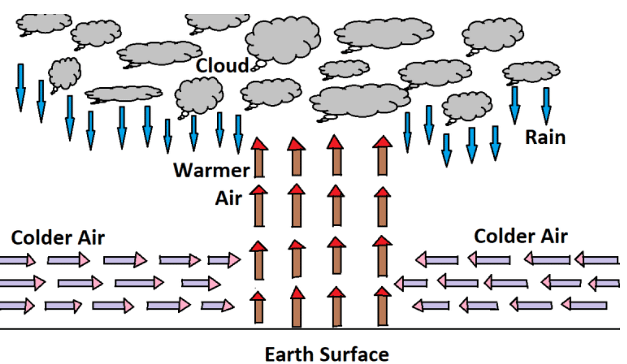
Types of Rainfall – Convective Rainfall
- Orographic Precipitation- Moving air masses have the potential to collide with obstacles such as mountains. They rise after striking, generating condensation and precipitation. When compared to the leeward side of the barrier, the windward side of the barrier receives more precipitation.
Orographic Precipitation
Things to Remember
- Precipitation is defined as any liquid or frozen water that occurs in the atmosphere and falls to the Earth's surface. It's a chemical reaction in which two ionic material solutions are combined to generate a solid ionic substance (a precipitate).
- Rain, fog drip, snow, sleet, hail, ice palette, and graupel are the different types of precipitation.
- Rain is the most prevalent type of precipitation.
- Snow is made up of flaky ice crystals with an average density of 0.1g/cc.
- Water dripping on the ground during fog is known as fog drip.
- Sleet is effectively ice balls, while hail is partly frozen rain.
- Ice pellets are microscopic, transparent ice balls that form as a form of precipitation.
- Condensation of water vapors in the air mass causes precipitation. Due to adiabatic cooling, the rising air mass containing a significant number of water vapors becomes saturated.
- The air mass can be pushed to higher elevations largely by three ways, each of which produces three distinct types of precipitation: Cyclonic, Convective and Orographic
Sample Questions
Ques. How Does Precipitation Purify Viruses? (3 marks)
Ans. Viruses, like other proteins, can be isolated by precipitating them with concentrated ammonium sulfate. To begin, sufficient ammonium sulfate is added to raise their concentration to a level slightly below that which causes the virus to precipitate. More ammonium sulfate is added once all the precipitated impurities have been removed, and the precipitated viruses are accumulated by centrifugation. Viruses are sensitive to the presence of ammonium sulfate and are normally purified using polyethylene glycol precipitation.
Ques. Distinguish between condensation and precipitation. (2 marks)
Ans. Condensation is the transformation of matter from a gaseous to a liquid state, whereas precipitation is the transformation of matter from an aqueous to a solid-state. Condensation is influenced by the system's temperature and pressure, whereas precipitation is influenced by the solution's temperature and concentration.
Ques. What exactly do you mean when you say "precipitation reaction"? (3 marks)
Ans. A precipitation reaction is a chemical event that occurs in an aqueous solution when two ionic bonds combine, forming an insoluble salt known as precipitates. When cations and anions in an aqueous solution combine to create an insoluble ionic solid called a precipitate, precipitation reactions occur. A precipitate is a solid that arises as a result of a chemical reaction.
Ques. Define the term "orographic rainfall." (3 marks)
Ans. Orographic precipitation, often known as orographic snow, is a type of orographic rainfall. Orographic rainfall occurs when upland mountains act as obstacles to airflow, pushing the air to ascend and moist air flowing upslope to cool down, resulting in clouds and precipitation. Showers and thunderstorms frequently occur when the air is unstable, whereas when the air is stable, precipitation is more widespread and consistent. On the windward side of the mountains, clouds and precipitation will be concentrated.
Ques. In a few words, describe the precipitation process. (2 marks)
Ans. Precipitation's form is mostly determined by the technique of generation and the climate temperature at the time of formation. The Collision-coalescence process and the Bergeron/ice crystal process are two of the main mechanisms regarded as being primarily responsible for the creation of precipitation particles.
Ques. What is an example of precipitate formation? (2 marks)
Ans. A chemical reaction happens when a silver nitrate solution is put into a sodium chloride solution, resulting in a white silver chloride precipitate. When the potassium iodide solution combines with the lead(II) nitrate solution, a yellow lead(II) iodide precipitate is generated.
Ques. What determines precipitation? (3 marks)
Ans. The three important elements that determine precipitation are prevailing waves, the existence of mountains, and seasonal waves. Mountain ranges are made up of a sequence of mountains linked by high soil. A mountain range in the direction of prevailing winds can also impact where precipitation occurs.
Ques. What is the significance of precipitation? (3 marks)
Ans. Precipitation is required to replenish the earth's water supply. This planet would be a vast desert if it didn't get any rain. Water level and water quality in an estuary are affected by the number and length of precipitation events. Estuaries rely on precipitation for freshwater, which is a significant supply of dissolved oxygen and nutrients. Droughts reduce freshwater intake to estuaries and inland lake water levels. Water drainage and circulation patterns in freshwater estuaries are influenced by lake levels.



Comments