

.png?h=56&w=56&mode=stretch)


PTE Retell Lecture is a Speaking and Listening test where an audio clip of 90 seconds is played. Applicants need to listen to this audio carefully and summarise it. They are given 10 seconds to prepare and 40 seconds to speak. Pearson scores the answer on content, pronunciation, and oral fluency. Memorised templates score zero, so the retell must use original words.
Retell Lecture is first scored by the AI, then by a human expert. This dual check applies to very few tasks in the PTE test. Retell Lecture feeds both the speaking and listening scores, so one weak answer pulls down two skill bands. Good notes decide the answer, so note-taking is the skill worth training.
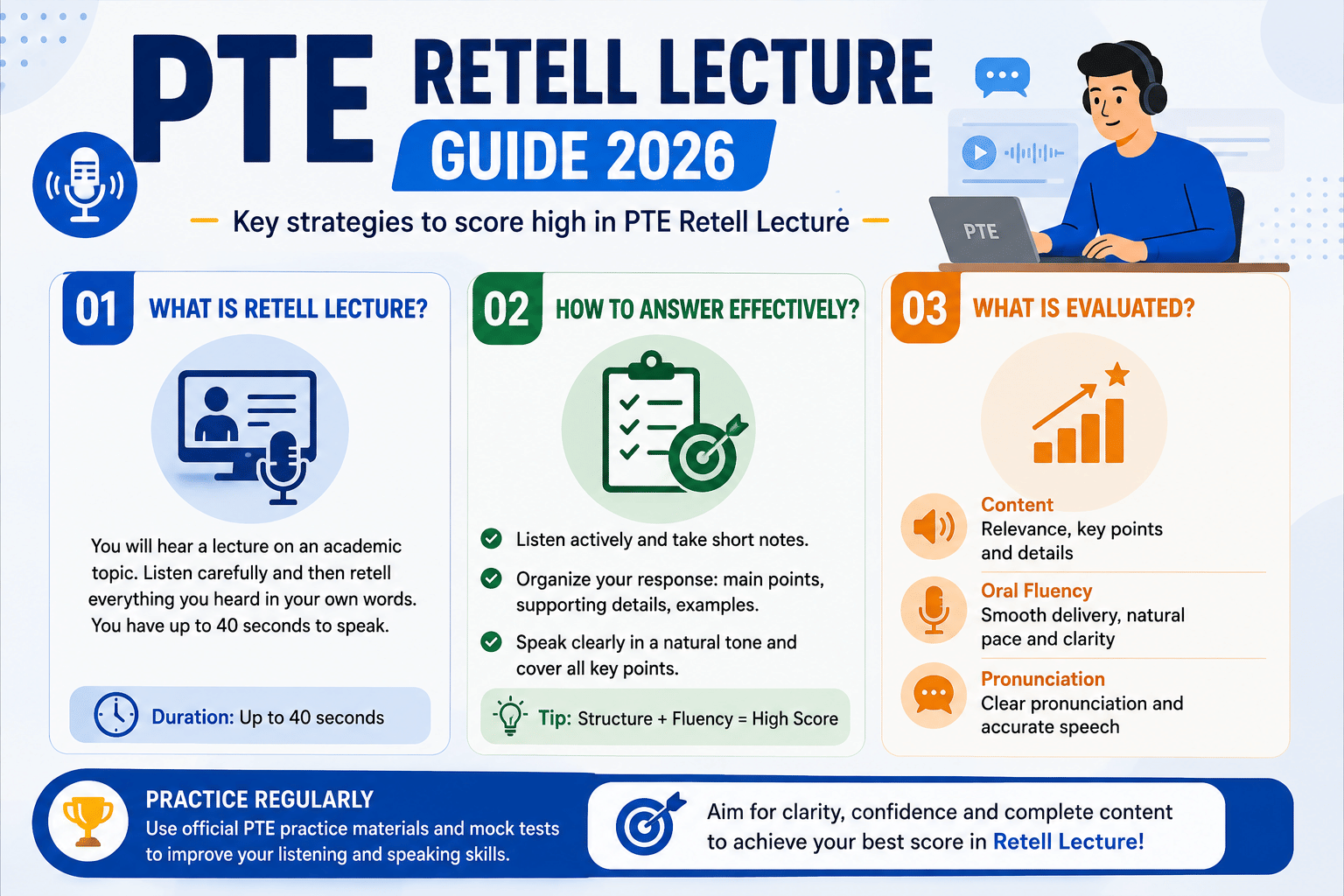
- Quick Facts on PTE Retell Lecture
- What is PTE Retell Lecture?
- PTE Retell Lecture format and timing
- How PTE Retell Lecture is scored
- Note-taking method for Retell Lecture
- Should you use a Retell Lecture template?
- Retell Lecture answer structure that works
- Common PTE Retell Lecture mistakes to avoid
- Retell Lecture vs Summarize Group Discussion
- Retell Lecture practice plan and test cost
- How much Retell Lecture affects your score
- FAQs
Quick Facts on PTE Retell Lecture
| Parameter | Detail |
|---|---|
| Lecture length | Up to 90 seconds |
| Preparation time | 10 seconds |
| Speaking time | 40 seconds |
| Traits scored | 3 (content, pronunciation, oral fluency) |
| Skills affected | Listening and speaking |
| Silence that ends the recording | 3 seconds |
| Recording attempts allowed | 1 |
| Image preview before audio | 3 seconds |
What is PTE Retell Lecture?
PTE Retell Lecture asks candidates to listen to an academic lecture and retell it in their own words. The audio plays automatically, and an image linked to the topic often appears beside it. When the audio stops, a countdown runs for 10 seconds. A short tone follows, and the microphone opens. Lectures are pulled from academic subjects.
Recent examples cover topics like planetary science, history, and website design. The vocabulary is academic, but the ideas are not specialist. No subject knowledge is needed to score well. This task integrates two skill scores at once. Both listening and speaking skills are tested during the test. The task sits fourth in the speaking order. It comes after Describe Image and before Answer Short Question.
Also read: PTE Academic exam pattern for 202
PTE Retell Lecture format and timing
The timing of the task is fixed and continuous. Nothing in that sequence can be paused or replayed. The clock keeps running according to the format and the chronology. The clock runs in four fixed blocks: 3 seconds of image preview, up to 90 seconds of audio, 10 seconds of prep, and 40 seconds of speech.
The audio is played only once. Followed by only one attempt to record your response. Applicants don’t get a second chance for any of the tasks. Here’s a detailed breakdown of the format and timing:
| Stage | Duration | What to do |
|---|---|---|
| Image preview | 3 seconds | Read the image and predict likely vocabulary |
| Lecture audio | Up to 90 seconds | Take symbol notes on the erasable noteboard |
| Preparation | 10 seconds | Order the notes and pick the opening line |
| Recording | 40 seconds | Speak without stopping until the bar fills |
Applicants must make maximum use of the 3-second image preview to guess the topic and the area. You can use the notepad and the pen given to note down pointers. Most candidates who score well start writing within the first 10 seconds.
The 3-second silence rule matters more here than anywhere else. If the recording detects 3 seconds of silence, it stops and marks the item complete. That applies even mid-sentence. The wider PTE exam pattern and syllabus repeat the same rule across the speaking tasks.
Also read: PTE result and score reporting rules
How PTE Retell Lecture is scored
Retell Lecture is scored on 3 main criteria that are content, pronunciation, and oral fluency. The content examines whether the applicant can understand the lecture or not. Following this, the pronunciation and fluency tests examine whether the applicant can explain the same in their own words. Here’s a detailed overview of the scoring criteria:
| Scoring Criteria | Skills Tested |
| content |
|
| Pronunciation |
|
| Oral fluency |
|
.
What Retell Lecture scores:
- How accurately and fully the lecture content is conveyed.
- How clearly individual sounds and word stress land.
- How steady the rhythm and phrasing stay across 40 seconds.
What Retell Lecture does not score:
- Accent, provided the speech remains understandable.
- Writing skill, since nothing is typed in this task.
- Reading skill, beyond understanding the instructions.
Note-Taking Method for Retell Lecture
Notes should capture the topic, two or three main points, and the conclusion, written as symbols rather than sentences. Don’t try to write the full sentence, as this will take more time and the information gathered will be less. The ear stops listening while the hand catches up. To note maximum points, try to note main points and symbols.
What good notes capture:
- The topic sentence, usually stated in the first 10 seconds.
- Two or three main points marked by signpost words.
- Names, numbers, and dates, written exactly as heard.
- The closing idea, which often carries the conclusion.
What notes should skip:
- Examples that only repeat a point already noted.
- Spelling accuracy, which nobody scores.
- Anything said after the argument has clearly closed.
Practising notes without speaking helps. Listen to a podcast clip of about 90 seconds. Write only symbols. Then check whether the notes rebuild the argument a day later. Listening accuracy under time pressure is the same muscle used elsewhere in the test. Work on PTE Listening question types alongside this task, and both scores move together. If the notes hold seven or eight useful fragments, then the 40 seconds fill themselves. That means the note stage, not the speaking stage, is where most marks are won.
Key Insight: Signpost words like first, another, however and finally mark where each new point begins. Tracking those words gives the retell a ready made order before the audio even ends.
Should you use a Retell Lecture Template?
No. Pearson states that significant pre-memorised content scores zero, and fluency and pronunciation are then not scored at all. Phrases like "the lecture gives important information about" circulate in almost every free template file. Thousands of candidates say the same sentence every week. Pearson explicitly warns against memorised responses and templated sentences for this task. The scoring engine flags unoriginal responses, and the task rules confirm that no credit is given for one.
Instead, applicants must go for a natural flow and fluency. Naturalness is scored well and helps applicants maintain their flow. Templates generally cannot help in this task, as they can be used only in the introduction or the conclusion. The presentation of the data has to be natural, as the applicant doesn’t know their Retell topic beforehand. Structured practice beats memorised wording. Broader PTE preparation tips and study strategy set out how to build naturalness.
Key Insight: A short natural opening in original words costs two seconds. A memorised opening can cost the entire item score. The risk is not balanced.
Check free PTE Speaking practice questions with sample answers
Retell Lecture answer structure that works
A strong 40-second retell moves through four beats: topic, main points, relationship between them and conclusion.
That shape mirrors how the lecture itself is built. It also matches what content scoring rewards. Pearson looks for main points plus possible developments, conclusions, or implications.
| Beat | Rough time | What it delivers |
|---|---|---|
| Topic | 5 seconds | Names the subject in original wording |
| Main points | 20 seconds | Two or three ideas with their details |
| Relationship | 8 seconds | Shows how the points connect |
| Conclusion | 7 seconds | States the implication the speaker reached |
The timings are a guide, not a rule. What matters is that the answer concludes before the bar fills. An answer that dies mid-point loses content marks that a shorter answer would have kept. Pearson advises speaking for up to the full 40 seconds. More speech gives more chance to cover the content requirements. Stopping at 20 seconds leaves marks unclaimed. Finishing around 36 to 38 seconds is a sensible target. That leaves a small buffer so no sentence gets cut. Many coaching sources suggest the same buffer, and it costs nothing to build in.
Pace matters more than vocabulary. A steady rate with clear phrasing scores better than a rushed answer packed with detail. Regular PTE mock tests with timed speaking make that pace automatic. Recording practice answers on a phone helps. Play them back and mark every pause longer than two seconds. Those pauses are where fluency marks leak.
Common PTE Retell Lecture mistakes to avoid
The costly mistakes are silence, self-correction, memorised openings, and trying to say everything. Pearson is direct about the first two. Repeating ideas, correcting yourself, or hesitating uses valuable time and loses score points. The advice is to keep talking and ignore mistakes already made.
- Freezing after a lost word triggers the 3 second cut off and ends the answer.
- Restarting a sentence reads as a false start and lowers oral fluency.
- Listing keywords without links gives the content scorer nothing to reward.
- Cramming every detail means the conclusion never gets said.
- Filler words unconnected to the lecture add nothing and burn seconds.
Trying to cover everything is the most common trap among strong listeners. Pearson notes that 40 seconds cannot hold the whole lecture. The instruction is to focus on the most important points. Speed is another silent killer. Rushing damages pronunciation and oral fluency. Two traits fall for the sake of one extra detail. Building consistency at home removes most of these habits. A structured routine for PTE preparation at home works well.
Check free PTE practice papers with previous-year questions
Retell Lecture vs Summarize Group Discussion
Both are integrated listening and speaking tasks, but Summarize Group Discussion gives three times the speaking time. Candidates often prepare them together because the skills overlap. The demands are different enough to need separate practice.
| Feature | Retell Lecture | Summarize Group Discussion |
|---|---|---|
| Audio length | Up to 90 seconds | Up to 3 minutes |
| Speakers | 1 | 3 |
| Preparation time | 10 seconds | 10 seconds |
| Speaking time | 40 seconds | 2 minutes |
| Extra content demand | Implications and conclusions | Who said what |
Retell Lecture rewards compression. Everything heard must fit into 40 seconds without losing the argument. Summarize Group Discussion rewards attribution instead, since the scorer wants each speaker's contribution paraphrased. The shared skill is symbol note-taking under pressure. Training it once improves both scores. A quick check with the PTE score calculator shows how much the speaking band shifts when both tasks improve.
Retell Lecture Practice Plan and Test Cost
Two weeks of daily 20-minute sessions is enough to fix note-taking and pacing for most candidates. Take symbol notes on one 90-second clip. Speak a 40-second retell. Record it. Play it back and mark pauses.
- Days 1 to 4: notes only, no speaking, focus on capturing structure.
- Days 5 to 9: notes plus untimed retell, focus on covering all points.
- Days 10 to 14: full 40-second timed retell under exam conditions.
Cost matters because a retake is expensive. The PTE Academic fee in India is INR 18,900 including 18 percent GST, effective 16 March 2026. PTE Home tests cost INR 15,300. Source: official Pearson test centres and fees data reported in the PTE exam fee breakdown for India.
| Test | Fee in India (2026) |
|---|---|
| PTE Academic | INR 18,900 |
| PTE Academic UKVI | INR 18,900 |
| PTE Core | INR 18,900 |
| PTE Home A1, A2 and B1 | INR 15,300 |
Booking early protects that flexibility. The current PTE cancellation and rescheduling policy sets out the refund slabs in full. Free practice beats paid practice for this task. Any recorded lecture of about 90 seconds works as material. Paid PTE preparation books help more with reading and writing than with retelling.
Read More: how much preparation time the PTE exam realistically needs
How Much Retell Lecture Affects Your Score
Retell Lecture feeds the speaking score and the listening score at the same time. Pearson classifies it as an integrated item. The task assesses listening, speaking, pronunciation, and oral fluency. One answer therefore touches two of the four reported skill bands. That double effect is why the task punches above its item count. Even at one to three questions, a zero on content removes marks from two bands at once.
The reverse is also true. Fixing this task lifts listening without any extra listening practice. Candidates targeting the top of the PTE maximum score range usually treat it as a priority rather than an afterthought. If content scores zero, then the other traits are not scored for that item. That means the whole item is lost, not just part of it. Enabling skills such as oral fluency and pronunciation appear separately on the score report. Weak retells drag those numbers down even when the four main bands look acceptable.
Also Check:
| PTE scores for Australia | PTE to IELTS score conversion | PTE score validity |
| PTE eligibility criteria | PTE exam dates | Average PTE score |
PTE Retell Lecture rewards preparation that is structural rather than verbal. Symbol notes, a fixed answer shape, and steady pacing do most of the work. Memorised openings now carry real risk under Pearson's unoriginal response rule. The task is short, but it moves two skill bands, so the practice pays back twice. Two focused weeks are usually enough to turn it from a weak spot into a reliable score.
FAQs
Ques. How long is the PTE Retell Lecture audio?
Ans. Up to 90 seconds. The audio plays automatically and cannot be replayed. An image linked to the topic may appear beside it.
Ques. How many seconds do you get to speak in Retell Lecture?
Ans. 40 seconds. A 10-second preparation window comes first. Pearson advises using close to the full speaking time to cover the content requirements.
Ques. How many Retell Lecture questions come in PTE Academic?
Ans. Roughly 1 to 3 items per test, based on preparation sources. Treat this as approximate, since the number varies between test forms.
Ques. Can you use a template for PTE Retell Lecture?
Ans. No. Pearson states that significant pre-memorised content receives a score of zero. Fluency and pronunciation are then not scored for that item.
Ques. Does Retell Lecture affect the PTE listening score?
Ans. Yes. It is an integrated item that assesses listening and speaking together. Pronunciation and oral fluency are also affected.
Ques. What happens if you stay silent during Retell Lecture?
Ans. The recording stops after 3 seconds of silence. The item is then marked complete and cannot be attempted again.
Ques. Are notes allowed during PTE Retell Lecture?
Ans. Yes. An erasable noteboard and pen are provided at the test centre. Notes can be taken while the audio is still playing.
Ques. Is Retell Lecture scored by a human or by AI?
Ans. Both. Content, pronunciation, and oral fluency are scored by artificial intelligence. A human expert then reviews content before the final score is confirmed.
Ques. Does an Indian accent lower the Retell Lecture score?
Ans. No. Pearson recognises regional and national varieties of English. The test measures whether the speech is easily understandable, not which accent is used.
Ques. How much does a PTE retake cost in India?
Ans. INR 18,900 for PTE Academic, Core and Academic UKVI, including 18 percent GST. PTE Home tests cost INR 15,300.
Ques. Should the answer mention every point from the lecture?
Ans. No. Pearson notes that 40 seconds cannot hold everything. Focus on the main points plus the conclusion or implication the speaker reached.
Ques. How long does it take to improve Retell Lecture?
Ans. About two weeks of daily 20-minute sessions for most candidates. Note-taking usually improves faster than pacing does.
*The article might have information for the previous academic years, which will be updated soon subject to the notification issued by the University/College.



Comments