



Exams Prep Master
Transformation is described as the process of altering something's appearance, texture, shape, size, model, colour, or other characteristics. In the same way, when we talk about mathematical transformation, we're talking about enlarging or contracting the size of an object or figure. A geometrical transformation occurs when the length of a rectangle is lowered from 8 cm to 3 cm, for example. Translation, rotation, dilation or resizing, and reflection are the four primary types of changing shapes. Let's look at the fourth form of reflection and learn about the highlighted themes in the sections below.
| Table of Content |
Also read: First Order Differential Equation
Reflection Definition
[Click Here for Sample Questions]
In geometry, a flip is a phrase used to describe a reflection. A reflection is a mirror image of a form. A reflection line is a path along which an image reflects. If one figure is said to be a mirror of another, each point in the first is equidistant from the equivalent point in the second image. The reflected image should have the same shape and size as the original, but face the other direction. Changes in posture during reflection may result in translation.

The initial image is known as the pre-image, and its reflection is known as the image. Pre-image and image are represented by the letters ABC and A'B'C', respectively. The reflection transformation might be in terms of the coordinate system (X and Y-axis).
Also Read: Algebra Formula
Reflection in the Coordinate Plane
[Click Here for Sample Questions]
Let's look at reflection via the lens of a graph now. The following subheadings give details on reflection in the coordinate plane, using the X-Axis and Y-Axis as references.
Reflection over X-Axis
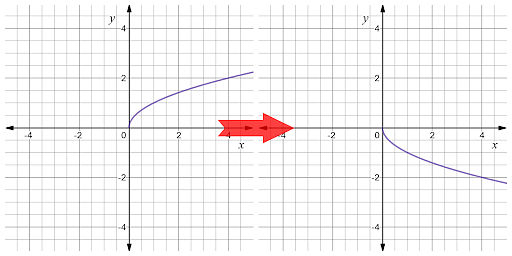
Assume a point is reflected along the X-Axis. As a result, the Y-coordinates will change signs in the opposite direction, while the X-coordinates will remain constant. If the reflection point is labeled X, Y, X, Y, then the identical coordinates across the X-Axis are X, Y, X, Y.

Reflection over Y-axis
The Y-coordinates of a point remain the same when it is reflected across the Y-axis. The X-coordinates, on the other hand, is changed into their polar opposites. As a result, the point (x, y) is reflected across the Y-axis (-x, y).
Reflection over Y = X
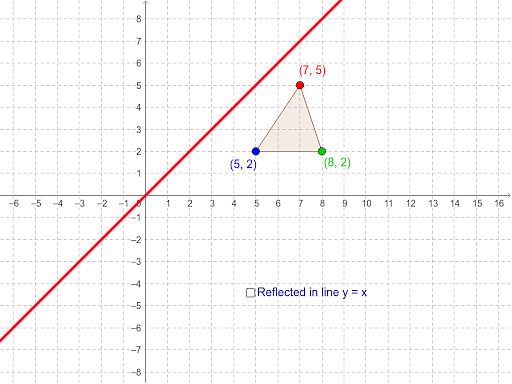
Consider the scenario of a point reflecting over a Y=X line. The locations of the X and Y coordinates will now be swapped. When the point of reflection is above a line Y = - X, the signs are negated/canceled, but the point of coordinates remains the same.
The following are the interpretations:
In the case of line Y = X, the reflection of point X, YX, Y is Y, XY, X.
In the case of line Y = - X, the reflection of point X,YX,Y is Y,XY,X.
Also Read:
Reflection in a Point
[Click Here for Sample Questions]
A reflection point is formed when a figure is created around a single point known as the point of reflection or the figure's center. Every point in the figure has an exact opposite point on the other side. When a figure is reflected, its size and form remain unchanged.
Reflection in the origin (0, 0)
In a coordinate plane, any random place is chosen as the point of reflection. The term 'origin' is commonly used.

As you can see in the graphic above, the original pre-image triangle has coordinates of 1,2,31,2,3 and the reflected image has coordinates of 1,2,31,2,3. You should record the line of origin, which is the figure's mid-point, by drawing a line segment at the point of reflection. After the alteration of the shape, the point of reflection, in the case of origin reflection, converts the coordinates to a negative value.
Also read: Quadrilateral Formula
Things to Remember
- A sort of transformation that flips a shape in a mirror line (also known as a line of reflection) such that each point is the same distance from the mirror line as its reflected point is reflection.
- When we place an object in front of a mirror, the image of that thing appears on the opposite side. This picture is referred to as the object's reflection, and it is symmetrical in nature.
- The figure is reversed in a reflection, which is a type of geometrical transformation. Both photos have equidistant spots on their surfaces.
- The mid-point of the reflection change is referred to as the point of reflection. The size and shape of the figure usually remain the same, with the only difference being the orientation with the preimage.
- Due to the opposite direction of reflection, the coordinates turn negative when the point of reflection is taken with the origin.
Also Read:
Sample Questions
Ques. Is it possible to reflect the mirror line in a vertical direction? (2 marks)
Ans. Yes. The mirror line, also known as the preimage, can be reflected both horizontally and vertically. Furthermore, this type of reflection change may be done in any direction, including up and down. This is merely a flip of the picture, resulting in whichever diagonal transformation is desired.
Ques. How Do I Write A Reflected Image's Coordinates On A Graph Paper? (2 marks)
Ans. simply draws dashes across the preimage's coordinates to mark the coordinates of a reflected image on graph paper. If your shape's coordinates before reflection are 1, 3, 5 then your reflected image's coordinates are 1′,3′,5. Every point of reflection following the preimage is marked with the symbol dash, which represents the 'Prime' value.
Ques. Why Is the Reflection-Transformation Process called An Involution? (2 marks)
Ans. Because the same process is performed twice, that is, if the reflection happens twice continuously, the final picture is identical to the original state, similar to the restoration of the figure, the process of reflection transformation is referred to as an involution.
Ques. Identify at least three properties of the reflection transformation. (2 marks)
Ans. The reflection transformation has an orthogonal matrix (an array of numbers) with a determinant value of -1. The product of two orthogonal matrices can be used to express the rotation transformation. The consequence of such a procedure is called 'improper rotation' when the reflection occurs with an odd integer.
Ques. What are some real-world examples of the transformation process of reflection? (2 marks)
Ans. When the moon reflects on water surfaces, it is the most common and attractive kind of reflection. Even the mirror image that your face exposes in the mirror is a direct type of reflection and is a flip of your original face. All gleaming surfaces and glossy or colourless components, such as water and diamond, reflect light.
Ques. What is the rule for a reflection over the y-axis? (1 mark)
Ans. (x, y) --> (-x, y)
Ques. Another name for Reflection is.? (1 mark)
Ans. Another name for reflection is flip.
More Related Topics:



Comments