



Education Journalist | Study Abroad Lead
Viscosity and density are the two parameters of the fluid. We know that matter is divided into four states: solids, liquids, gases, and plasma. Fluids are substances that are not closely packed like solids and can flow easily, for example, liquids and gases. They do not possess any definite shape. Solids and liquids have a definite volume, whereas gas fills the container. Consider an example. Take the same quantity of water and syrup in separate containers. Try pouring them completely into another container. Water takes less time than syrup. This is because water is less viscous and denser than syrup. Though we mention viscosity and density together, they are not the same. In this article, we will look at viscosity and density, and the relation between the two.
| Table of Contents |
Key Takeaways: viscosity, density, kinematic viscosity, water, fluid, liquid, dynamic viscosity
Viscosity
[Click Here for Sample Questions]
Viscosity is a parameter to measure the thickness of a fluid, that is, it is the property of the fluid which opposes the relative motion between the layers in a liquid that are moving at different velocities. In a simpler language, it is the property that tells us how difficult is it for the molecules to move relative to each other.

Viscosity
In the example mentioned above, the friction between the layers in syrup slows down the flowing rate. Therefore, syrup took more time than water.
The coefficient of viscosity is given by the ratio of shear stress and shear strain rate.
η= \(\frac{\frac{F}{A}}{\frac{\upsilon}{\ell}}\)
η= \(\frac{F\ell}{\upsilon{A}}\)
The video below explains this:
Viscosity Detailed Video Explanation:
Read also: Unit of Viscosity
Density
[Click Here for Sample Questions]
Density is a parameter to measure the distance between two particles in a fluid, that is, it is the measure of mass per volume. In a simpler language, it is the property that tells how closely the molecules are packed together, that is, the crowding of molecules at the molecular level.
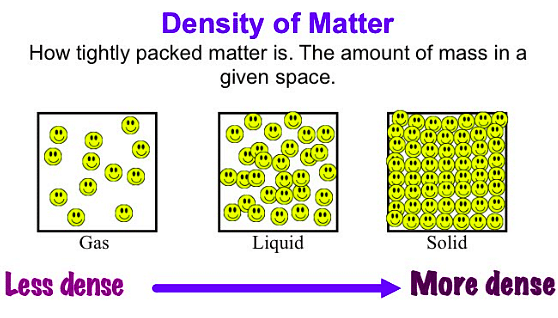
Density
In the example mentioned above, the molecules of syrup are tightly bound, whereas it is not so for water. Therefore, the syrup has more density than water.
Difference between viscosity and density
[Click Here for Sample Questions]
The primary differences between viscosity and density are given in the below table.
| Physical quantity | Symbol | Dimensions | Unit | Scalar or vector |
|---|---|---|---|---|
| Co-efficient of viscosity | η | [ML−1T−1] | Nsm−2 or Pa s or poiseiulle (PI) | Scalar |
| Density | ρ | [ML−3] | Kgm−3 | Scalar |
Relation between viscosity and density
[Click Here for Sample Questions]
Both viscosity and density are not directly related, but they are related in terms of temperature.
Let us explain this with an example. Consider a fluid (honey). First, let us freeze it, and now the molecules are attached. On rising its temperature, the molecules within it start moving faster. This makes the molecules collide with each other, and hence the viscosity is decreased. This also decreases the density.
In other words, the rising temperature will make the molecules move apart, and also, the friction between the layers decreases.

Relation between viscosity and density
The density of the fluid decreases when the temperature increases. This, in turn, makes the fluid less viscous.
In liquids, viscosity increases with increasing density. In gases, viscosity decreases with increasing density.
Read also: Mechanical Properties of Fluids
Dynamic Viscosity
[Click Here for Sample Questions]
Dynamic viscosity is defined as the ratio of shear stress and the rate of shear strain. The SI unit of is Pa s.

Dynamic Viscosity
Kinematic Viscosity (v)
[Click Here for Sample Questions]
The relation between viscosity and density can be explained by the kinematic viscosity equation. Kinematic viscosity is defined by the ratio of dynamic viscosity and fluid density.
v= mu/rho
The SI unit of v is m2s−1.
Viscosity and density of air and water
[Click Here for Sample Questions]
Kinematic viscosity and density of air at −10?, −15?, and −20? are given in the table below.
| Temperature | Density (Kgm−3) | Kinematic viscosity (m2s−1) |
|---|---|---|
| −20 | 1.3958 | 1.1622 × 10⁻⁵ |
| −15 | 1.3687 | 1.2039 × 10⁻⁵ |
| −10 | 1.3426 | 1.2462 × 10⁻⁵ |
The kinematic viscosity and density of water at 20?, 40?, and 60? are given in the table below.
| Temperature () | Density (Kgm−3) | Kinematic viscosity (m2s−1) |
|---|---|---|
| 20 | 998.21 | 1.004 × 10⁻⁶ |
| 40 | 992.22 | 0.658 × 10⁻⁶ |
| 60 | 983.20 | 0.475 × 10⁻⁶ |
These two tables show that viscosity decreases with decreasing density in liquids, whereas viscosity increases with decreasing density in gases.
Read also: Fluid Pressure
Things to remember
- Viscosity is a fluid property to measure the thickness of a fluid, i.e., it is a property that opposes the relative motion between the layers in a fluid which are moving at different velocities.
- Viscosity tells how difficult for the molecules to move relative to each other.
- Density is a fluid property to measure the distance between two particles in a fluid, i.e., it is the measure of mass per volume.
- Density tells how closely the molecules are packed together. In other words, the crowding of molecules at the molecular level.
- Both viscosity and density are not directly related, but they are related in terms of temperature.
- The relation between viscosity and density can be explained by the kinematic viscosity equation.
- Kinematic viscosity is defined as the ratio of dynamic viscosity and fluid density. The SI unit of v is m2s−1.
Sample questions
Ques. Why does hot water flow faster than cold water? (2 marks)
Ans. Hot water has a higher temperature than cold water. Therefore, the molecules within the hot water start moving faster, decreasing the viscosity. This makes the hot water flow faster than the cold water.
Ques. Explain the relation between viscosity and density. (5 marks)
Ans. Both the viscosity and density are not directly related, but they are related in terms of temperature. Let us explain this with an example. Consider a fluid (honey). First, let us freeze it, and now the molecules are attached. On rising its temperature, the molecules within it start moving faster. This makes the molecules collide with each other, and hence the viscosity is decreased. This also reduces the density.
In other words, the rising temperature will make the molecules move apart, and the friction between the layers decreases. When the temperature increases, the density of the fluid decreases. This, in turn, makes the fluid less viscous. In liquids, viscosity increases with increasing density. In gases, viscosity decreases with increasing density.
The kinematic viscosity equation can explain the relation between viscosity and density. Kinematic viscosity is defined by the ratio of dynamic viscosity and fluid density.
v=
The SI unit of v is m2s−1.
Ques. Glycerine and water are kept in separate containers. Both are stirred rapidly and kept. Which one will rest fast and why? (1 mark)
Ans. Since the viscosity of the glycerine is higher than the water, it will come to rest faster than the water.
Ques. What are the types of viscosity? Give their units. (4 marks)
Ans. There are two types of viscosity: kinematic and dynamic viscosity.
- Dynamic viscosity
Dynamic viscosity is defined as the ratio of shear stress and shear strain rate. The SI unit of is Pa s.
- Kinematic viscosity v
The kinematic viscosity equation can explain the relation between viscosity and density. Kinematic viscosity is defined by the ratio of dynamic viscosity and fluid density.
v=
The SI unit of v is m2s−1.
Ques. A flat plate having an area of 10cm2 is separated through a layer of glycerine which is 1 mm thick from a large plate. If the viscosity coefficient of glycerine is equal to 20 poise, what is the force that is required to keep the plate moving through a velocity of 1cm per sec? (5 marks)
Ans. Coefficient of viscosity η=FlυA
Given:
A = 10 cm2
l = 1 mm
= 20 poise
= 1 cm/s
F = ?
F=ηAυl
F=20 poise×10-1 Pa1 poise×10 cm210-4 m21 cm21 cms-110-2 m1 cm10 mm10-3 m1 mm
F=0.02 N 105 dyne1 N
F=2000 dyne
Ques. Derive the dimension of co-efficient of viscosity. (5 marks)
Ans. The coefficient of viscosity is
η=FlυA
Dimension of viscous force is MLT-2
Dimension of length is [L]
Dimension of velocity is LT-1
Dimension of the area is L2
η=MLT-2[L]LT-1L2
η=ML-1T-1
Ques. A metal plate 5 cm × 5 cm rests on a layer of castor oil 1 mm thick whose co-efficient of viscosity is 1.55Nsm−2. What is the horizontal force required to move the plate with a speed of 2cm/s? (5 marks)
Ans.
F=\(\frac{\eta{A}\mu}{\ell}\)
Given:
= 1.55Nsm−2
A=5×5 cm2 = 25cm2 = 2510-4m2
= 2cm/s = 210-2
l= 10-3
F= 1.55 × 25 × 10-4 × 2 × 10-2 / 10-3
F= 0.0775 N
Ques. Write the kinematic viscosity and density of air at −10?, −15?, and −20?. (3 marks)
Ans. The kinematic viscosity is as given below:
| Temperature (?) | Density (Kgm−3) | Kinematic viscosity (m2s−1) |
|---|---|---|
| −20 | 1.3958 | 1.1622 × 10⁻⁵ |
| −15 | 1.3687 | 1.2039 × 10⁻⁵ |
| −10 | 1.3426 | 1.2462 × 10⁻⁵ |



Comments