



Content Curator
Viscosity refers to the measure of a liquid’s resistance to the deformation at a given rate. In simpler words. Viscosity is the measure of the “thickness” of a liquid. Some liquids are more viscous/thick like jam and some are less viscous like water. Viscosity can be broadly categorized into two types as Kinematic Viscosity and Dynamic Viscosity. Dynamic viscosity refers to the force that a fluid requires to move through its internal molecular friction in order to keep flowing and Kinematic viscosity refers to the quantity of that fluid’s dynamic viscosity per unit density.
| Table of Content |
Key Takeaways: Viscosity, Kinematic Viscosity, Dynamic Viscosity, Fluid, Strain, Molecular friction, Resistance, Deformation
What is Viscosity?
[Click Here for Previous Year Questions]
Viscosity refers to the measure of a liquid’s resistance to the deformation at a given rate. In simpler words. Viscosity is the measure of the “thickness” of a liquid. Some liquids are more viscous/thick like jam and some are less viscous like water. Viscosity is calculated using the following formula:
\(η = \frac{2ga^2(\triangle \rho)}{9v}\)
where,
η = Viscosity
Δ\(\rho\) = Difference between the density of the liquid and the sphere
a = Radius of the sphere
v = Velocity of the sphere
The video below explains this:
Viscosity Detailed Video Explanation:
Also Read:
Kinematic Viscosity
[Click Here for Previous Year Questions]
- Kinematic Viscosity tells us how fast a liquid is moving when a force is applied to it. It is the ratio of the Dynamic Viscosity (\(\mu\)) to the Density (\(\rho\)) of the liquid.
- It is also called Momentum Diffusivity. It is denoted by the Greek letter nu (\(\nu\)):
\(\nu = \frac{\mu}{\rho}\)
- The dimensions of Kinematic Viscosity are L2T-1. The SI unit is specific energy multiplied by time (J / Kg .sec).

Kinematic Viscosity
Dynamic Viscosity
[Click Here for Previous Year Questions]
- Dynamic Viscosity tells us about the force required to make the liquid flow at a certain rate.
- It is the ratio of the shear stress to the shear strain.
- It is also called Absolute Viscosity. Dynamic Viscosity is denoted by the Greek letter mu (\(\mu\)).
- The dimensions of Dynamic Viscosity are ML-1T-1. The SI unit is pressure multiplied by time (Pa .sec).
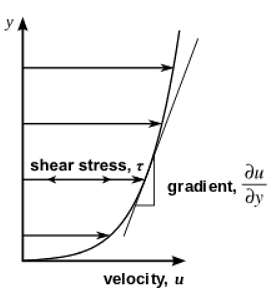
Dynamic Viscosity
Difference between Kinematic Viscosity & Dynamic Viscosity
[Click Here for Previous Year Questions]
The key differences between kinematic viscosity and dynamic viscosity id given below.
| Category | Kinematic Viscosity | Dynamic Viscosity |
|---|---|---|
| Definition | Kinematic Viscosity tells us how fast a liquid is moving when a force is applied to it. | Dynamic Viscosity tells us about the force required to make the liquid flow at a certain rate. |
| Symbol | nu (\(\nu\)) | mu (\(\mu\)) |
| Representation | Represents both inertia and viscous force. | Represents only the viscous force of the liquid. |
| Calculation | The ratio of the Dynamic Viscosity (\(\mu\)) to the Density (\(\rho\)) of the liquid. | The ratio of the shear stress to the shear strain. |
| Density | Dependent | Independent |
| Dimension | L2T-1 | ML-1T-1 |
| SI Unit | (J / Kg.sec) | (Pa.sec) |
| CGS Unit | Stokes (St) | Poise (P) |
Also Read:
| Learn more topics in Mechanical Properties of Fluids | ||
|---|---|---|
| Properties of Gases | Hydrostatic Pressure | Difference between stress and pressure |
| Fluid Flow | Pascal’s Law | Hydraulic Machines |
| Bernoulli’s principle | Venturi-meter | Stokes’ Law |
| Surface tension | Surface Energy | Mechanical Properties of Fluids |
| Barometer | Reynolds Number | Buoyant Force |
Things to Remember
- Viscosity refers to the measure of a liquid’s resistance to the deformation at a given rate.
- Viscosity is calculated using the following formula: \(η = \frac{2ga^2(\triangle \rho)}{9v}\)
- Viscosity can be broadly categorized into two types: Kinematic Viscosity and Dynamic Viscosity.
- Kinematic Viscosity tells us how fast a liquid is moving when a force is applied to it. It is the ratio of the Dynamic Viscosity (\(\mu\)) to the Density (\(\rho\)) of the liquid.
- Kinematic Viscosity is also called Momentum Diffusivity. It is denoted by the Greek letter nu (\(\nu\)).
- Dynamic Viscosity tells us about the force required to make the liquid flow at a certain rate. It is the ratio of the shear stress to the shear strain.
- Dynamic Viscosity is also called Absolute Viscosity. Dynamic Viscosity is denoted by the Greek letter mu (\(\mu\)).
Sample Questions
Ques. What is meant by Viscosity of a Liquid? (3 marks)
η = 2gr^2 (Δ\(\rho\)) / 9v
where
η = Viscosity
Δ\(\rho\)= Difference between the density of the liquid and the sphere
r = Radius of the sphere
v = Velocity of the sphere
Ques. What are the factors affecting a liquid’s viscosity? (3 marks)
- The viscosity of a liquid decreases with an increase in temperature.
- The viscosity of a liquid depends on its chemical composition and changes with a change in the chemical composition of the liquid.
- Suspended particles increase the viscosity of a liquid.
Ques. What is Kinematic Viscosity? (2 marks)
Ques. What is Dynamic Viscosity? (2 marks)
Ques. What are the dimensions and SI units of Kinematic and Dynamic Viscosity? (2 marks)
Ques. Derive the expression for the terminal velocity of a sphere moving in a liquid. (4 marks)
The downward force on the sphere:
F(g) = mg = 4/3 \(\pi\)r^3 \(\rho\)g
Upthrust (Upward Force):
U = 4/3 \(\pi \)r^3 \(\sigma\)g
Viscous Force (F) = 6\(\pi \)ηrv(t)
where v(t) is the terminal velocity.
Now,
F = F(g) - U
6\(\pi \)ηrv(t) = 4/3 \(\pi \)r^3 \(\rho\)g - 4/3 \(\pi \)r^3 \(\sigma\)g
After simplifying the expression, we get:
v(t) = 2/9 {r^2 (\(\rho\) - \(\sigma\))g / η}
Ques. Calculate the terminal velocity of a sphere moving through the water with radius and coefficient of viscosity as 8cm and 8.5 x 10^4. The density of the sphere is 7.8 cm^-3. (2 marks)
v(t) = 2/9 {r^2 (\(\rho\) - \(\sigma\))g / η}
v(t) = 2/9 {8 x 8 (7.8 - 1) 9.8 / 8.5 x 10^4
v(t) = 111.502 x 10^4 cm/sec
Do Check Out:



Comments