



Content Writer
| Key Highlights
|
A corn plant has both male and female reproductive parts, which means that a corn plant reproduces sexually.
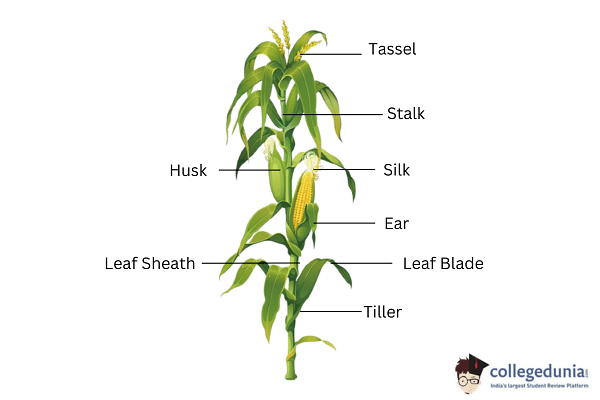
Anatomy of a Corn Plant
| Table of Content |
Keywords: Reproduction mode in corn plants, corn plant, reproduction in corn plants, plant reproduction, anatomy, sexual reproduction, monoecious plant, dioecious plant.
Anatomy of a Corn Plant
[Click Here for Sample Questions]
A corn plant is a monoecious plant. This means the male and female reproductive parts are present within the same plant. The anatomy of the corn plant is mentioned below.
- Corn plants have a single stem called a stalk. Leaves are grown after stalk growth.
- The average height of the stalk is 7-10 feet containing 17-23 leaves.
- The lower portion of the leaf is wrapped around the stalk and is connected at a point called nodes.
- The roots emerge from these nodes.
Reproduction Mode in Corn Plants
[Click Here for Sample Questions]
The reproduction mode in corn plants is the sexual mode of reproduction.
Tassel
The male reproductive part of the corn plant is called the tassel.
- After the growth of leaves, the tassel emerges from the top of the plant.
- Tassel consists of several branches which have small male flowers in them.
- These male flowers release pollen grains in large numbers, each containing the male sex cell.
Ear
The female reproductive part of the corn plant is called the ear.
- Development of the ear takes place from the shank which is a tiny structure similar to the stalk.
- After pollination, the cob and the eggs present on the ear develop into kernels and silk. Pollination occurs when the pollens land on the silk.
- Pollination occurs when pollen lands on the exposed silks.
- The male sex cells reach down to each silk (to meet the female egg) and fertilization occurs.
- The fertilized egg leads to the formation of a kernel which contains a single embryo.
Sample Questions
Ques. What is silk in a corn plant? (2 marks)
Ans. A silk is a hair-like structure found on the corn cob.
- The silk grows from the husk which is a group of leaves attached to the shank.
- Corn silk helps in the growth of corn.
Ques. How many nodes are present in a corn plant? (1 mark)
Ans. There are a total of six nodes present in a corn plant. Five of them are present below the ground and one single node is situated above the ground.
Ques. Mention the characteristics of sexual reproduction. (2 marks)
Ans. The characteristics of sexual reproduction are:
- Male and female gametes fuse to reproduce sexually.
- It is a slow process of reproduction.
Ques. Define a dioecious plant. How do they reproduce? (2 marks)
Ans. The plants that have either a male or a female reproductive organ in a single plant are called dioecious plants. Examples are willow, hemp, ginkgos, etc.
- Since these plants have only one reproductive organ they cannot fertilize by themselves and need external factors to reproduce.
- Dioecious plants can reproduce by cross-pollination.
Ques. What are an androecium and a gynoecium? (2 marks)
Ans. Androecium and gynoecium are the reproductive parts of a flowering plant.
- Androecium is also called stamen which is the male reproductive part.
- The gynoecium or pistil is the female reproductive part of the plant.
Ques. How do hermaphrodites differ from monoecious plants? (2 marks)
Ans.
- Hermaphrodites are those plants that have both male and female reproductive parts within the same flower. They can self-pollinate.
- Monoecious plants, on the other hand, have both male and female flowers in the same plant. They cannot self-pollinate.
Ques. Mention the advantages of dioecious plant reproduction. (2 marks)
Ans. The advantages of dioecious plant reproduction are:
- They have a greater genetic diversity.
- Prevents inbreeding.
- Adaptable to a changing environment.
Ques. Are there any drawbacks of dioecious plant reproduction? (2 marks)
Ans. Yes, dioecious plant reproduction has some drawbacks:
- These plants require pollinators.
- There is less seed production.
- Farmers face challenges in crop production.
Ques. Why do dioecious plants need pollinators? (3 marks)
Ans. Since dioecious plants do not have the male and female reproductive organs in the same plant they pollinate via cross-pollination.
- In cross-pollination, pollinators are required to transfer pollen between male and female parts.
- The absence of pollinators will limit seed production and fertilization
- Bees, birds, insects, or butterflies act as pollinators.
Ques. What are the benefits of cross-pollination? (2 marks)
Ans. Cross-pollination has some benefits:
- Formation of genetically viable plants.
- New variety of plant formation.
- Reduces inbreeding depression
Ques. What are the methods of asexual reproduction? (2 marks)
Ans. Asexual reproduction in plants can take place naturally and artificially.
- Budding, fragmentation, vegetative propagation, and spore formation are the natural methods.
- Artificial methods include budding, grafting, cutting, and layering.
Ques. What are the different pollination mechanisms of monoecious plants? (2 marks)
Ans. The different mechanisms of monoecious plants are:
- Wind-pollinated flowers- These flowers produce lightweight pollen grains in large numbers that are carried by wind. Examples are nutgrass, cottonwood, and papyrus.
- Insect-pollinated flowers- They produce nectar to attract the insects. These flowers are brightly colored with sweet fragrances.
Ques. What is inbreeding depression? (2 marks)
Ans. A phenomenon that reduces the ability of a population to reproduce or survive is called inbreeding depression. This occurs when mating takes place between related individuals.



Comments