



Content Writer
Seaborgium is an synthetic chemical element which is denoted by the symbol 'Sg'. In the periodic table of the elements, it is a d-block element with atomic number 106.
- Seaborgium was first discovered in 1974 by a group of scientists from the USA and Russia under the guidance of Albert Ghiorso.
- It was named after Glenn T. Seaborg, an American nuclear chemist, who became the living scientist after whom an element was named.
Key Terms: Seaborgium, Periodic Table, Properties of Seaborgium, Isotopes, Electrons, Neutrons, Protons, Seaborgium Isotopes
Key Highlights
- Seaborgium is an artificial element with the most stable isotopes represented by 271Sg.
- Currently, the element is used only for research purposes with no commercial use.
- Seaborgium is created by bombarding californium-249 with oxygen-18 nuclei.
- It is a radioactive compound that acts as a heavier homolog to Tungsten.
- The element is a transition method that has no stable isotopes.
What is Seaborgium?
[Click Here for Sample Questions]
Seaborgium (Sg) is a man-made chemical element with the atomic number 106 and the periodic table symbol Sg. The atomic mass of seaborgium is 269 g/mol. The electronic configuration of element is represented as [Rn]5f146d47s2.
- Seaborgium is thought to be the heaviest element in periodic table group 6.
- It is the third known member of the 6d transition metal series and is ranked fourth in the series.
- This was the first element named after a living person, after which IUPAC passed a rule prohibiting naming elements after living people.
- That was changed, however, because another element was named Einsteinium while Albert Einstein was still alive.
- The structure of seaborgium contains two actinide elements, uranium and plutonium.
- Other compounds found in the element include carbon, oxygen, phosphorus, and hydrogen.
- For the first time, a research group at RNC (RIKEN Nishina Centre for Accelerator-based Research, Japan) formed a bond between carbon and Seaborgium in 2014.
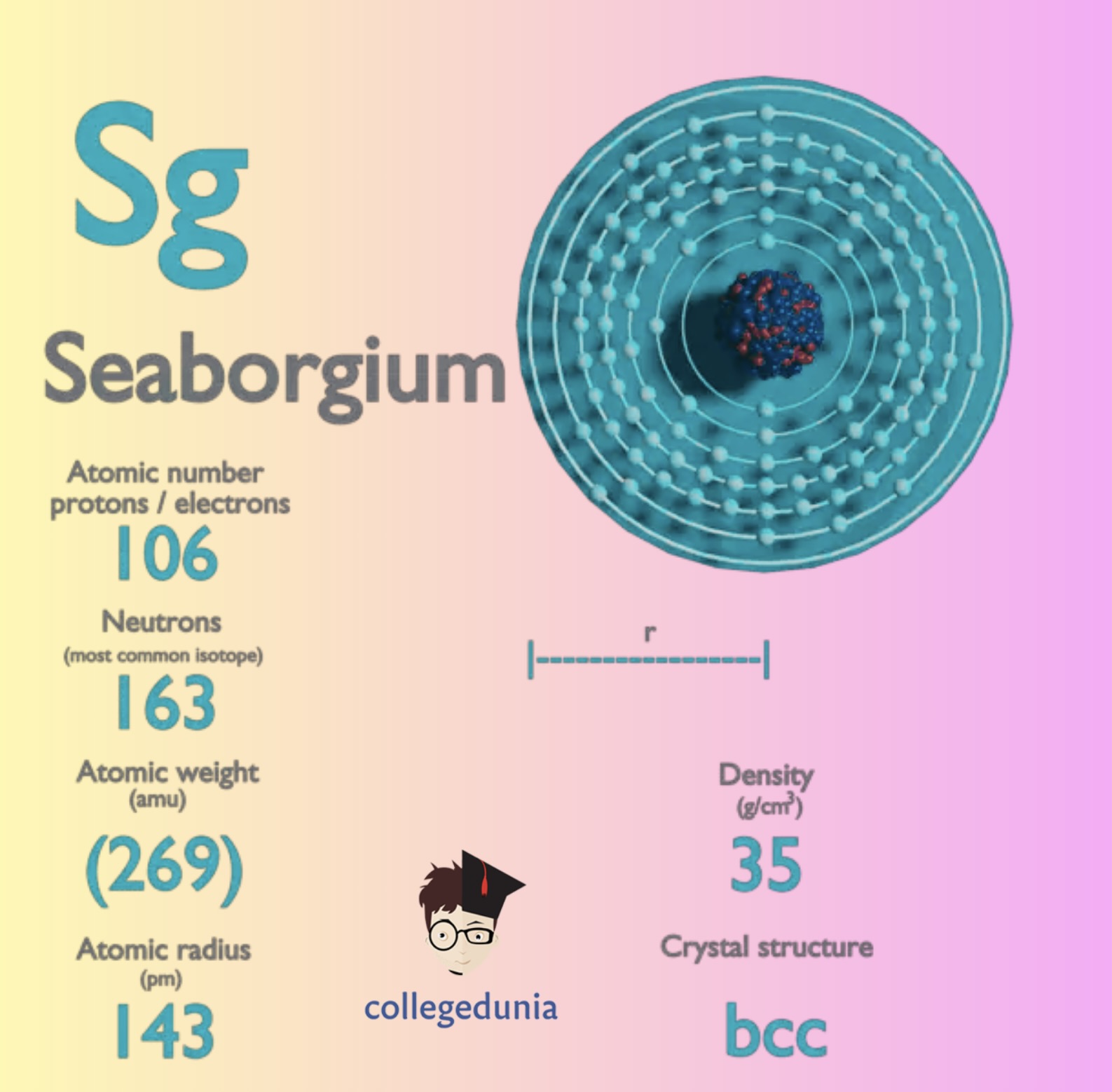
Seaborgium
Properties of Seaborgium
[Click Here for Sample Questions]
The physical and chemical properties of seaborgium are as follows:
Physical Properties of Seaborgium
The physical properties include
- The element seaborgium is radioactive in nature, with a half-life of approximately 2.4 minutes.
- It belongs to group 6 and is found in period 7 of the periodic table.
- According to the various experiments, seaborgium may act as a heavier homolog of the element Tungsten.
- Seaborgium has no stable isotopes and no naturally occurring isotopes.
- In the laboratory, the decay of heavy metals or the fusion of two atoms has contributed to the creation of several radioactive isotopes.
- Under natural or normal conditions, it is predicted to be in the state of solid matter.
- It has a metallic grey or silvery-white appearance with a hint of shine.
- The density of Seaborgium is assumed to be 35 g/cm³, though this value has not been confirmed.
- It is a paramagnetic compound that attracts iron only.
- Seaborgium has a mass and molar magnetic susceptibility of 6.66 x 10⁻⁸m³/ Kg and 5.921 x 10⁻⁹ m³/mol respectively.
- The volume magnetic susceptibility of the element is assumed to be 0.0002978.
- The atom has a covalent radius of 1.43.
The physical properties of seaborgium are tabulated below:
| Compound | Data |
|---|---|
| Symbol | Sg |
| Group | 6 |
| Period | 7 |
| Atomic number | 106 |
| Electron configuration | [Rn] 5f146d47s2 |
| Density | Unknown |
| Melting point | Unknown |
| Boiling point | Unknown |
Chemical Properties of Seaborgium
The chemical properties of seaborgium are as follows:
- Seaborgium has an oxidation state of +6 and is available in less stable states, +5 and +4.
- The stability of the highest oxidation state compound is as follows: LrIII > RfIV > DbV > SgVI.
- When seaborgium reacts with chlorine, it forms many compounds, such as olatile hexafluoride (SgF6), hexachloride (SgCl6), pentachloride (SgCl5), and oxychlorides (SgO2Cl2 and SgOCl4).
Sg+O2+2HCl→SgO2Cl2+H2
- In reaction with oxygen, it will form SgO2−
2Sg+3O2l→2SgO3
- The oxide form of seaborgium is formed by the hydrolysis process.
SgO3+H2Ol→SgO2(OH)2
Sources of Seaborgium
[Click Here for Sample Questions]
Seaborgium is not a naturally occurring element but rather created synthetically through nuclear bombardment. It can only be produced in trace amounts and has a short half-life. This radioactive element is created by bombarding Ne-22 with either Cm-248 or Cf-249 (Californianium-249) with O-18 (heavy oxygen atoms).
Seaborgium Isotopes
[Click Here for Sample Questions]
Among all the isotopes of Seaborgium, 271Sg is known to be the most stable. This is thought to have a half-life of about 2.4 minutes. The following table shows the isotopes of the seaborgium element.
| Isotopes | Half-life |
|---|---|
| 258Sg | 3 ms |
| 259Sg | 600 ms |
| 260Sg | 4 ms |
| 261Sg | 200 ms |
| 262Sg | 7 ms |
| 263Sg | 1 s |
Applications of Seaborgium
[Click Here for Sample Questions]
Seaborgium is still in its early stages of development, with few or no stable isotopes known. Its use and application are limited. The element is most commonly used in laboratories for research and development. The element has no commercial applications because it is short-lived and does not occur naturally or freely in nature.
Effects of Seaborgium
[Click Here for Sample Questions]
Due to its radioactive nature, Seaborgium may have harmful effects if exposed to the environment. However, due to its short lifespan and low yield, its threats and benefits are still unknown.
Sample Questions
Ques. Write a short note on Seaborgium? (2 marks)
Ans. Seaborgium has the atomic number 106 and is a synthetic transuranic element. It is extremely radioactive, with a half-life of about three minutes, so it basically doesn't exist, and has only ever existed as countable rather than weighable quantities of atoms.
Ques. How was seaborgium created? (3 marks)
Ans. Seaborgium was created for the first time in 1974 by a team of scientists led by Albert Ghiorso at the Lawrence Berkeley Laboratory in Berkeley, California. In a machine known as the Super-Heavy Ion Linear Accelerator, they bombarded californium-249 atoms with oxygen-18 ions to create seaborgium. The collision resulted in the formation of seaborgium-263 atoms as well as four free neutrons. Seaborgium-263 is a seaborgium isotope with an approximate half-life of one second. Three months before the Berkeley team made their announcement, scientists at Russia's Joint Institute for Nuclear Research in Dubna claimed to have discovered seaborgium.
Ques. What is Seaborgium's atomic mass? (2 marks)
Ans. Seaborgium has an atomic mass of 269 g/mol. It is also referred to as the relative atomic mass. This element's atomic weight was also discovered to be 271.
Ques. Which of the following groups does Seaborgium belong to? (2 marks)
Ans. In a periodic table, it belongs to the d-block. It belongs to period 7th and is a member of group 6. Moving from left to right, it is the fourth element in the 6d transition metals series. The results of the experiments indicate that this element may act as a heavier homolog to the element tungsten, which is found in group 6.
Ques. What are some of the effects of Seaborgium? (2 marks)
Ans. Due to its radioactive nature, it may have harmful effects if exposed to the environment. However, due to its short lifespan and low yield, its threats and benefits are still unknown.
Ques. What are the isotopes of Seaborgium? (3 marks)
Ans. An isotope is a variant of an element that has the same chemical properties as the element itself. Their atom nuclei, however, have a similar number of protons but a different number of neutrons. As a result, the relative atomic mass of the element and its isotope differs but not its chemical properties.
Among all the isotopes of Seaborgium, 271Sg is known to be the most stable. This is thought to have a half-life of about 2.4 minutes. Some of the isotopes of Seaborgium are as follows.
- Seaborgium – 258
- Seaborgium – 259
- Seaborgium – 260
- Seaborgium – 261
- Seaborgium – 262
- Seaborgium – 263
Ques. How is Seaborgium prepared? (2 marks)
Ans. It is not a naturally occurring element, but rather one created synthetically through nuclear bombardment. The element can only be produced in trace amounts and has a short half-life. This radioactive element is created by bombarding Ne-22 with either Cm-248 or Cf-249 (Californium-249) with O-18 (Heavy oxygen atoms).
Ques. What are the physical properties of Seaborgium? (5 marks)
Ans. The physical properties of Seaborgium are as follows:
- The element Seaborgium, as well as the compounds formed from it, are radioactive in nature.
- It belongs to group 6 and is found in period 7 of the periodic table.
- According to the results of various experiments, Seaborgium may act as a heavier homolog of the element Tungsten.
- Seaborgium has no stable isotopes and no naturally occurring isotopes. However, in the laboratory, the decay of heavy metals or the fusion of two atoms has contributed to the creation of several radioactive isotopes.
- Under natural or normal conditions, it is predicted to be in the state of solid matter.
- It has a structure similar to Tungsten, similar to a cubic crystal structure with the body centre.
- Seaborgium’s atomic weight is 271.
Ques. What are the chemical properties of Seaborgium? (3 marks)
Ans. The chemical properties of Seaborgium are as follows:
- At 200 degrees Celsius, the physical state of Seaborgium is said to be solid.
- The element's electronic configuration is represented as Rn 5 f14 6 d4 7 s2.
- Seaborgium's relative atomic mass is also known as 269.
- This element's key isotopes are represented by the symbol 271Sg.
- Seaborgium's CAS number will be 54038-81-2.
- It has a total of 106 electrons and 165 neutrons.
- Seaborgium has a total of 106 protons.
Ques. What was the first element that was named after a living scientist? (3 marks)
Ans. Seaborgium is the first element that was named after a living scientist. Seaborgium is thought to be the heaviest element in periodic table group 6. It is the third known member of the 6d transition metal series and is ranked fourth. This was the first element named after a living person, after which IUPAC passed a rule prohibiting the naming of elements after living people. That was changed, however, because another element was named Einsteinium while Albert Einstein was still alive.
Ques: How many electrons are found in seaborgium? (2 marks)
Ans: Seaborgium comprises 106 electrons because its atomic number is 106, which means it has 106 protons in its nucleus. In case of an electrically neutral atom, the number of electrons balances the number of protons.
Read Also:



Comments