



Education Journalist | Study Abroad Lead
Sodium oxide is a chemical compound composed of sodium (Na) and oxygen (O) atoms with the chemical formula Na2O. When sodium reacts with oxygen, it produces a bright, white light, and sodium oxide is formed. It is an ionic compound, typically appearing as a white solid at room temperature.
- Sodium oxide is highly reactive with water, producing sodium hydroxide (NaOH).
- It is used in glass manufacturing, as a flux to lower the melting point of silica.
- Due to its reactivity and acidic nature, sodium oxide is handled cautiously.
- In the Earth's crust, sodium ions often combine with oxygen in soil and rocks, forming sodium oxide (Na2O).
- It is one of the most prevalent forms of sodium.
- Sodium oxide is also known as disodium oxide and disodium monoxide.
Download PDF: Sodium Oxide Frequently Asked Questions
Structure of Sodium Oxide
[Click Here for Sample Questions]
The ionic structure of Sodium Oxide (Na2O) is as follows -
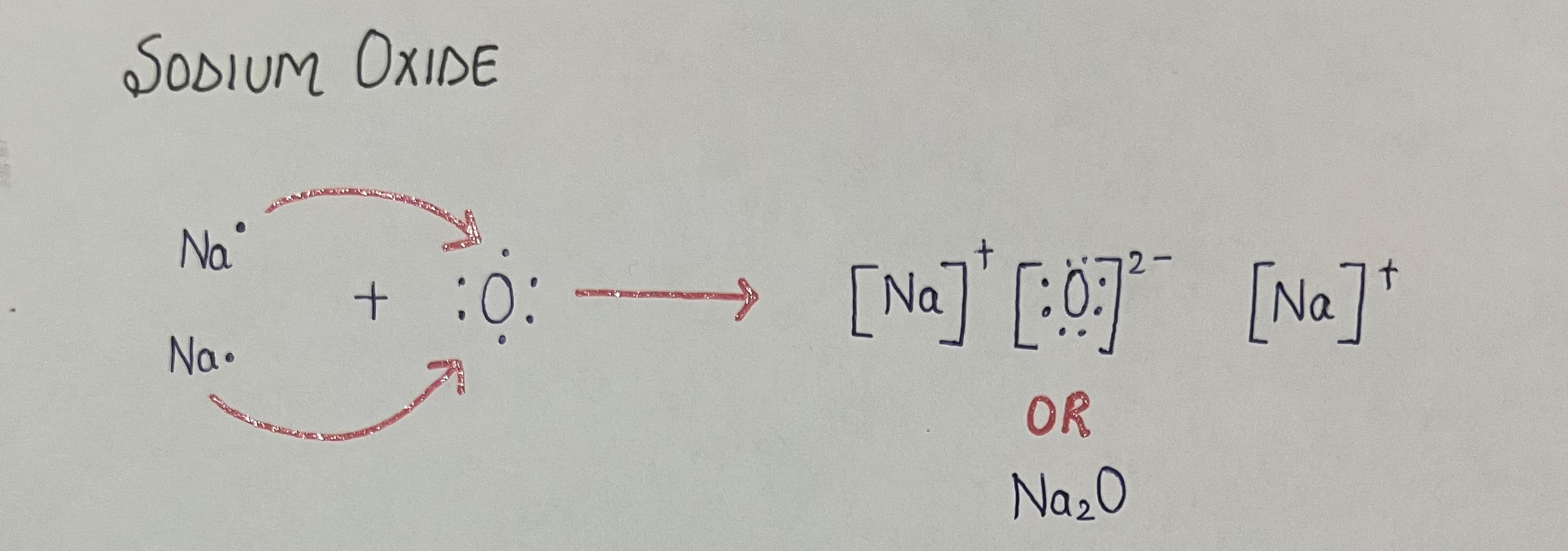
- Sodium oxide has an ionic structure composed of sodium (Na+) cations and oxide (O2-) anions.
- The sodium ions and oxide ions are arranged in a crystal lattice structure.
- Each sodium ion is surrounded by six oxide ions, and vice versa, forming a three-dimensional array with strong ionic bonds.
Physical Properties of Sodium Oxide
[Click Here for Sample Questions]
The physical properties of sodium oxide are -
| Property | Description |
|---|---|
| Chemical Formula | Na2O |
| Molecular Weight | 61.97894 g/mol |
| Appearance | White, odorless solid |
| Melting Point | 1132°C (2070°F) |
| Boiling Point | Decomposes at high temperatures |
| Density | 2.27 g/cm3 |
| Solubility in Water | Reacts vigorously, forming sodium hydroxide (NaOH) |
| Crystal Structure | Cubic |
| Electrical Conductivity | Insulator in its pure form and conducts when dissolved |

Chemical Properties of Sodium Oxide
[Click Here for Sample Questions]
Sodium oxide reacts with different reactants to form these compounds -
| Property | Equation | Explanation |
|---|---|---|
| Reactivity with Water | Na2O + H2O → 2NaOH | Sodium oxide reacts vigorously with water to form sodium hydroxide. |
| Acid-Base Reaction | Na2O + 2HCl → 2NaCl + H2O | Sodium oxide reacts with hydrochloric acid to produce sodium chloride and water. |
| Formation of Sodium Hydroxide | Na2O + H2O → 2NaOH | Sodium oxide readily reacts with water to form sodium hydroxide. |
| Reaction with Acids | Na2O + 2HNO3 → 2NaNO3 + H2O | Sodium oxide reacts with nitric acid to produce sodium nitrate and water. |
| Reducing Agent | 2Na2O + O2 → 2Na2O2 | Sodium oxide acts as a reducing agent, producing sodium peroxide in the presence of oxygen. |
| Reaction with Carbon Dioxide | 2Na2O + 3CO2 → 2Na2CO2 | Sodium oxide reacts with carbon dioxide to produce sodium carbonate. |
Uses of Sodium Oxide
[Click Here for Sample Questions]
Sodium oxide has varied applications –
- Sodium oxide acts as a flux to lower the melting point of silica (SiO2) during glass manufacturing.
Na2O + SiO2 → Na2SiO3 (sodium silicate)
- Sodium oxide is used as a desiccant for drying solvents and other substances by absorbing moisture.
Na2O + H2O → 2NaOH (sodium hydroxide)
- Sodium oxide serves as a base in various chemical reactions and is used to neutralize acids.
Na2O + HCl → 2NaCl + H2O (sodium chloride and water)
- It can act as a catalyst in certain organic synthesis reactions as it enhances reaction rates in specific processes.
- Sodium oxide serves as a deflocculant for casting slips, reducing viscosity.
- Sodium oxide is crucial in producing commercial glasses based on silicon oxides and additives:
-
Sodium oxide acts as an active flux in glazes, inducing exciting color responses.
Na2O + CuO → Na2O-CuO Glaze (Blue)
Na2O + CoO→ Na2O-CoO Glaze (Purple)
Na2O + MnO2→ Na2O-MnO2 Glaze (Purple)
Things to Remember
- Sodium oxide is represented by the chemical formula Na2O.
- It is an ionic compound composed of sodium (Na) cations and oxygen (O) anions.
- Sodium oxide typically appears as a white solid at room temperature.
- Sodium oxide reacts vigorously with water to produce sodium hydroxide (NaOH).
- It is used in glass manufacturing, glaze creation, and as a deflocculant for casting slips.
- Sodium oxide contributes to exciting color responses in glazes, such as blue from copper oxide and purple from cobalt and manganese oxides.
- Sodium oxide naturally adopts a cubic crystal form.
Sample Questions
Ques. Is sodium oxide a salt? (3 marks)
Ans. No, sodium oxide (Na2O) is not a salt in its pure form. It is an ionic compound composed of sodium (Na) cations and oxygen (O) anions.
- While salts are compounds formed by the reaction of an acid with a base, sodium oxide is formed by the direct combination of sodium metal with oxygen gas.
- However, sodium oxide can react with water to produce sodium hydroxide, which is a base and a type of salt when combined with an acid.
Ques. Is sodium oxide toxic? (2 marks)
Ans. Yes, sodium oxide is toxic. Inhalation, ingestion, or skin contact can cause serious health problems. Sodium oxide is converted into sodium hydroxide when exposed to water, which can be highly corrosive and cause burns to any human tissue that it comes in contact with. Therefore, sodium oxide must be handled with care.
Ques. How can sodium oxide be prepared? (5 marks)
Ans. Sodium oxide can be prepared by -
Reaction of Sodium Metal with Sodium Hydroxide
This method involves reacting two moles of sodium hydroxide (NaOH) with two moles of sodium metal (Na). The reaction yields two moles of sodium oxide (Na₂O) and one mole of hydrogen gas (H₂).
Thermal Decomposition of Sodium Carbonate
Heating sodium carbonate (Na₂CO₃) at high temperatures (around 850°C) leads to its decomposition, producing sodium oxide (Na₂O) and carbon dioxide (CO₂).
Reaction of Sodium with Sodium Nitrite or Sodium Peroxide
Sodium oxide can also be formed by the reaction of sodium metal (Na) with either sodium nitrite (NaNO₂) or sodium peroxide (Na₂O₂). These reactions involve the exchange of oxygen and/or nitrogen atoms.
Burning of Sodium in Air
While not the preferred method due to the risk of explosion, burning sodium metal (Na) in the presence of air can also produce a mixture of sodium oxide (Na₂O) and sodium peroxide (Na₂O₂).
Ques. How is sodium oxide formed by the transfer of electrons? (3 marks)
Ans. In sodium oxide (Na₂O) formation, electron transfer occurs:
- Sodium: Each sodium atom loses its one valence electron to achieve a stable configuration, becoming a sodium ion (Na⁺).
- Oxygen: The oxygen atom gains two electrons to fill its outer shell and become an oxide ion (O²⁻).
This transfer creates oppositely charged ions (Na⁺ and O²⁻) that attract and form the ionic compound, Na₂O.
Ques. Can sodium oxide be reduced by hydrogen? (5 marks)
Ans. No, sodium oxide (Na₂O) cannot be reduced by hydrogen (H₂) under normal conditions.
- Hydrogen acts as a reducing agent when it reacts with oxides of less electronegative elements than itself. It readily accepts electrons from these elements, reducing them to their free metal state.
- Oxygen is significantly more electronegative than hydrogen. This means oxygen has a stronger attraction for electrons compared to hydrogen.
- Due to the high difference in electronegativity, the ionic bond between sodium and oxygen in Na₂O is highly stable. Hydrogen lacks the necessary reducing power to overcome this strong bond and extract oxygen from the compound.
Therefore, even though hydrogen is a reducing agent, it cannot reduce sodium oxide under normal conditions due to the stability of the ionic bond and the high electronegativity of oxygen.
Ques. What is the coordination number of sodium in sodium oxide? (2 marks)
Ans. The coordination number of sodium in sodium oxide (Na₂O) is 4. This means each sodium ion is surrounded by four oxide ions (O²⁻) in the crystal lattice structure.
Ques. Is sodium oxide an acid or base? (3 marks)
Ans. Sodium oxide (Na₂O) is considered a base.
- While Na₂O itself doesn't dissolve in water, it reacts violently with water to form sodium hydroxide (NaOH), a strong base:
Na₂O + H₂O → 2NaOH
- Bases are typically defined as substances that can accept protons (H⁺) or donate hydroxide ions (OH⁻) in water. In this case, Na₂O readily reacts with water to generate OH⁻ ions, demonstrating its basic character.
Therefore, despite not being directly soluble in water, sodium oxide exhibits the chemical properties of a base when it reacts with water.
Ques. What are some uses of sodium oxide? (3 marks)
Ans. Sodium oxide has several industrial applications, including:
- Production of glass and ceramics: It acts as a flux, lowering the melting point of other materials.
- Neutralizing acidic soils: It can be used as a soil amendment to raise the pH level.
- Production of sodium peroxide: Na₂O reacts with oxygen to form Na₂O₂ (sodium peroxide), used as a bleaching agent and disinfectant.
Ques. How does sodium oxide react with water? (1 mark)
Ans. Sodium oxide reacts violently with water to form sodium hydroxide (NaOH) and heat:
Na₂O + H₂O → 2NaOH
Ques. Is sodium oxide flammable? (1 mark)
Ans. No, sodium oxide itself is not flammable. However, it can react with moisture in the air to release hydrogen gas, which is flammable.
Check-Out:
| Chemistry Study Guides | ||
|---|---|---|
| Chemistry Formulas | Important Named Reactions | Chemistry Study Notes |



Comments