



Content Curator
Transverse and Longitudinal waves are the two different types of mechanical waves that transfer energy across the medium due to the motion of the particle of the medium.
- Waves are the transfer of energy from one place to another.
- They are disturbances that transfer energy through a medium.
- Particles tend to move when a wave or waves pass through a certain region.
- However, there is no net movement of the particle.
- This means that once a wave has passed, the particle will return to its original position.
- A transverse wave is one in which a particle vibrates perpendicular to the direction of motion of the wave.
- Similarly, a longitudinal wave is one in which a particle vibrates in the same direction as the motion of the wave.
| Table of Content |
Key Terms: Waves, Transverse waves, Longitudinal waves, Motion, Energy, Wavelength, Amplitude, Periodic Motion, Frequency, Time period, Oscillation
What is Wave?
[Click Here for Sample Questions]
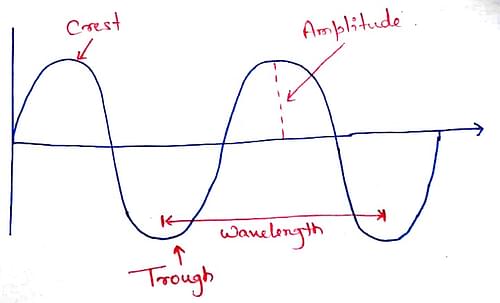
Waves can be described as disturbances that travel through a material medium. This happens due to the periodic motion of the particles within the medium about its mean position though no actual transport of the matter takes place. The characteristics of waves are:
- The particles produce small vibrations about their mean positions but do not get displaced towards the direction in which the wave transverses.
- The motion of a particle is similar to its predecessor and occurs perpendicular in direction to the one in which the wave moves.
- There is a transfer of energy when a wave is in motion.
Also Read:
| Related Articles | ||
|---|---|---|
| Oscillatory Motion | Oscillations Calculation | Wave Function |
| Wave Speed | Wave Power | Laplace Correlation |
Properties of Waves
[Click Here for Sample Questions]
The following are the properties of waves
- Amplitude: The maximum displacement of a particle from its location of rest is referred to as amplitude.
- Wavelength: The wavelength is the length of a complete cycle.
- Time Period: The time taken by a wave to complete one cycle is known as the time period of the wave.
- Frequency: Frequency refers to the number of waves that pass a certain point in a given time period. It is measured by hertz (Hz).
The relationship between time period and frequency is given by
Time period, T = 1 / frequency (f)
Mechanical Waves
[Click Here for Sample Questions]
A mechanical wave is a wave that oscillates matter and is responsible for the transfer of energy through a medium.
- The medium of transmission limits the distance over which the wave can propagate.
- In this case, the oscillating material moves about a fixed point with relatively minimal translational motion.
- A significant feature of mechanical waves is how they are measured, which is defined as displacement divided by wavelength.
- When this dimensionless factor is 1, harmonic effects occur.
- For example, waves break on the beach when this factor exceeds 1, causing turbulence.
There are two types of mechanical waves:
- Longitudinal waves
- Transverse waves
Longitudinal Waves
[Click Here for Sample Questions]
If the displacement of a particle takes place parallel to the direction of motion of the wave, then it can be called a longitudinal wave.
- In longitudinal waves, the movement of particles is often parallel to the movement of energy.
- The particles are also moved parallel to the direction of the traveling wave.
- Compressions along a slinky are an example of longitudinal waves.
- We can create a longitudinal wave by pushing and pulling the slinky horizontally.
- Longitudinal waves take the form of compression and rarefaction.
- Sound waves are the best example of a longitudinal wave.
The following properties can be observed in the case of longitudinal waves:
- Compression: These refer to the high-pressure areas created as a result of the motion of particles.
- Rarefaction: The low-pressure areas in a longitudinal wave are known as rarefaction.

Sound Waves
A single-frequency sound wave moving through the air produces a sinusoidal pressure change.
- The air motion caused by the passage of the sound wave will be back and forth in the direction of the sound's propagation, as is characteristic of longitudinal waves.
- Sound waves require a medium (or material) to travel through.
- These vibrating waves are also known as longitudinal waves.
- In fact, there are two types of waves: transverse and longitudinal.
Transverse Waves
[Click Here for Sample Questions]
Transverse waves occur when particles transfer energy from one location to another by vibrating perpendicular to the direction of the wave propagation.
- This indicates that in transverse waves, the movement of particles is at right angles to the movement of energy.
- In a transverse wave, particles are moved perpendicular to the direction of the motion of the wave.
- Transverse waves include vibrations on a string and ripples on the surface of the water.
- We can create a horizontal transverse wave by moving the slinky vertically up and down.
- Some examples of transverse waves are radio waves and water waves.
- A transverse wave can be best illustrated by waves created by strings.
- Transverse waves have peaks and troughs.
- The peak is the crest or top point of the wave, while the trough is its valley or bottom point.
- Waves produced in a string are standing waves.
-
All electromagnetic waves, including light waves, are transverse waves.

Difference Between Transverse and Longitudinal waves
[Click Here for Sample Questions]
The following are the differences between transverse and longitudinal waves
| Transverse Wave | Longitudinal Wave |
|---|---|
| The direction of the particle is perpendicular to the motion of the wave. | The direction of the particle is parallel to the motion of the wave |
| It is two-dimensional (has both x and y axis) | It is one directional |
| It shows crests and troughs | It showcases compressions and rarefactions |
| It is possible to align or polarize transverse waves | Longitudinal waves cannot be aligned or polarized |
| Transverse waves are slower in nature | Longitudinal waves are faster compared to transverse waves |
| Can be produced on solid and liquid surfaces | Can be produced in liquid, solid, or gas |
| Example: S Waves (secondary waves) | Example: P Waves (primary waves) |
There are cases where both transverse and longitudinal waves co-exist. Here are some examples:
- Rayleigh surface waves: This refers to the seismic waves as a result of earthquakes. It showcases a mix of both transverse and longitudinal waves.
- Water wave: The waves in water are a combination of longitudinal and transverse waves. The water particles have a clockwise motion while the wave travels in a transverse motion.
Also Read:
Things to Remember
- Waves can be described as disturbances that travel through a material medium.
- A transverse wave is one in which a particle vibrates perpendicular to the direction of motion of the wave.
- If the displacement of a particle takes place parallel to the direction of motion of the wave, then it can be called a longitudinal wave.
- The maximum displacement of a particle from its location of rest is referred to as amplitude.
- Compression refers to the high-pressure areas created as a result of the motion of particles.
- The low-pressure areas in a longitudinal wave are known as rarefaction.
- A single-frequency sound wave moving through the air produces a sinusoidal pressure change.
Sample Questions
Ques. Mention a few differences between transverse and longitudinal waves. (2 Marks)
Ans. Longitudinal waves are mechanical waves that require a medium for propagation, but transverse waves are non-mechanical waves that do not require a medium for propagation. Longitudinal waves consist of compressions and rarefactions, while transverse waves consist of crests and troughs.
Ques. Give examples of transverse and longitudinal waves. (1 Mark)
Ans. Light waves are transverse, while sound waves are longitudinal.
Ques. Are radio waves transverse or longitudinal waves? (1 Mark)
Ans. All electromagnetic waves, including radio waves, are transverse.
Ques. State True or False with explanation
i) Waves can be explained as the transfer of momentum and energy through a medium.
ii) A medium is not necessary for the propagation of mechanical waves.
iii) Waves that travel in the same medium will superimpose. (3 Marks)
Ans.
- True, Waves are propagated via a medium, and while it is in motion there is a transfer of momentum and energy that takes place among the particles.
- False, In the case of mechanical waves, the particles require a medium for propagation. Energy can only be transferred via a medium. For example, take sound waves that cannot travel in a vacuum as they need a medium to travel. To test this an electric bell can be attached in a jar with a vacuum. The sound of the bell will not be heard outside as there is no medium for it to propagate.
- True, If waves travel in the same medium they will superimpose. To calculate the net displacement you have to add the displacement of individual particles.
Ques. Explain the node in waves. (2 Marks)
Ans. In the case of a standing wave, a node is the point at which the amplitude is 0 so it is said to be stable at that point. Contradictingly an antinode is the point at which the amplitude is largest.
Ques. What factors do the velocity of sound depend on in any gaseous medium? (2 Marks)
Ans. There are a variety of factors such as
- Density
- Temperature
- Pressure
- Wind velocity
- Humidity
Ques. Is the speed of sound dependent on the medium it travels? (2 Marks)
Ans. Yes, if the particles in a medium are together/denser the vibrations will travel faster. So the more dense the medium, the faster sound can travel. This can be observed by the nature of sound in water and air, it travels faster in water compared to via air.
Ques. Can the length between two crests be wavelength? (2 Marks)
Ans. Yes, the wavelength is the length taken to complete one cycle, hence it could be the length between two crests or two troughs. It could also be the length between alternate nodes.

Ques. A string of mass 2. 50 kg is under a tension of 200 N. The length of the stretched string is 20. 0 m. Now, if the transverse jerk is struck at one end of the string, how long does the disturbance take to reach the other end? (3 Marks)
Ans.
Ques. A steel wire has a length of 12.0 m and a mass of 2.10 kg. What will be the tension in the wire so that the speed of a transverse wave on the wire equals the speed of sound in dry air at 20°C = 340 ms-1? (3 Marks)
Ans.
For Latest Updates on Upcoming Board Exams, Click Here: https://t.me/class_10_12_board_updates
Check-Out:



Comments