



Education Journalist | Study Abroad Lead
Terpenes are the organic compounds found in plants, animals, and insects. They serve as the basic components of essential oils, resins, and cannabinoids.
- Terpenes are found in cannabis, pine, and lavender, contributing to their unique fragrances.
- The molecular formula of terpenes is C5H8.
- They are composed of isoprenoid units, forming five-carbon rings, derived from isoprene.
- The term "terpene" is derived from turpentine, a substance rich in these compounds.
- Terpenes are considered a class of lipids containing isoprenoid units or rings.
Terpenes include the oxygenated derivatives of these hydrocarbons, known as terpenoids.
Download PDF: Terpenes Frequently Asked Questions with Answers
| Table of Content |
Key Terms: Terpenes, Terpenoids, Isoprenoid, Five Carbon Rings, Cannabis, Isoprene, Hydrocarbons
Formation of Terpenes
[Click Here for Sample Questions]
The basic unit for the formation of terpenes is a molecule called isoprene. They provide plants with their distinctive scents and flavours.
- Plants link these isoprene units together in different combinations to form various types and sizes of terpenes.
- The number of isoprene units determines the type of terpene (e.g., monoterpenes have two, diterpenes have four).
- This unique construction process allows for the vast diversity of terpenes and their properties.
Important Terpenes
| Terpene | Chemical Name | Formula |
|---|---|---|
| Alpha Pinene | 2,6,6-Trimethylbicyclo[3.1.1]hept-2-ene | C10H16 |
| Beta Pinene | 6,6-Dimethyl-2-methylenebicyclo[3.1.1]heptane | C10H16 |
| Delta Limonene | 1-Methyl-4-(1-methylethyl)-cyclohexene | C10H16 |
| Beta Myrcene | 7-Methyl-3-methylene-1,6-octadiene | C10H16 |
| Terpinolene | 1-Methyl-4-(1-methylethylidene)-cyclohexene | C10H16 |
| Linalool | 3,7-Dimethylocta-1,6-dien-3-ol | C10H18O |
| Alpha Terpineol | 2-(4-Methyl-1-cyclohex-3-enyl)propan-2-ol | C10H18O |
| Alpha Humulene | 2,6,6,9-Tetramethylbicyclo[4.4.0]decane | C15H24 |
| Alpha Caryophyllene | 4,11,11-Trimethyl-8-methylenebicyclo[7.2.0]undec-4-ene | C15H24 |

Formation of Terpenes
Structure of Terpenes
[Click Here for Sample Questions]
Terpenes are built from isoprene molecules, each comprising five carbon atoms. They can form linear chains or cyclic structures based on how isoprene units condense and cyclize.
- Functional groups like hydroxyl (-OH), carbonyl (C=O), and carboxyl (-COOH) groups contribute distinct chemical properties to terpenes.
- The structural diversity of terpenes arises from varied combinations of isoprene units.
Stereochemistry, including chiral centers and substituent arrangements, influences terpenes' biological activity and interactions.
| Class | Subclass |
|---|---|
| Acyclic Terpenoids | Open structure |
| Monocyclic Terpenoids | Single ring |
| Bicyclic Terpenoids | Two rings |
| Tricyclic Terpenoids | Three rings |
| Tetracyclic Terpenoids | Four rings |
Properties of Terpenes
[Click Here for Sample Questions]
Some key properties of terpenes are -
- Terpenes exist as volatile liquids or solid crystalline compounds.
- Terpenes evaporate readily at room temperature, contributing to plant aroma.
- Different terpenes produce distinct fragrances; e.g., limonene has a citrus scent and pinene smells like pine.
- Insoluble in water, they dissolve in organic solvents like ethanol and ether.
- Functional groups in terpenes enable various chemical reactions like oxidation and reduction.
- Due to their organic nature, terpenes are flammable.
- Some terpenes can rotate polarized light due to their asymmetric structure.
Importance of Terpenes
[Click Here for Sample Questions]
Terpenes lend characteristic scents and flavours to fruits, flowers, herbs, and spices.
- In plants, they serve roles like defence against herbivores, attracting pollinators, and inhibiting competing vegetation.
- Many terpenes have medicinal properties, including anti-inflammatory, antimicrobial, and antioxidant effects.
- Industries use terpenes in cosmetics, perfumery, food, agriculture, and biotechnology.
- They act as signalling molecules, modulating gene expression and cellular responses in organisms.
- Terpenes influence environmental processes like carbon cycling, atmospheric chemistry, and climate dynamics.
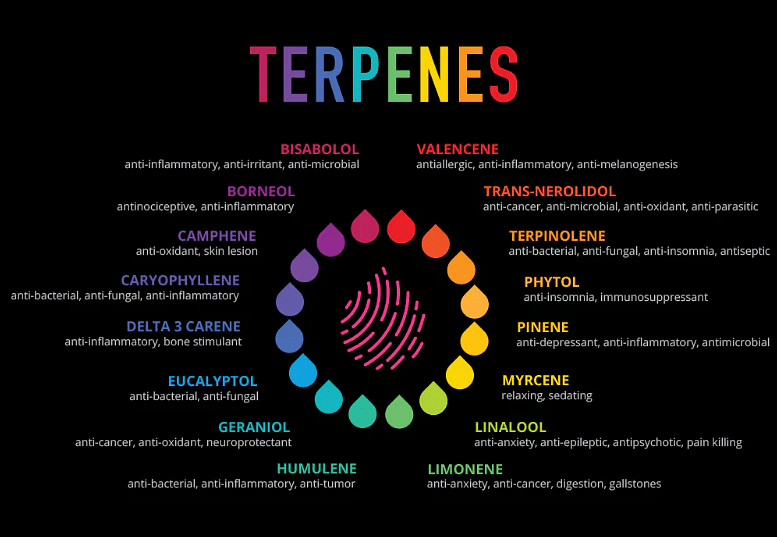
Importance of Terpenes
Structure Elucidation of Terpenes
[Click Here for Sample Questions]
| Analytical Technique | Description |
|---|---|
| Mass Spectrometry (MS) | Determines molecular mass and fragmentation patterns of terpenes. Common methods: GC-MS, LC-MS. Identifies molecular ions and fragment ions. |
| NMR Spectroscopy | Elucidates structural features and stereochemistry of terpenes. Uses 1H-NMR, ^13C-NMR. Provides atom connectivity, functional groups, spatial arrangement. |
| IR Spectroscopy | Identifies functional groups based on absorption bands in infrared spectrum. Reveals double bonds, carbonyl groups, etc. |
| UV-Vis Spectroscopy | Investigates electronic transitions and chromophoric properties. Offers insight into conjugated systems, aromaticity. |
| X-ray Crystallography | Determines 3D arrangement of atoms in crystalline terpenes. Analyzes diffraction patterns from X-rays interacting with crystal lattice. Reveals molecular geometry. |
| Chromatography | Separates and purifies terpene mixtures. Techniques include GC, HPLC. Enables isolation and identification of individual compounds. |
| Isolation & Derivatization | Isolates terpenes from natural sources or synthesizes in lab. Chemical derivatization enhances properties like solubility. Techniques: acetylation, methylation, silylation. |
Classification of Terpenoids
[Click Here for Sample Questions]
Terpenoids can be classified into three main types:
| Type | Description |
|---|---|
| Steroids | Found in animal and plant cells. Examples include cholesterol and hormones like estrogen and testosterone. |
| Carotenoids | Pigments responsible for yellow, orange, and red colors in fruits and vegetables. They play a role in photosynthesis. |
| Terpenes | Hydrocarbons found in essential oils of plants. Contribute to aroma and flavor. Widely used in perfumes, cosmetics, and food additives. |
Terpene Effect on Humans
[Click Here for Sample Questions]
Effects of terpenes vary depending on the dosage. Terpenes are utilized in aromatherapy due to their aromatic qualities.
- Terpenes exhibit potential antibacterial properties.
- They possess anti-inflammatory characteristics.
- Terpenes offer diverse benefits, acting as antioxidants, pain-relievers, mutation preventers, and antiseptic agents.
- They work synergistically with cannabinoids for amplified effects.
Advanced terpenes are modified forms of terpenes. These molecules are synthesized by combining different types of hydrocarbons for various applications.
Terpene OilTerpene oil is a natural compound found in the flowers or buds of the cannabis plant. It can be extracted through processes like vaporization or steam distillation.
|
Things to Remember
- Terpenes are organic compounds found in plants, responsible for their distinctive scents and flavors.
- They are widely used in aromatherapy, cosmetics, and food flavoring due to their aromatic properties.
- Terpenes can be extracted from plants through methods like steam distillation, solvent extraction, or cold pressing.
- They play vital roles in plant defense mechanisms, attracting pollinators, and deterring herbivores.
- Terpenes are composed of repeating units of isoprene, with the molecular formula (C5H8)n.
- There are thousands of different terpenes found in nature, each with unique aromatic profiles and potential health benefits.
- Terpenes interact synergistically with cannabinoids in cannabis plants, potentially influencing the therapeutic effects of cannabis products.
Sample Questions
Ques. Are Terpenes and Terpenoids the same? (5 marks)
Ans. Terpenes and terpenoids are not the same as:
- Terpenes are simple hydrocarbons (carbon and hydrogen) with a basic structure based on isoprene units (C5H8).
- They are the building blocks of terpenoids.
- Terpenoids are modified terpenes with additional functional groups (like oxygen, and nitrogen) besides just carbon and hydrogen.
- These modifications change the properties and functions compared to pure terpenes.
Terpenes are therefore the base and terpenoids are the modified versions with additional "features."
Ques. What is the difference between terpenes and essential oils? (2 marks)
Ans. The difference between terpenes and essential oils are -
| Terpenes | Essential Oils |
|---|---|
| Organic compounds found in plants, responsible for scent and flavour. | Concentrated liquid extracted from plants, containing various compounds including terpenes. |
| Diverse structures based on isoprene units (C5H8) | Complex mixture of various compounds, including terpenes, alcohols, aldehydes, and esters |
Ques. Can terpenes be harmful? (2 marks)
Ans. Terpenes pose minimal harm when encountered in their natural forms within plants or their diluted presence in essential oils.
- Inhaling highly concentrated terpenes, such as undiluted essential oils or vaping products
- Some terpenes may interact with certain medications.
Ques. What are the different types of terpenes? (5 marks)
Ans. Terpenes are classified based on the number of isoprene units (C5H8) they contain:
- Monoterpenes (C10H16): The smallest, with two isoprene units. Examples: limonene (citrus), and pinene (pine).
- Sesquiterpenes (C15H24): Contain three isoprene units. Examples: β-caryophyllene (cloves), and farnesene (hops).
- Diterpenes (C20H32): Made of four isoprene units. Examples: phytol (chlorophyll), and abietic acid (pine resin).
- Triterpenes (C30H48): Six isoprene units. Examples: lanosterol (precursor to cholesterol), and betulin (birch bark).
Ques. How do terpenes affect the smell of plants? (2 marks)
Ans. Plants contain a unique blend of terpenes, and the specific combination present determines their distinctive smell. Each terpene has its characteristic aroma, and the combination of these scents creates the overall fragrance profile of the plant.
Ques. Do terpenes have any health benefits? (3 marks)
Ans. Some health benefits of terpenes include -
- Antimicrobial: May help fight bacteria and fungi.
- Anti-inflammatory: May reduce inflammation.
- Relaxing and pain-relieving: Some terpenes may promote relaxation and potentially relieve pain.
Ques. Can terpenes be synthetically produced? (3 marks)
Ans. Yes, some terpenes can be synthetically produced in laboratories. However, this process is often more expensive and complex compared to extracting them from natural sources like plants.
Therefore, naturally occurring terpenes from plants are generally preferred, especially for aromatherapy and food flavoring purposes, as they offer a complex and nuanced aroma profile.
Ques. How are terpenes used? (3 marks)
Ans. Terpenes have diverse applications across various fields:
- Aromatherapy: Essential oils rich in terpenes are used for relaxation, stress relief, and promoting well-being.
- Food & Beverage Industry: Terpenes contribute to the unique flavors and aromas of various products like citrus fruits, spices, and beverages.
- Cosmetics & Fragrances: Pleasant-smelling terpenes are used in perfumes, lotions, and other cosmetic products.
Ques. What is an example of a terpene? (5 marks)
Ans. A few examples of terpenes and their associated aromas:
- Limonene: This terpene is commonly found in citrus fruits like lemons, oranges, and grapefruits. It has a bright, citrusy scent.
- Pinene: Found in pine trees and rosemary, pinene has a fresh, woody, and pine-like aroma.
- Linalool: Present in lavender and other floral varieties, linalool has a sweet, floral, and slightly spicy scent.
- Myrcene: Commonly found in hops and mangoes, myrcene has an earthy, musky, and slightly citrusy aroma.
- β-Caryophyllene: This terpene is present in cloves, black pepper, and cannabis. It has a peppery, spicy, and slightly woody scent.
Ques. Where do terpenes come from? (3 marks)
Ans. Terpenes primarily come from plants.
- They are produced by specialized structures within plant cells, such as trichomes (glands) and epithelial cells.
- These structures act like chemical factories, synthesizing terpenes from fundamental building blocks like isoprene units.
While less common, some animals and insects also produce small amounts of terpenes, likely for communication or defense purposes. However, plants remain the dominant source of these diverse and fragrant molecules.
Check-Out:
| Chemistry Study Guides | ||
|---|---|---|
| Chemical Reactions | Periodic Table in Chemistry | Named Reactions |



Comments