



Exams Prep Master
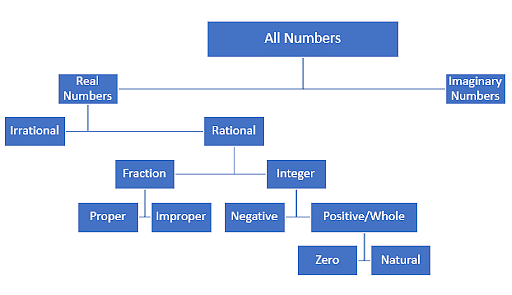
Numbers are everywhere. From the date on which a person was born to the time that the clock needles are ticking and much more, we are surrounded by the numbers. Moreover, numbers are the basic and integral aspect of mathematical concepts. For mathematical operations, there are types of numbers such as odd and even numbers, natural and whole numbers, prime and composite numbers, fractions, decimals, real numbers, rational and irrational numbers, integers, and so on. Let's have a look at all the types of numbers, their properties, and examples of their usage in mathematics.
| Table of Content |
Types of numbers in Mathematics
[Click Here for Sample Questions]
One can classify the numbers in various categories or types based on their properties along with the representation of these numbers on the number line. There is a logic behind every type of number which makes it different from other types of numbers. A list of all the types of numbers along with their properties and examples is provided below.
Natural Numbers
[Click Here for Sample Questions]
Natural numbers which are also known as “counting numbers” are the set of positive numbers beginning from 1 till infinity. The letter "N" is used to represent the set of natural numbers. The natural number set is as follows:
N = {1, 2, 3, 4, 5, ……….till infinity}
Examples: 53,95,210 and any positive number (except zero).
What are the Properties of Natural Numbers?
- Closed, associative, and commutative
Closed, associative, and commutative are the properties of natural numbers during addition and multiplication.
- Identify element is equal to zero under addition
Natural numbers' identity element under addition is zero. That means n+0 = n.
- Identify element is equal to one under multiplication
Natural numbers' identity element under multiplication is one. That means n x 1 = n.
Whole Numbers
The group of Whole numbers as types of numbers is very similar to natural numbers. The only difference there is that zero is also included in the group this time. The set has all the positive numbers along with zero. But, decimals and fractions are not a part of this set. Letter "W" is used for the representation of the set of whole numbers. The whole number set is provided below:
W = {0,1, 2, 3, 4, 5, ……….till infinity}
Examples: 39, 0, 58,304.
What are the Properties of Whole Numbers?
Whole numbers are closed under addition and multiplication.
- Closed under addition and multiplication
Whole numbers are found as closed under addition and repetitive addition (multiplication). In other words, whether you add or you multiply two whole numbers, the result would always be a whole number only.
- Identify element is equal to zero under addition
The whole numbers' identity element under addition is zero. That means W+0 = W.
- Identify element is equal to one under multiplication
The whole numbers' identity element under multiplication is one. That means W x 1 = W.
- Commutative and associative property
Associative and commutative are the properties of whole numbers during addition and multiplication.
- Distributive property of multiplication
Whole Numbers work in line with the distributive property of multiplication over addition. Moreover, vice versa is also the case here.
Read more:
Integers
[Click Here for Sample Questions]
The set of all whole numbers with all the natural numbers in negative mode, i.e., -1,-2,-3, and so on in the number line is known as Integers. This set is represented with the help of the letter "Z". Here is the set of Integers:
Z = {-3, -2, -1, 0, 1, 2, 3...till infinity}
Examples: -25, 0, -178, 61, 96, etc.
What are the Properties of Integers?
- Closed under addition, multiplication, and subtraction
Integers are observed as closed under addition, subtraction, and multiplication. It indicates that when two or more integers are added, subtracted, or multiplied; the result would always be an integer only.
- Distributive property of multiplication
Integers satisfy the commutative, associative, and distributive property of integers.
- Identify element is equal to zero under addition
Since Integers include whole and natural numbers, therefore, Integers' identity element under addition is also zero. That means Z+0 = Z.
- Identify element is equal to one under multiplication
Integers' identity element under multiplication is also one. That means Z x 1 = Z.
Real Numbers
[Click Here for Sample Questions]
Positive integers, negative integers as well as zero all were there. But, fractional numbers and decimals are not included yet. Real numbers are all the numbers that are found in the number line. From 1 to ½ to 1.111111 and so on. Real numbers are represented by the letter “R”. Anything that is not in the number line is not a part of real numbers.
Examples: ¾, 0.989, √5, 0, -100, 29, etc.
What are the Properties of Real Numbers?
- Distributive, commutative and associative properties of multiplication
Real Numbers are distributive, commutative, and, associative under addition and multiplication.
- Multiplication Identity Element equal to One
Real numbers' identity element under multiplication is also one. That means R x 1 = R.
- Additive Identity Element equal to zero
Real numbers' identity element under multiplication is also one. That means Z x 0 = Z.
- Inverse property
Inverse is the property followed by Real numbers.
Rational Numbers
[Click Here for Sample Questions]
Rational numbers are the numbers that one can write in the form of p/q. In other words, a ratio of one number over the other number. Rational numbers as types of numbers are represented by the symbol "Q".
Examples: 7/9, 2/5, 1/1, 0/1, etc.
What are the Properties of Rational Numbers?
- Closed under addition, subtraction, multiplication, and division
Rational numbers are closed under arithmetic operations of subtraction, addition, multiplication as well as division.
- Commutative and associative property under addition and multiplication
Rational Numbers are commutative and associative under addition and multiplication.
- Distributive property under addition and subtraction
Rational numbers follow the distributive property.
Also read:
Irrational Numbers
[Click Here for Sample Questions]
Those types of numbers that one cannot express in the form of ratio or p/q are expressed as Irrational numbers. Irrational numbers are represented by the symbol ”P”.
Examples: √2, Euler’s constant, π, etc
What are the Properties of Irrational Numbers?
- Not Closed
- Commutative and associative properties under addition and multiplication
- Distributive property under addition and subtraction
Complex Numbers
Complex numbers are the numbers that are written in the form of a+b. "a and b” are the real numbers there. Whereas, “i” is an imaginary number.
Examples: 8 + 4i, -2 + 6i, 3+√2i, etc
What are the Properties of Complex Numbers?
The following properties hold for the complex numbers:
- Associative and Commutative property under addition and multiplication.
- Distributive property of multiplication over addition.
Complex Numbers
[Click Here for Sample Questions]
Imaginary numbers, as types of numbers, are a category under complex numbers only. The product of real numbers added with the imaginary unit “i” can be known as imaginary numbers. The imaginary aspect of the complex numbers is denoted by the symbol Im (Z).
Examples: √2, i5, 6i, etc.
What are the Properties of Imaginary Numbers?
Imaginary Numbers have an interesting property.
- A cycle of four different values under multiplication
This is an interesting property of imaginary numbers. Imaginary number, when performed in multiplication operation, goes through four different values just by changing the place of value.
For example:
1 × i = i
i × i = -1
-1 × i = -i
-i × i = 1
Therefore, imaginary numbers can be written as...
i = √1
i2 = -1
i3 = -i
i4 = +1
i4n = 1
i4n-1= -i
Things to Remember
- Natural numbers don't include zero with them. The symbol of natural numbers is "N".
- Zero is a whole number and not a natural number. The symbol of the Whole number is "W".
- Numbers that can be written in a ratio form are rational numbers. "Q" is the symbol for rational numbers.
- Irrational Numbers are numbers that cannot be written in ratio form. "P" is for irrational numbers.
- Imaginary Numbers are a part of Complex numbers.
- Imaginary Numbers are represented as "i" in the formula.
Sample Questions
Ques. If we divide a positive integer by another positive integer, what is the resulting number? (2 marks)
(a) Always a natural number
(b) Always an integer
(c) A rational number
(d) An irrational number
Ans: “c” a rational number is the correct option.
Explanation: If a positive integer is divided by another positive integer, the number in the result will always be a rational number i.e., in the form of p/q. Although, exceptions are always there. Therefore, it can also be a natural number and an integer but only when the given denominator is 1.
Ques. How many irrational numbers lie between √2 and √3? (2 marks)
(a) One
(b) Zero
(c) Ten
(d) Infinite
Ans: The correct answer is d Infinite.
Explanation: Because infinite irrational numbers lie between √2 and √3. For instance, √2.1, √2.11, √2.101, √2.1032, and so on.
Ques: Who was the person inventing irrational numbers? (3 marks)
Ans: Hippasus is the person who invented these types of numbers known as Irrational numbers. It was a shock for many mathematicians. Due to the Pythagoreans' statement of rational numbers, i.e., all numbers can be written as the ratio of integers. Everyone believed in that statement and couldn't expect irrational numbers. But, Hippasus invented irrational numbers.
Ques: From the pairs of the numbers given below, whose product is Rational and Irrational Numbers? (3 marks)
(a) √12, √3
(a) √4, √3
(c) √10, √3
(d) √2, √3
Ans: Products of these pairs of numbers are as follows:
- The product of √12 × √3 is 6 which is a natural number.
- Product of √4 × √3 is √12 which is an irrational number
- √10 × √3 is √30 which is an irrational number
- √2 × √3 is √6 which is an irrational number
Related Mathematics Links:



Comments