



Exams Prep Master
The circle is a geometric figure with a closed round structure with a radius and its boundary known as the circumference. Unit Circle is a type of circle that can be defined as a circle with the coordinates (0, 0) as its center and its radius as one (1). It is no different than a circle, and hence it acquires its formula from the equation of circles. Besides, it is widely used to derive the standard angular values of the trigonometric functions. The unit circle formula can also be used for the calculation of any of the unknown coordinates of the unit circle itself. Here, we will discuss the formula for the unit circle in detail and solve some important questions.
| Table of Content |
Key Takeaways: Circle, unit circle, radius, circumference, trigonometric functions, sine, cosine.
Also read: Trapezoid Formula
Unit Circle Definition
[Click Here for Sample Questions]
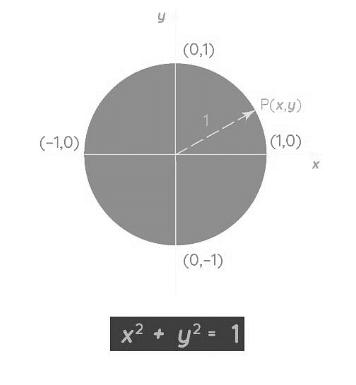
Unit circle is a closed geometric figure with its center as (0,0) and its radius as one or 1. The unit circle is represented with the help of the cartesian coordinate system. It is algebraically shown by the second–degree equation which includes the two variables, i.e. 'x' and 'y'.
The unit circle is defined as:
“The locus of a point which is at a distance of one unit from a fixed point is called a unit circle.”
The unit circle is used for different purposes some of them include:
- The calculation of any unknown coordinates of the unit circle itself.
- The unit circle is also used for deriving or extracting the values of different Trigonometric functions.
Also read: Questions on circle
Unit Circle Formula
[Click Here for Sample Questions]
The formula for a unit circle is derived from the equation of the circle, which is
(x – h)2 + (y – k)2 = r2
And for the case of a unit circle, the center or the origin of the unit circle is always at (0,0) which is the value of (h, k). Therefore, the equation for the unit circle is:
(x - 0)2 + (y – 0)2 = r2
And hence, the formula is,
x2 + y2 = r2
This formula or equation satisfies all the points lying in any of the four quadrants of the cartesian coordinate system.
Deriving Trigonometric Functions using the Unit Circle
[Click Here for Sample Questions]
As discussed above, a unit circle is used in deriving or extracting different trigonometric functions. By applying the Pythagoras theorem, we can particularly find the different trigonometric functions from the unit circle formula.
Let there be a right-angled triangle in a cartesian coordinate plane lying in a unit circle, wherein the radius is the hypotenuse of the triangle. The radius vector makes an angle theta with the positive x-axis. Hence, the endpoints of the vector will be (x, y), making 'x' as the base and 'y' as the altitude of the triangle.
Hence, sin θ = perpendicular/hypotenuse = x/1 or x.
cos θ = base/hypotenuse = y/1 = y.
And then, tan θ = sin/cos = x/y
Similarly, other functions can be derived as well.
Also read: Trigonometry
Things to Remember
- Unit Circle can be thought of as a circle with 1 unit as its radius. It is an enclosed structure.
- The unit circle can be used to evaluate or find the missing coordinates of the unit circle. It is also used for finding or deriving different trigonometric functions on a cartesian coordinate plane.
- The formula for the unit circle is derived from the equation of the circle which is (x – h)2 + (y – k)2 = r2
- The formula for the unit circle is (x-0)2 + (y-0)2 = r×r or x2 + y2 = r2.
- Unit Circle is said to represent a 2π radian complete angle and it is divided into four different quadrants as π, π/2, 3π/2 and 2π.
- The trigonometric functions derived using the unit circle are:
sin x = perpendicular/hypotenuse = x/1
cos x = base/hypotenuse = y/1
tan x = sin x/ cos x = x/y.
Also read: How to convert degrees to radians
Sample Questions
Ques. What is a unit circle? Discuss in detail. (2 marks)
Ans: A unit circle is said to be a circle with its center or the origin as (0,0) and its radius is 1 unit. It is further stated as a major component for deriving the value of different Trigonometric functions using a cartesian coordinate plane. It also gets its formula from the general circle equation.
Ques. Discuss the unit circle formula and how it is derived? (3 marks)
Ans: The formula for unit circle is derived from the equation of the Circle, which is
(x - h)2 + (y - k)2 = r*r
As known, the origin of the center of the unit circle is (0,0),
(x - 0)2 + (y - 0)2 = r*r
Therefore, the equation is,
x2 + y2 = r2.
Ques Discuss the derivation of trigonometric functions from the unit circle. (4 marks)
Ans: Let there be a right-angled triangle lying inside a unit circle in a cartesian coordinate plane. Its hypotenuse is the radius of the unit circle. The radius vector makes an angle theta and has its coordinates as x and y which are the base and altitude of the triangle, respectively.
And hence, the value of trigonometric functions will be,
sinθ = perpendicular/hypotenuse = x/1
cosecθ = 1/sinθ = 1/x
cosθ = base/hypotenuse = y/1
secθ = 1/cosθ = 1/y
And tanθ = sinθ/cosθ = x/y.
cotθ = y/x.
Ques. Discuss the relationship between the right-angled triangle and the unit circle. (3 marks)
Ans: The unit circle and a right-angled triangle are related to the scenario of trigonometric functions derivation. Considering a unit circle, all the points lying on the circle can be thought to be on a right-angled triangle where the radius of the circle is the hypotenuse of the triangle and the coordinates of the circle are the other two sides of the triangle.
And the unit circle formula completely satisfies the Pythagoras theorem of a right-angled triangle.
Ques. Do the points (2/3, 2/3) lie on the unit circle? (3 marks)
Ans: Given, point = (2/3,2/3) = (x,y) and radius is 1.
Consider the points lie on the unit circle, and hence they will satisfy the unit circle equation which is,
x2 + y2 = r2
Substitute (x,y) = (2/3,2/3)
(2/3)2 + (2/3)2 = 1
(4/9) + (4/9) = 1
8/9 is not equal to 1.
Hence, the points (2/3, 2/3) do not lie on the unit circle.
Ques. If the point (4/6,y) lies on the unit circle. Find y. (3 marks)
Ans: Given: point = (4/6, y) and radius = 1
The equation of the unit circle is,
x2 + y2 = 1
Putting values of (4/6,y) as (x,y),
(4/6)2 + y2 = 1
y2 = 1 – (16/36)
= (36-16)/36
= 20/36
y = √20/6.
Ques. Consider a point (x, √3/4) lying on the unit circle. Find x. (3 marks)
Ans: Given: point = (x, √3/4) , radius = 1
The equation of the circle is,
x2 + y2 = 1
Substitute the values of (x,y) as (x, √3/4), so
x2 + (√3/4)22 = 1
x2 = 1- (9/16)
= (16-9)/16
= 4/16
x = 2/4.
MATHEMATICS Related Links:



Comments