



Content Curator
The pressure created by the vapor of a liquid (or solid) above the liquid's surface is known as vapor pressure. This pressure is created in a closed container at a specific temperature in a thermodynamic equilibrium condition. The equilibrium vapor pressure determines the rate of evaporation of a liquid. As the temperature rises, so does the vapor pressure. The boiling point of a liquid is the point at which the ambient pressure equals the pressure exerted by the vapor.
Read More: Vapour Pressure
Table of Contents
| Table of Content |
Key Terms: Vapor pressure formula, Raoult’s Law, Vapor pressure characteristics, Equilibrium vapor pressure, Raoult’s Law derivation
What is Vapour Pressure?
[Click Here for Sample Questions]
The pressure imposed by a vapor in thermodynamic equilibrium with its Solid or Liquid condensed phases at a certain temperature in a closed system is known as vapor pressure or equilibrium vapor pressure. The evaporation rate of a liquid is determined by the equilibrium vapor pressure. It has to do with particles' proclivity for escaping from solid or liquid.
Volatile refers to a material that has a high vapor pressure at room temperature. Vapor pressure is the pressure exerted by vapor existing above a liquid surface. When the temperature of a liquid rises, so does the kinetic energy of its molecules. The number of molecules transitioning into a vapor grows as the kinetic energy of the molecules increases, raising the vapor pressure.
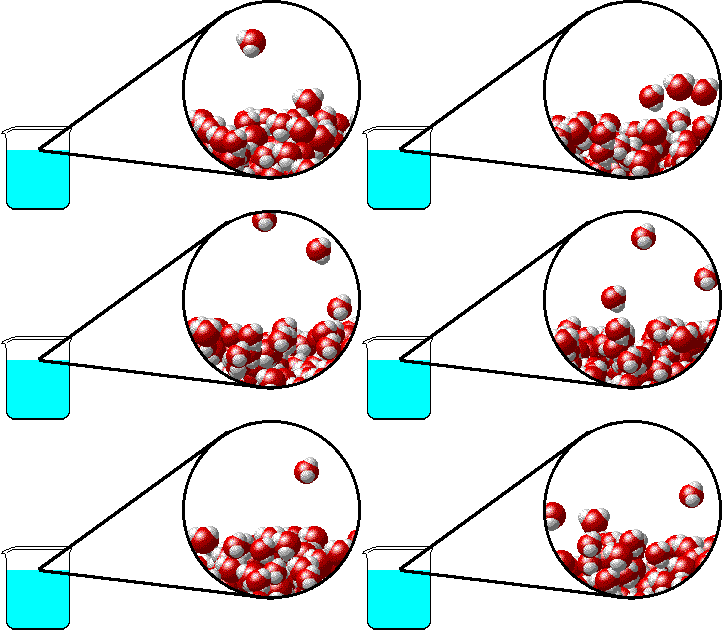
Vapour Pressure on Molecular Level
Note: Vapor or vapour are the same, there is only difference in spelling. Vapour is called ``vapour'' in English-speaking countries other than the US.
As per the Clausius–Clapeyron relationship, the vapor pressure of any material grows non-linearly with temperature. The temperature at which the vapor pressure matches the ambient air pressure is known as the atmospheric pressure boiling point of a liquid. The vapor pressure grows sufficient to overcome air pressure & raise the liquid to create vapor bubbles inside the bulk of the material with any incremental rise in temperature.
Bubble formation at a deeper depth in the liquid necessitates a higher temperature due to the increased fluid pressure, which rises above atmospheric pressure as depth rises. The increased temperature necessary to start bubble production is more critical at shallow depths. The bubble wall's surface tension causes an overpressure in the extremely tiny, first bubbles.
Also read: Class 12 Chemistry Notes
Characteristics of Vapor Pressure
[Click Here for Sample Questions]
The following are the characteristics of Vapor Pressure.
- In comparison to a liquid's solution, a pure liquid has a higher vapour pressure.
- It's inversely proportional to the attraction forces that exist between liquid molecules.
- It rises in response to a rise in temperature. This is due to the molecules gaining kinetic energy and hence rapidly vapourizing.
Read More: Three States of Matter
Vapour Pressure Formula
[Click Here for Sample Questions]
When a material within a sealed container evaporates, vapor pressure is the force exerted on the container's walls. Use the Clausius-Clapeyron equation to calculate the vapour pressure at a given temperature:
Psolution= Psolvent Xsolvent
Xsolvent = the mole fraction of the solvent in the solution
Psolution = the vapour pressure of the solution
Psolvent = the vapour pressure of the solvent
Read More: Critical Temperature
Raoult's Law
[Click Here for Sample Questions]
The partial pressure is exactly proportional to the mole fraction of the solute component, according to the law. As a result of Raoult's Law, A's partial pressure will be
PA ∝ XA
PA = PA0 XA
The vapour pressure of pure liquid component A is PA0. B's partial pressure will be the same.
PB ∝ XB
PB = PB0 XB
The vapour pressure of pure liquid component B is PB0. We'll now apply Dalton's partial pressures law. The total pressure (Ptotal) of a solution put in a container is equal to the sum of the partial pressures of its constituents, according to this rule. That is correct.

Raoult's Law
Read More: Intermolecular Forces
Ptotal = PA + PB
Ptotal = PA0 XA + PB0 XB
Also since, XA + XB = 1 , or as:
Ptotal = PA0+ (PB0 – PA0) XB
Vapour Pressure of Liquid-Liquid Solutions
[Click Here for Sample Questions]
We'll use two volatile liquid solutions to test this & Let's call their liquid components A and B for now. After placing the volatile liquid and also its components in a closed vessel, we discover that equilibrium between the liquid and vapour phases has been established.
Let PA & PB are the partial vapour pressures for components A & B, respectively, and PTotal are the overall vapour pressure at equilibrium. Furthermore, the corresponding components' mole fractions are XA & XB, respectively. Raoult's Law is used to determine the vapour pressure of volatile liquids.
Also read: Melting and Boiling Point
Vapour Pressure of Solutions of Solids in Liquids
[Click Here for Sample Questions]
Let's take a look at the other form of solution, which is solids in liquid. In this case, the solute is a solid, while the solvent is a liquid. The solute is non-volatile in these situations. The vapour pressure is lower than the solution's pure vapour pressure. We may also use Raoult's Law to find it.
Things to Remember
- Partial pressure is the vapour pressure that a single component in a mixture contributes to the overall pressure in the system.
- The gaseous molecules formed will not escape if the liquid is contained in a closed container, but will remain above the liquid.
- A solution is formed when a solid is dissolved in a liquid.
- The gaseous molecules generated as a liquid evaporates escape into the air.
- The vapour pressure is the pressure formed by the evaporated particles above the liquid.
Read More: Dispersion forces
Sample Questions
Ques. Why does the Vapour Pressure drop when we add a non-volatile solute to the solvent? (3 Marks)
Ans. Evaporation is a surface phenomena, as we all know. The more surface area there is, the more evaporation occurs. As a result, the vapour pressure is higher. We can observe that in a pure liquid, there is greater surface area available for the molecules to evaporate. As a result, they have a higher vapour pressure. We induce the solvent molecules to have less surface to escape when we add a non-volatile solute. As a result, it falls.
Ques. The vapor pressure of pure water is 760mm at 25 degree Celsius. The vapor pressure of a solution containing 1 m of solution of glucose will be what?" (3 Marks)
Ans. As per the colligative qualities. The pressure reduction of water is PX', where P is the pure solvent pressure and X' is the molar percentage of the solute.
There are 1000/18 mols of water in 1L of water, which equals 55.6 mols.
So, for every 1L of solution, there are 56.6 mols of molecules (one comes from glucose and 55.6 from water as calculated).
As a result, the molar fraction of the solute is 1/56.6 1.768.10-2.
So the pressure drop is 760mmHg multiplied by 1.768.10-2, or 13.44 mmHg.
Finally, the solution's vapour pressure is 760mmHg-13.44mmHg = 746.56mmHg.
Ques. Is vapor pressure related to temperature? (3 Marks)
Ans. The tendency of a substance to convert into a gaseous or vapour state is measured by vapour pressure, which rises with temperature. The boiling point of a liquid is defined as the temperature at which the vapour pressure at its surface equals the pressure exerted by its surroundings.
Read More: Vaporization
Ques. Why does vapor pressure increase temperature? (3 Marks)
Ans. Because the kinetic energy of those molecules increases as the temperature of the liquid rises, more liquid molecules near the surface will want to escape to the gas phase, causing the number of molecules in the gas phase to rise, and therefore the vapour pressure to rise.
Ques. What are the factors affecting vapor pressure? (3 Marks)
Ans. The pressure created by liquids evaporating is known as vapour pressure. Surface area, intermolecular interactions, and temperature are three main elements that impact the vapour press. At different temperatures, a molecule's vapour pressure varies.
Ques. At 25 °C, the vapour pressure of an aqueous solution is 23.80 mmHg. What is the solute mole fraction in this solution? At 25 °C, the vapour pressure of water is 25.756 mm Hg. (2 Marks)
Ans. Use Raoult’s Law: Psolution = (Xsolvent) (P°solvent)
23.80 = (X) (25.756)
X = 0.92405
Xsolute = 1 – 0.92405
Xsolute = 0.07595
Ques. At 25 °C, the vapour pressure of an aqueous solution is 30 mmHg. What is the solute mole fraction in this solution? At 25 °C, the vapour pressure of water is 50 mm Hg. (2 Marks)
Ans. Use Raoult’s Law: Psolution = (Xsolvent) (P°solvent)
30 = (X) (50)
X = 0.6
Xsolute = 1 – 0.6
Xsolute = 0.4
Ques. What is the vapour pressure of 120 g acetone (mwt = 58g/mol) and 800 g propanol (mwt = 60g/mol)? At 25°C, acetone and propanol have vapour pressures of 30mmHg and 21mmHg, respectively. (5 Marks)
Ans. Molar fractions calculations:
na = 120g/58g/mol = 2.1mol
np = 800g/60g/mol = 13.3mol
ntotal = na + np = 2.1 + 13.3 = 15.4mol
xa = 2.1/15.4 = 0.136
xp = 13.3/15.4 = 0.863
Partial pressure of each component:
Pa = xaPo,a = 0.136 * 30 = 4.08mmHg
Pp = xpPo,p = 0.863 * 21 = 18.12mmHg
The pressure of the vapor mixture
Pmixture = Pa + Pp = 4.08 + 18.12 = 4.08 + 18.12 = 22.2mmHg
Also read: Charles Law Formula
Ques. How would you determine the vapour pressure of a solution generated by dissolving 88.2 g of urea in 303 mL of water at 35°C (molar mass = 60.06 g/mol)? Water has a vapour pressure of 42.18 mmHg at 35 degrees. (5 Marks)
Ans. The mole fraction must be determined before the vapour pressure of the solution can be calculated. A solvent's mole fraction is computed by dividing the number of moles of solvent by the total number of moles in the solution.
urea mass = 88.2 g.
Molar mass of urea = 60.06 g/mol
Volume of water = 303 mL.
Temperature = 35oC
water vapor pressure = 42.18 mmHg
Because urea has no vapour pressure, the solution's vapour pressure may be calculated using the mole fraction of water and the vapour pressure of pure water.
The equation below is used to determine the solution's vapour pressure.
Psol = Xwater X Pwater
Where,
Psol = solution vapour pressure
Xwater = mole fraction of water
Pwater = vapour pressure of pure water
To get the solution's vapour pressure, we must first determine the mole fraction. The mass is initially computed using the density formula to determine the mole fraction.
water density = 0.994 g/mL.
The density formula is presented below.
D = m/V
where,
D be the density
m be the mass
V be the volume.
To calculate the mass, substitute the values in the above equation.
⇒ 0.994g/mL=m303mL
⇒ m=0.994g/mL×303mL
⇒ m=301.2g
Below is the formula for calculating the number of moles.
n = m/M
Where,
n be the number of moles
m be the mass
M be the molecular weight
Substitute the numbers in the preceding equation to obtain the moles of water.
n = 301.2g18g/mol
n = 16.73mol
Substitute the numbers in the preceding equation to obtain the moles of urea.
n = 88.2g60.06g/mol
n = 1.469mol
Substitute the numbers in the preceding equation to obtain the mole fraction of water.
Xwater= nwater /ntotal
Where,
Xwater = mole fraction of water
nwater= number of moles of water
ntotal = total moles
Xwater = 16.72mol16.72+1.469mol
Xwater= 16.72mol18.19mol
Xwater= 0.9192
Substitute the numbers in the formula to get the vapour pressure of the solution.
Psol = 0.9192×42.18mmHg
Psol = 38.8mmHg
As a result, a solution formed by dissolving 88.2 g of urea in 303 mL of water at 35°C has a vapour pressure of 38.8mmHg.
Read More: Specific Heat Capacity of Water
Ques. Calculate the vapour pressure of 252 g of n-pentane (Mw = 72) and 1400 g of n-eptane (Mw = 100) at 20oC. 420 mm Hg and 36 mm Hg are the vapour pressures of n-pentane and n-eptane, respectively. (3 Marks)
Ans. The vapour pressure exerted by a component in a mixture may be computed using Raoult's law as follows:
P = Po x
where
P be the vapor pressure of the component in the mixture.
Po be the vapor pressure of the pure component.
x be the molar fraction of the component in the mixture.
Calculation of molar fractions (x)
moles n-pentane = 252/72 = 3.5
moles n-eptano = 1400/100 = 14
Totals = 3.5 + 14 = 17.5 moles
xn-pentane = 3.5/17.5 = 0.2
xn-eptane = 14/17.5 = 0.8
Thus
Pn-pentane = 0.2 x 420 = 84 mm Hg
Pn-eptane = 0.8 x 36 = 28.8 mm Hg
and the vapor pressure of mixture is
Pmixture = 84 + 28.8 = 112.8 mm
Also read: Chemistry: Notes, Periodic Table, Chemical Reactions, Study Guides



Comments