



Education Journalist | Study Abroad Lead
Angiosperms refer to a classification of plants that produce their seeds within a fruit. The classification of kingdom Plantae depends on various characteristics such as differentiated and distinct plant body, presence of special tissues for transportation of water and other materials, the ability to carry seeds, and if they are enclosed within the fruits. Angiosperms are the type of vascular seed plants that produce flowers. The seeds of these plants are found in the flowers. They are known to be the largest and the most diverse group in the kingdom Plantae due to their innate capability of growing in different habitats in the form of herbs, shrubs, bushes as well as trees. There are approximately more than 250,000 species of angiosperms known today. In this article, we will look at the characteristics of angiosperms and their classification.
| Table of Contents |
Keywords: Angiosperms, Plantae, flowers, stamens, carpels, Monocots, Dicots, Cotyledons, Pollination, endosperm, venation
What are Angiosperms?
[Click Here for Sample Questions]
Angiosperms are a type of plant belonging to the kingdom Plantae. The word Angiosperm is derived from two Greek words: angio (covered) and sperma (seed). They are the types of plants that contain flowers which is a distinct feature and the seeds are enclosed within the fruits. They are also called flowering plants since they can bear both flowers and seeds and comprise around 80% of the living plants.

Angiosperms
Characteristics of Angiosperms
[Click Here for Sample Questions]
Angiosperms have the following characteristics:
The reproductive tissues of Angiosperms are flowers that distinguish them from other seed-bearing plants.
Unlike gymnosperms, they have a different set of organs attached to the floral structure:
- Sepals- It is the outermost layer and encloses the flower bud.
- Petals- The next layer is the petals that are generally bright-colored.
- Stamens- They are microsporophylls or spore-producing structures and are comparatively slender than those present in gymnosperms.
- Carpels- They are present at the center and are megasporophylls. The ovules are enclosed within the ovary at the base of these closed carpels.
An important role of the flower is to assure fertilization of the ovule and the development of fruits.
After fertilization, the ovules of an angiospermous plant develop into seeds enclosed within an ovary that further modify into fruits.
The flowers produce two types of spores or reproductive cells- Microspores and Megaspores.
- Microspores are the “male” cells that are responsible for pollen grains.
- Megaspores on the other hand are “female” cells present in the ovule enclosed in the carpel.
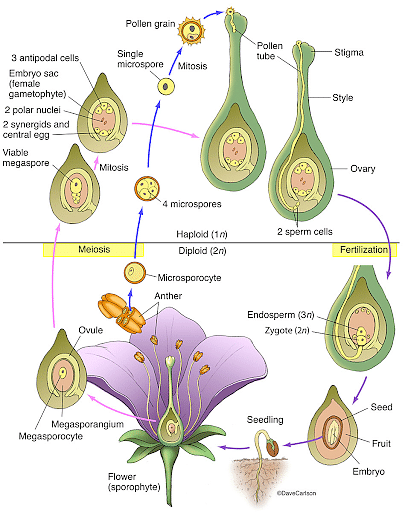
Angiosperm: Structure and Life Cycle
Pollination occurs from anther to stigma. The size of pollen grains is relatively smaller than other non-flowering plants.
Unlike non-vascular plants, angiosperms have specialized cells and tissues responsible for the functions like photosynthesis, cell division, etc along with vascular tissues (xylem and phloem) that are further specialized to carry out the translocation of water and nutrients throughout the whole plant body.
The root system is composed of a complex network of layers such as protoxylem, xylem, phloem, sclerenchyma, cortex, and epidermis.
In angiosperms, the fertilization process begins after pollination shorter than that in the gymnosperms.
The formation of endosperm, a highly nutritive tissue, initiates after the process of fertilization and before the first division of the zygote. The endosperm provides a great advantage by supplying nutrients essential for the development of the embryo and the cotyledons.
Classification of Angiosperms
The plant embryos present in the seeds have structures that are known as cotyledons. On the basis of the number of these cotyledons present in the seed, angiosperms are divided into two groups:
Monocotyledons
- The seeds of these plants contain a single cotyledon.
- The plants have simple leaves with parallel venation.
- They have a large number of closed vascular bundles.
- The flowers are trimerous in nature i.e. they are arranged in a three-fold or six-fold manner.
- The roots are adventitious and primary taproots are absent.
- E.g.- Bananas, Lilies, Sugarcane plants, bamboo, etc.
Dicotyledons
- These plants contain two cotyledons in their seed.
- A distinct feature of this group is that the leaves have reticulate venation.
- They generally contain two to six arranged in the form of a ring.
- The flowers are usually tetramerous or pentamerous.
- Taproots are present in dicots.
- E.g.- Sunflower, Tomatoes, Dandelions, etc.

Monocotyledons and Dicotyledons
Things to remember
- Angiosperms are plants that contain both flowers and seeds.
- The seeds further develop into fruits.
- They are diverse in nature and are capable of growing in any habitat.
- Reproductive organs of angiosperms are flowers.
- Stamen is the male reproductive organ.
- Carpel is the Female reproductive organ
- Angiosperms are divided into two types:
- Monocotyledons (have only a single cotyledon)
- Dicotyledons (Have two cotyledons)
Sample Questions
Ques. What are the differences between monocots and dicots? (5 marks)
Ans. The difference between monocotyledons and dicotyledons are as tabulated below:
| Monocotyledons | Dicotyledons |
|---|---|
| They have only a single cotyledon in their seed. | They contain two cotyledons in their seed. |
| The leaves exhibit parallel venation. | The leaves show reticulate venation. |
| Taproot is absent. | Taproot is present. |
| Flowers are trimerous. | Flowers are tetramerous or pentamerous. |
Ques. State the differences between Angiosperms and Gymnosperms. (3 marks)
Ans. Angiosperms and Gymnosperms are differentiated on the following characteristics:
| Angiosperms | Gymnosperms |
|---|---|
| The seeds of these plants develop inside the ovary that further modifies into fruit. | The plants under this class bear naked seeds. |
| There are many cotyledons present in the plant embryos of the seeds. | The plant embryos usually contain one or more cotyledons only. |
| The plants are usually evergreen, woody, and perennial. | Being the most diverse group, the plants can be biennial, perennial, or annual, and woody or non-woody. |
Ques. State the criterion used for the classification of the species belonging to the kingdom Plantae. (3 marks)
Ans. There are several characteristics based on which the Plantae kingdom is classified as we progress from one level to another. These are:
- Well-differentiated and distinct features of the plant body.
- Presence of specialized tissues in the well-differentiated plant body for water transportation and carrying other substances.
- Ability to bear seeds and if they are enclosed within the fruits of the plants.
Ques. What do you mean by “adventitious roots”? (2 marks)
Ans. The roots that arise from any other organ apart from the radical are called adventitious roots. These types of roots mainly develop from steam or a leaf. They perform many functions such as regulating absorption, providing mechanical support, food storage, etc.
Ques. How do the reproductive organs of angiosperms differ from that of gymnosperms? (5 marks)
Ans. In angiosperms, the reproductive organs are present in the flower region. The seeds are shielded by a covering called the fruit. The male reproductive cells or the microspores are present in the pollen grain while the female cells or the megaspores are present in the ovule of the ovary. They undergo double fertilization.
In gymnosperms, the female reproductive part is the cone and the male reproductive part is the pollen grains. Many gymnosperms produce two types of cones- the pollen cone (male cone) and the seed cone (larger female cone). The reproductive parts do not undergo double fertilization.
Ques. Explain the process of pollination in Angiosperms. (5 marks)
Ans. Pollination takes place in the following way:
- In angiosperms, the transfer of pollen grains from the anther to the stigma of the flower of the same or another plant is known as pollination.
- The male reproductive organ in the angiosperms is the stamen.
- The anther is present at the end of this stamen where pollen grains are generated.
- The female reproductive part of the flower receives these pollen grains through the pistil.
- The stigma present at the bottom of the pistil carries the pollen grain through a tube called the style.
- Through the style, the pollen grain reaches the ovary where fertilization takes place.
Ques. Draw a well-labeled diagram of an angiosperm plant. Which part is responsible for the shielding of pollen grains from the external environment? (2 marks)
Ans. The diagram of an angiosperm plant is as shown below:
Petals play an important role in a flower by attracting the pollinators and also shielding the inner reproductive parts of the flower.
Ques: How does a microspore differ from a pollen grain?
Ans. The differences between microspore and pollen grain are:
| Microspore | Pollen Grain |
|---|---|
| The spores present in heterosporous plants that are responsible for the generation of male gametophytes are called microspores. | The pollen grain is where the male reproductive cell of a plant is present. |
| It usually occurs in seedless vascular plants. | They occur in plants that have seeds. |
| It has a unicellular structure. | It has a multicellular structure. |
| The process of formation of a microsphere is called microsporogenesis. | It undergoes both the processes of microsporogenesis and microgametogenesis. |
Ques. Explain the meaning of double fertilization in angiosperms. (3 marks)
Ans. Angiosperms undergo a process called double fertilization which involves the formation of a zygote and the endosperm through a complex mechanism.
- The microspore contains a pollen tube cell and the generative cell.
- Through time, the pollen tube cell grows into the pollen tube while the generative cell travels through this pollen tube and splits into two sperm cells.
- These sperm cells formed by splitting of the generative cell get involved where one fertilizes the egg cell to form a diploid (2n) zygote, while the other one gets involved in fusion with two nuclei to form a triploid (3n) cell that further develops into the endosperm.
- These two fertilized processes are together termed as double fertilization.



Comments