



Education Journalist | Study Abroad Lead
Zinc Sulfide is a chemical compound and the most prevalent form of zinc found in nature. Sulfide, also written sulphide, is one of three types of sulfur-containing chemical compounds. Inorganic sulfides, organic sulfides (also known as thioethers), and phosphine sulfides are the three types of sulfides that exist. Inorganic sulfides are ionic compounds that include the negatively charged sulfide ion, S2, and are salts of the extremely weak acid hydrogen sulfide. Organic sulfides are substances in which two organic groups are covalently linked to a sulfur atom. When compared to other molecules, ZnS has a unique structure type. It has a diamond-type network at a different temperature. Although the zinc blende structure is more thermodynamically favorable, both forms of ZnS can be discovered due to the wurtzite structure's delayed development. In this article, we will discuss definitions, formulas, uses, and sample questions of Zinc Sulfide.
Read Also:- Classification of Organic Compounds
| Table of Contents |
Key Terms: Metals, Atoms, Compounds
What is Zinc Sulfide?
[Click Here for Sample Questions]
The chemical compound zinc sulfide (also known as zinc sulfide) has the formula ZnS. This is the most prevalent type of zinc found in nature, and it's typically found in sphalerite. Even though it is normally black due to various impurities, the pure material is white and is often used as a pigment. In its thick synthetic form, zinc sulfide can be transparent and is used as a window for visual and infrared optics.

Zinc Sulfide Powder
Read More: Chemical reactions
Zinc Sulfide Formula
- Zinc sulfide is a chemical compound that is made up of zinc and sulfur.
- ZnS is the chemical formula for Zinc Sulfide.
- Zinc sulfide is made up of two ions: zinc (Zn2+) and sulfide (S2–). Zinc sulfide has a molar mass of 97.474g/mol.
Structure of Zinc Sulfide
[Click Here for Sample Questions]
When compared to other molecules, ZnS has a unique structure type with many forms of unique structures.
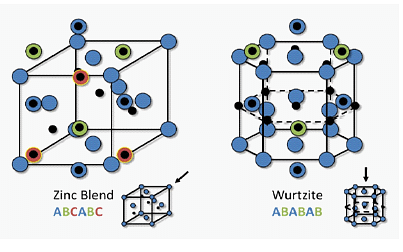
- ZnS can have a zinc blende structure, which is a kind of "diamond-type network," at a different temperature.
- At another temperature, ZnS can change to a wurtzite structure, which has a hexagonal symmetry.
Although the zinc blende structure is more thermodynamically favorable, both forms of ZnS can be discovered due to the wurtzite structure's delayed development.
Zinc blend is a chemical that appears in two different forms: sphalerite and wurtzite. A 1:1 stoichiometric ratio of Zinc to Sulfur distinguishes these. In both forms, it preserves a tetrahedral structure.

Sphalerite

Wurtzite
Read More: Alpha-Particle scattering
Preparation of Zinc Sulfide
Zinc Sulfide can be prepared in the following ways:
- Zinc sulfide is typically made from waste materials such as smelter slag and pickle liquors.
- Zinc sulfide is produced as a by-product of the methane-to-ammonia conversion process. That is, zinc sulfide is generated during the process when zinc oxide is utilized to scavenge the hydrogen sulfide impurities contained in natural gas. The chemical equation for the reaction is,
ZnO + H2S → ZnS + H2O
- Zinc sulfide is made in the laboratory by burning a combination of zinc and sulfur. Zinc sulfide is formed as a result. That is to say,
Zn(s) + S(s) → ZnS(s)
- Zn2+ salts quickly generate zinc sulfide precipitate in the presence of sulfide (S2–) ions (ZnS).
Zn2+ + S2– → ZnS
The gravimetric measurement of zinc is based on the process described above.
Check out: Calcination and Roasting
Zinc Sulfide Properties
[Click Here for Sample Questions]
The physical and chemical properties of zinc sulfide are as given below:
Physical Properties
- Zinc sulfide in its purest form appears white. Because of the presence of impurities, the naturally occurring mineral zinc sulfide appears black.
- It is either insoluble in water or has low water solubility.
- Zinc sulfide has a high melting point, which is around 2123K.
- Zinc sulfide has a density of 4.090g/cm3.
- Zinc sulfide can exhibit luminescence, fluorescence, and phosphorescence in a certain activated form (with fewer levels of certain components).
Chemical Properties
- When zinc sulfide is cooked in the presence of oxygen, zinc oxide and sulfur dioxide are produced. The reaction's chemical equation is as follows:
2ZnS + 3O2 → 2ZnO + 2SO2
- When zinc sulfide is combined with dilute hydrochloric acid, zinc chloride and hydrogen sulfide are formed. The reaction's chemical equation is as follows:
ZnS + 2HCl → ZnCl2 + H2S
- Sulfuric acid interacts with zinc sulfide to produce zinc sulfate and hydrogen sulfide. The reaction's chemical equation is as follows:
ZnS + H2SO4 → ZnSO4 + H2S
Uses of Zinc Sulfide
Zinc Sulfide has multiple applications such as:
- When activated with an appropriate activator, zinc sulfide becomes a luminous substance. This characteristic is useful in a variety of situations. It's utilized as a phosphor in cathode ray tubes, for example.
- Zinc sulfide's phosphorescence makes it helpful in a variety of ornamental and electrical applications.
- It can be employed as an optical material in the infrared range. That is, it can be formed into a lens or utilized as a planar optical window.
- Zinc sulfide is a pigment that can be used in paints, rubber, and plastics. Sachtolith is a zinc sulfide pigment that is widely used.
- Lithopone, a pigment composed of zinc sulfate (ZnS) and barium sulfate (BaSO4), is used in low-gloss paints.
- An effective catalyst is powdered zinc sulfide. It creates hydrogen gas from water when illuminated.
- ZnS typically forms the shells of semiconductor quantum dots in this age of nanotechnology, with cadmium selenide (CdSe) serving as the cores.
![ZnS application]()

Read More: Atoms and Molecules
Things to remember
- Zincblende has a basic structure, consisting of a polar covalent link between the zinc metal and the sulfur atom.
- Zinc Sulfide has the molecular or chemical formula ZnS.
- The burning of a combination of sulfur and zinc can produce ZnS.
- When zinc sulfate reacts with sodium sulfide or hydrogen sulfide gas is passed through a Zn2+ solution, the insoluble ZnS precipitates. It has a wide range of applications due to its luminous feature.
- In the presence of oxidizing agents and acids, this chemical decomposes.
- Although ZnS is not toxic to humans, it is damaging to the environment.
- Zinc mix is made up of two minerals: sphalerite and wurtzite. A 1:1 stoichiometric ratio of Zinc to Sulfur distinguishes these. In both forms, it preserves a tetrahedral structure.
Sample Questions
Ques. Is Zinc Sulfide a Toxic Substance? (2 marks)
Ans. Vapors containing zinc can produce metal fume fever. Sulfides have the potential to cause skin irritation. It is toxic, unpleasant, and flammable if hydrogen sulfide is created. Some of the negative effects include conjunctivitis, headache, nausea, dizziness, coughing, pulmonary edema, and death.
Ques. How should zinc sulfide's formula be written? (2 marks)
Ans. Zinc sulfide is a chemical compound that is made up of zinc and sulfur. It comprises sulfide (S2–) and zinc (Zn2+) radicals. The valency of the zinc radical is two, as is the valency of the sulfide radical. We may acquire the formula of zinc sulfide as ZnS by crisscrossing the valency values.
Ques. What is Zinc Sulfide used for? (5 marks)
Ans. Zinc sulfide has a wide range of applications.
- It's utilized as a phosphor in cathode ray tubes, for example.
- It can be used for a variety of decorative and electrical purposes.
- Zinc sulfide is a pigment that can be used in paints, rubber, and plastics.
- Zinc sulfide can be employed as an optical material in the infrared range.
- An effective catalyst is powdered zinc sulfide.
Ques. What is the color of Zinc Sulfide? (1 mark)
Ans. The color of Zinc Sulfide is white.
Ques. In ZnS, what is the charge on the cation? (1 mark)
Ans. Zinc cation (Zn2+) is the cation found in zinc sulfide. It has a charge of +2.
Ques. Is zinc sulfide a phosphorescent substance? (2 marks)
Ans. Zinc sulfide is a phosphorescent compound. Phosphorescence occurs when zinc sulfide is combined with the appropriate activator.
Ques. Name the type of flaw that appears in the crystals of zinc sulfide. (1 mark)
Ans. Frenkel defect occurs in zinc sulfide (ZnS) crystals.
Ques. Mention 3 chemical reactions of ZnS. (3 marks)
Ans. When zinc sulfide is cooked in the presence of oxygen, zinc oxide and sulfur dioxide are produced. The reaction's chemical equation is as follows:
2ZnS + 3O2 → 2ZnO + 2SO2
When zinc sulfide is combined with dilute hydrochloric acid, zinc chloride and hydrogen sulfide are formed. The reaction's chemical equation is as follows:
ZnS + 2HCl → ZnCl2 + H2S
Sulfuric acid interacts with zinc sulfide to produce zinc sulfate and hydrogen sulfide. The reaction's chemical equation is as follows:
ZnS + H2SO4 → ZnSO4 + H2S
Ques. How zinc sulphide is produced? (5 marks)
Ans. Zinc sulfide is usually made from waste products from other industries. Smelter, slag, and pickle liquors are common sources. It's also a by-product of the ammonia-from-methane synthesis, where zinc oxide is employed to remove hydrogen sulfide contaminants from the natural gas:
ZnO + H2S → ZnS + H2O
It is simply made by burning a zinc and sulfur combination. Zinc sulfide can be made in a precipitation reaction since it is insoluble in water. In the presence of sulfide ions, solutions containing Zn2+ salts rapidly produce the precipitate ZnS. (e.g., from H2S)
Zn2+ + S2− → ZnS
Gravimetric analysis for zinc is based on this reaction.
Read More:



Comments