





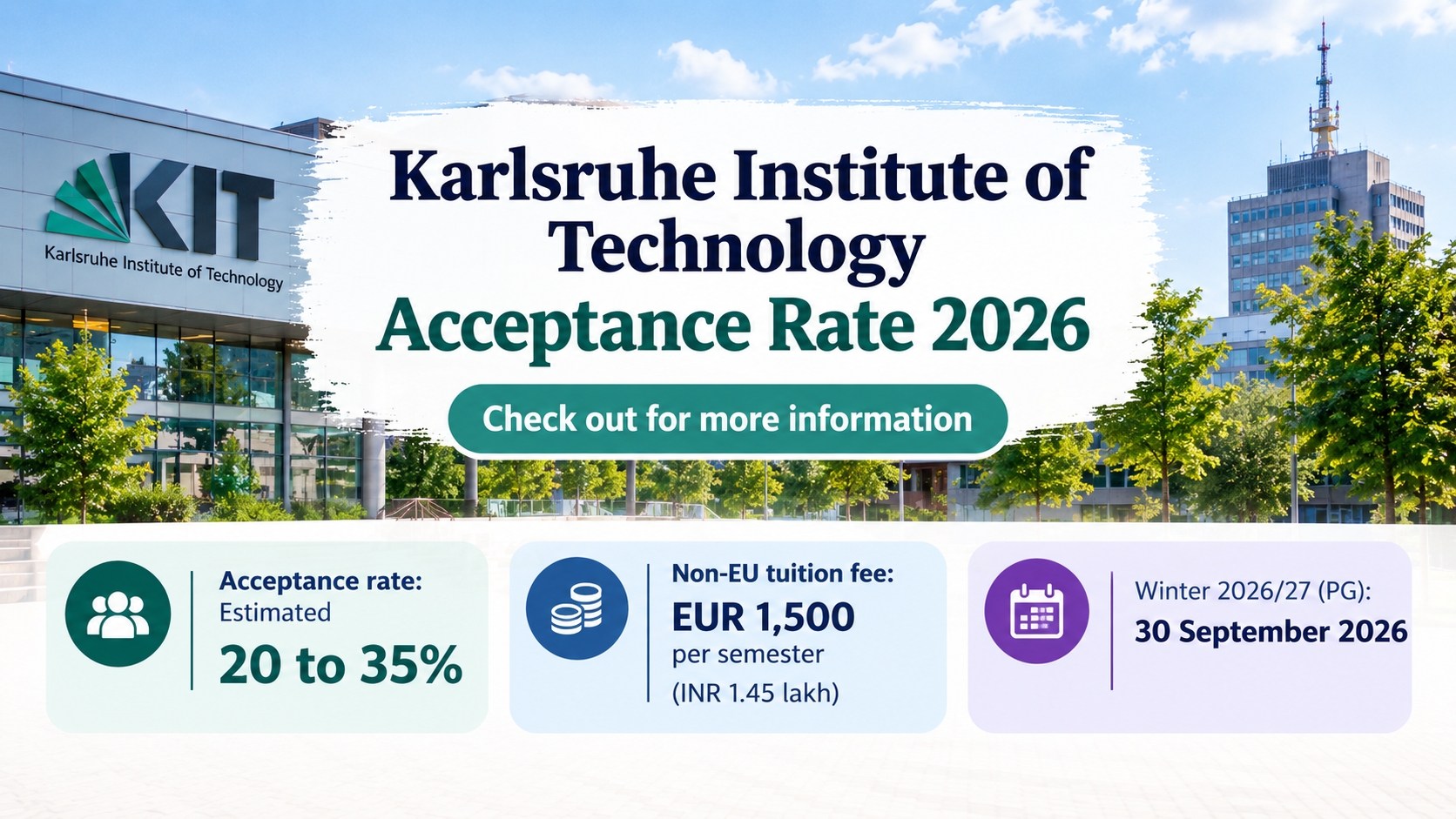
The Karlsruhe Institute of Technology acceptance rate is not officially published by the university. Student community reports and program-level admit patterns suggest a moderate selectivity band, with most master’s courses landing in an estimated 20 to 35% admit range. Indian applicants who meet the subject and language thresholds have a fair shot.
- KIT uses threshold-based selection, not a fixed percentage cutoff like US schools.
- Meeting subject match and language proof matters more than a raw GPA number.
- English-taught master’s courses face heavier competition from Indian and Asian applicants.
- A weak subject fit hurts more than a mid-range Abitur equivalent.
KIT is a University of Excellence and one of the TU9 group of leading German technical universities. That reputation pulls a heavy Indian applicant pool into computer science, mechanical engineering and electrical engineering each year.
Also Read: KIT Karlsruhe: Fees 2026, Eligibility, Scholarships and Rankings
- All Courses and Fees at KIT for Indian Students
- KIT Admission Requirements for Indian Students 2026-27
Quick Facts on KIT Admissions
| Parameter | Detail |
|---|---|
| Overall acceptance rate | Not officially published (estimated 20 to 35%) |
| Location | Karlsruhe, Baden-Württemberg, Germany |
| Non-EU tuition fee | EUR 1,500 per semester (INR 1.45 lakh) |
| Winter intake deadline | July 15, 2026 (closed) |
| Summer intake deadline | January 15, 2027 (limited programs) |
| Language proof | IELTS 6.5 or TOEFL iBT 90 for English-taught courses |
What Is the KIT Acceptance Rate?
KIT does not publish an official acceptance rate, unlike US or UK universities. German public universities work on a threshold model. If your profile clears the subject, grade, and language bar, you get in.
That means an Indian applicant does not fight a fixed quota. The fight is against the eligibility rules and the depth of your subject match. Student data and forum reports suggest that competitive master’s courses at KIT admit roughly one in three to one in five qualified international applicants. Treat this as an estimate, not an official figure.
KIT is part of the TU9 group of top technical universities in Germany. That pulls a dense international pool, so headline chances feel tighter than the actual gatekeeping.
Why an exact number is hard to pin down
- German data privacy rules limit what universities publish on rejections.
- Each faculty runs its own selection panel, so admit rates vary by department.
- Applicants often withdraw after admits from other TU9 schools, skewing yield.
- Winter and summer intakes have different applicant pools and thresholds.
Program-wise Admission at KIT
Admission chances at KIT change sharply by subject. Popular English-taught master’s courses in computer science and mechanical engineering face heavier Indian and Chinese demand, which tightens the effective admission rate.
The table below shows an indicative selectivity pattern based on student reports. Treat every number as an estimate, not an official KIT figure.
| Program | Language | Estimated Selectivity |
|---|---|---|
| M.Sc. Computer Science | German or English | Highly competitive |
| M.Sc. Information Engineering and Management | English | Highly competitive |
| M.Sc. Mechanical Engineering | German | Moderate to competitive |
| M.Sc. Electrical Engineering and IT | German or English | Moderate to competitive |
| M.Sc. Chemical and Process Engineering | German | Moderate |
Source: KIT program pages and Indian student admission forums. Verify current status on the KIT International Students Office site before you apply.
What KIT looks for beyond grades
- At least 60-70% subject overlap between your bachelor’s and the chosen master’s.
- A clear letter of motivation tied to KIT’s research groups.
- Proof of quantitative work such as a thesis, projects, or lab experience.
- Language score at or above the program cutoff.
Eligibility for KIT for Indian Students
Indian applicants must clear three gates for KIT admission: academic equivalence, subject match and language proof. Miss any one and the application does not move forward.
KIT accepts a recognised Indian bachelor’s degree (four-year technical or three-year plus one year of relevant work or study) as equivalent to a German bachelor’s. Anabin, the German database, is the reference the university uses to check your Indian degree.
Bachelor’s programs
- Class 12 with strong science and maths marks.
- Feststellungsprüfung or one year of Indian bachelor’s study for direct entry.
- Proof of German language proficiency at C1 level (TestDaF or DSH) for most bachelor’s courses.
Master’s programs
- Four-year Indian bachelor’s in a related subject with first-class marks.
- Subject overlap of 60% or more between undergrad and target master’s.
- Language proof: IELTS 6.5 or TOEFL iBT 90 for English tracks. C1 German for German tracks.
- GRE is not mandatory, but a strong score helps for competitive programs.
If your degree needs an APS certificate (Academic Evaluation Centre check), start that at least three months before the KIT deadline. The APS process is now mandatory for Indian applicants and runs through the German Embassy in Delhi.
KIT Application Process Step by Step
KIT runs its application through the university’s own portal, not uni-assist, for most master’s programs. The step order matters because language, APS and university documents each take time.
- Check your degree on Anabin and confirm KIT’s subject list for your target master’s.
- Book IELTS or TestDaF and get your score in hand.
- Apply for the APS certificate at the Delhi office, at least three months before the KIT deadline.
- Create your account on the KIT application portal (Campus Management or uni-assist as required by the program).
- Upload transcripts, degree certificate, language proof, APS, motivation letter, and CV.
- Pay any application fee if the program routes through uni-assist.
- Submit before the deadline and track the status on the portal.
What KIT admission gives you
- A place at a University of Excellence with strong research funding.
- Access to KIT’s industry links with Bosch, SAP, Mercedes, and Siemens.
- An automatic block on a residence permit application for Germany.
What KIT admission does not cover
- It does not fund your tuition or living costs.
- It does not book your housing (KIT student services can help but do not guarantee).
- It does not include health insurance, which you must arrange separately.
Read More: Complete Guide to Study in Germany for Indian Students
KIT Deadlines and Application Timeline
KIT runs two intakes a year, but most master’s programs only start in the winter semester. Miss the July window, and you often wait a full year.
| Intake | Deadline | Course Start |
|---|---|---|
| Winter semester (main) | July 15, 2026 (closed) | October |
| Summer semester (limited programs) | January 15, 2027 | April |
The two dates above are the standard KIT deadlines. Some programs move a few days on either side, so confirm on the program’s own page.
Recommended timeline for Indian applicants
- 15 to 18 months before start: Shortlist programs, start IELTS or German prep.
- 12 months before: Book language test, gather transcripts.
- 9 to 10 months before: Apply for APS certificate.
- 6 to 7 months before: Draft motivation letter, get LORs, submit KIT application.
- 3 to 4 months before: Apply for the German student visa and block account.
- 1 to 2 months before: Book housing and travel.
Key Insight: The German visa slot at VFS Delhi and Mumbai fills up fast between April and August. Book your visa appointment the day your KIT admit letter arrives.
Documents Required for KIT Admission
Missing a single document is the most common reason Indian applicants get rejected at KIT. The list below covers what most master’s programs need.
Core academic documents
- Class 10 and Class 12 marksheets.
- Bachelor’s degree certificate and all semester transcripts.
- Anabin printout showing your university’s status.
- APS certificate for Indian applicants.
Language and test scores
- IELTS Academic (6.5 or higher) or TOEFL iBT (90 or higher) for English tracks.
- TestDaF (minimum TDN 4 in all sections) or DSH-2 for German tracks.
- GRE score if the program lists it as optional but recommended.
Supporting documents
- Motivation letter of one to two pages linked to a KIT research group.
- Two academic Letters of Recommendation.
- Updated CV in European format.
- Passport copy.
- Passport-size photograph.
Also Read:
The Karlsruhe Institute of Technology acceptance rate is not a single fixed number. It is a set of thresholds across academic fit, language, and paperwork. Indian applicants who plan the APS, language test, and motivation letter in time have a strong shot at competitive master’s tracks. Fees remain among the lowest for a top-ranked technical university in the world. Add Karlsruhe’s low cost of living and Baden-Württemberg’s dense industry base, and the return on this admit is one of the best in Europe.
FAQs
Ques. Is an APS certificate mandatory for KIT admission?
Ans. Yes. Since 2022, the APS certificate is mandatory for all Indian applicants to German universities, including KIT. Apply at the German Embassy office in Delhi at least three months before the KIT application deadline.
Ques. Which programs at KIT are most competitive for Indians?
Ans. M.Sc. Computer Science and M.Sc. Information Engineering and Management face the heaviest Indian and Chinese applicant pools. These English taught tracks have tighter admits than German taught mechanical or electrical engineering programs.
Ques. Can I get a scholarship at KIT as an Indian student?
Ans. Yes. Indian students can apply for DAAD scholarships covering around EUR 934 per month, or the Deutschlandstipendium worth EUR 300 per month. Both are merit based and highly competitive.
Ques. What is the KIT student visa amount for the blocked account?
Ans. The blocked account amount for a German student visa is EUR 11,904 per year as of 2024. This proves you can support yourself in Germany during your first year of study.
Ques. Does KIT offer stay back after graduation for Indian students?
Ans. Yes. Every KIT graduate can apply for an 18 month job search visa after their master’s. Once you land a role tied to your degree, you can switch to an EU Blue Card and later to permanent residency.
Ques. Is KIT a good university for Indian students?
Ans. Yes. KIT is one of the TU9 top technical universities in Germany and a University of Excellence. Low tuition, strong industry links with Bosch, SAP and Mercedes, and moderate cost of living make it a top choice for Indian STEM students.
interested in this College ?
Follow & Share this college to get information about admission.



Comments