



Study Abroad Expert | Updated On - Apr 27, 2026
Managing money abroad is one of the most underestimated challenges Indian students face after landing at their destination. You have your admission letter, your visa, your bags packed — but the moment you need to pay rent, buy groceries, or withdraw cash from an ATM in a foreign country, the wrong financial tool can quietly drain hundreds of dollars in hidden fees. A forex card for Indian students is specifically designed to solve this problem. It locks in exchange rates, eliminates the 3.5%+ markup that regular debit cards charge on every swipe, and gives your family in India a way to reload funds remotely. With the Indian rupee at approximately ₹93 per USD in April 2026, every percentage point saved on currency conversion directly reduces your cost of studying abroad. This guide covers the best forex cards available to Indian students right now, with fee data sourced directly from official bank websites, and real student insights from Quora and Reddit threads.
Conversion Note: All INR conversions in this article are based on 1 USD = ₹93 (27, April 2026)
What Is a Forex Card and Why Do Indian Students Need One Abroad?
A forex card is a prepaid travel card loaded with foreign currency at a fixed exchange rate. Unlike your regular Indian debit card, it does not charge a 3.5% foreign transaction markup on every purchase. Unlike cash, it cannot be stolen without recourse. Unlike a credit card, it does not accumulate debt.
For Indian students, the practical advantage is significant. When you load a forex card with USD, GBP, EUR, or AUD before departure, you lock in the rate at that moment. If the rupee weakens further after you land, your card balance is unaffected. Your family can reload the card from India through net banking, and you can track every transaction through an app.
The RBI's Liberalised Remittance Scheme (LRS) allows Indian residents to remit up to USD 2,50,000 per financial year for education purposes. Forex cards fall under this scheme. From April 1, 2026, TCS on self-funded education remittances above ₹10 lakh has been reduced from 5% to 2%, making it cheaper to load and reload your card from India. Read more about the TCS reduction and how much your family saves.
The key difference between a forex card and a regular international debit card is the markup fee. Every time you swipe your Indian debit card abroad, your bank charges a cross-currency markup of 3.5% plus GST. On a monthly spend of USD 1,000 (approx. ₹93,000), that is ₹3,255 lost every single month — over ₹39,000 in a year — just in markup fees.
Best Forex Cards for Indian Students Studying Abroad: Compared
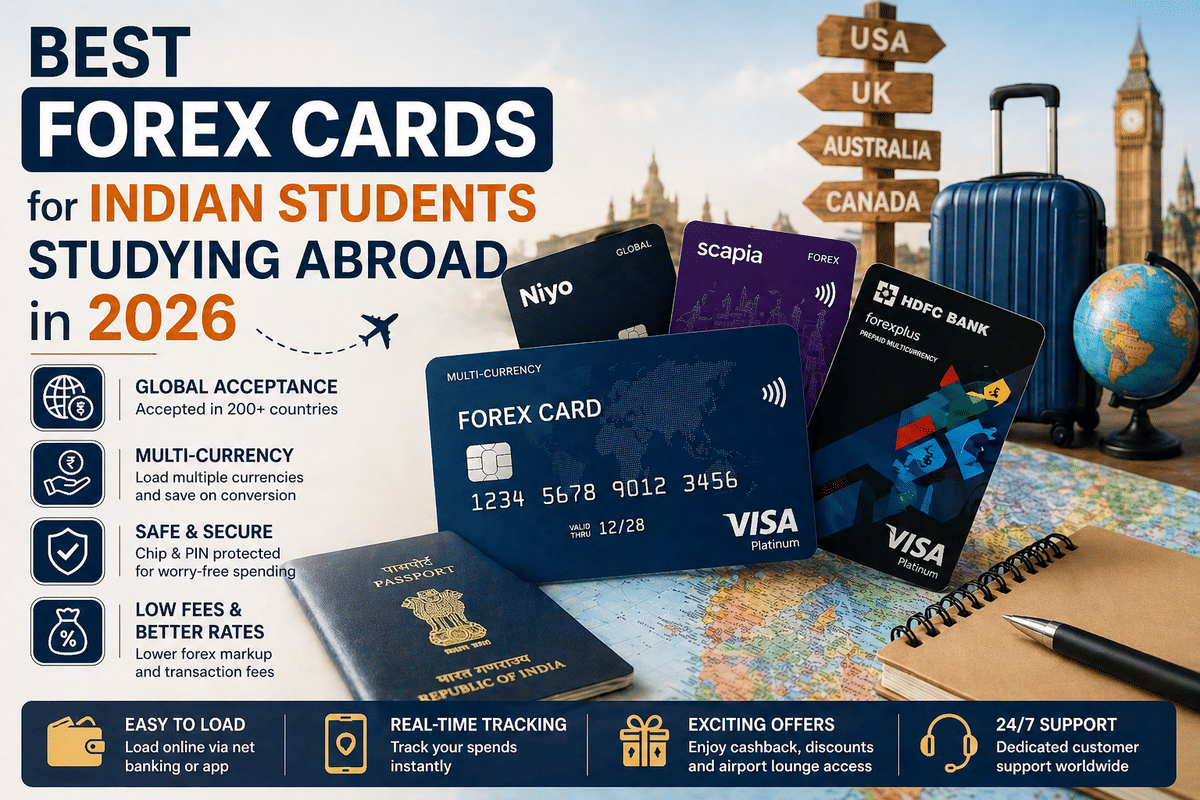
The four most widely used forex cards among Indian students are the Niyo Global Card (SBM Bank), HDFC Multicurrency Platinum ForexPlus Card, ICICI Bank Student Forex Prepaid Card, and Axis Bank Multi-Currency Forex Card. Each has a distinct fee structure and set of features suited to different student needs.
The table below is built entirely from official bank and issuer websites. No third-party fee estimates have been used.
| Feature | Niyo Global Card (SBM Bank) | HDFC Multicurrency ForexPlus | ICICI Student Forex Prepaid Card | Axis Bank Multi-Currency Forex Card |
|---|---|---|---|---|
| Issuance Fee | NIL (physical card requires ₹5,000 initial load) | ₹500 + GST (waived on loading USD 1,000+) | NIL | ₹300 + GST |
| Annual / Joining Fee | ₹423 + GST (waived on ₹5,000 avg monthly balance) | NIL | NIL | NIL |
| Forex Markup | Zero (VISA rate applies directly) | 2% cross-currency markup | Competitive bank-set rates | 3.5% cross-currency markup |
| Reload Fee | NIL | ₹75 + GST per reload (per currency) | NIL | NIL (digital reload) |
| ATM Withdrawal Fee | NIL (up to free limit) | USD 2 per withdrawal (USD wallet) | 1 free per month for 5 years; charges apply after | USD 2.25 per withdrawal |
| Currencies Supported | 100+ (INR-based, VISA rate at transaction time) | 22 currencies | Multiple currencies | 16 currencies |
| Card Validity | As per card expiry date | 5 years | 5 years | As per card expiry date |
| Student-Specific Benefits | Zero markup, lounge access, app-based card lock/unlock, up to 7% interest on balance | Free ISIC card (₹999), free IYTC card, free international SIM, zero surcharge at Allpoint ATMs | Free ISIC membership (₹999), 1 lounge access, Uber voucher ₹500, free international SIM (via Visa), free replacement card | Free ISIC card, insurance cover up to ₹3 lakh, Allpoint ATM network access |
| Insurance Cover | Not specified on official page | Up to ₹5 lakh (card misuse), ₹25 lakh (air accident), ₹20,000 (lost baggage) | Up to ₹5 lakh (lost card liability), ₹1,600 card protection insurance | Up to ₹3 lakh (fraud/loss), ₹60,000 (ATM assault) |
| Existing Account Required | No — open via Niyo app | No — non-HDFC customers can apply | No | Yes — Axis Bank savings account required |
| Official Source | sbm.bank.in / goniyo.com | hdfc.bank.in | icici.bank.in | axis.bank.in |
A key point students miss: the Axis Bank Multi-Currency Forex Card requires you to hold an Axis Bank savings account. If you do not already bank with Axis, you will need to open an account first. All other cards on this list can be obtained without an existing relationship with the issuer.
The HDFC card's issuance fee of ₹500 is waived if you load a minimum of USD 1,000 (approx. ₹93,000) at the time of purchase — which most students going abroad for a semester or more will do anyway.
Planning to study abroad? Explore top universities and courses on Collegedunia Study AbroadNiyo Global Card: Is Zero Forex Markup Actually Worth It for Students?
For students who want the lowest possible transaction cost on daily spending, the Niyo Global Card (powered by SBM Bank) is the strongest option available to Indian students in 2026. It charges zero forex markup on all international transactions — meaning you pay exactly the VISA exchange rate with no additional percentage added by the bank.
The card is INR-based. You load Indian rupees into your SBM Bank savings account, and the conversion happens at the live VISA rate at the time of each transaction. This is different from a traditional multi-currency forex card where you pre-load a specific foreign currency at a fixed rate.
What this means practically: if the rupee strengthens between the time you load and the time you spend, you benefit. If it weakens, you pay more per transaction. For students who receive regular monthly transfers from family in India, this works well. For students who want to lock in a rate before a period of expected rupee depreciation, a traditional multi-currency card like HDFC's may be more suitable.
The SBM Bank savings account linked to the Niyo card also earns up to 7% interest per annum on the balance, with monthly payouts. This is a meaningful benefit for students who keep a semester's worth of funds in the account.
Student Insight (Quora): "The Niyo forex card is the best card I have used. Best conversion rate compared to other private bank forex cards. No reloading fee, no ATM withdrawal fee, no inactivity fees. The only downside is the transaction limit — ₹1 lakh/day, ₹2 lakh/month, ₹5 lakh/year — which makes it difficult to pay university fees directly." — MS Computer Science graduate, University of Georgia
This transaction limit is a real constraint. If your semester tuition is above ₹5 lakh, you cannot pay it through the Niyo card alone. Most students use Niyo for daily expenses and a separate bank transfer or multi-currency card for large tuition payments.
HDFC and ICICI Student Forex Cards: What You Actually Get
The HDFC Multicurrency Platinum ForexPlus Card and the ICICI Bank Student Forex Prepaid Card are the two most established bank-backed forex cards for Indian students, with the widest acceptance and the most comprehensive insurance coverage.
The HDFC card supports 22 currencies and has a daily ATM withdrawal limit of USD 5,000 — the highest among the cards compared here. It comes with a complimentary insurance package that includes air accident cover of ₹25 lakh, road/rail accident cover of ₹5 lakh, and loss of checked baggage cover of ₹20,000. For students travelling to the US, UK, Canada, or Australia, this insurance is genuinely useful.
The ICICI Student Forex Prepaid Card is the only card on this list designed specifically for students. It comes with a free ISIC (International Student Identity Card) membership worth ₹999, which gives access to discounts at over 1,50,000 outlets in 125+ countries. It also includes one complimentary international airport lounge access, an Uber voucher worth ₹500, and a free international SIM card offered by Visa. The joining fee and annual fee are both NIL.
The ICICI card also provides one free ATM withdrawal per month for the first five years. After the first free withdrawal each month, ATM fees apply based on the currency used.
Student Insight (Quora): "Do not buy the SBI Forex card. The card does not have a chip, and most services in the UK require a chip card. The server keeps going down. Customer service is terrible — the server usually falls during Indian nights, which is daytime in western countries. Get two cards from two different banks so that if one does not work, you can use the other." — Parent of a student who studied in the UK
This is a critical point. Always carry two cards from two different issuers. Card servers go down. Cards get blocked by fraud detection. Having a backup is not optional — it is essential.
Forex Card Fees That Indian Students Often Miss
The issuance fee and annual fee are visible. The fees that quietly drain your balance are the cross-currency markup, ATM withdrawal charges, and Dynamic Currency Conversion (DCC) traps.
Here is what each fee means in practice for a student spending USD 500 per month abroad:
| Fee Type | What It Is | Monthly Cost on USD 500 Spend | How to Avoid It |
|---|---|---|---|
| Cross-Currency Markup | Charged when you spend in a currency not loaded on the card | ₹1,627 (at 3.5%) to ₹930 (at 2%) | Always spend in the currency loaded on your card |
| ATM Withdrawal Fee | Fixed fee per ATM transaction | USD 2–2.25 per withdrawal (approx. ₹186–₹209) | Withdraw larger amounts less frequently |
| Dynamic Currency Conversion (DCC) | ATM or merchant converts to INR at their own rate instead of card rate | Can add 3–5% extra on each transaction | Always choose to pay in local currency, never in INR |
| Reload Fee | Charged per reload transaction (HDFC only among cards listed) | ₹75 + GST per reload per currency (HDFC) | Reload in larger amounts less frequently |
| Inactivity / Dormancy Fee | Charged if card is unused for a defined period | Varies by issuer | Use the card regularly or close it before going dormant |
The DCC trap is the most common mistake students make at ATMs abroad. When an ATM asks "Do you want to be charged in INR or in USD?" — always choose the local currency (USD, GBP, EUR, etc.). Choosing INR means the ATM's bank applies its own conversion rate, which is almost always worse than your forex card's rate.
The Axis Bank Multi-Currency Forex Card charges 3.5% cross-currency markup. This means if you have loaded USD on the card but spend in EUR (for example, during a trip to Europe), you pay 3.5% extra on every transaction. Plan your currency wallets carefully before travel.
Which Forex Card Should Indian Students Pick Based on Their Study Destination?
The right forex card depends on your destination, your spending pattern, and whether you need to make large tuition payments directly from the card. Here is a destination-wise recommendation based on official card features:
| Destination | Primary Currency | Recommended Card | Why |
|---|---|---|---|
| USA | USD | Niyo Global + HDFC ForexPlus (backup) | Zero markup for daily spend; HDFC for large tuition payments and higher ATM limit |
| UK | GBP | ICICI Student Forex Card + Niyo | ICICI's chip-and-PIN works everywhere in UK including public transport; Niyo for zero markup daily spend |
| Canada | CAD | HDFC ForexPlus or ICICI Student Card | Both support CAD; HDFC has higher daily ATM withdrawal limit |
| Australia | AUD | HDFC ForexPlus or Niyo Global | HDFC supports AUD wallet with locked rate; Niyo for zero markup on daily transactions |
| Germany / Europe | EUR | ICICI Student Card + Niyo | ICICI for EUR wallet with locked rate; Niyo for zero markup on daily transactions |
| Singapore | SGD | HDFC ForexPlus or Axis Bank | Both support SGD; HDFC has higher daily ATM limit of USD 5,000 equivalent |
| Multi-country travel | Multiple | HDFC ForexPlus (22 currencies) | Widest currency support among all cards listed; single card for multiple destinations |
For students going to the UK specifically, chip-and-PIN is mandatory for most transactions including public transport. All four cards compared in this article have chip-and-PIN functionality. Avoid the SBI Forex Card for the UK based on reported issues with chip availability and server downtime.
Students planning to study in Germany should note that many German merchants and ATMs prefer chip-and-PIN cards. Read about Germany's blocked account requirement for Indian students.
Check the average cost of studying abroad by destination to plan your forex card loading amountHow to Apply for a Student Forex Card Before Leaving India
All four forex cards can be applied for online, and most offer home delivery within 5–7 working days. Apply at least 2 weeks before your departure date to avoid last-minute issues.
The documents required are standard across all issuers:
- Valid Indian passport (self-attested copy)
- PAN card (self-attested copy)
- Visa copy or air ticket (required for HDFC if you are not an existing customer)
- University admission or enrolment letter (required for ICICI Student Card)
- Aadhaar card (for Niyo Global — KYC completed via app)
The Niyo Global Card has the simplest application process. You download the Niyo app, complete KYC using your PAN, Aadhaar, and Indian passport, and your virtual card is ready immediately for online transactions. To get the physical card, you load ₹5,000 into the SBM savings account and place a card order. Physical delivery takes 5–7 days.
For HDFC and ICICI, non-customers can apply online and either get home delivery or collect from a branch. HDFC requires non-customers to visit a branch for KYC verification before the card is activated. The ICICI Student Forex Prepaid Card requires a university enrolment letter as proof of student status.
The Axis Bank Multi-Currency Forex Card requires an existing Axis Bank savings account. If you do not have one, you will need to open an account first, which adds time to the process. The card can be applied for online through the Axis Bank website or mobile app once the account is active.
Student Insight (Reddit): "My advice is to have Niyo plus a Thomas Cook Prepaid Forex Card. The Niyo card is great for daily spending with zero markup. The Thomas Cook card is useful for loading specific currencies at a locked rate when you want to hedge against rupee depreciation." — Student who completed a 4-month exchange semester in Milan
RBI Rules and TCS on Forex Cards: What Indian Students Must Know in 2026
Loading a forex card is an outward remittance under the RBI's Liberalised Remittance Scheme (LRS). The annual limit is USD 2,50,000 per individual per financial year (April to March). This limit covers all outward remittances combined — forex card loads, wire transfers, and any other foreign currency transactions.
From April 1, 2026, TCS on self-funded education remittances above ₹10 lakh per year has been reduced from 5% to 2%. If your family is funding your education from savings (not an education loan), they now pay 2% TCS on the amount above ₹10 lakh sent in a financial year. TCS is not a permanent cost — it is credited to your family's tax account and can be claimed back when filing the income tax return.
If your education is funded by a bank loan, TCS on remittances is NIL. This has not changed.
One important check before your family makes any remittance: ensure PAN is linked to Aadhaar. If PAN is not linked to Aadhaar, the bank will charge TCS at 5% regardless of the Budget 2026 reduction. Linking takes a few minutes at incometax.gov.in.
For large tuition payments, wire transfers are often more practical than forex cards due to higher transaction limits. Read about wire transfer options for Indian students in the USA. For daily living expenses, a forex card is the most cost-effective tool.
Also check: Education Loan for Abroad Studies: Types, Eligibility and Application
FAQs
Ques. Which is the best forex card for Indian students studying abroad in 2026?
Ans. The best forex card depends on your use case. For zero markup on daily spending, the Niyo Global Card (SBM Bank) is the strongest option. For a student-specific card with ISIC membership, lounge access, and insurance, the ICICI Bank Student Forex Prepaid Card is purpose-built. For the widest currency support (22 currencies) and highest ATM limit, the HDFC Multicurrency Platinum ForexPlus Card is recommended. Most students benefit from carrying two cards — one for daily spending and one as a backup for large payments.
Ques. Can I use a forex card to pay university tuition fees abroad?
Ans. Yes, you can use a forex card to pay tuition fees directly to your university. However, check the transaction limits on your card. The Niyo Global Card has a limit of ₹5 lakh per year, which may not be sufficient for full tuition payments. The HDFC ForexPlus Card allows up to USD 2,50,000 per financial year. For very large tuition payments, a wire transfer through your Indian bank is often more practical.
Ques. What is the forex markup fee and how does it affect Indian students?
Ans. A forex markup fee is a percentage charged by the card issuer on top of the exchange rate for every transaction made in a foreign currency. The Niyo Global Card charges zero markup. HDFC charges 2% cross-currency markup (only when spending in a currency different from the one loaded). Axis Bank charges 3.5% cross-currency markup. On a monthly spend of USD 500 (approx. ₹46,500), a 3.5% markup costs approximately ₹1,627 extra every month — over ₹19,500 per year.
Ques. Do I need an existing bank account to get a forex card?
Ans. Not for most cards. The Niyo Global Card, HDFC ForexPlus Card, and ICICI Student Forex Prepaid Card can all be obtained without an existing account with the issuer. The Axis Bank Multi-Currency Forex Card requires an existing Axis Bank savings account. The Niyo card has the simplest process — apply entirely through the Niyo app with PAN, Aadhaar, and passport details.
Ques. What is Dynamic Currency Conversion (DCC) and how do I avoid it?
Ans. Dynamic Currency Conversion (DCC) is when an ATM or merchant abroad offers to convert your transaction into Indian rupees at their own exchange rate. This rate is almost always worse than your forex card's rate. Always decline DCC and choose to pay in the local currency of the country you are in. This applies at ATMs, hotel checkouts, and retail POS terminals.
Ques. How many forex cards should an Indian student carry abroad?
Ans. Carry at least two cards from two different issuers. Card servers can go down, cards can be blocked by fraud detection systems, and some cards may not be accepted in smaller towns or specific merchants. A common combination used by Indian students is Niyo Global (for zero markup daily spending) plus HDFC or ICICI (for backup and large payments). Keep the backup card in a separate location from your primary card.
Ques. Is TCS applicable when loading a forex card in 2026?
Ans. Yes. Loading a forex card is an outward remittance under the RBI's LRS. From April 1, 2026, TCS on self-funded education remittances above ₹10 lakh per financial year is 2% (reduced from 5%). If your education is funded by a bank loan, TCS is NIL. TCS is not a permanent cost — it is credited to your tax account and can be claimed back when filing your income tax return.
Ques. Can my parents reload my forex card from India while I am abroad?
Ans. Yes. All four cards covered in this article support remote reload from India. For HDFC and ICICI, your family can reload through net banking. For Niyo, reload is done through the Niyo app or by transferring funds to the linked SBM Bank savings account. Axis Bank customers can reload through Axis net banking or the mobile app. Ensure your family has the card number and reload details before you depart.
Ques. What documents are needed to apply for a student forex card in India?
Ans. The standard documents required are a valid Indian passport (self-attested copy), PAN card (self-attested copy), and for the ICICI Student Forex Prepaid Card, a university enrolment or admission letter. For Niyo Global, KYC is completed digitally using PAN, Aadhaar, and passport details through the app. For HDFC, non-customers also need a copy of their air ticket or visa and a bank statement or passbook copy.
Ques. What should I do if my forex card stops working abroad?
Ans. Call the international toll-free number of your card issuer immediately. HDFC, ICICI, and Axis Bank all provide country-specific toll-free numbers for cardholders abroad. For Niyo, 24x7 in-app live chat support is available. This is why carrying two cards from two different issuers is essential — if one card fails, you have an immediate backup. Keep the customer care numbers saved on your phone before you travel.


1778823093.png?tr=w-305,h-145,c-force?h=175&w=350&mode=stretch)



Comments