



Study Abroad Expert | Updated On - Oct 15, 2026
The Reserve Bank of India raised the repo rate by 25 basis points to 5.50% on 7 October 2026, lifting EMIs for Indian students funding degrees in the US, UK and Canada through variable-rate education loans. The Monetary Policy Committee also shifted its stance from Neutral to Calibrated Tightening in a 4-2 vote. Governor Sanjay Malhotra confirmed the new rate takes effect immediately. The move follows a Reuters poll where 35 of 61 economists expected the hike.
- Repo-linked education loans reset to higher EMIs on the next interest reset date, not immediately for all borrowers.
- Of 53 economists polled by Reuters, 29 expect at least one more 25 bps hike in December 2026.
- Dr Nagesh Kumar and Prof Ram Singh voted to keep the Neutral stance, signalling MPC split on tightening speed.
The last RBI rate rise was in February 2023, which makes this the first hike in over three and a half years. Floating-rate borrowers on External Benchmark Lending Rates face the direct hit, while fixed-rate loan holders stay unaffected until their next reset.
Also Read: Education Loan Options for Study Abroad
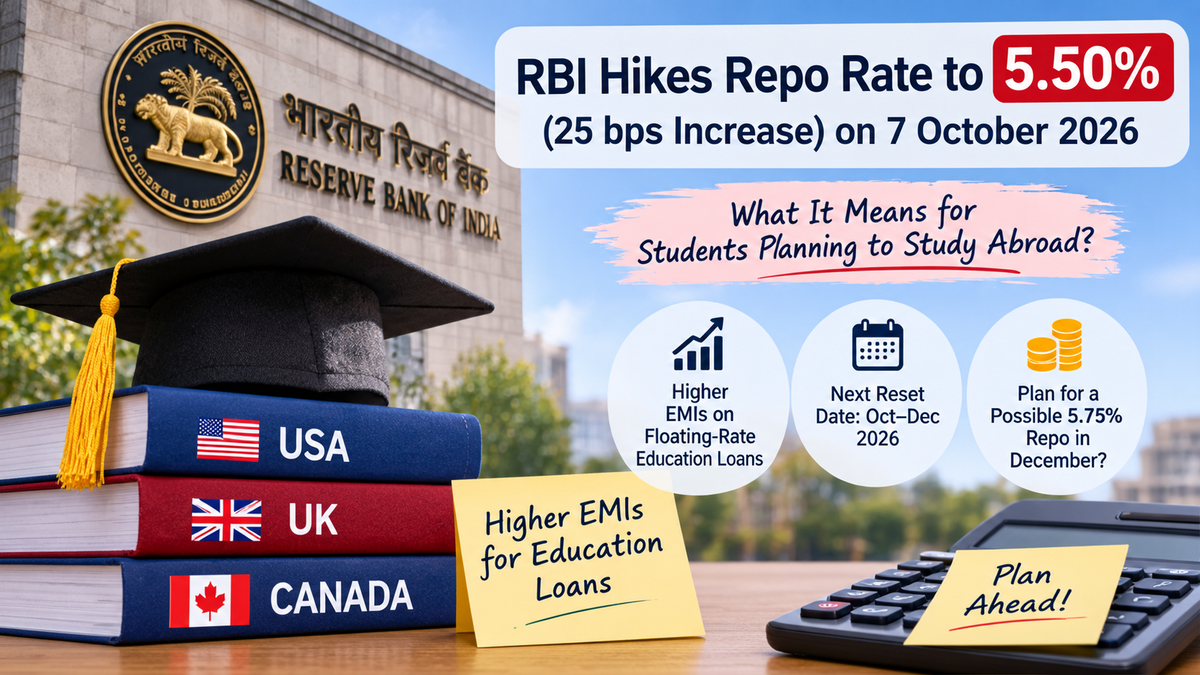
What Changes for Indian Students in the US, UK and Canada
Students funding degrees abroad through EBLR-linked rupee loans will see higher EMIs from their next reset date. The 25 basis point hike flows into every floating-rate education loan tied to the repo rate.
A rupee education loan sanctioned at repo plus 3% now costs 8.50% for new borrowers, up from 8.25%. Existing borrowers on floating rates reset at their scheduled reset date, usually quarterly or half-yearly.
| Loan Amount | Old EMI at 8.25% | New EMI at 8.50% | Monthly Increase |
|---|---|---|---|
| INR 40 Lakh (10 year tenure) | INR 49,069 | INR 49,624 | INR 555 |
| INR 60 Lakh (10 year tenure) | INR 73,603 | INR 74,436 | INR 833 |
| INR 80 Lakh (10 year tenure) | INR 98,138 | INR 99,248 | INR 1,110 |
Figures are indicative, computed on standard reducing balance EMI math. Actual EMI depends on your lender's spread over EBLR and your specific reset cycle.
What it means for Indian Students: A student loaning INR 60 lakh for a two-year US masters pays roughly INR 10,000 extra per year after this reset. Over a 10-year tenure, that is INR 1 lakh in added interest cost per hike.
Why This Hike Hits US-Bound Students Hardest
Students targeting the US face the biggest absolute cost rise because US tuition is already the highest among the three countries. A one-year US masters tuition averages US$ 40,000 to US$ 60,000, which translates to INR 35 to 53 lakh at current rates.The rupee has stayed under pressure through 2026, hovering around INR 94 to 95 per US dollar. That currency weakness compounds the EMI rise for US-bound borrowers.
- US masters: INR 35 to 53 lakh tuition + INR 15 to 20 lakh living = INR 50 to 73 lakh total.
- UK masters: around GBP 25,000 to GBP 35,000 tuition, roughly INR 32 to 45 lakh plus GBP 12,000 living.
- Canada masters: CAD 30,000 to CAD 45,000 tuition, roughly INR 18 to 27 lakh plus CAD 15,000 living.
Canada's lower absolute tuition cushions the EMI impact for students on the Intakes in Canada route. Students targeting Ivy League or Russell Group institutions bear the brunt of the hike.
How Floating Rate Education Loans Reset After This RBI Decision
Floating rate education loans linked to the External Benchmark Lending Rate reset on the borrower's scheduled reset date, not on 7 October 2026. Reset cycles typically run quarterly, so most borrowers face the new rate between October and December 2026.
Fixed-rate education loans stay unaffected throughout the loan tenure. Hybrid loans, which fix the rate for the first few years and then float, face the hike only after their fixed window ends.
- Check your loan agreement for the reset frequency and benchmark on your sanction letter.
- Confirm whether your spread over EBLR is fixed for the tenure or itself resets.
- Ask your lender for the exact new EMI figure after the next reset date.
- Consider part-prepayment if liquidity allows, since prepayment charges are typically nil on education loans.
Major lenders like SBI, HDFC Credila, Avanse, ICICI Bank and Bank of Baroda publish their revised education loan rates after each MPC meeting on their official websites.
Market Reaction and the December MPC Meeting
The 4-2 MPC vote signals internal disagreement on the pace of tightening. Dr Nagesh Kumar and Prof Ram Singh voted to retain the Neutral stance, which hints at a tighter December MPC call.
In the Reuters poll of 53 economists, 29 expected at least one more 25 basis point hike in December 2026. If that follow-through happens, repo climbs to 5.75% before the Spring 2027 study abroad cycle starts.
Students in the Fall 2027 application cycle should model loan EMIs at 5.75% repo, not 5.50%, to build a buffer. The December MPC meeting falls in the first week of December 2026, which lands before most January 2027 intake visa file submissions.
Key Caveat: The hike only lifts EMIs for repo-linked floating loans. Students with fixed-rate education loans from NBFCs like Avanse Fixed or MPower Financing face no change. Check your sanction letter before assuming the hike affects you.
What Study Abroad Applicants Should Do Now
Fall 2027 applicants should rework their loan math with a 50 basis point cushion. That cushion covers the current 25 bps hike plus a possible December 2026 one. Students comparing loan offers across SBI Global Ed-Vantage, HDFC Credila, Avanse, Prodigy Finance and MPower Financing should ask for fixed-rate quotes alongside floating ones. The fixed-rate premium is usually 50 to 100 basis points higher, which may now look worth paying.
Parents dipping into retirement savings or FDs for study abroad costs can factor in the FD rate rise that follows a repo hike. Senior citizen FD rates at top banks typically rise within weeks of a repo decision. Students yet to apply should also compare total ROI across destinations. The Study Abroad cost math shifts meaningfully when rupee weakness and loan EMI rise together.
Action Plan for Current Borrowers and Fresh Applicants
- Check your education loan reset date in your sanction letter this week.
- Get a revised EMI projection from your lender for the new rate.
- If applying for a fresh loan, ask for both fixed and floating quotes.
- Model loan EMIs for your intake at 5.75% repo, not 5.50%, as a safety buffer.
- Factor in rupee weakness alongside the EMI rise when picking your destination.
The RBI rate hike adds a thin layer of cost to study abroad, but the compounded hit from rupee weakness and tuition inflation stays the bigger factor. The December MPC decision will clarify whether this is a one-off adjustment or the start of a sharper tightening cycle. Students in the January 2027 intake and Fall 2027 application cycle should plan with the higher rate as the new base.
Next Key Date for Study Abroad Borrowers: The next RBI MPC meeting falls in the first week of December 2026. A second 25 basis point hike that week would take repo to 5.75% before the Spring 2027 intake cycle closes.


1778823093.png?tr=w-305,h-145,c-force?h=175&w=350&mode=stretch)



Comments