



Study Abroad Expert
Most Indian students applying to Cambridge know they need strong grades. What catches many off guard is the mandatory admissions test that comes before the interview, and in some cases, before Cambridge even looks at the rest of your application. These are not optional. Missing the registration deadline for a required test can invalidate your application entirely.
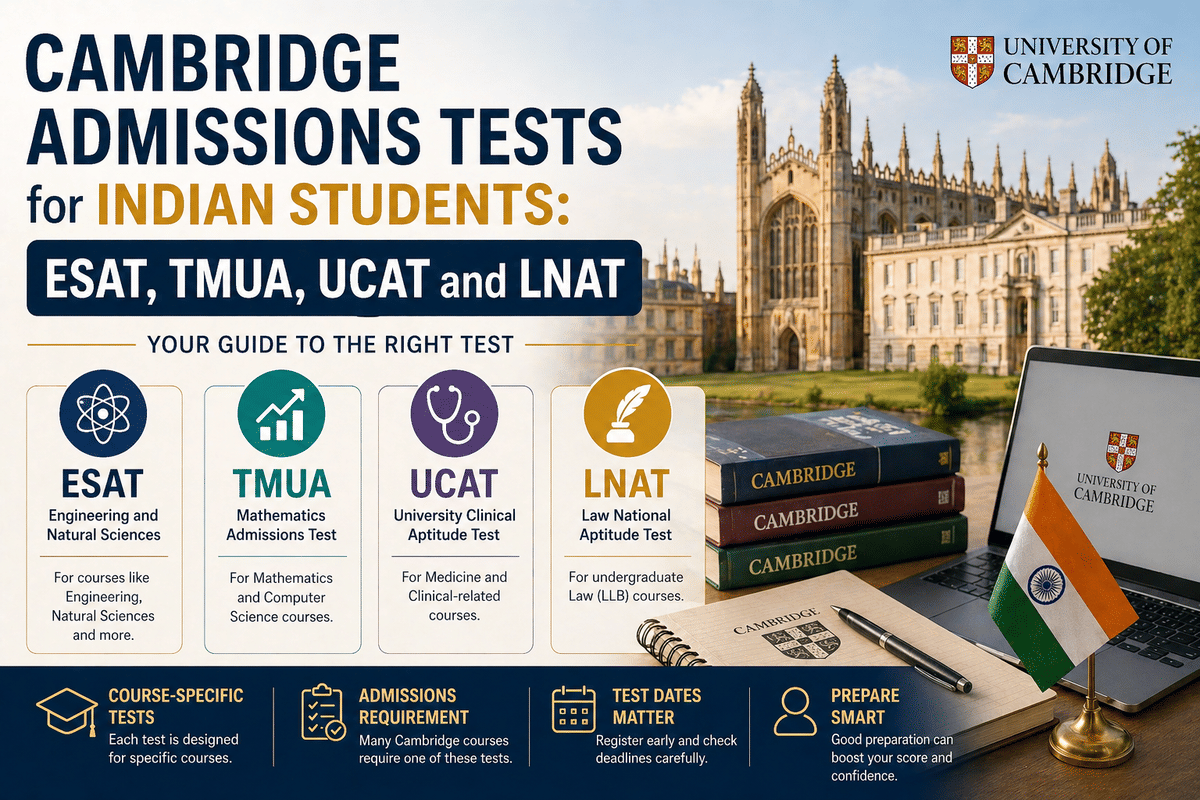
Cambridge requires a subject-specific admissions test for most undergraduate courses. There are four pre-registration tests — ESAT, TMUA, UCAT and LNAT — and a separate category of College admission assessments that are arranged after you are shortlisted for interview. Each test is different in format, timing and what it measures.
For Indian students, the challenge is not just preparing for these tests. It is knowing which test applies to your course, when to register, where to sit it in India, and how much it costs. The ESAT and TMUA are both taken at Pearson test centres, which are available across India. The UCAT is available in over 130 countries. The LNAT has over 500 test centres globally. None of these tests require you to travel abroad.
This article covers every Cambridge admissions test for 2027 entry, with all dates, fees and formats sourced directly from Cambridge's official website and the official test provider pages.
Conversion Note: All GBP to INR conversions in this article are based on the live rate of £1 = ₹127.64 (as of April 27, 2026).
Which Cambridge Admissions Test Do You Need for Your Course?
The test you need depends entirely on the course you are applying for, not your nationality or qualifications. Indian students take the same tests as UK students. There is no separate test for international applicants.
Cambridge divides its admissions assessments into two types. The first type must be registered for in advance and is taken before Cambridge decides whether to shortlist you for interview. The second type is a College admission assessment, arranged automatically after you are invited to interview. You do not register for the second type separately.
The table below covers all courses for 2027 entry, based on the official Cambridge admissions tests page.
| Course | Test Required | Pre-Registration Needed |
|---|---|---|
| Chemical Engineering and Biotechnology | ESAT (Engineering and Science Admissions Test) | Yes |
| Engineering | ESAT | Yes |
| Natural Sciences | ESAT | Yes |
| Veterinary Medicine | ESAT | Yes |
| Computer Science | TMUA (Test of Mathematics for University Admission) | Yes |
| Economics | TMUA | Yes |
| Mathematics | TMUA | Yes |
| Medicine (Standard A100 and Graduate A101) | UCAT (University Clinical Aptitude Test) | Yes |
| Law | LNAT (National Admissions Test for Law) | Yes |
| History, Geography, Philosophy, HSPS, Linguistics, Architecture, Design, Classics, Music, MML, AMES, Anglo-Saxon Norse and Celtic | College Admission Assessment | No (arranged by College after interview invite) |
| Archaeology, Education, History of Art, Environment Law and Economics | No test required | Not applicable |
Note for Computer Science applicants: If you are applying to Lucy Cavendish, Peterhouse, Selwyn or Trinity, you will also need to take the Computer Sciences Aptitude Test (CSAT) in addition to the TMUA. This is arranged separately by those Colleges.
Check the full University of Cambridge admissions requirements for your course before registering for any test.
ESAT: The Cambridge Science and Engineering Admissions Test Explained
The ESAT replaced the older NSAA and ENGAA tests and is now the standard pre-interview test for all science and engineering applicants at Cambridge. It is also used by Imperial College London, UCL and the University of Oxford, so if you are applying to multiple universities, you only need to sit it once.
The ESAT is a computer-based, multiple-choice test. It is made up of individual modules, each lasting 40 minutes and containing 27 questions. Mathematics 1 is compulsory for all candidates. The remaining modules depend on your course.
| Course | Modules Required | Total Duration |
|---|---|---|
| Engineering | Mathematics 1 + Physics + Mathematics 2 | 120 minutes |
| Natural Sciences | Mathematics 1 + two from: Biology, Chemistry, Physics, Mathematics 2 | 120 minutes |
| Chemical Engineering and Biotechnology | Mathematics 1 + two from: Biology, Chemistry, Physics, Mathematics 2 | 120 minutes |
| Veterinary Medicine | Mathematics 1 + two from: Biology, Chemistry, Physics, Mathematics 2 | 120 minutes |
Scores are reported on a scale of 1 (low) to 9 (high) per module. There is no pass or fail. You do not lose marks for wrong answers, so attempting every question is worth it.
ESAT Key Dates for 2027 Entry (Indian Students)
| Milestone | Date |
|---|---|
| Registration opens | 20 July 2026 |
| Access arrangements application opens | 1 June 2026 |
| Access arrangements deadline | 14 September 2026 |
| Registration deadline | 28 September 2026 |
| Test window (Sitting 1 — required for Cambridge applicants) | 12 to 16 October 2026 |
Important for Indian students: The January 2027 sitting (4 to 8 January 2027) is only for mature applicants applying to a Cambridge mature college with a January deadline. Standard applicants must sit the ESAT in October 2026.
ESAT Fee for Indian Students
The ESAT costs £133 (~₹16,976) for candidates sitting outside the UK and Republic of Ireland. You pay at the time of booking through the UAT-UK website. The test is taken at a Pearson test centre. You can locate your nearest centre on the Pearson website.
Note on preparation: Cambridge states that the ESAT tests your ability to apply science and mathematics knowledge, not just recall it. Free practice materials are available on the official ESAT website (esat-tmua.ac.uk). No preparation course is required or endorsed by Cambridge.
TMUA: What Indian Students Applying for Maths, Economics or CS Need to Know
The TMUA tests mathematical thinking and reasoning, not just calculation. It is used by Cambridge for Mathematics, Economics and Computer Science applicants. It is also accepted by LSE, UCL, Warwick, Durham and Oxford, so one sitting covers multiple universities.
The TMUA lasts 2 hours 30 minutes and is divided into two papers of 20 multiple-choice questions each. No calculator or dictionary is permitted.
| Paper | What It Tests | Questions | Duration |
|---|---|---|---|
| Paper 1: Applications of Mathematical Knowledge | Applying mathematics in new situations | 20 multiple-choice | 75 minutes |
| Paper 2: Mathematical Reasoning | Mathematical reasoning and elementary logic | 20 multiple-choice | 75 minutes |
Scores are reported on a scale of 1 to 9. There is no pass or fail. Wrong answers do not reduce your score.
TMUA Key Dates for 2027 Entry
| Milestone | Date |
|---|---|
| Registration opens | 20 July 2026 |
| Access arrangements deadline | 14 September 2026 |
| Registration deadline | 28 September 2026 |
| Test window (Sitting 1 — required for Cambridge applicants) | 12 to 16 October 2026 |
TMUA Fee for Indian Students: The TMUA costs £133 (~₹16,976) for candidates sitting outside the UK and Republic of Ireland. You register and pay through the UAT-UK website and sit the test at a Pearson test centre.
Note for Indian students: The TMUA is based on content typically covered in Higher Level GCSE Mathematics or AS Level Mathematics. If you are coming from a CBSE or ISC background, the content is broadly comparable to Class 11 and 12 Mathematics, but the style of questions is very different. The test rewards reasoning and problem-solving, not memorisation. Cambridge recommends reading the test specification and practising with the free materials on the TMUA website before sitting.
Explore what Cambridge really looks for in Indian applicants beyond test scores.
UCAT: Cambridge Medicine Applicants Must Register by September 2026
The UCAT is required for all Medicine applicants at Cambridge, both the standard undergraduate course (A100) and the graduate course (A101). It is a computer-based test taken at Pearson test centres and is used by multiple UK medical schools, so one sitting covers all your applications.
The UCAT assesses four areas: verbal reasoning, decision making, quantitative reasoning and situational judgement. It is not a subject knowledge test. It tests aptitude and clinical thinking skills.
UCAT Key Dates for 2026 (for 2027 Entry)
| Milestone | Date |
|---|---|
| Account registration opens | 20 May 2026 |
| Booking opens | 23 June 2026 |
| Test window opens | 13 July 2026 |
| Registration and booking deadline | 16 September 2026 (15:00 UK time) |
| Last date to sit the test | 24 September 2026 |
UCAT Fee for Indian Students: The UCAT costs £115 (~₹14,679) for candidates sitting outside the UK. You pay at the time of booking. Results are shared automatically with Cambridge after you sit the test.
Note on UCAT ANZ: If you are also applying to medical schools in Australia or New Zealand, Cambridge accepts the UCAT ANZ. You cannot take both the UCAT and UCAT ANZ in the same year. Choose based on where you are applying.
The UCAT is available at Pearson test centres in over 130 countries, including India. Book early as popular dates fill up quickly, especially in July and August.
LNAT: What Indian Law Applicants at Cambridge Must Prepare For
The LNAT is required for all Law applicants at Cambridge. It tests verbal reasoning, the ability to interpret information and analytical thinking. It is used by Cambridge and several other UK law schools, so one sitting covers multiple applications.
The LNAT has over 500 test centres globally, including centres in India. You can sit it on any day when your chosen test centre has availability, as long as it is before the Cambridge deadline.
LNAT Key Information
| Detail | Information |
|---|---|
| Test format | Multiple-choice section + essay section |
| Registration | Via the LNAT website (lnat.ac.uk) |
| Deadline | Check lnat.ac.uk for current dates and deadlines |
| Fee (outside UK/EU) | £120 (~₹15,317) |
| Test centres in India | Available at Pearson test centres across India |
| Results | Sent directly to Cambridge when you register Cambridge as your university |
Important for Indian students: Cambridge strongly advises booking your LNAT as early as possible. The LNAT has earlier registration deadlines and different arrangements compared to other Cambridge admissions tests. A delay in booking may mean you have to travel further to find an available test centre before the deadline.
When registering for the LNAT, you must indicate that you plan to apply to the University of Cambridge. This ensures your results are sent directly to Cambridge. If you do not do this at registration, your results will not reach Cambridge automatically.
Read more about why Cambridge admissions is so competitive for Indian students and what the numbers actually say.
College Admission Assessments: The Tests You Do Not Register For Separately
If your course does not require ESAT, TMUA, UCAT or LNAT, you may still have a College admission assessment after you are shortlisted for interview. These are arranged by the College that invites you. You do not register for them in advance.
These assessments are taken at the time of your interview, either online or in person depending on your College. The format varies by subject.
| Course | Assessment Format | Duration |
|---|---|---|
| Architecture and Design | Graphic and spatial ability test | 30 minutes |
| Linguistics | Three-part written assessment covering different areas of linguistics | 60 minutes |
| Modern and Medieval Languages (MML) | Discursive response in Foreign Language (40 min) + Discursive response in English (20 min) | 60 minutes |
| Classics (3-year course) | Latin or Greek skills assessment interview | 20 minutes |
| Classics (4-year course) | Language aptitude assessment interview | 20 minutes |
| History, Geography, Philosophy, HSPS, Music, Anglo-Saxon Norse and Celtic | Details provided by the relevant College | Varies by College |
Not all Colleges require a College admission assessment for every course. The information above is for 2027 entry and is subject to confirmation in May 2026. Check the official Cambridge College assessments page for the latest details before your interview.
Note: For English, the assessment format is listed as TBC for 2027 entry. Cambridge will confirm this in May 2026. If you are applying for English, check back on the official Cambridge website before the October 2026 deadline.
Cambridge Admissions Test Fees Compared: What Indian Students Will Pay
All four pre-registration tests charge a fee. Since Indian students sit these tests outside the UK, the international fee applies in every case. The table below gives you a clear picture of what to budget.
| Test | Fee (Outside UK) | Approx. INR (at £1 = ₹127.64) | Where to Pay |
|---|---|---|---|
| ESAT | £133 | ~₹16,976 | UAT-UK website (esat-tmua.ac.uk) |
| TMUA | £133 | ~₹16,976 | UAT-UK website (esat-tmua.ac.uk) |
| UCAT | £115 | ~₹14,679 | UCAT website (ucat.ac.uk) |
| LNAT | £120 | ~₹15,317 | LNAT website (lnat.ac.uk) |
| College Admission Assessment | No fee | No fee | Arranged by College |
Note on LNAT payment for Indian students: India is not on the LNAT's restricted card list, so you can pay by major credit or debit card. However, Switch/Maestro debit cards are not accepted. If you do not have access to a Visa or Mastercard, you can apply for an LNAT voucher through the LNAT website. Allow at least one week for voucher processing before your intended test date.
Note on bursaries: Bursary schemes for ESAT and TMUA are available only to UK candidates. Indian students are not eligible for these bursaries.
Cambridge Admissions Test Timeline for Indian Students: 2027 Entry at a Glance
Missing a single deadline in this process can end your Cambridge application. The timeline below covers every critical date for Indian students applying for 2027 entry.
| Date | Action Required | Relevant Test |
|---|---|---|
| 20 May 2026 | UCAT account registration opens | UCAT (Medicine) |
| 1 June 2026 | ESAT and TMUA access arrangements applications open | ESAT / TMUA |
| 23 June 2026 | UCAT booking opens | UCAT (Medicine) |
| 13 July 2026 | UCAT test window opens | UCAT (Medicine) |
| 20 July 2026 | ESAT and TMUA registration opens | ESAT / TMUA |
| 14 September 2026 | ESAT and TMUA access arrangements deadline | ESAT / TMUA |
| 16 September 2026 | UCAT registration and booking deadline (15:00 UK time) | UCAT (Medicine) |
| 24 September 2026 | Last date to sit UCAT | UCAT (Medicine) |
| 28 September 2026 | ESAT and TMUA registration deadline | ESAT / TMUA |
| 12 to 16 October 2026 | ESAT and TMUA test window (Sitting 1) | ESAT / TMUA |
| 15 October 2026 | UCAS application deadline (6pm UK time) | All courses |
| 22 October 2026 | My Cambridge Application deadline (6pm UK time) | All courses |
| November 2026 | Interview invitations sent to shortlisted candidates | All courses |
| 7 to 18 December 2026 | Main interview period (College admission assessments taken here) | All courses |
| 27 January 2027 | Results announced for October applicants | All courses |
Note on LNAT: The LNAT has its own registration dates and deadlines that are separate from the above. Check the LNAT website (lnat.ac.uk) for the current cycle's specific dates. Cambridge strongly advises booking the LNAT as early as possible to secure your preferred test centre and date.
For the full application process step by step, read How to Get Into Cambridge University from India.
What Indian Students Get Wrong About Cambridge Admissions Tests
Based on recurring questions from Indian students on forums and communities, here are the most common misconceptions about Cambridge admissions tests.
Misconception 1: "I can prepare for these tests the same way I prepared for JEE or boards."
Cambridge itself states that almost no one gets full marks on these tests. Some strong applicants do not even finish the paper. The ESAT and TMUA are not designed to test what you have memorised. They test how you apply knowledge to new situations. Practising past papers under timed conditions is more useful than content revision alone.
Misconception 2: "If I miss the test registration, I can still apply."
No. Cambridge is explicit: failing to register for a required test may invalidate your application. There are no exceptions to registration deadlines.
Misconception 3: "The January sitting of ESAT or TMUA is fine for Cambridge."
The January sitting (4 to 8 January 2027) is not accepted for standard Cambridge applicants. It is only for mature applicants applying to a Cambridge mature college with a January admissions deadline. All standard applicants must sit in October 2026.
Misconception 4: "I need to travel to the UK to sit these tests."
All four tests are available at Pearson test centres in India. The LNAT has over 500 centres globally. You do not need to travel abroad for any Cambridge admissions test.
Misconception 5: "A high test score guarantees an interview."
Test scores are used alongside your grades, personal statement and school reference to decide whether to shortlist you for interview. A strong score improves your chances but does not guarantee an interview. Cambridge looks at the full application together.
Read what Cambridge interviews are actually like so you know what comes after the test.
Frequently Asked Questions: Cambridge Admissions Tests for Indian Students
Ques. Which Cambridge admissions test do I need for Engineering?
Ans. Engineering applicants must take the ESAT (Engineering and Science Admissions Test). The required modules are Mathematics 1, Physics and Mathematics 2. You must register by 28 September 2026 and sit the test between 12 and 16 October 2026.
Ques. Is the ESAT the same as the old ENGAA or NSAA?
Ans. No. The ESAT replaced both the ENGAA (for Engineering) and the NSAA (for Natural Sciences) from 2024 entry onwards. It is a new computer-based test with a modular format. Past ENGAA and NSAA papers are not directly equivalent, though the subject content overlaps.
Ques. Can I sit the ESAT or TMUA in India?
Ans. Yes. Both tests are delivered at Pearson test centres, which are available across India. You select your preferred test
Ques. Can I sit the ESAT or TMUA in India?
Ans. Yes. Both tests are delivered at Pearson test centres, which are available across India. You select your preferred test centre when booking through the UAT-UK website. Book early as popular centres and dates fill up quickly.
Ques. What is the fee for the ESAT and TMUA for Indian students?
Ans. Both the ESAT and TMUA cost £133 (~₹16,976) for candidates sitting outside the UK and Republic of Ireland. This is the international fee and applies to all Indian students regardless of which city they sit the test in.
Ques. Do I need to take the TMUA for both Mathematics and Computer Science if I am applying to both?
Ans. You only need to sit the TMUA once. The same score is used for all courses that require it. However, you can only apply to one Cambridge course per UCAS application, so this situation would not arise for Cambridge specifically.
Ques. What is the UCAT deadline for Cambridge Medicine applicants?
Ans. You must be registered for the UCAT by 16 September 2026 and must have taken the test by 24 September 2026. The test window opens on 13 July 2026. Cambridge requires the UCAT for both the standard Medicine course (A100) and the Graduate Medicine course (A101).
Ques. Is the LNAT available in India?
Ans. Yes. The LNAT is available at over 500 test centres globally, including centres in India. You can sit it on any day when your chosen centre has availability, as long as it is before the Cambridge deadline. Check the LNAT website (lnat.ac.uk) for current dates and your nearest centre.
Ques. What happens if I do not register for the required admissions test?
Ans. Cambridge is explicit on this: failing to register for a required test may invalidate your application. There are no exceptions. If your course requires ESAT, TMUA, UCAT or LNAT, you must register before the relevant deadline.
Ques. Do I need to take a Cambridge admissions test if I am applying for History or Geography?
Ans. History and Geography do not require a pre-registration test. However, if you are shortlisted for interview, the College that interviews you may arrange a College admission assessment. You do not register for this separately. The College will inform you of the format and timing when they invite you to interview.
Ques. Is there a pass mark for the ESAT or TMUA?
Ans. No. There is no pass or fail for either test. Scores are reported on a scale of 1 to 9. Cambridge uses your score alongside your grades, personal statement and school reference to decide whether to shortlist you for interview. Cambridge itself states that almost no one gets full marks and some strong applicants do not finish the paper.
Ques. Can I use the January sitting of the ESAT or TMUA for my Cambridge application?
Ans. No. The January 2027 sitting (4 to 8 January 2027) is not accepted for standard Cambridge applicants. It is only for mature applicants applying to a Cambridge mature college with a January admissions deadline. All standard applicants must sit in the October 2026 window (12 to 16 October 2026).
Ques. Are there any free preparation materials for these tests?
Ans. Yes. Free practice materials are available for all four tests on their official websites. The ESAT and TMUA materials are on esat-tmua.ac.uk. UCAT practice tests are on ucat.ac.uk. LNAT preparation guidance is on lnat.ac.uk. Cambridge does not endorse any paid preparation courses and states that all official guidance is available free.



Comments