





University of Cambridge admissions run through UCAS for undergraduate applicants and Cambridge’s Applicant Portal for postgraduate applicants, with Indian students needing five A1 grades in Class XII plus supplementary tests for UG, and a Bachelor’s at around 70% (UK Upper Second, or 2:1) for PG.
- Next live deadline: The Cambridge UCAS deadline for the Michaelmas October 2027 intake is 15 October 2026 (6 pm UK time).
- Base tuition and application fee: Group 4 UG tuition (Engineering, Natural Sciences, Computer Science) is £44,214 per year (INR 5.99 Lakhs), the UCAS application fee is £34.50 (INR 4,447), and most PG courses charge an £85 (INR 10,956) application fee.
- Eligibility floor: UG needs five A1 grades in Class XII plus JEE Advanced, five AP tests at Grade 5, or A Levels for STEM courses; PG needs a Bachelor’s at around 70% (or CGPA 7.3/10) with IELTS 7.5 overall and no band below 7.0.
- Acceptance rate: About 21% overall and 15.4% for international applicants across the University.
Engineering Tripos, MPhil in Machine Learning and Machine Intelligence, and the Cambridge Judge MBA remain the popular Indian-applicant picks, with alumni citing the collegiate system and one-to-one supervisions as the decisive drawcards, though offer rates for Indian applicants often sit in the low single digits. For a broader institutional view covering rankings, placements, and campus life, the University of Cambridge profile is the starting point.
Also Check: University of Cambridge Courses and Fees
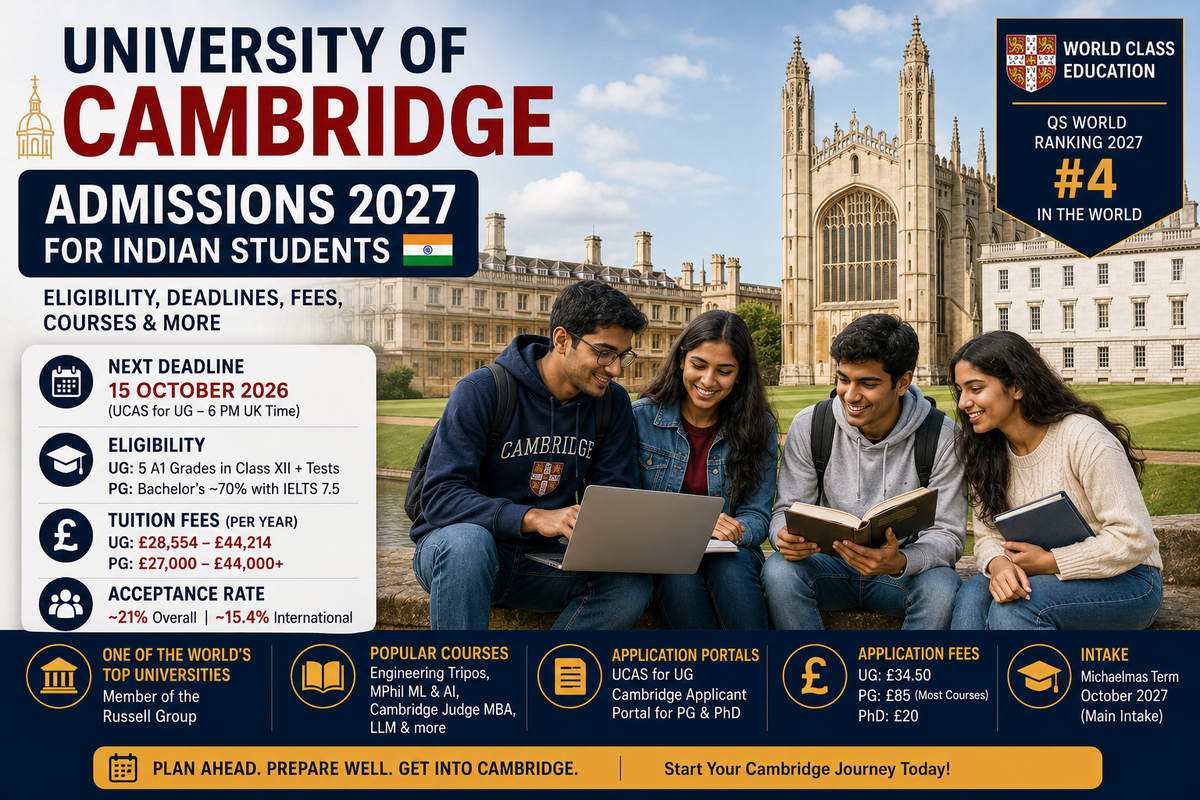
Table of Content
- University of Cambridge Application Deadlines
- Cambridge Eligibility for Indian Students
- Cambridge PG Programs and English Scores
- University of Cambridge UG Programs
- Cambridge Judge MBA Rounds and GMAT
- University of Cambridge PhD Funding
- Cambridge Application Process Steps
- University of Cambridge Documents Required
- Cambridge Acceptance Rate for Indians
- UK Student Visa Process for Cambridge
- Tips and Checklist for Cambridge Admissions
- FAQs
University of Cambridge Application Deadlines for Indian Students
Cambridge runs on a single main intake, Michaelmas Term starting in October 2027, for both undergraduate and postgraduate courses. Undergraduate applications route through UCAS with an additional My Cambridge Application form, while postgraduate applications go directly through the University’s Applicant Portal. The Cambridge Judge MBA runs a separate five-round cycle for a September 2027 start. Dates below come from the official Cambridge application dates page and the Judge Business School MBA page.
Cambridge’s primary intake for Indian students is Michaelmas (October 2027). Every UG course and most PG programmes open here.
| Intake | Level | App Opens | Deadline | App Fee | Portal |
|---|---|---|---|---|---|
| Michaelmas 2027 (Primary intake) | UG (all courses) | 1 September 2026 | 15 October 2026 (6 pm UK) | £34.50 (INR 4,447) |
UCAS |
| Michaelmas 2027 | UG (My Cambridge Application) | 1 September 2026 | 22 October 2026 (6 pm UK) | Included above | Cambridge Applicant Portal |
| Michaelmas 2027 | PG (MPhil, LLM, MRes) | Early September 2026 | Course-specific (mostly Dec 2026 to Mar 2027) | £85 (INR 10,956) |
Cambridge Applicant Portal |
| Michaelmas 2027 | PhD and doctoral | Early September 2026 | Course-specific (mostly Dec 2026 to Jan 2027) | £20 (INR 2,578) |
Cambridge Applicant Portal |
| Michaelmas 2027 | Foundation Year (UK-based) | Open | 13 January 2027 (6 pm UK) | £34.50 (INR 4,447) |
UCAS |
| September 2027 | Judge MBA Round 1 (closing soon) | Open | 24 August 2026 | £165 (INR 21,266) |
Judge Applicant Portal |
| September 2027 | Judge MBA Round 2 | Open | 5 October 2026 | £165 (INR 21,266) |
Judge Applicant Portal |
| September 2027 | Judge MBA Round 3 | Open | 4 January 2027 | £165 (INR 21,266) |
Judge Applicant Portal |
| September 2027 | Judge MBA Round 4 | Open | 22 March 2027 | £165 (INR 21,266) |
Judge Applicant Portal |
| September 2027 | Judge MBA Round 5 | Open | 4 May 2027 | £165 (INR 21,266) |
Judge Applicant Portal |
Planning note: Cambridge UG applicants file twice. Submit the UCAS form by 15 October 2026, then the My Cambridge Application form with transcripts by 22 October 2026. Missing the second stage voids the UCAS submission.
Interviews for main-round UG applicants fall in the first three weeks of December 2026. UG decisions land on 27 January 2027, with the final offer confirmation in August 2027 after exam results. PG and MBA decisions follow each course’s own rolling schedule.
University of Cambridge Eligibility for Indian Students
Cambridge sets one of the highest academic bars in the UK for Indian applicants. Undergraduate offers turn on top-band Class XII grades plus at least one supplementary qualification, since Cambridge treats Class XII alone as sufficient for only a narrow set of humanities and social science courses. Postgraduate offers ask for a strong Bachelor’s from a well-ranked institution plus a well-above-average IELTS score.
Cambridge Undergraduate Eligibility (Class XII, JEE, AP, A Levels)
- Class XII (CBSE, CISCE, State Boards): Five A1 grades in subjects relevant to the course applied for.
- STEM courses (Engineering, Natural Sciences, Computer Science): Class XII alone is not enough. Add JEE Advanced (typically rank within 2,000), or five AP tests at Grade 5, or A Levels at A*A*A.
- Humanities and Social Sciences: Class XII with five A1 grades is accepted for around 19 courses including English, History, Law, Theology, and Modern Languages.
- Undergraduate degrees: A completed Bachelor’s from a strong Indian university can also be presented for UG entry to a related Tripos.
Cambridge Postgraduate Eligibility Bands
- UK 2:1 equivalent: Around 70% (or CGPA 7.3/10) in a Bachelor’s from a well-ranked Indian institution. This is the university-wide floor.
- UK High 2:1: Around 73% (or CGPA 7.7/10). The practical bar for competitive MPhils in Machine Learning, Economics, and Advanced Computer Science.
- UK First Class: Around 75% (or CGPA 8.0/10). Expected for LLM shortlisting and top MPhil funded seats.
- Institution-specific bands: Ashoka, National Law School Bengaluru, and O.P. Jindal Global carry their own CGPA thresholds on Cambridge’s international qualifications page.
- Accepted degree types: 3 or 4-year Bachelor’s in Arts, Science, or Commerce from well-ranked institutions, or 4-year professional degrees in Engineering, Technology, or Pharmacy.
What is the minimum IELTS score for Cambridge Indian applicants?
Cambridge accepts IELTS Academic, TOEFL iBT, C1 Advanced, and C2 Proficiency. Scores must be dated no more than two years before the course start.
| Test | Level | Minimum Score |
|---|---|---|
| IELTS Academic | Undergraduate | 7.5 overall, no band below 7.0 |
| IELTS Academic | Postgraduate (competitive MPhils, LLM, MBA) | 7.5 overall, minimum 7.0 in each element |
| TOEFL iBT | Undergraduate | 110 overall, minimum 25 in each element |
| C1 Advanced | Undergraduate and Postgraduate | 193 overall, minimum 185 in each element |
Cambridge IELTS Waiver for Indian Students
Cambridge does not routinely waive its English test for Indian applicants. The exemption applies only to nationals of majority English-speaking countries educated in those countries, or to holders of a three-year Bachelor’s from a majority English-speaking country (excluding Canada) completed within the past two years. Medium of instruction letters from Indian universities are not accepted as a waiver. Indian applicants should plan on an IELTS or TOEFL result, timed for submission with the main application.
Also Check: UK Student Visa Requirements for Indian Students 2026
Cambridge PG Programs and English Scores
The postgraduate menu at Cambridge is dominated by the one-year MPhil and the two-year MRes plus PhD pathway. Most competitive MPhils sought by Indian applicants sit in Computer Science, Economics, Engineering, and Business, plus the Master of Law (LLM) at the Faculty of Law. Base tuition for the MPhil in Management is £42,468 (INR 54.74 Lakhs) per year, with STEM MPhils typically higher.
| Programme | Duration | Minimum Eligibility | English Req. Min. |
|---|---|---|---|
| MPhil in Machine Learning and Machine Intelligence | 10 months | Bachelor’s in CS, Maths, or Engineering at 73%+ (High 2:1) | IELTS 7.5 |
| MPhil in Advanced Computer Science | 11 months | Bachelor’s in CS or Maths at 73%+ (High 2:1) | IELTS 7.5 |
| MPhil in Economics | 9 to 10 months | Bachelor’s in Economics with strong quant background at 73%+ | IELTS 7.5 |
| MPhil in Finance | 9 months | Bachelor’s with quantitative rigour at 70%+ (UK 2:1) | IELTS 7.5 |
| MPhil in Management | 11 months | Bachelor’s in any discipline at 70%+ (UK 2:1) | IELTS 7.5 |
| MPhil in Engineering (research pathway) | 10 to 12 months | Bachelor’s in Engineering at 70%+ (UK 2:1) | IELTS 7.5 |
| MPhil in Public Policy | 10 months | Bachelor’s at 70%+ with policy or governance interest | IELTS 7.5 |
| Master of Law (LLM) | 9 months | Bachelor of Law at 75%+ (UK First) preferred | IELTS 7.5 |
| MPhil in Development Studies | 9 months | Bachelor’s at 70%+ in Social Sciences or related | IELTS 7.5 |
| MPhil in Bioscience Enterprise | 11 months | Bachelor’s in Biological Sciences at 70%+ | IELTS 7.5 |
PG applicants also pay the University Composition Fee plus a separate College Fee. The College Fee for 2026-27 ranges from £11,500 to £14,500 (INR 14.82 Lakhs to INR 18.69 Lakhs) depending on the college. Fees for 2027-28 will be published by Cambridge no later than 1 October 2026.
Note: Program-specific entry requirements, fees, and intake availability may differ from the institution-wide minimums shown above. Always confirm on the official Cambridge postgraduate course page for your chosen programme before applying.
Check Out: University of Cambridge Accommodation
University of Cambridge UG Programs and Requirements
Cambridge’s undergraduate courses are called Triposes, a Cambridge term for the multi-subject exam-based degrees run by each Faculty. STEM Triposes are typically four years (integrated MEng, MSci) while Arts and Humanities are three years (BA Hons). Every UG applicant must also pass the course-specific admissions test (ESAT, TMUA, LNAT, UCAT, or STEP, depending on the Tripos).
Base tuition for 2026-27 sits at £29,052 (INR 37.44 Lakhs) for Group 1 humanities, rising to £44,214 (INR 56.99 Lakhs) for Group 4 STEM courses and £70,554 (INR 90.94 Lakhs) for Medicine. Fees are fixed for the duration of the course.
| Programme | Duration | Minimum Eligibility | English Req. Min. |
|---|---|---|---|
| Engineering Tripos (MEng) | 4 years | Class XII 5xA1 plus JEE Advanced rank under 2,000, or A Levels at A*A*A in Maths, Physics, and one more | IELTS 7.5 |
| Natural Sciences Tripos | 3 years (BA) or 4 years (MSci) | Class XII 5xA1 plus 5 AP tests at Grade 5, or JEE Advanced, or A Levels at A*A*A | IELTS 7.5 |
| Computer Science Tripos | 3 years (BA) or 4 years (MEng) | Class XII 5xA1 plus TMUA and A Levels at A*A*A in Maths and Further Maths | IELTS 7.5 |
| Economics Tripos | 3 years (BA) | Class XII 5xA1 with Maths, plus TMUA | IELTS 7.5 |
| Law Tripos | 3 years (BA) | Class XII 5xA1 accepted, plus LNAT completed by 15 October 2026 | IELTS 7.5 |
Cambridge Judge MBA Rounds and GMAT
The Cambridge Judge MBA is a one-year full-time programme running from September to September, taught at Cambridge Judge Business School inside the Silicon Fen entrepreneurial cluster. It runs on a five-round admissions cycle rather than the UK PG rolling model. Tuition for the September 2027 intake is £86,250 (INR 111.17 Lakhs) per source Judge Business School.
Cambridge MBA Round Structure and Interview Windows
Round 1 is closing soon on 24 August 2026. Rounds 2 to 5 follow at roughly two-month intervals. Each round has a Virtual Interview Day about six weeks after the deadline, followed by a two-week interview window. Applicants are notified of shortlist status within three weeks of submission.
| Round | Deadline | Virtual Interview Day | App Fee |
|---|---|---|---|
| Round 1 | 24 August 2026 (closing soon) | 25 September 2026 | £165 (INR 21,266) |
| Round 2 | 5 October 2026 | 6 November 2026 | £165 (INR 21,266) |
| Round 3 | 4 January 2027 | 12 February 2027 | £165 (INR 21,266) |
| Round 4 | 22 March 2027 | 16 April 2027 | £165 (INR 21,266) |
| Round 5 | 4 May 2027 | 28 May 2027 | £165 (INR 21,266) |
Cambridge MBA GMAT and Work Experience
- GMAT (current Focus Edition): Mean class score 625 to 635.
- GMAT (previous format): Mean class score 690 to 700.
- GRE: Verbal 76th percentile, Quantitative 60th percentile.
- Test validity: 5 years from the test date.
- Work experience: Minimum 2 years full-time, class average around 6 years.
- Academic floor: Bachelor’s at UK High 2:1 or equivalent (73%).
Insider note: Cambridge Judge screens for career trajectory and Cambridge fit, not just GMAT. Indian applicants who cluster around the 700+ GMAT range should invest heavily in the essay and referee choice, since the class averages leave little room for a weak narrative.
Shortlisted candidates accept via a non-refundable reservation fee of £7,950 (INR 10.25 Lakhs), which goes towards tuition. Interviews are held virtually.
Note: Round-specific requirements and reservation terms can change between cycles. Confirm on the official Cambridge MBA page before applying.
University of Cambridge PhD Application and Funding
Doctoral study at Cambridge runs across every Faculty and School. Most STEM PhDs are 3 to 4 years full-time. Applicants need a UK Master’s (or Indian Master’s, which Cambridge treats as equivalent) plus a supervisor who has agreed in principle to take them on. PhD tuition varies by subject group, and the application fee is £20 (INR 2,578) per submission.
Cambridge PhD Funding for Indian Students
- Gates Cambridge Scholarship: Full course and college fees plus a maintenance stipend for the full programme length, plus a return airfare. Deadline for non-US applicants for 2027 entry is 8 December 2026 or 6 January 2027 depending on the course.
- Cambridge Trust Scholarships: Partial to full awards administered centrally. Indian applicants are automatically considered when they submit the main application by the funding deadline.
- Commonwealth Scholarships: Awarded through the Commonwealth Scholarship Commission, applicable to PhDs at Cambridge.
- Departmental studentships: Held by supervisors, often tied to funded research projects in Engineering, Chemistry, Life Sciences, and Physical Sciences.
For the full award list plus per-scholarship amounts, see Cambridge’s funding options for Indian students at Cambridge.
Cambridge PhD Application Steps
- Identify a supervisor: Read Faculty research pages and email 2 to 3 potential supervisors with a research proposal 6 months before the deadline.
- Prepare the research proposal: 1,500 to 2,500 words, aligned to the supervisor’s research programme.
- Apply via the Applicant Portal: Pay the £20 (INR 2,578) doctoral application fee and mark scholarship considerations.
- Interview: Most Cambridge PhD offers require a supervisor interview, held online.
Planning note: For a Gates Cambridge Scholarship, the funding application closes weeks before most course deadlines. Get your referees and research proposal ready by early November 2026 for the December cycle.
Note: PhD entry requirements, stipend levels, and supervisor availability differ by Department. Always confirm on the official Cambridge postgraduate course page for your target research area before applying.
University of Cambridge Application Process for Indian Students
The Cambridge application flow differs by level. Undergraduates route through UCAS plus the My Cambridge Application form. Postgraduates apply directly through the Cambridge Applicant Portal. MBA applicants apply through the Judge Business School portal. The steps below cover the UG path first, then the PG and MBA differences.
- Register on the platform: UG applicants create a UCAS account (submissions for the 2027 cycle open 1 September 2026). PG and MBA applicants create a Cambridge Applicant Portal account.
- Choose your course and college: List Cambridge as one of five UCAS choices, then pick a college or opt for the open application pool.
- Pay the application fee: UG pays the UCAS fee of £34.50 (INR 4,447) on the UCAS portal. PG pays £85 (INR 10,956) per course. Doctoral applicants pay £20 (INR 2,578). MBA applicants pay £165 (INR 21,266).
- Sit the admissions test: ESAT, TMUA, LNAT, UCAT, or STEP as required for the course, with UG test windows in September and October 2026.
- Submit the My Cambridge Application: UG applicants file this by 22 October 2026 with the personal statement, transcripts, and referee details.
- Submit English proof and references: Upload the IELTS or TOEFL score and academic references before the course deadline.
- Attend the interview: UG interviews sit in the first three weeks of December 2026. PG and MBA interviews are round-specific and typically online.
- Track the decision: UG decisions arrive on 27 January 2027. PG and MBA decisions follow each round’s rolling schedule.
Check Out: University of Cambridge Scholarships
Cambridge Documents Required for Indian Students
Cambridge asks Indian applicants to upload a defined set of documents through the relevant portal. Nothing is posted by mail. Documents should be scanned in colour, in English (or with a certified English translation), and named clearly.
- Valid Indian passport: Bio page scan, with at least 15 months of validity from course start.
- Class X and Class XII mark sheets: Certified copies from CBSE, CISCE, or the relevant State Board.
- Bachelor’s transcripts and degree certificate: For PG and MBA applicants, from the awarding Indian university, with year-wise marks.
- Master’s transcripts (if held): For PhD applicants.
- English language test score: IELTS Academic, TOEFL iBT, C1 Advanced, or C2 Proficiency, dated within two years of course start.
- Standardised test score: ESAT, TMUA, LNAT, UCAT, or STEP for UG; GMAT or GRE for MBA (not compulsory for most MPhils).
- Two academic references: Submitted directly by referees via the Applicant Portal.
- Statement of Purpose or Personal Statement: Course-specific brief on academic motivation and fit with Cambridge.
- Research proposal: 1,500 to 2,500 words for PhD applicants.
- CV or resume: Standard 1 to 2 page CV for PG and MBA applicants.
- Passport-size photograph: Recent, on a plain background.
- Financial evidence: Bank statements or scholarship letters, requested at the offer stage for the Student visa.
University of Cambridge Acceptance Rate for Indian Students
Cambridge publishes its admissions statistics annually through the University’s official Facts and Figures release. The overall acceptance rate is 21 %. For international (overseas) applicants, the rate falls to 15.4%. Indian-specific rates are not published separately by the University but are widely reported as lower still. For a per-course view, see the Cambridge acceptance rate breakdown.
What is the Cambridge acceptance rate for international students?
The 15.4% international rate is a University-wide figure across UG and PG. Competitive Triposes (Engineering, Natural Sciences, Computer Science, Law, Economics) sit meaningfully below this. Humanities Triposes sit slightly above. At the PG level, the funded MPhils in Machine Learning and Economics run in the single digits for overseas offers, based on published cohort sizes against typical applicant volumes.
What does Cambridge actually look for in Indian applicants?
Cambridge weights the academic record, the admissions test performance, the personal statement, references, and the interview roughly equally. Indian applicants who convert offers usually pair a five-A1 Class XII record with either a JEE Advanced rank inside the top 2,000, five AP Grade 5s, or a strong subject-specific project. Interview performance is the tie-breaker between shortlisted applicants.
Reality check: A near-perfect Class XII and 8.0 IELTS band alone are not enough. Cambridge shortlisters look for evidence of independent subject curiosity, which typically shows up in extended projects, research papers, olympiad medals, or JEE Advanced performance beyond the qualifying rank.
UK Student Visa Process for Cambridge Admits
Indian students admitted to Cambridge apply for the UK Student visa, previously called Tier 4 (General). Cambridge is a UKVI-registered sponsor and issues a Confirmation of Acceptance for Studies (CAS) once the offer is unconditional and the deposit is paid. The visa application opens up to six months before the course start date.
Applicants submit the online application on gov.uk, pay the visa fee and the Immigration Health Surcharge (IHS) for the full duration of the course, book biometrics at a VFS Global centre in India (Bengaluru, Chennai, Delhi, Kolkata, or Mumbai), and undertake a tuberculosis test at an IOM-approved clinic. Financial evidence must show first-year tuition plus nine months of maintenance for Cambridge, held in an eligible account for 28 consecutive days. Decisions are typically issued within three weeks of biometrics, and the visa lets students work up to 20 hours per week during term.
2026 update: The Graduate Route lets Cambridge Master’s graduates stay in the UK for two years post-completion, and PhD graduates for three years, without needing a job offer. Apply from inside the UK before the Student visa expires.
Check Out: UK Student Visa Requirements for Indian Students 2026
Tips and Application Checklist for Cambridge Admissions
The tips and timeline steps below are drawn from Indian-applicant patterns at Cambridge, focused on the Michaelmas October 2027 intake for UG and PG and the September 2027 intake for MBA. Sequence and timing matter more than any single document choice.
- Register on UCAS by mid-August 2026: Gives you six weeks to draft the personal statement before the 15 October deadline.
- Book the admissions test by early September 2026: ESAT, TMUA, LNAT, and UCAT slots at Indian centres fill up quickly.
- Request Class XII transcripts eight weeks before deadline: CBSE and CISCE certified copies can take four to six weeks.
- Take IELTS or TOEFL by August 2026: Leaves room for one retake before the December interview shortlist.
- Contact your PhD supervisor by August 2026: Supervisor buy-in is decisive for the December to January PhD deadlines and Gates Cambridge shortlisting.
- Draft the Personal Statement around one academic thread: Cambridge favours depth over breadth, and interviewers pull from the statement to open the interview.
- Pick the open application over a specific college if unsure: The pool system spreads strong applicants across colleges rather than penalising college choice.
- Prepare for the interview in mock format: Practise reasoning aloud on unfamiliar problems, which is closer to the Cambridge supervision style than memorised answers.
- Apply for a Cambridge Trust scholarship on the main form: Missing the funding box on the Applicant Portal disqualifies you from central awards.
Cambridge admissions reward preparation over spontaneity for Indian applicants. Pair a five-A1 Class XII record with a supplementary qualification, plan the UCAS and My Cambridge Application windows in October 2026 back-to-back, and treat the December interview as a subject conversation rather than a personality test. Round 1 MBA applicants have thirteen days to file, and PhD applicants targeting Gates funding should have referees confirmed by early November 2026.
Frequently Asked Questions
Ques. What is the Cambridge UCAS deadline for the 2027 intake?
Ans. The Cambridge UCAS deadline for 2027 entry is 15 October 2026 (6 pm UK time). The follow-up My Cambridge Application form is due by 22 October 2026 (6 pm UK time). Missing either deadline voids the application.
Ques. Is Class XII enough for admission to Cambridge?
Ans. Class XII with five A1 grades is accepted for around 19 humanities and social science courses at Cambridge. For STEM courses, applicants also need JEE Advanced (typically rank within 2,000), five AP tests at Grade 5, or A Levels at A*A*A.
Ques. What IELTS score is required for Cambridge for Indian students?
Ans. Undergraduate applicants need IELTS 7.5 overall with no band below 7.0. Most competitive postgraduate MPhils, LLM, and the MBA also ask for IELTS 7.5. TOEFL iBT 110 is the UG equivalent. Scores must be within two years of course start.
Ques. Does Cambridge waive IELTS for Indian students with English-medium schooling?
Ans. No. Cambridge does not accept Medium of Instruction letters from Indian universities as an English waiver. The exemption applies only to nationals of majority English-speaking countries educated there.
Ques. What is the Cambridge application fee for Indian students?
Ans. UG applicants pay a UCAS fee of £34.50 (INR 4,447). PG applicants pay £85 (INR 10,956) per course. PhD applicants pay £20 (INR 2,578). MBA applicants pay £165 (INR 21,266).
Ques. What is the Cambridge Judge MBA deadline for the 2027 intake?
Ans. The Cambridge MBA runs five rounds. Round 1 closes on 24 August 2026, Round 2 on 5 October 2026, Round 3 on 4 January 2027, Round 4 on 22 March 2027, and Round 5 on 4 May 2027. Indian applicants usually target Rounds 1 to 3 for stronger scholarship consideration.
Ques. How much is Cambridge tuition for Indian students?
Ans. UG tuition for 2026-27 ranges from £29,052 (INR 37.44 Lakhs) for Group 1 humanities to £44,214 (INR 56.99 Lakhs) for Group 4 STEM and £70,554 (INR 90.94 Lakhs) for Medicine. The MBA is £86,250 (INR 111.17 Lakhs) for the September 2027 intake.
Ques. What is the Cambridge acceptance rate for international students?
Ans. Cambridge’s overall acceptance rate is around 21%, dropping to 15.4% for international applicants. Competitive Triposes such as Engineering, Natural Sciences, and Computer Science admit at meaningfully lower rates for the overseas pool.
Ques. Does Cambridge require GMAT for MPhil in Management?
Ans. The MPhil in Management does not require GMAT or GRE. The Cambridge MBA does require GMAT or GRE, with class averages of 625 to 635 on the GMAT Focus Edition and 690 to 700 on the previous format.
Ques. When should Indian applicants take IELTS for Cambridge?
Ans. Take IELTS by August 2026 for the Michaelmas 2027 intake. This leaves room for one retake before the December interview shortlist and before the postgraduate course-specific deadlines that run from December 2026 to March 2027.
Ques. Can Indian PhD applicants get full funding at Cambridge?
Ans. Yes. The Gates Cambridge Scholarship covers full fees plus a stipend for the entire programme length. Cambridge Trust Scholarships and Commonwealth Scholarships also offer full or partial funding. Indian applicants must apply by the funding deadline, which is typically 8 December 2026 or 6 January 2027 for 2027 entry.
Ques. How long does the UK Student visa take for Cambridge admits?
Ans. The UK Student visa decision typically arrives within three weeks of the biometrics appointment. Cambridge issues the Confirmation of Acceptance for Studies (CAS) once the deposit is paid, and the visa application opens up to six months before the course start date.
College Student Profiles

University of Cambridge Program Fees & Deadlines
| Program | Important Dates | Fees | Application Fees | Eligibility | Financial Aid |
|---|---|---|---|---|---|
Fall 2027 Round 3 MBA application deadline (4th Jan 2027) Fall 2027 Round 4 MBA application deadline (22nd Mar 2027) Fall 2027 Round 5 MBA application deadline (4th May 2027) | USD 113,850 /Yr GBP 86,250 /Yr | 165 | GMAT/GRE: Required, Bachelor's Degree (High 2:1 equivalent) | ||
BA Computer Science 3 years | Fall 2027 UCAS Oxbridge application deadline (15th Oct 2026) | USD 58,362 /Yr GBP 44,214 /Yr | 29 | IELTS: 7.5 | |
MB BChir Medicine 6 years | Fall 2027 UCAS Oxbridge application deadline (15th Oct 2026) | USD 93,131 /Yr GBP 70,554 /Yr | 29 | IELTS: 7.5 | |
MPhil Economics 9 months | Fall 2027 Economics application deadline (3rd Dec 2026) | USD 57,441 /Yr GBP 43,516 /Yr | 85 | IELTS: 7.5, TOEFL: 110, GRE: Required, Bachelor's Degree in Economics | |
MPhil Advanced Computer Science 9 months | Fall 2027 Advanced Computer Science deadline (26th Feb 2027) | USD 63,613 /Yr GBP 48,192 /Yr | 85 | IELTS: 7.5, TOEFL: 107, First Class Honours Degree in Computer Science | |
BA Mathematics 3 years | Fall 2027 UCAS Oxbridge application deadline (15th Oct 2026) | USD 42,776 /Yr GBP 32,406 /Yr | 29 | A*A*A at A-Level or IB 41-42 with STEP, High School Diploma or Secondary School Leaving Certificate | |
MFin Finance 1 year | Fall 2027 Master of Finance application deadline (31st May 2027) | USD 79,200 /Yr GBP 60,000 /Yr | 120 | IELTS: 7.0, TOEFL: 100 | |
MASt Physics 9 months | Fall 2027 Michaelmas entry application deadline (14th May 2027) | USD 49,227 /Yr GBP 37,293 /Yr | 85 | IELTS: 7.0, TOEFL: 100, High II.i Honours Degree in Physics | |
PhD Computer Science 3 years | Fall 2027 Michaelmas entry application deadline (14th May 2027) | USD 54,521 /Yr GBP 41,304 /Yr | 20 | IELTS: 7.5, TOEFL: 107, Bachelor's Degree with First Class Honours | |
MPhil Management 9 months | Fall 2027 MPhil Management application deadline (26th Feb 2027) | USD 56,058 /Yr GBP 42,468 /Yr | 85 | IELTS: 7.5, TOEFL: 110, First Class Honours Degree (non-business/management subject) |
Do you think the Dates are wrong ? Report Here
Important Alerts
| Events | Dates |
|---|---|
| Computer Science Fall 2027 UCAS Oxbridge application deadline | Closing in 4 days |
| Mathematics Fall 2027 UCAS Oxbridge application deadline | Closing in 4 days |
| Architecture Fall 2027 UCAS Oxbridge application deadline | Closing in 4 days |


Course Finder - Search from 50K+ courses
Popular Streams:
Reviews
Most Popular Tags
7 Reviews Found
Likes
- Access to the UK's sharpest minds, leading companies, and prestigious alumni network
- Globally diverse cohort - classmates from over 50 countries, great way to meet new people and make lifelong connections from across the globe
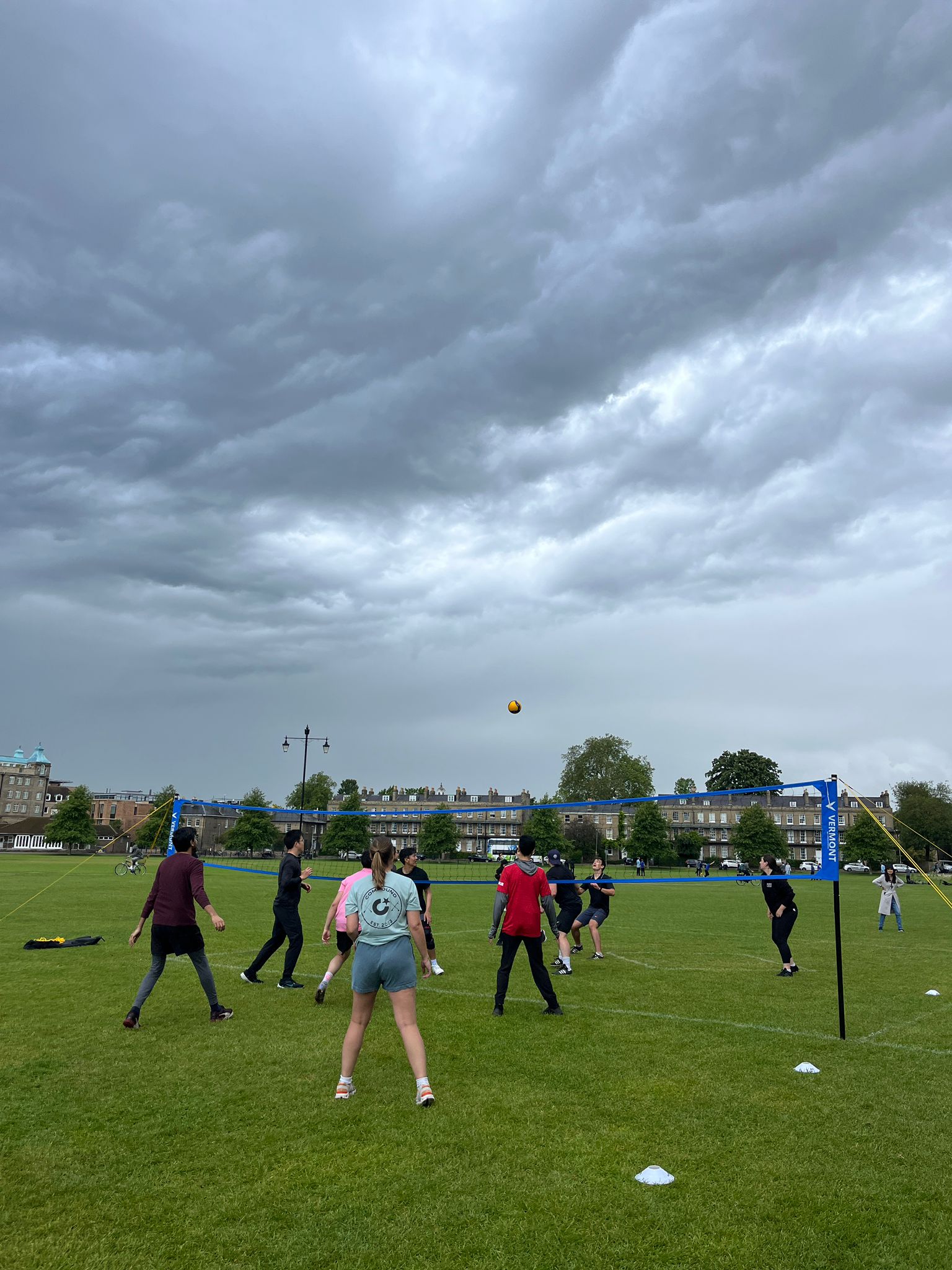
- Fun extracurricular activities and college life - such as sports, MBAT, debate clubs, and formal dinners
Dislikes
- Balance between academic and non-academic endeavours. While we were encouraged to not focus al our time on studies and told to spend time networking, the academically rigorous nature of the course often clashed with such aspirations.
Likes
- Collegiate system provides a unique communal experience. Each college is a mini society within Cambridge; addressing different needs based on academic rigour, gender, age, etc.
- Global Exposure from around 100 countries.
- Chance to work under top computer scientists.
Dislikes
- Short terms. Each term is only 8 weeks long.
- Each week starts from Thursday for an odd reason.
- Workload can overwhelming you. In the first term, I wrote 2 essays, each 1500 words long and reading 4 papers per week. In the second term, I read at least 3 papers per week, and writing a 1000 word review while doing my research.
Scholarship
- I was ineligible for scholarships due to a late application. However, if applied between November and December, you can get a partial scholarship for up to £10,000. This depends on your college preference and allocated college too. The most competitive ones can get a Gates Cambridge Scholarship or even a Commonwealth Scholarship for up to £60,000. Usually scholarships are reserved for PhDs, as more than 80% of students pay for their MPhil.
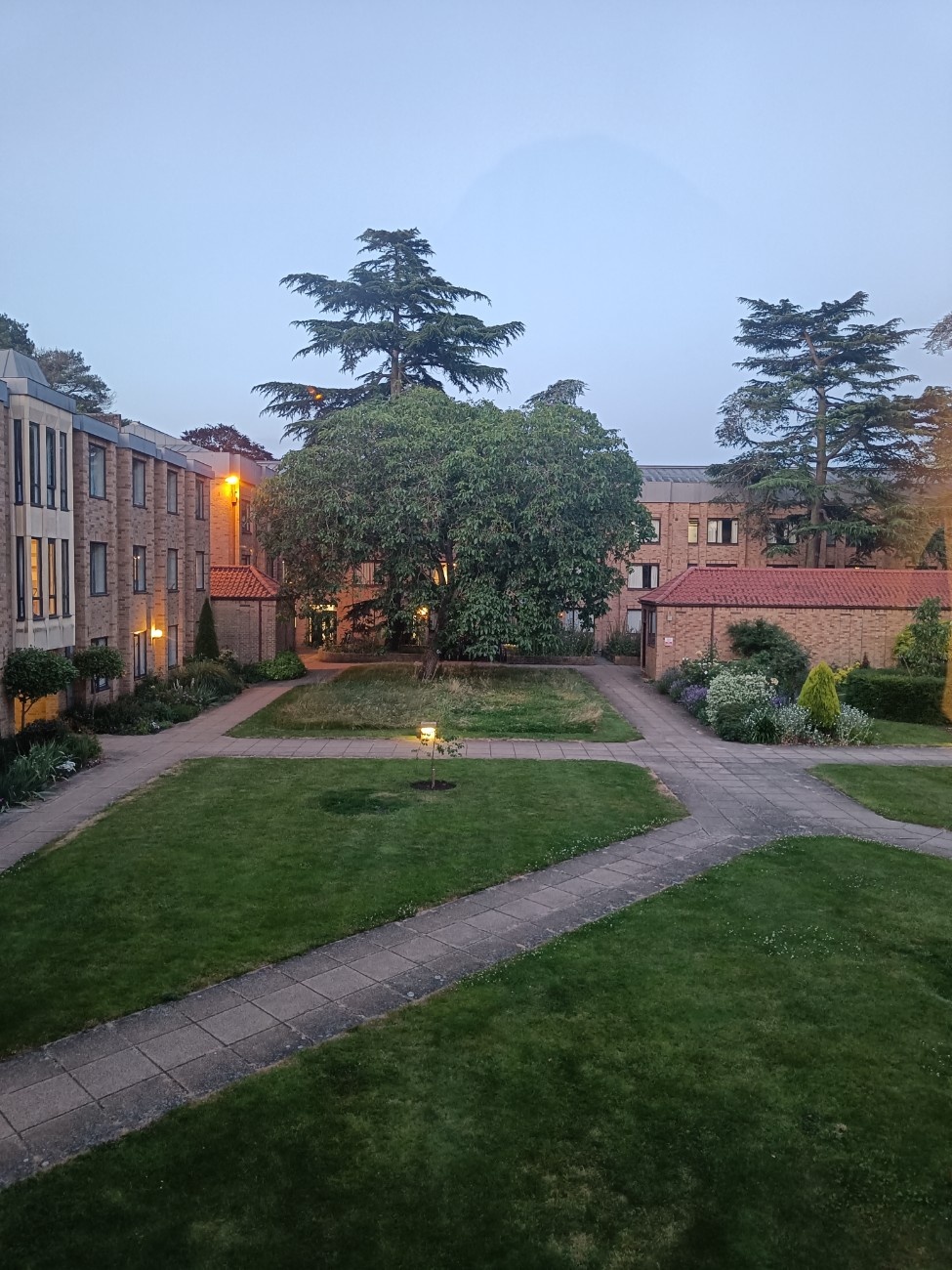
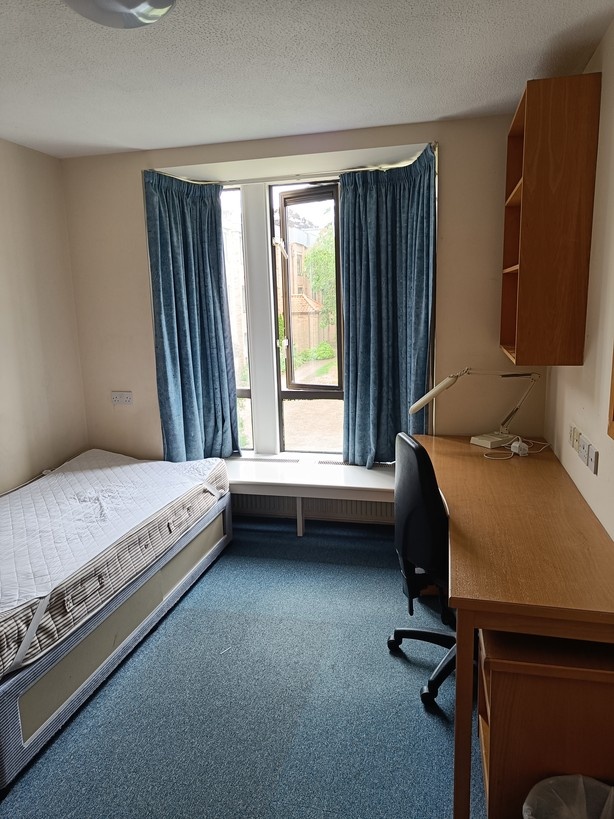
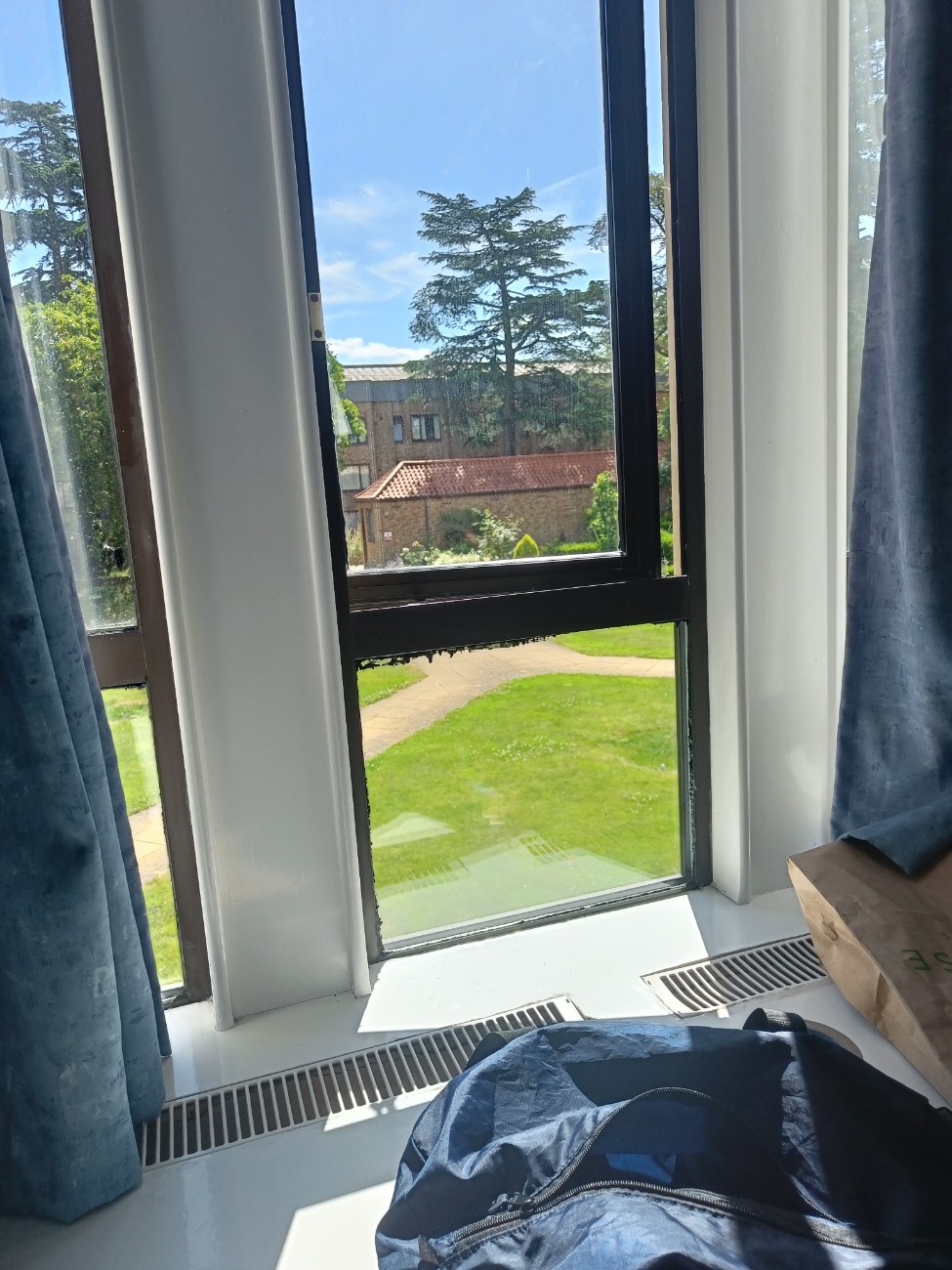
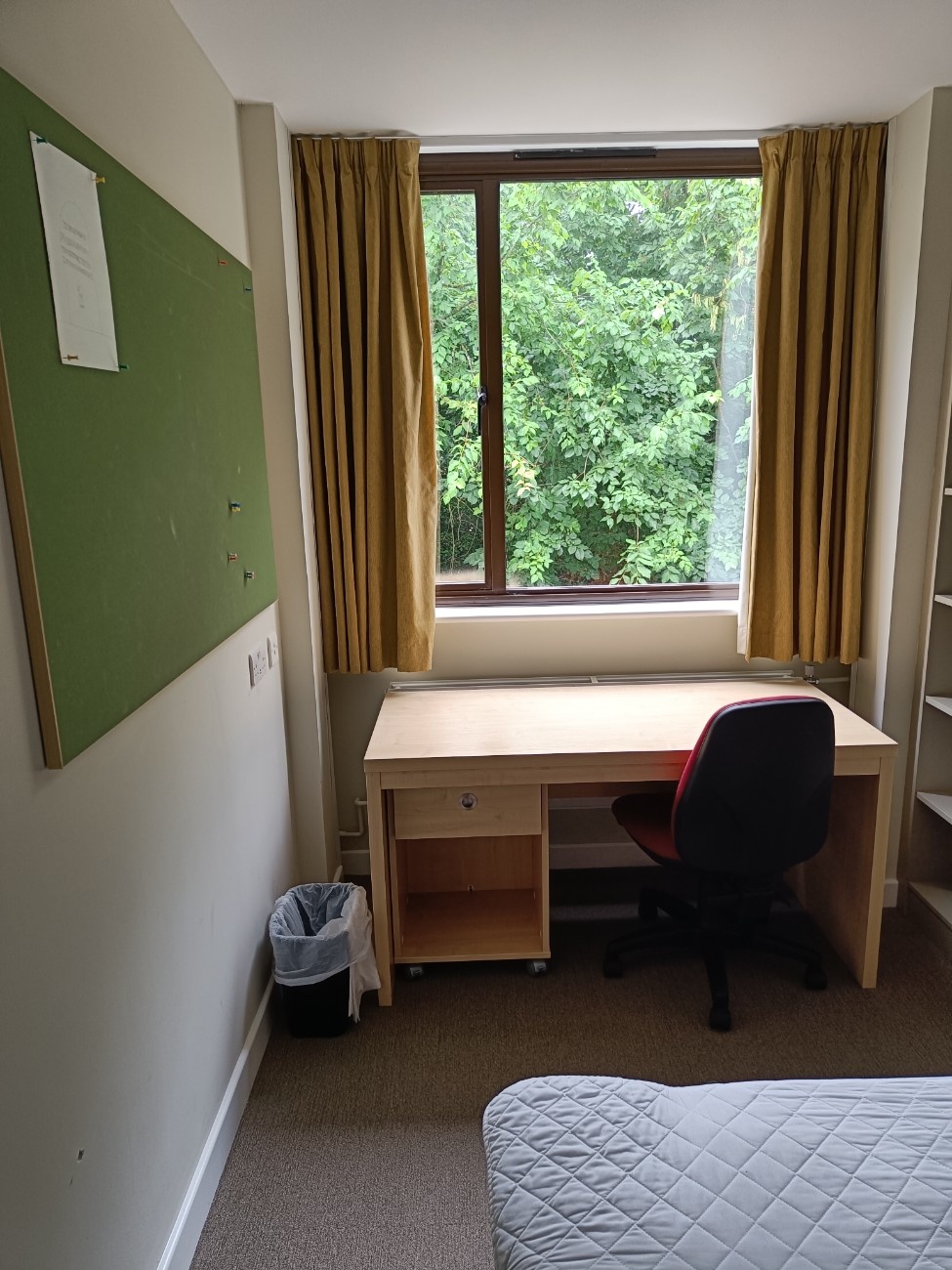
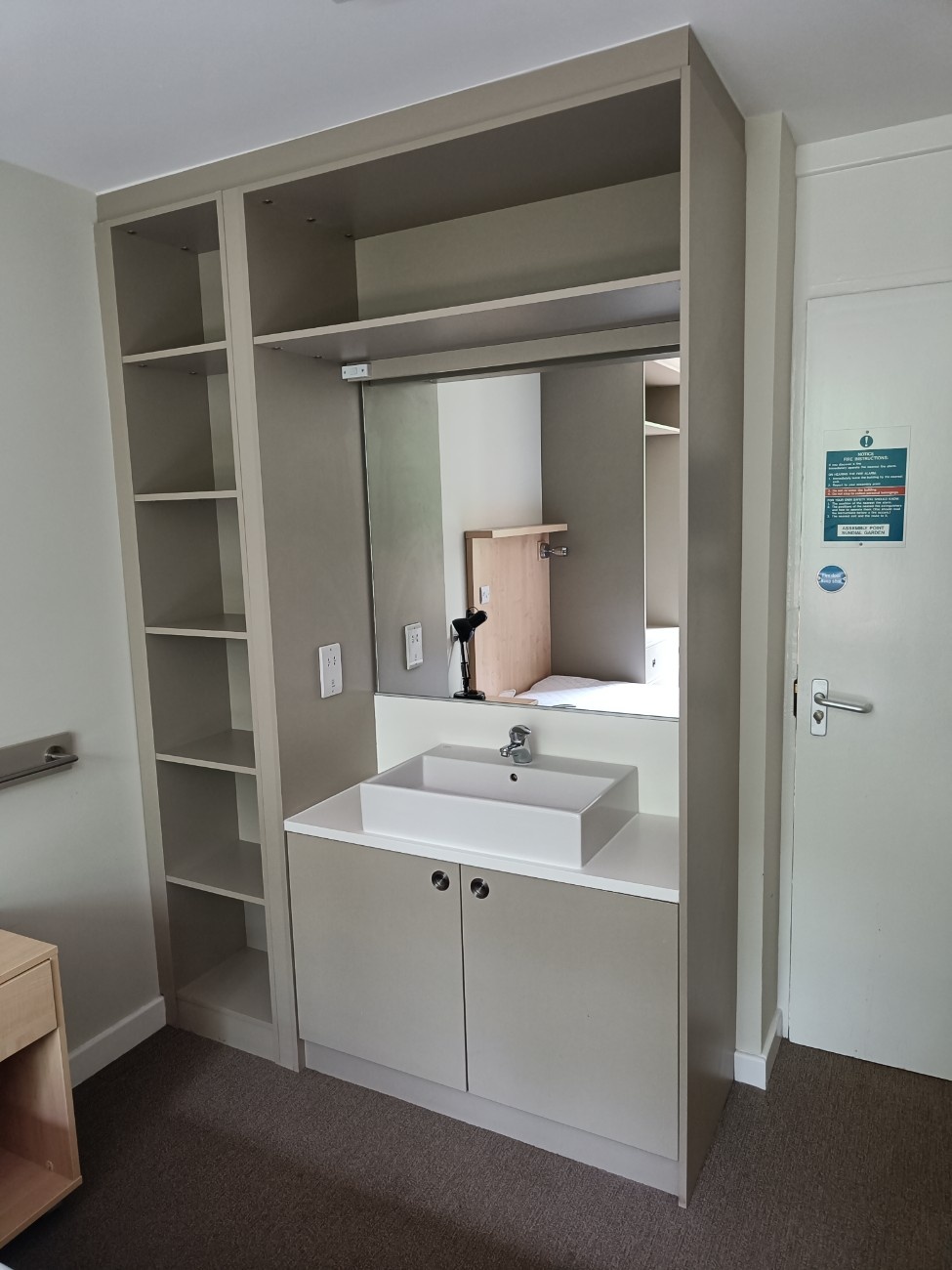
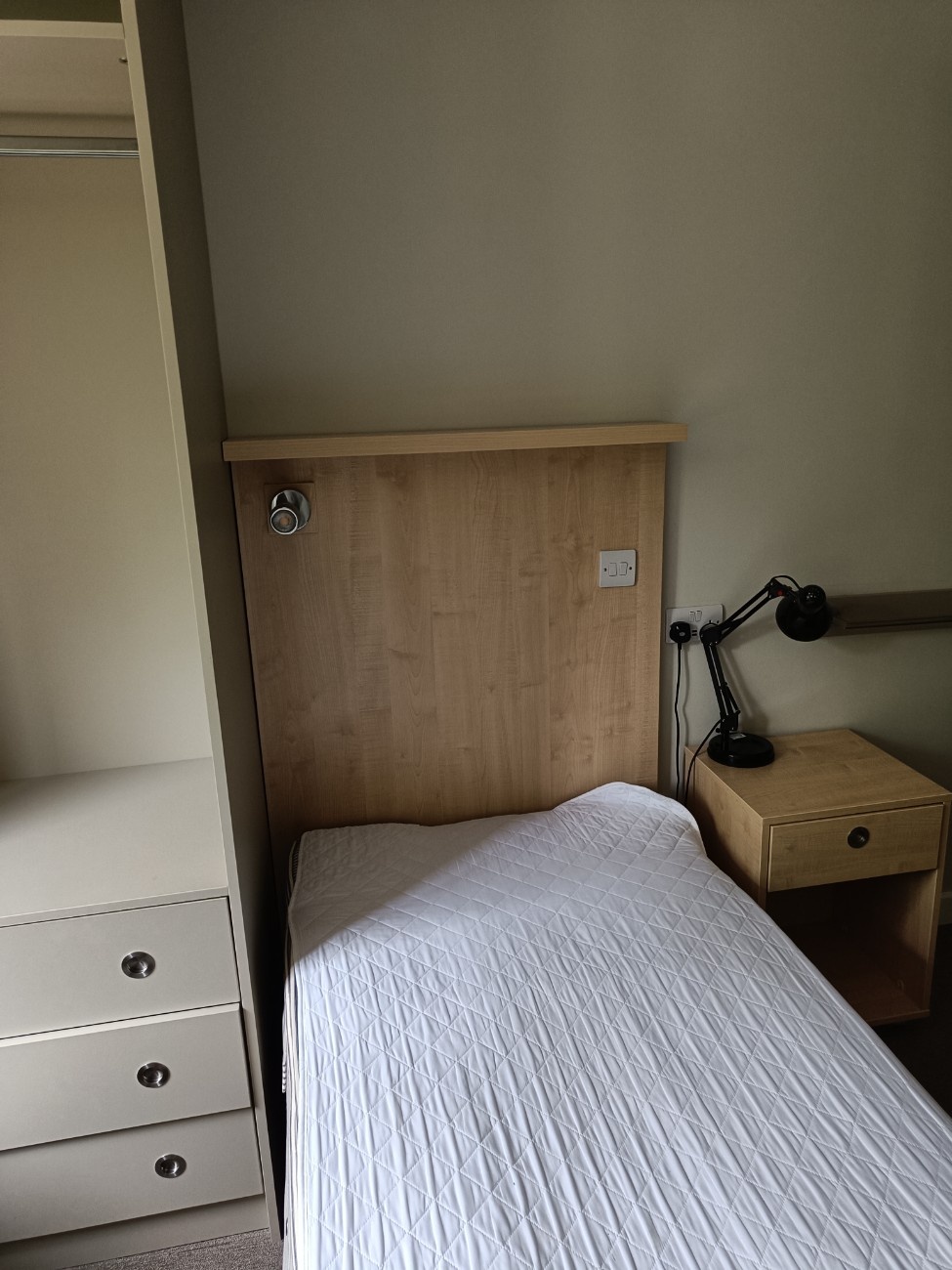
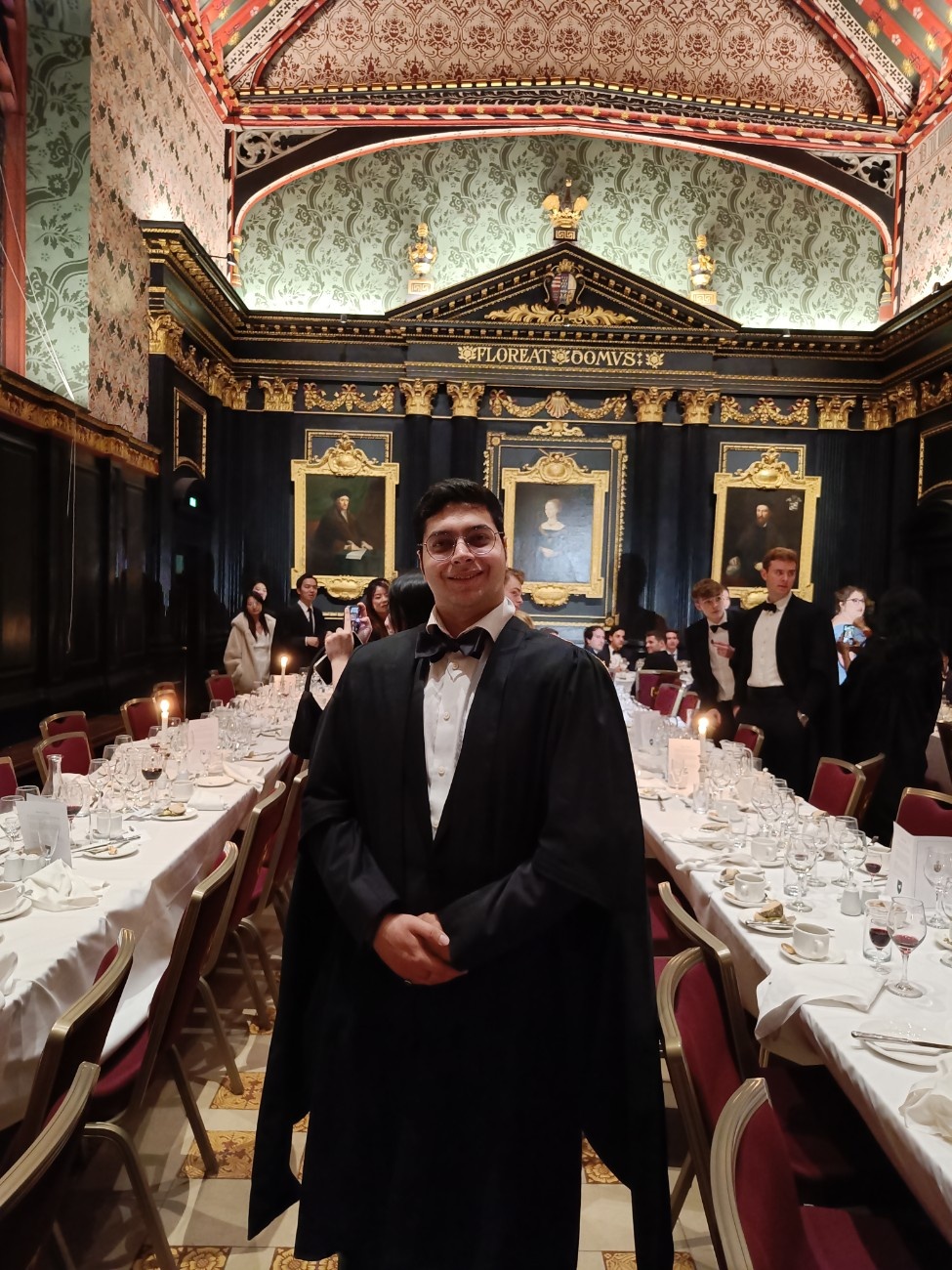


Likes
- Academic facilities, dedicated libraries, research tools.
- Case study based lectures
- Mental health platform free for students
Dislikes
- Lack of individual focus on studies, everybody is on their own
- No placements system, self secure jobs by creating network
- Food and travel expensive
Scholarship
-
There are bursaries available and various diversity and merit based internal and external scholarships. I got a 7500 GBP bursary. There is a Forte fellowship which is given to 4 girls in each of the admission rounds. There is an external scholarship called Chevening scholarship for British schools. There are some sports based scholarships as well.



Overview
Cambridge University is itself a brand name. Being a student at this university is itself an honour. The admission procedure includes filling out the admission form at the official website of you qualify for the eligibility criteria.
Overview
One of the best undergraduate law programs in the world. I appreciated the world-class teaching and the professors who were at the leading edge of their subjects.
Scholarship
No
Overview
Well reputed and offers a good quality education. Really nice campus town.
Scholarship
NA
Overview
It's prestigious and this means that graduates often enjoy excellent job opportunities. It's hard to get into (interview process, high grades, etc.) so the need to work hard to get in was a source of motivation when I was studying for my A level exams.
Scholarship
Yes - Student Finance. Most UK students receive this funding. It's means-tested: the amount you receive depends on the income of your parents. You receive payments for your college funds and a maintenance loan (to cover living costs). Students whose families earn less than $45,000 a year also get an annual bursary from the university of up to $3,500.

interested in this College ?
Follow & Share this college to get information about admission.



Comments