





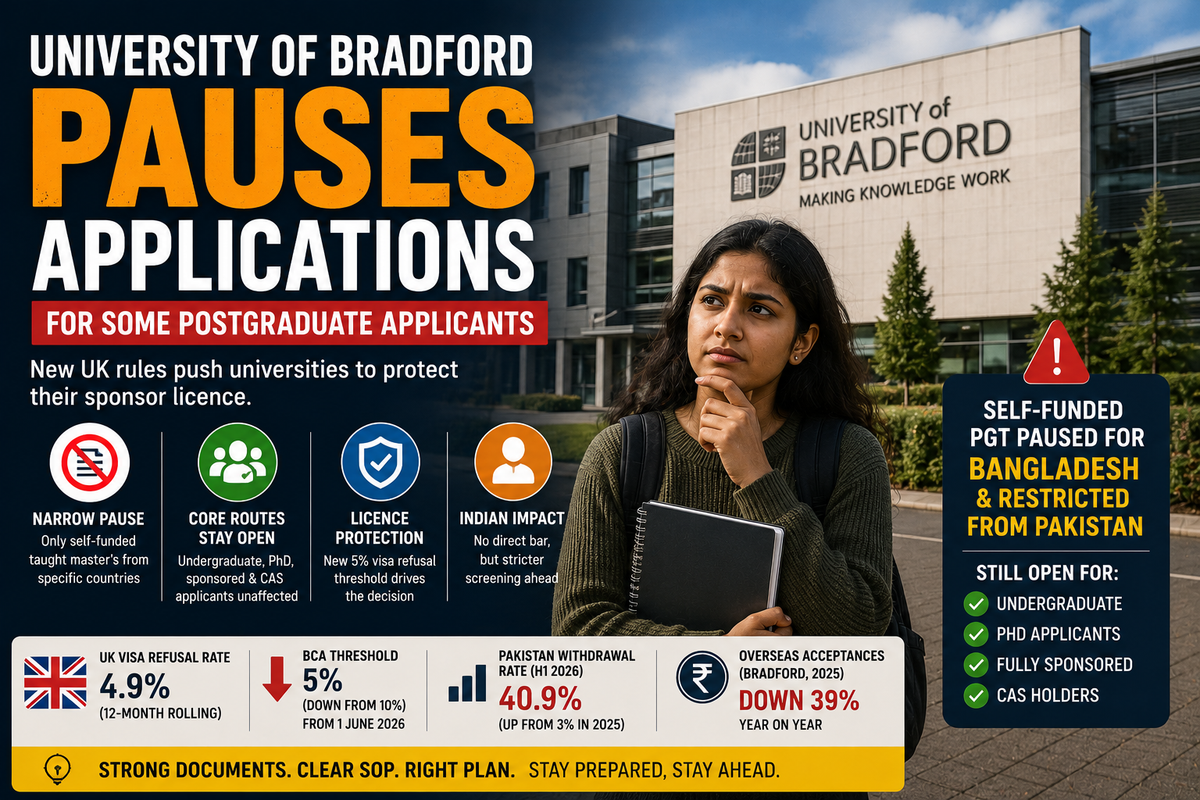
The University of Bradford has paused applications from self-funded postgraduate students from Bangladesh and restricted intake from Pakistan. Undergraduates, PhD applicants, fully sponsored students and existing CAS holders can still apply. The move protects the university’s UK sponsor licence under new Home Office rules.
- Narrow pause: only self-funded taught master’s from a short list of countries face the block.
- Core routes stay open: fully sponsored, undergraduate, PhD and CAS applicants are unaffected.
- Licence protection: Bradford is defending its sponsor status, not exiting global recruitment.
- Indian impact: no direct bar on Indian applicants, but tighter screening across the UK is likely.
Check University of Bradford Fees, Rankings and Deadlines for Indian Students
Bradford’s vice-chancellor Gillian Murray confirmed the pause was a hard decision. She told Times Higher Education that letters from the community and the local MP arrive on the topic. About 25% of Bradford’s city population is of Pakistani descent. For Indian applicants, this signals a shift where sponsor-licence maths decides who gets a CAS.
Quick Facts on the Bradford Pause
Hard numbers on the pause, the UK threshold change and country-level visa data.
| Parameter | Detail |
|---|---|
| Affected group | Self-funded postgraduate taught students from Bangladesh (Pakistan heavily restricted) |
| Still accepting | Undergraduate, PhD, fully sponsored, CAS-held applicants |
| UK visa refusal rate (12-month rolling) | 4.9% |
| BCA refusal threshold | 5% (lowered from 10% on 1 June 2026) |
| Pakistani applicant visa withdrawal rate (H1 2026) | 40.9% (up from 3% in 2025) |
| Bangladeshi withdrawal rate (H1 2026) | 23.5% |
| Indian withdrawal rate (H1 2026) | 5.2% (up from 1.2%) |
| Bradford QS World Ranking 2027 | #497 |
| Bradford overseas acceptances (2025 UCAS cycle) | Down 39% year on year |
Source: The Boar (12 November 2026), Times Higher Education, Financial Times analysis of Home Office data, UKVI.
- Who the Bradford application pause affects
- Why Bradford paused international applications
- Who can still apply during the Bradford pause
- What the Bradford pause means for Indians
- UK visa refusals driving the Bradford pause
- UK universities following the Bradford playbook
- What to do if Bradford was your plan
- Bradford backup plan for Indian applicants
Who the Bradford application pause affects
The pause blocks self-funded postgraduate taught (PGT) students from Bangladesh and tightens access from Pakistan. PGT means one-year taught master’s degrees like MSc and MBA. Other applicant groups continue as normal.
Vice-chancellor Gillian Murray said the call was driven by visa refusal risk. She described the move as a hard decision, taken because the risk of refusals had grown too high in certain markets.
The affected group is narrow but concentrated:
- Country scope: Bangladesh (full pause on self-funded PGT) and Pakistan (heavily restricted).
- Study level: only taught master’s programmes.
- Funding type: only self-funded applicants, not scholarship or employer-sponsored.
- Intake: the restriction is active for the 2026-27 cycle and the upcoming January 2027 intake.
If you are an Indian self-funded taught master’s applicant, the pause does not currently apply to you. However, a tighter screening process is expected across all markets with higher refusal risk. Bradford’s admissions team will now look harder at statement of purpose quality and financial documents before issuing a CAS.
Key Insight: The pause is market-specific, not a blanket closure. A rumour that Bradford "stopped Indian applications" is false.
Why Bradford paused international applications
The pause protects Bradford’s student sponsor licence under a new 5% visa refusal cap. From 1 June 2026, the Home Office halved the Basic Compliance Assessment (BCA) threshold. BCA is the yearly check every UK sponsor must pass.
Every UK university that sponsors international students has one BCA each year. A refusal rate of 5% or more can trigger red-rating, licence suspension or revocation. Lose the licence and no new CAS can be issued. A CAS is the admission letter you need to apply for a UK student visa. The old rule allowed 10% refusals. The new rule is much stricter, and it hits universities with large South Asian recruitment hardest.
Bradford had to act for three reasons:
- Rising country risk: Pakistani applicant withdrawals jumped to 40.9% in the first half of 2026.
- Thin headroom: with the cap at 5%, a few bad refusals can tip the whole university into the red.
- Financial pressure: Bradford’s staff count fell from 1,740 in 2023-24 to 1,566 in 2024-25.
The Home Office also runs a Red-Amber-Green (RAG) rating. A refusal rate between 4% and 5% is amber, which means closer monitoring. Below 4% is green. Bradford is defending its green zone.
Source: Home Office compliance guidance, UKVI RAG rating note, The Boar reporting.
Who can still apply during the Bradford pause
Four applicant groups can still apply to Bradford as normal. The pause carves out clear exceptions so that the university keeps its main recruitment channels open. The following groups are unaffected:
- Undergraduate applicants: all BA, BSc and BEng courses accept applications from every country.
- PhD applicants: research degrees in every subject remain open.
- Fully sponsored students: anyone with a government, employer or named scholarship covering fees and living costs.
- Existing CAS holders: if you already have a CAS, you can still apply for your UK student visa.
If you are an Indian applicant targeting the January 2027 intake, your normal admission route works. The pause does not block Indian PGT applicants. However, Bradford’s team may ask for extra financial documents before issuing the CAS.
What counts as fully sponsored
Bradford treats you as sponsored when:
- A government scheme like Chevening, Commonwealth or Marshall pays your fees.
- Your employer covers tuition and sends a letter to Bradford confirming this.
- A named Bradford scholarship covers 100% of tuition plus a stipend.
Partial scholarships do not count as fully sponsored. If a Bradford award covers only part of fees, you are still classed as self-funded for the pause check.
Key Insight: A fully sponsored offer changes your visa risk score in the BCA maths. Scholarship holders rarely withdraw, so the university counts them as low-risk.
What the Bradford pause means for Indians
Indian applicants are not banned by the Bradford pause, but the mood music has changed. Across the UK, visa withdrawals from Indian applicants have jumped sharply in 2026.
Financial Times analysis of Home Office data shows the Indian withdrawal rate rose to 5.2%. That covers the first half of 2026. The same figure was 1.2% in 2025. That is a four-fold rise in one year.
Why that matters for an applicant from Chennai or Pune:
- Tighter CAS checks: expect deeper financial and English-proficiency reviews.
- Slower response times: admissions teams add compliance review steps.
- Higher evidence bar: stronger proof of funds and genuine student intent.
- More risk-averse offers: some universities now prefer applicants from Tier-1 Indian institutes.
The Bradford policy still lets Indian students apply at all study levels. That said, rejection reasons for UK visas are now the first thing admissions teams audit. Weak SOPs, thin bank statements or vague career plans trigger extra review. A CAS can be withdrawn before you file the visa.
What UK applicants report in recent community discussions: "CAS turnaround is slower, and admissions want six months of bank history, not three. Even strong profiles face extra compliance review."
If your funds history is under six months old, start preparing documents now. For the September 2027 intake you will need a fixed deposit or loan sanction by March 2027. The latest UK CAS guidance for Indian students covers what admissions teams check now.
UK visa refusals driving the Bradford pause
The UK-wide student visa refusal rate has hit 4.9% on a 12-month rolling basis. That number sits just below the 5% BCA red line. Country-level data explains the pressure on Bradford and its peers. The sharpest spikes are in South Asia and West Africa.
| Applicant country | H1 2026 withdrawal rate | H1 2025 rate |
|---|---|---|
| Pakistan | 40.9% | 3% |
| Bangladesh | 23.5% | Not reported |
| Nigeria | 22.7% | Not reported |
| India | 5.2% | 1.2% |
Source: Financial Times analysis of Home Office data, first half 2026.
Withdrawals are different from refusals. A withdrawal happens when the applicant pulls the application or the university cancels the CAS before the Home Office rules. A refusal is a final Home Office rejection.
Why withdrawals matter for universities: a withdrawn application can also count against the BCA score. So universities now cancel CAS at the first sign of risk rather than wait for a refusal.
- Enroly data: CAS issuances fell by 27% year on year in 2026.
- Visa refusal climb: UK refusals jumped by around 30% on the same baseline.
- International tuition revenue: UK universities earned £12.4 billion (INR 1.58 lakh crore) from overseas students in 2024-25.
Universities under pressure also tighten entry-test cutoffs. UK universities accepting IELTS may raise their minimum bands or audit scores more closely. International fees are 23% of total UK university income. A sponsor licence loss would be a direct hit to budgets.
Conversions based on a GBP-INR rate of INR 127.64 as of November 16, 2026. Rates fluctuate; check the current rate before financial planning.
UK universities following the Bradford playbook
Around 15 UK institutions have paused or restricted recruitment from Pakistan in 2026. Several have also tightened intake from Bangladesh and Nigeria. Public reports and sector tracking name the following moves:
- University of Wolverhampton: no new undergraduate applications from Pakistan or Bangladesh.
- University of East London: paused all Pakistan recruitment.
- University of Bradford: paused self-funded PGT from Bangladesh and restricted Pakistan.
- Several Russell Group universities: quietly tightened CAS review for high-risk markets.
Pakistan’s response has been sharp. Local MPs and community groups in Bradford have written to the vice-chancellor about the impact. The pause hurts a city where one in four residents has family ties to the country.
Bradford has not blocked India, and that is the pattern across the sector. The Indian market is seen as lower-risk because the 5.2% withdrawal rate is still below the red zone. Many UK universities now prefer Indian applicants from recognised engineering, commerce or sciences backgrounds.
If you are planning the September 2027 cycle, choice of university still matters. Look for institutions with a strong track record on CAS issuance to Indian students. Also check how UK entry test scores are being read. Higher scores help the risk calculation.
What to do if Bradford was your plan
Keep Bradford on your list if you are an Indian applicant, but adjust your documents and timing. The pause does not shut you out, so the smart play is to build a stronger file.
Your five-step action plan:
- Confirm your route: email intenquiries@bradford.ac.uk to check your eligibility for the January 2027 or September 2027 intake.
- Clean your funds history: get six months of bank statements, a fixed deposit certificate or a loan sanction letter.
- Rewrite the SOP: show clear academic fit, specific career outcome and genuine return-to-India plans.
- Book IELTS or PTE early: aim for 7.0 overall with no band below 6.5 to sit in a safe zone.
- Add a backup: apply to two more UK universities in the Russell Group or Top 50 Guardian ranking.
Bradford backup plan for Indian applicants
If Bradford’s compliance review holds your CAS, pivot fast. Several UK institutions with stable Indian intake include Leeds, Sheffield, Manchester, Nottingham and Birmingham. Each has strong business, engineering and health sciences schools.
For cost-conscious applicants, consider affordable MBA programmes in the UK and government-funded scholarships. The Chevening Scholarship for Indian applicants covers fees, stipend and flights for one year.
Bradford has not said when the pause ends. The vice-chancellor has signalled that policy will stay in place until the UK-wide refusal rate drops well below 5%. That could take two to three BCA cycles.
Also Check:
| UK Student Visa Guide | IELTS Scores for UK | UK Government Scholarships |
| MBA in London | Student Guide to the UK | UK Scholarships and Loans |
Bradford’s pause is a visible sign of how UK admissions now run on compliance maths rather than pure academic signals. Indian applicants are not blocked but the margin for error has shrunk. A strong funds trail, early English-test booking and a sharp SOP matter more than ever this cycle. Other UK universities follow the same risk logic. The smart move is to prepare a clean, well-documented application for September 2027. Bradford itself remains open for undergraduates, PhDs, scholarship holders and most Indian taught-master’s applicants.
FAQs
Ques. Has the University of Bradford paused applications from Indian students?
Ans. No. The pause covers self-funded postgraduate taught applicants from Bangladesh and restricts Pakistan. Indian applicants can still apply at all study levels. Expect tighter checks on funds and SOPs during CAS review.
Ques. Which students are affected by the Bradford pause?
Ans. Self-funded postgraduate taught (one-year master’s) applicants from Bangladesh and Pakistan are affected. Fully sponsored students, undergraduates, PhD applicants and existing CAS holders remain unaffected.
Ques. Why did the University of Bradford pause international applications?
Ans. The Home Office cut the Basic Compliance Assessment visa refusal threshold from 10% to 5% on 1 June 2026. Pakistani applicant withdrawals reached 40.9% in H1 2026. Bradford paused high-risk markets to defend its sponsor licence.
Ques. Can I still apply to Bradford for the September 2027 intake?
Ans. Yes, if you are Indian or from any non-restricted country. Applications for the September 2027 intake open in the usual window. Expect stricter financial document and SOP review before CAS is issued.
Ques. What is a CAS and why does it matter now?
Ans. A CAS (Confirmation of Acceptance for Studies) is the admission letter a UK university sends you to apply for your student visa. Bradford now withdraws CAS if risk flags appear. Clean funds and a strong SOP matter more than ever.
Ques. Do Indian students still qualify for Bradford scholarships?
Ans. Yes. Bradford’s merit, academic and subject-based scholarships stay open to Indian applicants. Full-sponsorship awards also help applicants bypass the self-funded pause. Apply early for best consideration.
Ques. What is the Basic Compliance Assessment (BCA)?
Ans. The BCA is the yearly check every UK student sponsor must pass. It measures visa refusal rate, enrolment rate and course completion. From 1 June 2026, the refusal cap dropped to 5% from 10%. Fail the BCA and the sponsor licence can be suspended.
Ques. Will the UK Graduate Route still apply to Bradford graduates?
Ans. Yes. The Graduate Route (post-study work visa) is unchanged by the pause. Eligible Bradford graduates can stay and work in the UK for two years after a taught master’s. PhD graduates get three years.
Ques. Should I withdraw my current Bradford application?
Ans. No, do not withdraw before confirming your status. Email intenquiries@bradford.ac.uk to check if your route is affected. If the pause blocks you, Bradford’s team may offer a transfer to the next cycle or a different programme.
Ques. How long will the Bradford application pause last?
Ans. Bradford has not set an end date. The pause depends on country-level visa refusal data. The vice-chancellor has signalled it stays until UK-wide refusals fall well below 5%. That likely means two to three BCA cycles.

interested in this College ?
Follow & Share this college to get information about admission.



Comments