

.jpeg?h=300&w=1440&mode=stretch)



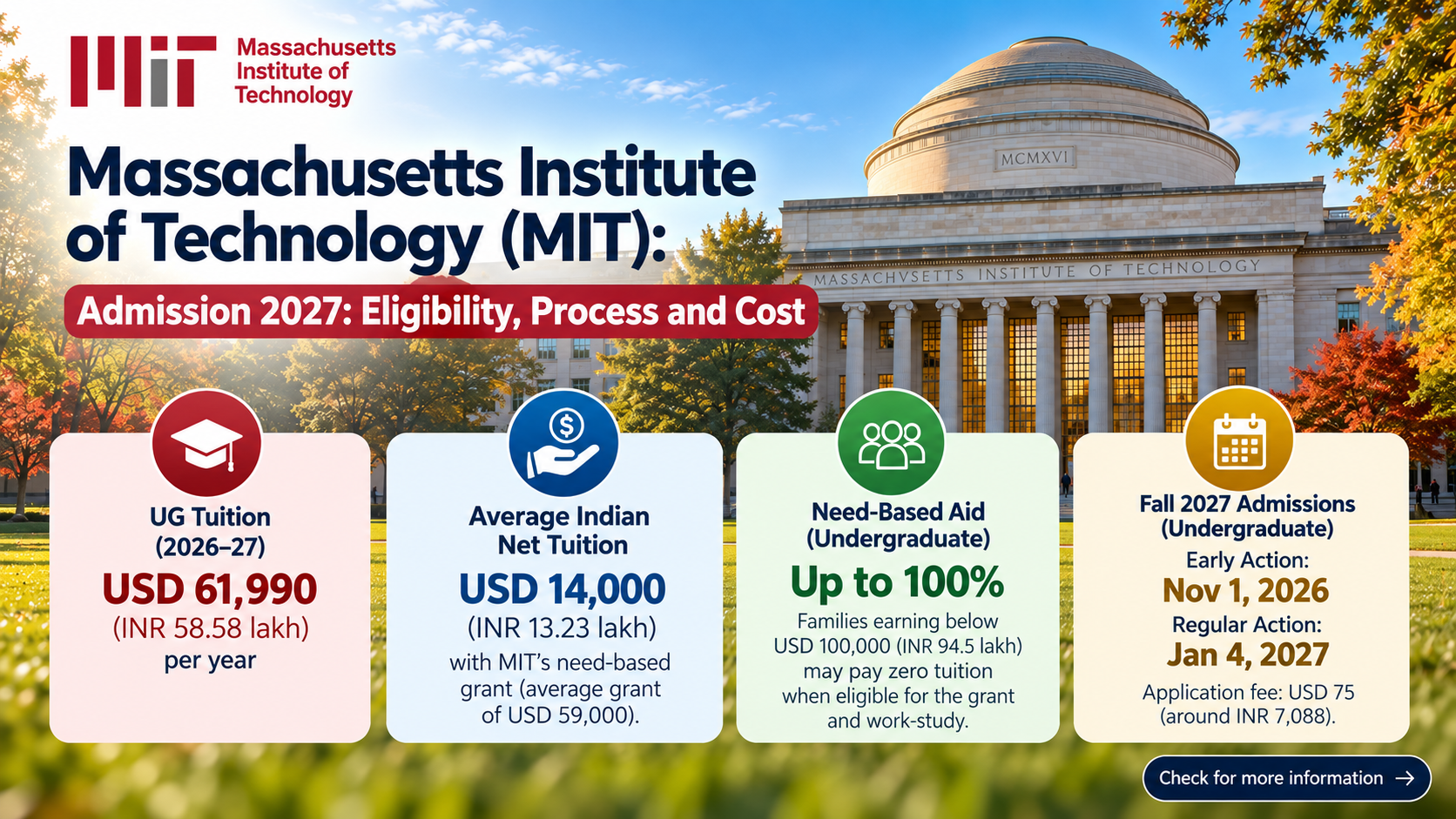
Massachusetts Institute of Technology admissions are handled through MIT’s own application portals, with no Common App or Coalition Application. MIT evaluates applicants holistically, considering academics, research or engineering experience, problem-solving ability, and overall fit. Undergraduate applicants need a strong Class XII record with Mathematics, Physics and Chemistry, along with SAT or ACT scores, while master’s and PhD applicants generally need a relevant bachelor’s degree, academic strength, research or industry exposure and, where required, English proficiency scores.
- Fall 2027 primary intake: UG Early Action closes November 1, 2026; Regular Action closes January 4, 2027
- Application fee: USD 75 (around INR 7,088) for UG and PG applications
- UG eligibility: Strong Class XII performance with SAT/ACT scores
- PG eligibility: Relevant bachelor’s degree with programme-specific academic and English proficiency requirements
- Acceptance rate: Overall 4.5% for the Class of 2029; Early Action and Regular Action rates vary
Indian applicants commonly target Computer Science, EECS, Aerospace Engineering, Mechanical Engineering and the MIT Sloan MBA. The application process is highly competitive, so students should focus on demonstrating academic strength, meaningful projects or experience and a clear reason for choosing their programme.
Also check,
- Massachusetts Institute of Technology (MIT)
- Undergraduate Courses in USA for Indian Students 2026
- Cheapest Universities in USA for Indian Students 2026
Table of Contents
- Massachusetts Institute of Technology Application Deadlines
- MIT Eligibility for Indian Students
- MIT PG Programs and English Scores
- Massachusetts Institute of Technology UG Programs
- MIT Sloan MBA Rounds and Requirements
- MIT PhD Admissions and Funding
- Massachusetts Institute of Technology Application Process
- MIT Documents Required for Indian Applicants
- Massachusetts Institute of Technology Acceptance Rate
- USA Student Visa Process for MIT Admits
- FAQs
Massachusetts Institute of Technology Application Deadlines
MIT follows fixed application deadlines by programme rather than open admission rounds. Fall (August) is the primary intake for first-year undergraduates, with no January or Spring entry. Graduate deadlines vary by department, with most master’s and PhD programmes closing between mid-December 2026 and mid-January 2027. For Indian students, Fall 2027 is the main intake for most MIT programmes.
| Intake | Level | App Opens | Deadline | App Fee |
|---|---|---|---|---|
| Fall 2027 (Primary intake) Early Action | UG | 1 August 2026 | 1 November 2026 | USD 75 (INR 7,088) |
| Fall 2027 Regular Action | UG | 1 August 2026 | 4 January 2027 | USD 75 (INR 7,088) |
| Fall 2027 (Sloan MBA Round 1) | PG | Late July 2026 | 29 September 2026 | USD 250 (INR 23,625) |
| Fall 2027 (Sloan MBA Round 2) | PG | Open | 12 January 2027 | USD 250 (INR 23,625) |
| Fall 2027 (Sloan MBA Round 3) | PG | Open | 6 April 2027 | USD 250 (INR 23,625) |
| Fall 2027 (Media Lab MAS/PhD) | PG | Open | 1 December 2026 | USD 75 (INR 7,088) |
| Fall 2027 (EECS Master’s/PhD) | PG | Open | 15 December 2026 | USD 75 (INR 7,088) |
Planning note: MIT does not participate in Common App or Coalition. Every first-year applicant creates a separate account on the MIT-only portal, so start early and do not assume a Common App submission reaches MIT.
Also check,
Massachusetts Institute of Technology Eligibility for Indian Students
MIT does not publish a single cut-off percentage. The admissions office reviews Class XII grades, curriculum rigour, testing, essays, letters, and demonstrated impact in one holistic read. That said, admitted Indian students typically clear the bars below on the MIT tests and scores page.
- UG academic floor: Class XII around 90 percent with Mathematics, Physics, and Chemistry as core subjects
- UG testing: SAT or ACT is required. EA candidates must test by 30 November, RA by 31 December
- PG academic floor: Bachelor’s with around 75 percent or a US 3.5 GPA equivalent, in a subject aligned to the department
- PG research signal: published work, internships, or industry projects that map to the target lab
MIT English Proficiency Scores for Indian Applicants
MIT accepts multiple tests. The undergraduate office recommends English exams for applicants who have used English fewer than five years or do not speak it at home or school, while graduate departments have their own hard floors.
| Test | UG Minimum | UG Recommended | PG Minimum |
|---|---|---|---|
| TOEFL iBT | 90 | 100 | 100 |
| IELTS Academic | 7.0 | 7.5 | 7.0 |
| PTE Academic | 65 | 70 | Accepted (dept sets floor) |
| Cambridge English | 185 | 190 | 190 |
| Duolingo English Test | 120 | 125 | 135 |
Massachusetts Institute of Technology PG Programs and English Scores
MIT’s graduate schools, including Engineering, Sloan, Science, Architecture, Humanities and Media Arts, offer research master’s, professional master’s and doctoral programmes. Base tuition for many graduate programmes is around USD 65,160 (INR 61.58 lakh) per academic year, while Sloan and programmes with additional fees may have higher costs. Students should check the specific programme’s fee structure for the exact tuition.
| Programme | Duration | Minimum Eligibility | English Req. Min. |
|---|---|---|---|
| Master of Science in EECS | 2 years | Bachelor’s in EE or CS with 75%+ and research exposure | TOEFL 100 |
| Master of Engineering in EECS | 1 year (MIT UG-only track) | MIT Bachelor’s in EECS | TOEFL 100 |
| MS in Mechanical Engineering | 2 years | Bachelor’s in ME with 75%+ and lab or project record | TOEFL 100 |
| MS in Aeronautics and Astronautics | 2 years | Bachelor’s in Engineering with 75%+ in relevant subjects | TOEFL 100 |
| MS in Civil and Environmental Engineering | 1.5 to 2 years | Bachelor’s in CEE or related with 75%+ | TOEFL 100 |
Insider note: MIT graduate admissions are department-driven rather than fully centralised. Applicants should tailor their statement of purpose to relevant faculty, labs and current research projects instead of writing broadly about MIT as a whole.
Also check, Massachusetts Institute of Technology (MIT): Courses and Fees
Massachusetts Institute of Technology UG Programs
MIT admits undergraduates to the Institute rather than a specific major, allowing students to choose from 50+ majors after the first year. Around 40% of MIT undergraduates pursue EECS-affiliated majors, making these tracks especially popular among Indian applicants.
| Programme | Duration | Minimum Eligibility | English Req. Min. |
|---|---|---|---|
| Bachelor in Computer Science and Engineering (6-3) | 4 years | Class XII around 90% with Mathematics, Physics, Chemistry + SAT/ACT | TOEFL 90 |
| Bachelor in Electrical Engineering and Computer Science (6-2) | 4 years | Class XII around 90% with Mathematics and Physics + SAT/ACT | TOEFL 90 |
| Bachelor in Mechanical Engineering (Course 2) | 4 years | Class XII around 90% with Mathematics and Physics + SAT/ACT | TOEFL 90 |
| Bachelor in Aerospace Engineering (Course 16) | 4 years | Class XII around 90% with Mathematics and Physics + SAT/ACT | TOEFL 90 |
| Bachelor in Mathematics (Course 18) | 4 years | Class XII around 90% with strong Mathematics record + SAT/ACT | TOEFL 90 |
Planning note: The Bachelor in Electrical Engineering and Computer Science (6-2) is a joint programme between Departments 6 and 3 within the Schwarzman College of Computing. Students do not need to commit to this track at admission and can change their academic path after completing core coursework.
Massachusetts Institute of Technology Sloan MBA Rounds and Requirements
The MIT Sloan full-time MBA is a two-year residential programme with three application rounds each cycle. For the 2026–27 cohort, base tuition is around USD 86,550 (INR 81.79 lakh) per year, with detailed charges listed on the Sloan financial services page.
Sloan MBA Application Rounds for Fall 2027
| Round | Deadline | Interview Invites | Final Decision |
|---|---|---|---|
| Round 1 | 29 September 2026 | Late October 2026 | Mid-December 2026 |
| Round 2 | 12 January 2027 | Late February 2027 | Early April 2027 |
| Round 3 | 6 April 2027 | Late April 2027 | Mid-May 2027 |
Sloan MBA Eligibility and Test Policy
- Work experience: average 5 years for Sloan MBA admits, though there is no formal minimum
- Test policy: GMAT or GRE required. Executive Assessment accepted for the Executive MBA only
- Interview: by invitation, held virtually, and includes a behavioural interview plus a short written reflection
- Sloan Fellows (Executive): minimum 10 years of full-time work experience, with a substantive leadership record
Also check,
- MBA in USA 2027: Top Colleges, Fees and Eligibility
- Affordable MBA Colleges in USA for Indian Students
Massachusetts Institute of Technology Application Process
MIT uses its own application platforms and does not accept the Common App or Coalition Application. Undergraduate applicants apply through apply.mitadmissions.org, most graduate applicants use apply.mit.edu, and MIT Sloan has a separate portal at applymitsloan.mit.edu. These platforms generally open in late July or early August each year.
- Create your MIT portal account. First-year applicants use apply.mitadmissions.org; graduate applicants use apply.mit.edu or the Sloan portal for MBA and Master of Finance
- Complete the biographical and academic sections. Enter every school attended from Class IX onward, list Class X and Class XII marks, and add any competition results
- Upload transcripts and mark sheets. Self-report on the portal at submission and follow up with school-mailed official documents
- Submit test scores. Send SAT/ACT (UG) or GRE/GMAT (PG, where required) plus TOEFL, IELTS, PTE, Duolingo, or Cambridge English scores directly from the test agency
- Add essays and short answers. MIT’s five short essays each cap at 200 words, so plan drafts across two months
- Request recommendations. UG needs two teacher recommendations plus one counsellor letter; PG typically needs three, mostly from research supervisors
- Pay the application fee of USD 75 (around INR 7,088) on the MIT application portal, or apply for a need-based fee waiver
- Submit before the deadline. The portal closes at 11:59 pm US Eastern Time on the deadline date
Massachusetts Institute of Technology Documents Required for Indian Applicants
MIT’s document checklist is longer than most US peers because every school and department can request extras. The list below covers the institution-wide baseline. Confirm any department-specific additions on your target program’s page before submitting.
- Passport bio-page scan: valid for at least 12 months beyond the intended arrival date
- Class X and Class XII mark sheets: uploaded to the portal, with hard copies mailed by the school after admission
- Bachelor’s transcripts and degree certificate: for PG applicants, with year-wise mark sheets
- Standardised test score reports: SAT/ACT, GRE, GMAT, sent directly from ETS or the College Board
- English proficiency score report: TOEFL, IELTS, PTE, Duolingo, or Cambridge English, sent from the test agency
- Statement of purpose or personal essays: MIT’s five short essays for UG, or the SOP for PG
- Letters of recommendation: 2 for UG (teachers) + 1 counsellor; 3 for PG (research or work supervisors)
- Resume or CV: single page for UG, up to two pages for PG applicants
- Financial documents (for I-20 after admission): bank statement covering the first year’s tuition and living costs
- Portfolio: Architecture, Media Arts and Sciences, and design-track applicants
Also check,
- Documents Required for US University Applications 2027
- I-20 Form Guide for Indian Students: Complete Explanation
Massachusetts Institute of Technology Acceptance Rate
MIT’s overall acceptance rate for the Class of 2029 (Fall 2025 entry) was 4.5%, based on 29,282 applicants and 1,324 admits. The rate has generally remained between 4% and 7% over the past decade, and MIT’s holistic admissions process means high test scores alone do not guarantee admission.
MIT Acceptance Rate by Application Round
| Round | Applicants | Admits | Acceptance Rate |
|---|---|---|---|
| Early Action | 12,053 | 721 | 6.0% |
| Regular Action | 17,229 | 603 | 3.5% |
| Overall | 29,282 | 1,324 | 4.5% |
USA Student Visa Process for MIT Admits
Indian students admitted to MIT generally apply for the F-1 student visa through the U.S. Embassy or Consulates in India. After admission and submission of financial documents, MIT’s International Students Office issues the I-20 form. Students then pay the SEVIS I-901 fee of USD 350 (around INR 33,075), complete the DS-160, pay the USD 185 (around INR 17,483) visa application fee, and schedule their biometrics and visa interview.
At the visa interview, students should show financial proof covering their first-year estimated expenses, which may be around USD 88,000 (INR 83.16 lakh) for undergraduate study, including tuition, room, board and health insurance. Funded PhD students may need to show less personal funding. After arrival, F-1 students can work up to 20 hours per week on campus during the academic term and may be eligible for 12 months of OPT, with an extension to 36 months for eligible STEM graduates.
Also check,2026 update: The U.S. Department of State has emphasised proof of ties to India and clear post-study plans during F-1 visa interviews. Indian MIT admits should prepare concise answers explaining why MIT specifically and how the degree connects to a clear career plan in India or a global role.
- US Student Visa Requirements: Cost, Application & Process
- US Student Visa Types: Differences Between J, M and F Visa
MIT admissions value specificity, evidence and clarity of purpose more than polished language. Indian applicants should focus on one strong project narrative, honest test scores and focused essays rather than a long but less substantial CV. Prepare documents by early October 2026 for Early Action and mid-December 2026 for Regular Action, and use the MIT application portal as the final source of truth for all submission requirements and deadlines.
FAQs
Ques. Does MIT accept the Common App or Coalition application?
Ans. No. MIT uses its own portal at apply.mitadmissions.org for undergraduate applicants and apply.mit.edu for most graduate programs. Sloan MBA and Master of Finance use applymitsloan.mit.edu. There is no Common App route.
Ques. What is the MIT application fee for Indian students?
Ans. The application fee is USD 75 (around INR 7,088) for undergraduate, most graduate, and Media Lab applications. Sloan MBA charges USD 250 (around INR 23,625). Need-based fee waivers are available to applicants who cannot pay.
Ques. What Class XII percentage do I need for MIT?
Ans. MIT does not publish a hard cut-off, but admitted Indian students typically hold Class XII scores around 90 percent with strong performance in Mathematics, Physics, and Chemistry. Curriculum rigour is weighted alongside grades.
Ques. Is IELTS or TOEFL required for MIT undergraduate applications?
Ans. English proficiency exams are strongly recommended for non-native speakers who have used English fewer than five years. Indian applicants from English-medium schools often qualify for the exemption at the UG level, but scores strengthen the file.
Ques. What is the minimum TOEFL score for MIT graduate programs?
Ans. The institution-wide minimum is TOEFL iBT 100 or IELTS 7.0. Individual departments can set higher floors, and applicants should verify on the target department’s page before booking a test.
Ques. When does MIT release admission decisions?
Ans. Undergraduate Early Action decisions arrive in mid-December 2026 and Regular Action decisions in mid-March 2027. Sloan MBA decisions land inside 12 weeks of the round deadline, while other graduate decisions release across February to April.
College Student Profiles

Massachusetts Institute of Technology Program Fees & Deadlines
| Program | Important Dates | Fees | Application Fees | Eligibility | Financial Aid |
|---|---|---|---|---|---|
Application Deadline For Fall 2027 Intake (1st Dec 2026) | USD 64,310 /Yr | 90 | TOEFL iBT : 5, IELTS : 7 | - | |
MFin 18 months | USD 93,834 /Yr | 150 | GMAT:700, GRE:260 | - | |
MBA 2 years | USD 91,892 /Yr | 250 | GRE: 311, GMAT:730,CGPA:3.7 | - | |
BS Aerospace Engineering 4 years | USD 64,310 /Yr | 75 | TOEFL: 100, IELTS:7.5, Duolingo-125 | ||
| USD 64,310 /Yr | 75 | TOEFL: 100, IELTS:7.5, Duolingo-120 | |||
MS Business Analytics 12 months | USD 93,834 /Yr | 150 | TOEFL : 100, IELTS: 7 | - | |
MArch 42 months | USD 86,530 /Yr | 90 | TOEFL iBT : 100, IELTS : 7,Duolingo : 135+ | - | |
BS Architecture 4 years | USD 64,310 /Yr | 75 | TOEFL: 90, IELTS: 7, PTE: 65, Duolingo: 120 | ||
MS Economics 2 years | USD 86,530 /Yr | 90 | IELTS: 7, TOEFL: 100 | - | |
MASc Supply Chain Management 10 months | USD 86,530 /Yr | 90 | IELTS: 7, TOEFL: 100 | - |
Do you think the Dates are wrong ? Report Here
Important Alerts
| Events | Dates |
|---|---|
| Computer Science and Molecular Biology Early Action Application Deadline for 2027 Intake | Closing in 19 days |


Course Finder - Search from 50K+ courses
Popular Streams:

interested in this College ?
Follow & Share this college to get information about admission.



Comments