



Chitkara University co-hosted a strategic meeting with the BAJA SAEINDIA Organising Committee in Chandigarh, and it brought together two sides that have diligently worked alongside each other for years, and used the occasion to talk about where that collaboration goes next.
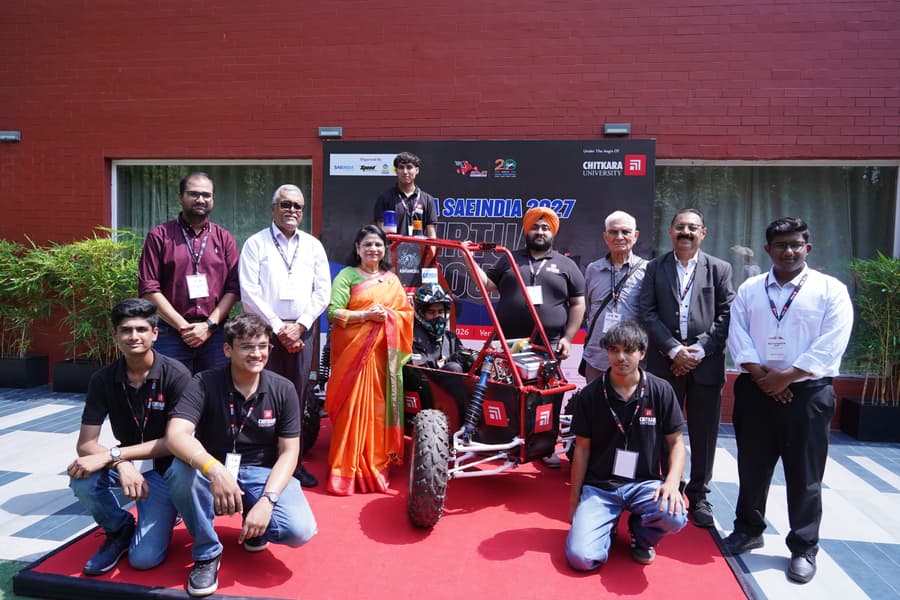
Chitkara University's leadership was represented at the interaction by Dr. Madhu Chitkara, President and Co-founder; Dr. Sandhir Sharma, Vice Chancellor; and Dr. Rakesh Sharma, Registrar, who met with the BAJA SAEINDIA Organising Committee. On the other side of the table were distinguished leaders from the automobile sector, including Mr. Balraj Subramaniam, Chairman of the Organising Committee, Mr. Jatin Garg, its Honorary Secretary, Dr. K. C. Vora, Senior Advisor to the Committee, and Mr. Balraj Bhanot, a widely respected automotive homologation expert and former Director at ARAI.
Mr. Subramaniam opened proceedings by speaking about BAJA SAEINDIA's legacy in nurturing engineering talent through hands-on learning and innovation. Dr. Sandhir Sharma, Vice Chancellor, Chitkara University, responded by highlighting how essential strong academia-industry partnerships have become in preparing students for the technological challenges now emerging across the mobility sector.
A presentation on the journey and legacy of BAJA SAEINDIA traced how the competition has evolved into one of India's most respected experiential learning platforms, and today functions as an umbrella spanning Electric Vehicle BAJA, Mechanical BAJA, Autonomous BAJA, and Hydrogen BAJA. Each of these four arms reflects a distinct engineering discipline in its own right. Electric Vehicle BAJA calls for an understanding of battery systems and power electronics, Autonomous BAJA brings in sensor technology and decision-making logic, Hydrogen BAJA introduces fuel-cell engineering and safety protocols, and Mechanical BAJA continues to test the fundamentals of traditional vehicle design. Together, this range gives participating students the chance to explore diverse future mobility technologies through hands-on, competitive engineering challenges, rather than encountering them only as chapters in a textbook.
The scale of what students actually take on inside this framework is considerable. Participants conceptualise, design, analyse, fabricate and validate single-seater, all-terrain vehicles strictly in line with the BAJA SAEINDIA Rulebook, before their work is tested in rigorous static and dynamic evaluations that assess engineering excellence, innovation, safety and endurance. The static evaluations examine the reasoning behind each design decision, while the dynamic evaluations put the finished vehicle through actual driving conditions on rough terrain, leaving little room for a design that looks strong on paper but performs poorly in practice. It is precisely this kind of demanding, real-world framework that has made BAJA SAEINDIA a meaningful reference point for institutions like Chitkara University that emphasise industry-aligned learning.
Addressing the gathering, Dr. Madhu Chitkara, President and Co-founder, Chitkara University, spoke about the university's continued association with BAJA SAEINDIA and emphasised the transformative role experiential learning plays in engineering education. Such initiatives, she noted, inspire students to translate classroom learning into practical innovation, while simultaneously strengthening their technical expertise, teamwork, leadership and problem-solving abilities. Her remarks reflected a broader theme that ran through the interaction: that engineering skills are best developed not only through instruction, but through the process of building something, testing it, and learning from where it falls short.
The discussion also turned to the Virtual Round of BAJA SAEINDIA, where digital engineering tools and simulation-based assessments evaluate vehicle design, engineering analysis, and innovation before teams advance to the competition's later stages. This stage allows teams to test and refine their engineering choices digitally before committing time and resources to physical fabrication, and it has become an increasingly important part of how the competition assesses innovation and design thinking early in the process. For universities that emphasise rigorous, industry-aligned learning, this newer layer of the competition fits naturally into the kind of preparation students benefit from well before they graduate. It rewards teams that get the fundamentals right early, rather than teams that simply look impressive once a vehicle is finally built.
The interaction gave both sides a useful, direct exchange on how industry needs are shifting, whether in electric drivetrains, autonomous systems or hydrogen-based mobility, and how engineering education can keep pace with those shifts rather than trail behind. The most progressive part of the interaction was the shared exploration of ways to strengthen collaboration between academia and industry, ensuring that engineering education remains aligned with the evolving needs of the automotive and mobility sectors.
By the end of the meeting, one thing was evident: BAJA SAEINDIA brought a well-established legacy and an evolving four-category competition structure to the table, and Chitkara University brought a matching commitment to experiential learning that has shaped its engineering programs for years. Together, both sides used the conversation to think through how that shared groundwork can be carried forward for the next generation of engineering students.
About Chitkara University
Chitkara University is a UGC-recognised and NAAC-accredited private university in North India, with campuses in Punjab and Himachal Pradesh, offering career-oriented undergraduate and postgraduate programs in Engineering, Business, Healthcare, Pharmacy, Design, Architecture, Hospitality, and emerging technology fields. For students planning higher education, the University provides industry-aligned programs designed to combine academic excellence with practical exposure.
The curriculum emphasises experiential learning through internships, industry projects, research opportunities, and global collaborations, supported by modern infrastructure, advanced laboratories, industry mentorship, and skill-based training that strengthens student employability. Backed by 2,000+ campus recruiters and 300+ international academic and industry collaborations, students gain strong placement support, international exposure, academic exchange, and collaborative research opportunities.
Consistently ranked among leading institutions by national and global frameworks such as NIRF, QS World University Rankings, and Times Higher Education, the University maintains high academic rigour and industry relevance. With strong corporate partnerships and a focus on innovation, entrepreneurship, and interdisciplinary learning, it prepares students for emerging career opportunities in India and abroad.





![MBA/PGDM | admission | 2024 | Narsee Monjee Institute of Management Studies - [NMIMS Deemed to be University]](https://img.collegedunia.com/public/college_data/images/logos/1506323004Logo.jpg?h=72&w=72&mode=stretch)


![MBA/PGDM | admission | 2024 | Indian Institute of Management - [IIMC]](https://img.collegedunia.com/public/college_data/images/logos/1488950580d2.png?h=72&w=72&mode=stretch)



Comments