




The National Testing Agency (NTA) conducted the CUET PG 2026 Agricultural Science (SCQP01) examination on March 12, 2026, during Shift 1 from 09:00 AM to 10:30 AM. Students who appeared for the exam reported that the overall difficulty level of the paper was moderate.
Candidates have 105 minutes to answer questions covering agronomy, genetics, soil science, and economics. The marking scheme is +4 for correct answers and -1 for wrong answers, totaling 300 marks. CUET PG 2026 Agricultural Science Question Paper with Solutions PDF is available here for Download.
CUET PG 2026 Agricultural Science Question Paper with Solutions PDF
| CUET PG 2026 Agricultural Science Question Paper | Download PDF | Check Solutions |
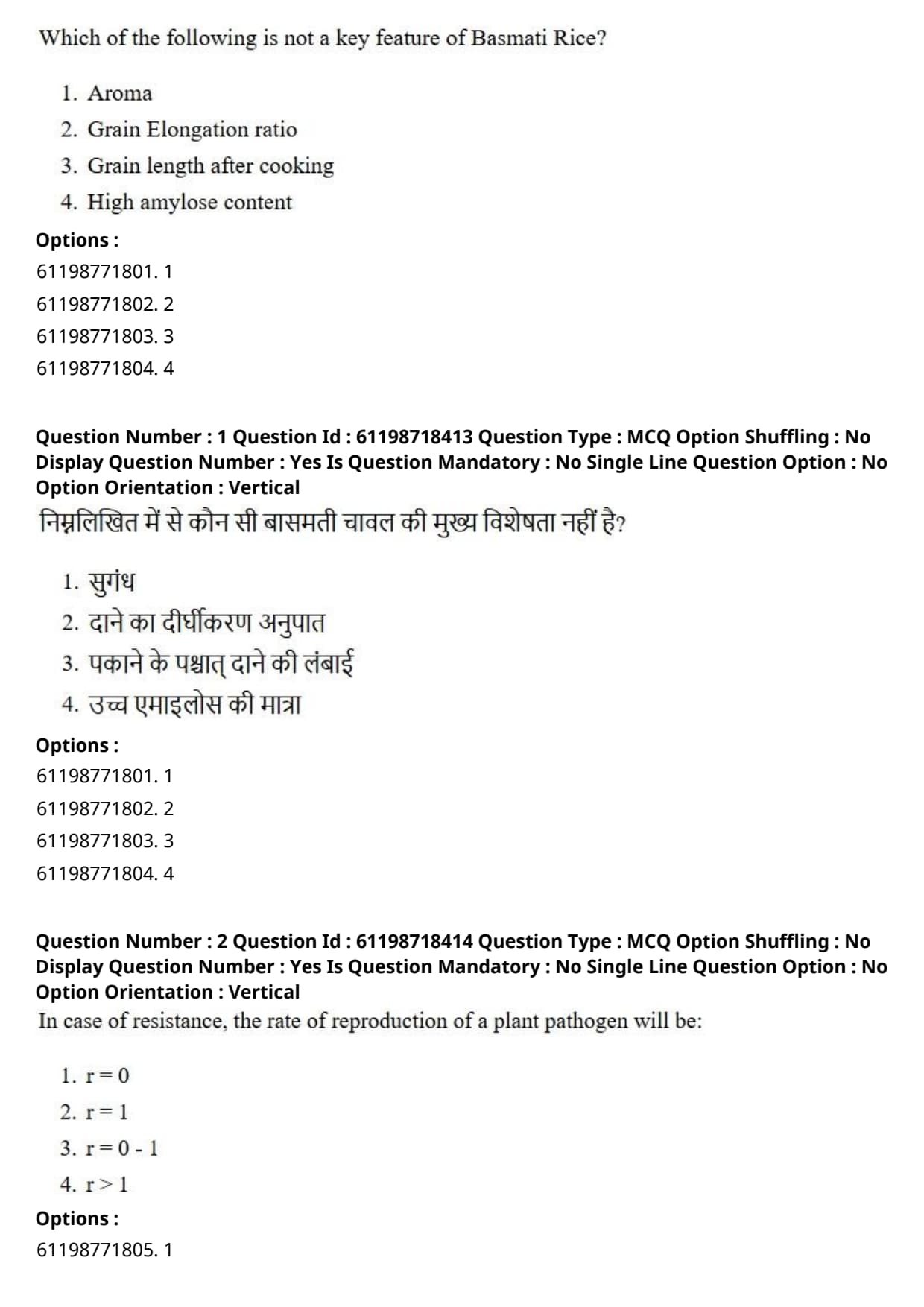





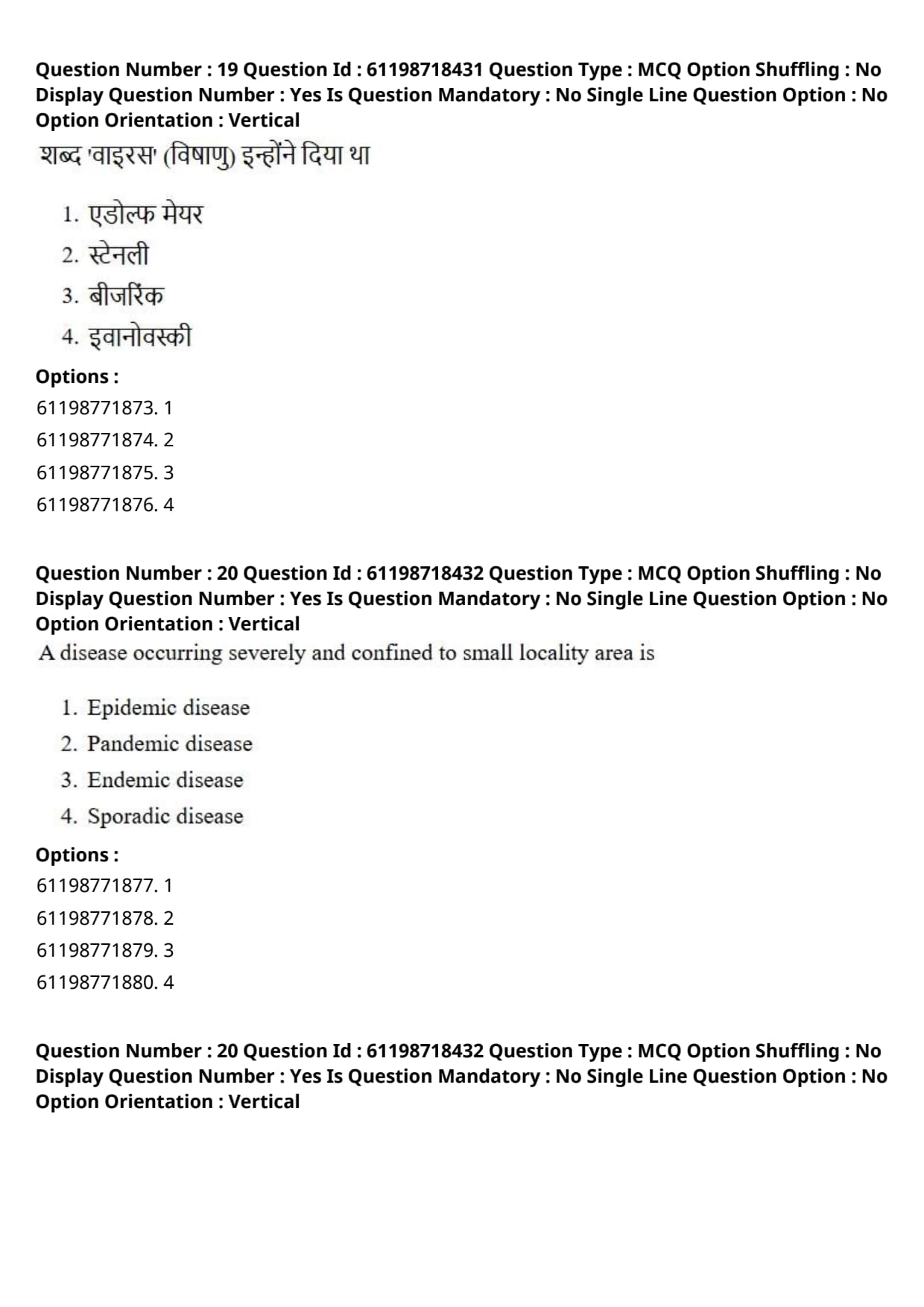


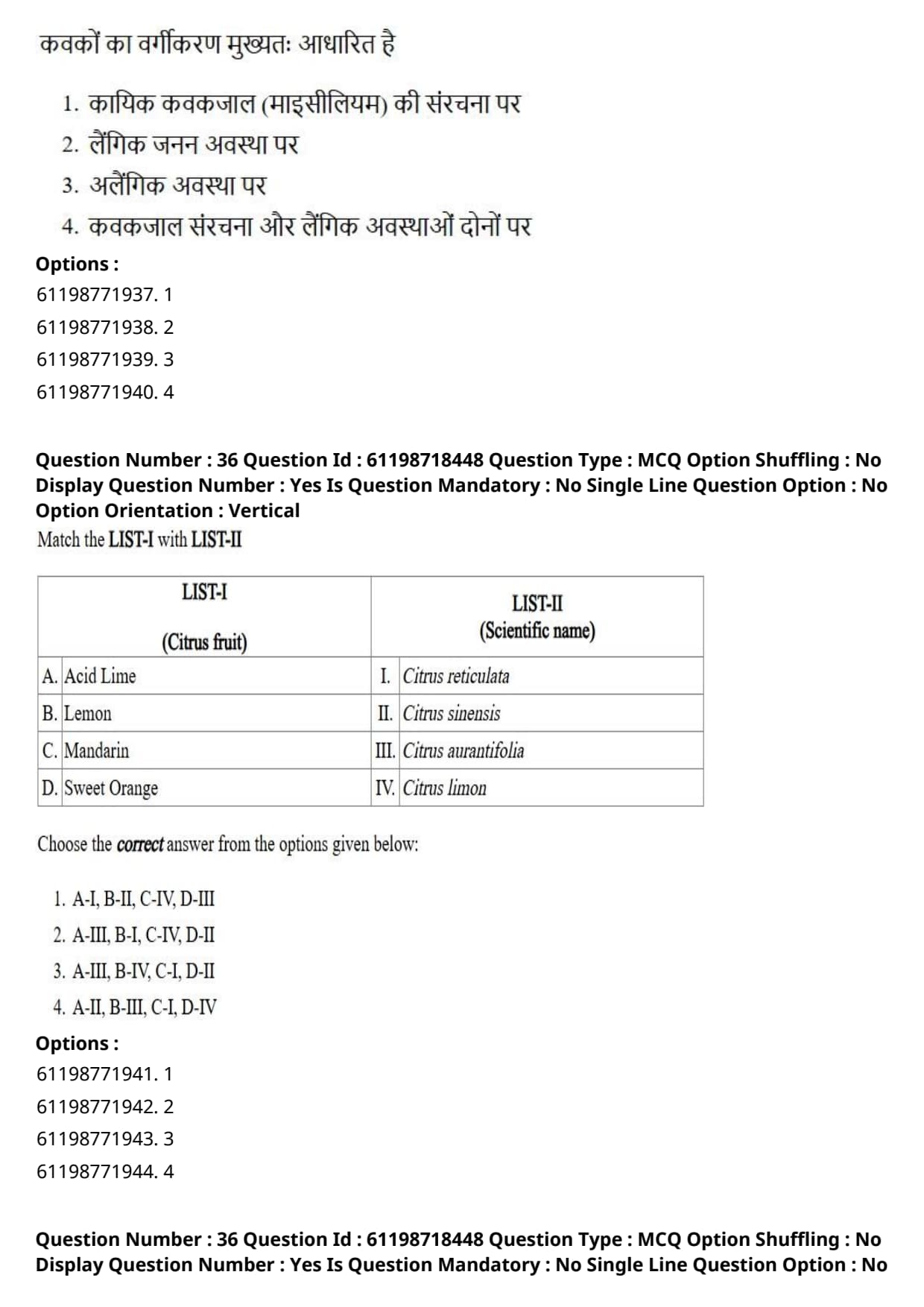
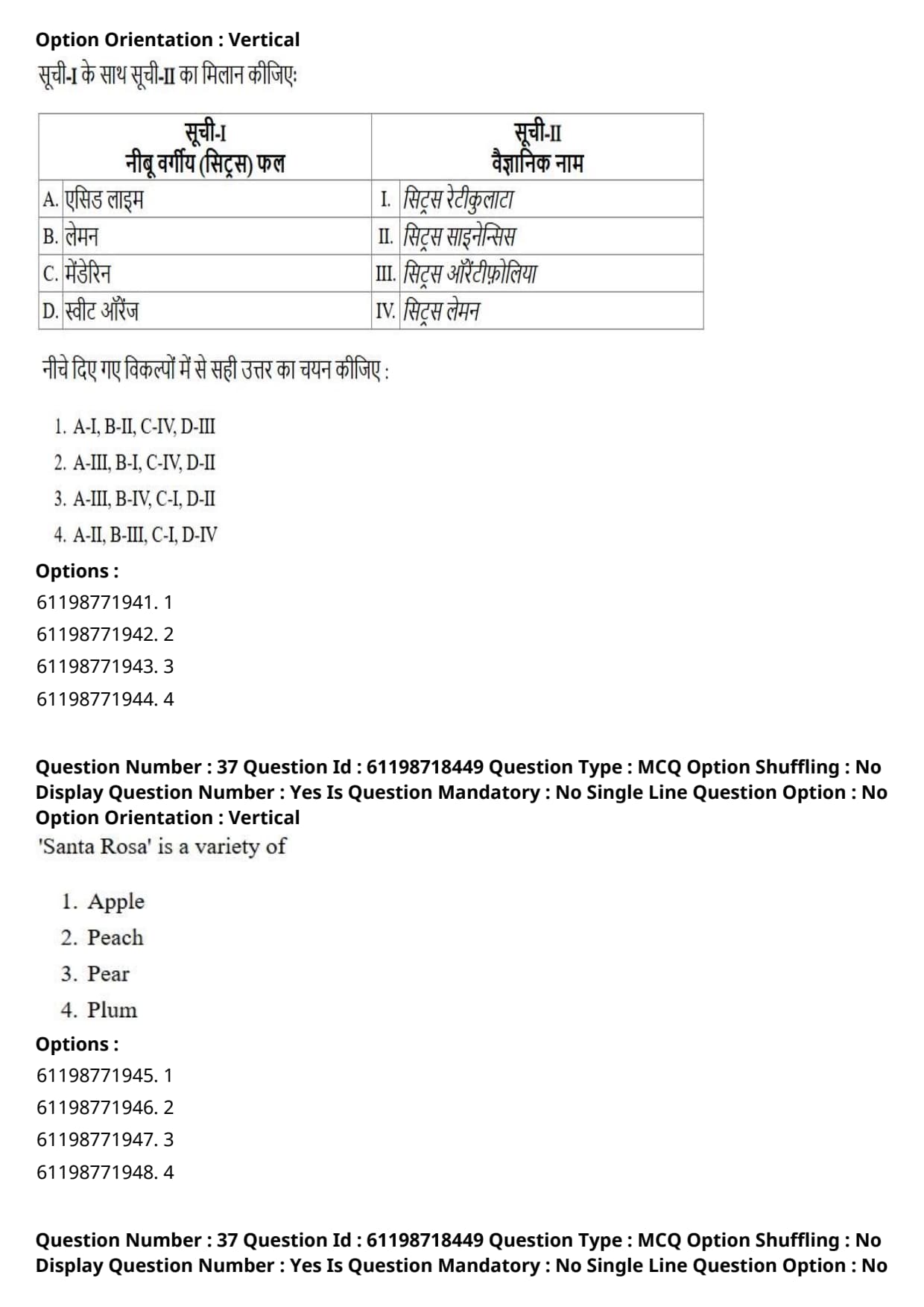
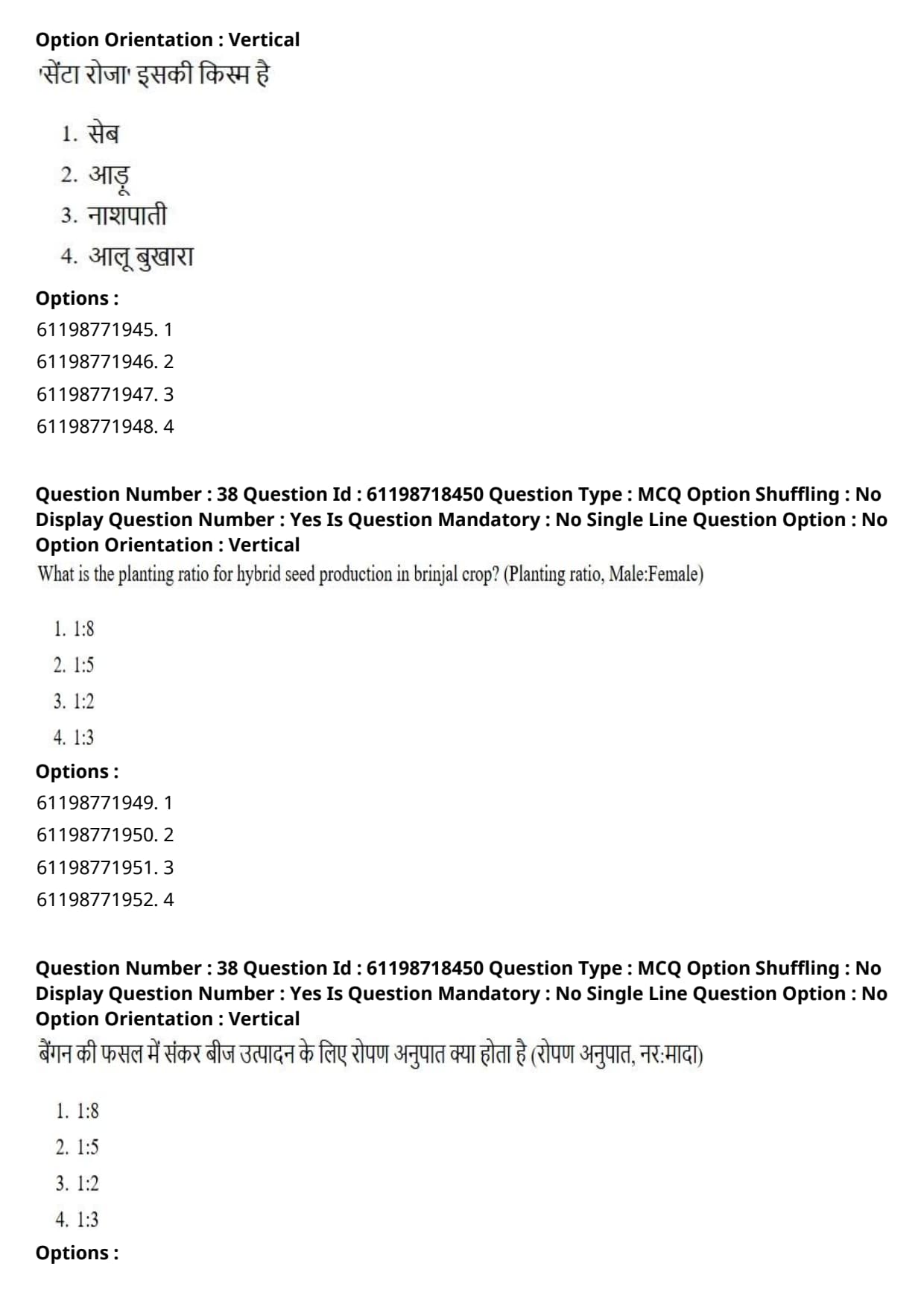
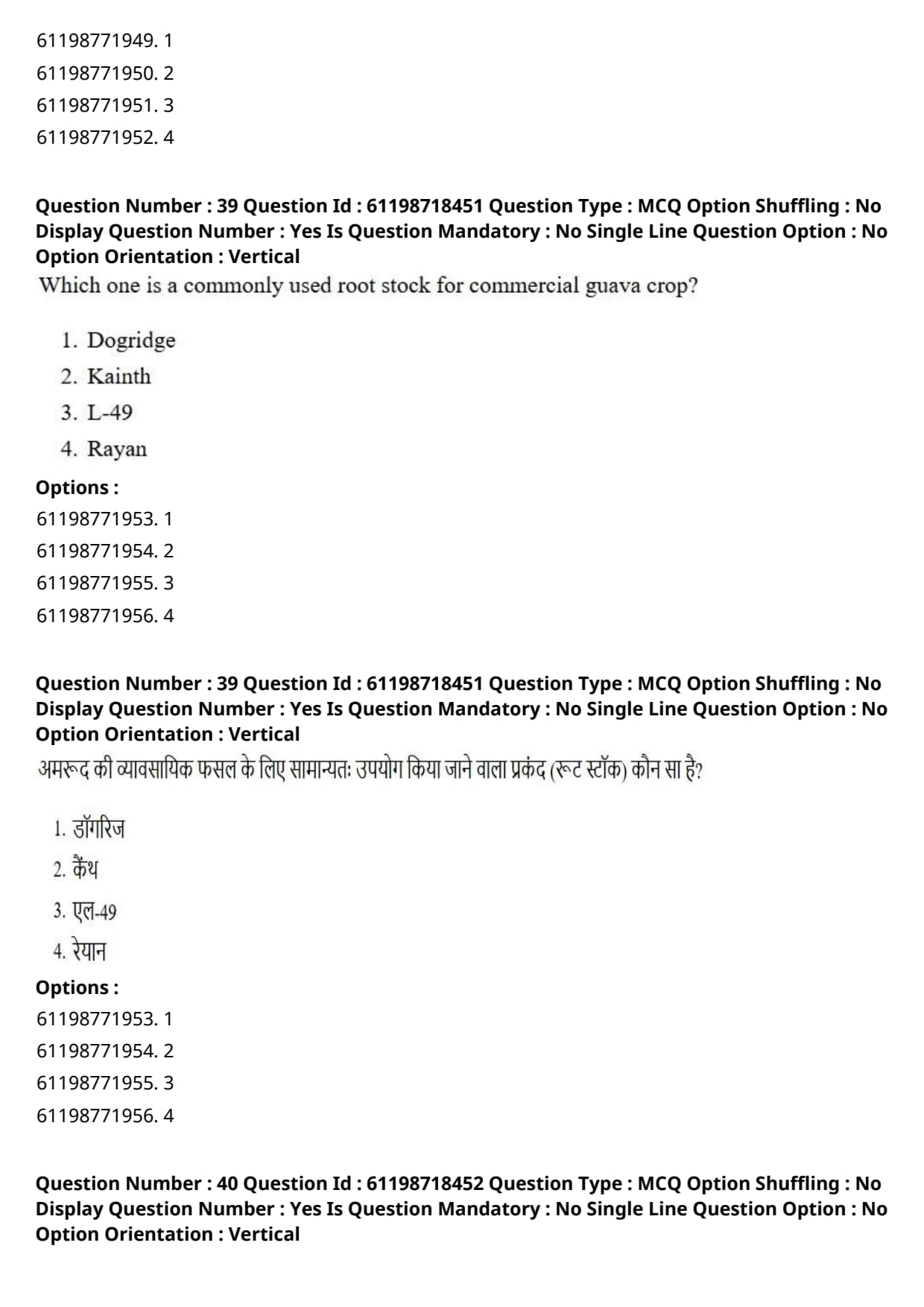



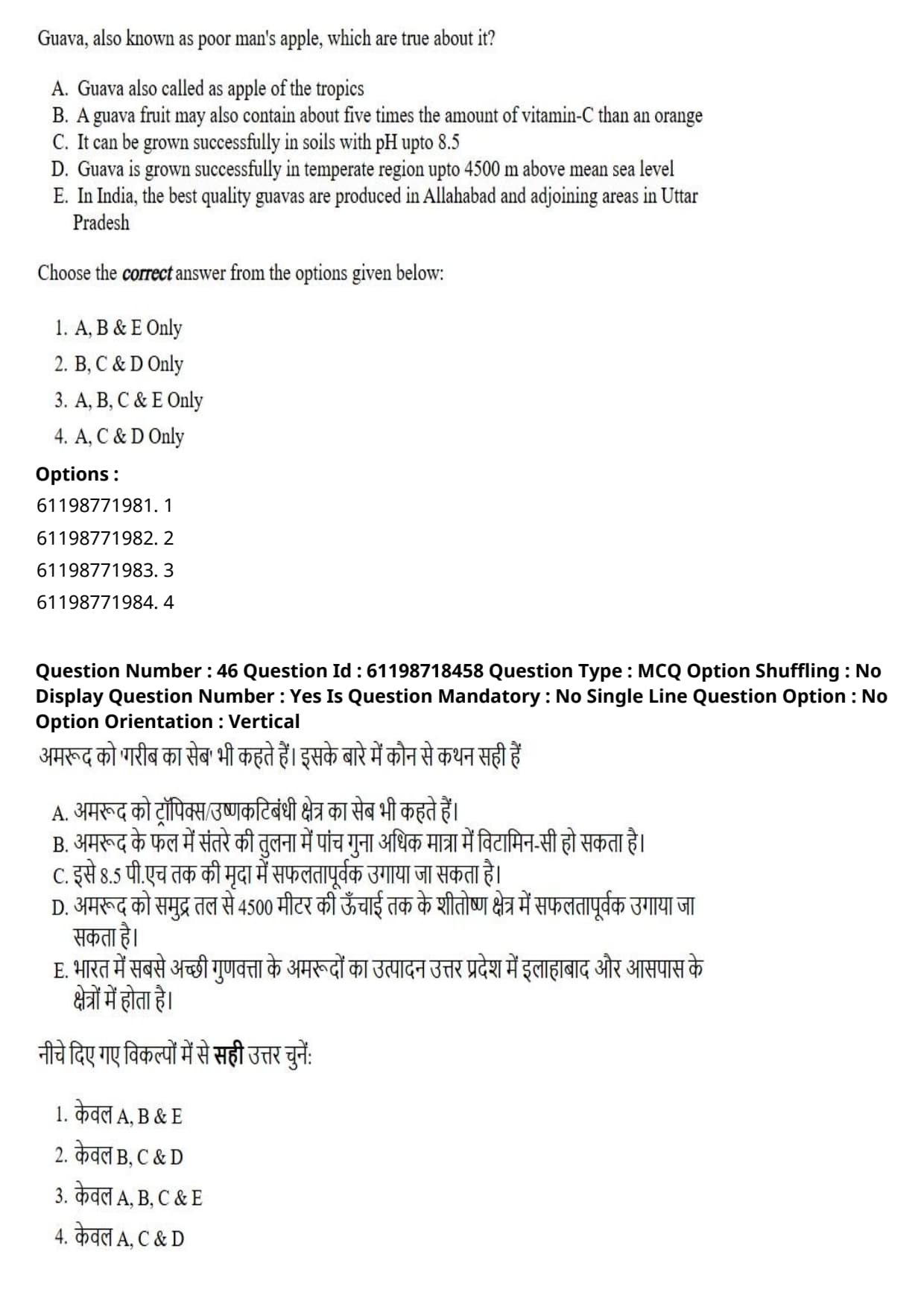



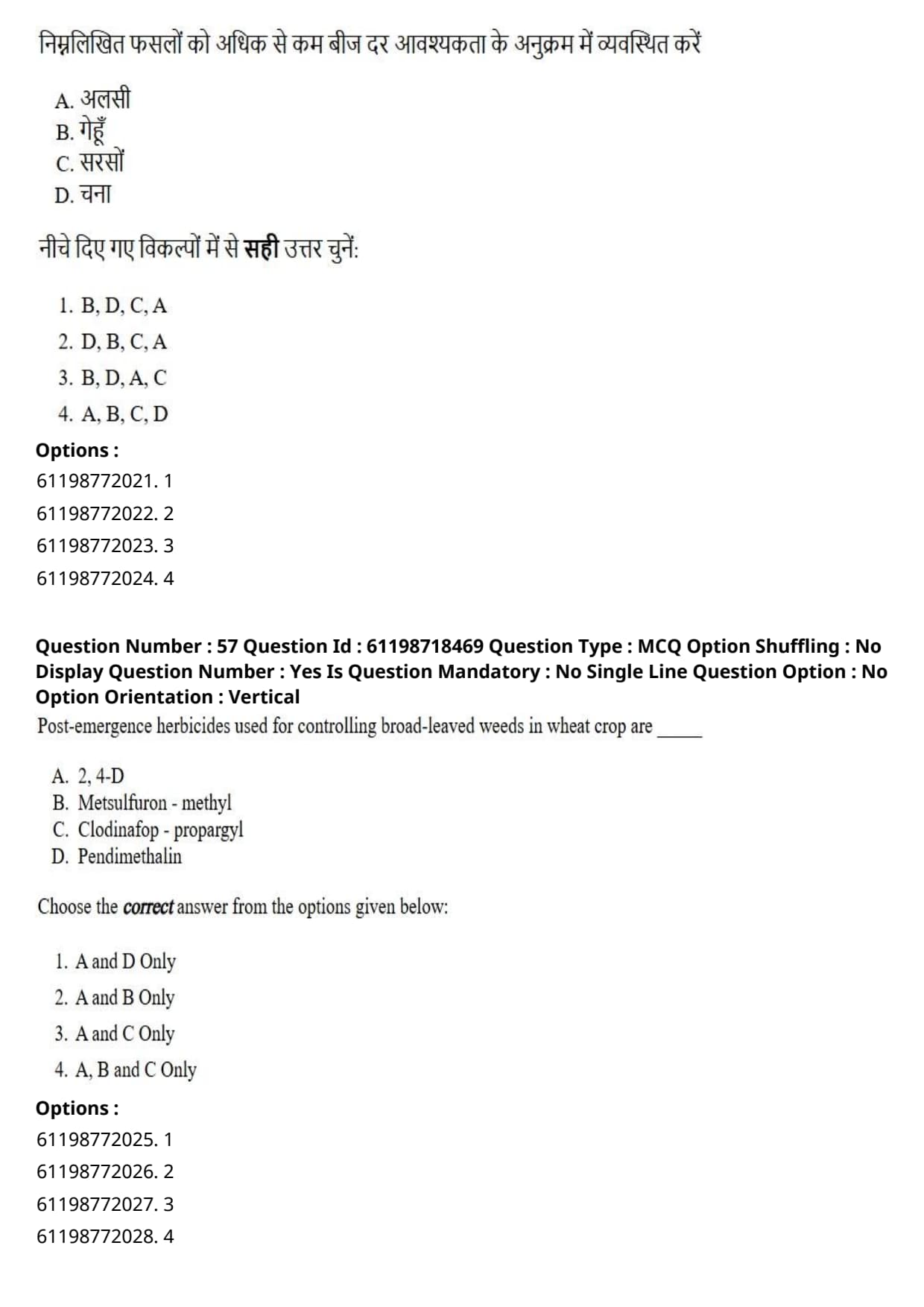



Which of the following is not a key feature of Basmati Rice?
View Solution
Concept:
Basmati rice is a premium quality aromatic rice. It is mainly identified by its special fragrance, long slender grains, and excellent elongation after cooking.
Step 1: Understand the important quality features of Basmati rice.
The important features of Basmati rice include: \[ Aroma \] \[ Long slender grain \] \[ High grain elongation after cooking \] \[ Good cooking quality \]
Step 2: Check option (A).
Aroma is one of the most important features of Basmati rice. Basmati rice is famous for its characteristic fragrance.
\[ (A) is a key feature \]
Step 3: Check option (B).
Grain elongation ratio is also an important feature. Basmati rice grains elongate significantly after cooking.
\[ (B) is a key feature \]
Step 4: Check option (C).
Grain length after cooking is also important because Basmati rice becomes long and fluffy after cooking.
\[ (C) is a key feature \]
Step 5: Check option (D).
High amylose content is not considered a special identifying key feature of Basmati rice in comparison to aroma and grain elongation.
\[ (D) is not a key feature \]
\[ \therefore Correct Answer is (D) \] Quick Tip: Basmati rice is mainly known for aroma, long slender grains, and high elongation after cooking.
In case of resistance, the rate of reproduction of a plant pathogen will be:
View Solution
Concept:
Resistance in plants reduces the ability of a pathogen to multiply and spread. The reproduction rate of pathogen is represented by \(r\).
Step 1: Understand pathogen reproduction rate.
If pathogen reproduction rate is high, the disease spreads quickly.
\[ r>1 \Rightarrow pathogen population increases \]
If pathogen reproduction rate is low, disease development becomes slow.
\[ 0
Step 2: Effect of resistance.
A resistant plant does not allow the pathogen to multiply freely. Therefore, pathogen reproduction is suppressed.
Step 3: Choose correct range.
In resistance, the rate is reduced and remains between \(0\) and \(1\).
\[ r=0-1 \]
\[ \therefore Correct Answer is (C) \] Quick Tip: Resistance reduces pathogen multiplication, so the reproduction rate remains below \(1\).
Backcross breeding method is useful for the improvement of:
View Solution
Concept:
Backcross breeding is used to transfer one or a few desirable genes from a donor parent into an otherwise superior recurrent parent.
Step 1: Understand backcross breeding.
In backcross breeding, hybrid progeny is repeatedly crossed with the recurrent parent.
\[ Hybrid \times Recurrent parent \]
This helps to recover most of the genetic background of the recurrent parent while adding one desired trait.
Step 2: Type of traits suitable for backcrossing.
Backcross breeding is most suitable for traits controlled by one or a few major genes.
Such traits usually show high heritability because their expression is mainly controlled by genes and less affected by the environment.
Step 3: Eliminate wrong options.
Polygenic traits are controlled by many genes and are not easily improved by simple backcrossing. Low heritable and environmentally influenced traits are also difficult to transfer through backcross breeding.
Therefore, backcross breeding is useful for: \[ Highly heritable traits \]
\[ \therefore Correct Answer is (A) \] Quick Tip: Backcross breeding is best for transferring highly heritable traits controlled by one or few major genes.
As per Hardy-Weinberg Law, in a random mating population what is the frequency of \(AA\) genotypes from a cross of \(Aa(2pq)\times Aa(2pq)\)?
View Solution
Concept:
According to Hardy-Weinberg equilibrium: \[ AA=p^2,\quad Aa=2pq,\quad aa=q^2 \]
Step 1: Given cross. \[ Aa(2pq)\times Aa(2pq) \]
The frequency of this mating is: \[ (2pq)(2pq)=4p^2q^2 \]
Step 2: Genotypic ratio of \(Aa\times Aa\). \[ Aa\times Aa \Rightarrow AA:Aa:aa=1:2:1 \]
So, the fraction of \(AA\) progeny from this cross is: \[ \frac{1}{4} \]
Step 3: Frequency of \(AA\) from this mating. \[ Frequency of AA=4p^2q^2\times \frac{1}{4} \]
\[ =p^2q^2 \]
\[ \therefore Correct Answer is (C) \] Quick Tip: For \(Aa\times Aa\), the fraction of \(AA\) progeny is always \(\frac{1}{4}\).
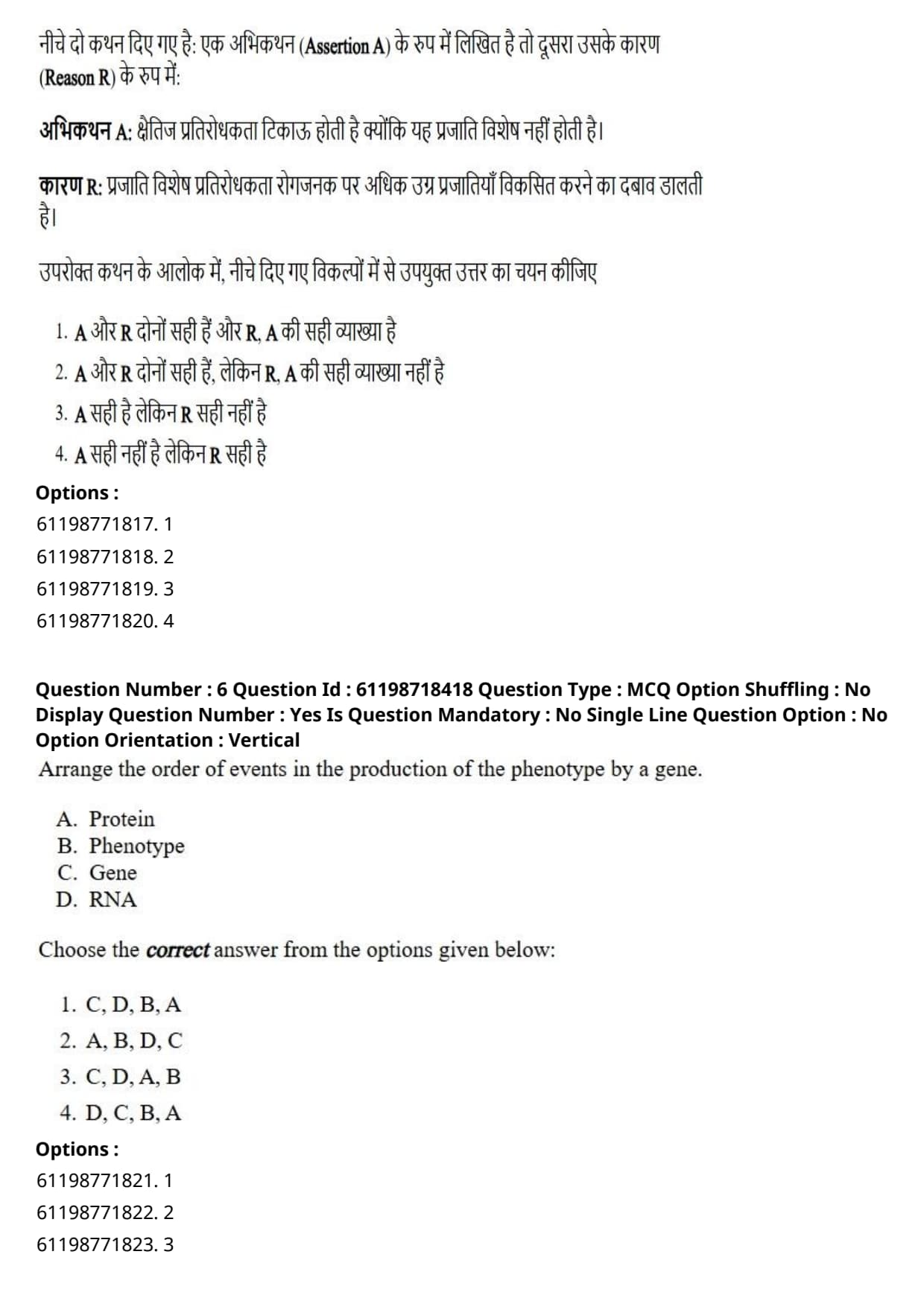
Given below are two statements:
Assertion (A): Horizontal resistance is durable as it is non-race specific.
Reason (R): Race specific resistance puts pressure on the pathogen to evolve more virulent races.
View Solution
Concept:
Horizontal resistance and vertical resistance are two important types of disease resistance in plants.
Step 1: Understand horizontal resistance.
Horizontal resistance is non-race specific. It acts against many races of a pathogen and is usually controlled by many genes.
Because of this broad effect, it is generally more durable.
\[ A is correct \]
Step 2: Understand race specific resistance.
Race specific resistance is also called vertical resistance. It is effective against specific races of a pathogen.
Such resistance may put selection pressure on pathogen populations, causing the evolution of more virulent races.
\[ R is correct \]
Step 3: Check explanation.
Reason talks about race specific resistance, while Assertion talks about horizontal resistance.
Both statements are correct, but Reason does not directly explain the durability of horizontal resistance.
\[ \therefore Correct Answer is (B) \] Quick Tip: Horizontal resistance is non-race specific and durable, while vertical resistance is race specific and may break down easily.
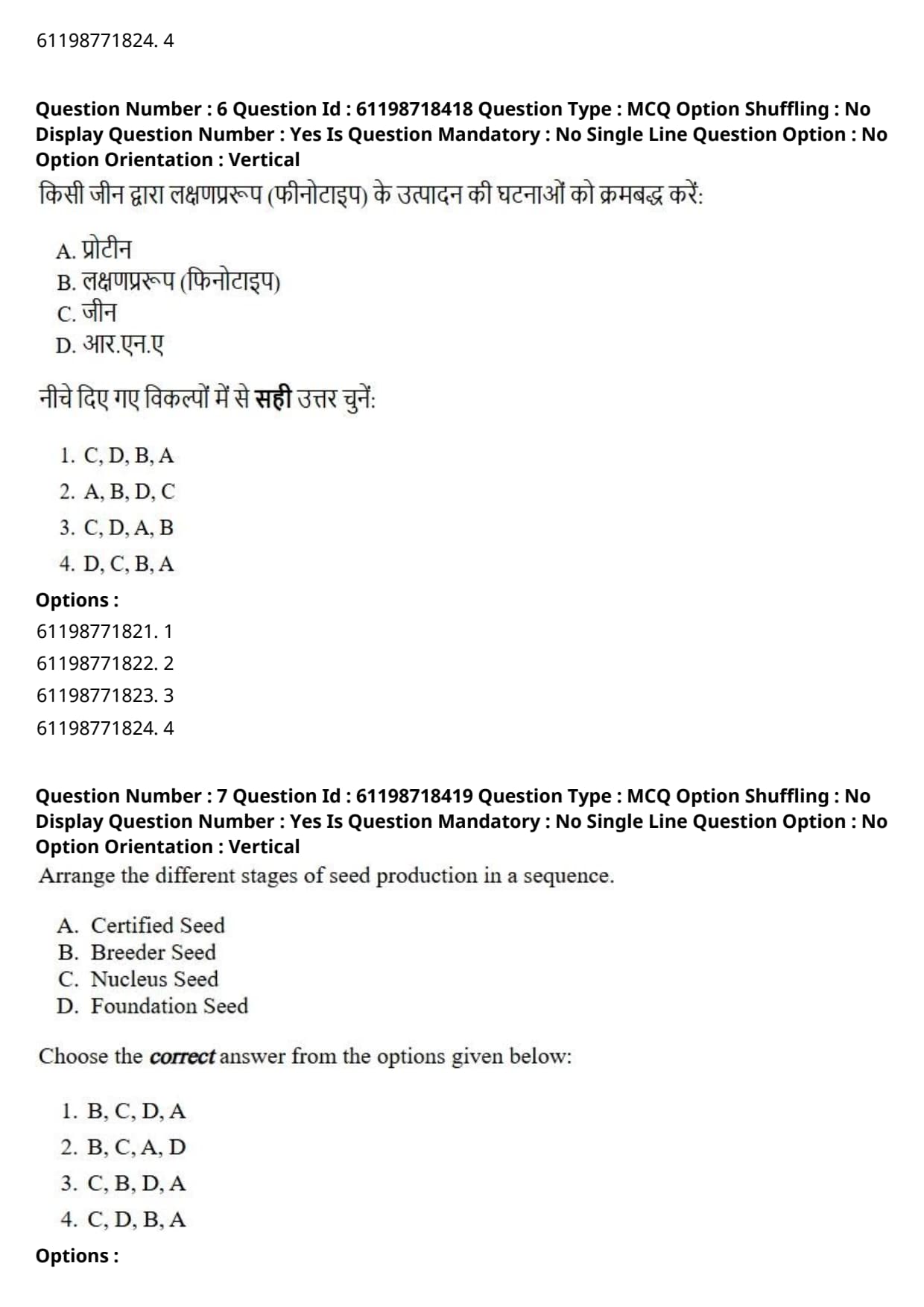
Arrange the order of events in the production of the phenotype by a gene.
A. Protein
B. Phenotype
C. Gene
D. RNA.
View Solution
Concept:
The expression of a gene into a visible trait follows the central dogma of molecular biology.
Step 1: Gene.
The process starts with a gene, which contains genetic information.
\[ First step=C \]
Step 2: RNA.
The gene is transcribed into RNA.
\[ Second step=D \]
Step 3: Protein.
RNA is translated into protein.
\[ Third step=A \]
Step 4: Phenotype.
The protein performs biological functions and produces the observable character or phenotype.
\[ Fourth step=B \]
Therefore, the correct sequence is: \[ C,D,A,B \]
\[ \therefore Correct Answer is (C) \] Quick Tip: Gene expression follows: Gene \(\rightarrow\) RNA \(\rightarrow\) Protein \(\rightarrow\) Phenotype.
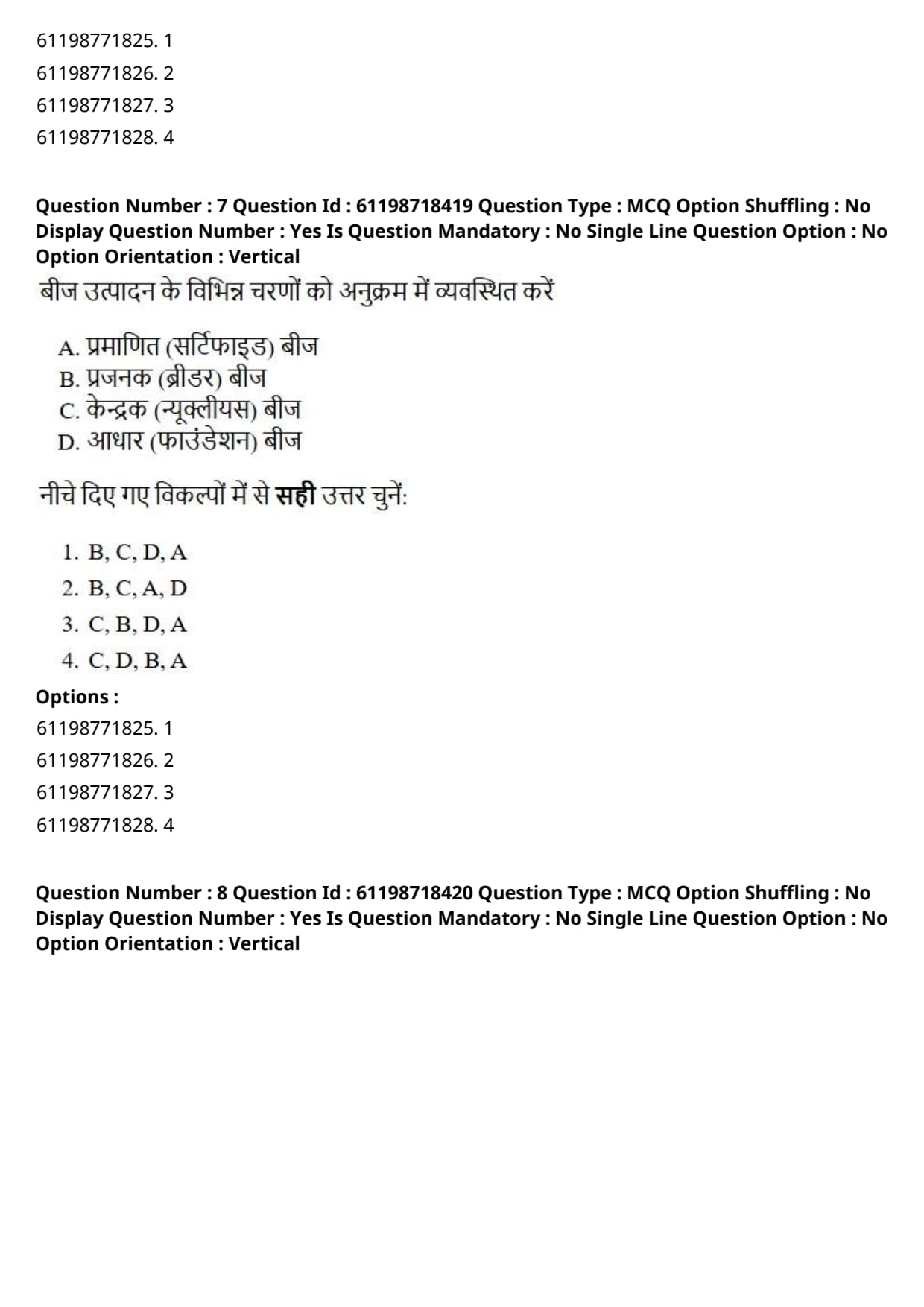
Arrange different stages of seed production in a sequence.
A. Certified Seed
B. Breeder Seed
C. Nucleus Seed
D. Foundation Seed.
View Solution
Concept:
Seed production follows a fixed sequence to maintain genetic purity and quality.
Step 1: Nucleus seed.
Nucleus seed is the first and purest seed maintained by the breeder.
\[ First step=C \]
Step 2: Breeder seed.
Breeder seed is produced from nucleus seed under the supervision of the plant breeder.
\[ Second step=B \]
Step 3: Foundation seed.
Foundation seed is produced from breeder seed.
\[ Third step=D \]
Step 4: Certified seed.
Certified seed is produced from foundation seed and supplied to farmers for cultivation.
\[ Fourth step=A \]
Therefore, the correct sequence is: \[ C,B,D,A \]
\[ \therefore Correct Answer is (C) \] Quick Tip: Seed production sequence is: Nucleus seed \(\rightarrow\) Breeder seed \(\rightarrow\) Foundation seed \(\rightarrow\) Certified seed.
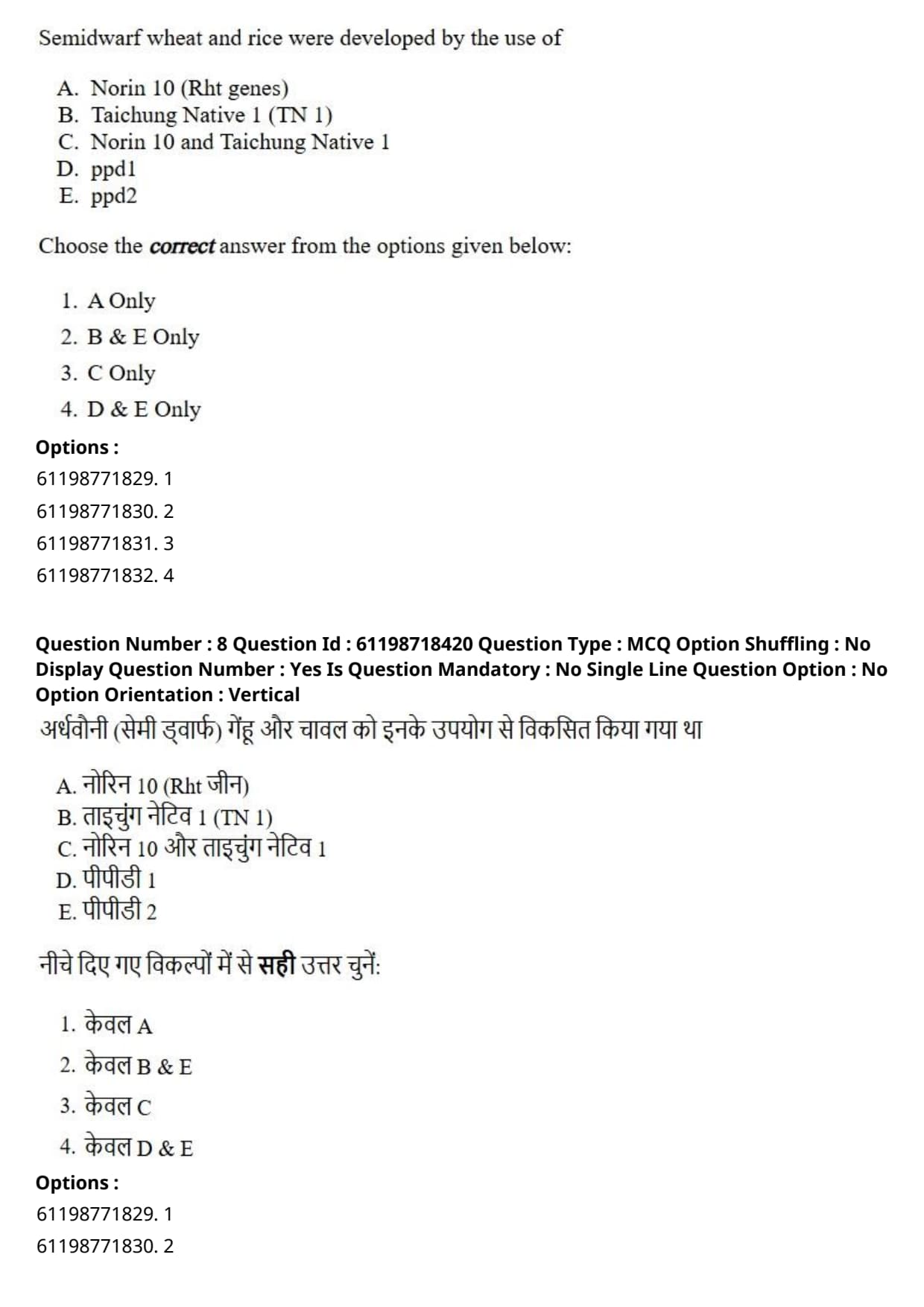
Semidwarf wheat and rice were developed by the use of
A. Norin 10 (Rht genes
B. Taichung Native 1 (TN 1)
C. Norin 10 and Taichung Native 1
D. ppd1
E. ppd2.
View Solution
Concept:
Semidwarf varieties played an important role in the Green Revolution. Dwarfing genes helped to develop short, lodging-resistant and high-yielding varieties.
Step 1: Semidwarf wheat.
Norin 10 is an important source of dwarfing genes in wheat.
\[ Norin 10 \rightarrow Semidwarf wheat \]
Step 2: Semidwarf rice.
Taichung Native 1 is an important semidwarf rice variety.
\[ Taichung Native 1 \rightarrow Semidwarf rice \]
Step 3: Combined statement.
The correct combination for semidwarf wheat and rice is: \[ Norin 10 and Taichung Native 1 \]
This is represented by statement C.
\[ \therefore Correct Answer is (C) \] Quick Tip: Norin 10 is associated with semidwarf wheat, while Taichung Native 1 is associated with semidwarf rice.
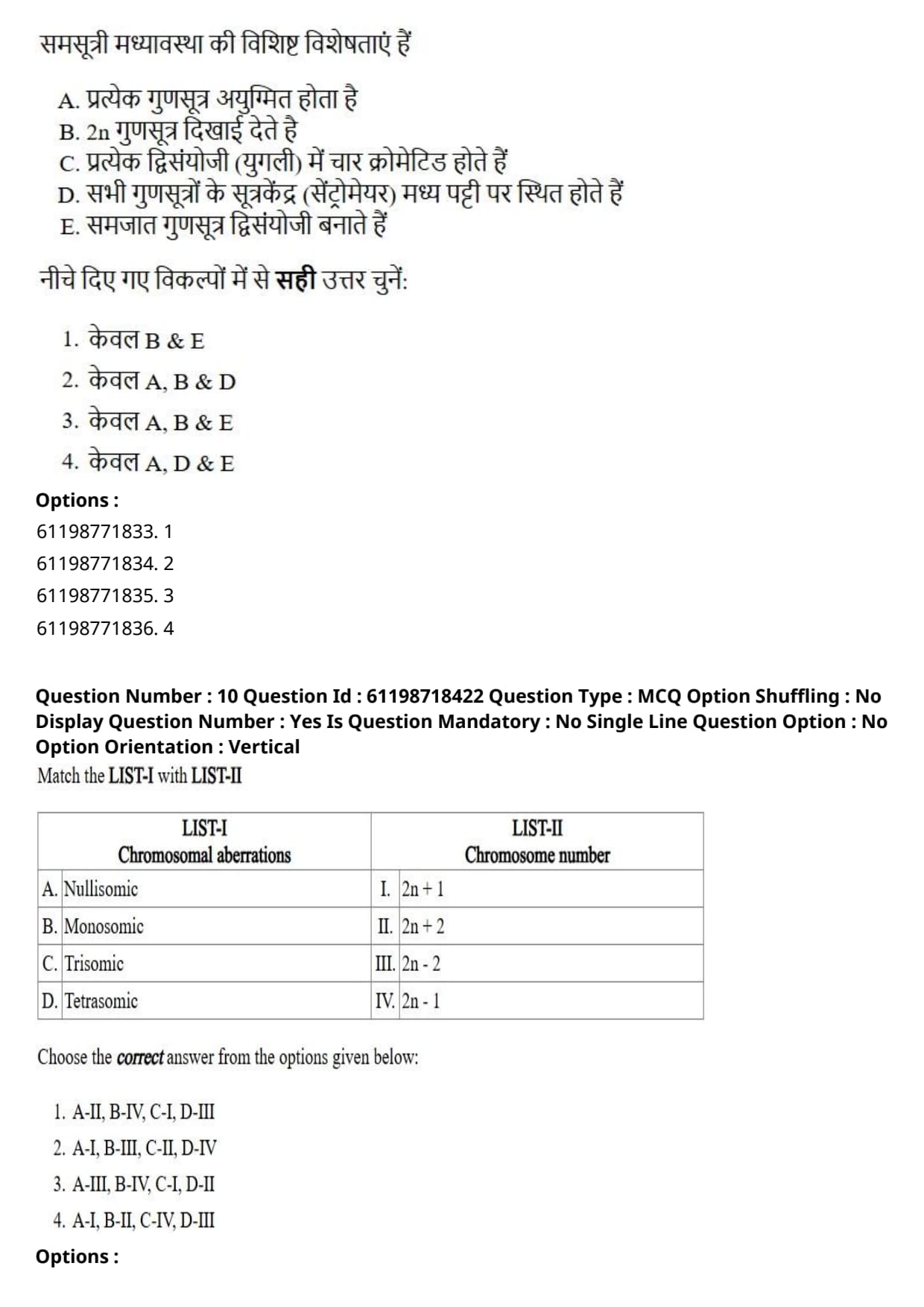
Characteristic features of mitotic metaphase are
A. Each chromosome is unpaired,
B. \(2n\) chromosomes are seen,
C. Each bivalent has four chromatids,
D. Centromeres of all the chromosomes lie on the equatorial plate,
E. Homologous chromosomes form bivalents.
View Solution
Concept:
Metaphase is the stage of cell division in which chromosomes arrange themselves at the equatorial plate.
Step 1: Check statement A.
In mitosis, chromosomes do not pair with homologous chromosomes. Therefore, each chromosome remains unpaired.
\[ A is correct \]
Step 2: Check statement B.
In mitosis, chromosome number remains the same as the parent cell.
\[ 2n chromosomes are seen \]
So, B is correct.
Step 3: Check statement C.
Bivalents are formed in meiosis, not in mitosis. Therefore, this statement is incorrect.
\[ C is incorrect \]
Step 4: Check statement D.
During metaphase, centromeres of chromosomes lie on the equatorial plate.
\[ D is correct \]
Step 5: Check statement E.
Homologous chromosomes form bivalents during meiosis-I, not during mitosis.
\[ E is incorrect \]
Thus, correct statements are: \[ A,B,D \]
\[ \therefore Correct Answer is (B) \] Quick Tip: In mitotic metaphase, chromosomes are arranged at the equatorial plate, but bivalents are not formed.
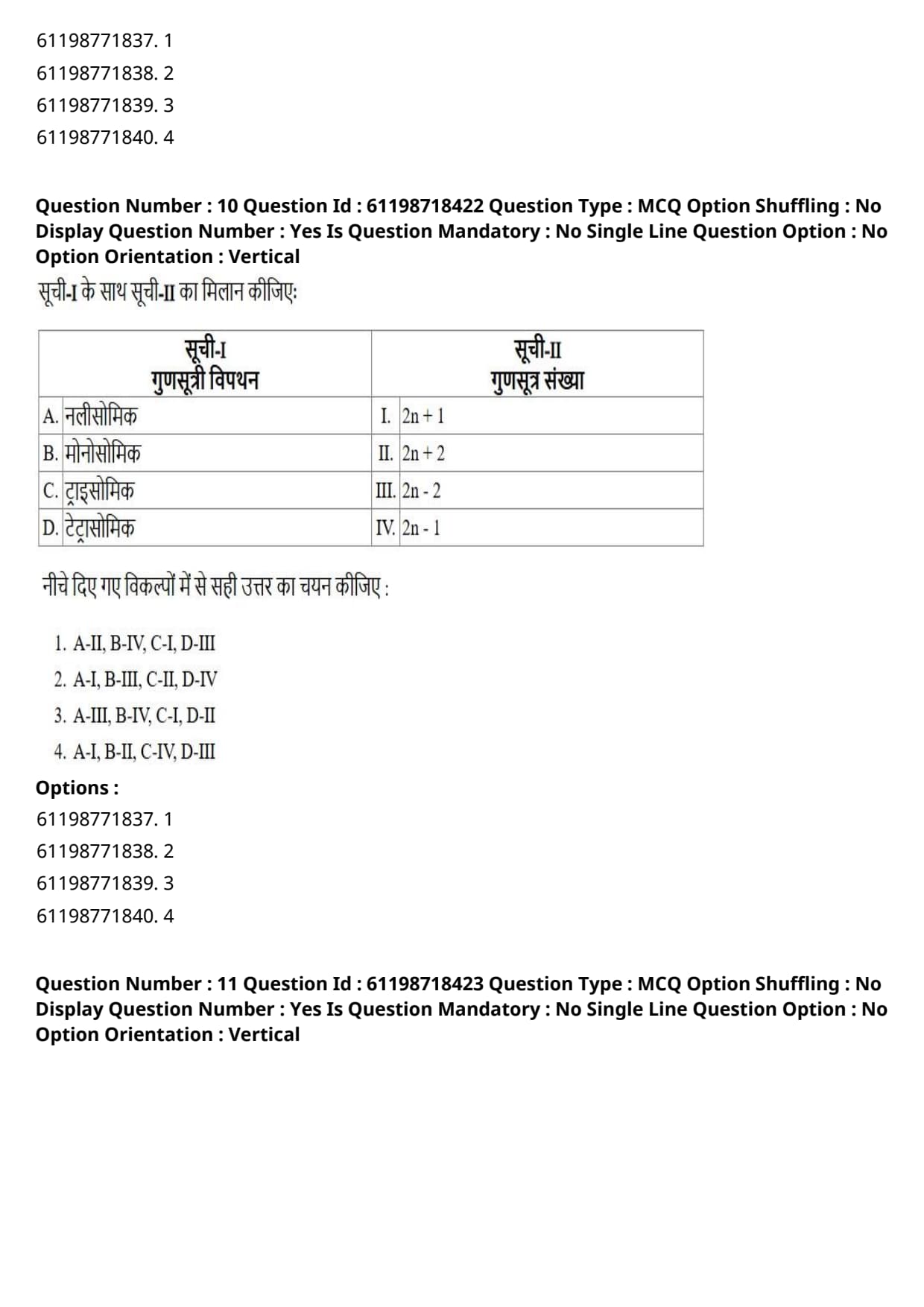
Match the LIST-I with LIST-II.

View Solution
Concept:
Aneuploidy means change in chromosome number due to loss or gain of one or more chromosomes.
Step 1: Nullisomic.
Nullisomic means loss of both chromosomes of a homologous pair.
\[ 2n-2 \]
So, \[ A\rightarrow III \]
Step 2: Monosomic.
Monosomic means loss of one chromosome.
\[ 2n-1 \]
So, \[ B\rightarrow IV \]
Step 3: Trisomic.
Trisomic means addition of one extra chromosome.
\[ 2n+1 \]
So, \[ C\rightarrow I \]
Step 4: Tetrasomic.
Tetrasomic means addition of two extra chromosomes of the same pair.
\[ 2n+2 \]
So, \[ D\rightarrow II \]
Therefore, \[ A-III,\ B-IV,\ C-I,\ D-II \]
\[ \therefore Correct Answer is (C) \] Quick Tip: Nullisomic \(=2n-2\), Monosomic \(=2n-1\), Trisomic \(=2n+1\), and Tetrasomic \(=2n+2\).
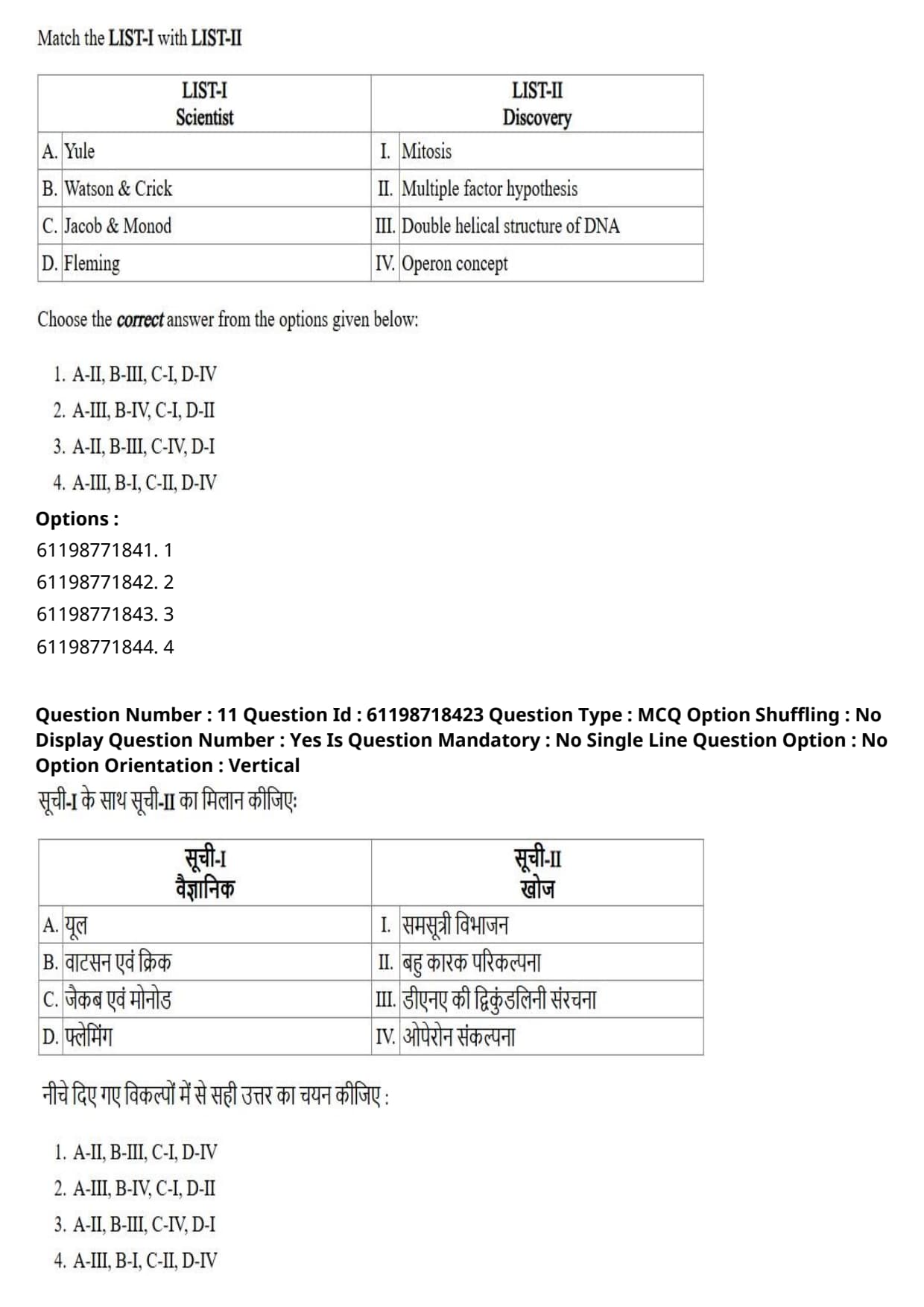
Match the LIST-I with LIST-II.

View Solution
Concept:
This question is based on important scientists and their discoveries or concepts in genetics and biology.
Step 1: Yule.
Yule is associated with the multiple factor hypothesis.
\[ A\rightarrow II \]
Step 2: Watson and Crick.
Watson and Crick proposed the double helical structure of DNA.
\[ B\rightarrow III \]
Step 3: Jacob and Monod.
Jacob and Monod proposed the operon concept.
\[ C\rightarrow IV \]
Step 4: Fleming.
Fleming is associated with mitosis.
\[ D\rightarrow I \]
Therefore: \[ A-II,\ B-III,\ C-IV,\ D-I \]
\[ \therefore Correct Answer is (C) \] Quick Tip: Watson and Crick are remembered for DNA double helix, while Jacob and Monod are remembered for the operon concept.
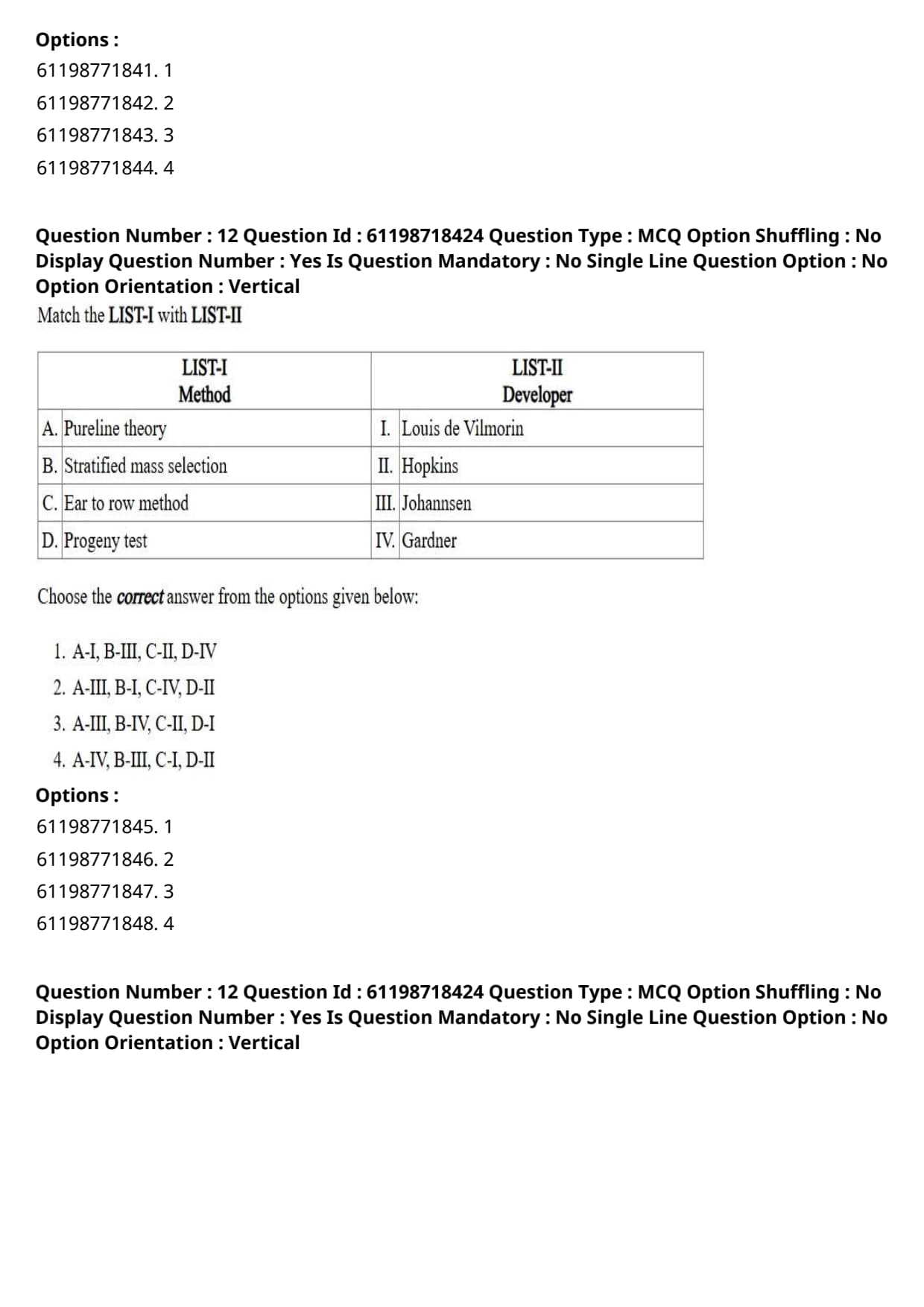
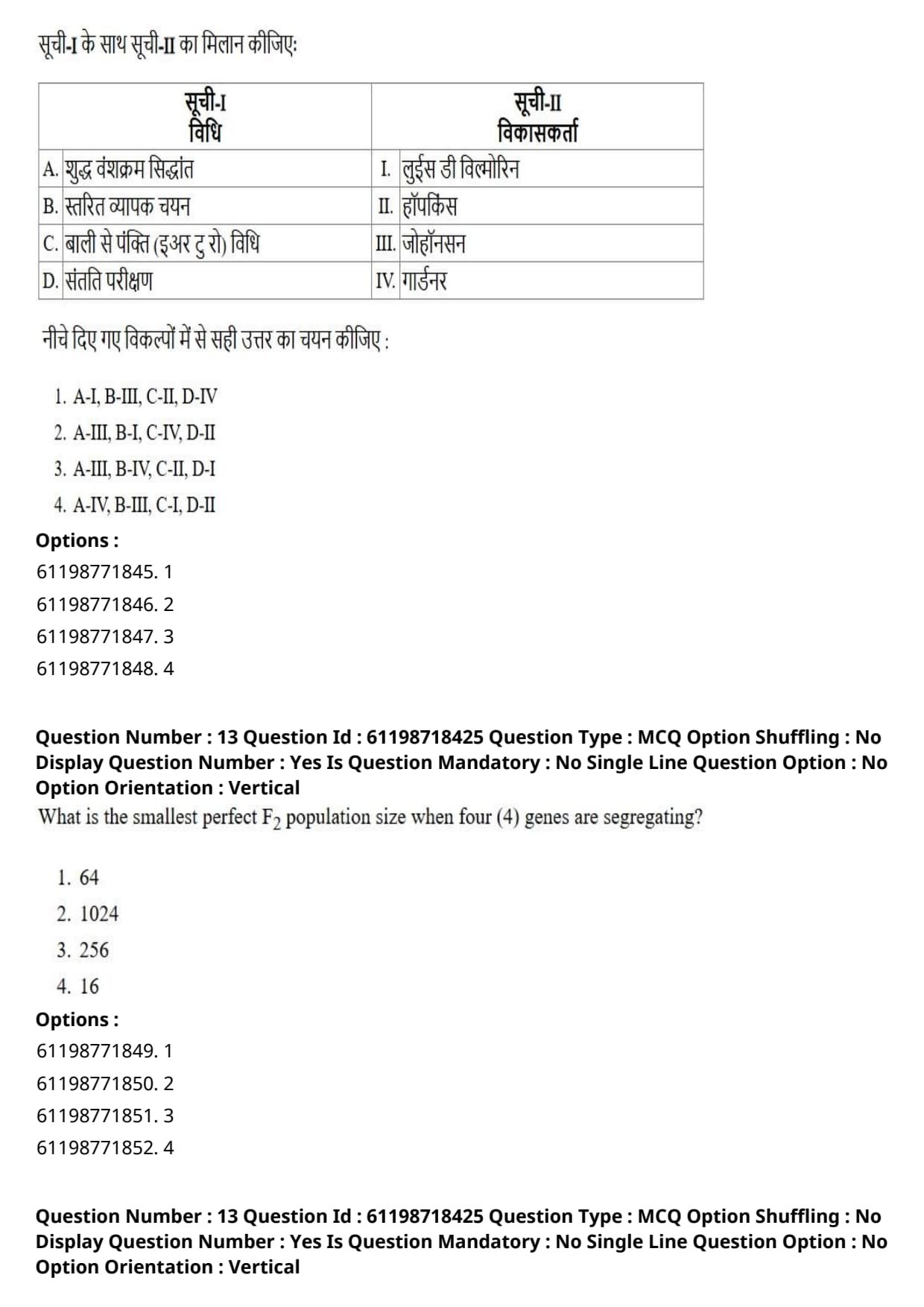
Match the LIST-I with LIST-II.

View Solution
Concept:
Plant breeding methods are associated with different scientists who developed or popularized them.
Step 1: Pureline theory.
Pureline theory was proposed by Johannsen.
\[ A\rightarrow III \]
Step 2: Stratified mass selection.
Stratified mass selection is associated with Gardner.
\[ B\rightarrow IV \]
Step 3: Ear to row method.
Ear to row method is associated with Hopkins.
\[ C\rightarrow II \]
Step 4: Progeny test.
Progeny test is associated with Louis de Vilmorin.
\[ D\rightarrow I \]
Therefore: \[ A-III,\ B-IV,\ C-II,\ D-I \]
\[ \therefore Correct Answer is (C) \] Quick Tip: Pureline theory is linked with Johannsen and progeny test is linked with Louis de Vilmorin.
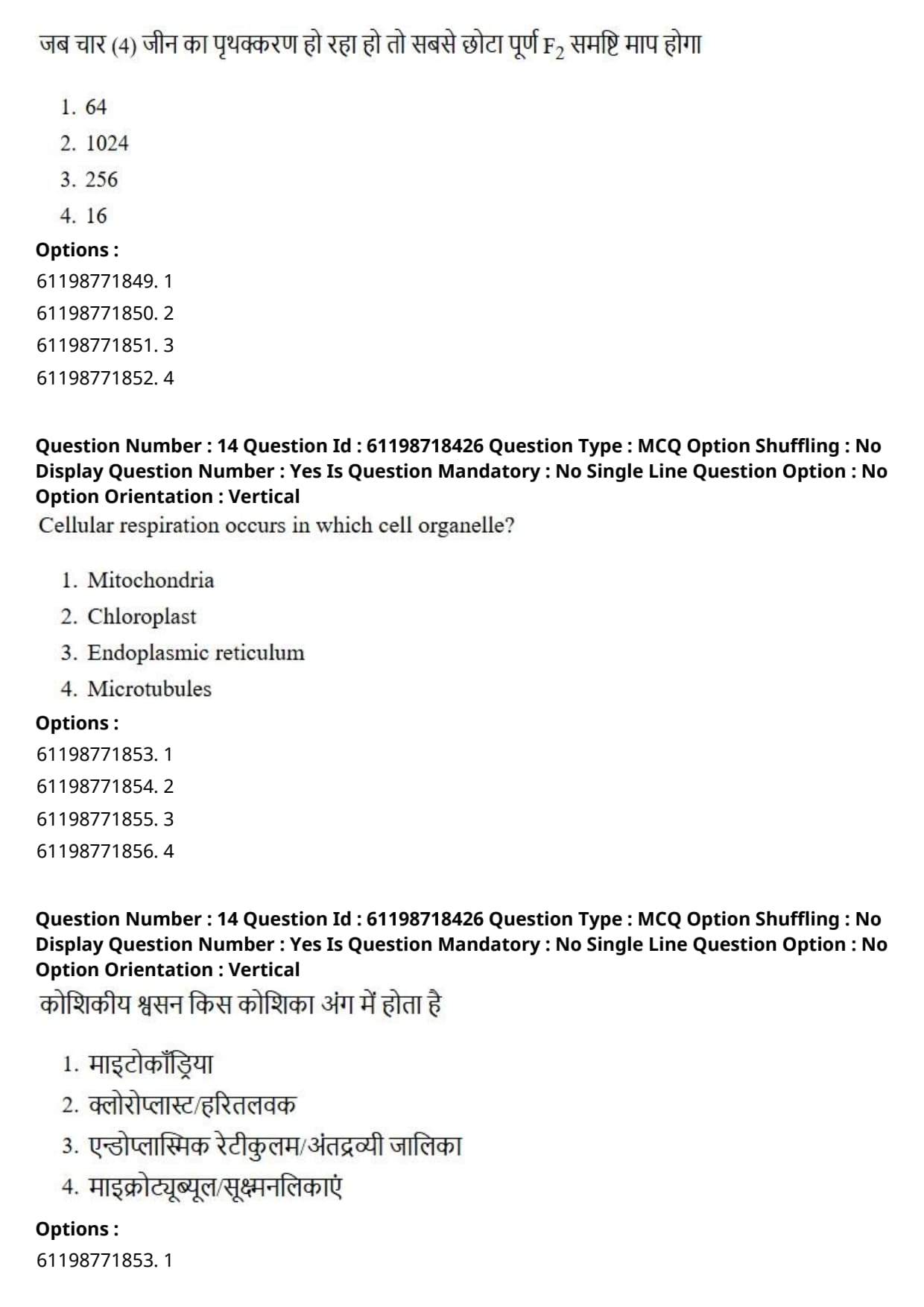
What is the smallest perfect \(F_2\) population size when four genes are segregating?
View Solution
Concept:
For \(n\) segregating genes, the smallest perfect \(F_2\) population size is generally calculated as: \[ 4^n \]
Step 1: Identify the number of segregating genes. \[ n=4 \]
Step 2: Apply the formula. \[ Smallest perfect F_2 population size=4^n \]
\[ =4^4 \]
Step 3: Calculate the value. \[ 4^4=4\times4\times4\times4 \]
\[ =256 \]
\[ \therefore Correct Answer is (C) \] Quick Tip: For \(n\) segregating genes, smallest perfect \(F_2\) population size is \(4^n\).
Cellular respiration occurs in which cell organelle?
View Solution
Concept:
Cellular respiration is the process by which cells produce energy in the form of ATP by breaking down food molecules.
Step 1: Understand cellular respiration.
In aerobic respiration, glucose is oxidized to release energy.
\[ Glucose+Oxygen\rightarrow Carbon dioxide+Water+ATP \]
Step 2: Identify the organelle.
Mitochondria are called the powerhouse of the cell because they produce ATP through cellular respiration.
Step 3: Eliminate other options.
Chloroplast is involved in photosynthesis. Endoplasmic reticulum is involved in synthesis and transport of molecules. Microtubules provide structural support and help in cell division.
\[ \therefore Correct Answer is (A) \] Quick Tip: Mitochondria are called the powerhouse of the cell because they produce ATP through respiration.
Stomata opens at night in which type of plants?
View Solution
Concept:
CAM stands for Crassulacean Acid Metabolism. CAM plants are adapted to dry conditions and open their stomata at night to reduce water loss.
Step 1: Understand stomatal opening.
Most plants open their stomata during the day for carbon dioxide intake.
Step 2: Special feature of CAM plants.
CAM plants open stomata at night and take in carbon dioxide when temperature is lower and water loss is less.
Step 3: Day time condition.
During the day, CAM plants keep stomata closed to conserve water and use stored carbon dioxide for photosynthesis.
Therefore, stomata open at night in: \[ CAM plants \]
\[ \therefore Correct Answer is (D) \] Quick Tip: CAM plants open stomata at night to reduce water loss in dry environments.
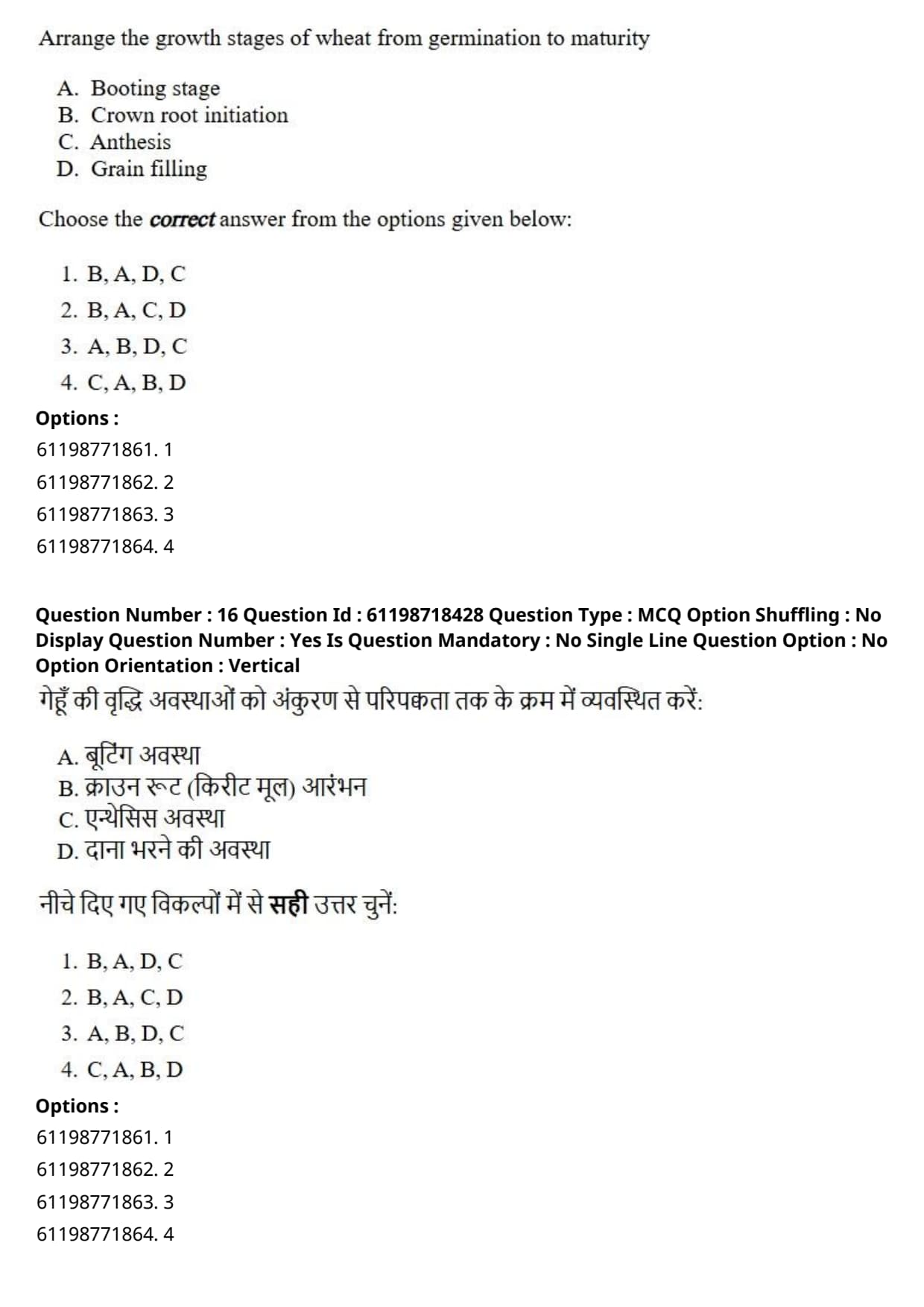
Arrange the growth stages of wheat from germination to maturity.
A. Booting stage
B. Crown root initiation
C. Anthesis
D. Grain filling.
View Solution
Concept:
Wheat growth follows a definite sequence from germination to maturity.
Step 1: Crown root initiation.
After germination, crown roots start developing. This is an early vegetative growth stage.
\[ First step=B \]
Step 2: Booting stage.
Booting stage occurs later when the developing ear is enclosed within the leaf sheath.
\[ Second step=A \]
Step 3: Anthesis.
Anthesis means flowering. It occurs after booting and heading.
\[ Third step=C \]
Step 4: Grain filling.
After anthesis and fertilization, grain filling occurs.
\[ Fourth step=D \]
Therefore, the correct sequence is: \[ B,A,C,D \]
\[ \therefore Correct Answer is (B) \] Quick Tip: In wheat, crown root initiation occurs early, followed by booting, anthesis and grain filling.
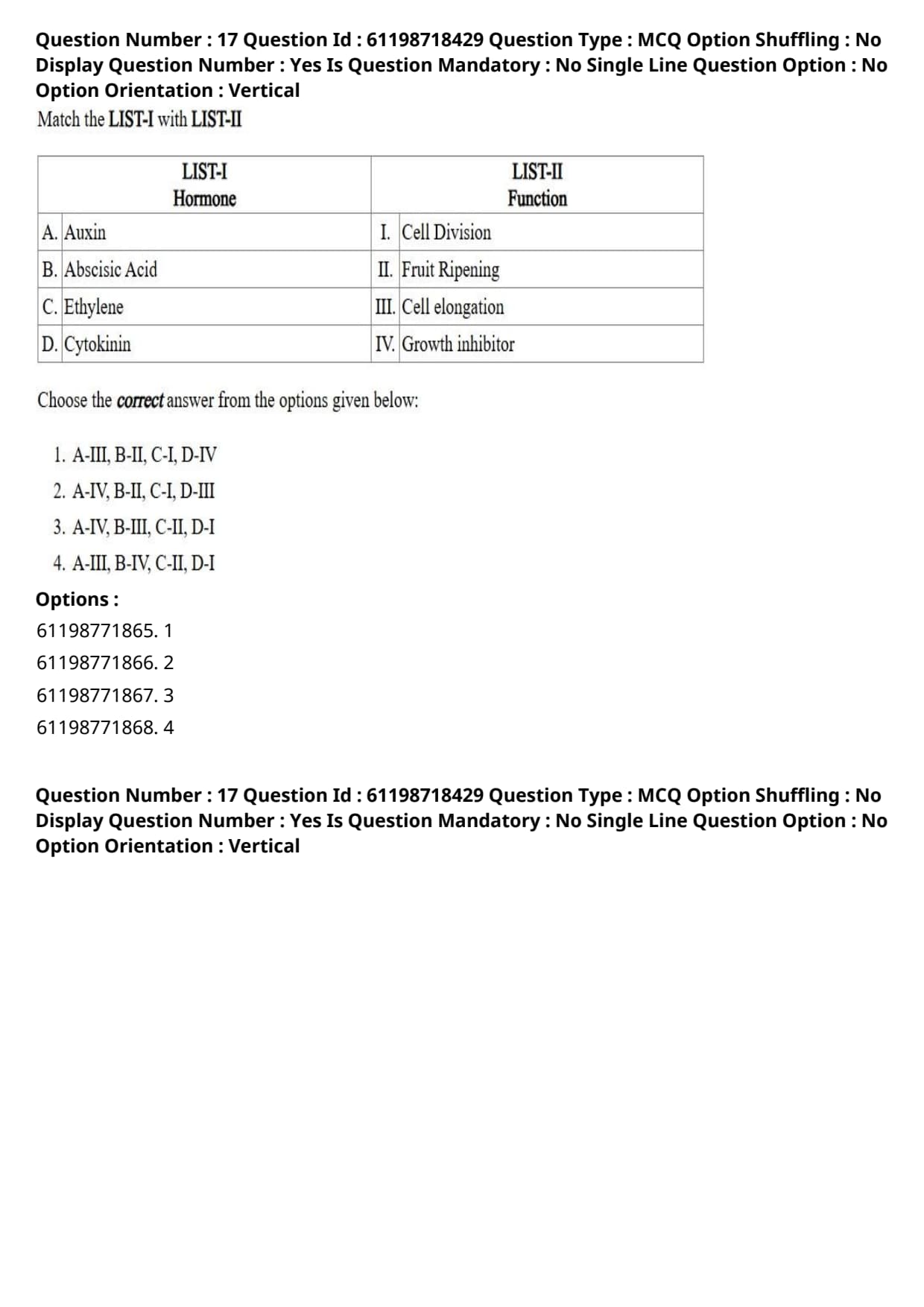
Match the LIST-I with LIST-II.

View Solution
Concept:
Plant hormones regulate growth and development in plants.
Step 1: Auxin.
Auxin mainly promotes cell elongation.
\[ A\rightarrow III \]
Step 2: Abscisic acid.
Abscisic acid is a growth inhibitor and is also involved in stress responses.
\[ B\rightarrow IV \]
Step 3: Ethylene.
Ethylene promotes fruit ripening.
\[ C\rightarrow II \]
Step 4: Cytokinin.
Cytokinin promotes cell division.
\[ D\rightarrow I \]
Therefore: \[ A-III,\ B-IV,\ C-II,\ D-I \]
\[ \therefore Correct Answer is (D) \] Quick Tip: Auxin promotes elongation, cytokinin promotes division, ethylene promotes ripening and ABA inhibits growth.
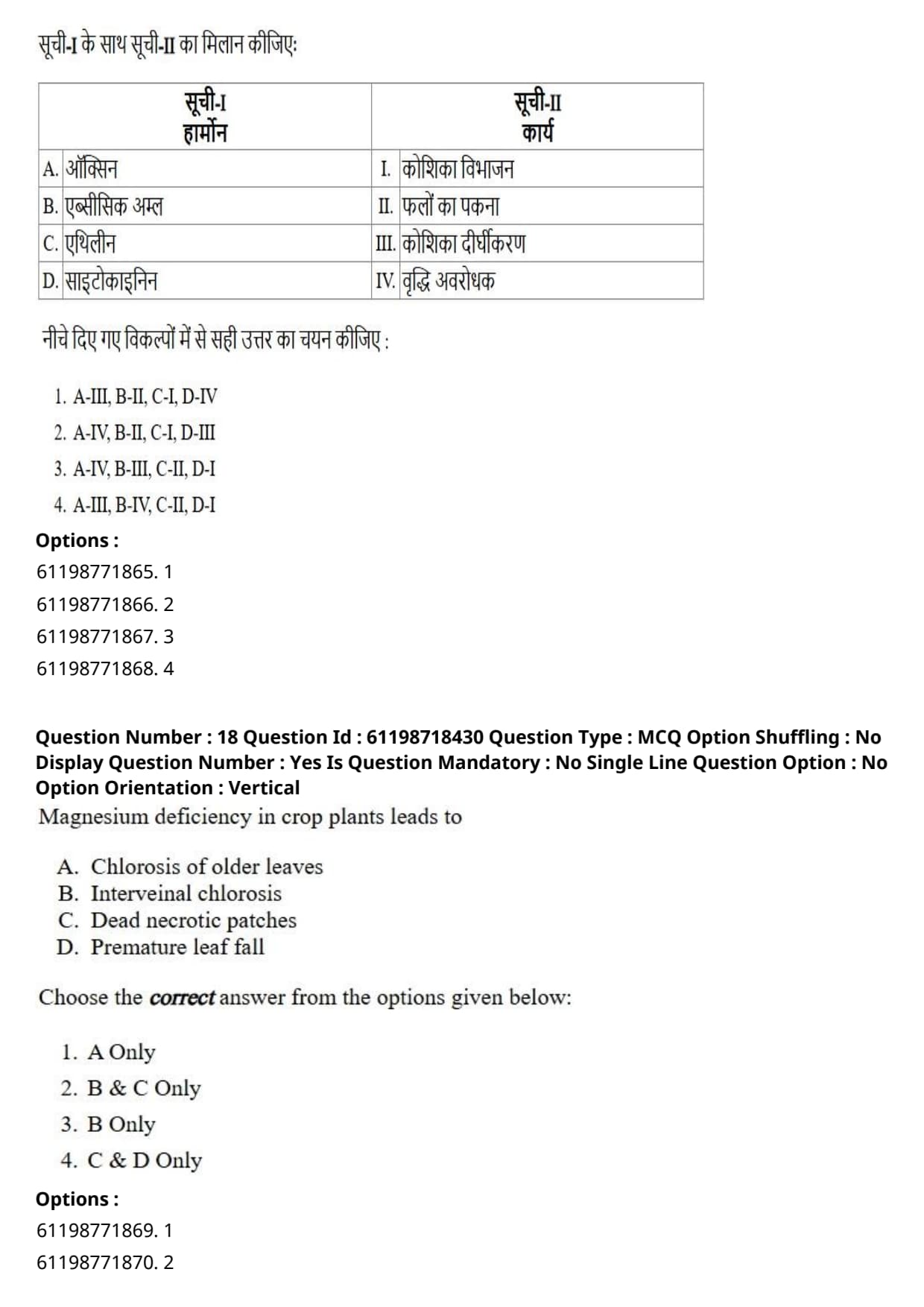
Magnesium deficiency in crop plants leads to
A. Chlorosis of older leaves
B. Interveinal chlorosis
C. Dead necrotic patches
D. Premature leaf fall.
View Solution
Concept:
Magnesium is an essential plant nutrient and is a central component of chlorophyll. Therefore, its deficiency mainly affects leaf greenness.
Step 1: Role of magnesium.
Magnesium is required for chlorophyll formation and photosynthesis.
Step 2: Deficiency symptom.
When magnesium is deficient, leaves show interveinal chlorosis. This means the area between veins becomes yellow while veins may remain green.
\[ B is correct \]
Step 3: Severe deficiency.
In severe cases, chlorotic areas may develop dead necrotic patches.
\[ C is correct \]
Step 4: Select correct combination.
The correct symptoms from the given options are: \[ B and C \]
\[ \therefore Correct Answer is (B) \] Quick Tip: Magnesium deficiency mainly causes interveinal chlorosis, and severe deficiency may produce necrotic patches.
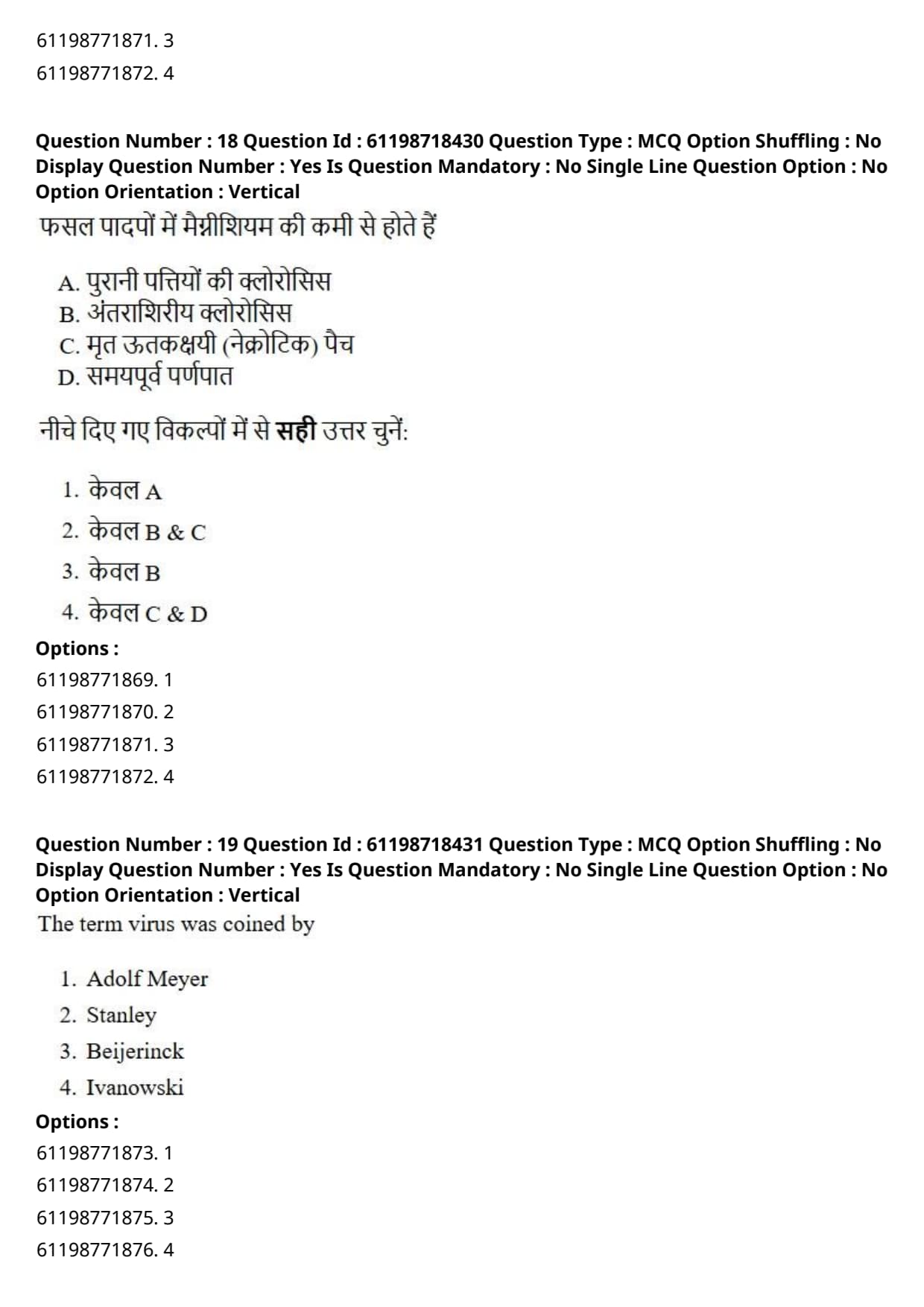
The term virus was coined by:
View Solution
Concept:
The history of virology includes important contributions by many scientists.
Step 1: Adolf Meyer.
Adolf Meyer studied tobacco mosaic disease but did not coin the term virus.
Step 2: Ivanowski.
Ivanowski showed that the causal agent of tobacco mosaic disease could pass through bacterial filters.
Step 3: Beijerinck.
Beijerinck described the infectious agent as a living contagious fluid and used the term virus.
\[ Virus term \rightarrow Beijerinck \]
Step 4: Stanley.
Stanley crystallized tobacco mosaic virus.
Therefore, the term virus was coined by: \[ Beijerinck \]
\[ \therefore Correct Answer is (C) \] Quick Tip: Beijerinck is associated with the term virus, while Stanley is known for crystallizing TMV.
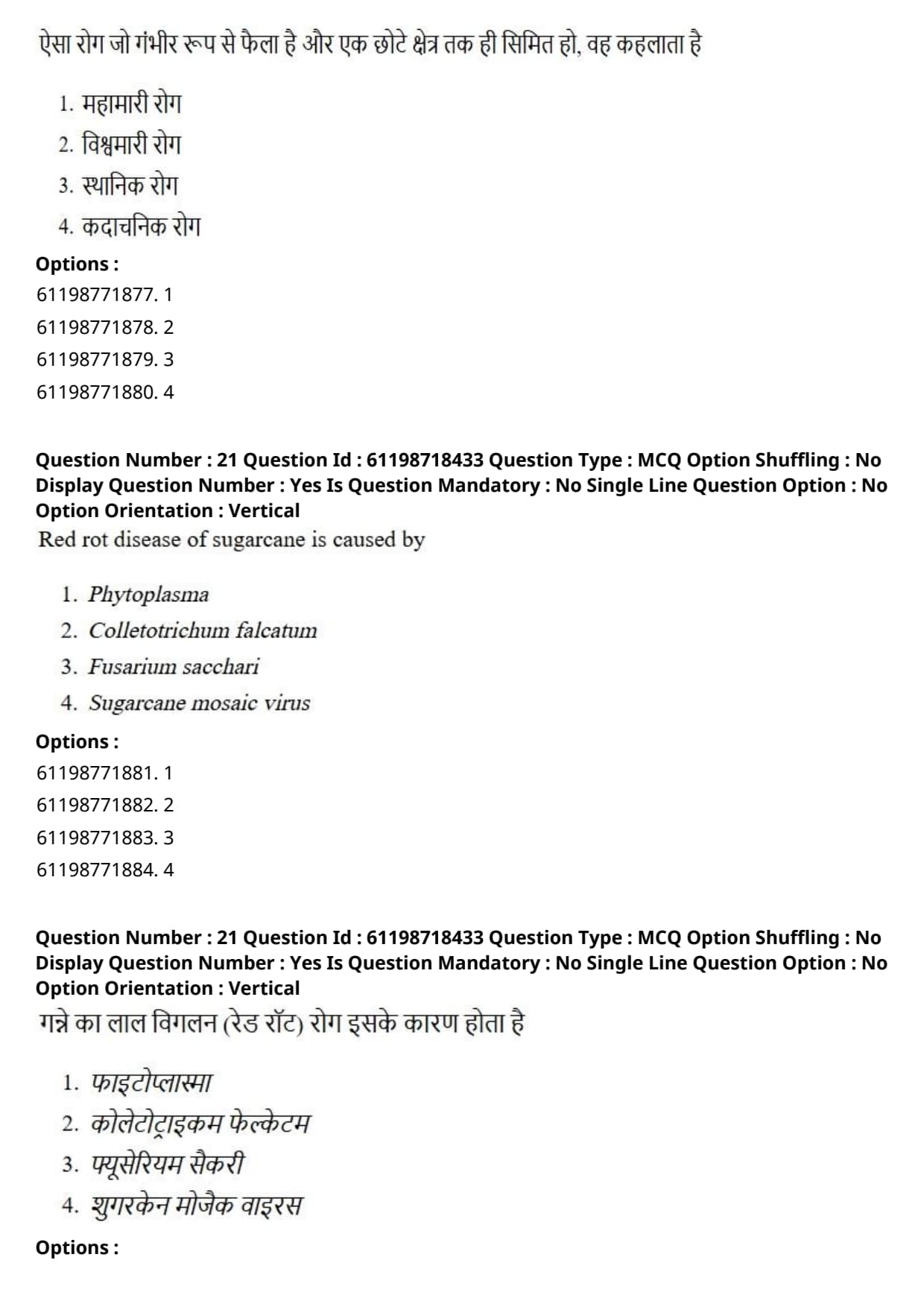
A disease occurring severely and confined to small locality area is:
View Solution
Concept:
Plant diseases may be classified based on their occurrence and spread in an area.
Step 1: Epidemic disease.
An epidemic disease spreads rapidly over a large area and affects many plants in a short time.
Step 2: Pandemic disease.
A pandemic disease spreads over a very wide geographical area, often across countries or continents.
Step 3: Endemic disease.
An endemic disease is regularly present or confined to a particular locality or region.
If a disease occurs severely but remains limited to a small local area, it is considered endemic in that region.
Step 4: Sporadic disease.
A sporadic disease occurs irregularly and occasionally.
Therefore, the disease described is: \[ Endemic disease \]
\[ \therefore Correct Answer is (C) \] Quick Tip: Endemic disease is confined to a particular locality or region, while epidemic disease spreads rapidly over a larger area.
Red rot disease of sugarcane is caused by
View Solution
Concept:
Red rot is one of the most destructive diseases of sugarcane. It is a fungal disease and is commonly known as the ``cancer of sugarcane'' because it causes severe damage to the crop.
Step 1: Identify the disease.
The disease given in the question is: \[ Red rot of sugarcane \]
Step 2: Identify the causal organism.
Red rot disease of sugarcane is caused by the fungus: \[ Colletotrichum falcatum \]
Step 3: Eliminate other options.
Phytoplasma causes phytoplasma-related diseases, not red rot.
Fusarium sacchari is associated with other sugarcane diseases but not the standard causal organism of red rot.
Sugarcane mosaic virus causes mosaic disease, not red rot.
Therefore, red rot of sugarcane is caused by: \[ \textit{Colletotrichum falcatum \]
\[ \therefore Correct Answer is (B) \] Quick Tip: Red rot of sugarcane is caused by Colletotrichum falcatum. It is also called the cancer of sugarcane.
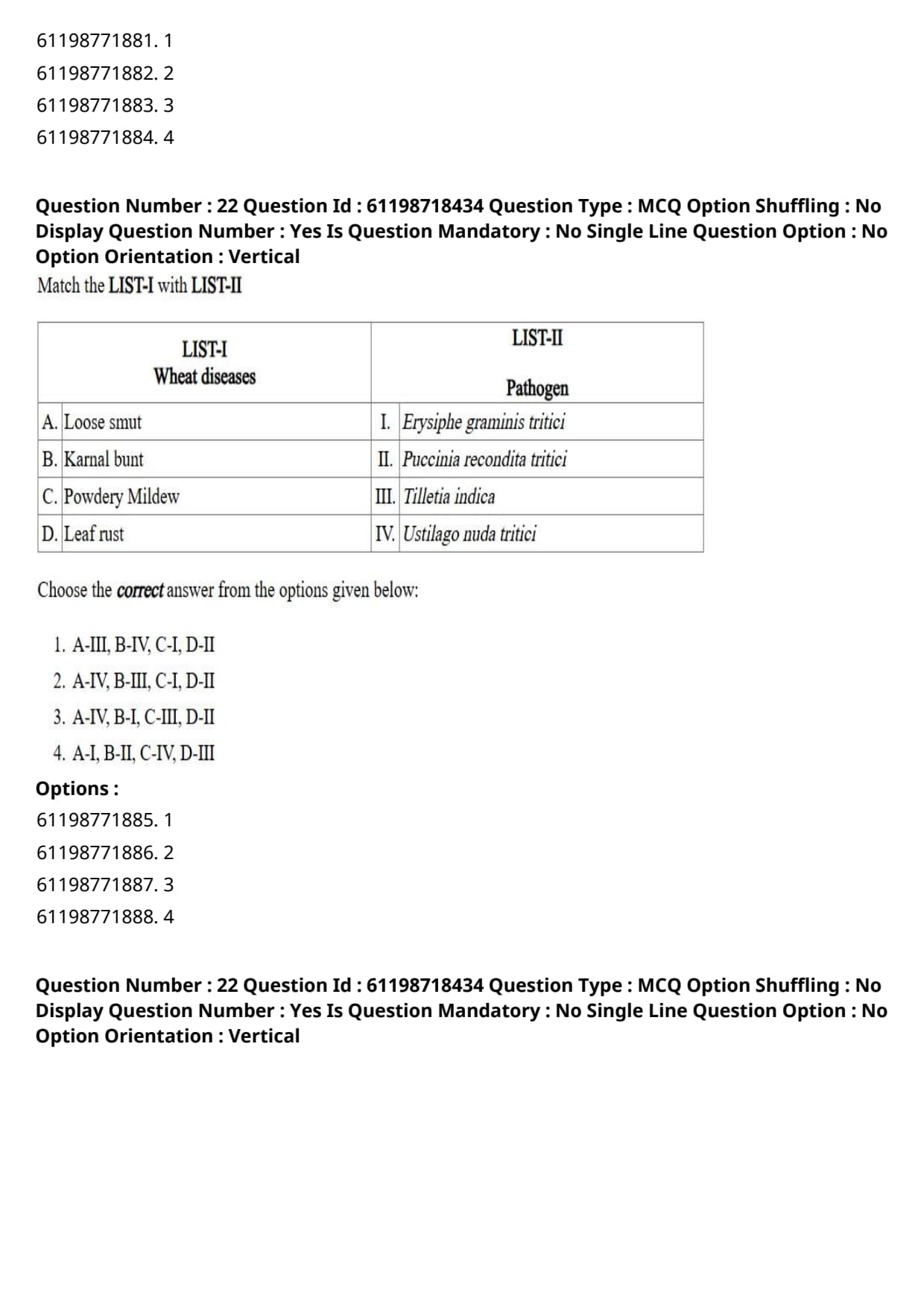
Match the LIST-I with LIST-II.

View Solution
Concept:
Wheat is affected by several fungal diseases. Each disease has a specific causal pathogen.
Step 1: Match Loose smut.
Loose smut of wheat is caused by: \[ Ustilago nuda tritici \]
So, \[ A \rightarrow IV \]
Step 2: Match Karnal bunt.
Karnal bunt of wheat is caused by: \[ Tilletia indica \]
So, \[ B \rightarrow III \]
Step 3: Match Powdery mildew.
Powdery mildew of wheat is caused by: \[ Erysiphe graminis tritici \]
So, \[ C \rightarrow I \]
Step 4: Match Leaf rust.
Leaf rust of wheat is caused by: \[ Puccinia recondita tritici \]
So, \[ D \rightarrow II \]
Therefore, the correct matching is: \[ A-IV,\ B-III,\ C-I,\ D-II \]
\[ \therefore Correct Answer is (B) \] Quick Tip: Loose smut is caused by Ustilago nuda tritici, Karnal bunt by Tilletia indica, powdery mildew by Erysiphe graminis tritici, and leaf rust by Puccinia recondita tritici.
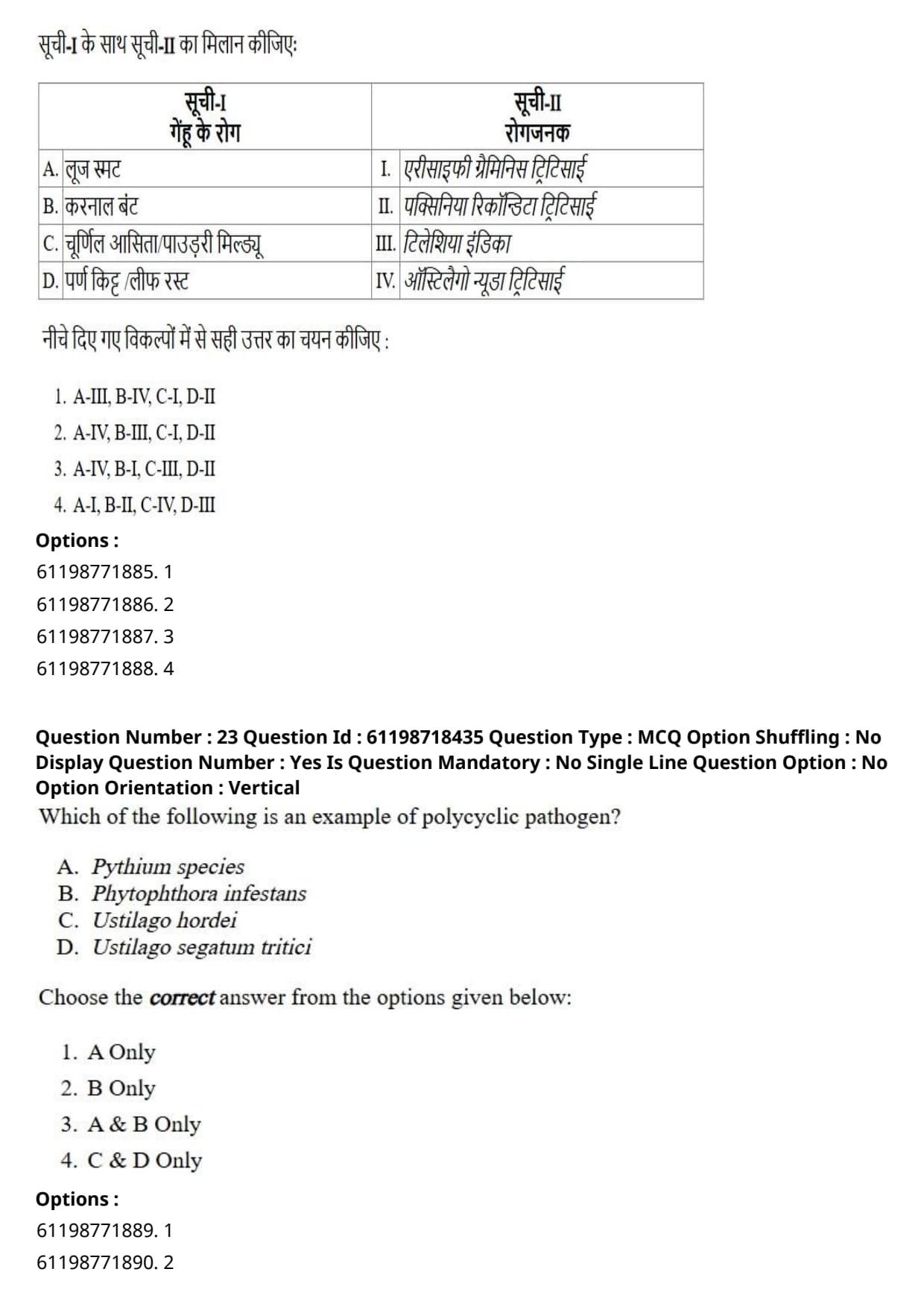
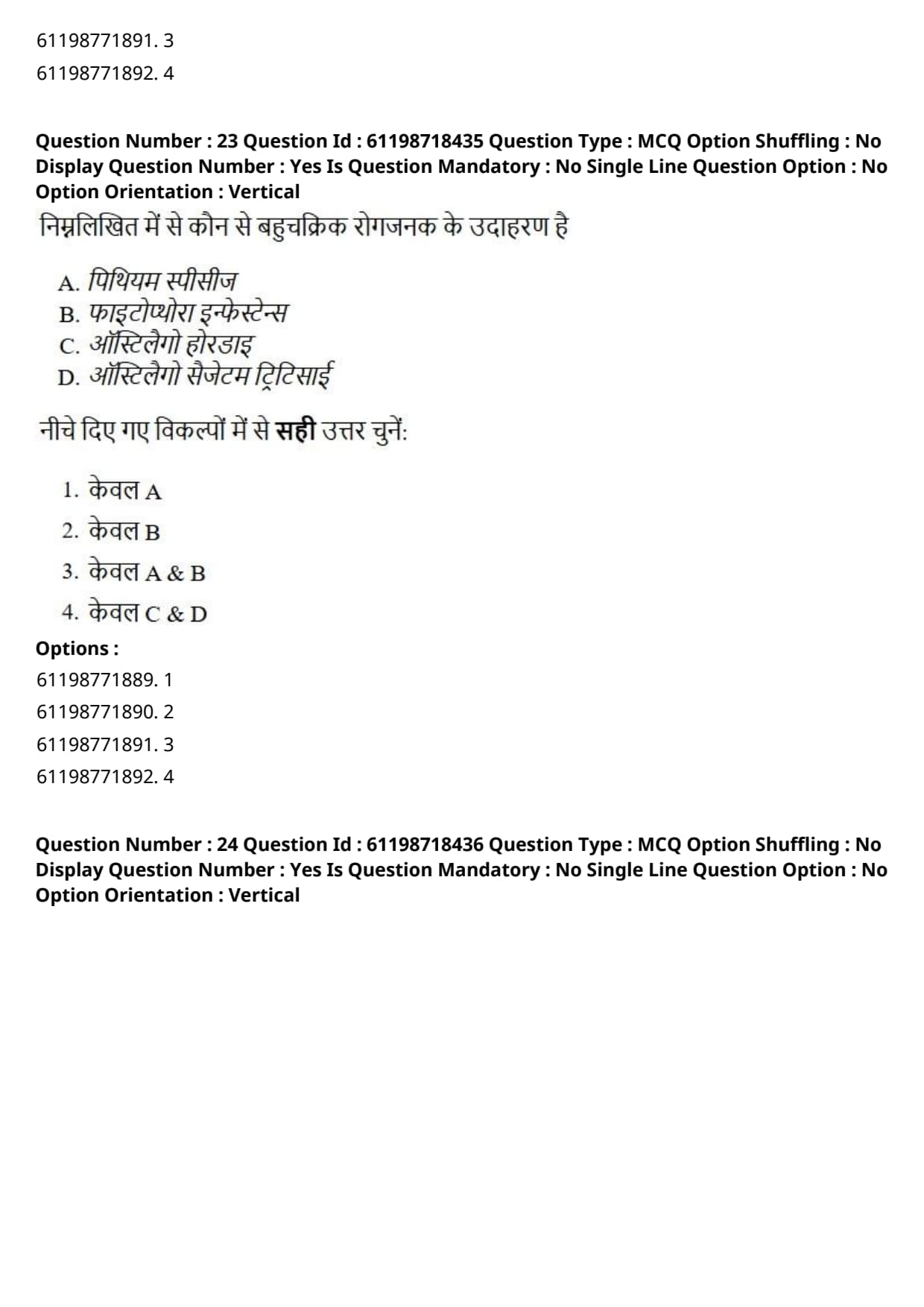
Which of the following is an example of polycyclic pathogen?
A. Pythium species
B. Phytophthora infestans
C. Ustilago hordei
D. Ustilago segetum tritici.
View Solution
Concept:
Plant pathogens may be monocyclic or polycyclic. A polycyclic pathogen produces repeated infection cycles during the same growing season.
Step 1: Understand polycyclic pathogen.
A polycyclic pathogen produces secondary inoculum many times in one crop season.
\[ Primary infection \rightarrow Secondary infection \rightarrow Repeated disease spread \]
Step 2: Check Phytophthora infestans.
Phytophthora infestans causes late blight of potato. It produces repeated infection cycles under favourable conditions.
\[ B is correct \]
Step 3: Check smut pathogens.
\textit{Ustilago hordei and \textit{Ustilago segetum tritici are smut pathogens. Smut diseases are generally not treated as typical polycyclic diseases.
Step 4: Final selection.
Among the given options, the best example of a polycyclic pathogen is: \[ \textit{Phytophthora infestans \]
\[ \therefore Correct Answer is (B) \] Quick Tip: Polycyclic pathogens produce repeated disease cycles in one season. Late blight pathogen Phytophthora infestans is a common example.
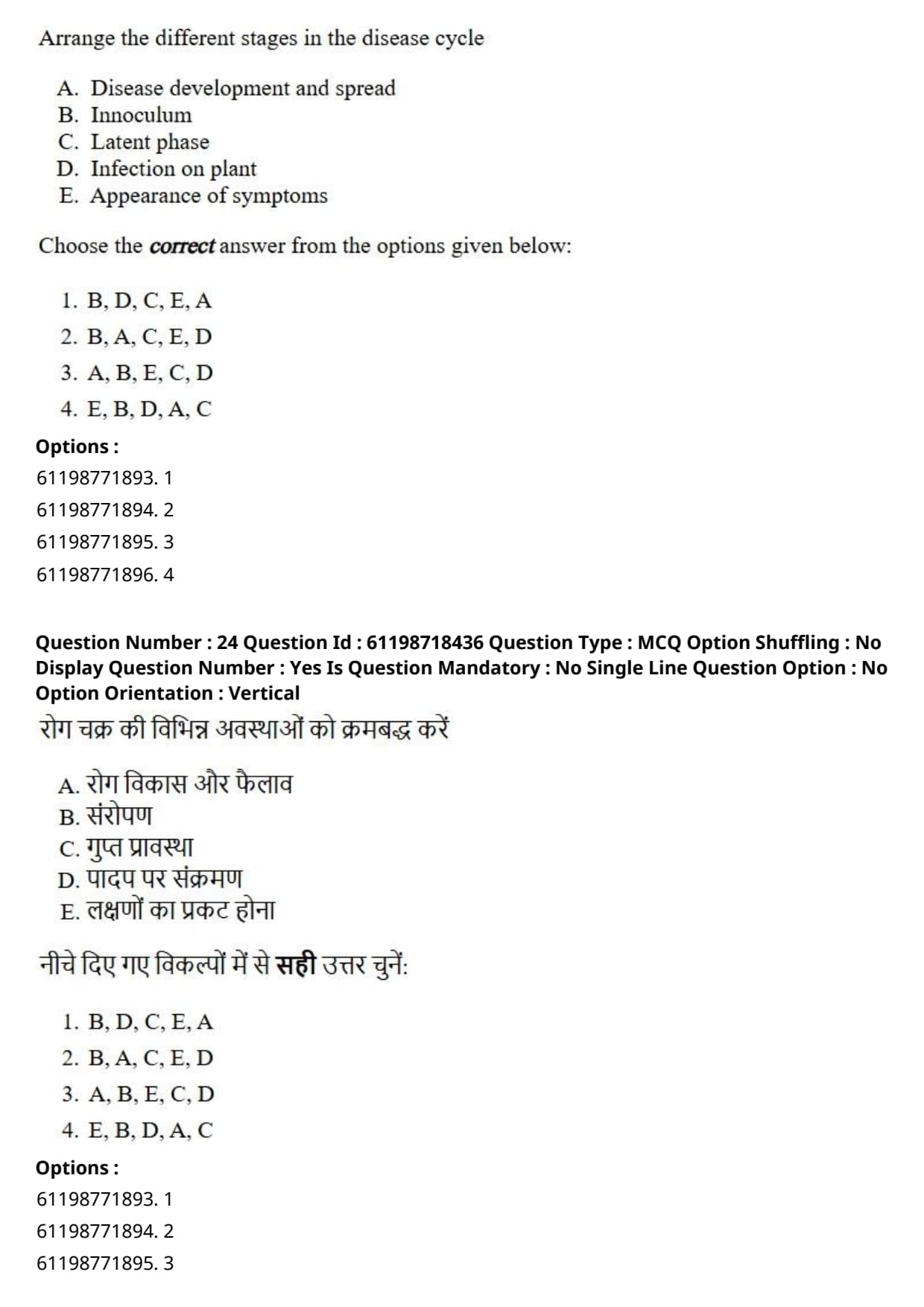
Arrange the sequence of events occurring in plant disease cycle.
A. Disease development and spread
B. Inoculum
C. Latent phase
D. Infection on plant
E. Appearance of symptoms.
View Solution
Concept:
The plant disease cycle explains how a pathogen starts infection, develops inside the host, produces symptoms, and spreads further.
Step 1: Inoculum.
The disease cycle starts with inoculum. Inoculum is the pathogen material capable of causing infection.
\[ First step=B \]
Step 2: Infection on plant.
After inoculum reaches the suitable host, infection begins.
\[ Second step=D \]
Step 3: Latent phase.
After infection, the pathogen develops inside the plant without visible symptoms. This is the latent phase.
\[ Third step=C \]
Step 4: Appearance of symptoms.
After the latent period, symptoms appear on the plant.
\[ Fourth step=E \]
Step 5: Disease development and spread.
Finally, disease develops further and spreads to other plants.
\[ Fifth step=A \]
Thus, the correct sequence is: \[ B,D,C,E,A \]
\[ \therefore Correct Answer is (A) \] Quick Tip: Disease cycle sequence is: inoculum, infection, latent phase, symptoms, and disease development or spread.
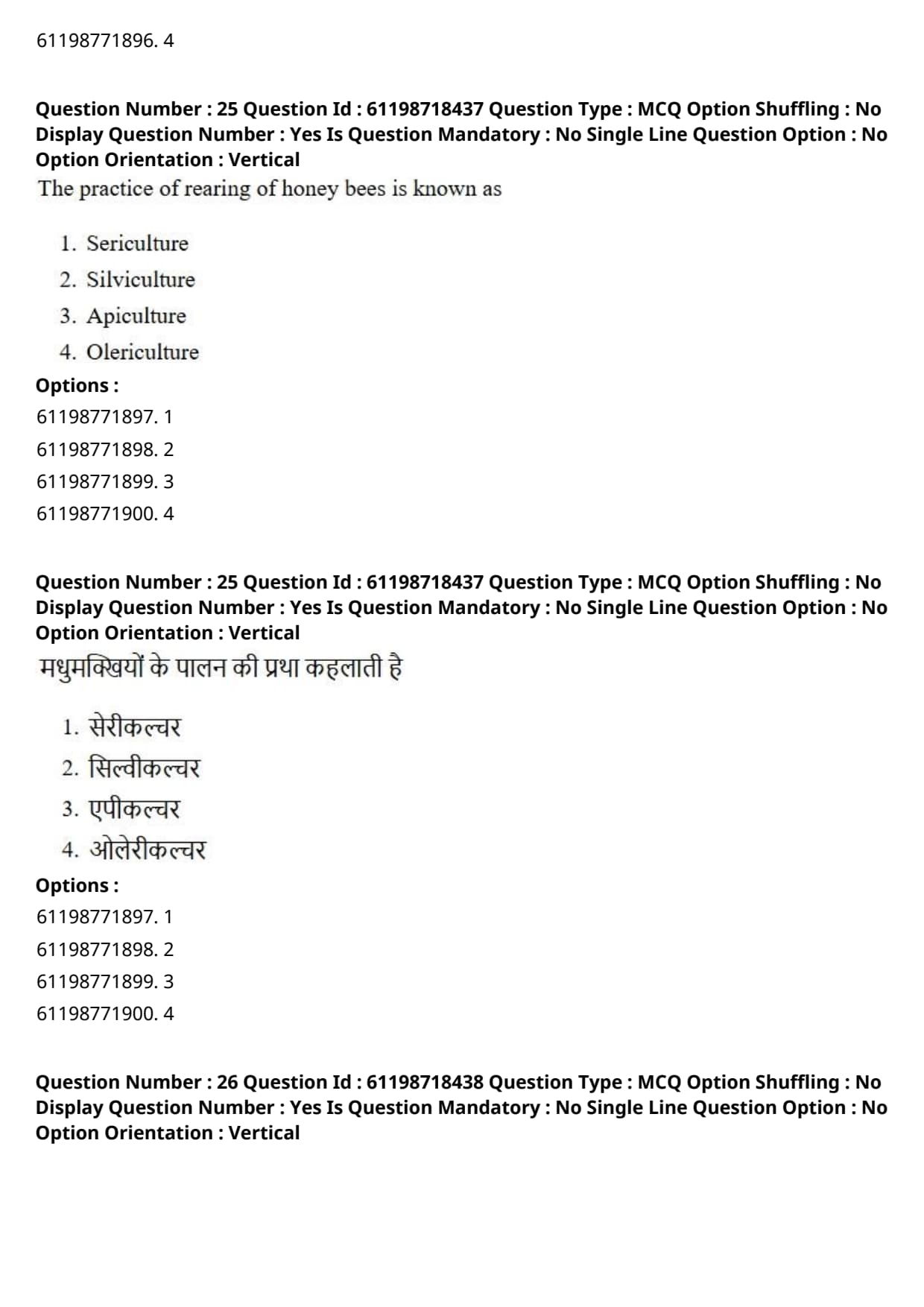
The practice of rearing of honey bees is known as
View Solution
Concept:
Different agricultural practices have specific names depending on the organism or crop being reared or cultivated.
Step 1: Understand apiculture.
Apiculture means rearing and management of honey bees.
\[ Honey bee rearing=Apiculture \]
Step 2: Eliminate other options.
Sericulture is rearing of silkworms.
Silviculture is related to cultivation and management of forest trees.
Olericulture is cultivation of vegetables.
Therefore, the practice of rearing honey bees is: \[ Apiculture \]
\[ \therefore Correct Answer is (C) \] Quick Tip: Apiculture means honey bee rearing, while sericulture means silkworm rearing.
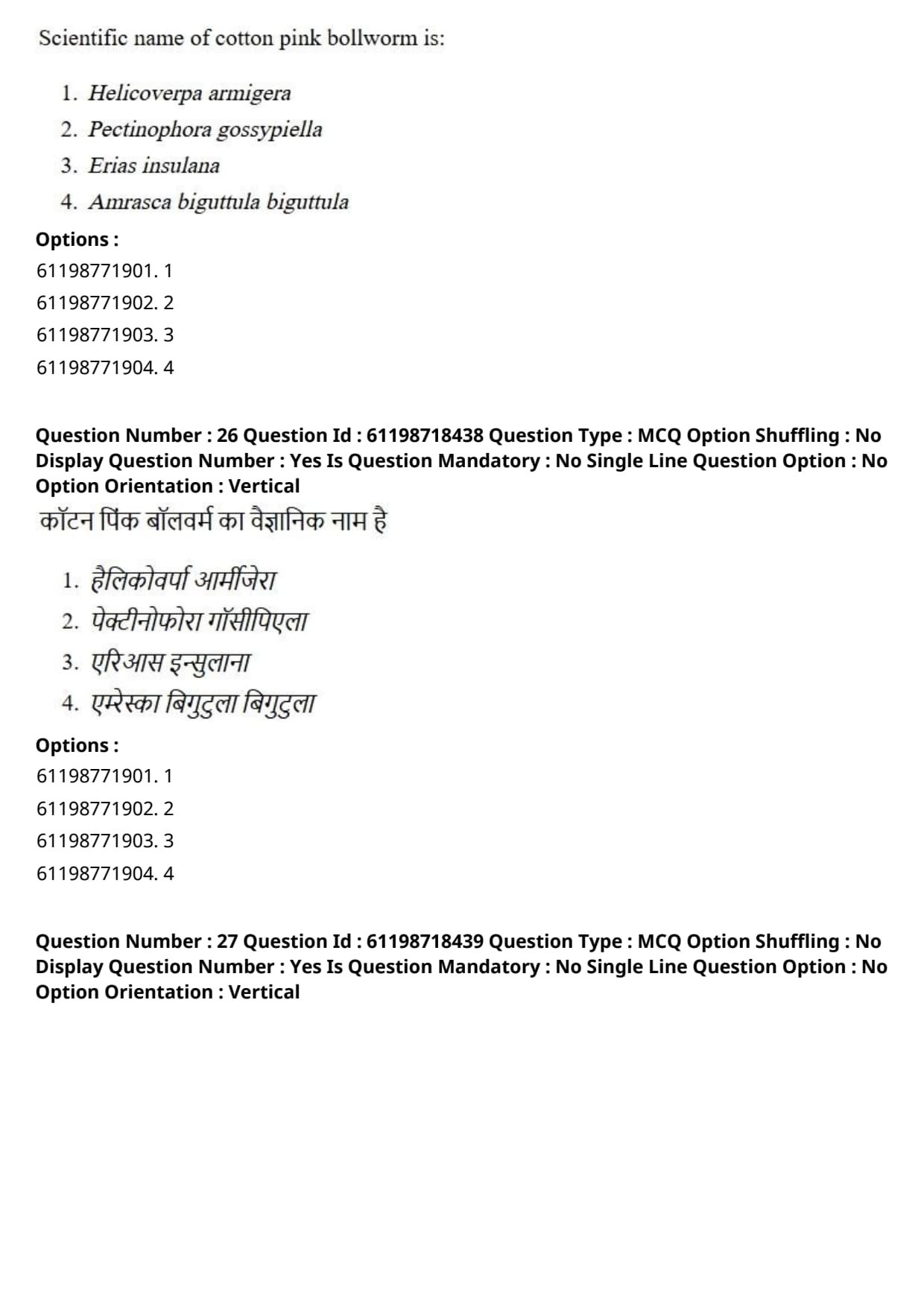
Pink bollworm of cotton is caused by
View Solution
Concept:
Cotton crop is attacked by several insect pests. Pink bollworm is one of the important bollworm pests of cotton.
Step 1: Identify the pest.
The pest asked in the question is: \[ Pink bollworm of cotton \]
Step 2: Identify its scientific name.
Pink bollworm of cotton is: \[ Pectinophora gossypiella \]
Step 3: Eliminate other options.
Earias vittella is spotted bollworm.
\textit{Aphis gossypii is cotton aphid.
\textit{Helicoverpa armigera is American bollworm.
Therefore: \[ Pink bollworm=\textit{Pectinophora gossypiella \]
\[ \therefore Correct Answer is (B) \] Quick Tip: Pink bollworm of cotton is Pectinophora gossypiella.
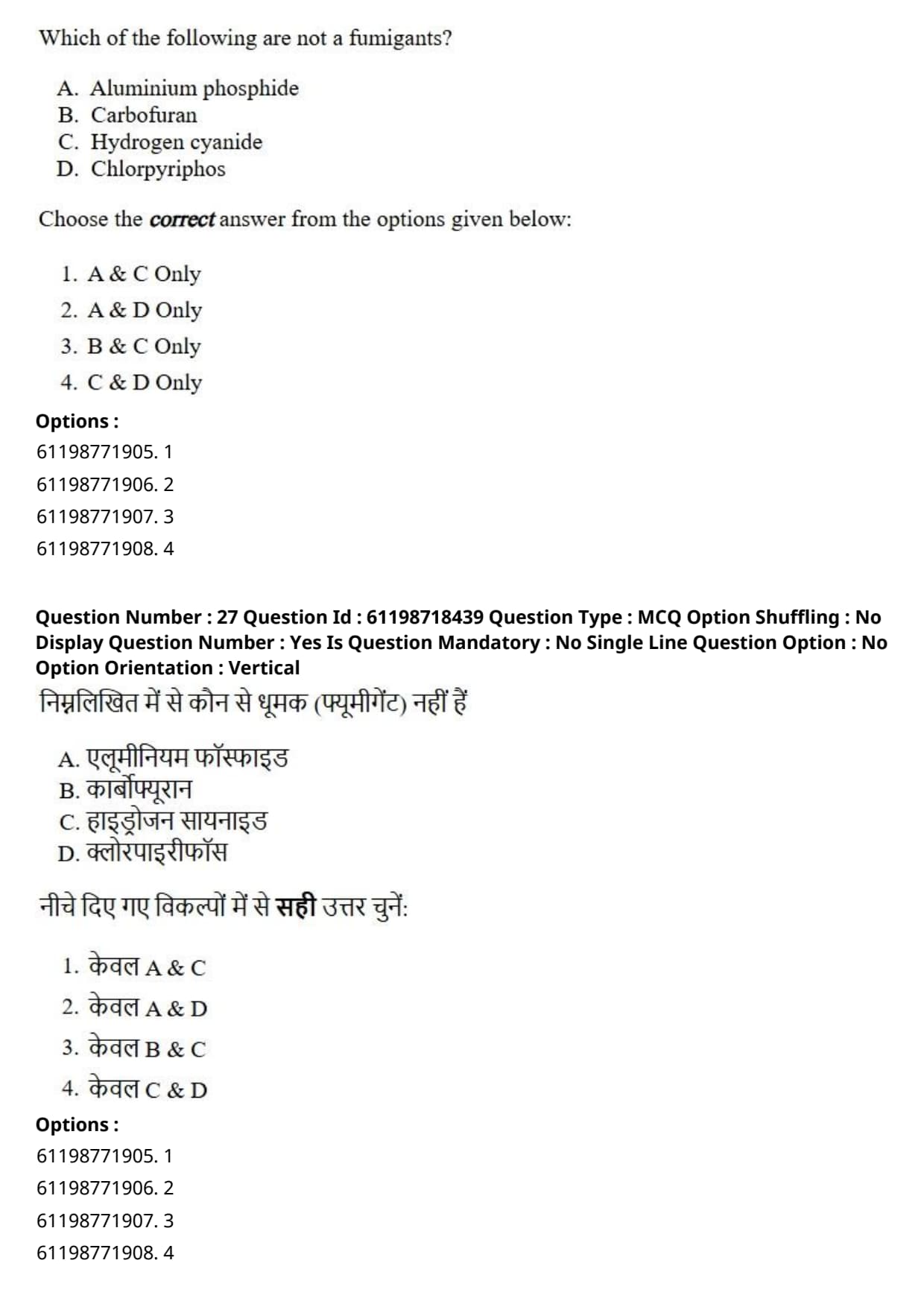
Which of the following are not fumigants?
A. Aluminium phosphide
B. Carbofuran
C. Hydrogen cyanide
D. Chlorpyriphos.
View Solution
Concept:
Fumigants are chemicals that produce toxic gases or vapours used for killing pests, especially in stored grains and enclosed spaces.
Step 1: Check Aluminium phosphide.
Aluminium phosphide releases phosphine gas and is used as a fumigant.
\[ A is a fumigant \]
Step 2: Check Hydrogen cyanide.
Hydrogen cyanide is a gaseous fumigant.
\[ C is a fumigant \]
Step 3: Check Carbofuran.
Carbofuran is a carbamate insecticide/nematicide. It is not a fumigant.
\[ B is not a fumigant \]
Step 4: Check Chlorpyriphos.
Chlorpyriphos is an organophosphate insecticide. It is not classified as a fumigant.
\[ D is not a fumigant \]
Thus, the correct combination should be: \[ B and D \]
But this combination is not present in the given options.
\[ \therefore Correct Answer: None of the given options \] Quick Tip: Aluminium phosphide and hydrogen cyanide are fumigants, while carbofuran and chlorpyriphos are not fumigants.
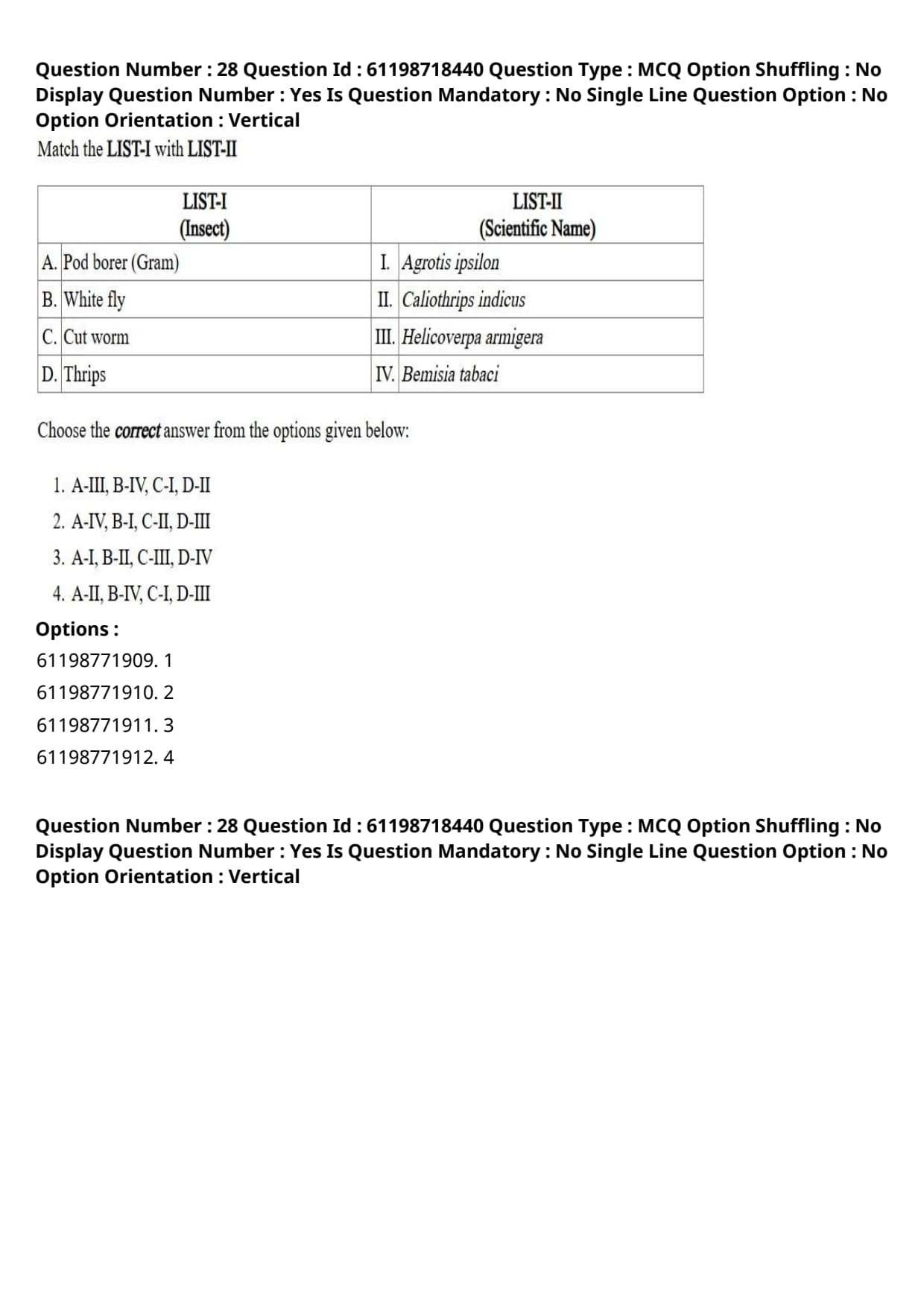
Match the LIST-I with LIST-II.

View Solution
Concept:
Insect pests are identified by their common names and scientific names.
Step 1: Pod borer of gram.
Pod borer of gram is: \[ Helicoverpa armigera \]
So, \[ A\rightarrow III \]
Step 2: White fly.
White fly is: \[ Bemisia tabaci \]
So, \[ B\rightarrow IV \]
Step 3: Cut worm.
Cut worm is: \[ Agrotis ipsilon \]
So, \[ C\rightarrow I \]
Step 4: Thrips.
Thrips is: \[ Caliothrips indicus \]
So, \[ D\rightarrow II \]
Therefore: \[ A-III,\ B-IV,\ C-I,\ D-II \]
\[ \therefore Correct Answer is (A) \] Quick Tip: Pod borer of gram is Helicoverpa armigera, white fly is Bemisia tabaci, and cut worm is Agrotis ipsilon.
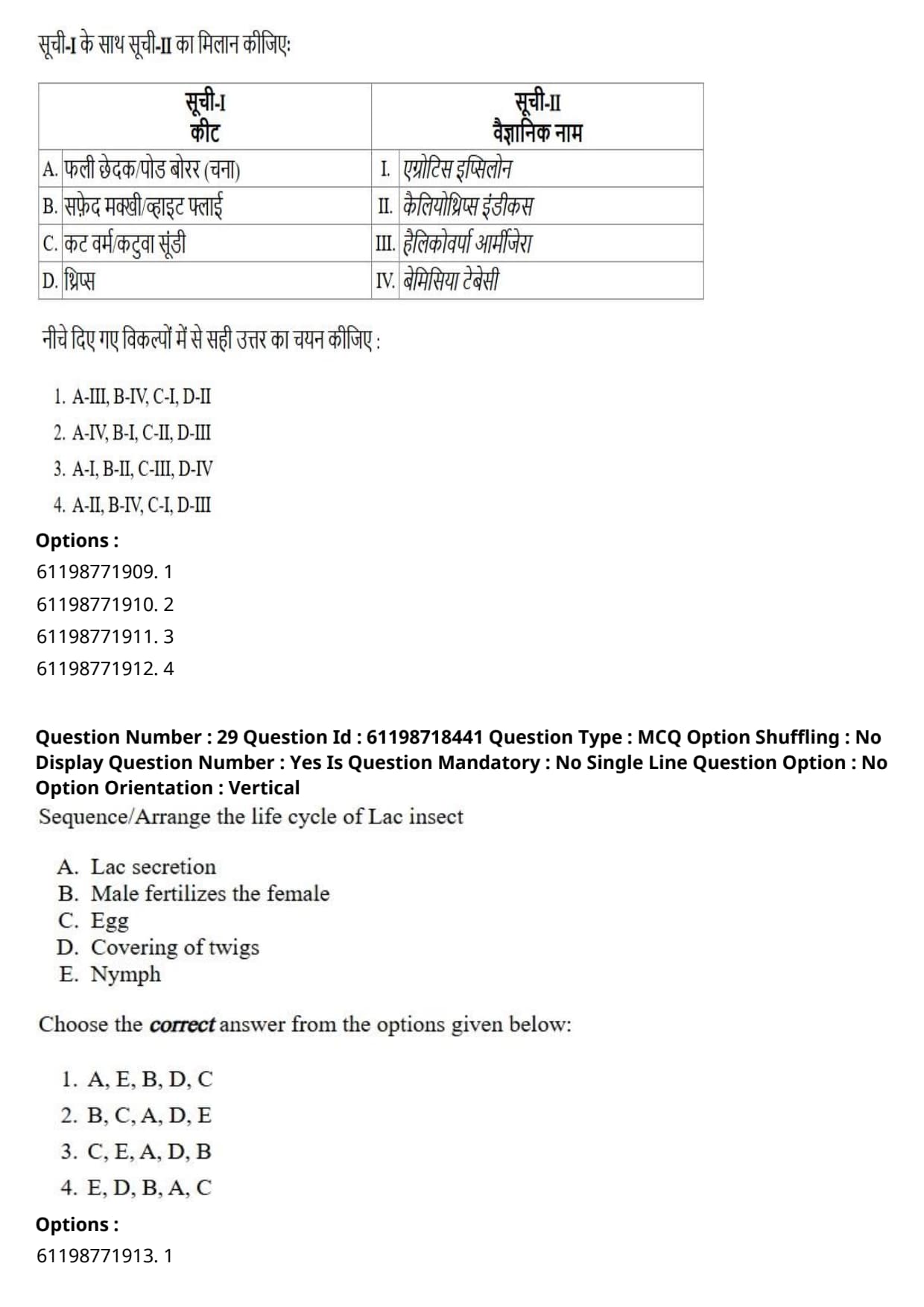
Sequence/Arrange the life cycle of Lac insect.
A. Lac secretion
B. Male fertilizes the female
C. Egg
D. Covering of twigs
E. Nymph.
View Solution
Concept:
Lac insect produces lac resin. Its life cycle includes egg, nymph, settlement, secretion of lac, covering of twigs, and fertilization.
Step 1: Egg.
The life cycle begins with eggs.
\[ First step=C \]
Step 2: Nymph.
Eggs hatch into nymphs, which move and settle on host twigs.
\[ Second step=E \]
Step 3: Lac secretion.
After settling, nymphs start secreting lac resin.
\[ Third step=A \]
Step 4: Covering of twigs.
The secreted lac forms a covering on twigs.
\[ Fourth step=D \]
Step 5: Male fertilizes the female.
Later, male fertilizes the female and the cycle continues.
\[ Fifth step=B \]
Thus, the correct sequence is: \[ C,E,A,D,B \]
\[ \therefore Correct Answer is (C) \] Quick Tip: Lac insect life cycle starts with egg, followed by nymph, lac secretion, covering of twigs, and fertilization.
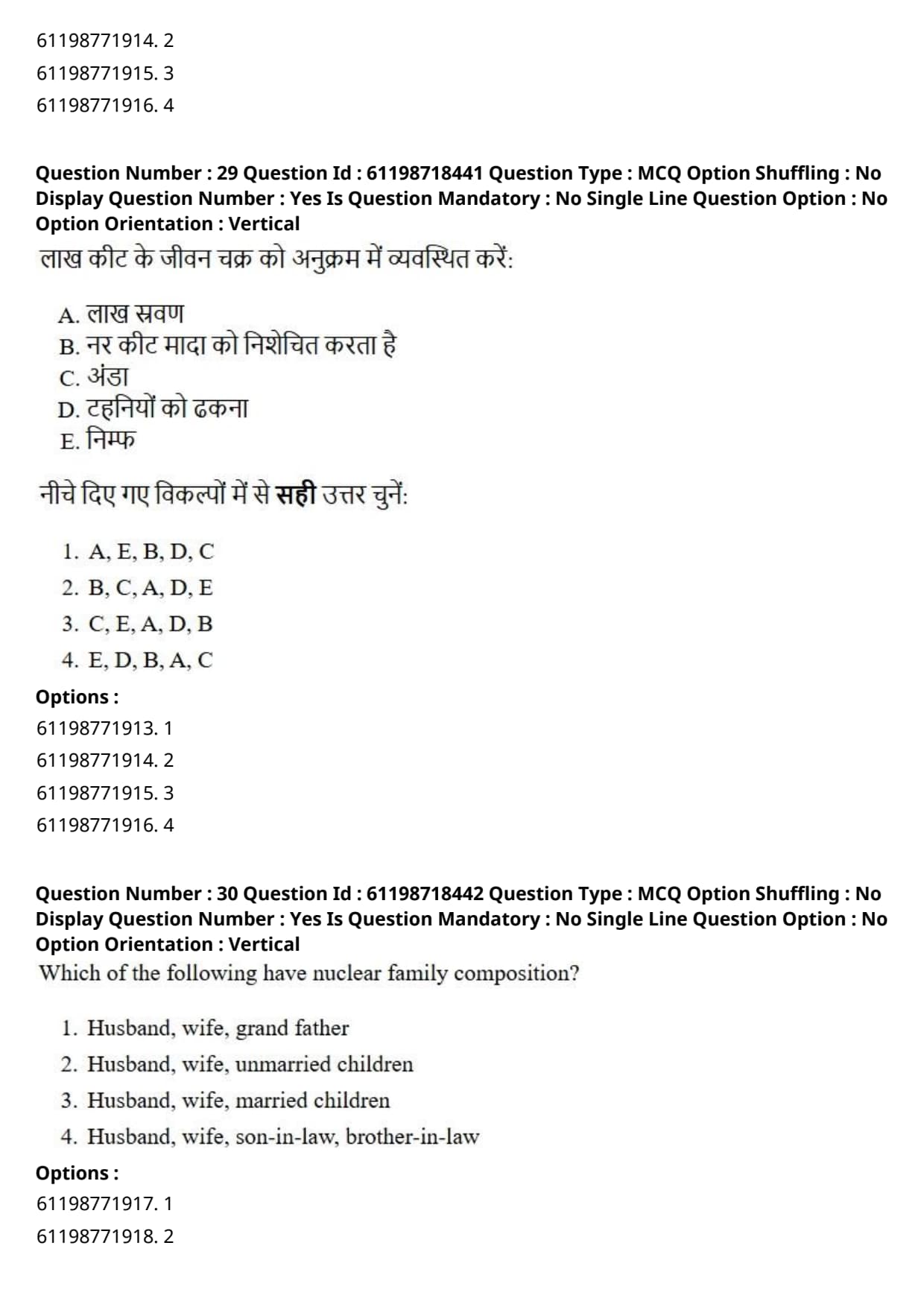
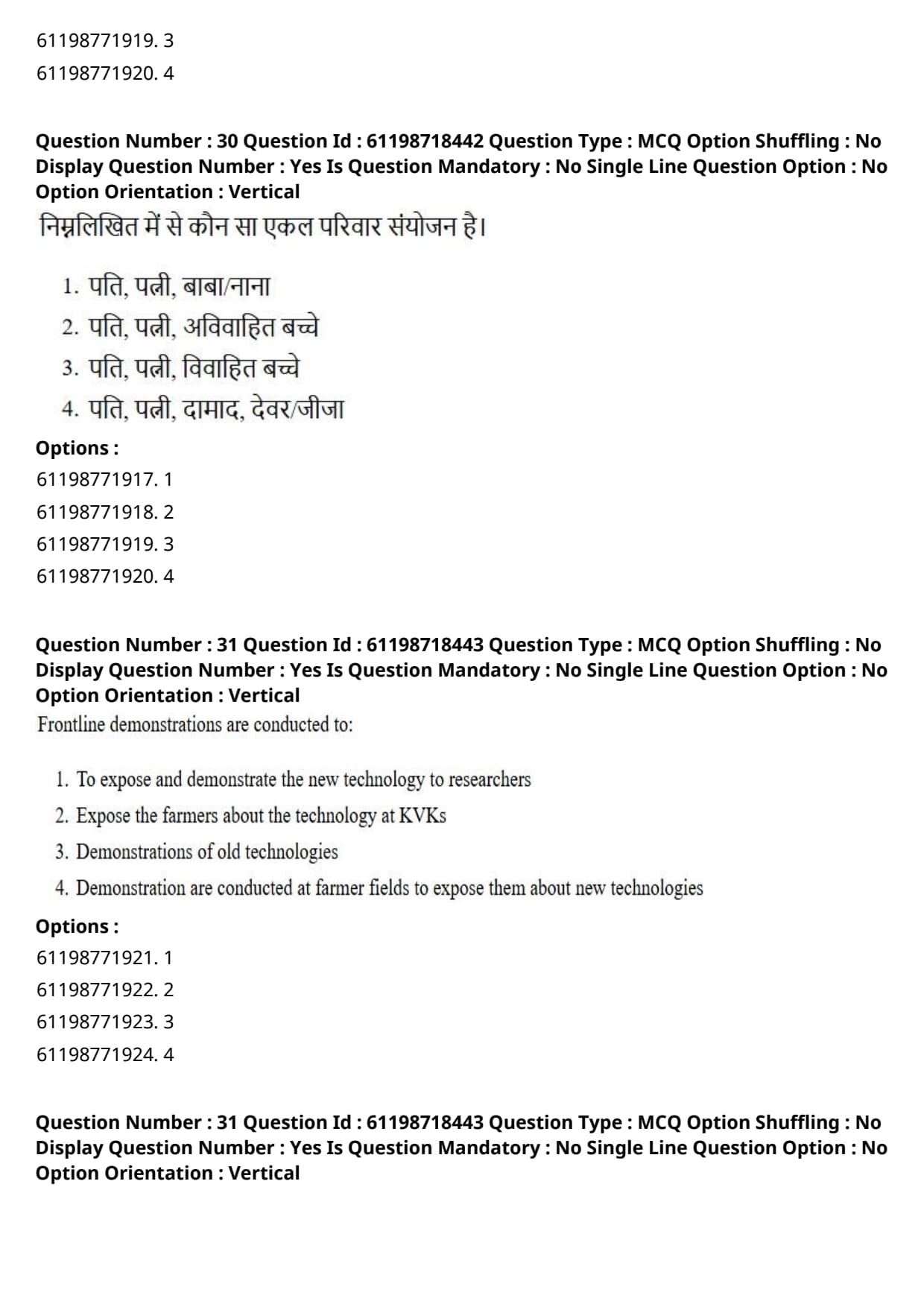
Which of the following have nuclear family composition?
View Solution
Concept:
A nuclear family is a small family unit consisting of parents and their unmarried children.
Step 1: Understand nuclear family.
A nuclear family usually includes: \[ Husband+Wife+Unmarried children \]
Step 2: Check option (A).
Grandfather is part of extended family, not nuclear family.
Step 3: Check option (B).
Husband, wife and unmarried children form a nuclear family.
Step 4: Check option (C) and (D).
Married children, son-in-law and brother-in-law indicate joint or extended family composition.
Therefore, nuclear family composition is: \[ Husband, wife, unmarried children \]
\[ \therefore Correct Answer is (B) \] Quick Tip: Nuclear family consists of husband, wife and unmarried children.
Frontline demonstrations are conducted to:
View Solution
Concept:
Frontline demonstrations are important extension activities. They are conducted to demonstrate improved technologies directly under farmers' field conditions.
Step 1: Purpose of frontline demonstration.
The main purpose is to show farmers the practical performance of new technologies.
Step 2: Location of demonstration.
Frontline demonstrations are conducted on farmers' fields, not only inside research stations or classrooms.
Step 3: Final conclusion.
They expose farmers to new technologies under real field conditions.
\[ \therefore Correct Answer is (D) \] Quick Tip: Frontline demonstrations are conducted on farmers' fields to show the practical benefits of improved technologies.
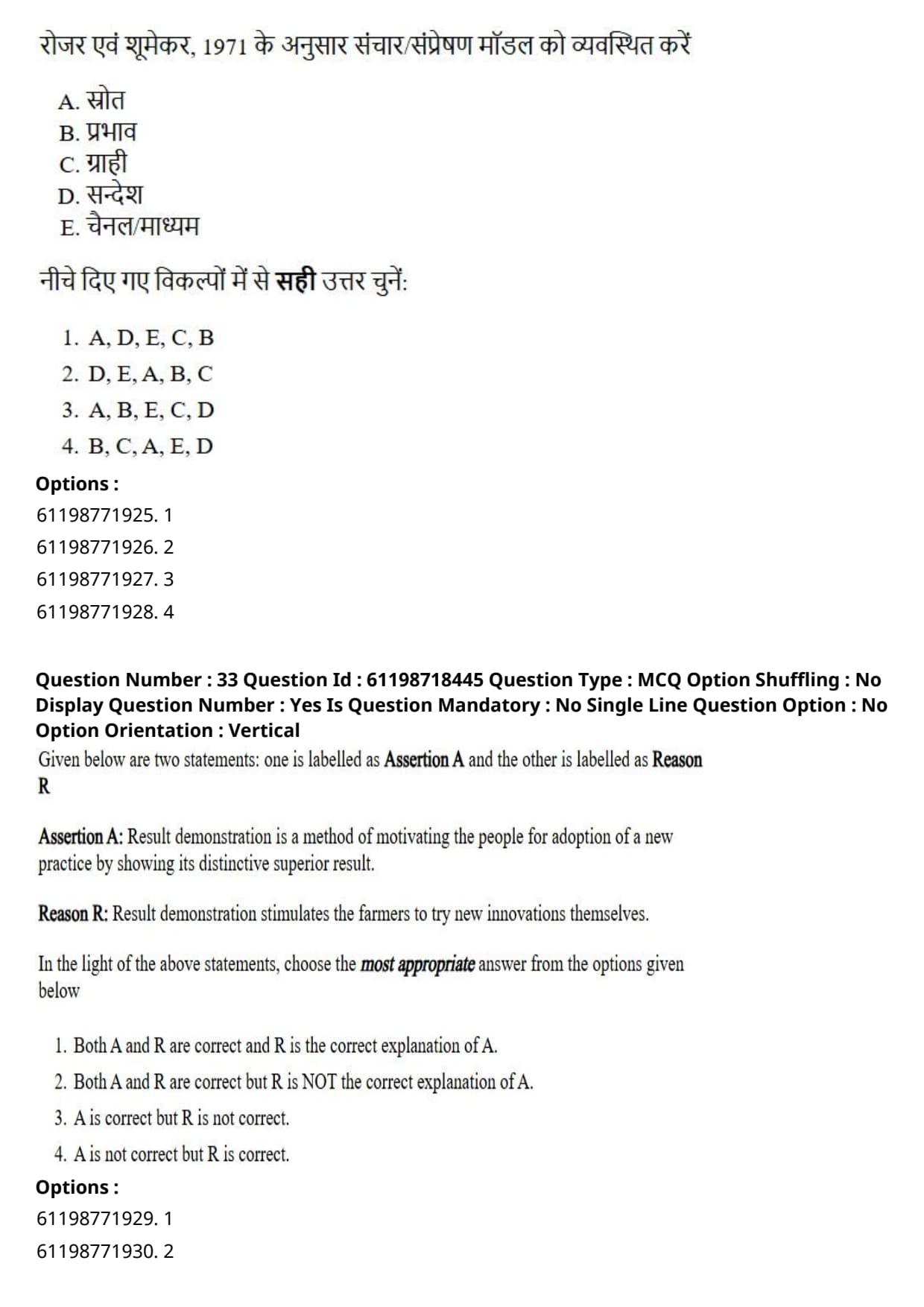
Arrange the communication model as per Rogers and Shoemaker 1971.
A. Source
B. Effect
C. Receiver
D. Message
E. Channel.
View Solution
Concept:
Communication is the process of transferring information from one person or source to another receiver through a channel.
Step 1: Source.
Communication begins with the source.
\[ First step=A \]
Step 2: Message.
The source prepares the message.
\[ Second step=D \]
Step 3: Channel.
The message is sent through a channel.
\[ Third step=E \]
Step 4: Receiver.
The receiver receives and interprets the message.
\[ Fourth step=C \]
Step 5: Effect.
Finally, communication produces an effect or response.
\[ Fifth step=B \]
Thus, the sequence is: \[ A,D,E,C,B \]
\[ \therefore Correct Answer is (A) \] Quick Tip: Basic communication sequence is source, message, channel, receiver and effect.
Given below are two statements:
Assertion (A): Result demonstration is a method of motivating the people for adoption of a new practice by showing its distinctive superior result.
Reason (R): Result demonstration stimulates the farmers to try new innovations themselves.
View Solution
Concept:
Result demonstration is an extension teaching method used to show the benefit of a new practice by comparing its result with existing practices.
Step 1: Check Assertion.
Result demonstration motivates people by showing superior results of a new practice.
\[ A is correct \]
Step 2: Check Reason.
When farmers see better results, they become interested and are stimulated to try the new practice themselves.
\[ R is correct \]
Step 3: Check explanation.
The reason explains why result demonstration motivates adoption of new practices.
\[ \therefore Correct Answer is (A) \] Quick Tip: Result demonstration motivates farmers by showing visible superior results of a new practice.
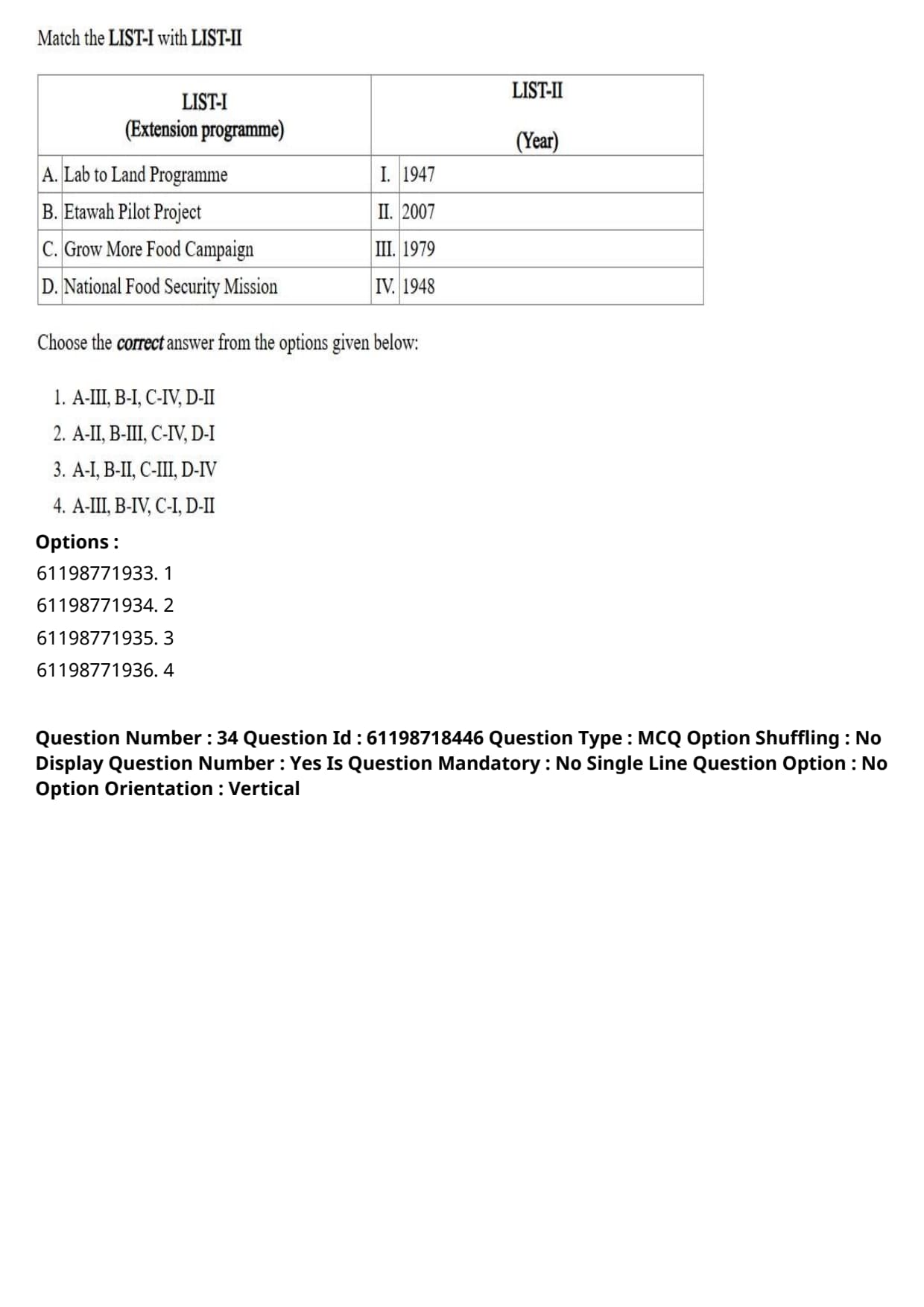
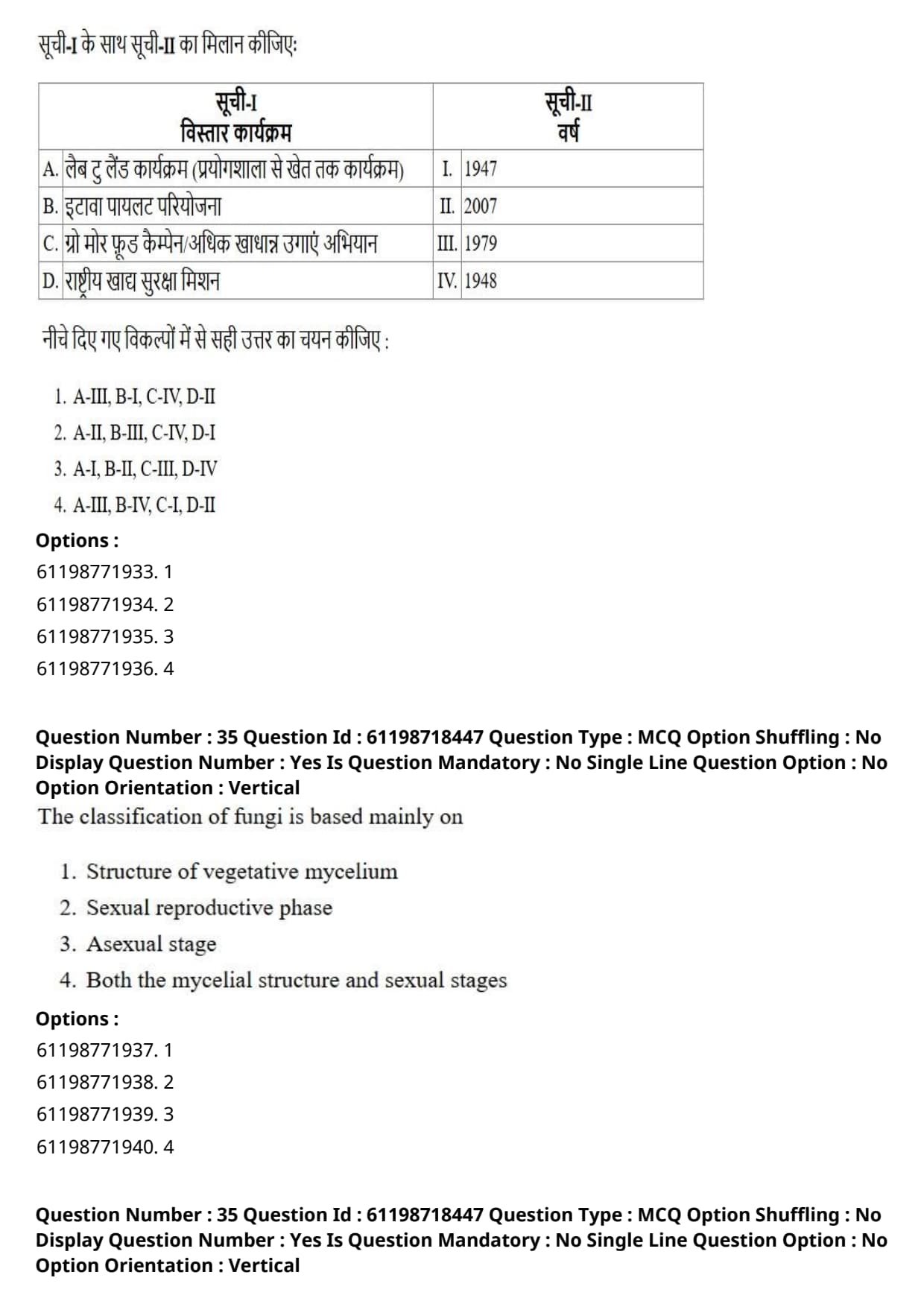
Match the LIST-I with LIST-II.

View Solution
Concept:
Agricultural extension programmes in India were launched in different years to improve agricultural production and rural development.
Step 1: Lab to Land Programme.
Lab to Land Programme was launched in: \[ 1979 \]
So, \[ A\rightarrow III \]
Step 2: Etawah Pilot Project.
Etawah Pilot Project was started in: \[ 1948 \]
So, \[ B\rightarrow IV \]
Step 3: Grow More Food Campaign.
Grow More Food Campaign is matched with: \[ 1947 \]
So, \[ C\rightarrow I \]
Step 4: National Food Security Mission.
National Food Security Mission was launched in: \[ 2007 \]
So, \[ D\rightarrow II \]
Therefore: \[ A-III,\ B-IV,\ C-I,\ D-II \]
\[ \therefore Correct Answer is (D) \] Quick Tip: Lab to Land Programme was launched in 1979 and National Food Security Mission was launched in 2007.
The classification of fungi is based mainly on
View Solution
Concept:
Fungi are classified on the basis of important morphological and reproductive characters.
Step 1: Mycelial structure.
The structure of mycelium is important in fungal classification. Mycelium may be septate or aseptate.
Step 2: Sexual stage.
Sexual reproduction is also very important because different fungal groups produce different types of sexual spores.
Step 3: Combined basis.
Therefore, classification is not based only on one character. It mainly considers both mycelial structure and sexual reproductive stages.
\[ \therefore Correct Answer is (D) \] Quick Tip: Fungal classification mainly depends on mycelial structure and sexual reproductive characters.
Match the LIST-I with LIST-II.

View Solution
Concept:
Citrus fruits are identified by their scientific names.
Step 1: Acid lime.
Acid lime is: \[ Citrus aurantifolia \]
So, \[ A\rightarrow III \]
Step 2: Lemon.
Lemon is: \[ Citrus limon \]
So, \[ B\rightarrow IV \]
Step 3: Mandarin.
Mandarin is: \[ Citrus reticulata \]
So, \[ C\rightarrow I \]
Step 4: Sweet orange.
Sweet orange is: \[ Citrus sinensis \]
So, \[ D\rightarrow II \]
Therefore: \[ A-III,\ B-IV,\ C-I,\ D-II \]
\[ \therefore Correct Answer is (C) \] Quick Tip: Acid lime is Citrus aurantifolia, lemon is Citrus limon, mandarin is Citrus reticulata, and sweet orange is Citrus sinensis.
`Santa Rosa' is a variety of
View Solution
Concept:
Fruit crops have many improved varieties. `Santa Rosa' is a well-known cultivar name.
Step 1: Identify the variety.
`Santa Rosa' is not a variety of apple, peach or pear.
Step 2: Correct crop.
`Santa Rosa' is a famous variety of plum.
\[ Santa Rosa \rightarrow Plum \]
\[ \therefore Correct Answer is (D) \] Quick Tip: Santa Rosa is a well-known plum variety.
What is the planting ratio for hybrid seed production in brinjal crop? Planting ratio, Male:Female
View Solution
Concept:
In hybrid seed production, male and female parent rows are planted in a proper ratio to ensure effective pollination and good seed set.
Step 1: Understand planting ratio.
The planting ratio tells how many male rows are planted with female rows.
\[ Planting ratio=Male:Female \]
Step 2: Brinjal hybrid seed production.
For hybrid seed production in brinjal, the commonly used male to female planting ratio is: \[ 1:5 \]
Step 3: Interpretation.
This means one male row is planted for five female rows.
\[ \therefore Correct Answer is (B) \] Quick Tip: In brinjal hybrid seed production, the male:female planting ratio is commonly taken as \(1:5\).
Which one is a commonly used root stock for commercial guava crop?
View Solution
Concept:
Rootstock is the plant part on which a desired scion is grafted or budded. In fruit crops, rootstocks are selected for compatibility, vigour and adaptability.
Step 1: Check Dogridge.
Dogridge is commonly associated with grape rootstock, not guava.
Step 2: Check Kainth.
Kainth is commonly associated with pear rootstock.
Step 3: Check L-49.
L-49 is a well-known guava cultivar and is used in commercial guava cultivation context.
\[ L-49 \rightarrow Guava \]
Step 4: Check Rayan.
Rayan is not the common answer for guava rootstock in this question.
Therefore, the commonly used rootstock for commercial guava crop among the given options is: \[ L-49 \]
\[ \therefore Correct Answer is (C) \] Quick Tip: L-49 is associated with guava, while Dogridge is commonly associated with grape and Kainth with pear.
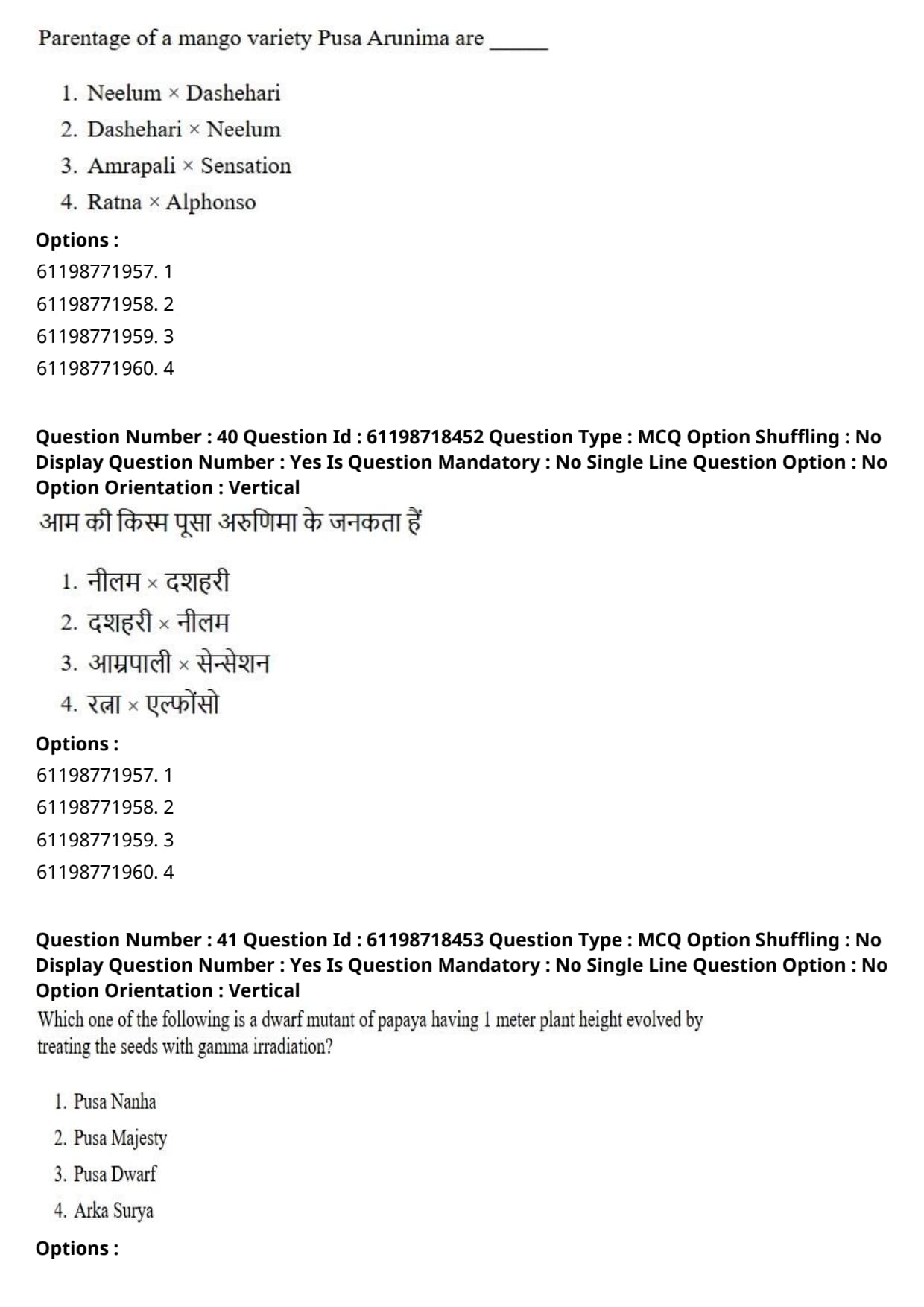
Parentage of a mango variety Pusa Arunima are
View Solution
Concept:
Mango varieties may be developed through hybridization. The parentage tells which two varieties were crossed to develop a new variety.
Step 1: Identify the variety.
The mango variety asked in the question is: \[ Pusa Arunima \]
Step 2: Identify its parentage.
Pusa Arunima was developed from: \[ Amrapali \times Sensation \]
Step 3: Select the correct option.
Among the given options: \[ Amrapali \times Sensation \]
is option (C).
\[ \therefore Correct Answer is (C) \] Quick Tip: Pusa Arunima is a mango hybrid developed from Amrapali \(\times\) Sensation.
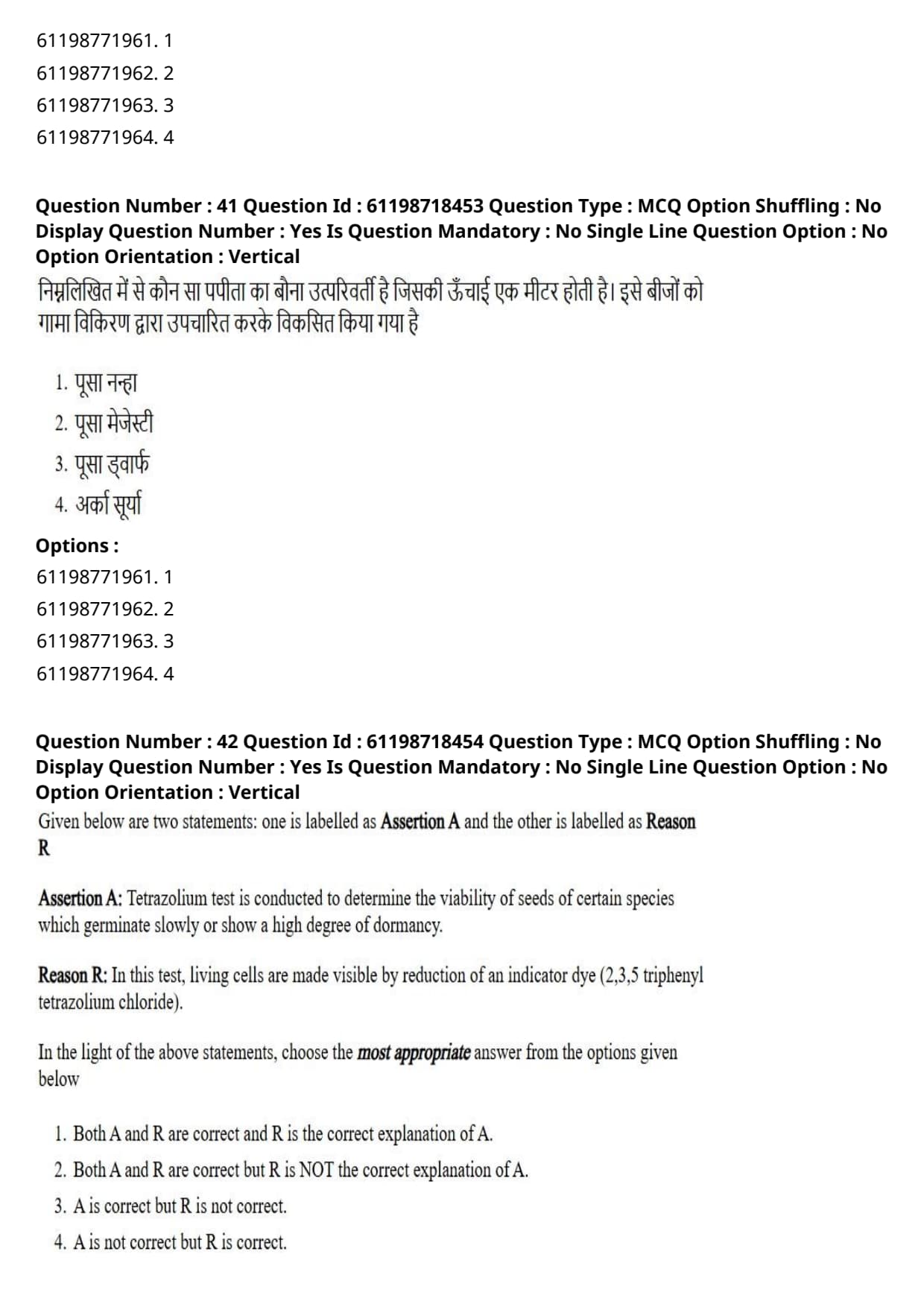
Which one of the following is a dwarf mutant of papaya having 1 meter plant height evolved by treating the seeds with gamma irradiation?
View Solution
Concept:
Mutation breeding is a plant breeding method in which mutations are artificially induced using physical or chemical mutagens. Gamma irradiation is one of the commonly used physical mutagens.
Step 1: Understand mutation breeding.
In mutation breeding, seeds or plant parts are exposed to mutagens such as: \[ Gamma rays \] \[ X-rays \] \[ Chemical mutagens \]
These mutagens create genetic changes, and useful mutants are selected for crop improvement.
Step 2: Identify the crop mentioned.
The crop mentioned in the question is: \[ Papaya \]
The question asks about a dwarf mutant of papaya having about \(1\) meter plant height.
Step 3: Identify the correct variety.
Pusa Nanha is a dwarf mutant variety of papaya. It was evolved through mutation breeding using gamma irradiation.
Step 4: Eliminate other options.
Pusa Majesty, Pusa Dwarf, and Arka Surya are not the correct answers for the dwarf mutant papaya developed through gamma irradiation.
\[ \therefore Correct Answer is (A) \] Quick Tip: Pusa Nanha is a dwarf mutant papaya variety developed through gamma irradiation.
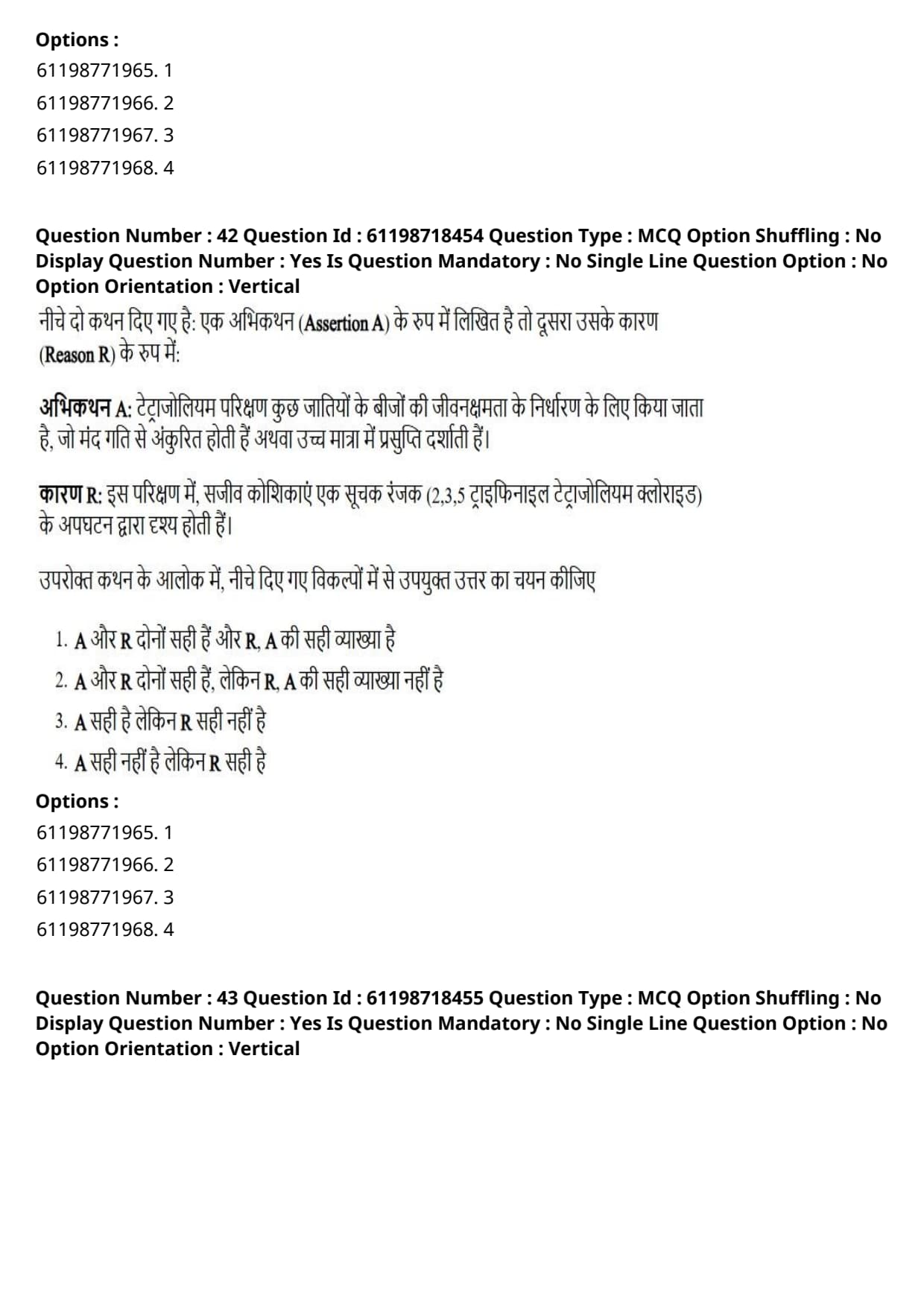
Given below are two statements:
Assertion (A): Tetrazolium test is conducted to determine the viability of seeds of certain species which germinate slowly or show a high degree of dormancy.
Reason (R): In this test, living cells are made visible by reduction of an indicator dye, 2,3,5-triphenyl tetrazolium chloride.
View Solution
Concept:
Tetrazolium test is a biochemical test used to determine seed viability quickly. It is especially useful when seeds germinate slowly or show dormancy.
Step 1: Check Assertion (A).
The assertion states that tetrazolium test is used to determine seed viability in species that germinate slowly or show dormancy.
This is correct because normal germination tests may take a long time in such seeds.
\[ A is correct \]
Step 2: Check Reason (R).
In tetrazolium test, living seed tissues reduce 2,3,5-triphenyl tetrazolium chloride into a red coloured compound.
\[ Living tissue \rightarrow Red staining \]
Dead tissues do not stain properly.
\[ R is correct \]
Step 3: Check whether R explains A.
The reason explains how the tetrazolium test determines viability. Since living cells reduce the dye and become visible, the test can identify viable seeds quickly.
\[ R correctly explains A \]
\[ \therefore Correct Answer is (A) \] Quick Tip: Tetrazolium test is a quick seed viability test. Living seed tissues stain red due to reduction of tetrazolium chloride.
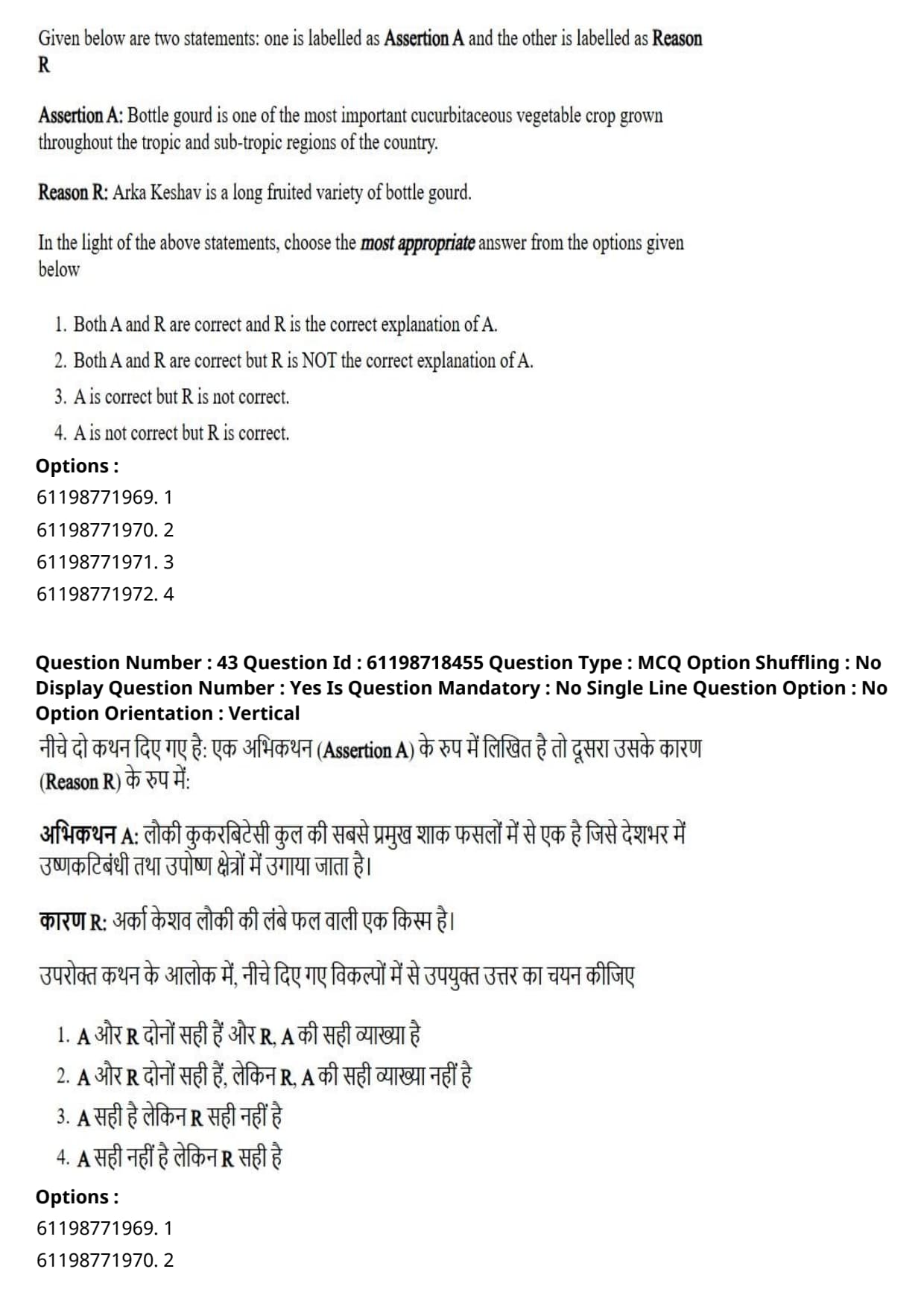
Given below are two statements:
Assertion (A): Bottle gourd is one of the most important cucurbitaceous vegetable crop grown throughout the tropic and sub-tropic regions of the country.
Reason (R): Arka Keshav is a long fruited variety of bottle gourd.
View Solution
Concept:
This is an Assertion-Reason type question. In such questions, we must check two things:
\[ First, whether Assertion (A) is correct or not \]
\[ Second, whether Reason (R) is correct or not \]
After that, we check whether Reason correctly explains the Assertion.
Step 1: Check Assertion (A).
Assertion says that bottle gourd is one of the most important cucurbitaceous vegetable crops grown throughout tropical and sub-tropical regions of the country.
Bottle gourd belongs to the family Cucurbitaceae. It is widely grown in tropical and sub-tropical regions because it performs well under warm climatic conditions.
Therefore,
\[ A is correct \]
Step 2: Check Reason (R).
Reason says that Arka Keshav is a long fruited variety of bottle gourd.
Arka Keshav is indeed a variety of bottle gourd and it is known for long fruits.
Therefore,
\[ R is also correct \]
Step 3: Check whether R explains A.
Although Reason is correct, it only gives the name of one variety of bottle gourd.
It does not explain why bottle gourd is an important cucurbitaceous vegetable crop or why it is grown in tropical and sub-tropical regions.
So,
\[ R is not the correct explanation of A \]
Step 4: Final conclusion.
Both Assertion and Reason are correct, but Reason does not correctly explain Assertion.
\[ \therefore Correct Answer is (B) \] Quick Tip: In Assertion-Reason questions, even if both statements are true, check carefully whether the Reason actually explains the Assertion.
Arrange the correct sequence of the following classes of seed for a five generation model of vegetable seed production:
A. Foundation Seed (Stage-II)
B. Breeder Seed
C. Foundation Seed (Stage-I)
D. Certified Seed (Stage-II)
E. Certified Seed (Stage-I).
View Solution
Concept:
Seed production follows a fixed generation sequence to maintain genetic purity and seed quality.
Step 1: Start with breeder seed.
Breeder seed is produced under the direct supervision of the breeder and is the source seed for further multiplication.
\[ First step=B \]
Step 2: Foundation Seed Stage-I.
Foundation seed stage-I is produced from breeder seed.
\[ Second step=C \]
Step 3: Foundation Seed Stage-II.
Foundation seed stage-II is produced from foundation seed stage-I.
\[ Third step=A \]
Step 4: Certified Seed Stage-I.
Certified seed stage-I is produced from foundation seed.
\[ Fourth step=E \]
Step 5: Certified Seed Stage-II.
Certified seed stage-II is the next multiplication stage.
\[ Fifth step=D \]
Thus, the correct sequence is: \[ B,C,A,E,D \]
\[ \therefore Correct Answer is (A) \] Quick Tip: Five generation seed production sequence is Breeder Seed \(\rightarrow\) Foundation Seed Stage-I \(\rightarrow\) Foundation Seed Stage-II \(\rightarrow\) Certified Seed Stage-I \(\rightarrow\) Certified Seed Stage-II.
Mango is acclaimed as the King of Fruits in Indian continent, which are true about it?
A. Mango is native to South and Southeast Asia
B. Mango is ideally grown in soil having pH ranges from 6.5--7.5
C. All mango varieties are regular bearer
D. Mango can be raised from seed or propagated vegetatively
E. Black tip is a physiological disorder of mango fruit.
View Solution
Concept:
Mango is an important tropical fruit crop. It is called the King of Fruits because of its excellent taste, flavour, and commercial importance.
Step 1: Check statement A.
Mango is native to South and Southeast Asia.
\[ A is correct \]
Step 2: Check statement B.
Mango grows well in slightly acidic to neutral soils. A pH range of about \(6.5\) to \(7.5\) is suitable.
\[ B is correct \]
Step 3: Check statement C.
All mango varieties are not regular bearers. Some varieties show alternate or biennial bearing.
\[ C is incorrect \]
Step 4: Check statement D.
Mango can be raised from seed and also propagated vegetatively through methods like grafting.
\[ D is correct \]
Step 5: Check statement E.
Black tip is a physiological disorder of mango fruit.
\[ E is correct \]
Thus, correct statements are: \[ A,B,D,E \]
\[ \therefore Correct Answer is (B) \] Quick Tip: Mango may show alternate bearing. Therefore, the statement that all mango varieties are regular bearers is false.
Guava, also known as poor man's apple, which are true about it?
A. Guava also called as apple of the tropics
B. A guava fruit may also contain about five times the amount of vitamin-C than an orange
C. It can be grown successfully in soils with pH upto 8.5
D. Guava is grown successfully in temperate region upto 4500 m above mean sea level
E. In India, the best quality guavas are produced in Allahabad and adjoining areas in Uttar Pradesh.
View Solution
Concept:
Guava is an important fruit crop known for its nutritional value, especially high vitamin-C content.
Step 1: Check statement A.
Guava is called the apple of the tropics and also poor man's apple.
\[ A is correct \]
Step 2: Check statement B.
Guava contains very high vitamin-C and may contain much more vitamin-C than orange.
\[ B is correct \]
Step 3: Check statement C.
Guava is hardy and can tolerate comparatively alkaline soils, even up to about pH \(8.5\).
\[ C is correct \]
Step 4: Check statement D.
Guava is mainly a tropical and subtropical crop. The statement about temperate region up to \(4500\) m is not correct.
\[ D is incorrect \]
Step 5: Check statement E.
Allahabad and adjoining regions of Uttar Pradesh are famous for high quality guava.
\[ E is correct \]
Thus, correct statements are: \[ A,B,C,E \]
\[ \therefore Correct Answer is (C) \] Quick Tip: Guava is called poor man's apple and apple of the tropics. Allahabad region is famous for good quality guava.
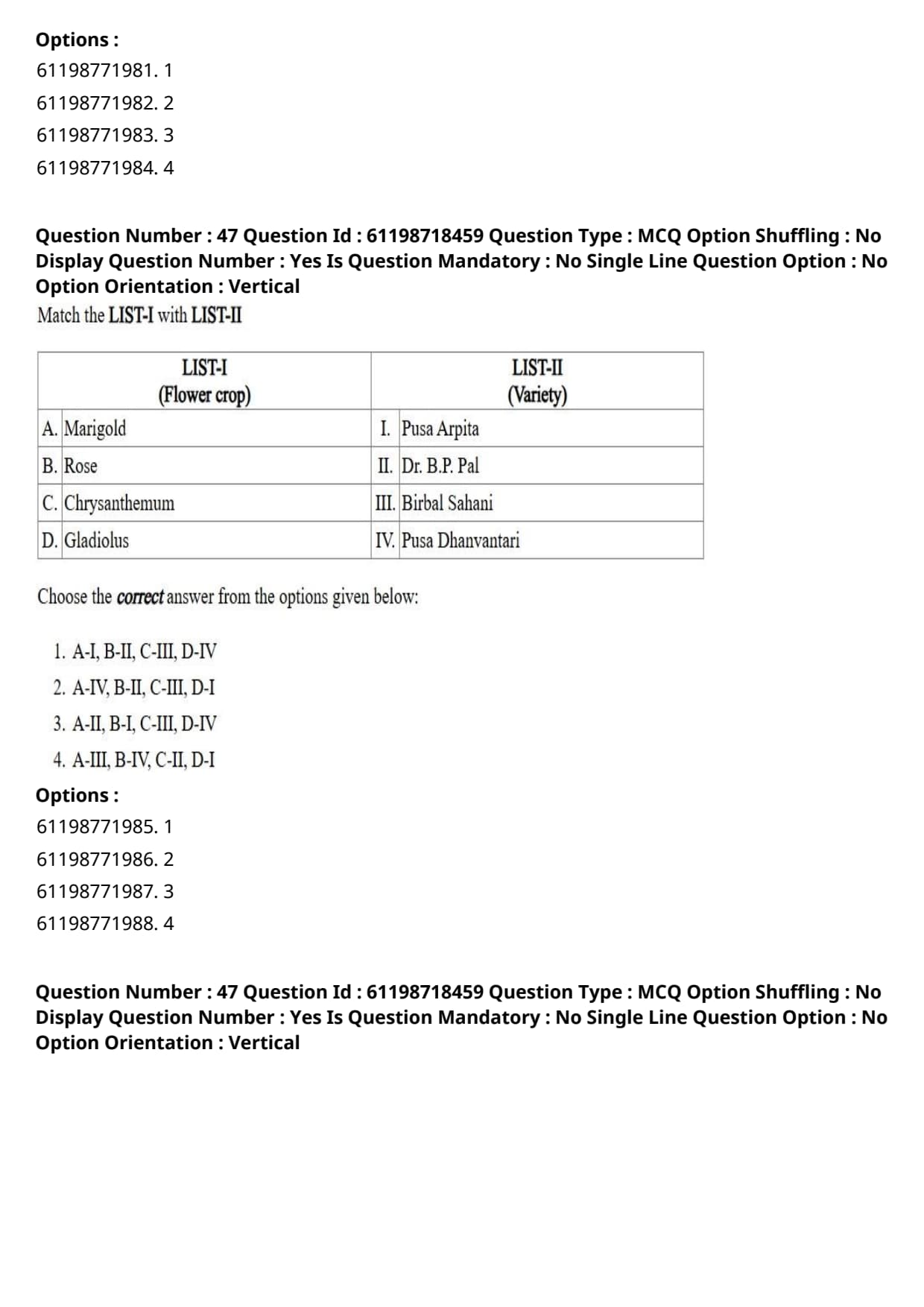
Match the LIST-I with LIST-II.

View Solution
Concept:
Different flower crops have specific varieties. Matching crop with variety is important in floriculture.
Step 1: Marigold.
Pusa Arpita is a variety of marigold.
\[ A\rightarrow I \]
Step 2: Rose.
Dr. B.P. Pal is a rose variety.
\[ B\rightarrow II \]
Step 3: Chrysanthemum.
Birbal Sahani is associated with chrysanthemum variety.
\[ C\rightarrow III \]
Step 4: Gladiolus.
Pusa Dhanvantari is a variety of gladiolus.
\[ D\rightarrow IV \]
Therefore: \[ A-I,\ B-II,\ C-III,\ D-IV \]
\[ \therefore Correct Answer is (A) \] Quick Tip: Remember crop-variety pairs: Marigold--Pusa Arpita, Rose--Dr. B.P. Pal, Gladiolus--Pusa Dhanvantari.
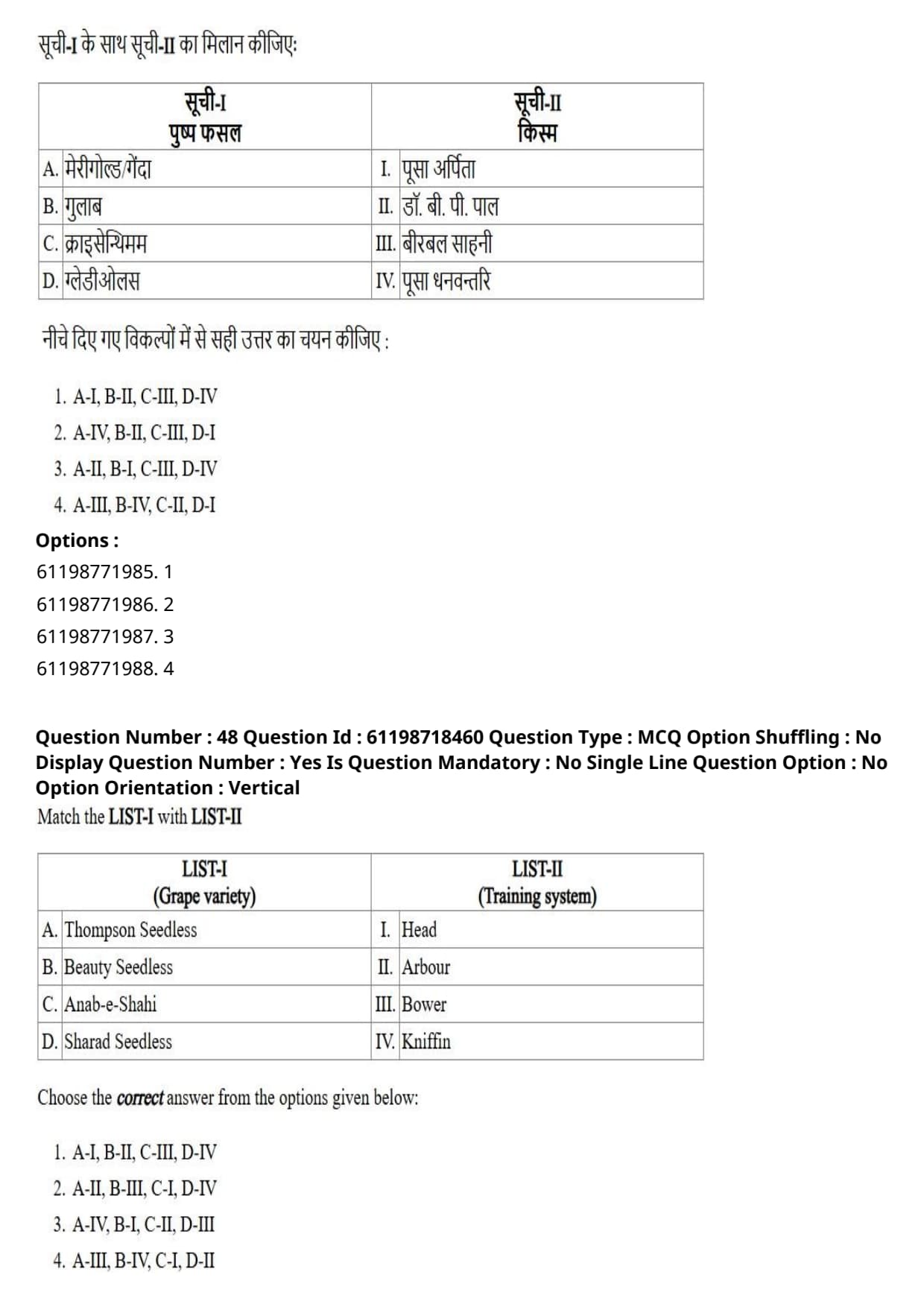
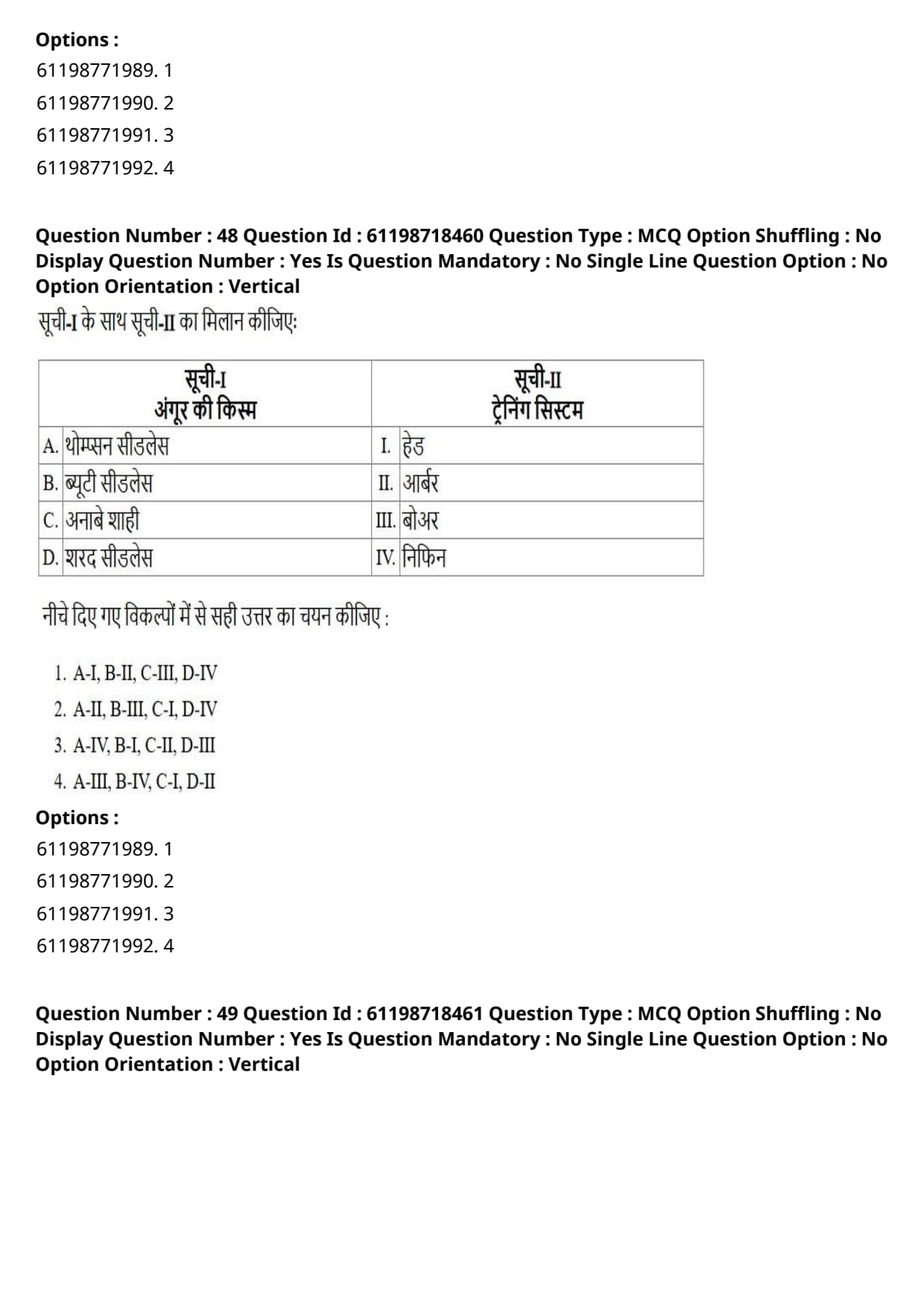
Match the LIST-I with LIST-II.

View Solution
Concept:
In grape cultivation, different varieties are trained using suitable training systems such as head, arbour, bower, and kniffin.
Step 1: Thompson Seedless.
Thompson Seedless is matched with Kniffin system.
\[ A\rightarrow IV \]
Step 2: Beauty Seedless.
Beauty Seedless is matched with Head system.
\[ B\rightarrow I \]
Step 3: Anab-e-Shahi.
Anab-e-Shahi is matched with Arbour system.
\[ C\rightarrow II \]
Step 4: Sharad Seedless.
Sharad Seedless is matched with Bower system.
\[ D\rightarrow III \]
Therefore: \[ A-IV,\ B-I,\ C-II,\ D-III \]
\[ \therefore Correct Answer is (C) \] Quick Tip: In grape cultivation, variety and training system are matched according to growth habit and production requirement.
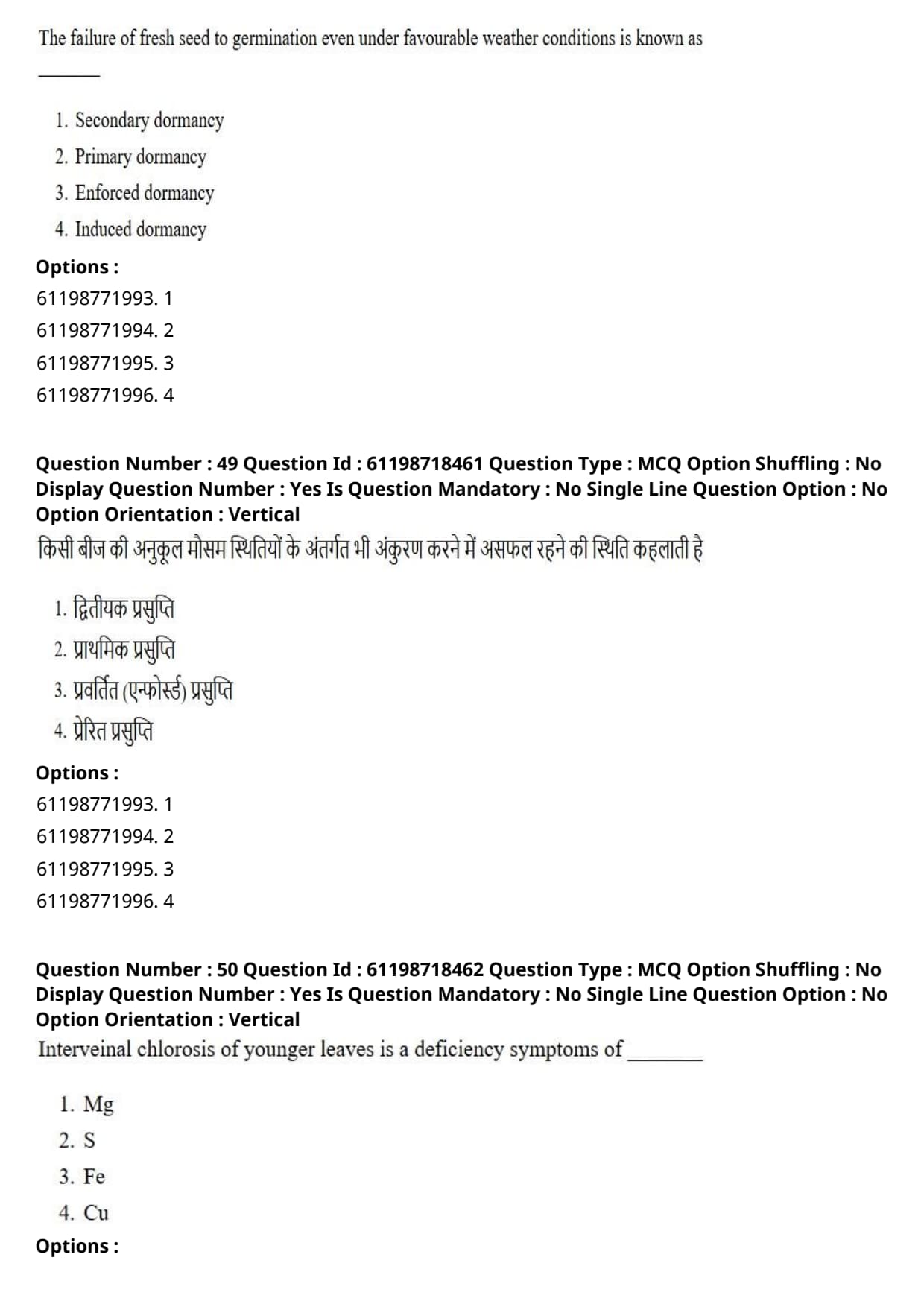
The failure of fresh seed to germination even under favourable weather conditions is known as
View Solution
Concept:
Seed dormancy is the condition in which a viable seed does not germinate even when environmental conditions are favourable.
Step 1: Understand primary dormancy.
Primary dormancy is present in freshly harvested seeds. It is caused by internal factors such as immature embryo, hard seed coat, or chemical inhibitors.
Step 2: Interpret the question.
The question says fresh seed fails to germinate even under favourable conditions.
This is the definition of: \[ Primary dormancy \]
Step 3: Eliminate other options.
Secondary dormancy develops after seed dispersal due to unfavourable conditions.
Enforced dormancy is due to external unfavourable conditions.
Induced dormancy is caused by later environmental influences.
\[ \therefore Correct Answer is (B) \] Quick Tip: Fresh viable seeds failing to germinate under favourable conditions indicate primary dormancy.
Interveinal chlorosis of younger leaves is a deficiency symptom of
View Solution
Concept:
Nutrient deficiency symptoms depend on whether the nutrient is mobile or immobile in plants.
Step 1: Understand iron mobility.
Iron is an immobile nutrient in plants. Therefore, its deficiency symptoms first appear in younger leaves.
Step 2: Identify the symptom.
Iron deficiency causes: \[ Interveinal chlorosis of younger leaves \]
This means leaf tissue between veins becomes yellow, while veins may remain green.
Step 3: Compare with magnesium.
Magnesium deficiency also causes interveinal chlorosis, but it appears first in older leaves because magnesium is mobile.
Therefore: \[ Younger leaf interveinal chlorosis=Iron deficiency \]
\[ \therefore Correct Answer is (C) \] Quick Tip: Iron deficiency causes interveinal chlorosis in younger leaves, while magnesium deficiency affects older leaves first.
The word `Agronomy' is derived from
View Solution
Concept:
Agronomy is the science of crop production and soil management.
Step 1: Origin of the word.
The word agronomy is derived from Greek words: \[ Agros=field \]
and \[ Nomos=management \]
Step 2: Meaning.
Thus, agronomy means the management of fields for crop production.
\[ \therefore Correct Answer is (B) \] Quick Tip: Agronomy comes from Greek words agros meaning field and nomos meaning management.
In universal soil loss equation \(A=R\times K\times LS\times C\times P\), alphabet \(K\) denotes
View Solution
Concept:
The Universal Soil Loss Equation is used to estimate soil erosion loss.
\[ A=R\times K\times LS\times C\times P \]
Step 1: Meaning of \(R\).
\[ R=Rainfall erosivity factor \]
Step 2: Meaning of \(K\).
\[ K=Soil erodability factor \]
It represents the susceptibility of soil to erosion.
Step 3: Meaning of other factors.
\[ LS=Slope length and steepness factor \] \[ C=Crop management factor \] \[ P=Conservation practice factor \]
\[ \therefore Correct Answer is (B) \] Quick Tip: In USLE, \(K\) represents soil erodability factor.
The instrument used for measuring cloud height is called as
View Solution
Concept:
Different meteorological instruments are used to measure different weather parameters.
Step 1: Identify the parameter.
The parameter asked in the question is: \[ Cloud height \]
Step 2: Identify the correct instrument.
Cloud height is measured using: \[ Ceilometer \]
Step 3: Eliminate other options.
Assmann psychrometer measures humidity.
Anemometer measures wind speed.
Pyrgeometer measures longwave radiation.
\[ \therefore Correct Answer is (A) \] Quick Tip: Ceilometer measures cloud height, while anemometer measures wind speed.
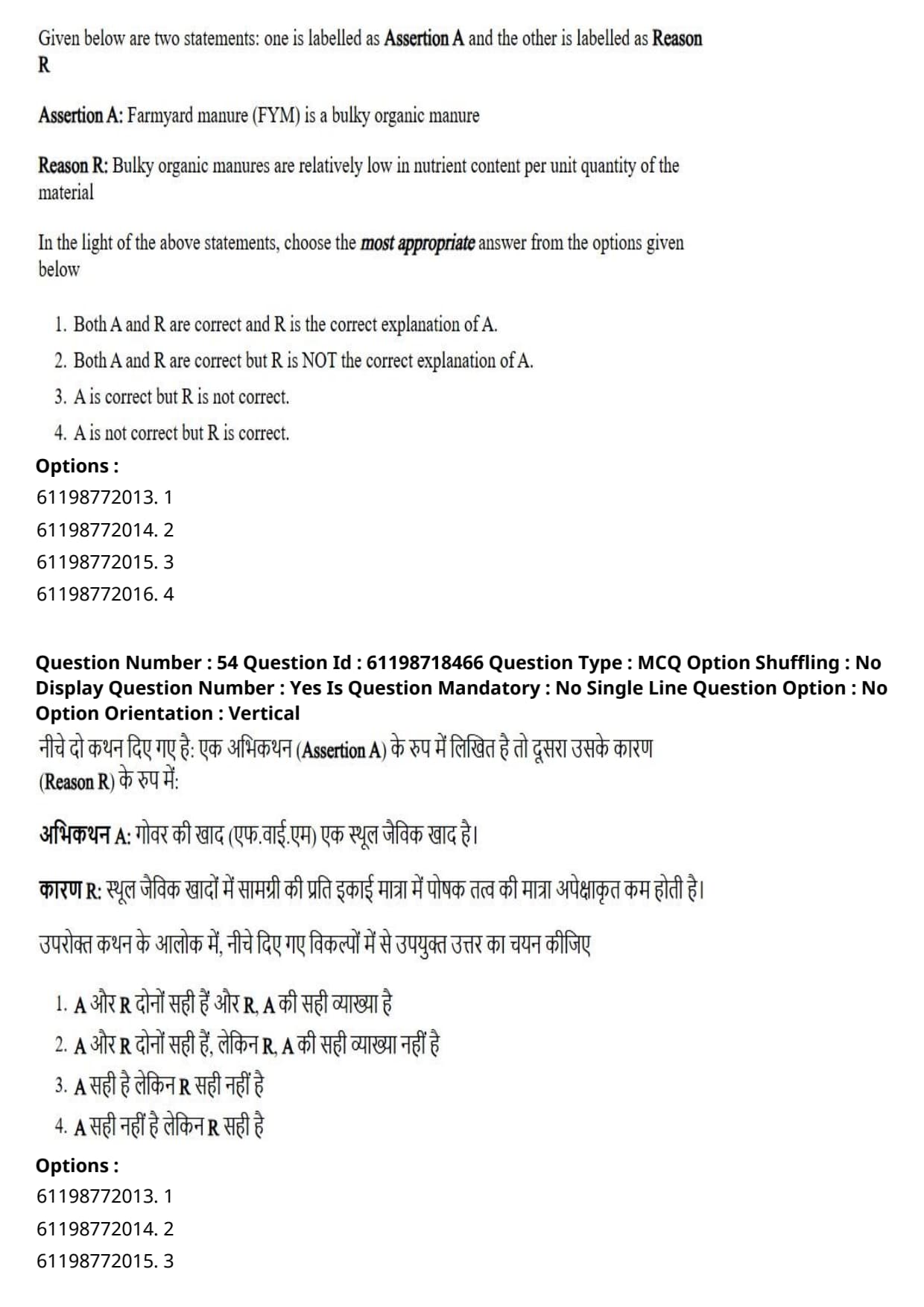
Given below are two statements:
Assertion (A): Farmyard manure (FYM) is a bulky organic manure.
Reason (R): Bulky organic manures are relatively low in nutrient content per unit quantity of the material.
View Solution
Concept:
Organic manures are broadly classified into bulky organic manures and concentrated organic manures.
Step 1: Check Assertion.
Farmyard manure contains decomposed mixture of dung, urine, litter, and leftover organic materials.
It is applied in large quantity because its nutrient content per unit weight is low.
\[ A is correct \]
Step 2: Check Reason.
Bulky organic manures are low in nutrient content per unit quantity and are applied in large amounts.
\[ R is correct \]
Step 3: Check explanation.
FYM is called bulky organic manure because it contains relatively low nutrient concentration and must be used in bulk quantity.
\[ R correctly explains A \]
\[ \therefore Correct Answer is (A) \] Quick Tip: FYM is a bulky organic manure because it has low nutrient content and is applied in large quantity.
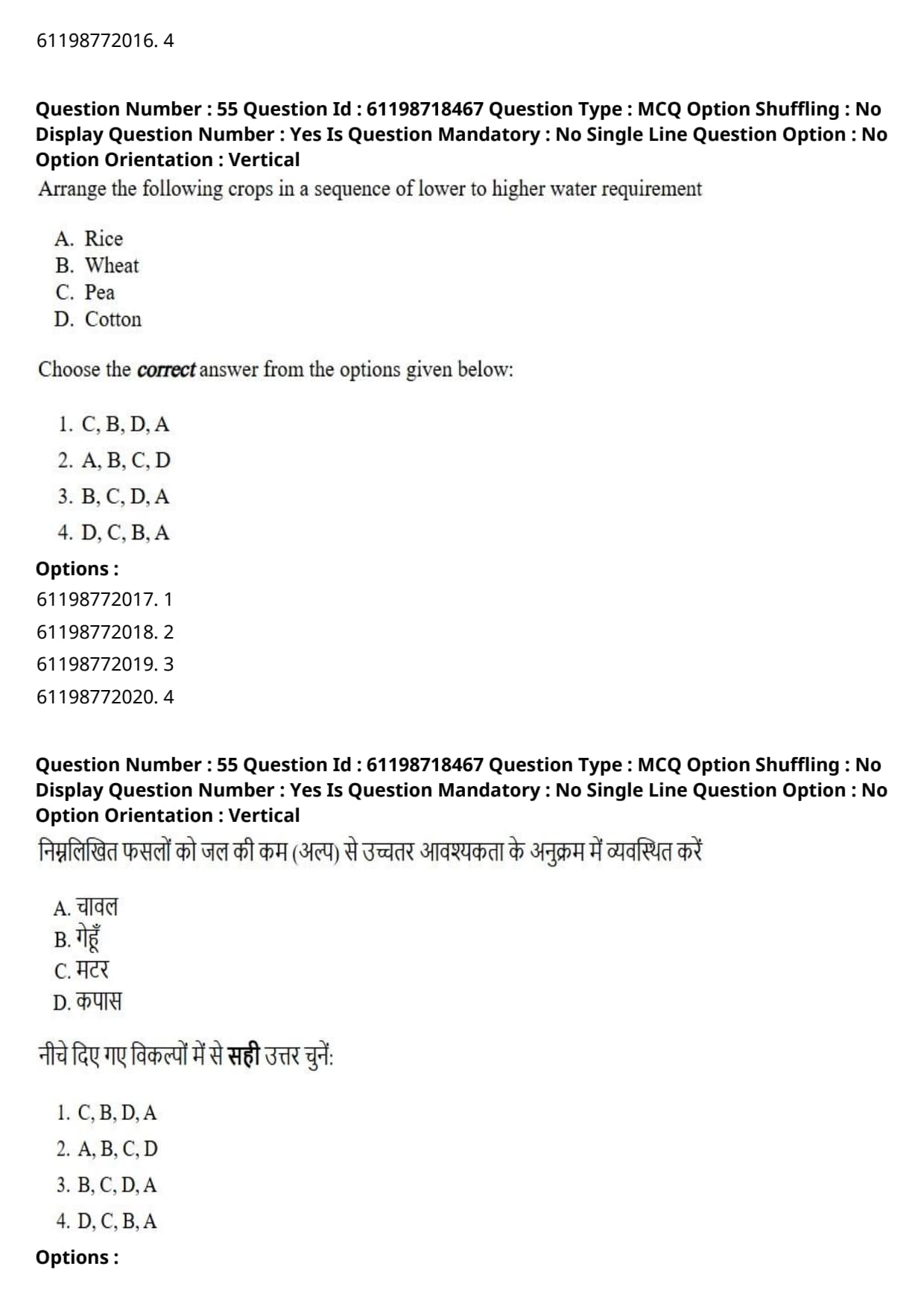
Arrange the following crops in a sequence of lower to higher water requirement:
A. Rice
B. Wheat
C. Pea
D. Cotton.
View Solution
Concept:
Different crops require different amounts of water depending on crop duration, growth habit, and physiological demand.
Step 1: Lowest water requirement.
Pea has comparatively lower water requirement among the given crops.
\[ Lowest=C \]
Step 2: Wheat.
Wheat requires more water than pea but less than cotton and rice.
\[ Next=B \]
Step 3: Cotton.
Cotton has higher water requirement than wheat.
\[ Next=D \]
Step 4: Highest water requirement.
Rice has the highest water requirement among the given crops.
\[ Highest=A \]
Thus, lower to higher water requirement is: \[ C,B,D,A \]
\[ \therefore Correct Answer is (A) \] Quick Tip: Rice generally has the highest water requirement among common field crops.
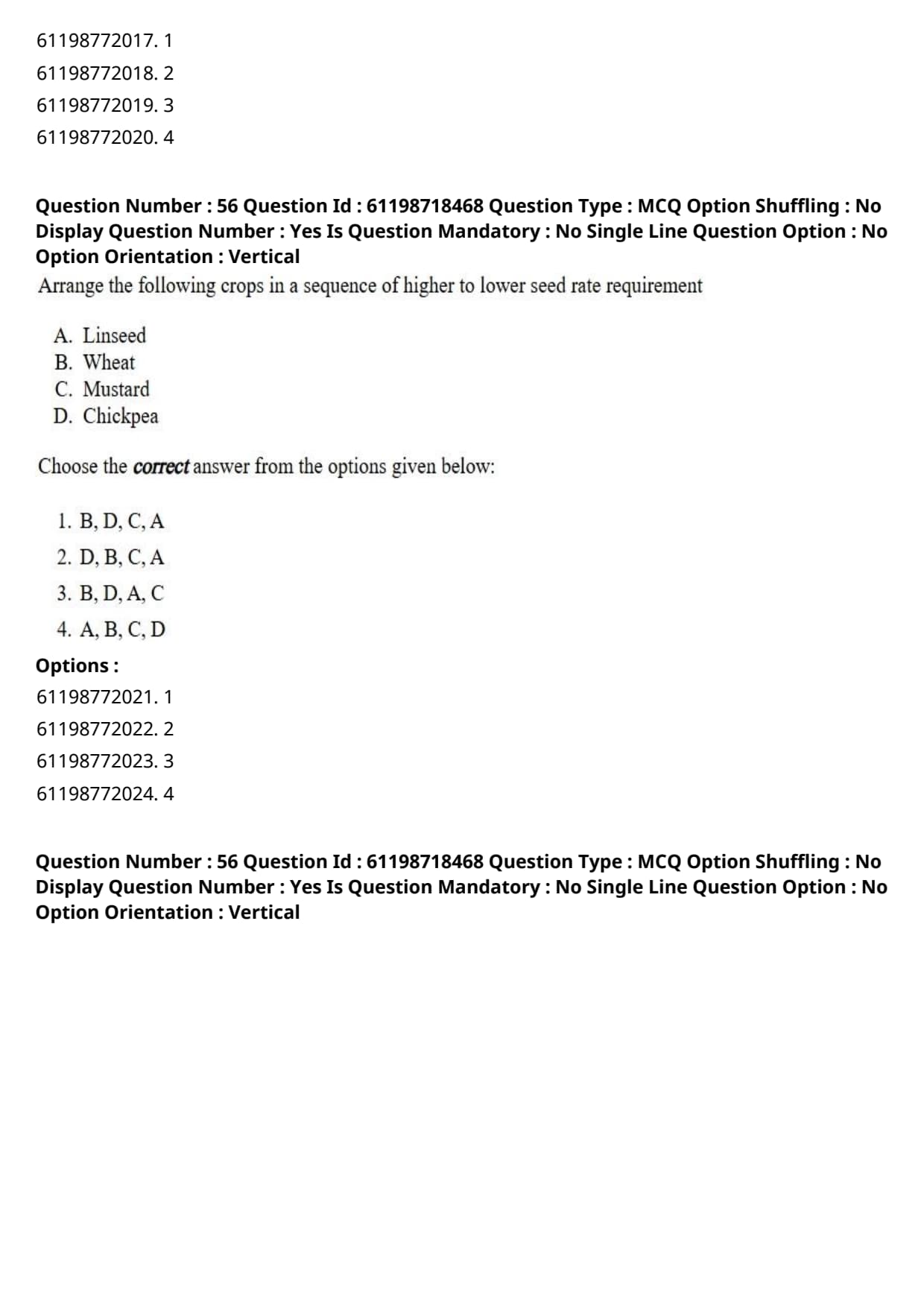
Arrange the following crops in a sequence of higher to lower seed rate requirement:
A. Linseed
B. Wheat
C. Mustard
D. Chickpea.
View Solution
Concept:
Seed rate depends on seed size, crop spacing, germination percentage, and plant population requirement.
Step 1: Highest seed rate.
Wheat generally requires the highest seed rate among the given crops.
\[ Highest=B \]
Step 2: Chickpea.
Chickpea seed rate is also high due to larger seed size.
\[ Next=D \]
Step 3: Linseed.
Linseed seed rate is lower than wheat and chickpea but higher than mustard.
\[ Next=A \]
Step 4: Mustard.
Mustard has small seeds and requires comparatively low seed rate.
\[ Lowest=C \]
Thus, higher to lower seed rate is: \[ B,D,A,C \]
\[ \therefore Correct Answer is (C) \] Quick Tip: Small seeded crops like mustard generally require lower seed rate, while wheat and chickpea require higher seed rate.
Post-emergence herbicides used for controlling broad-leaved weeds in wheat crop are
A. 2,4-D
B. Metsulfuron-methyl
C. Clodinafop-propargyl
D. Pendimethalin.
View Solution
Concept:
Post-emergence herbicides are applied after crop and weeds emerge. In wheat, broad-leaved weeds are controlled by specific herbicides.
Step 1: Check 2,4-D.
2,4-D is a post-emergence herbicide commonly used to control broad-leaved weeds in wheat.
\[ A is correct \]
Step 2: Check Metsulfuron-methyl.
Metsulfuron-methyl is also used as a post-emergence herbicide for broad-leaved weeds in wheat.
\[ B is correct \]
Step 3: Check Clodinafop-propargyl.
Clodinafop-propargyl is mainly used to control grassy weeds, not broad-leaved weeds.
\[ C is incorrect \]
Step 4: Check Pendimethalin.
Pendimethalin is generally used as a pre-emergence herbicide.
\[ D is incorrect \]
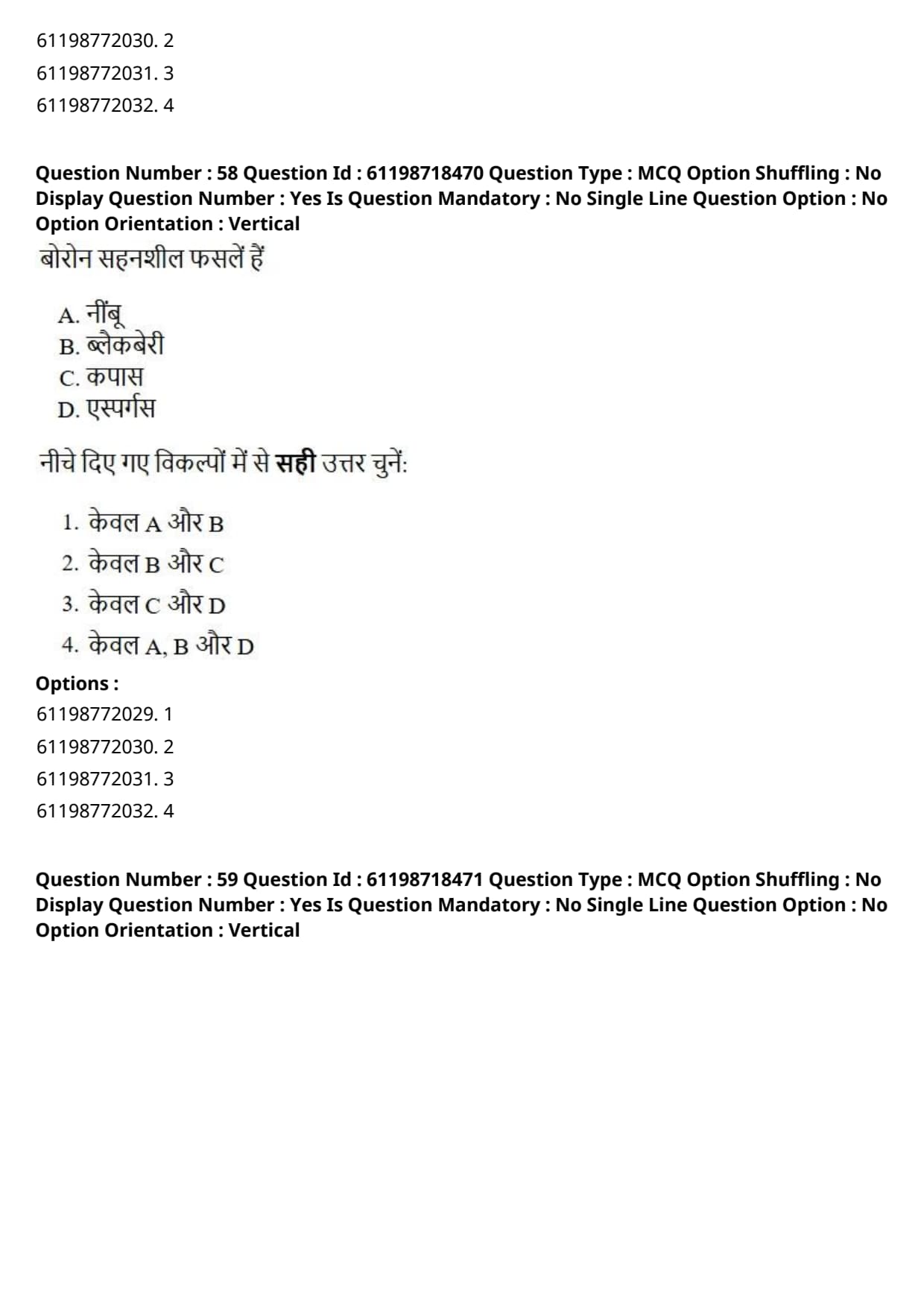
\[ \therefore Correct Answer is (B) \] Quick Tip: For broad-leaved weeds in wheat, remember 2,4-D and Metsulfuron-methyl.
Boron tolerance crops are
A. Lemon
B. Blackberry
C. Cotton
D. Asparagus.
View Solution
Concept:
Different crops differ in their tolerance to boron concentration in soil or irrigation water. Some crops are sensitive, while some crops are more tolerant.
Step 1: Sensitive crops.
Lemon and blackberry are relatively sensitive to boron.
\[ A and B are not tolerant \]
Step 2: Tolerant crops.
Cotton is relatively tolerant to boron. Asparagus is also considered boron tolerant.
\[ C and D are tolerant \]
Thus, boron tolerant crops among the given options are: \[ C and D \]
\[ \therefore Correct Answer is (C) \] Quick Tip: Cotton and asparagus are comparatively boron tolerant crops.
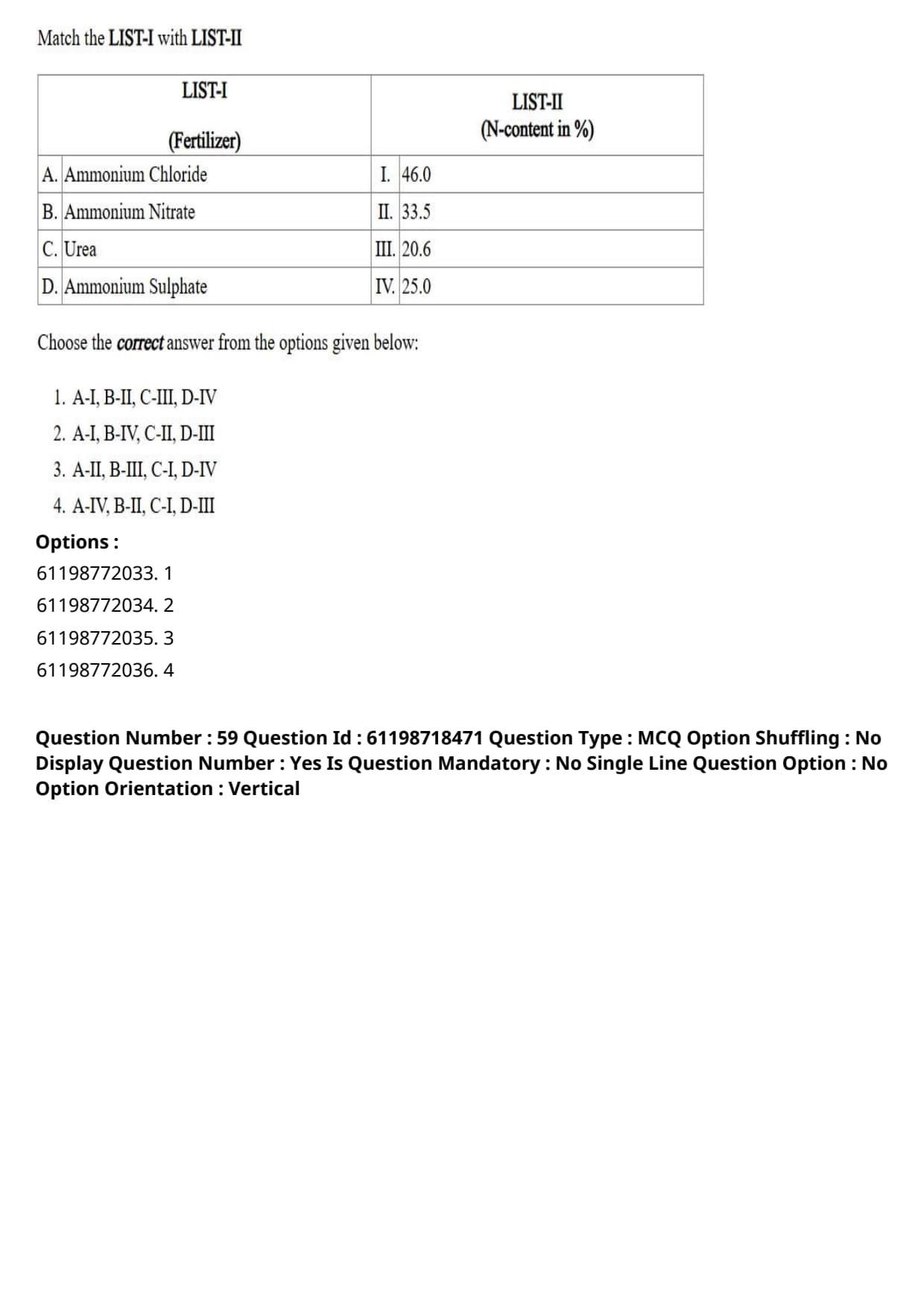
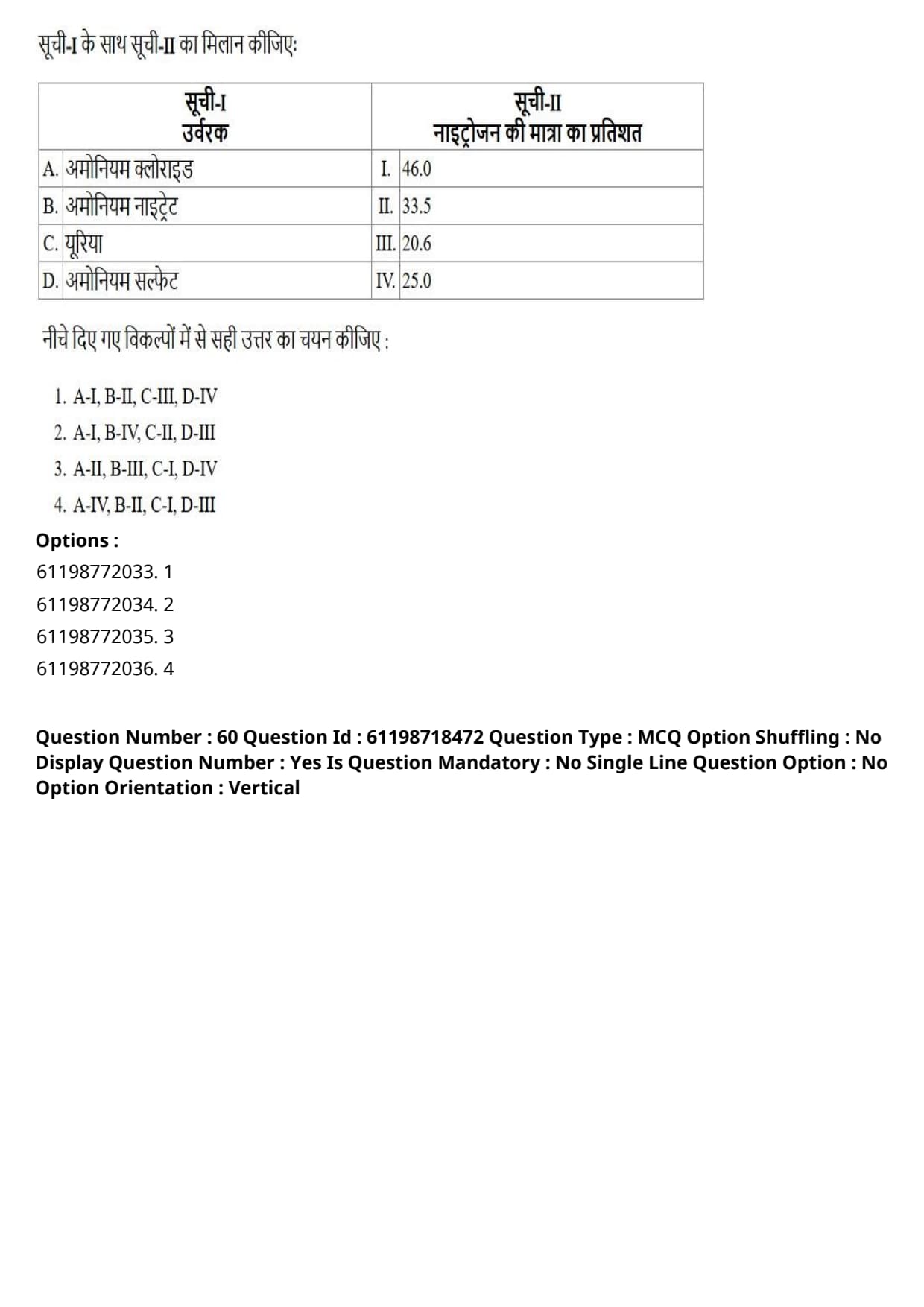
Match the LIST-I with LIST-II.

View Solution
Concept:
Nitrogenous fertilizers contain different percentages of nitrogen.
Step 1: Ammonium Chloride.
Ammonium chloride contains about: \[ 25.0% nitrogen \]
So, \[ A\rightarrow IV \]
Step 2: Ammonium Nitrate.
Ammonium nitrate contains about: \[ 33.5% nitrogen \]
So, \[ B\rightarrow II \]
Step 3: Urea.
Urea contains about: \[ 46.0% nitrogen \]
So, \[ C\rightarrow I \]
Step 4: Ammonium Sulphate.
Ammonium sulphate contains about: \[ 20.6% nitrogen \]
So, \[ D\rightarrow III \]
Therefore: \[ A-IV,\ B-II,\ C-I,\ D-III \]
\[ \therefore Correct Answer is (D) \] Quick Tip: Urea has the highest nitrogen content among common solid nitrogenous fertilizers, about \(46%\).
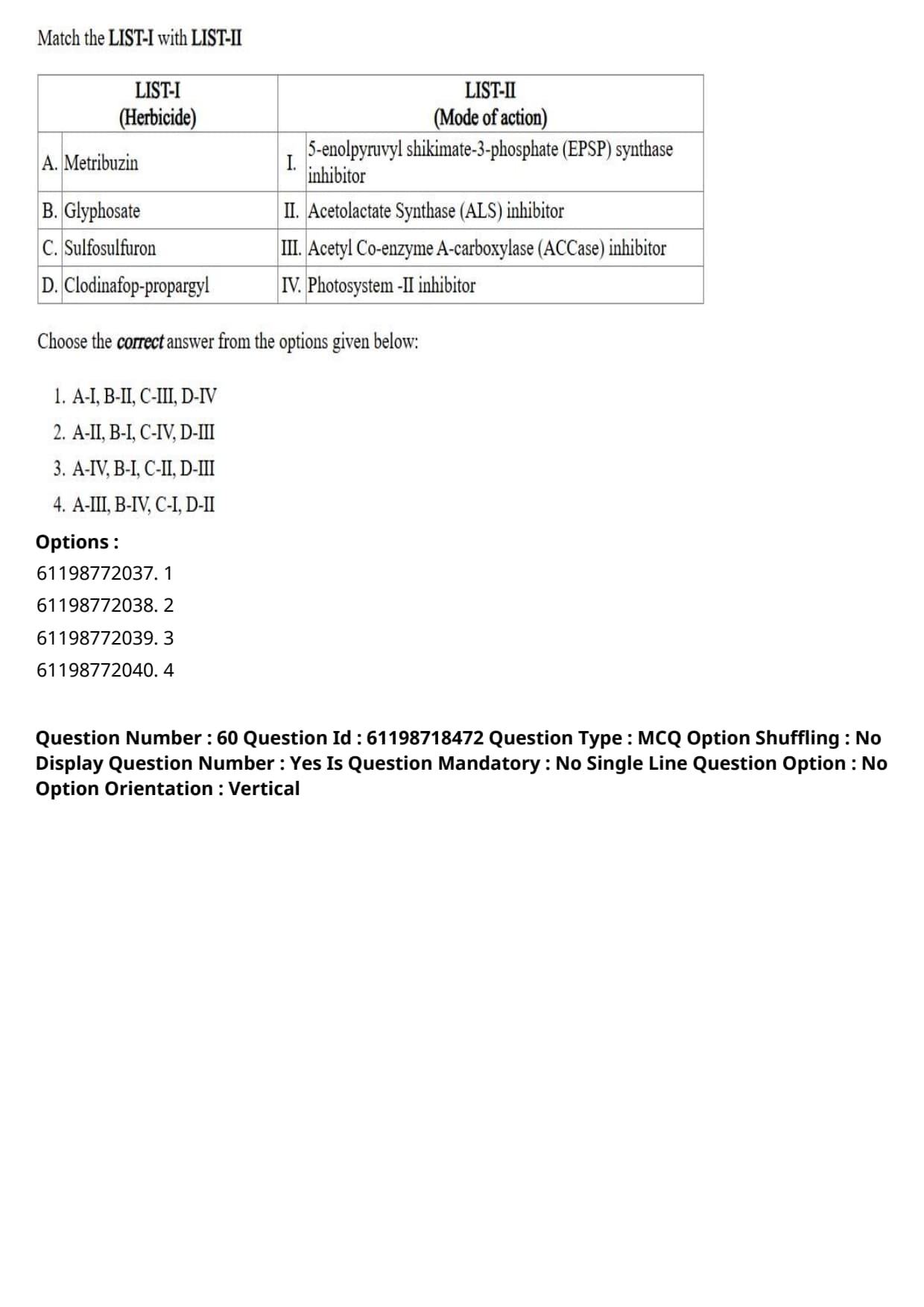
Match the LIST-I with LIST-II.

View Solution
Concept:
Herbicides are classified according to their mode of action. Different herbicides inhibit different biochemical pathways in weeds.
Step 1: Metribuzin.
Metribuzin inhibits photosystem-II.
\[ A\rightarrow IV \]
Step 2: Glyphosate.
Glyphosate inhibits EPSP synthase enzyme.
\[ B\rightarrow I \]
Step 3: Sulfosulfuron.
Sulfosulfuron is an ALS inhibitor.
\[ C\rightarrow II \]
Step 4: Clodinafop-propargyl.
Clodinafop-propargyl is an ACCase inhibitor.
\[ D\rightarrow III \]
Therefore: \[ A-IV,\ B-I,\ C-II,\ D-III \]
\[ \therefore Correct Answer is (C) \] Quick Tip: Glyphosate inhibits EPSP synthase, sulfosulfuron inhibits ALS, and clodinafop-propargyl inhibits ACCase.
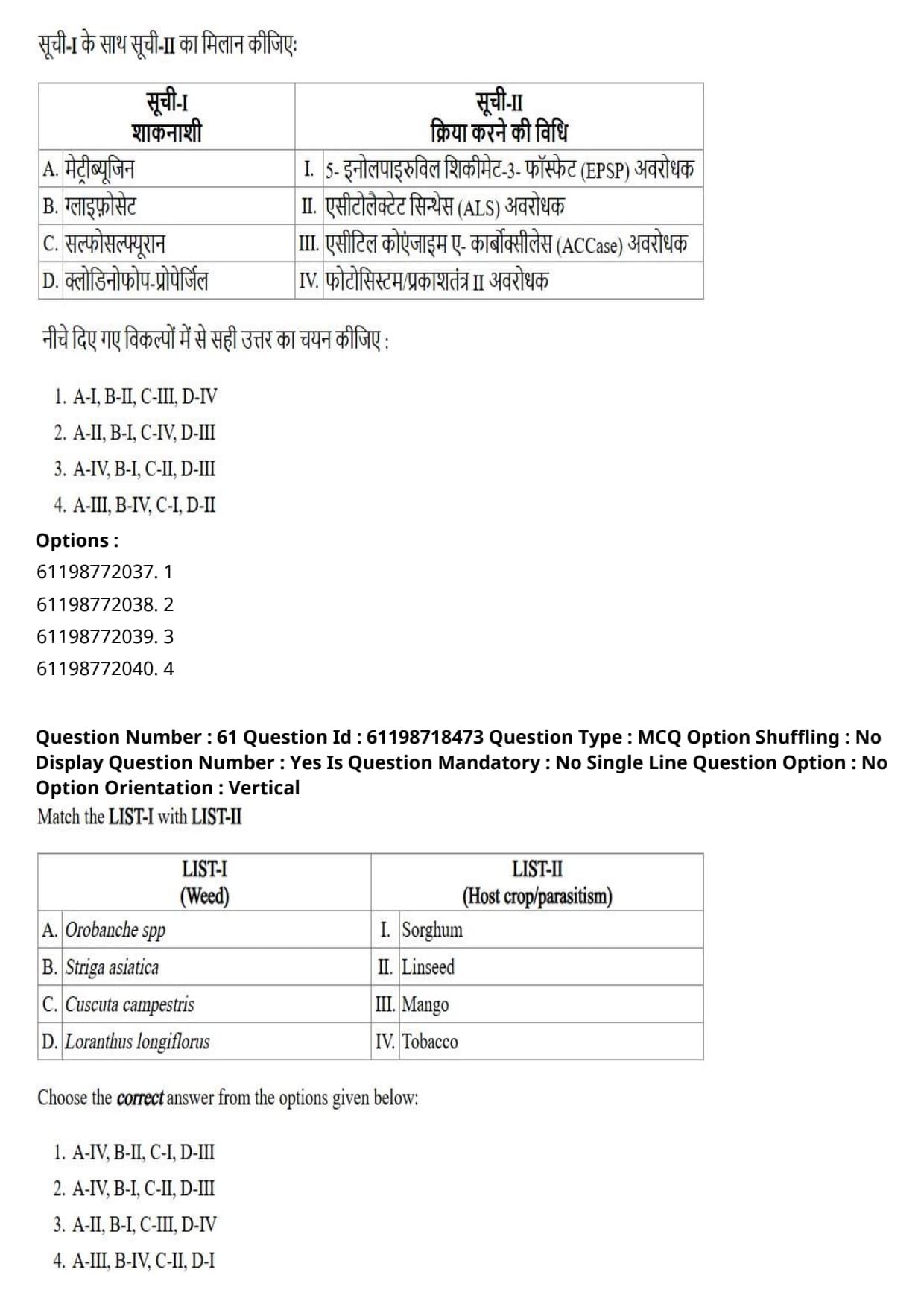
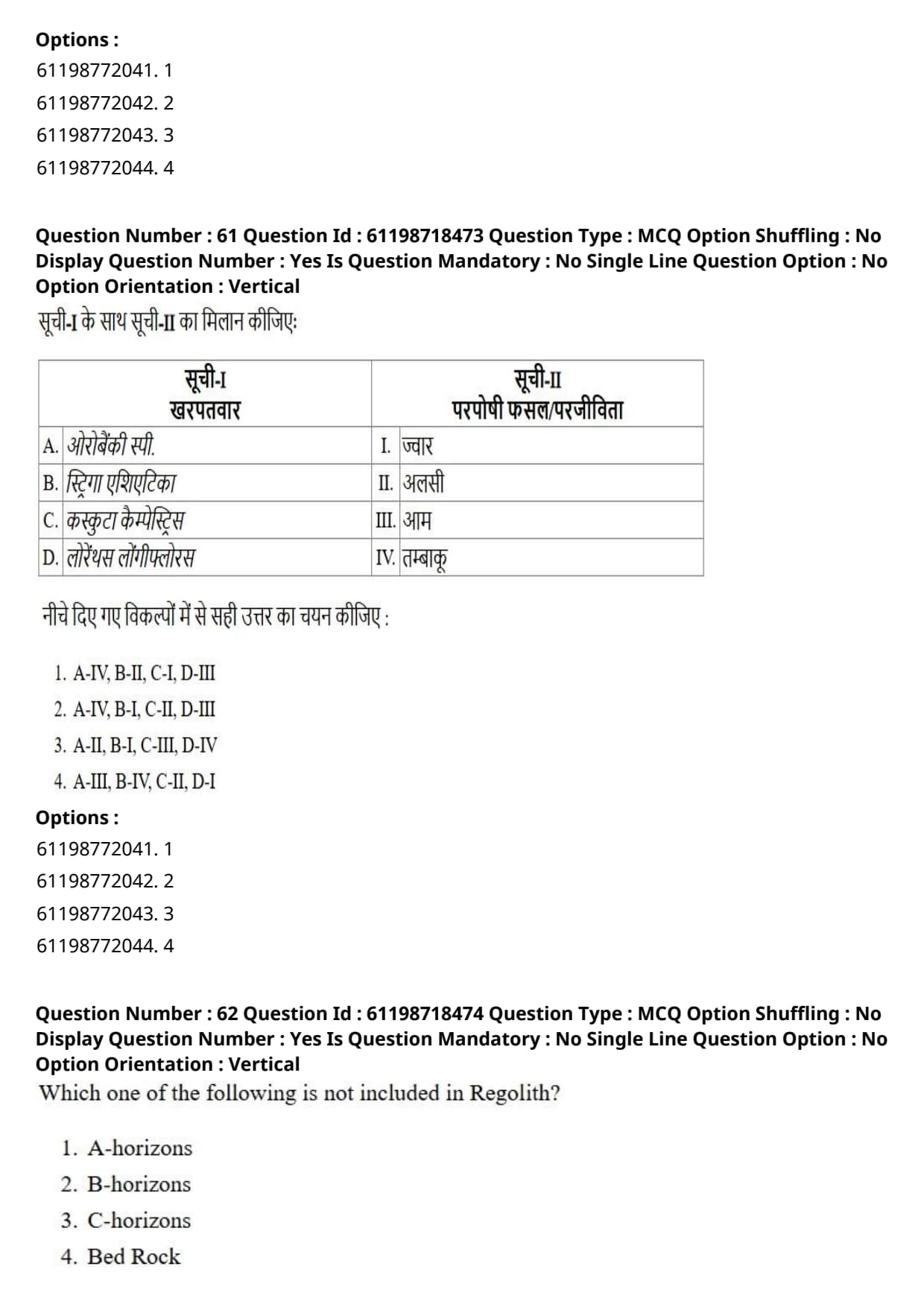
Match LIST-I with LIST-II.

View Solution
Concept:
Parasitic weeds depend on host plants for nutrition. Different parasitic weeds are commonly associated with specific host crops.
Step 1: Match Orobanche spp.
Orobanche is a root parasitic weed commonly associated with tobacco.
\[ A \rightarrow IV \]
Step 2: Match \textit{Striga asiatica.
Striga asiatica is a serious parasitic weed of cereals, especially jowar.
\[ B \rightarrow I \]
Step 3: Match \textit{Cuscuta campestris.
Cuscuta campestris is a stem parasite and is associated with crops like alsi.
\[ C \rightarrow II \]
Step 4: Match \textit{Loranthus longiflorus.
Loranthus longiflorus is a parasitic plant commonly found on mango.
\[ D \rightarrow III \]
Therefore, the correct matching is: \[ A-IV,\ B-I,\ C-II,\ D-III \]
\[ \therefore Correct Answer is (B) \] Quick Tip: Remember: \textit{Orobanche is associated with tobacco, Striga with jowar, and Loranthus with mango.
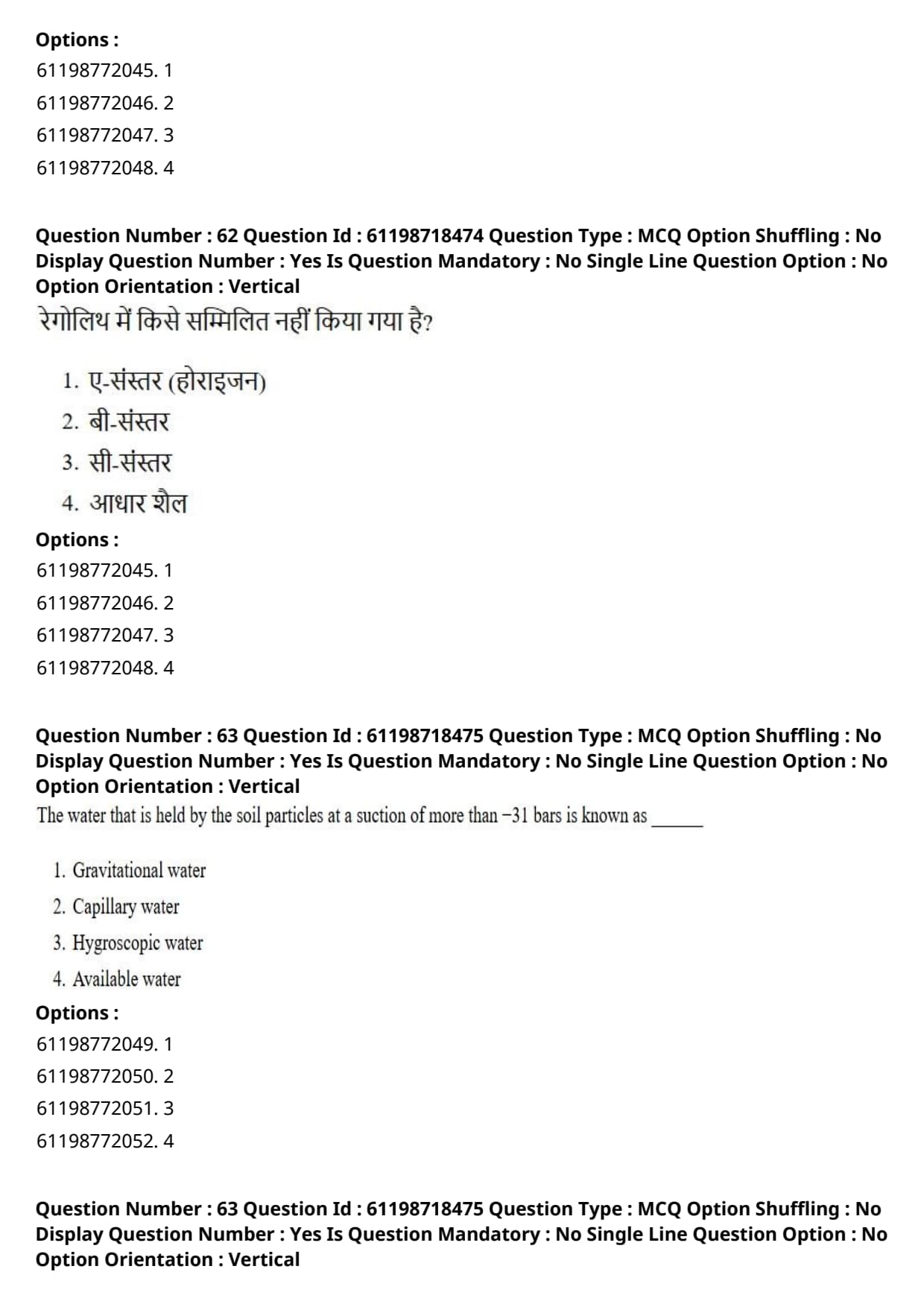
Which one of the following is not included in Regolith?
View Solution
Concept:
Regolith is the unconsolidated material lying above the hard bedrock. It includes soil horizons and weathered parent material.
Step 1: Understand regolith.
Regolith includes loose and weathered material present above solid rock.
Step 2: Check A-horizon.
A-horizon is the top mineral soil layer and is part of regolith.
\[ A is included \]
Step 3: Check B-horizon.
B-horizon is the subsoil zone and is also included in regolith.
\[ B is included \]
Step 4: Check C-horizon.
C-horizon is weathered parent material and is included in regolith.
\[ C is included \]
Step 5: Check bed rock.
Bed rock is the hard solid rock below regolith. It is not considered a part of regolith.
\[ D is not included \]
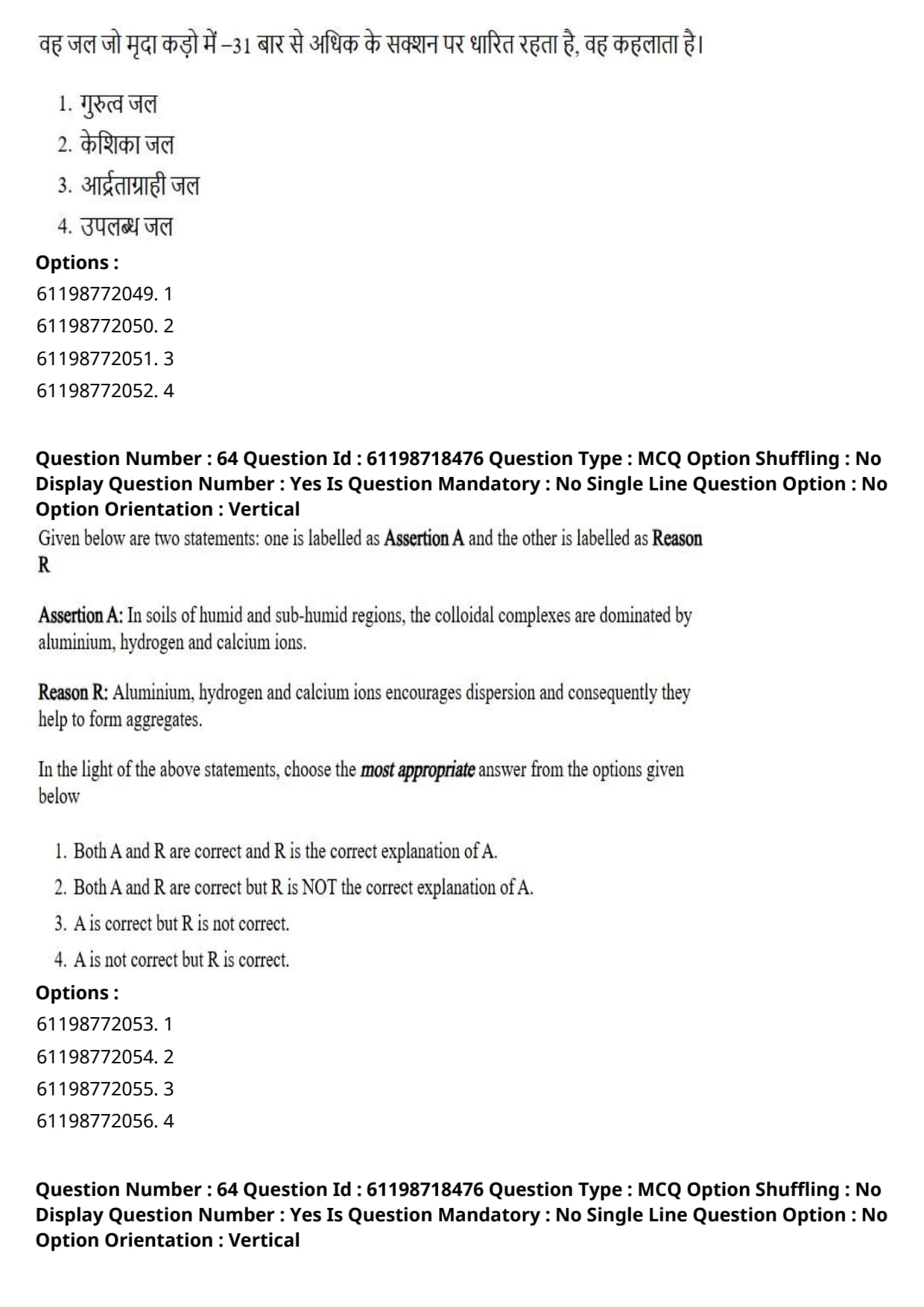
\[ \therefore Correct Answer is (D) \] Quick Tip: Regolith includes soil horizons and weathered material above bedrock. Bedrock itself is not included in regolith.
The water that is held by the soil particles at a suction of more than \(-31\) bars is known as
View Solution
Concept:
Soil water is classified on the basis of the force with which it is held by soil particles. The stronger the suction, the less available the water is to plants.
Step 1: Understand gravitational water.
Gravitational water moves downward through soil pores due to gravity and is generally not held strongly by soil particles.
Step 2: Understand capillary water.
Capillary water is held in small soil pores and is generally available to plants.
Step 3: Understand hygroscopic water.
Hygroscopic water is held very tightly on the surface of soil particles. It is held at very high suction and is not available to plants.
Step 4: Apply the given condition.
The question says water is held at suction of more than: \[ -31 bars \]
Such strongly held water is: \[ Hygroscopic water \]
\[ \therefore Correct Answer is (C) \] Quick Tip: Hygroscopic water is strongly held by soil particles and is not available to plants.
Given below are two statements:
Assertion (A): In soils of humid and sub-humid regions, the colloidal complexes are dominated by aluminium, hydrogen and calcium ions.
Reason (R): Aluminium, hydrogen and calcium ions encourage dispersion and consequently they help to form aggregates.
View Solution
Concept:
Soil colloids carry charges and adsorb cations. The dominant cations depend on soil climate, leaching and soil reaction.
Step 1: Check Assertion (A).
In humid and sub-humid regions, leaching is high. Basic cations may be removed and acidic cations like hydrogen and aluminium become important on exchange complexes.
\[ A is correct \]
Step 2: Check Reason (R).
The reason says aluminium, hydrogen and calcium encourage dispersion and help to form aggregates.
This statement is not fully correct. Calcium generally promotes flocculation and aggregation, while dispersion is more commonly associated with sodium-dominated soils.
\[ R is not correct \]
Step 3: Final conclusion.
Assertion is correct, but the reason given is incorrect.
\[ \therefore Correct Answer is (C) \] Quick Tip: Calcium generally improves soil aggregation, while sodium causes dispersion.
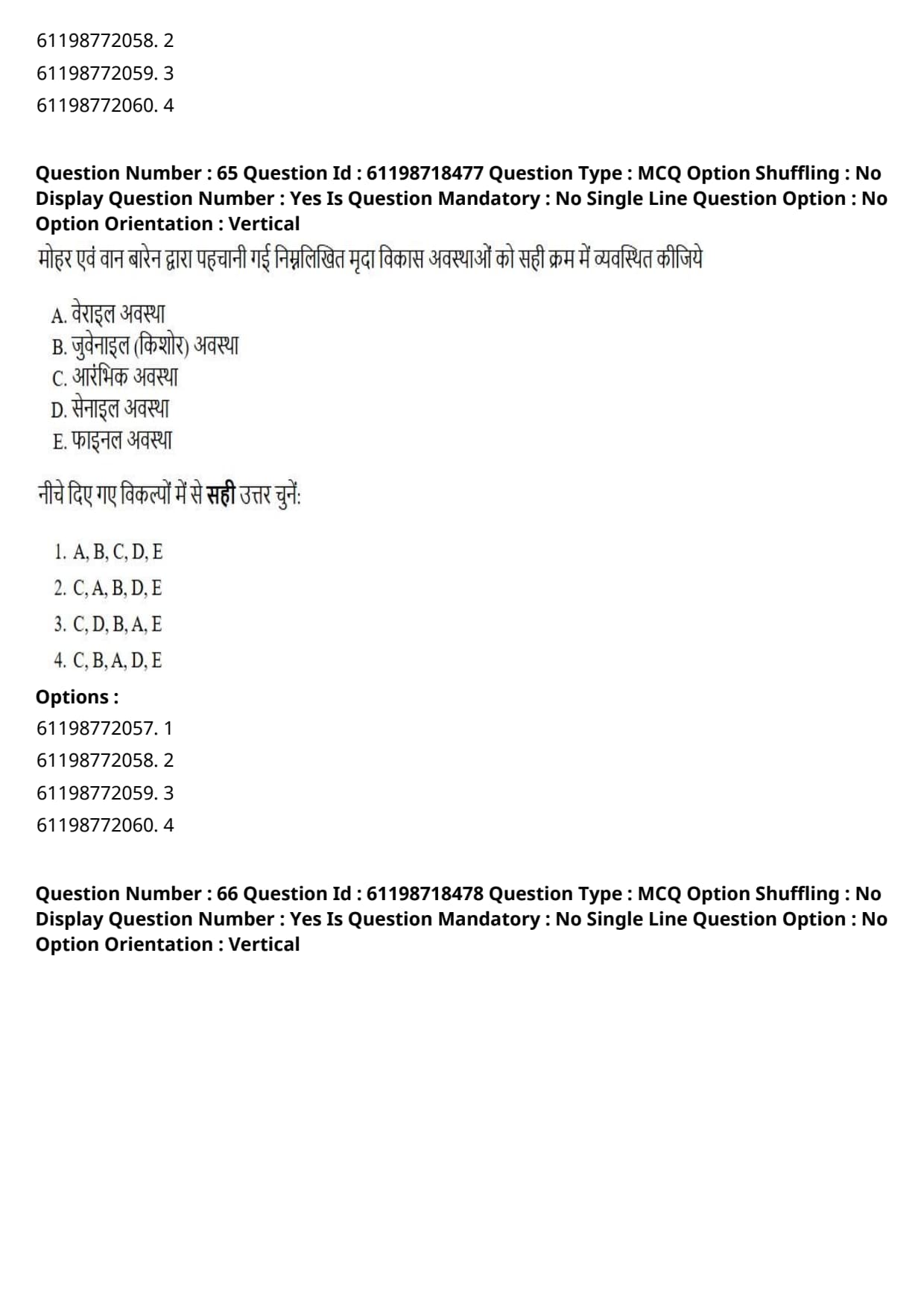
Arrange the Mohr and Van Baren recognized stages of soil development in correct order.
A. Virile
B. Juvenile stage
C. Initial stage
D. Senile
E. Final.
View Solution
Concept:
Mohr and Van Baren classified soil development into stages based on the degree of weathering and profile development.
Step 1: Initial stage.
Soil development begins with the initial stage, where weathering has just started.
\[ First step=C \]
Step 2: Juvenile stage.
In the juvenile stage, soil formation progresses but the profile is still immature.
\[ Second step=B \]
Step 3: Virile stage.
In the virile stage, soil development becomes mature and active.
\[ Third step=A \]
Step 4: Senile stage.
In the senile stage, the soil becomes highly weathered and old.
\[ Fourth step=D \]
Step 5: Final stage.
The last stage is the final stage.
\[ Fifth step=E \]
Thus, the correct order is: \[ C,B,A,D,E \]
\[ \therefore Correct Answer is (D) \] Quick Tip: Soil development sequence is Initial \(\rightarrow\) Juvenile \(\rightarrow\) Virile \(\rightarrow\) Senile \(\rightarrow\) Final.
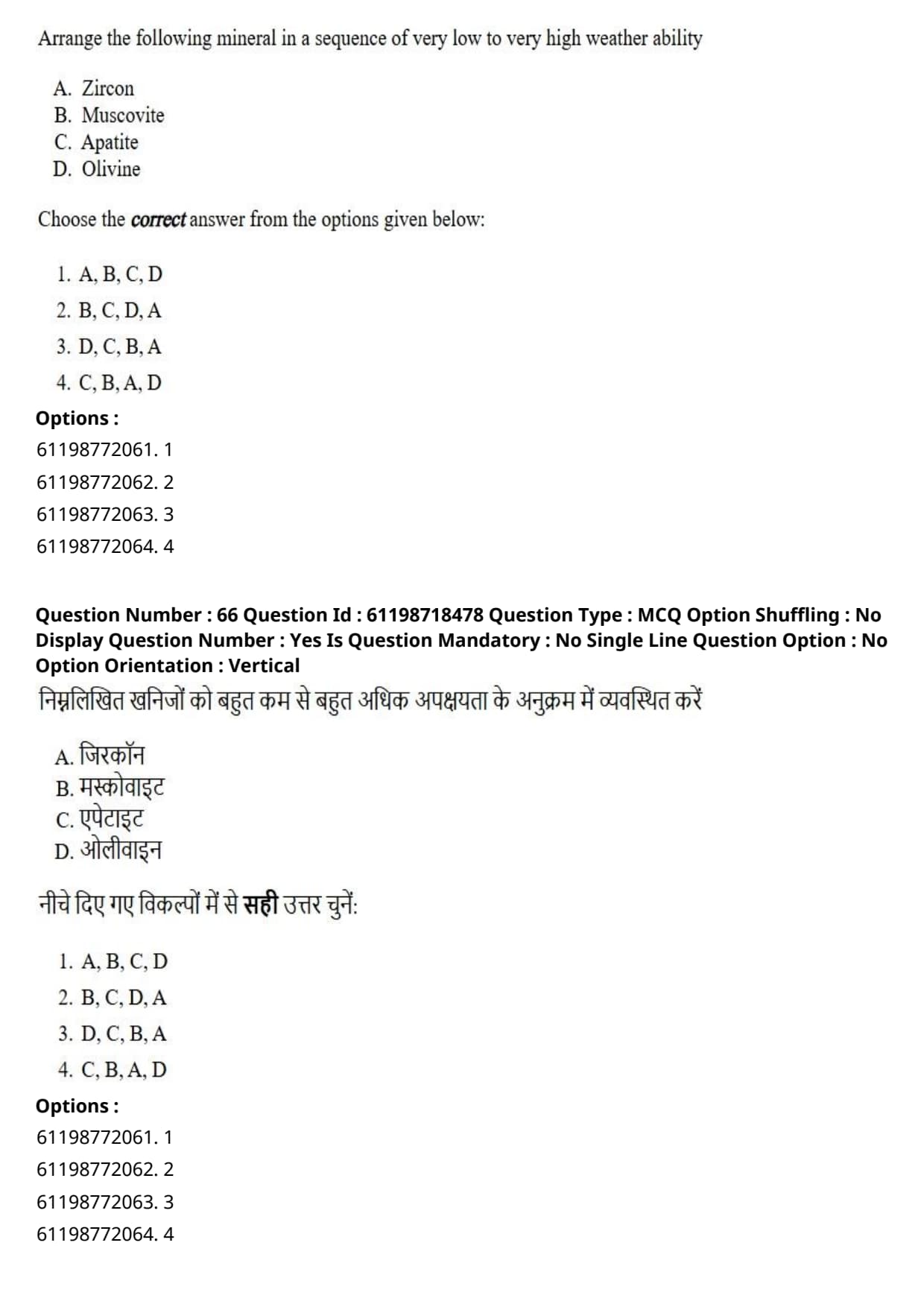
Arrange the following minerals in a sequence of very low to very high weatherability.
A. Zircon
B. Muscovite
C. Apatite
D. Olivine.
View Solution
Concept:
Minerals differ in their resistance to weathering. Stable minerals weather slowly, while unstable minerals weather rapidly.
Step 1: Very low weatherability.
Zircon is highly resistant to weathering. Hence, it has very low weatherability.
\[ Very low=A \]
Step 2: Low to moderate weatherability.
Muscovite is more weatherable than zircon but less weatherable than apatite and olivine.
\[ Next=B \]
Step 3: Higher weatherability.
Apatite is more easily weathered than muscovite.
\[ Next=C \]
Step 4: Very high weatherability.
Olivine is highly susceptible to weathering.
\[ Very high=D \]
Therefore, the correct order is: \[ A,B,C,D \]
\[ \therefore Correct Answer is (A) \] Quick Tip: Zircon is highly resistant to weathering, while olivine weathers very easily.
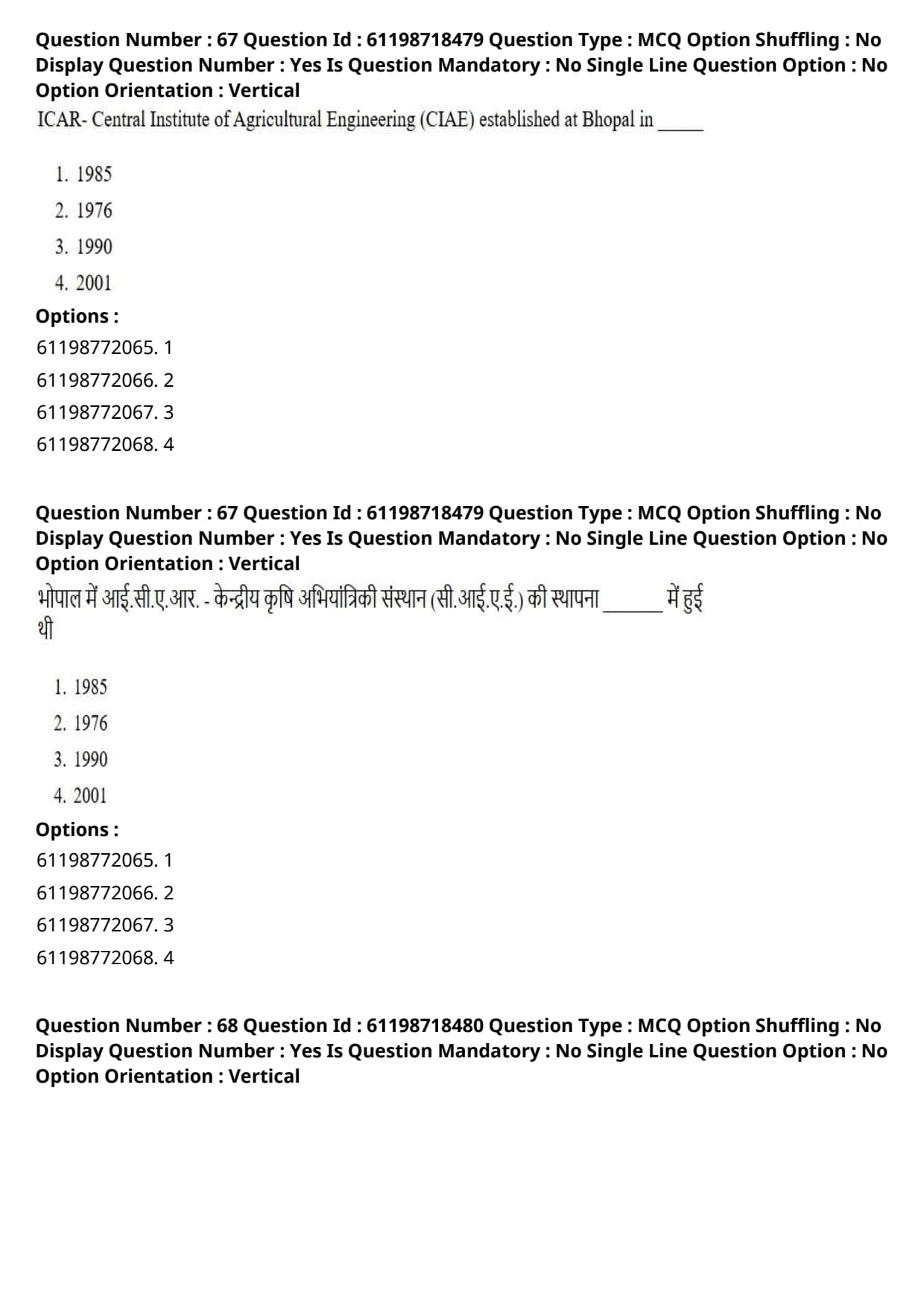
ICAR-Central Institute of Agricultural Engineering (CIAE) was established at Bhopal in
View Solution
Concept:
ICAR institutes are established for research and development in specialized areas of agriculture.
Step 1: Identify the institute.
The institute mentioned is: \[ ICAR-Central Institute of Agricultural Engineering \]
Step 2: Identify its location.
It is located at: \[ Bhopal \]
Step 3: Identify the establishment year.
ICAR-CIAE was established in: \[ 1976 \]
\[ \therefore Correct Answer is (B) \] Quick Tip: ICAR-Central Institute of Agricultural Engineering is located at Bhopal and was established in 1976.
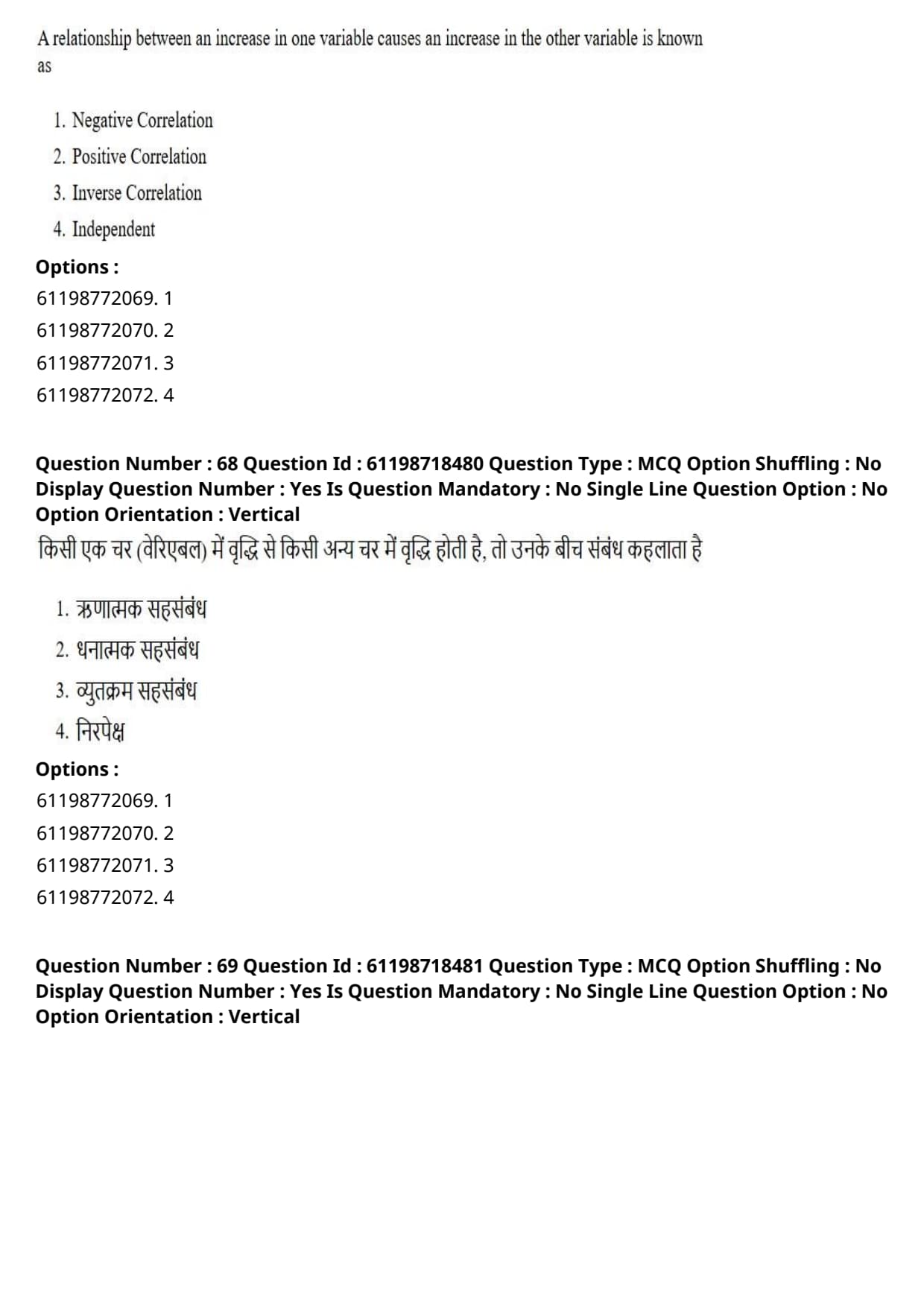
A relationship between an increase in one variable causes an increase in the other variable is known as
View Solution
Concept:
Correlation shows the relationship between two variables. It tells whether both variables move in the same direction or opposite direction.
Step 1: Understand positive correlation.
If one variable increases and the other variable also increases, the relationship is called positive correlation.
\[ X \uparrow \Rightarrow Y \uparrow \]
Step 2: Understand negative correlation.
If one variable increases and the other decreases, the relationship is called negative correlation.
\[ X \uparrow \Rightarrow Y \downarrow \]
Step 3: Apply the condition.
The question says increase in one variable causes increase in another variable.
Therefore, the relationship is: \[ Positive correlation \]
\[ \therefore Correct Answer is (B) \] Quick Tip: If both variables move in the same direction, the correlation is positive.
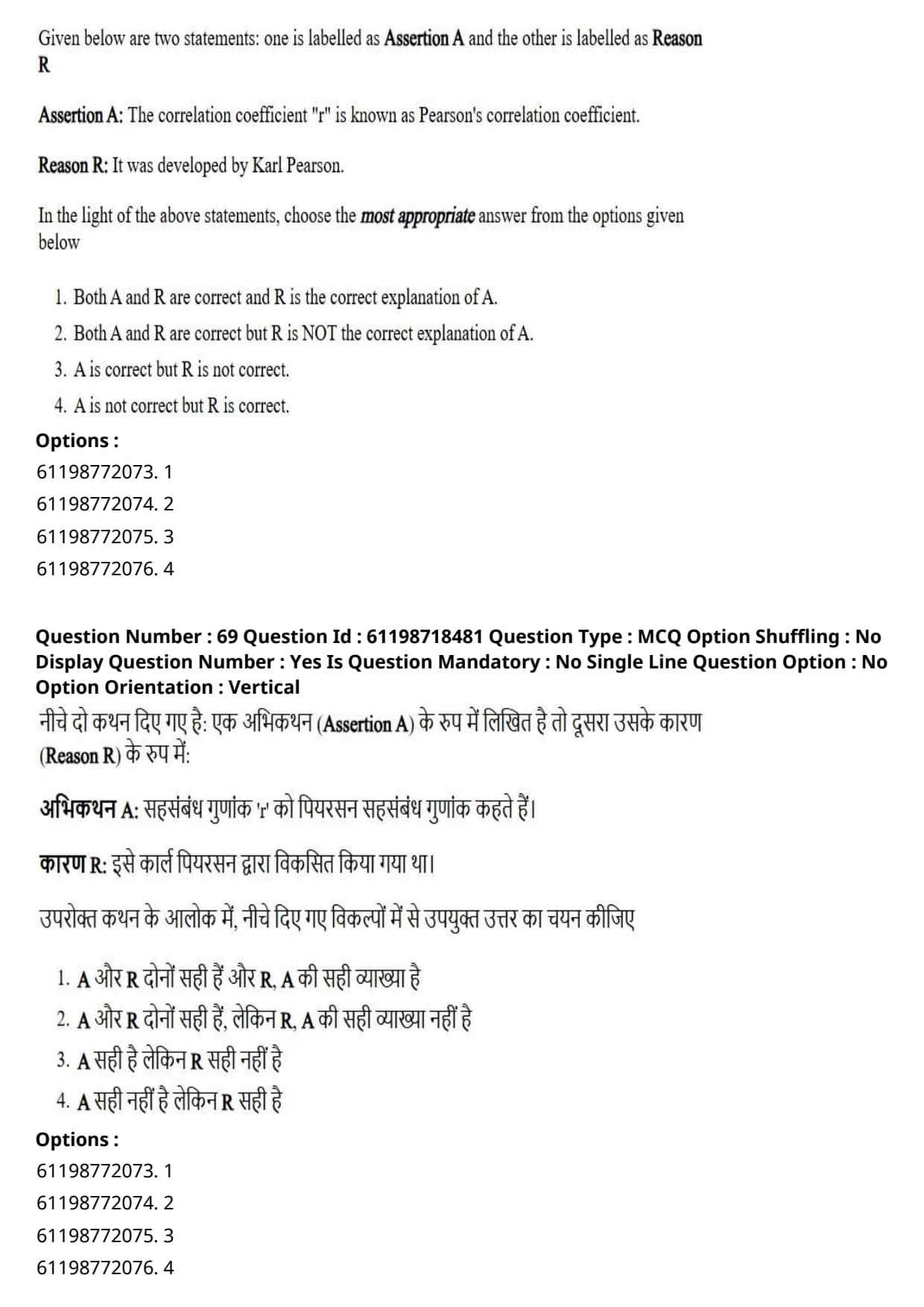
Given below are two statements:
Assertion (A): The correlation coefficient \(r\) is known as Pearson's correlation coefficient.
Reason (R): It was developed by Karl Pearson.
View Solution
Concept:
Pearson's correlation coefficient is a statistical measure used to determine the strength and direction of linear relationship between two variables.
Step 1: Check Assertion (A).
The correlation coefficient \(r\) commonly represents Pearson's correlation coefficient.
\[ A is correct \]
Step 2: Check Reason (R).
Pearson's correlation coefficient was developed by Karl Pearson.
\[ R is correct \]
Step 3: Check explanation.
Since the coefficient was developed by Karl Pearson, it is known as Pearson's correlation coefficient.
\[ R correctly explains A \]
\[ \therefore Correct Answer is (A) \] Quick Tip: Pearson's correlation coefficient is denoted by \(r\) and measures linear correlation between two variables.
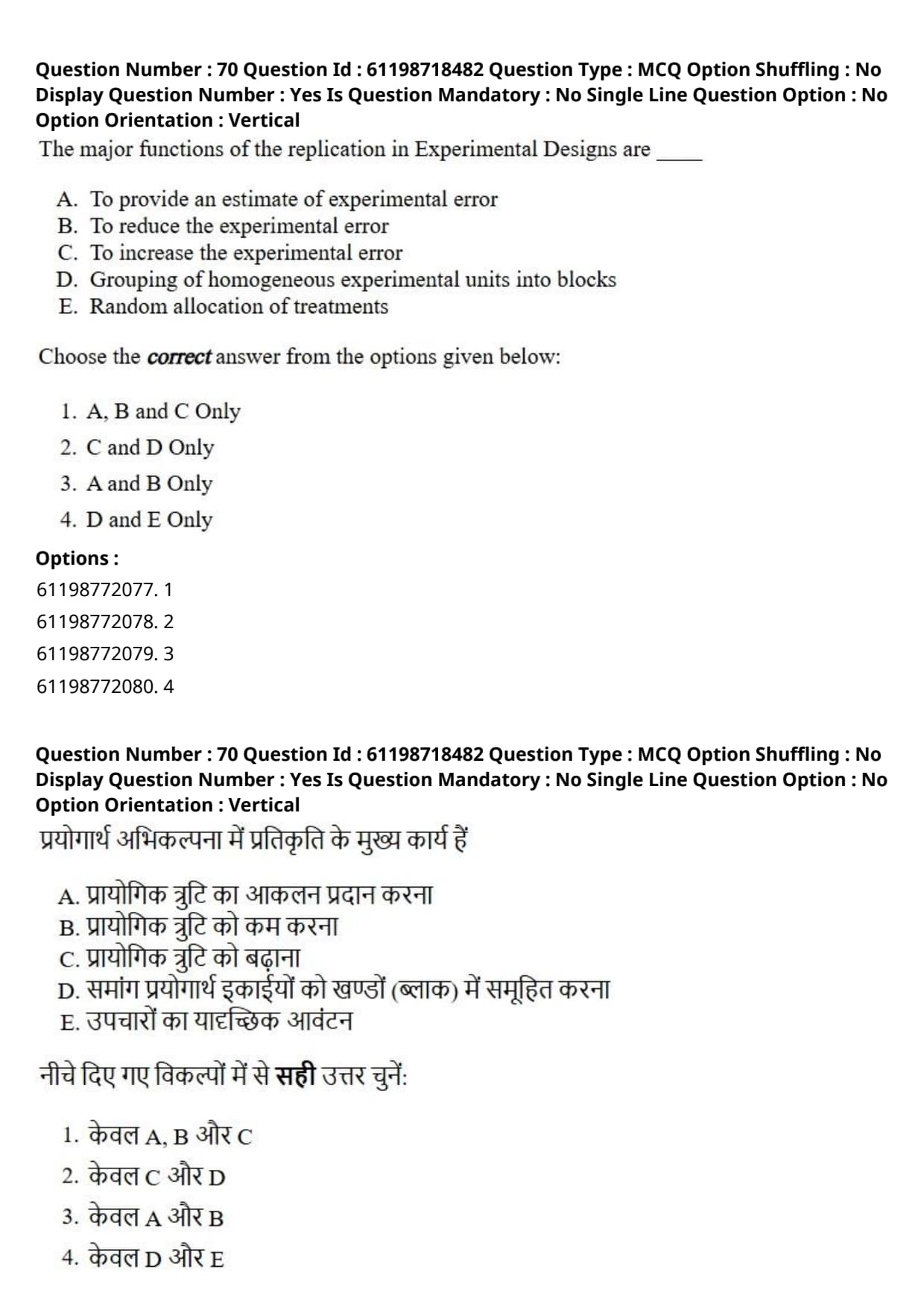
The major functions of replication in Experimental Designs are
A. To provide an estimate of experimental error
B. To reduce the experimental error
C. To increase the experimental error
D. Grouping of homogeneous experimental units into blocks
E. Random allocation of treatments.
View Solution
Concept:
Replication is one of the basic principles of experimental design. It means repeating the treatments more than once.
Step 1: Check statement A.
Replication helps in estimating experimental error.
\[ A is correct \]
Step 2: Check statement B.
Replication reduces the effect of random variation and helps reduce experimental error.
\[ B is correct \]
Step 3: Check statement C.
Replication does not increase experimental error. It helps in reducing and estimating error.
\[ C is incorrect \]
Step 4: Check statements D and E.
Grouping homogeneous experimental units into blocks is the function of local control or blocking. Random allocation of treatments is related to randomization.
\[ D and E are not functions of replication \]
Thus, the correct statements are: \[ A and B \]
\[ \therefore Correct Answer is (C) \] Quick Tip: The three basic principles of experimental design are replication, randomization, and local control.
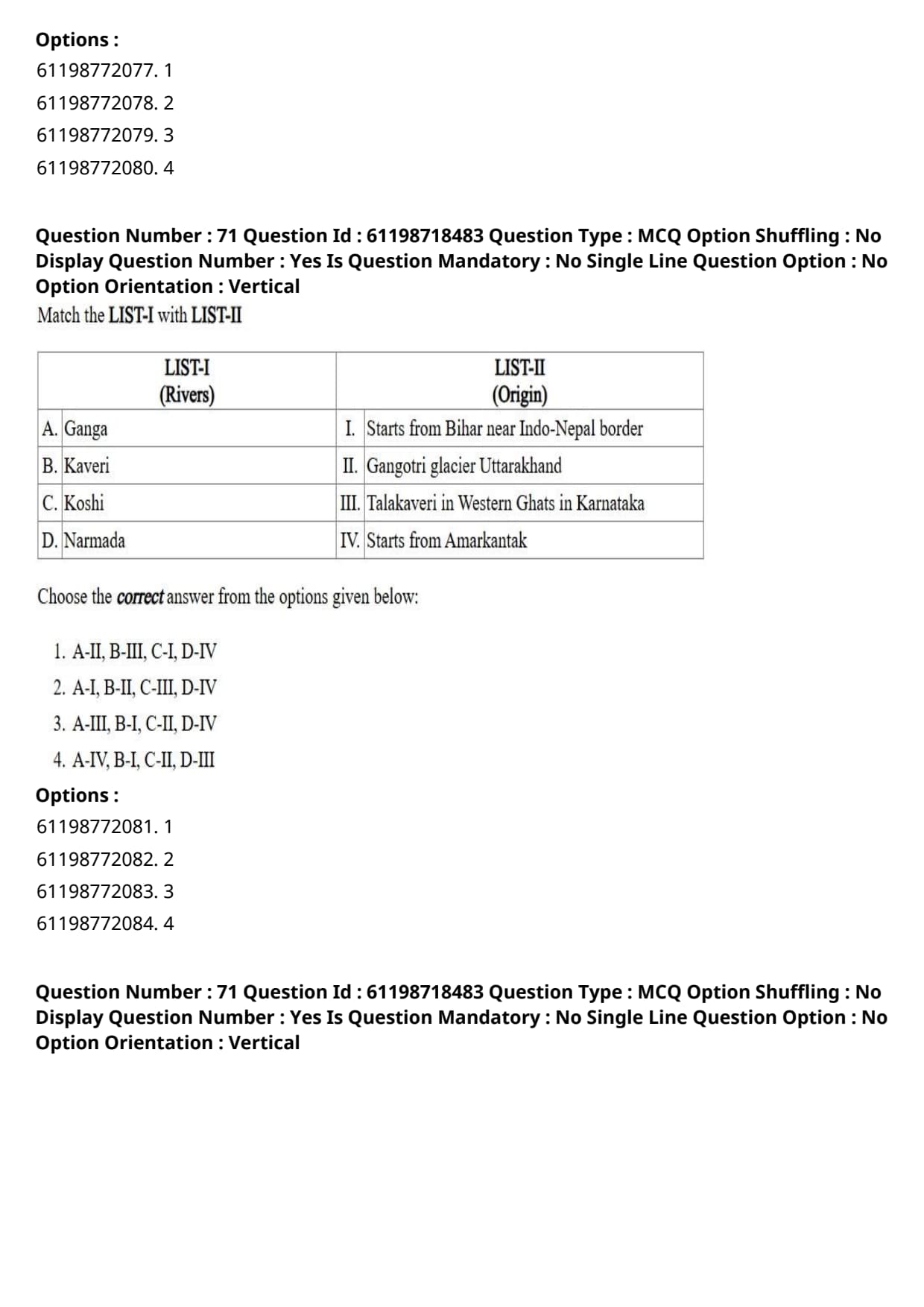
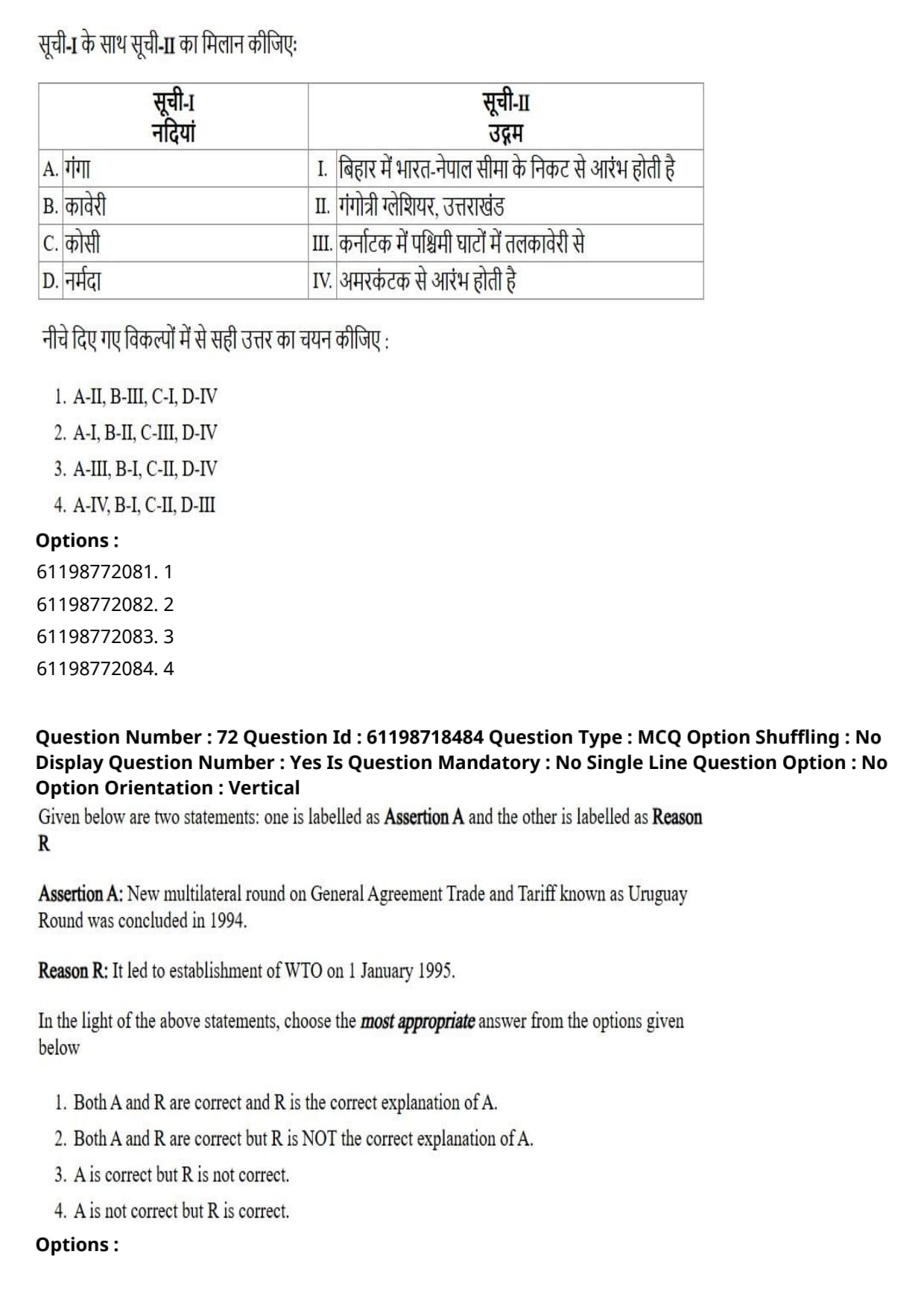
Match LIST-I with LIST-II.

View Solution
Concept:
Major Indian rivers have specific origin points. Matching rivers with their origins is important in geography and agriculture-related water resource studies.
Step 1: Ganga.
The Ganga originates from Gangotri glacier in Uttarakhand.
\[ A \rightarrow II \]
Step 2: Kaveri.
Kaveri originates from Talakaveri in the Western Ghats of Karnataka.
\[ B \rightarrow III \]
Step 3: Koshi.
Koshi is associated with the Indo-Nepal border region and Bihar.
\[ C \rightarrow I \]
Step 4: Narmada.
Narmada starts from Amarkantak.
\[ D \rightarrow IV \]
Therefore: \[ A-II,\ B-III,\ C-I,\ D-IV \]
\[ \therefore Correct Answer is (A) \] Quick Tip: Ganga originates from Gangotri glacier, Kaveri from Talakaveri, and Narmada from Amarkantak.
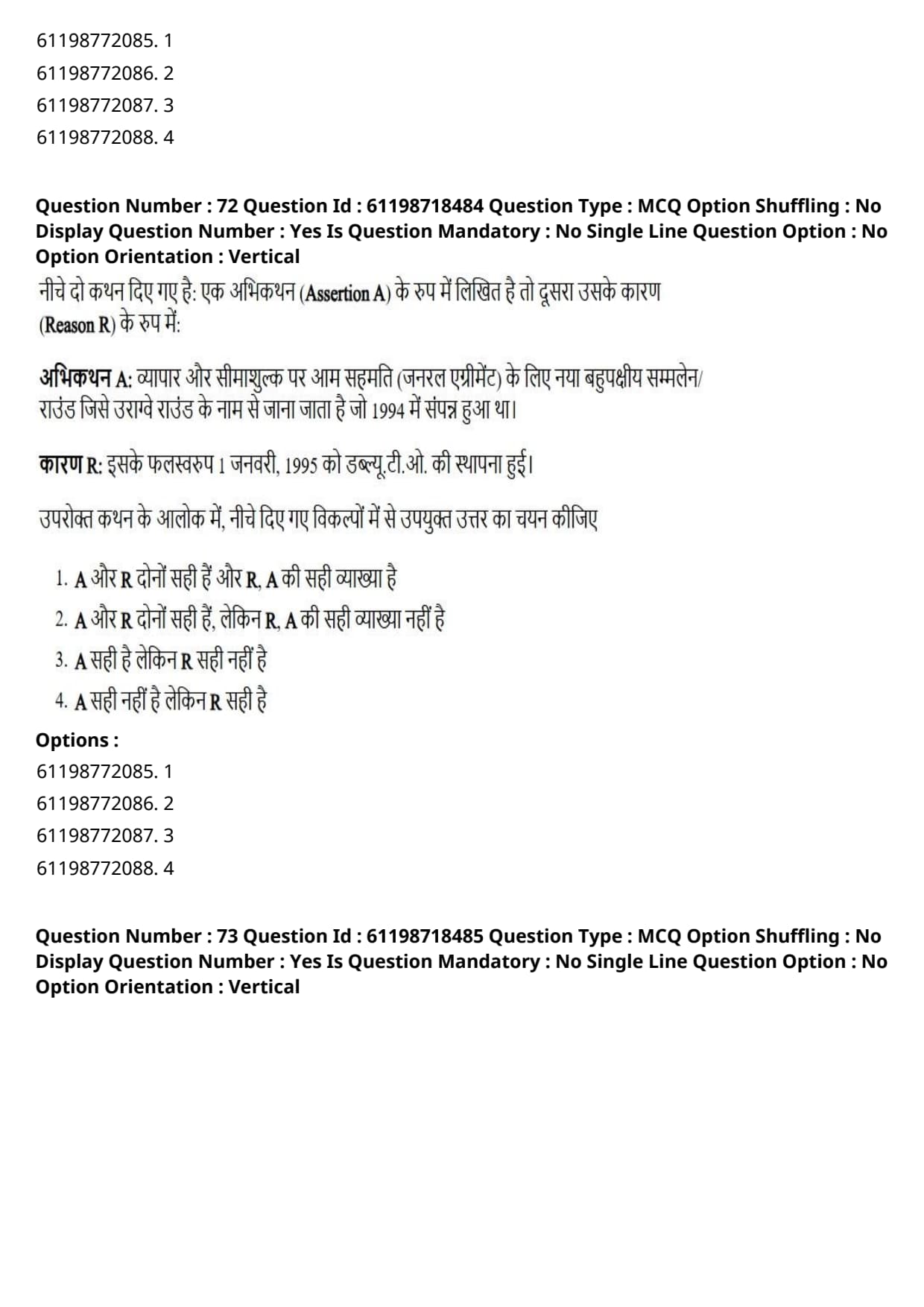
Given below are two statements:
Assertion (A): New multilateral round on General Agreement on Trade and Tariff known as Uruguay Round was concluded in 1994.
Reason (R): It led to establishment of WTO on 1 January 1995.
View Solution
Concept:
The Uruguay Round was an important round of multilateral trade negotiations under GATT. It resulted in major changes in global trade rules.
Step 1: Check Assertion (A).
The Uruguay Round was concluded in 1994.
\[ A is correct \]
Step 2: Check Reason (R).
The Uruguay Round led to the establishment of the World Trade Organization.
\[ WTO established on 1 January 1995 \]
So, \[ R is correct \]
Step 3: Check explanation.
Reason is a consequence of the Uruguay Round, but it does not directly explain why the Uruguay Round was concluded in 1994.
Therefore, both statements are correct, but Reason is not the correct explanation of Assertion.
\[ \therefore Correct Answer is (B) \] Quick Tip: Uruguay Round was concluded in 1994 and WTO came into existence on 1 January 1995.
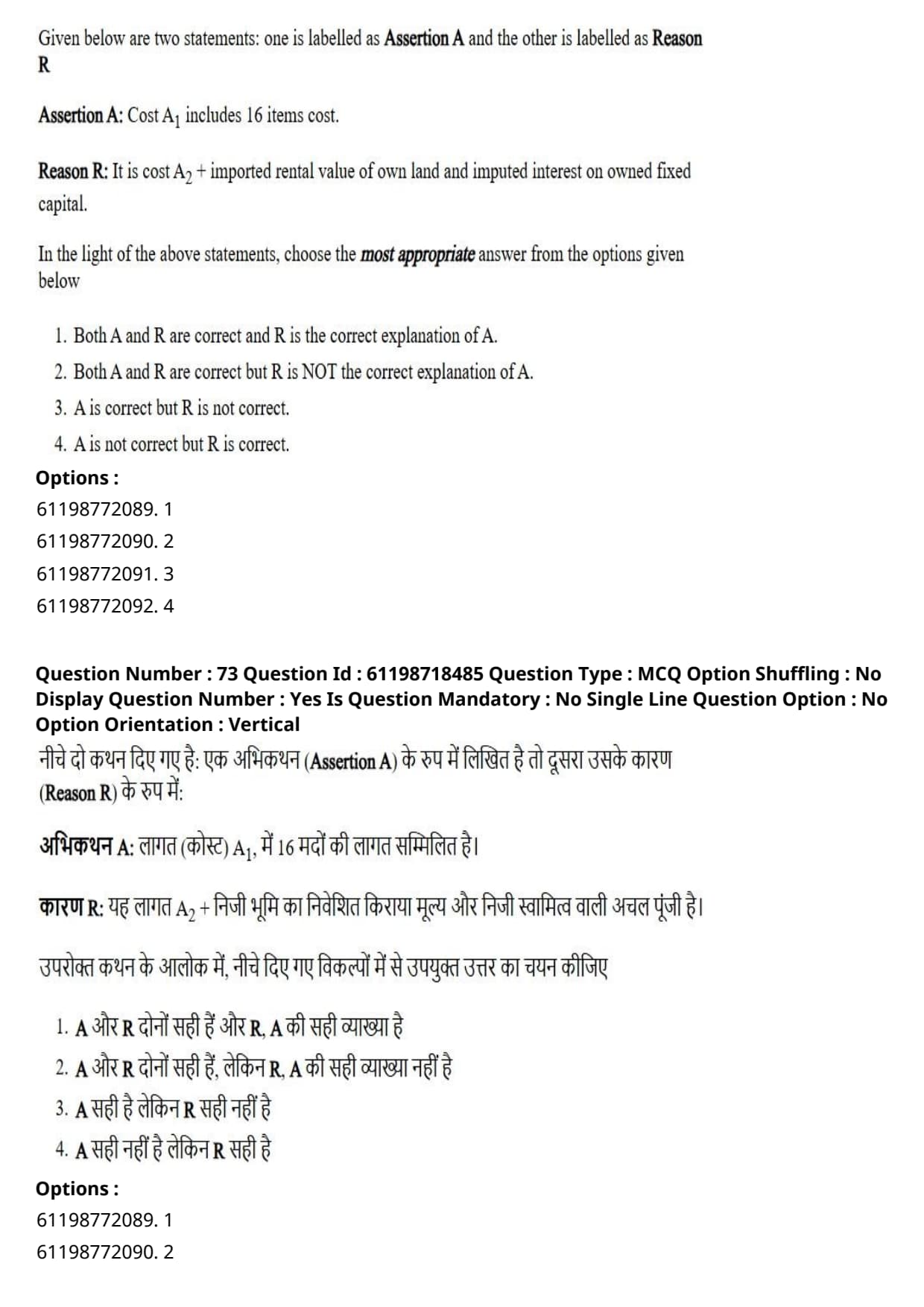
Given below are two statements:
Assertion (A): Cost \(A_1\) includes 16 items cost.
Reason (R): It is cost \(A_2\) plus imputed rental value of own land and imputed interest on owned fixed capital.
View Solution
Concept:
Cost concepts in farm management include \(A_1\), \(A_2\), \(B_1\), \(B_2\), \(C_1\), \(C_2\), etc. These are used to calculate cost of cultivation.
Step 1: Check Assertion (A).
Cost \(A_1\) includes several actual paid-out costs such as hired labour, seed, fertilizer, manure, plant protection, irrigation, depreciation, land revenue, interest on working capital, and other expenses.
\[ A is correct \]
Step 2: Check Reason (R).
The reason says that it is cost \(A_2\) plus imputed rental value of own land and imputed interest on owned fixed capital.
This description does not represent cost \(A_1\). It represents a higher cost concept related to \(B\)-type costs.
\[ R is not correct \]
Step 3: Final conclusion.
Assertion is correct but Reason is incorrect.
\[ \therefore Correct Answer is (C) \] Quick Tip: Cost \(A_1\) mainly includes actual paid-out costs, while imputed value of owned land and fixed capital belongs to higher cost concepts.
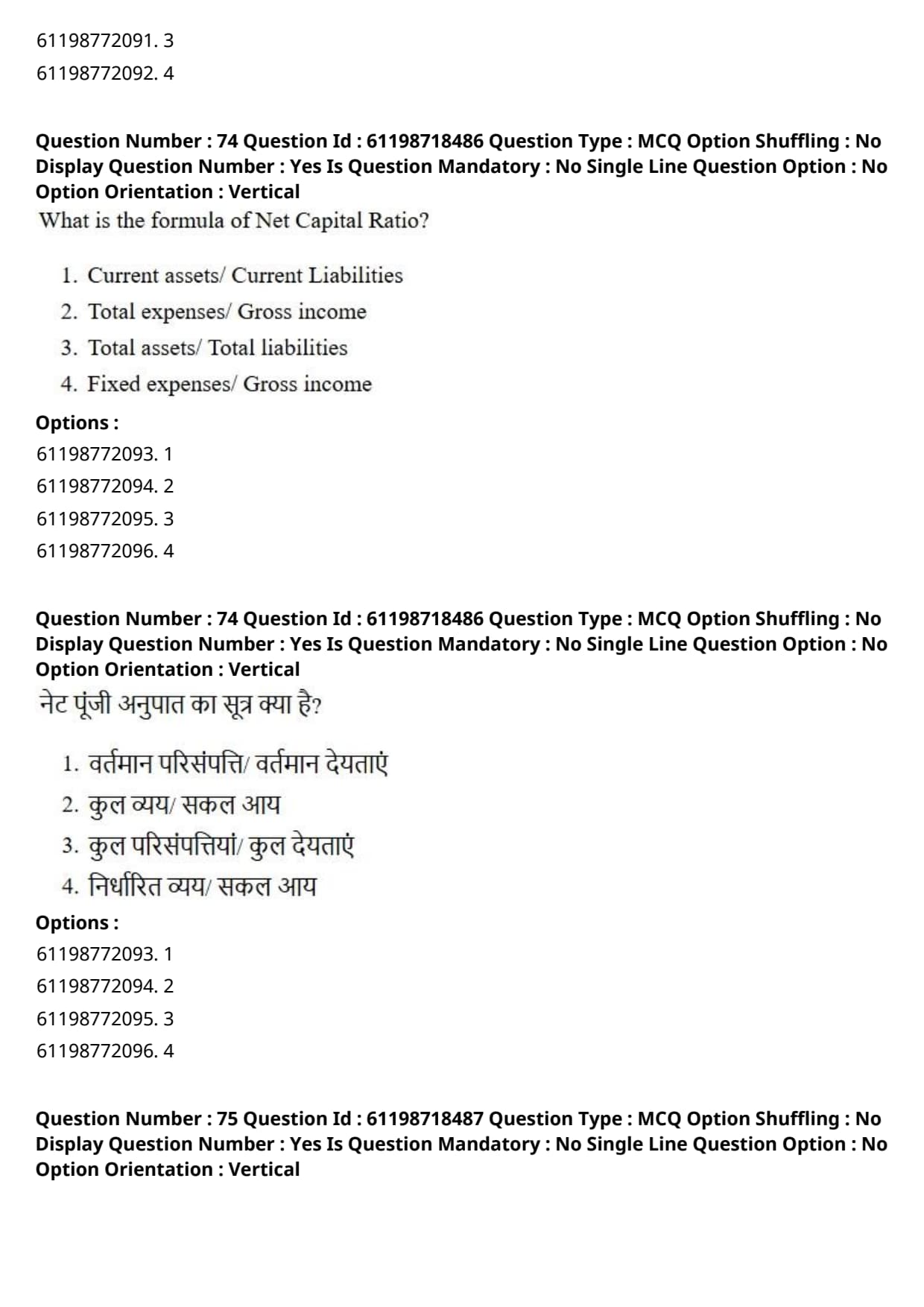
What is the formula of Net Capital Ratio?
View Solution
Concept:
Net capital ratio is used in farm financial analysis to study the solvency position of a farm business.
Step 1: Understand the meaning.
Net capital ratio compares total assets with total liabilities.
Step 2: Write the formula. \[ Net Capital Ratio=\frac{Total Assets}{Total Liabilities} \]
Step 3: Interpret the formula.
A higher ratio indicates that the farm has more assets in comparison to its liabilities.
Therefore, the formula is: \[ \frac{Total assets}{Total liabilities} \]
\[ \therefore Correct Answer is (C) \] Quick Tip: Net capital ratio is calculated as total assets divided by total liabilities.
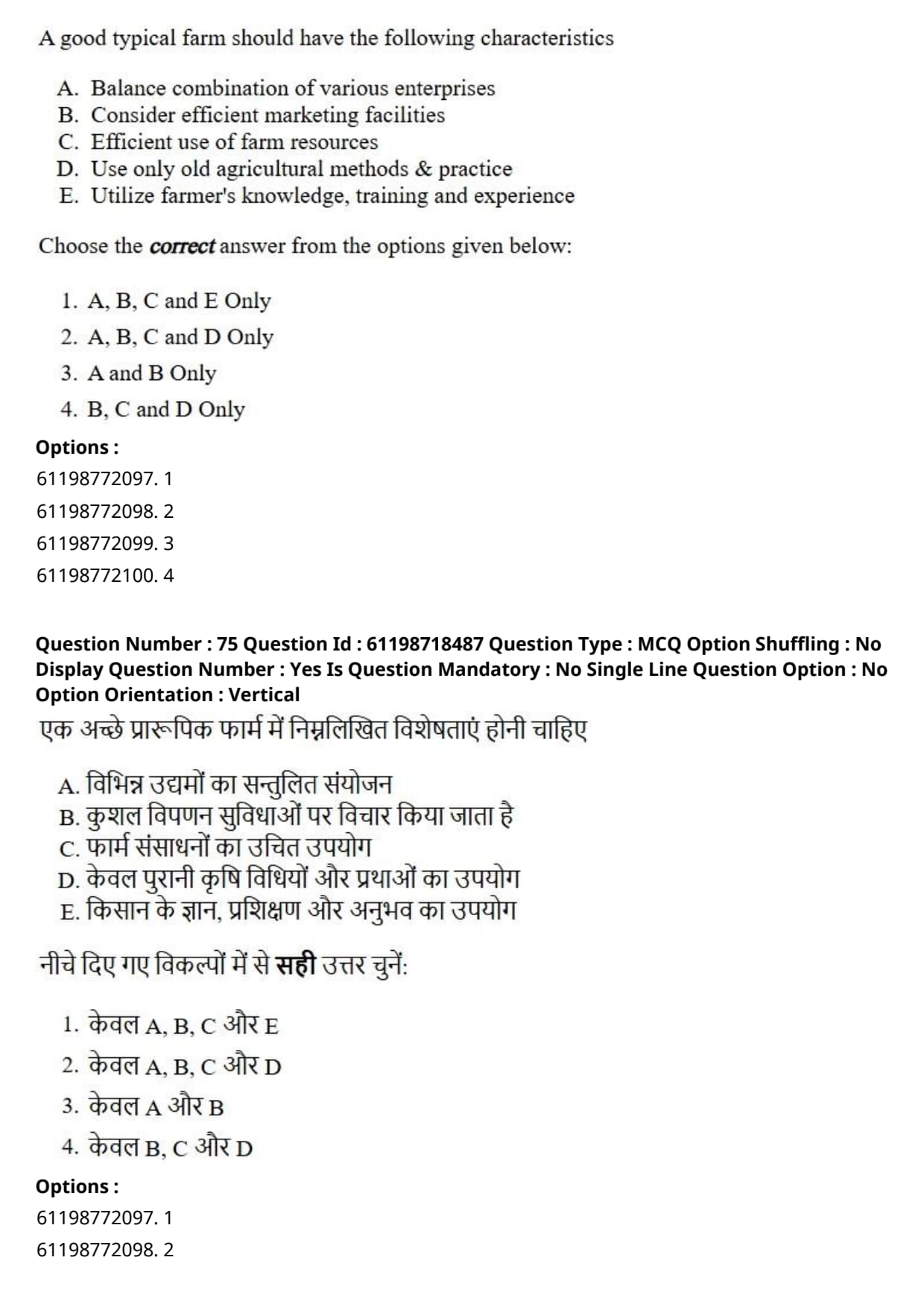
A good typical farm should have the following characteristics:
A. Balance combination of various enterprises
B. Consider efficient marketing facilities
C. Efficient use of farm resources
D. Use only old agricultural methods and practice
E. Utilize farmer's knowledge, training and experience.
View Solution
Concept:
A good farm plan should ensure efficient use of resources, balanced enterprises, proper marketing and practical use of farmer experience.
Step 1: Check statement A.
A good farm should have a balanced combination of various enterprises such as crops, livestock, horticulture or other farm activities.
\[ A is correct \]
Step 2: Check statement B.
Efficient marketing facilities are important because production should be linked with profitable sale.
\[ B is correct \]
Step 3: Check statement C.
Efficient use of farm resources such as land, labour, capital, irrigation and machinery is essential.
\[ C is correct \]
Step 4: Check statement D.
A good farm should not use only old agricultural methods. It should adopt improved and suitable modern practices whenever beneficial.
\[ D is incorrect \]
Step 5: Check statement E.
Farmer's knowledge, training and experience are very useful for farm planning and decision making.
\[ E is correct \]
Thus, correct statements are: \[ A,B,C,E \]
\[ \therefore Correct Answer is (A) \] Quick Tip: A good farm should use resources efficiently, have balanced enterprises, consider marketing, and utilize farmer experience.



Comments