




The CUET PG Economics syllabus 2027 (COQP10) covers seven units based on undergraduate-level Economics concepts. Each paper has 75 MCQs in 90 minutes, carrying 300 marks total. The CUET PG Economics exam is conducted in Computer-Based Test (CBT) mode, in English and Hindi.
- The CUET PG Economics Syllabus 2027 (COQP10) covers 7 units:
- Microeconomics,
- Macroeconomics,
- Money & Inflation,
- Consumption & Investment,
- Statistical Methods,
- Mathematical Methods, and
- Indian Economy.
- Microeconomics covers consumer behaviour, utility analysis, production functions, cost theory, market structures, and welfare economics.
- Macroeconomics focuses on national income accounting, classical and Keynesian theories, the IS-LM model, aggregate demand and supply, and economic growth.
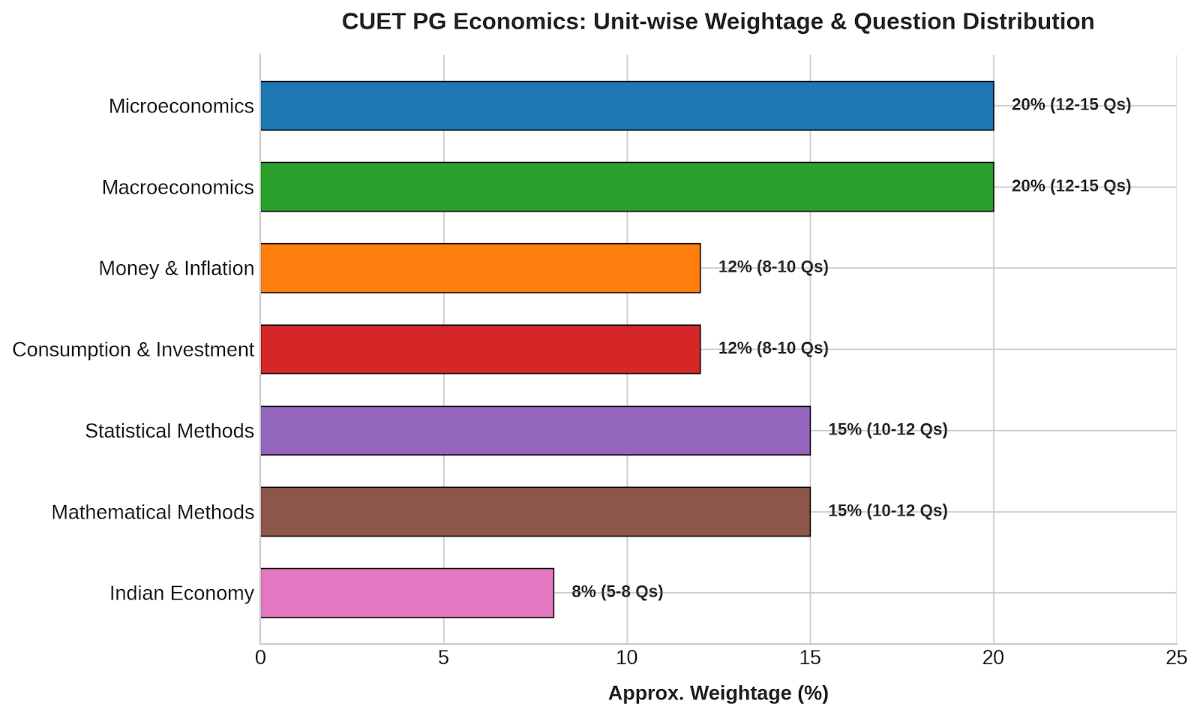
- Microeconomics and Macroeconomics carry the highest estimated weightage, with approximately 12–15 questions each, accounting for nearly 20% of the paper individually.
- Statistical Methods and Mathematical Methods are expected to contribute around 10–12 questions each, making numerical and analytical practice important.
- Money and Inflation and Consumption and Investment Function are estimated to contribute 8–10 questions each, with emphasis on economic theories and their applications.
- Indian Economy is expected to contribute approximately 5–8 questions, particularly from economic reforms, Five-Year Plans, poverty measurement, and balance of payments.
Related Links:
- CUET PG Exam Pattern 2027: Questions, Marks, Duration & Marking Scheme
- CUET PG 2026 Question Paper (Available): Check Previous Year Question Paper with Solution PDF (2025-2021)
- CUET PG Preparation 2027: Subject-wise Study Plan, Timetable, Last-month Strategy, PYQs, and Mock Tests
Key Summary
- The CUET PG Economics Syllabus 2027 has 7 units, worth 300 marks across 75 MCQs, with +4 for correct and -1 for wrong answers.
- Microeconomics and Macroeconomics carry the highest combined weightage, at roughly 40% of the paper.
- Recent cycles have shifted toward Assertion-Reasoning, Statement verification, Matrix Matching, and Chronological Ordering, moving away from simple one-liner MCQs.
- H.L. Ahuja, Chiang, S.C. Gupta, and Gujarati are the core recommended authors across Micro, Macro, Mathematical Methods, and Econometrics.
CUET PG Economics Syllabus 2027: Overview
The CUET PG Economics Syllabus 2027 is built entirely on domain-specific questions. There is no General Aptitude Part A for pure subject papers like Economics.
- The exam carries 300 marks total, from 75 questions × 4 marks each.
- The syllabus is based on the core undergraduate economics framework, across 7 units.
- The syllabus release date is expected by mid-December 2026, alongside the official information bulletin.
| Parameter | Official Specification |
|---|---|
| Conducting Body | National Testing Agency (NTA) |
| Examination Name | Common University Entrance Test for Postgraduate (CUET PG 2027) |
| Academic Session | 2027–2028 |
| Official Website | NTA CUET PG Portal |
| Total Marks | 300 Marks (75 questions × 4 marks each) |
| Total Marks per Subject | 300 Marks (The exam consists entirely of domain-specific questions with no General Aptitude Part A) |
| Syllabus Basis | 7 units: Microeconomics, Macroeconomics, Money and Inflation, Consumption and Investment Function, Statistical Methods, Mathematical Methods, and Indian Economy. |
| Syllabus Release Date | Expected mid-December 2026 |
Ques. What is the Economics CUET syllabus 2025 basis compared to 2027?
Ans. Both follow the same core undergraduate economics framework across 7 units. The topic list has stayed consistent across recent cycles.
Ques. When will the CUET PG economics syllabus PDF be released for 2027?
Ans. Expected mid-December 2026, alongside the official information bulletin.
Check Out:
CUET PG Economics Syllabus 2027 (COQP10)
The Economics paper (COQP10) tests undergraduate Honours-level knowledge across seven units. Microeconomics and Macroeconomics together account for the largest share of questions and should be your first priority.
- Nearly half the paper now relies on Assertion-Reasoning, Statement 1/Statement 2 verifications, Matrix Matching, and Chronological Ordering, not simple one-liner MCQs.
- Recent cycles, especially 2025 and 2026, have shifted the question style toward application and verification, not pure recall.
- The Mathematical and Statistical Methods units require consistent numerical practice.
| Unit No. | Unit Name | Key Topics |
|---|---|---|
| Unit 1 | Microeconomics |
|
| Unit 2 | Macroeconomics |
|
| Unit 3 | Money and Inflation |
|
| Unit 4 | Consumption and Investment Function |
|
| Unit 5 | Statistical Methods |
|
| Unit 6 | Mathematical Methods |
|
| Unit 7 | Indian Economy |
|
Ques. What are the 7 units of the CUET MA Economics syllabus?
Ans. Microeconomics, Macroeconomics, Money and Inflation, Consumption and Investment Function, Statistical Methods, Mathematical Methods, and Indian Economy.
Ques. What question formats does the CUET Eco syllabus test besides direct MCQs?
Ans. Assertion-Reasoning, Statement 1/Statement 2 verification, Matrix Matching, and Chronological Ordering, alongside standard single-correct MCQs.
Also Check:
CUET PG Economics Syllabus 2027: Unit-wise Weightage
The distribution below is derived from analysis of previous CUET PG Economics papers across the 2022–2026 cycles.
- Microeconomics and Macroeconomics form the core of the exam, consistently drawing 12 to 15 questions each.
- Statistical Methods and Mathematical Methods account for roughly 20–24 questions combined.
- Money, Inflation, Consumption & Investment together carry about 24% of the paper. Their syllabus boundaries are tighter and more predictable than core Macro.
- Indian Economy yields fewer conceptual questions (5–8) but is heavily packed with factual, chronological, and scheme-based questions.
| Unit | Unit Name | Approx. Questions | Approx. Weightage | High-Priority Topics |
|---|---|---|---|---|
| Unit 1 | Microeconomics | 12–15 | ~20% | Indifference curve analysis, monopoly pricing and price discrimination, market structure comparisons |
| Unit 2 | Macroeconomics | 12–15 | ~20% | IS-LM model, national income accounting, Solow growth model, Keynesian multiplier |
| Unit 3 | Money and Inflation | 8–10 | ~12% | Money supply measures (M0–M4), Phillips curve, RBI policy instruments, demand for money theories |
| Unit 4 | Consumption & Investment | 8–10 | ~12% | Permanent income hypothesis, life-cycle hypothesis, Tobin's q, multiplier-accelerator model |
| Unit 5 | Statistical Methods | 10–12 | ~15% | OLS regression and R², hypothesis testing (t-test, chi-square), index numbers |
| Unit 6 | Mathematical Methods | 10–12 | ~15% | Lagrange optimization, matrix algebra (Cramer's rule, eigenvalues), linear programming duality |
| Unit 7 | Indian Economy | 5–8 | ~8% | 1991 LPG reforms, Five-Year Plans, balance of payments, poverty measurement methods |
Ques. Which unit has the highest weightage in CUET PG economics?
Ans. Microeconomics and Macroeconomics, each contributing roughly 20% of the paper.
Also Check:
CUET PG Economics Syllabus: Important Topics
The core syllabus for CUET PG Economics (COQP10) consists of 7 units, but the actual question distribution highlights a clear tier system. Out of 75 domain-specific questions (300 marks total), certain high-yield topics account for the majority of the paper.
- Microeconomics important topics span Consumer Choice Theory, Production and Cost Theory, Market Structures, and Welfare Economics.
- Macroeconomics important topics centre on National Income Accounting, the IS-LM Framework, and Economic Growth Models.
- Statistical Methods and Econometrics draw heavily on Probability Distributions and Hypothesis Testing.
- Mathematical Methods tests Optimization Techniques and Linear Algebra most consistently.
| Subject | Major Topics | Important Subtopics to Cover |
|---|---|---|
| Microeconomics | Consumer Choice Theory | Indifference Curves, Budget Constraints, Slutsky Equation, Income and Substitution Effects, Revealed Preference Theory |
| Production and Cost Theory | Short-Run and Long-Run Cost Functions, Returns to Scale, Returns to a Variable Factor | |
| Market Structures | Monopoly, Price Discrimination, Deadweight Loss, Cournot Model, Bertrand Model, Stackelberg Model | |
| Welfare Economics | Pareto Efficiency, Conditions for Pareto Optimality, Edgeworth Box | |
| Macroeconomics | National Income Accounting | GDP, GNP, NDP, NNP, National Income Accounting Methods, Circular Flow of Income |
| IS-LM Framework | IS-LM Model, Classical and Keynesian Approaches, Monetary and Fiscal Policy Multipliers, Crowding-Out Effect | |
| Economic Growth Models | Solow Growth Model, Steady-State Equilibrium, Golden Rule of Capital Accumulation, Convergence, Harrod-Domar Model | |
| Statistical Methods and Econometrics | Probability and Probability Distributions | Bayes' Theorem, Binomial Distribution, Poisson Distribution, Normal Distribution and Its Properties |
| Hypothesis Testing | t-Test, F-Test, Chi-Square Test, Critical Values and Applications | |
| Mathematical Methods | Optimization Techniques | Unconstrained and Constrained Optimization, Lagrange Multiplier Method, Utility Maximization, Cost Minimization |
| Linear Algebra | Matrix Operations, Determinants, Cramer's Rule, Solving Simultaneous Equations, Eigenvalues |
Ques. What are the most important microeconomics topics in the cuet economics syllabus?
Ans. Consumer Choice Theory, Production and Cost Theory, Market Structures, and Welfare Economics.
Check Out:
CUET PG Exam Pattern 2027
The official exam pattern for the CUET PG Economics Exam 2027 (COQP10) follows the streamlined, single-domain structure implemented by the NTA.
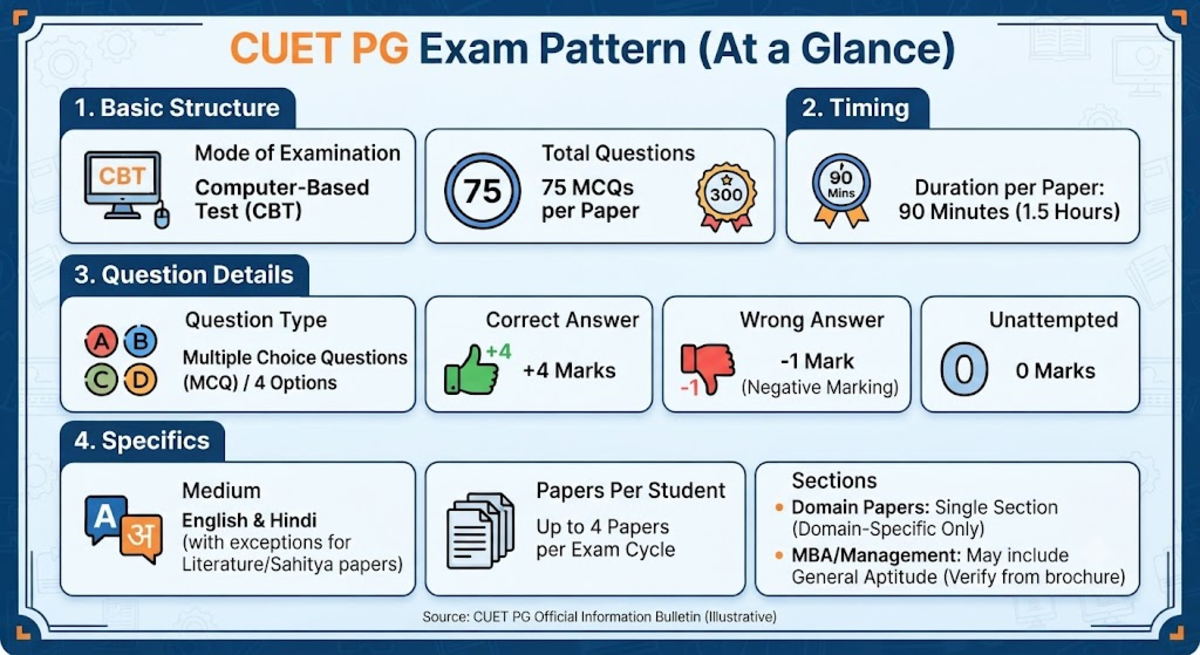
- Each domain paper consists of 75 MCQs for 300 marks, in a 90-minute CBT session.
- Pure subject papers have no separate general aptitude section. Every question tests domain knowledge.
- At 75 questions in 90 minutes, you get exactly 1.2 minutes (72 seconds) per question.
| Parameter | Details |
|---|---|
| Mode of Examination | Computer-Based Test (CBT) |
| Number of Questions per Paper | 75 MCQs |
| Total Marks per Paper | 300 |
| Duration per Paper | 90 minutes |
| Type of Questions | Multiple Choice Questions (4 options, 1 correct answer) |
| Marks for Correct Answer | +4 |
| Negative Marking (Wrong Answer) | −1 |
| Unattempted Question | 0 marks |
| Medium of Paper | English and Hindi (Literature/Sahitya papers: respective language only) |
| Number of Papers per Student | Up to 4 papers per exam cycle |
| Sections per Domain Paper (e.g., Economics) | Single section, domain-specific questions only |
| Sections for MBA/Management Papers | May include a General Aptitude component — verify from the official brochure |
Ques. How much time do I get per question in the CUET PG economics exam?
Ans. About 1.2 minutes (72 seconds) per question, across 75 questions in 90 minutes.
Ques. Is there negative marking in the CUET PG economics question paper?
Ans. Yes. -1 mark for every wrong answer. Unattempted questions score zero.
Check Out:
How to Download CUET PG Economics 2027 Syllabus PDF
Follow these steps to access the official subject-wise syllabus from the NTA portal once the 2027 notification is released.
- Visit the official NTA CUET PG portal.
- Open the Information Bulletin or Syllabus PDF.
- Search for your paper code (e.g., COQP10 for Economics).
- Press Ctrl + S (Windows) or Cmd + S (Mac) to save the PDF.
- Compare the 2027 syllabus with the 2026 syllabus to identify additions or deletions.
Ques. How do I find the CUET PG economics syllabus PDF inside the information bulletin?
Ans. Search for the paper code "COQP10" within the downloaded Information Bulletin PDF to jump directly to the Economics unit list.
Ques. Where can I find the CUET PG chemistry syllabus PDF?
Ans. The same way as Economics, download the Information Bulletin from the NTA CUET PG portal and search for Chemistry's specific paper code, since each subject has its own code and unit list inside the same bulletin.
Best Books for CUET PG Economics 2027
The best books for CUET PG Economics 2027 should cover core economic theories, quantitative methods, econometrics, and the Indian economy.
- Use H.L. Ahuja as a primary reference for both Microeconomics and Macroeconomics.
- Use S.C. Gupta and Chiang for quantitative topics, Statistics and Mathematical Methods, respectively.
- Refer to advanced books like Varian and Gujarati selectively, for mathematical and applied concepts only.
- Avoid reading every book cover to cover. Prioritise syllabus-aligned chapters and CUET PG previous-year questions.
| Subject / Section | Recommended Books | Author(s) | Important Topics Covered |
|---|---|---|---|
| Microeconomics | Advanced Economic Theory | H.L. Ahuja | Consumer Behaviour, Production and Cost, Market Structures, Price Determination, Welfare Economics |
| Microeconomic Analysis | Hal R. Varian | Utility Maximisation, Consumer Choice, Constrained Optimisation, Lagrange Multiplier Applications | |
| Macroeconomics | Macroeconomics | H.L. Ahuja | National Income, IS-LM Model, Classical and Keynesian Theories, Monetary and Fiscal Policy |
| Macroeconomics: Theories and Policies | Richard T. Froyen | Classical Economics, Keynesian Economics, IS-LM Framework, Stabilisation Policies | |
| Economic Growth | David N. Weil | Solow Growth Model, Harrod-Domar Model, Capital Accumulation, Economic Growth and Convergence | |
| Macroeconomics | N. Gregory Mankiw | Growth Theories, Consumption, Investment, Inflation and Monetary Policy | |
| Mathematical Methods in Economics | Fundamental Methods of Mathematical Economics | Alpha C. Chiang and Kevin Wainwright | Matrix Algebra, Determinants, Cramer's Rule, Optimisation, Difference Equations |
| Mathematics for Economic Analysis | Knut Sydsæter and Peter J. Hammond | Mathematical Functions, Calculus, Linear Algebra, Constrained Optimisation | |
| Statistical Methods and Econometrics | Fundamentals of Statistics | S.C. Gupta | Probability, Normal Distribution, Binomial Distribution, Poisson Distribution, Hypothesis Testing |
| Basic Econometrics | Damodar N. Gujarati | Simple and Multiple Linear Regression, OLS Method, CLRM Assumptions, Regression Analysis | |
| Money, Inflation, Consumption and Investment | Macroeconomics | H.L. Ahuja / N. Gregory Mankiw | Money Supply, Inflation, Liquidity Preference, Consumption Functions, Permanent Income Hypothesis (PIH), Life Cycle Hypothesis (LCH) |
| Indian Economy | Indian Economy | Ramesh Singh | Economic Planning, Economic Reforms, Fiscal Policy, Poverty, Development and Growth |
| Indian Economy | Mishra and Puri | Indian Economic Development, Agriculture, Industry, Planning and Economic Reforms | |
| Current Economic Affairs | Union Budget 2027–28 and Economic Survey 2026–27 | Ministry of Finance, Government of India | Fiscal Policy, Government Expenditure, Economic Growth, Inflation, Employment and Development Indicators |
| NITI Aayog Reports | NITI Aayog | Poverty Estimation, Sustainable Development, Economic Reforms and Development Indicators |
This Reddit thread discusses the CUET PG Economics preparation and suggested tips by fellow students:
- Save time by watching structured video lectures (e.g., YouTube or online batches) instead of reading lengthy textbooks cover-to-cover.
- Print out foundational study materials and create your own quick-revision short notes daily to keep up with tight schedules.
- Prioritize Previous Year Questions (PYQs) from CUET PG, IIT JAM, HCU, JNU, and UGC NET both for practice and ongoing revision.

Source: Reddit
Ques. Which book is best for mathematical methods in the CUET Economics syllabus?
Ans. Chiang and Wainwright's Fundamental Methods of Mathematical Economics, for matrix algebra, optimisation, and difference equations.
Also Check:
CUET PG Economics 2027 Preparation Strategy
With approximately 5–6 months before the expected March 2027 exam, you have adequate time. Divide preparation into three phases: concept building, revision and topic tests, and full-length mock test practice.
- Begin with Microeconomics and Macroeconomics: they carry the highest combined weightage (~40%) and build the foundation for other units.
- Build your mathematical foundation before tackling Unit 6 in depth. Lagrange optimisation and matrix operations appear across multiple units.
- For Unit 5 (Statistics), practise numerical problems every day. OLS regression interpretation, chi-square tests, and index number calculations are high-yield.
- Cover Unit 7 (Indian Economy) through a standard textbook and the latest Government of India Economic Survey. Current affairs make this unit unpredictable.
- Solve all available CUET PG economics previous year question papers (2022–2026) under timed conditions. This is the single most effective preparation activity.
This video by the channel “ArthaPoint - One Stop Platform For Economics” discusses how to study Macroeconomics for CUET PG Economics 2027, the CUET PG Economics 2027 detailed syllabus and important topics, and how to prepare theoretical and numerical questions. It also discusses the role of previous year questions (PYQs) in preparation and how to revise Macroeconomics effectively
CUET PG Economics Syllabus FAQs
Ques. What are the 7 units of the CUET PG Economics (COQP10) syllabus?
Ans. Microeconomics, Macroeconomics, Money and Inflation, Consumption and Investment Function, Statistical Methods, Mathematical Methods, and Indian Economy.
Ques. Which unit has the highest weightage in CUET PG Economics?
Ans. Microeconomics and Macroeconomics, each contributing roughly 20% of the paper, based on analysis of past cycles.
Ques. Which are the best books for CUET PG Economics preparation?
Ans. H.L. Ahuja for Micro and Macro, Chiang and Wainwright for Mathematical Methods, S.C. Gupta for Statistics, and Gujarati for Econometrics.
Ques. Does the CUET PG Economics paper include a General Aptitude (GAT) section?
Ans. No. Pure domain papers like Economics have a single section of domain-specific questions only. Only MBA/Management papers may include a General Aptitude component.
Ques. How many papers can a student attempt in CUET PG 2027?
Ans. Up to 4 papers per exam cycle.
Ques. Does this syllabus apply to CUET M.Com as well?
Ans. No. CUET M.Com follows a separate paper code and syllabus focused on commerce and management topics, distinct from the Economics (COQP10) syllabus covered here.
Ques. Is the IIT JAM Economics syllabus the same as the CUET PG Economics syllabus?



Comments