




The National Testing Agency (NTA) conducted the CUET PG 2026 Bioinformatics (SCQP06) examination on March 13, 2026, during Shift 2 from 12:30 PM to 02:00 PM.
Students who appeared for the exam reported that the overall difficulty level of the paper was moderate. CUET PG 2026 Bioinformatics Question Paper with Solutions PDF is available here for download. The marking scheme is +4 for correct answers and -1 for wrong answers, totaling 300 marks.
CUET PG 2026 Bioinformatics Question Paper with Solutions PDF
| CUET PG 2026 Bioinformatics Question Paper | Download PDF | Check Solutions |
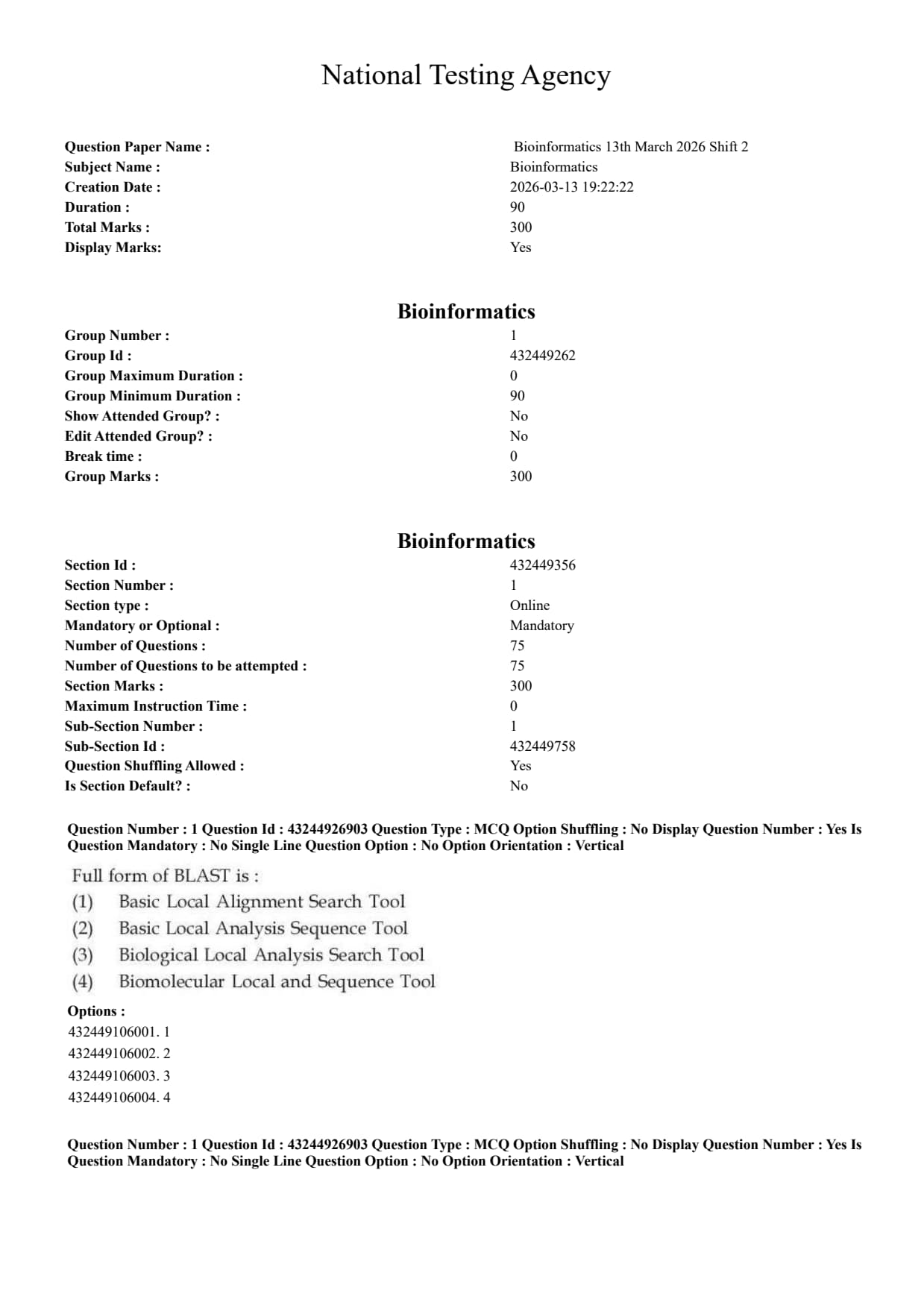
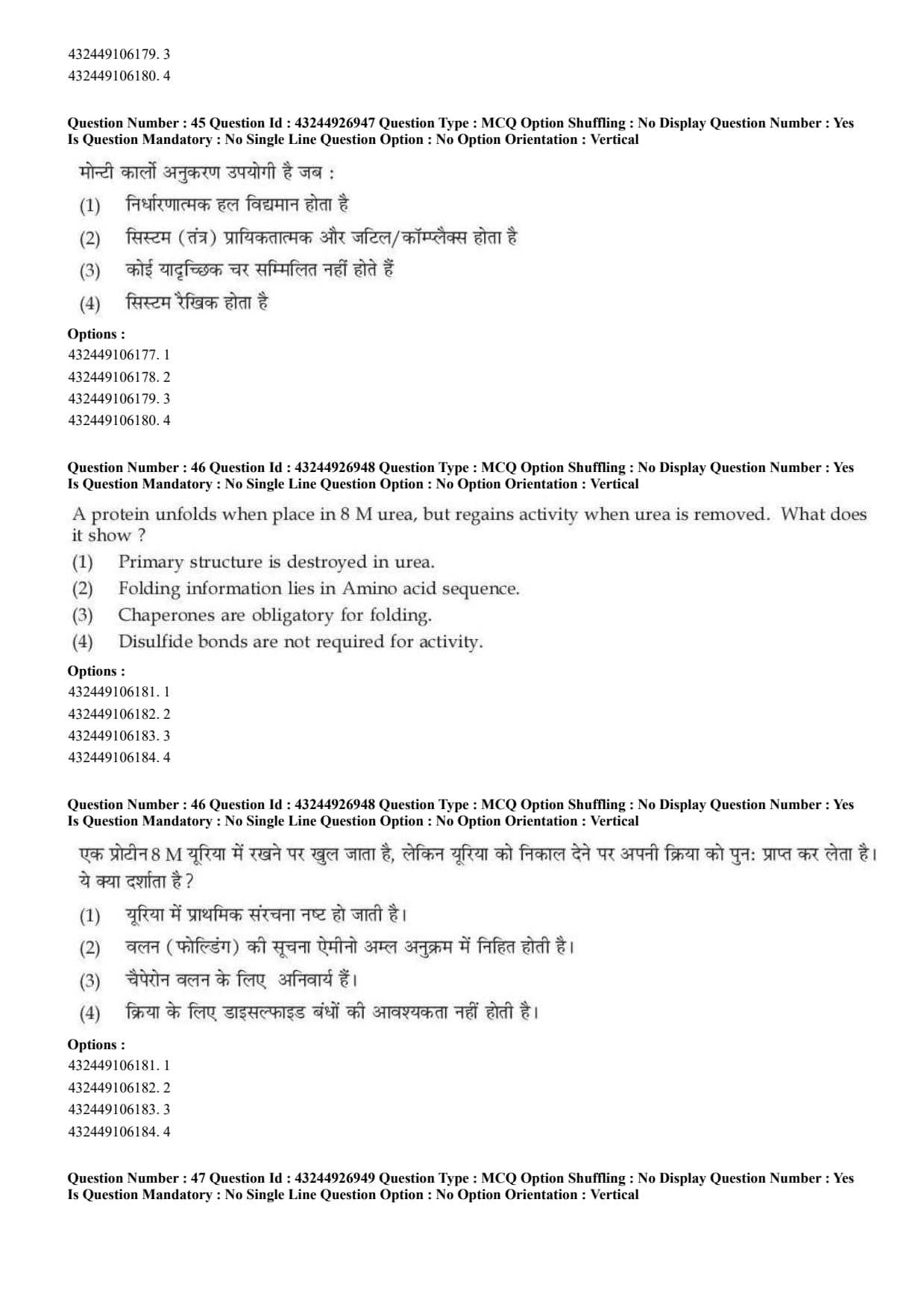
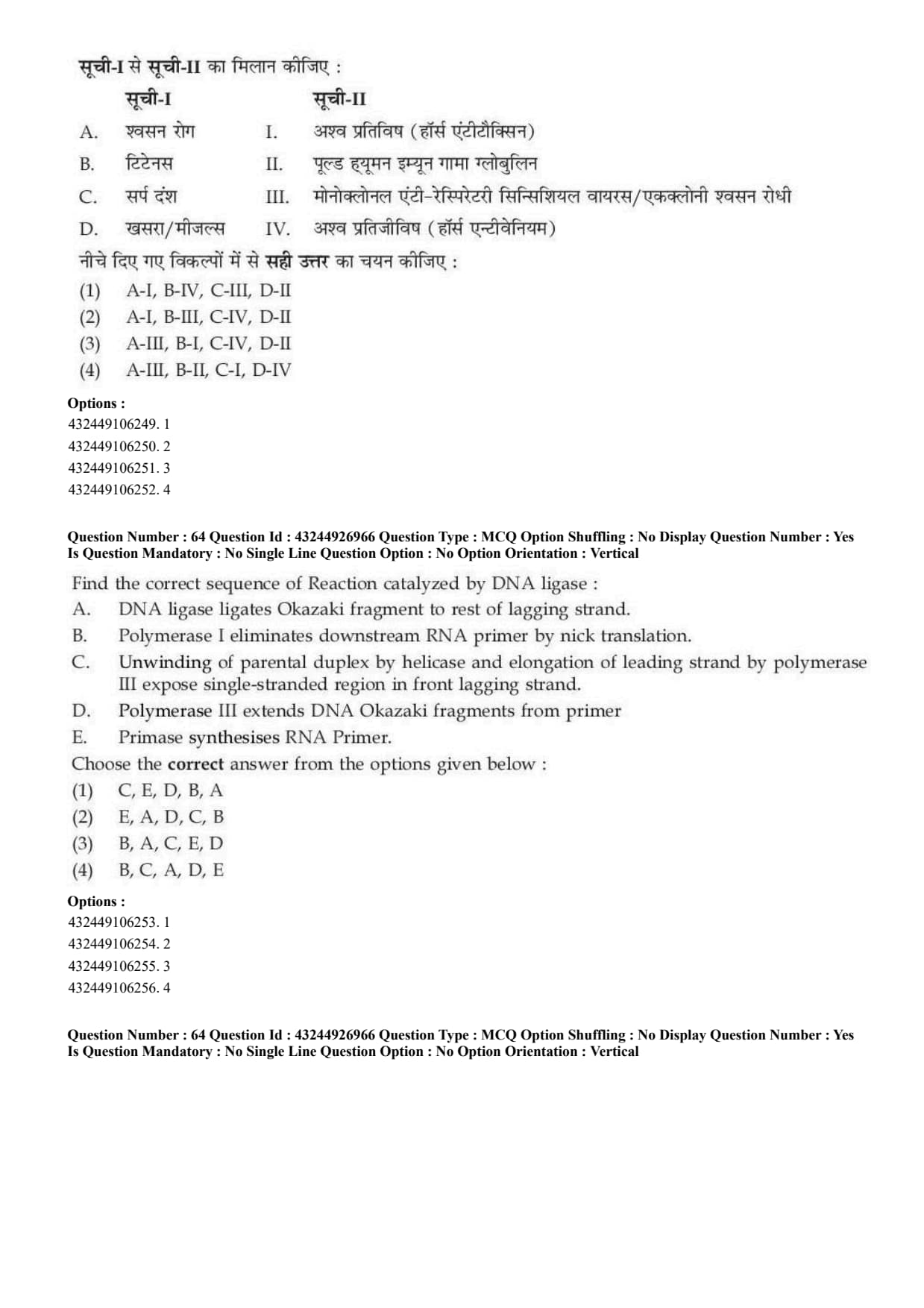
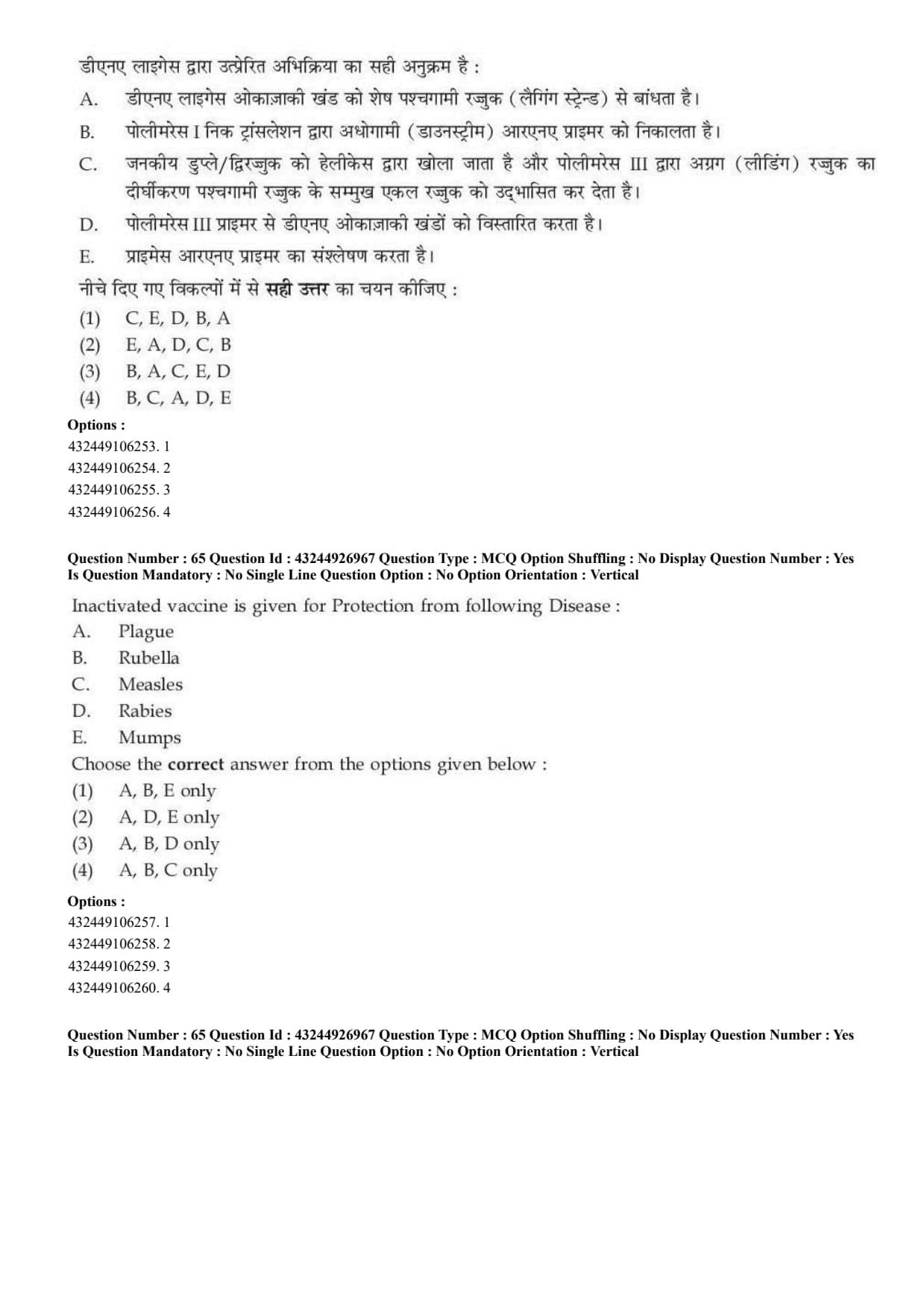
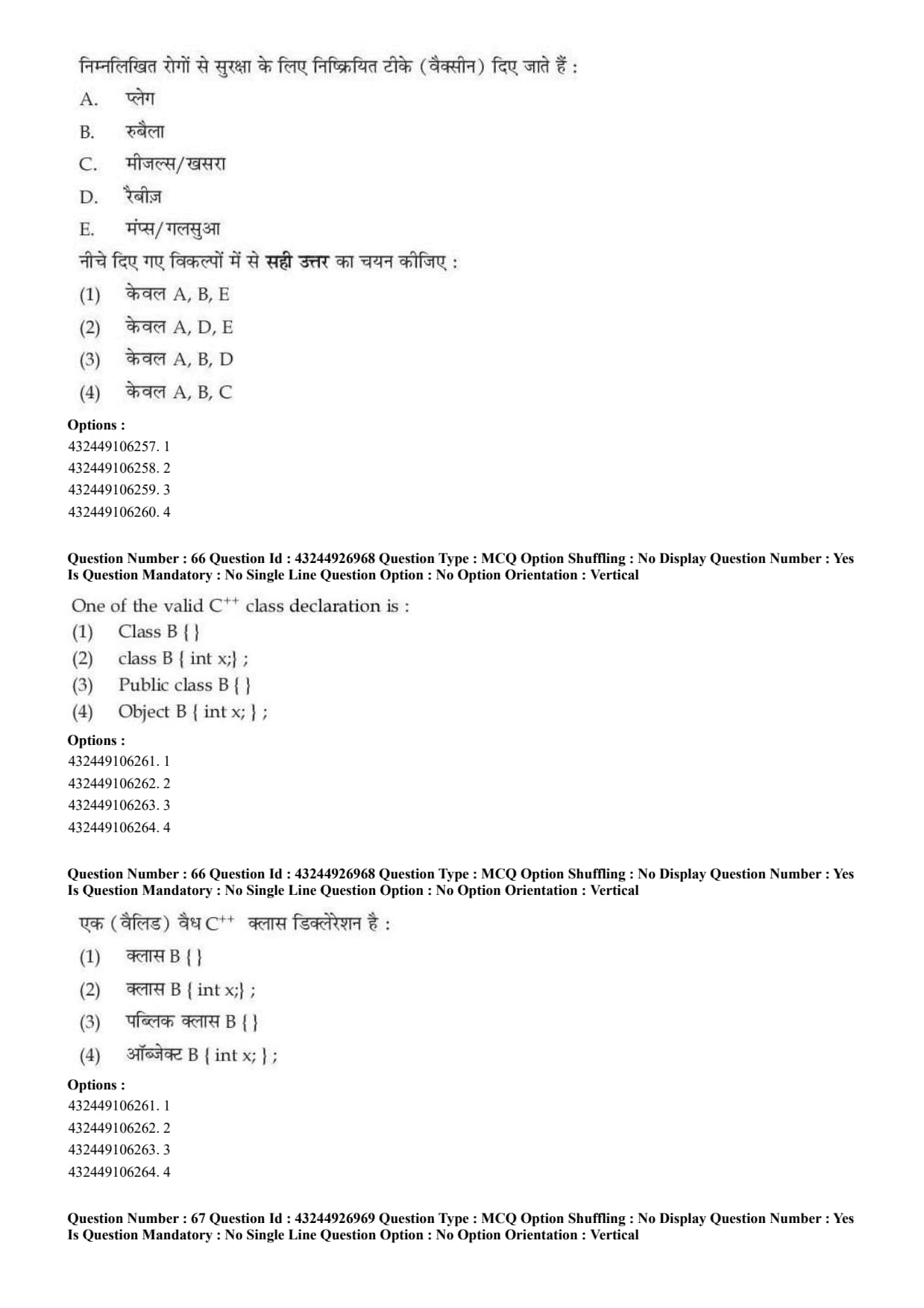
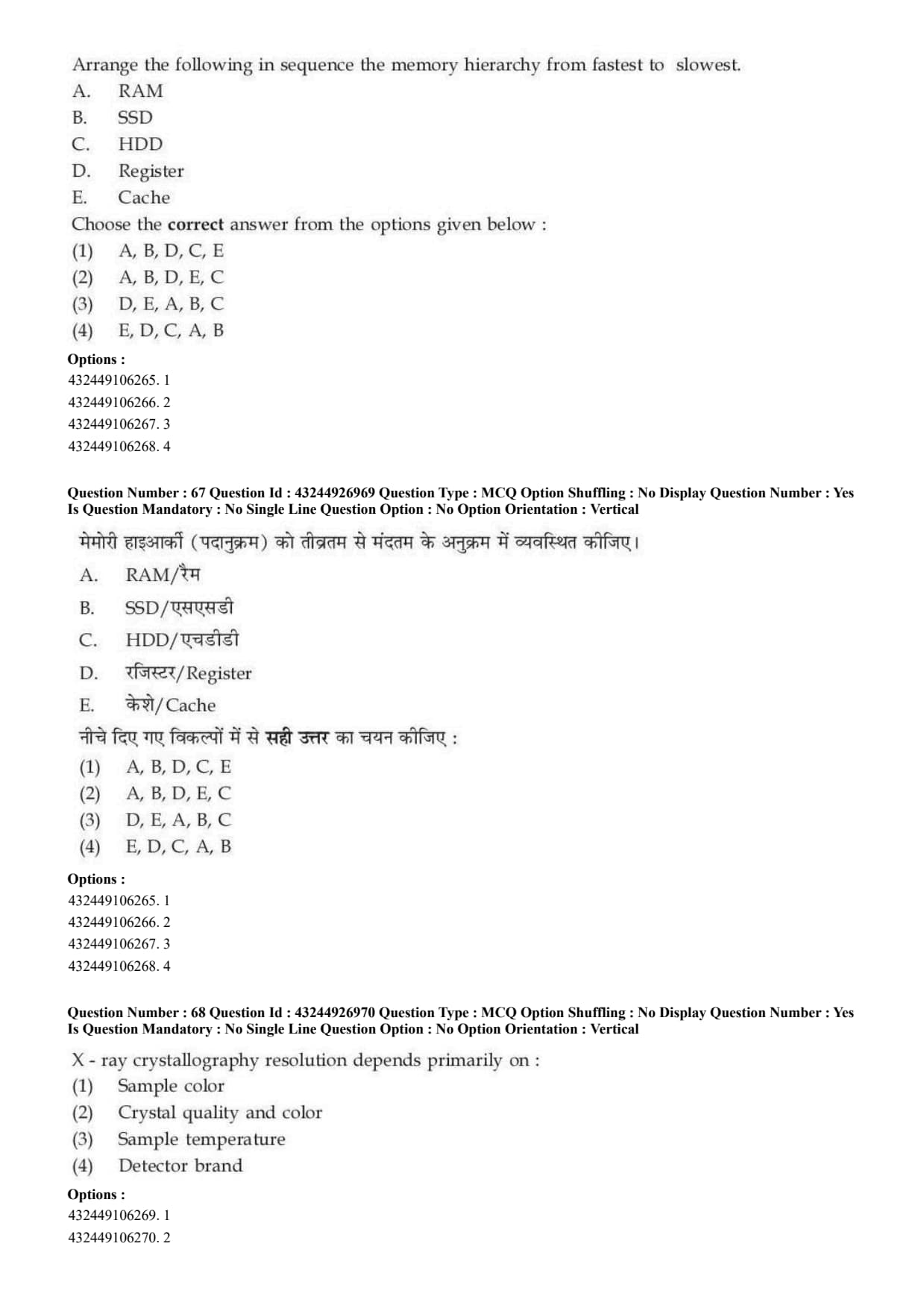
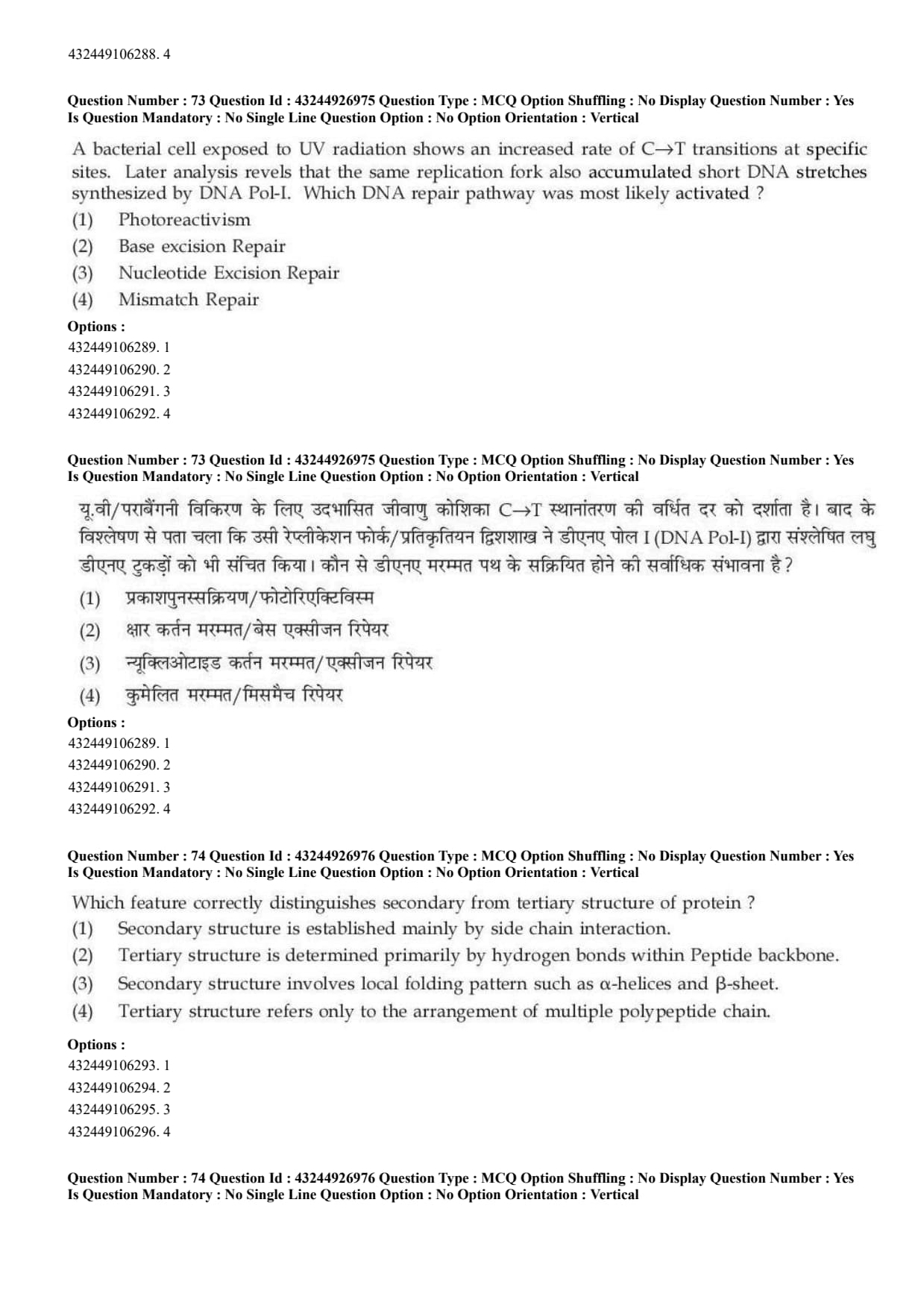
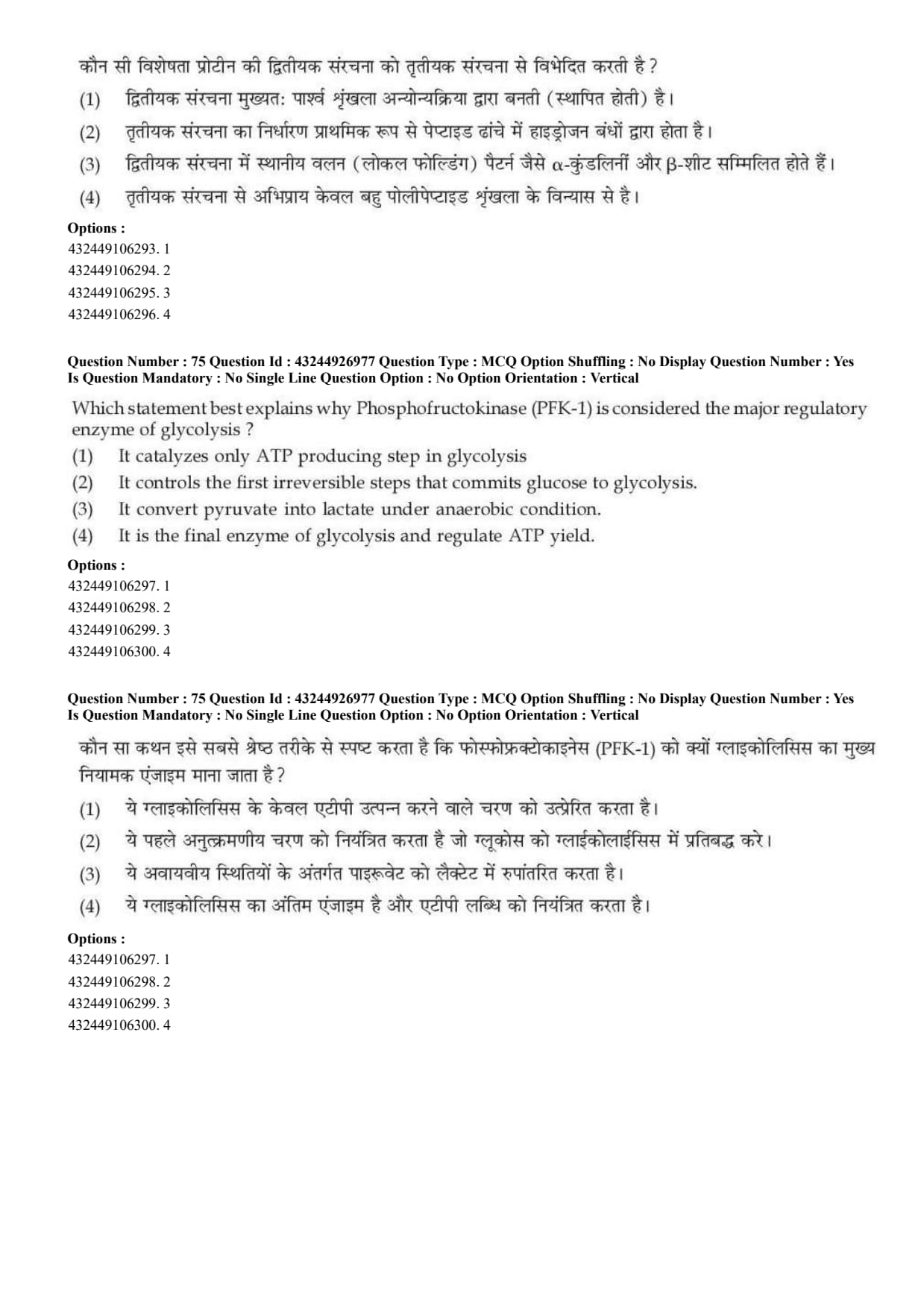
Full form of BLAST is:
View Solution
Concept:
BLAST is one of the most commonly used tools in bioinformatics. It is used to compare a biological sequence such as a DNA sequence, RNA sequence, or protein sequence with sequences already stored in biological databases.
Step 1: Understand the full form of BLAST.
BLAST stands for: \[ Basic Local Alignment Search Tool \]
Here, \[ B = Basic \] \[ L = Local \] \[ A = Alignment \] \[ S = Search \] \[ T = Tool \]
Step 2: Understand the meaning of local alignment.
Local alignment means comparing only the most similar regions between two biological sequences. It does not require the entire sequence to match from beginning to end.
Step 3: Purpose of BLAST.
BLAST helps in identifying similarity between a query sequence and known sequences present in databases such as NCBI. It is useful for finding homologous genes, identifying unknown sequences, and studying evolutionary relationships.
Step 4: Check the options.
Option (A) says Basic Local Alignment Search Tool, which is the correct full form of BLAST.
\[ \therefore Correct Answer is (A) \] Quick Tip: BLAST is always remembered as \textbf{Basic Local Alignment Search Tool}. The word ``Local'' is important because BLAST searches for local regions of similarity between sequences.
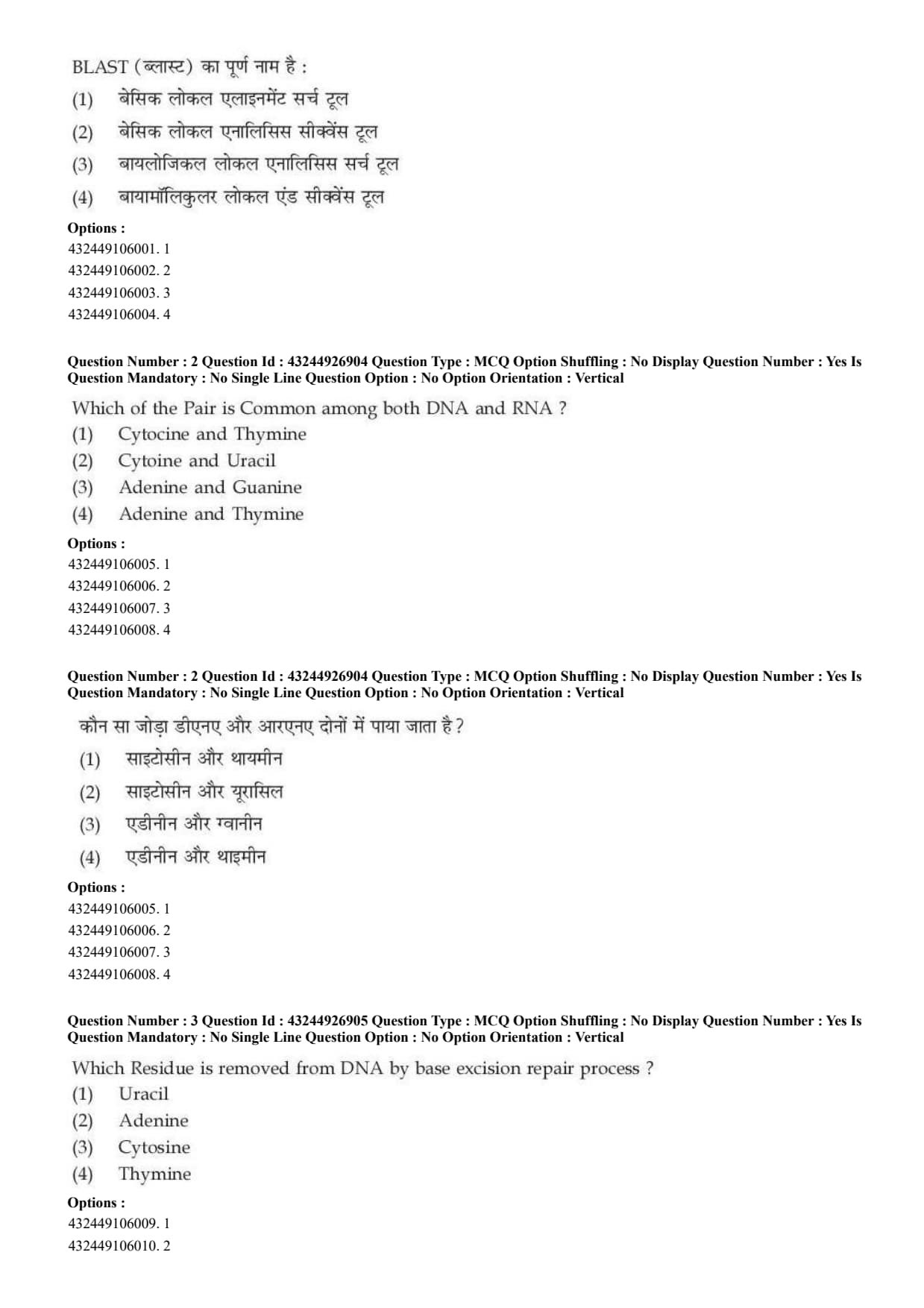
Which of the pair is common among both DNA and RNA?
View Solution
Concept:
DNA and RNA are nucleic acids. Both are made up of nitrogenous bases, sugar, and phosphate groups. The nitrogenous bases present in DNA and RNA are partly similar and partly different.
Step 1: Write the nitrogenous bases present in DNA.
DNA contains four nitrogenous bases: \[ Adenine (A), Guanine (G), Cytosine (C), Thymine (T) \]
Step 2: Write the nitrogenous bases present in RNA.
RNA contains four nitrogenous bases: \[ Adenine (A), Guanine (G), Cytosine (C), Uracil (U) \]
Step 3: Compare DNA and RNA bases.
Common bases in both DNA and RNA are: \[ Adenine, Guanine, Cytosine \]
DNA has thymine, while RNA has uracil instead of thymine.
Step 4: Check the given pairs.
Option (A): Cytosine and Thymine. Thymine is not present in RNA. So this is incorrect.
Option (B): Cytosine and Uracil. Uracil is not present in DNA. So this is incorrect.
Option (C): Adenine and Guanine. Both are present in DNA and RNA. So this is correct.
Option (D): Adenine and Thymine. Thymine is not present in RNA. So this is incorrect.
\[ \therefore Correct Answer is (C) \] Quick Tip: DNA and RNA both contain Adenine, Guanine, and Cytosine. DNA contains Thymine, while RNA contains Uracil.
Which residue is removed from DNA by base excision repair process?
View Solution
Concept:
Base excision repair is a DNA repair mechanism. It repairs damaged or abnormal bases in DNA without removing a large portion of the DNA strand.
Step 1: Understand why repair is required.
DNA can undergo chemical changes. One common change is the deamination of cytosine. When cytosine undergoes deamination, it gets converted into uracil.
\[ Cytosine \longrightarrow Uracil \]
Step 2: Why uracil is abnormal in DNA?
Uracil is normally present in RNA, not in DNA. DNA normally contains thymine instead of uracil. Therefore, if uracil appears in DNA, it is considered an abnormal base.
Step 3: Enzyme involved in removal.
The enzyme uracil-DNA glycosylase recognizes uracil present in DNA and removes it. This creates an abasic site, which is later repaired by other enzymes.
Step 4: Final conclusion.
Since uracil is not a normal DNA base and is removed during base excision repair, the correct answer is Uracil.
\[ \therefore Correct Answer is (A) \] Quick Tip: Base excision repair commonly removes abnormal bases such as uracil from DNA. Remember: Uracil belongs to RNA, not DNA.
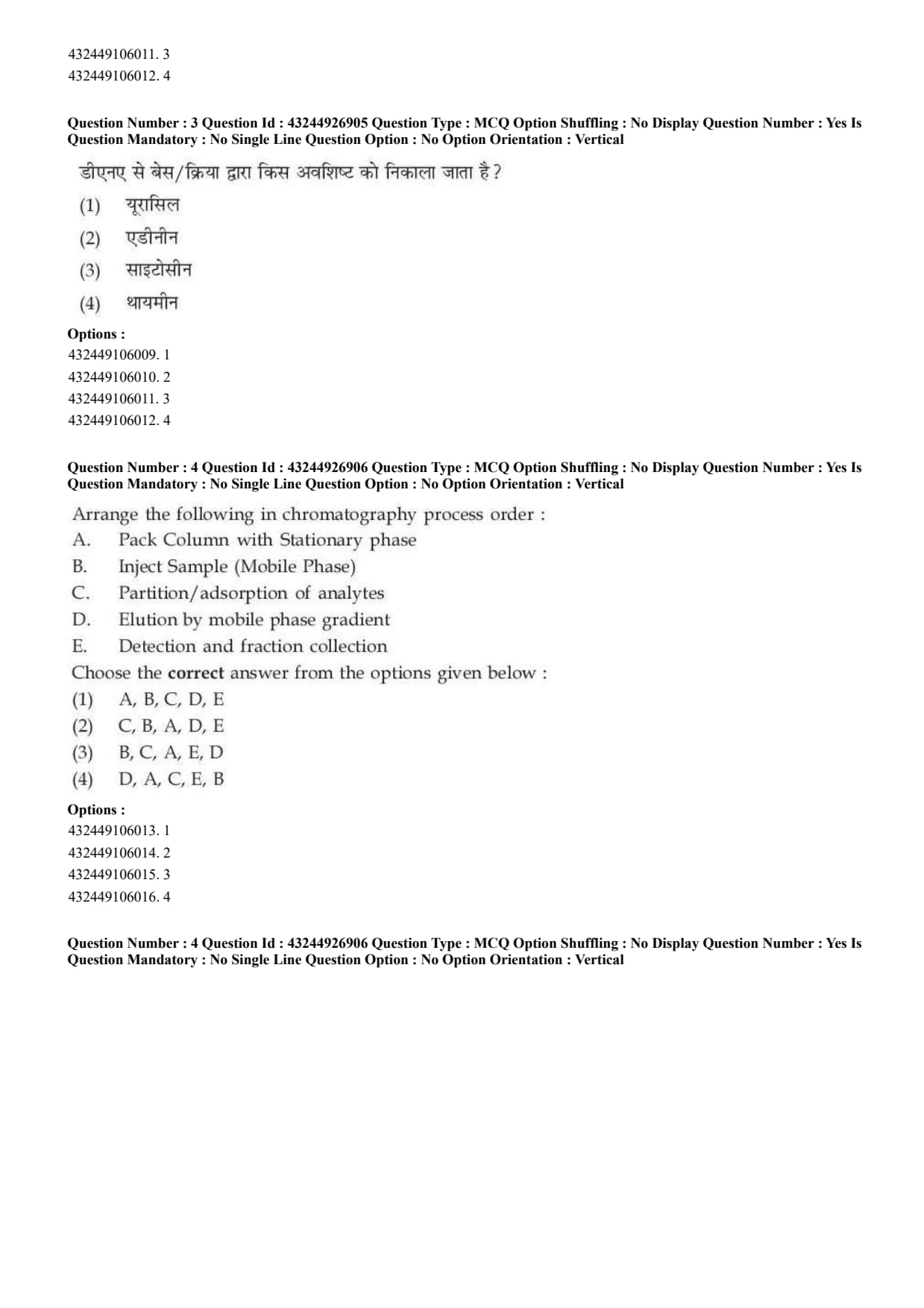
Arrange the following in chromatography process order:
A. Pack column with stationary phase
B. Inject sample (mobile phase)
C. Partition/adsorption of analytes
D. Elution by mobile phase gradient
E. Detection and fraction collection.
View Solution
Concept:
Chromatography is a separation technique used to separate components of a mixture. It works on the basis of differential interaction of analytes with the stationary phase and mobile phase.
Step 1: First prepare the column.
Before separation begins, the column must be packed with the stationary phase.
\[ First step = A \]
Step 2: Introduce the sample.
After the column is prepared, the sample mixture is injected into the column along with the mobile phase.
\[ Second step = B \]
Step 3: Interaction of analytes.
Different molecules interact differently with the stationary phase and mobile phase. This causes partitioning or adsorption of analytes.
\[ Third step = C \]
Step 4: Elution process.
The mobile phase is passed through the column. Sometimes a gradient of mobile phase is used to elute different molecules at different times.
\[ Fourth step = D \]
Step 5: Detection and collection.
Finally, the separated molecules are detected and collected as fractions.
\[ Fifth step = E \]
Therefore, the correct order is: \[ A, B, C, D, E \]
\[ \therefore Correct Answer is (A) \] Quick Tip: In chromatography, remember the sequence: prepare the column, load the sample, allow interaction, elute the components, and then detect or collect the fractions.
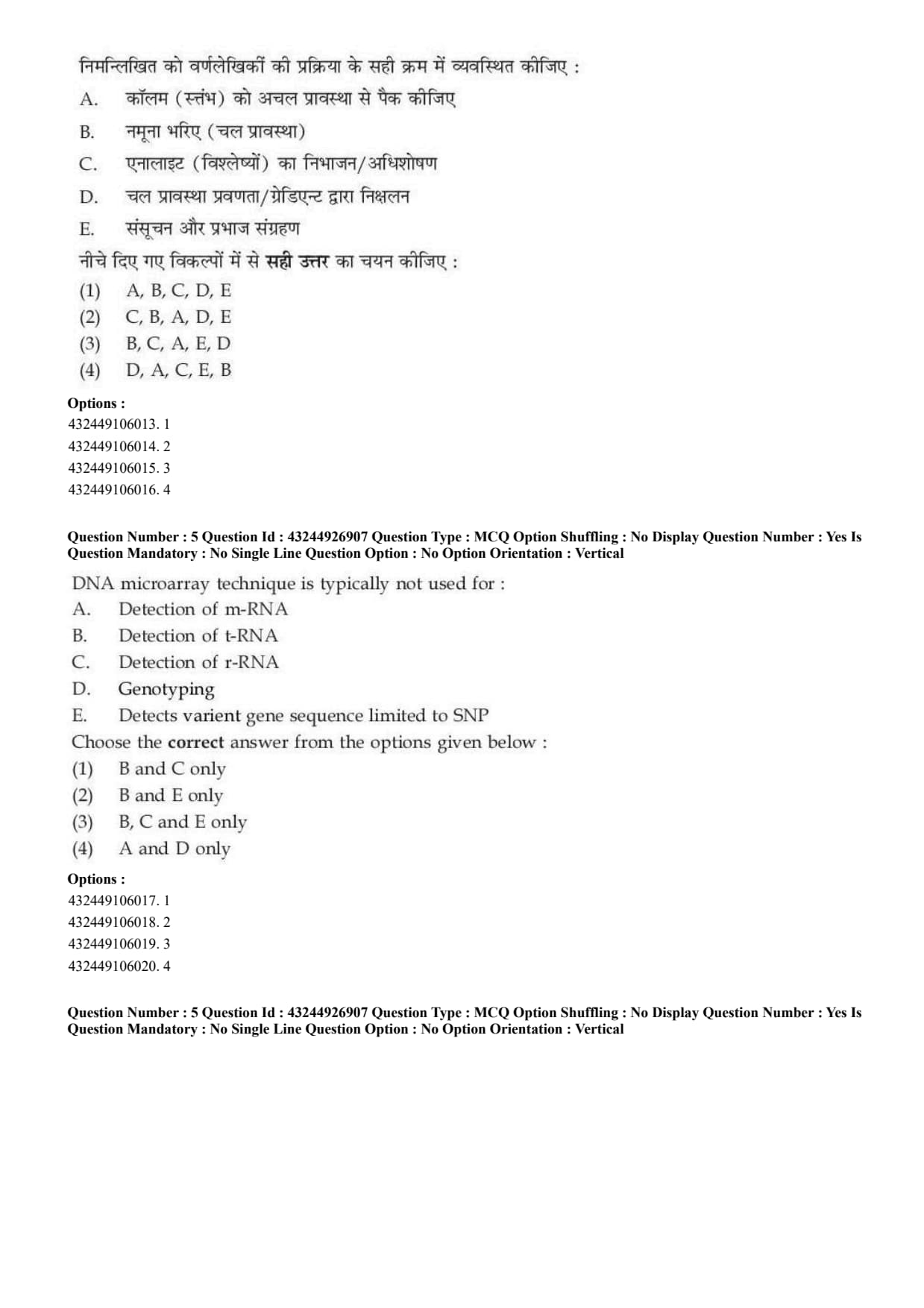
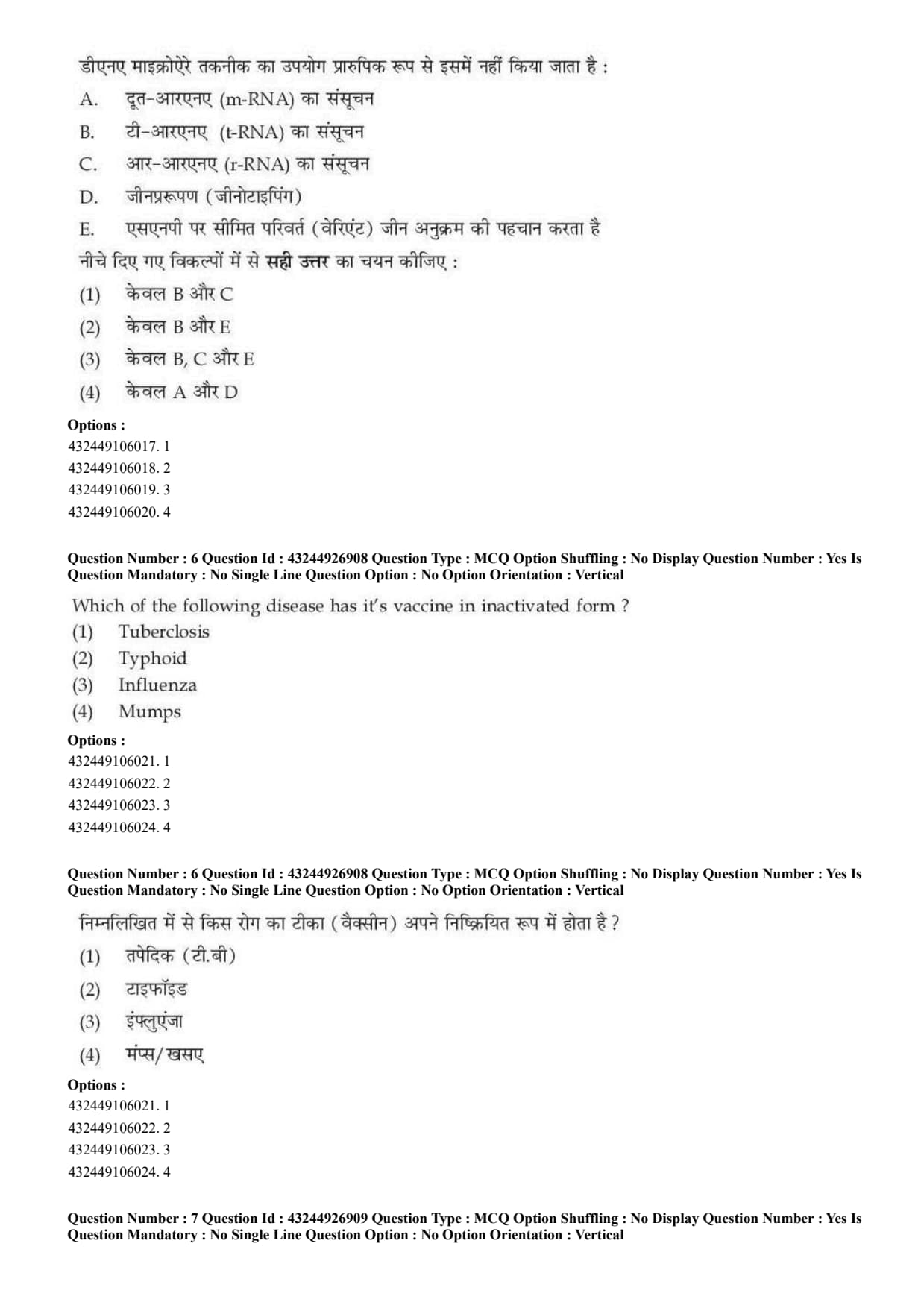
DNA microarray technique is typically not used for:
A. Detection of m-RNA
B. Detection of t-RNA
C. Detection of r-RNA
D. Genotyping
E. Detects variant gene sequence limited to SNP.
View Solution
Concept:
DNA microarray is a molecular biology technique used to detect the expression of many genes at the same time. It is mainly used for mRNA expression analysis, genotyping, and detection of sequence variations such as SNPs.
Step 1: Understand the main use of DNA microarray.
DNA microarray contains many DNA probes fixed on a solid surface. These probes hybridize with complementary nucleic acid sequences from the sample.
Step 2: Check statement A.
Detection of mRNA is one of the most common applications of microarray. In gene expression studies, mRNA is converted into complementary DNA and then hybridized with probes.
\[ A is used in microarray \]
Step 3: Check statement B.
tRNA detection is not a typical or common use of DNA microarray. tRNA molecules are small and are not usually studied using standard DNA microarray gene expression platforms.
\[ B is typically not used \]
Step 4: Check statement C.
rRNA detection is also not a typical application of DNA microarray. rRNA is highly abundant and is usually removed or ignored in gene expression analysis.
\[ C is typically not used \]
Step 5: Check statement D.
Genotyping is a common application of microarray. Microarrays are used to detect genetic variations among individuals.
\[ D is used in microarray \]
Step 6: Check statement E.
SNP detection is also an important application of microarray. SNP arrays are widely used for identifying single nucleotide polymorphisms.
\[ E is used in microarray \]
Hence, DNA microarray is typically not used for: \[ B and C only \]
\[ \therefore Correct Answer is (A) \] Quick Tip: DNA microarray is mainly used for gene expression analysis using mRNA, genotyping, and SNP detection. It is not typically used for tRNA and rRNA detection.
Which of the following disease has its vaccine in inactivated form?
View Solution
Concept:
Vaccines may be live attenuated, inactivated, toxoid, subunit, recombinant, or conjugate vaccines. An inactivated vaccine contains pathogens that have been killed or chemically inactivated so that they cannot reproduce.
Step 1: Understand inactivated vaccine.
Inactivated vaccines contain killed forms of the pathogen. Since the organism is dead, it cannot cause disease, but it can still stimulate the immune system.
Step 2: Check tuberculosis vaccine.
Tuberculosis vaccine is BCG. BCG is a live attenuated vaccine, not an inactivated vaccine.
\[ Tuberculosis \rightarrow Live attenuated vaccine \]
Step 3: Check mumps vaccine.
Mumps vaccine is usually given as part of MMR vaccine. It is also a live attenuated vaccine.
\[ Mumps \rightarrow Live attenuated vaccine \]
Step 4: Check influenza vaccine.
Influenza has commonly used inactivated vaccines. Inactivated influenza vaccines are widely used to provide protection against seasonal flu.
\[ Influenza \rightarrow Inactivated vaccine \]
Step 5: Final conclusion.
Among the given options, influenza is the disease whose vaccine is commonly available in inactivated form.
\[ \therefore Correct Answer is (C) \] Quick Tip: BCG and MMR are live attenuated vaccines, while influenza vaccine is commonly available as an inactivated vaccine.
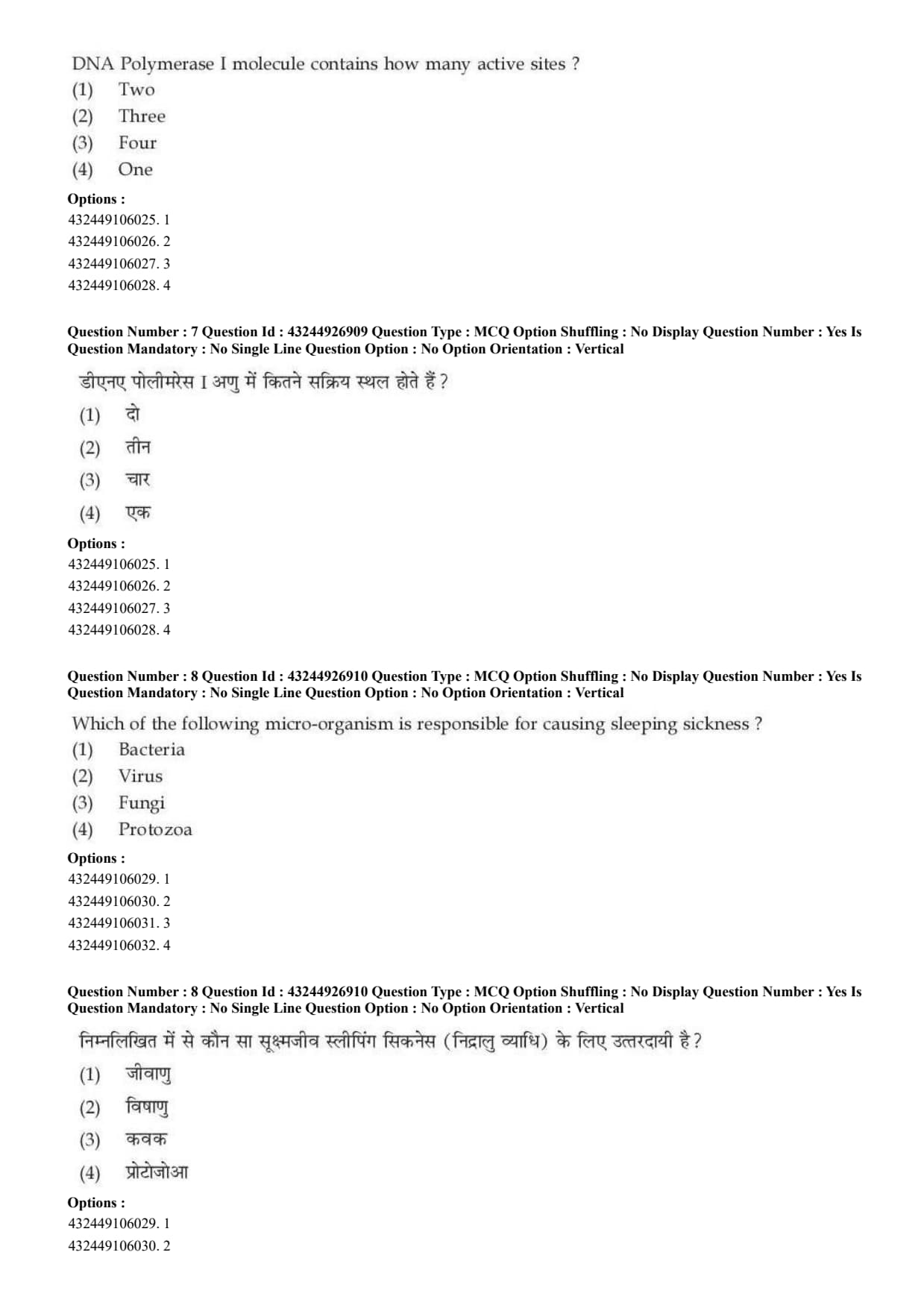
DNA Polymerase I molecule contains how many active sites?
View Solution
Concept:
DNA Polymerase I is an important enzyme involved in DNA replication and DNA repair in prokaryotes. It has multiple enzymatic activities.
Step 1: Identify the functions of DNA Polymerase I.
DNA Polymerase I has three major activities: \[ 1. \quad 5' \rightarrow 3' polymerase activity \] \[ 2. \quad 3' \rightarrow 5' exonuclease activity \] \[ 3. \quad 5' \rightarrow 3' exonuclease activity \]
Step 2: Understand polymerase activity.
The polymerase activity adds nucleotides to the growing DNA strand in the \(5' \rightarrow 3'\) direction.
Step 3: Understand proofreading activity.
The \(3' \rightarrow 5'\) exonuclease activity removes incorrectly added nucleotides. This provides proofreading ability.
Step 4: Understand primer removal activity.
The \(5' \rightarrow 3'\) exonuclease activity removes RNA primers during DNA replication and helps in repair processes.
Step 5: Count the active sites.
Since DNA Polymerase I has three functional enzymatic activities, it is considered to have three active sites.
\[ \therefore Correct Answer is (B) \] Quick Tip: DNA Polymerase I has three important activities: polymerase activity, proofreading exonuclease activity, and primer-removing exonuclease activity.
Which of the following micro-organism is responsible for causing sleeping sickness?
View Solution
Concept:
Sleeping sickness is also known as African trypanosomiasis. It is a parasitic disease caused by a protozoan parasite.
Step 1: Identify the disease.
Sleeping sickness is caused by the parasite: \[ Trypanosoma brucei \]
Step 2: Identify the type of organism.
Trypanosoma belongs to protozoa. Protozoa are unicellular eukaryotic organisms.
Step 3: Vector of sleeping sickness.
Sleeping sickness is transmitted by the bite of the tsetse fly.
\[ Tsetse fly \rightarrow Transmission of Trypanosoma \]
Step 4: Check the options.
Bacteria do not cause sleeping sickness.
Virus does not cause sleeping sickness.
Fungi do not cause sleeping sickness.
Protozoa cause sleeping sickness.
Therefore, the responsible micro-organism is: \[ Protozoa \]
\[ \therefore Correct Answer is (D) \] Quick Tip: Sleeping sickness is caused by the protozoan parasite \textit{Trypanosoma brucei, which is transmitted by the tsetse fly.
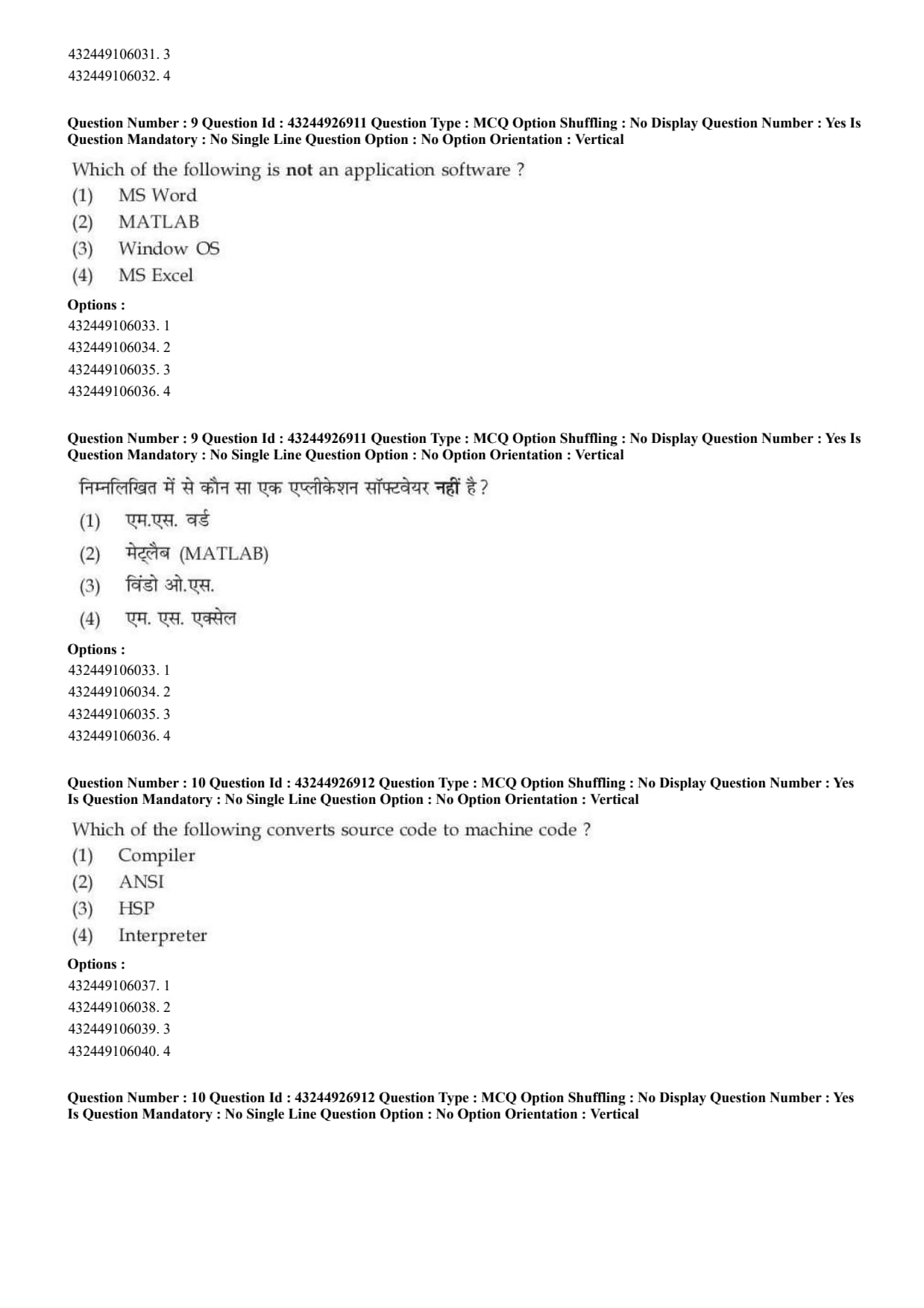
Which of the following is not an application software?
View Solution
Concept:
Software is generally divided into two main categories: system software and application software.
Step 1: Understand application software.
Application software is designed to perform specific tasks for users. Examples include word processing, spreadsheet creation, data analysis, and mathematical computation.
Step 2: Check MS Word.
MS Word is used for document creation and editing. Therefore, it is application software.
\[ MS Word \rightarrow Application software \]
Step 3: Check MATLAB.
MATLAB is used for numerical computation, programming, simulation, and data analysis. Therefore, it is application software.
\[ MATLAB \rightarrow Application software \]
Step 4: Check MS Excel.
MS Excel is used for spreadsheets, calculations, charts, and data analysis. Therefore, it is application software.
\[ MS Excel \rightarrow Application software \]
Step 5: Check Window OS.
Windows OS is an operating system. It manages computer hardware, memory, files, and provides a platform for application software to run.
\[ Window OS \rightarrow System software \]
Therefore, Window OS is not application software.
\[ \therefore Correct Answer is (C) \] Quick Tip: Operating systems like Windows, Linux, and macOS are system software. Programs like MS Word, MS Excel, and MATLAB are application software.
Which of the following converts source code to machine code?
View Solution
Concept:
A computer can directly understand only machine code, which is written in binary form. Source code written by programmers in high-level languages must be converted into machine code before execution.
Step 1: Understand source code.
Source code is the program written by a programmer using a high-level language such as C, C++, Java, or Python.
Step 2: Understand machine code.
Machine code is the binary instruction format that can be directly executed by the CPU.
\[ Machine code = Binary instructions understood by computer \]
Step 3: Role of compiler.
A compiler translates the entire source code into machine code or object code before execution.
\[ Source Code \xrightarrow{Compiler} Machine Code \]
Step 4: Compare with interpreter.
An interpreter translates and executes code line by line. It does not generally convert the complete source program into machine code at once like a compiler.
Step 5: Check other options.
ANSI is a standards organization, not a translator.
HSP is not the correct answer here.
Interpreter translates line by line, but the standard answer for converting source code to machine code is compiler.
Therefore: \[ Compiler converts source code into machine code. \]
\[ \therefore Correct Answer is (A) \] Quick Tip: Compiler converts the complete source code into machine code before execution. Interpreter executes the program line by line.
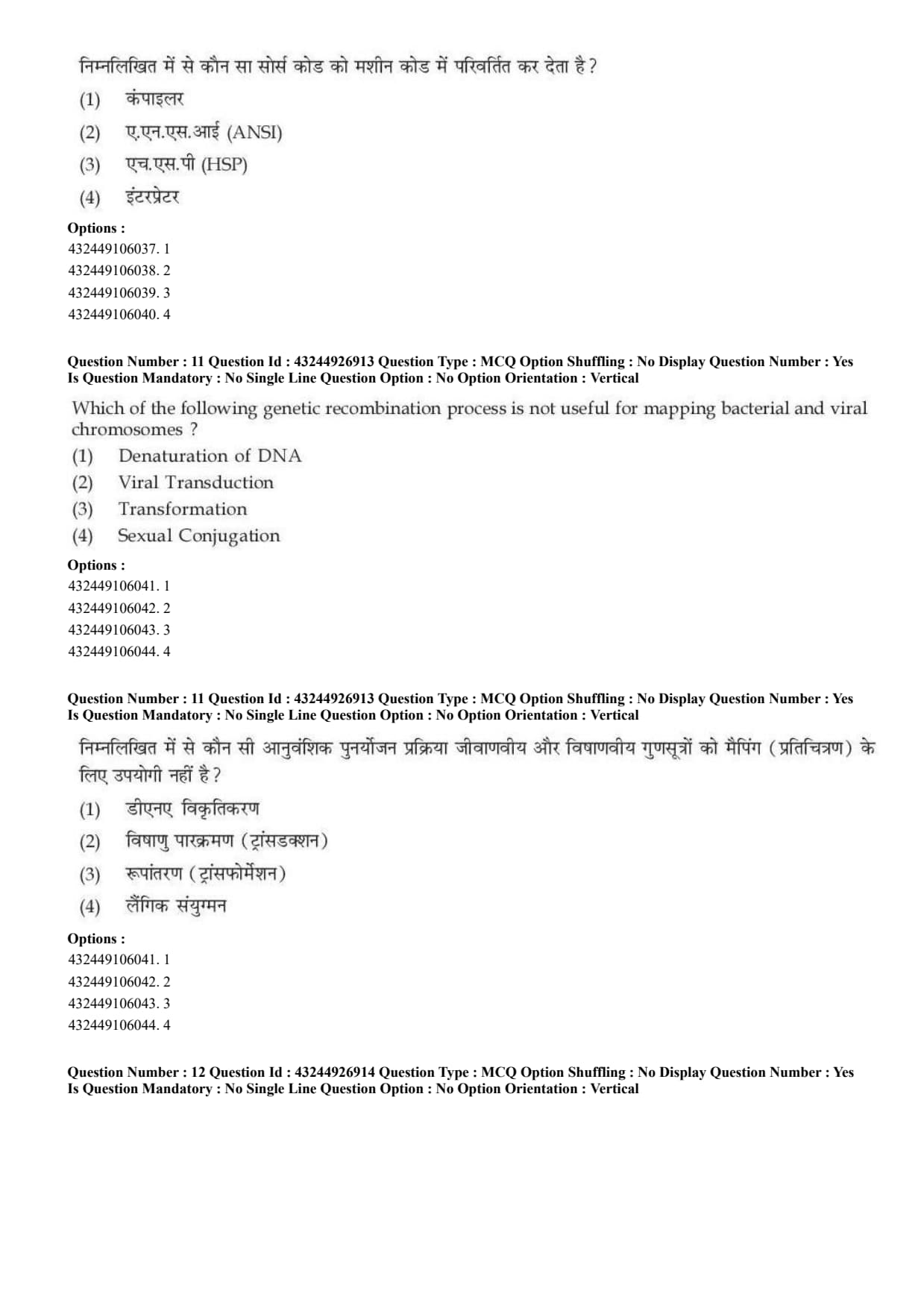
Which of the following genetic recombination process is not useful for mapping bacterial and viral chromosomes?
View Solution
Concept:
Genetic recombination is an important biological process in which genetic material is exchanged between organisms or cells. In bacteria and viruses, recombination methods are very useful for genetic mapping because they help to determine the relative position of genes on chromosomes.
Step 1: Understand genetic mapping.
Genetic mapping means finding the arrangement and relative position of genes on a chromosome. In bacteria and viruses, mapping is often done using recombination-based methods.
Step 2: Check viral transduction.
Viral transduction occurs when a bacteriophage transfers genetic material from one bacterium to another. This process is useful in bacterial gene mapping.
\[ Viral transduction \rightarrow Useful for mapping \]
Step 3: Check transformation.
Transformation occurs when bacteria take up free DNA from the surroundings. This can be used to study linkage and gene position.
\[ Transformation \rightarrow Useful for mapping \]
Step 4: Check sexual conjugation.
Sexual conjugation involves transfer of DNA from donor bacterium to recipient bacterium through direct contact. It is very useful in bacterial chromosome mapping.
\[ Sexual conjugation \rightarrow Useful for mapping \]
Step 5: Check denaturation of DNA.
Denaturation of DNA means separation of two DNA strands by breaking hydrogen bonds. It is a physical process, not a genetic recombination process. Therefore, it is not useful for mapping bacterial and viral chromosomes.
\[ \therefore Correct Answer is (A) \] Quick Tip: For bacterial genetic mapping, remember three important recombination-related methods: transformation, transduction, and conjugation. DNA denaturation is only strand separation, not recombination.
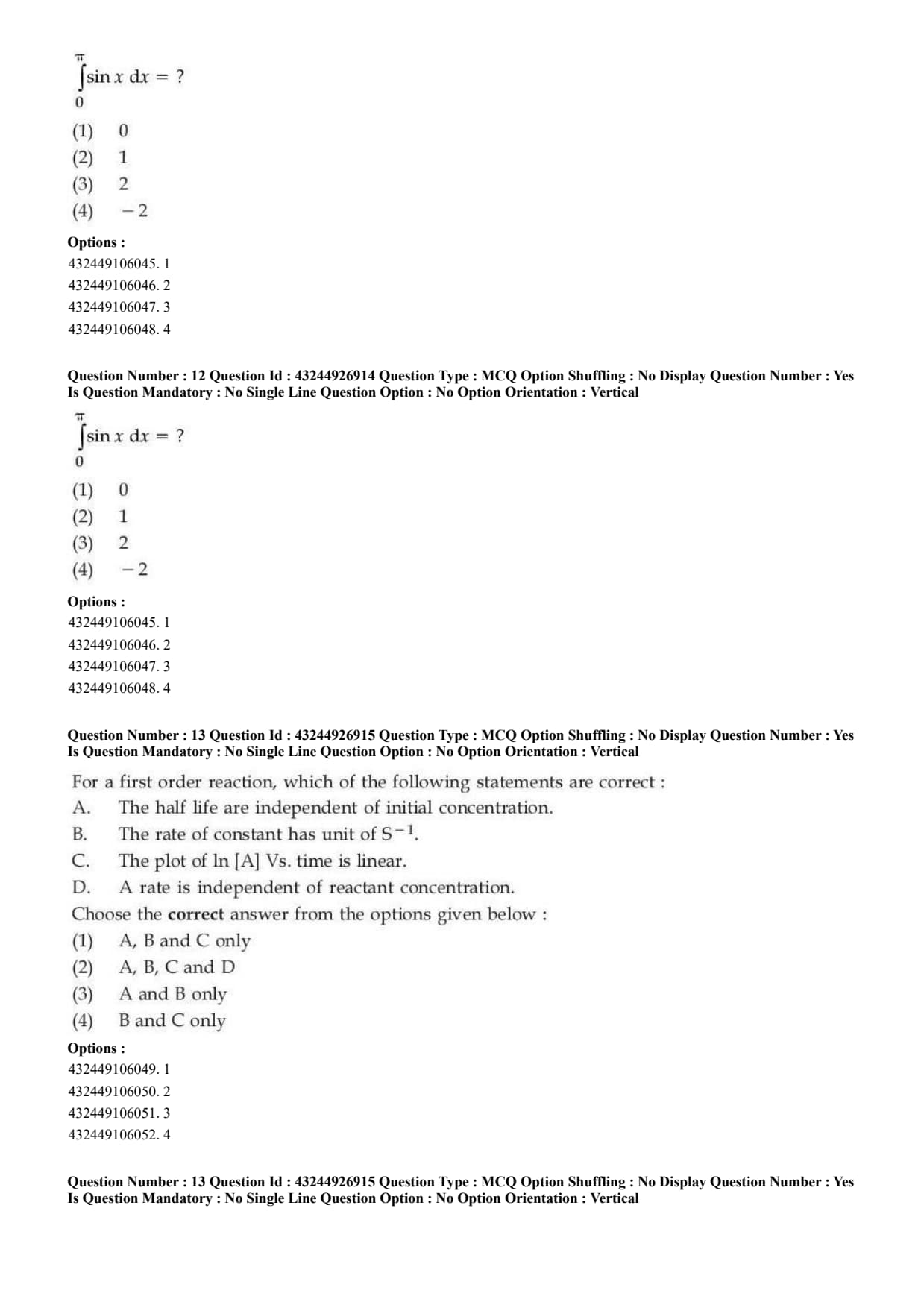
\(\displaystyle \int_{0}^{\pi} \sin x \, dx = ?\)
View Solution
Concept:
Definite integration is used to calculate the area under a curve between two given limits. Here, we have to integrate the trigonometric function \(\sin x\) from \(0\) to \(\pi\).
Step 1: Write the given integral. \[ I = \int_{0}^{\pi} \sin x \, dx \]
Step 2: Find the antiderivative of \(\sin x\). \[ \int \sin x \, dx = -\cos x \]
Therefore, \[ I = \left[-\cos x\right]_{0}^{\pi} \]
Step 3: Apply the upper and lower limits. \[ I = -\cos \pi - \left(-\cos 0\right) \]
We know that: \[ \cos \pi = -1 \]
and \[ \cos 0 = 1 \]
Step 4: Substitute the values. \[ I = -(-1) - (-1) \] \[ I = 1 + 1 \] \[ I = 2 \]
Therefore, \[ \int_{0}^{\pi} \sin x \, dx = 2 \]
\[ \therefore Correct Answer is (C) \] Quick Tip: For \(\int_{0}^{\pi} \sin x\,dx\), always remember the answer is \(2\), because the curve of \(\sin x\) remains positive between \(0\) and \(\pi\).
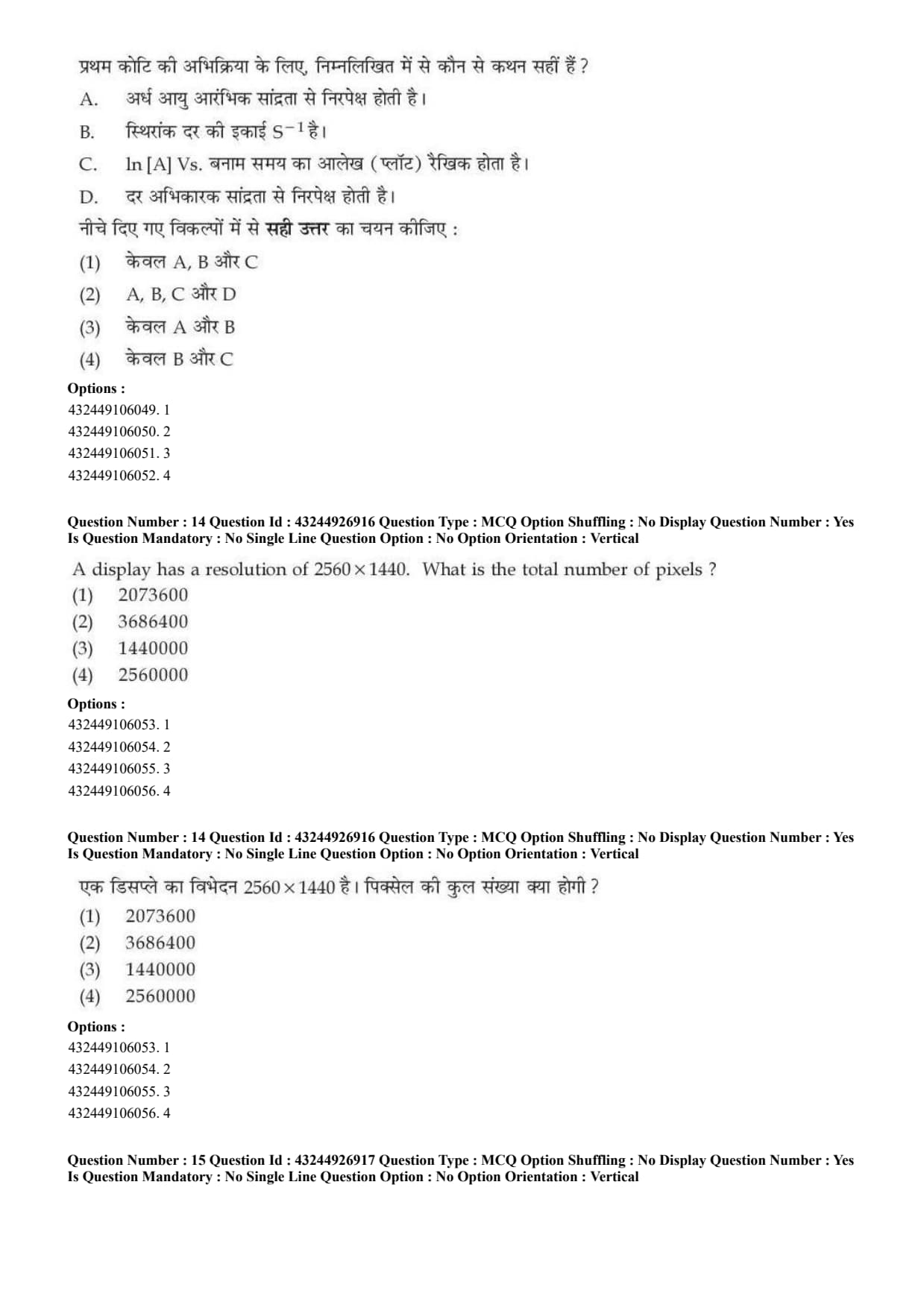
For a first order reaction, which of the following statements are correct?
A. The half life are independent of initial concentration.
B. The rate of constant has unit of \(s^{-1}\).
C. The plot of \(\ln[A]\) vs. time is linear.
D. A rate is independent of reactant concentration.
View Solution
Concept:
For a first order reaction, the rate of reaction depends directly on the concentration of one reactant. The general rate law is: \[ Rate = k[A] \]
where \(k\) is the rate constant and \([A]\) is the concentration of reactant.
Step 1: Check statement A.
For a first order reaction, half-life is given by: \[ t_{1/2} = \frac{0.693}{k} \]
This formula does not contain initial concentration. Therefore, the half-life of a first order reaction is independent of initial concentration.
\[ A is correct \]
Step 2: Check statement B.
For a first order reaction: \[ Rate = k[A] \]
The unit of rate is: \[ mol L^{-1}s^{-1} \]
The unit of concentration is: \[ mol L^{-1} \]
So, \[ k = \frac{Rate}{[A]} \] \[ k = \frac{mol L^{-1}s^{-1}}{mol L^{-1}} \] \[ k = s^{-1} \]
Therefore, the unit of rate constant for a first order reaction is \(s^{-1}\).
\[ B is correct \]
Step 3: Check statement C.
The integrated rate equation for a first order reaction is: \[ \ln[A] = \ln[A]_0 - kt \]
This equation is similar to: \[ y = c + mx \]
Hence, the plot of \(\ln[A]\) versus time is a straight line.
\[ C is correct \]
Step 4: Check statement D.
For a first order reaction: \[ Rate = k[A] \]
This shows that the rate depends on reactant concentration. Therefore, the statement that rate is independent of reactant concentration is wrong.
\[ D is incorrect \]
Thus, correct statements are: \[ A, B and C only \]
\[ \therefore Correct Answer is (A) \] Quick Tip: For a first order reaction, remember: \(t_{1/2}=\frac{0.693}{k}\), unit of \(k\) is \(s^{-1}\), and \(\ln[A]\) vs time gives a straight line.
A display has a resolution of \(2560 \times 1440\). What is the total number of pixels?
View Solution
Concept:
Resolution of a display tells us the number of pixels present horizontally and vertically. If a display has resolution: \[ Width \times Height \]
then total number of pixels is: \[ Total pixels = Width \times Height \]
Step 1: Identify the given resolution. \[ 2560 \times 1440 \]
Here, \[ Width = 2560 \] \[ Height = 1440 \]
Step 2: Use the formula. \[ Total pixels = 2560 \times 1440 \]
Step 3: Multiply the values. \[ 2560 \times 1440 = 3686400 \]
Therefore, the total number of pixels is: \[ 3686400 \]
\[ \therefore Correct Answer is (B) \] Quick Tip: To find total pixels in a display, simply multiply horizontal pixels by vertical pixels.
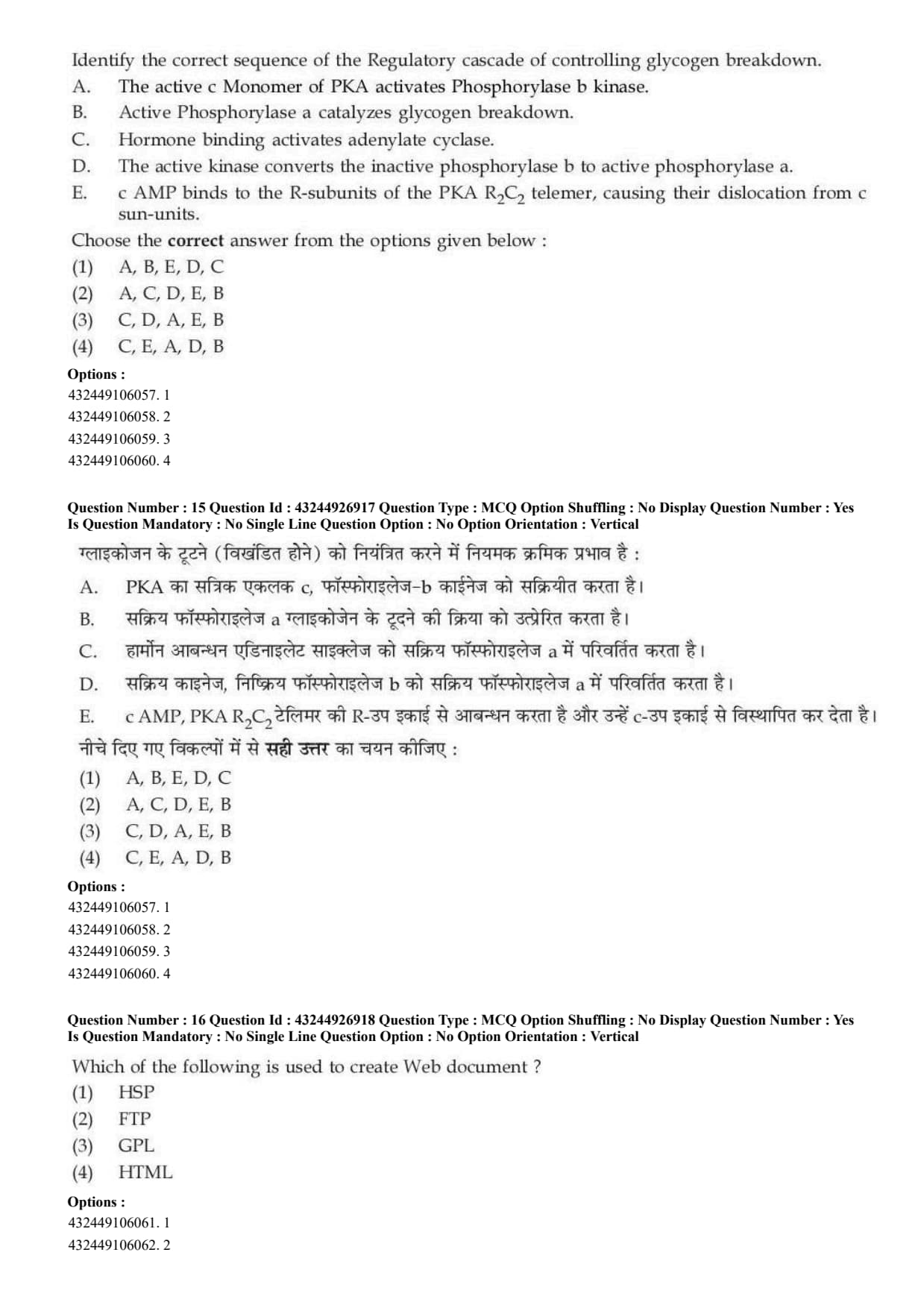
Identify the correct sequence of the Regulatory cascade of controlling glycogen breakdown.
A. The active C Monomer of PKA activates Phosphorylase b kinase.
B. Active Phosphorylase a catalyzes glycogen breakdown.
C. Hormone binding activates adenylate cyclase.
D. The active kinase converts the inactive phosphorylase b to active phosphorylase a.
E. cAMP binds to the R-subunits of the PKA \(R_2C_2\) tetramer, causing their dissociation from C sub-units.
View Solution
Concept:
Glycogen breakdown is controlled by a hormonal signaling cascade. This cascade involves hormone binding, formation of cAMP, activation of protein kinase A, activation of phosphorylase kinase, and finally activation of glycogen phosphorylase.
Step 1: Hormone binding starts the process.
The first event is hormone binding to its receptor. This activates adenylate cyclase.
\[ First step = C \]
Step 2: cAMP activates PKA.
Adenylate cyclase increases cAMP level. cAMP binds to the regulatory subunits of PKA and causes dissociation of catalytic subunits.
\[ Second step = E \]
Step 3: Catalytic subunit of PKA activates phosphorylase b kinase.
The active catalytic monomer of PKA phosphorylates and activates phosphorylase b kinase.
\[ Third step = A \]
Step 4: Phosphorylase b is converted into phosphorylase a.
The active kinase converts inactive phosphorylase b into active phosphorylase a.
\[ Fourth step = D \]
Step 5: Glycogen breakdown occurs.
Active phosphorylase a catalyzes the breakdown of glycogen.
\[ Fifth step = B \]
Therefore, the correct sequence is: \[ C, E, A, D, B \]
\[ \therefore Correct Answer is (D) \] Quick Tip: For glycogen breakdown cascade, remember the order: Hormone \(\rightarrow\) cAMP \(\rightarrow\) PKA \(\rightarrow\) phosphorylase kinase \(\rightarrow\) phosphorylase a \(\rightarrow\) glycogen breakdown.
Which of the following is used to create Web document?
View Solution
Concept:
A web document is a document that can be displayed in a web browser. Web pages are mainly created using HTML.
Step 1: Understand HTML.
HTML stands for: \[ HyperText Markup Language \]
It is used to structure content on web pages such as headings, paragraphs, tables, links, images, and forms.
Step 2: Check FTP.
FTP stands for File Transfer Protocol. It is used to transfer files from one system to another, not to create web documents.
Step 3: Check GPL.
GPL stands for General Public License. It is a software license, not a language for creating web documents.
Step 4: Check HTML.
HTML is the correct tool/language used to create web documents.
\[ Web document \rightarrow HTML \]
\[ \therefore Correct Answer is (D) \] Quick Tip: HTML is used to create the structure of web pages. CSS is used for styling and JavaScript is used for interactivity.
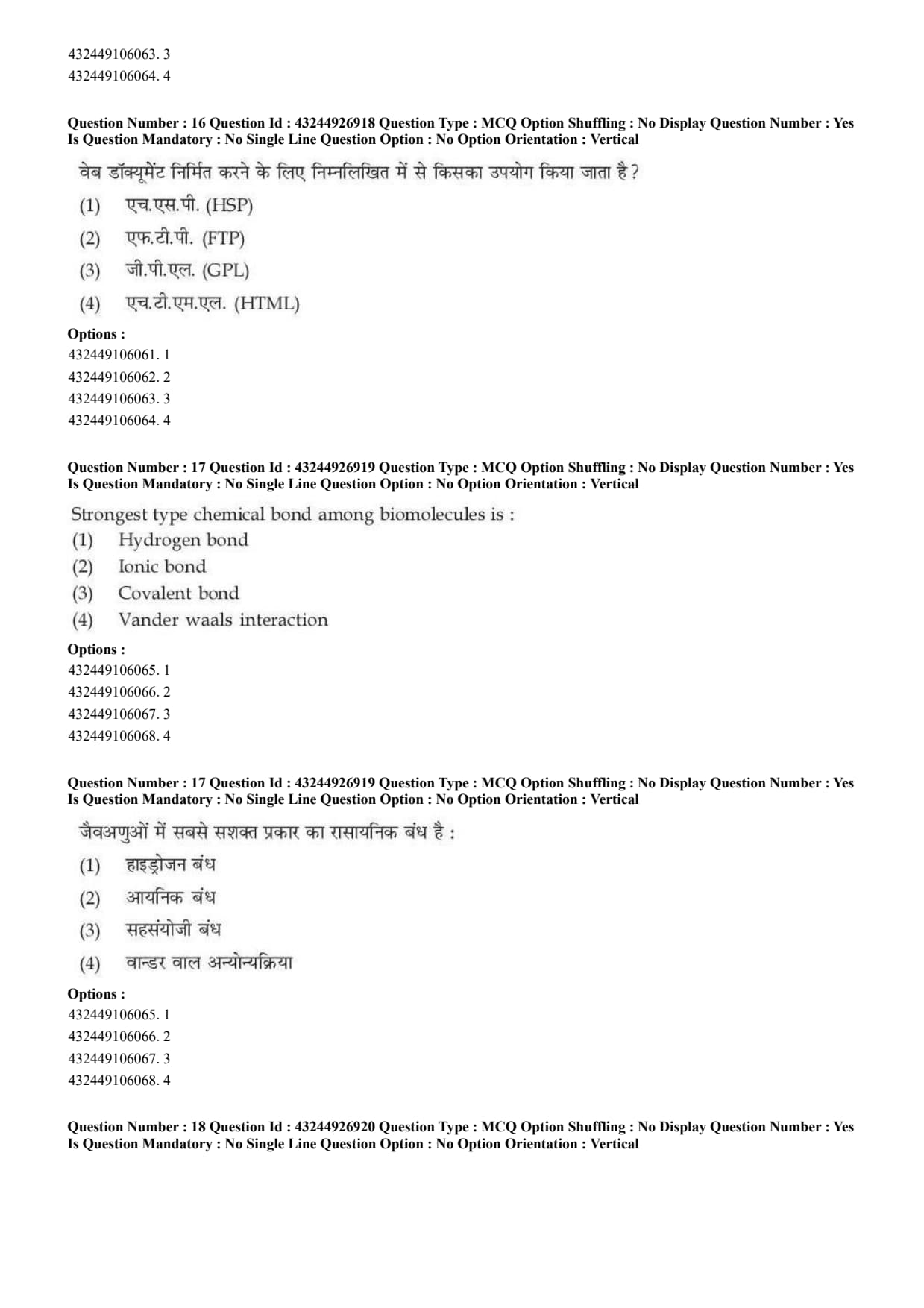
Strongest type chemical bond among biomolecules is:
View Solution
Concept:
Biomolecules are held together by different types of chemical interactions. These include covalent bonds, ionic bonds, hydrogen bonds, and van der Waals interactions.
Step 1: Understand covalent bond.
A covalent bond is formed by sharing of electrons between atoms. It is a strong chemical bond and forms the backbone of biomolecules such as proteins, nucleic acids, carbohydrates, and lipids.
Step 2: Understand hydrogen bond.
Hydrogen bonds are weaker than covalent bonds. They are important in DNA base pairing and protein secondary structure.
Step 3: Understand ionic bond.
Ionic bonds are electrostatic attractions between oppositely charged ions. They are strong in dry conditions but weaker in aqueous biological systems.
Step 4: Understand van der Waals interaction.
Van der Waals interactions are weak attractions between molecules. They are important collectively but individually weak.
Step 5: Compare the strength.
The general order of bond strength is: \[ Covalent bond > Ionic bond > Hydrogen bond > Van der Waals interaction \]
Therefore, the strongest bond among the given options is covalent bond.
\[ \therefore Correct Answer is (C) \] Quick Tip: Covalent bonds are the strongest bonds in biomolecules because they involve sharing of electrons between atoms.
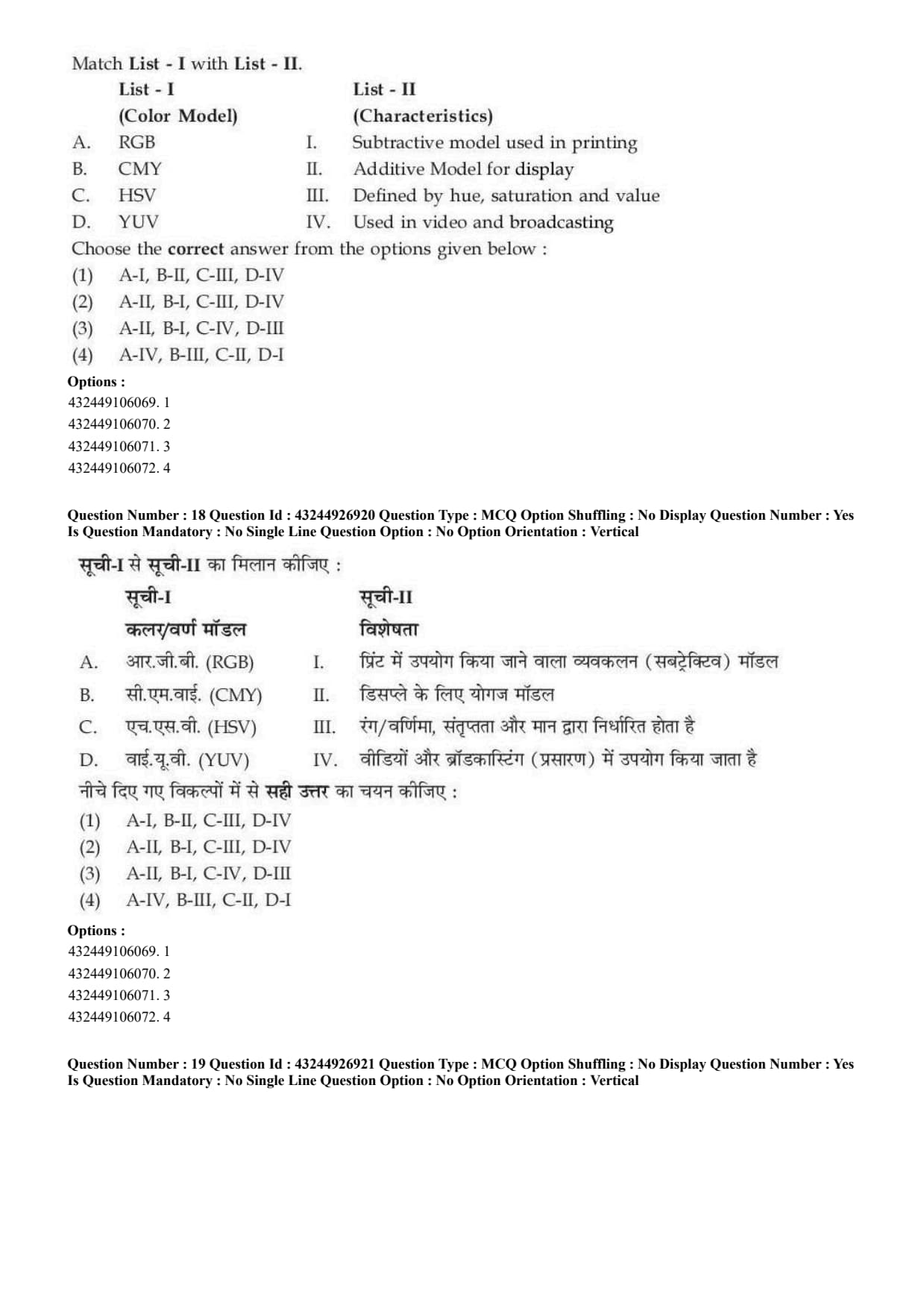
Match List-I with List-II.

View Solution
Concept:
Color models are mathematical models used to represent colors in digital imaging, printing, video, and broadcasting.
Step 1: Match RGB.
RGB stands for Red, Green, and Blue. It is an additive color model used in screens and display devices.
\[ A \rightarrow II \]
Step 2: Match CMY.
CMY stands for Cyan, Magenta, and Yellow. It is a subtractive color model used mainly in printing.
\[ B \rightarrow I \]
Step 3: Match HSV.
HSV stands for Hue, Saturation, and Value. It represents colors based on these three properties.
\[ C \rightarrow III \]
Step 4: Match YUV.
YUV separates brightness information from color information and is commonly used in video and broadcasting.
\[ D \rightarrow IV \]
Therefore, the correct matching is: \[ A-II,\ B-I,\ C-III,\ D-IV \]
\[ \therefore Correct Answer is (B) \] Quick Tip: RGB is used for displays, CMY is used for printing, HSV is based on hue-saturation-value, and YUV is used in video broadcasting.
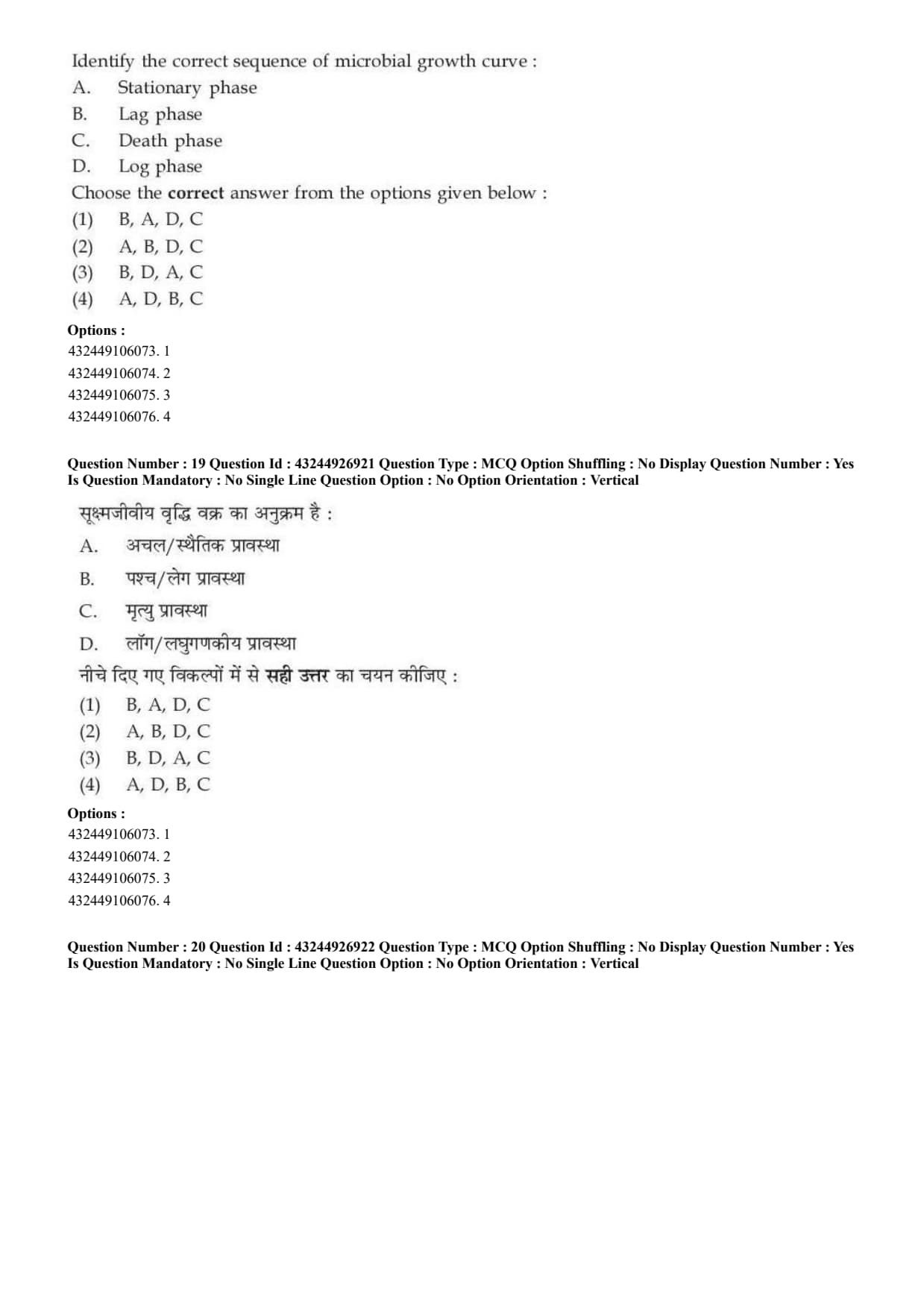
Identify the correct sequence of microbial growth curve:
A. Stationary phase
B. Lag phase
C. Death phase
D. Log phase.
View Solution
Concept:
A microbial growth curve shows the growth pattern of microorganisms in a closed culture system. It has four major phases.
Step 1: Lag phase.
In the lag phase, microorganisms adapt to the new environment. Cell division is slow or absent.
\[ First phase = B \]
Step 2: Log phase.
In the log phase, microorganisms divide rapidly and the population increases exponentially.
\[ Second phase = D \]
Step 3: Stationary phase.
In the stationary phase, the rate of cell division becomes equal to the rate of cell death. Nutrients become limited.
\[ Third phase = A \]
Step 4: Death phase.
In the death phase, cells die due to nutrient depletion and accumulation of toxic products.
\[ Fourth phase = C \]
Therefore, the correct order is: \[ B, D, A, C \]
\[ \therefore Correct Answer is (C) \] Quick Tip: Microbial growth curve sequence is: Lag phase \(\rightarrow\) Log phase \(\rightarrow\) Stationary phase \(\rightarrow\) Death phase.
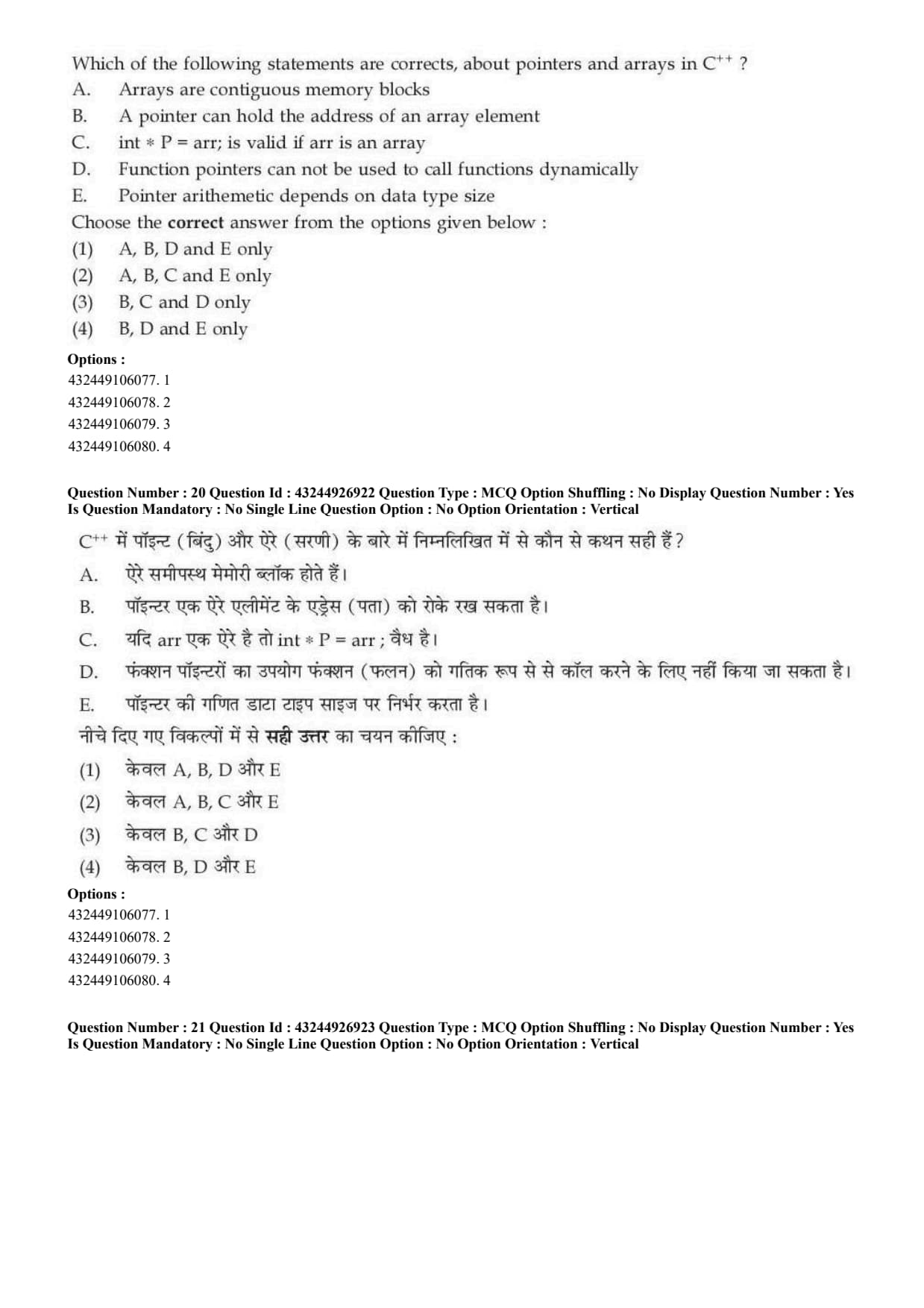
Which of the following statements are correct, about pointers and arrays in C++?
A. Arrays are contiguous memory blocks.
B. A pointer can hold the address of an array element.
C. \(int *P = arr;\) is valid if arr is an array.
D. Function pointers cannot be used to call functions dynamically.
E. Pointer arithmetic depends on data type size.
View Solution
Concept:
In C++, arrays and pointers are closely related. The name of an array usually represents the address of its first element.
Step 1: Check statement A.
Arrays store elements in contiguous memory locations.
\[ A is correct \]
Step 2: Check statement B.
A pointer stores the address of a variable. Therefore, it can store the address of an array element.
\[ B is correct \]
Step 3: Check statement C.
If \(arr\) is an integer array, then: \[ int *P = arr; \]
is valid because \(arr\) represents the address of the first element of the array.
\[ C is correct \]
Step 4: Check statement D.
Function pointers can be used to call functions dynamically. Therefore, the statement saying they cannot be used is incorrect.
\[ D is incorrect \]
Step 5: Check statement E.
Pointer arithmetic depends on the size of the data type. For example, if an integer takes 4 bytes, then incrementing an integer pointer moves it by 4 bytes.
\[ E is correct \]
Thus, the correct statements are: \[ A, B, C and E \]
\[ \therefore Correct Answer is (B) \] Quick Tip: Array name gives the base address of the array. Pointer arithmetic always moves according to the size of the data type.
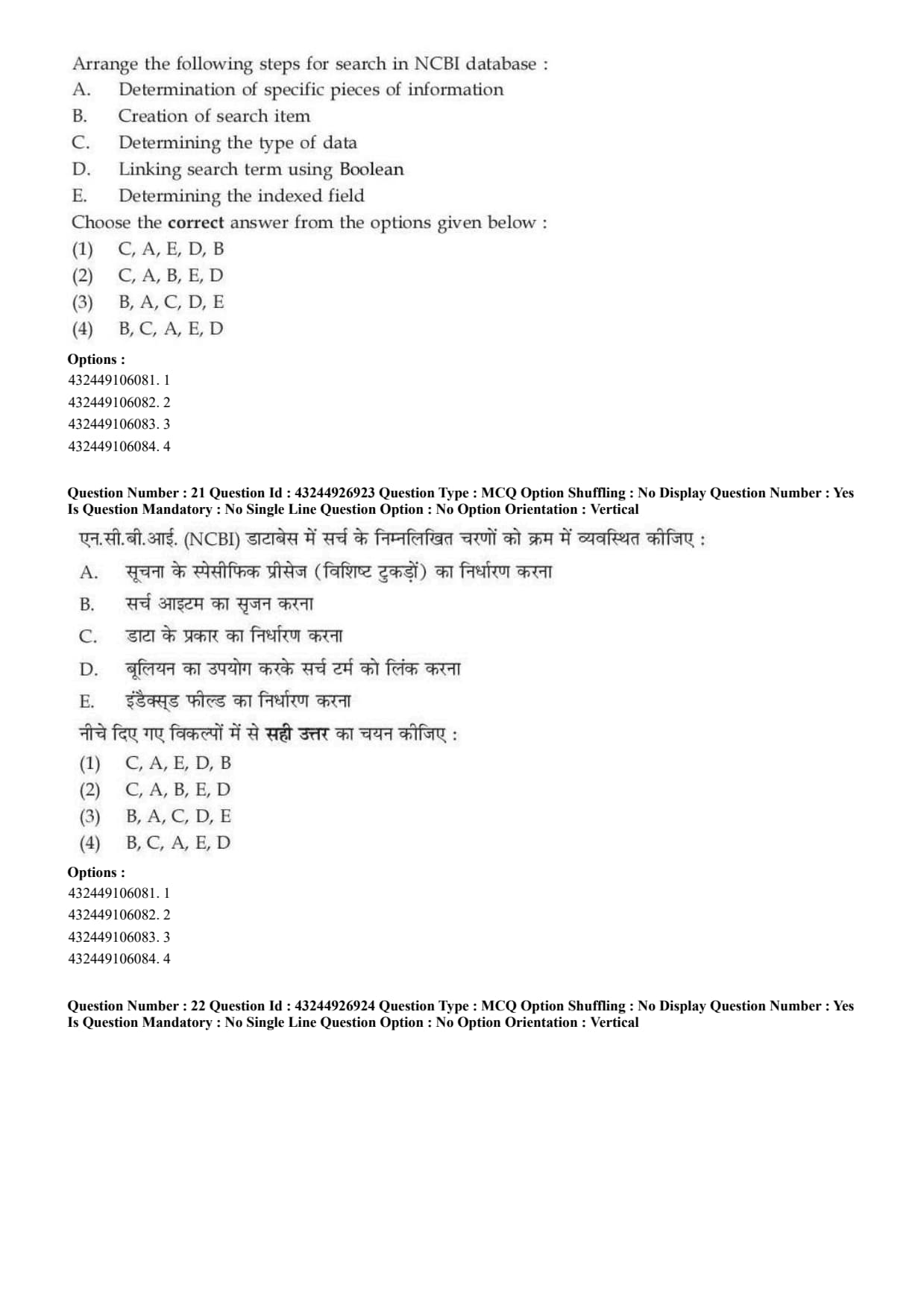
Arrange the following steps for search in NCBI database:
A. Determination of specific pieces of information
B. Creation of search item
C. Determining the type of data
D. Linking search term using Boolean
E. Determining the indexed field.
View Solution
Concept:
NCBI databases contain biological information such as nucleotide sequences, protein sequences, gene information, literature, and structural data. Searching effectively in NCBI requires a proper search strategy.
Step 1: Determine the type of data.
First, we decide what type of data we need, such as DNA sequence, protein sequence, gene record, or article.
\[ First step = C \]
Step 2: Determine specific information.
After deciding the data type, we identify the specific information required.
\[ Second step = A \]
Step 3: Determine indexed field.
Next, we decide the indexed field such as author, organism, gene name, accession number, or title.
\[ Third step = E \]
Step 4: Link search terms using Boolean operators.
Boolean operators such as AND, OR, and NOT are used to combine search terms.
\[ Fourth step = D \]
Step 5: Create the search item.
Finally, the complete search query is created and entered into the NCBI search box.
\[ Fifth step = B \]
Therefore, the correct sequence is: \[ C, A, E, D, B \]
\[ \therefore Correct Answer is (A) \] Quick Tip: For database searching, first decide the data type, then decide the exact information, choose indexed fields, connect terms using Boolean operators, and finally create the search query.
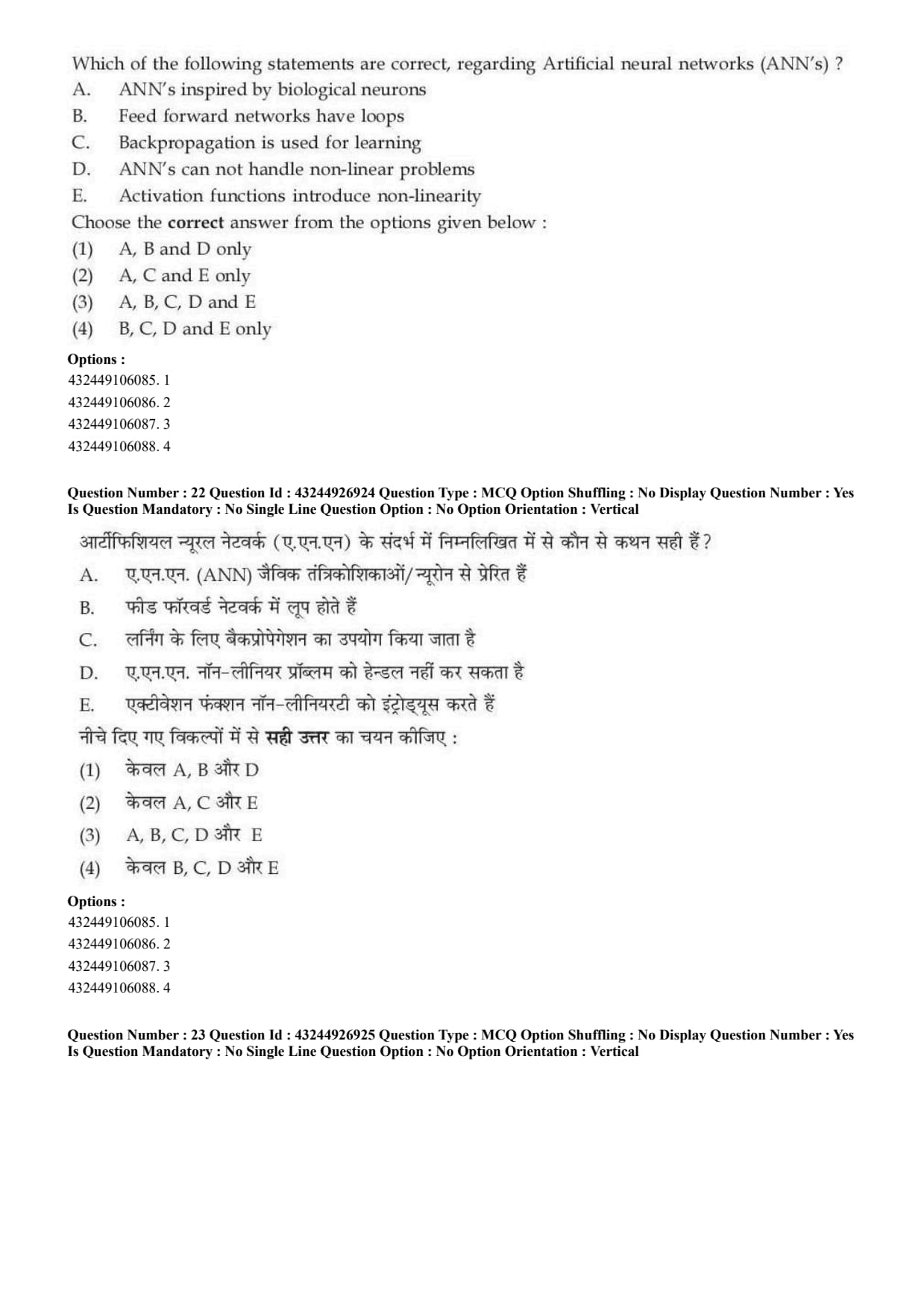
Which of the following statements are correct, regarding Artificial neural networks (ANN's)?
A. ANN's inspired by biological neurons.
B. Feed forward networks have loops.
C. Backpropagation is used for learning.
D. ANN's can not handle non-linear problems.
E. Activation functions introduce non-linearity.
View Solution
Concept:
Artificial Neural Networks are computational models inspired by the structure and functioning of biological neurons. They are widely used in machine learning and deep learning.
Step 1: Check statement A.
ANNs are inspired by biological neurons of the brain.
\[ A is correct \]
Step 2: Check statement B.
Feed forward networks do not have loops. In feed forward neural networks, information flows only in one direction from input layer to output layer.
\[ B is incorrect \]
Step 3: Check statement C.
Backpropagation is used to train neural networks by updating weights using error gradients.
\[ C is correct \]
Step 4: Check statement D.
ANNs can handle non-linear problems because they use activation functions.
\[ D is incorrect \]
Step 5: Check statement E.
Activation functions such as sigmoid, tanh, and ReLU introduce non-linearity into neural networks.
\[ E is correct \]
Therefore, correct statements are: \[ A, C and E \]
\[ \therefore Correct Answer is (B) \] Quick Tip: ANNs are inspired by biological neurons. Backpropagation helps in learning, and activation functions make neural networks capable of solving non-linear problems.
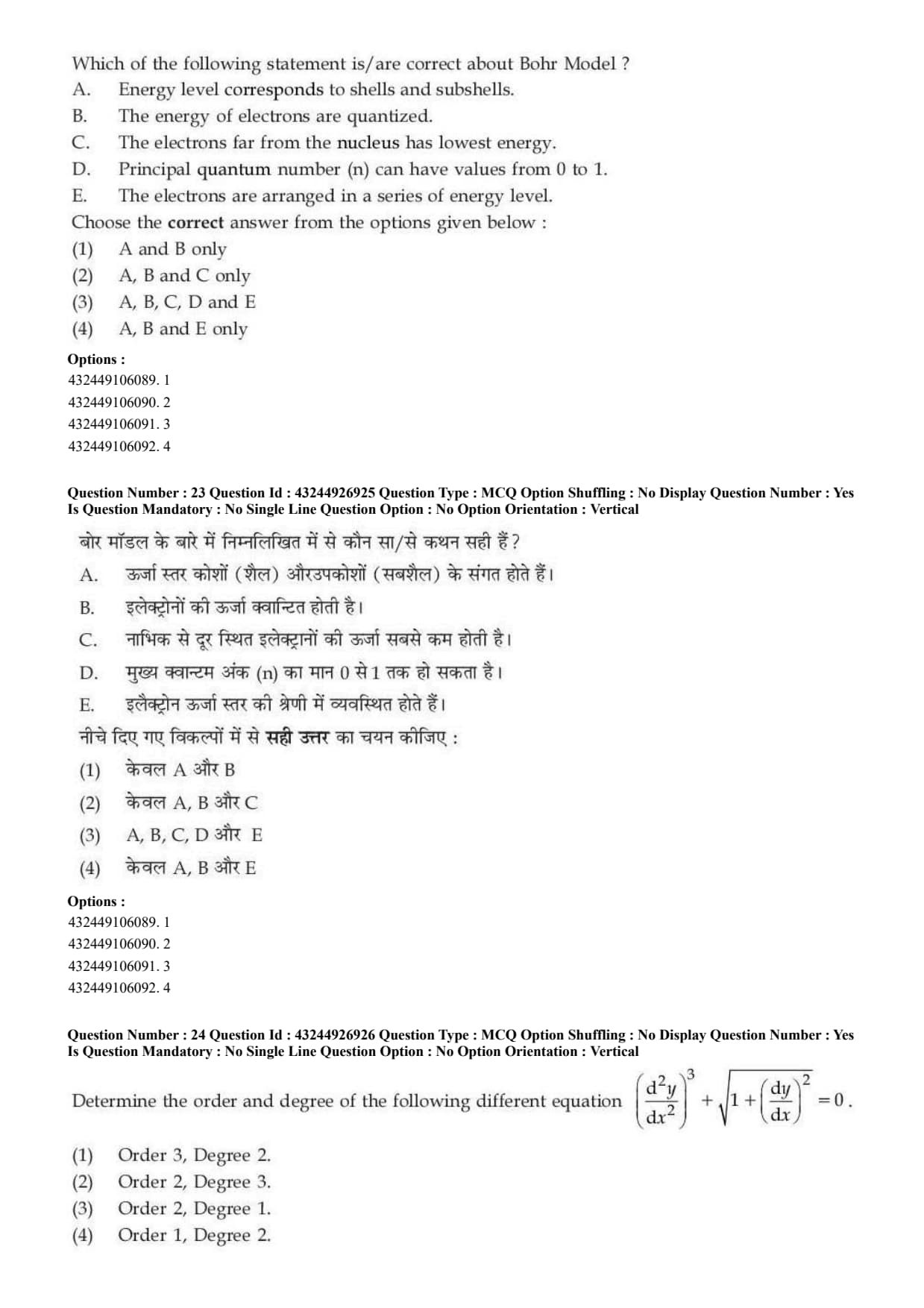
Which of the following statement is/are correct about Bohr Model?
A. Energy level corresponds to shells and subshells.
B. The energy of electrons are quantized.
C. The electrons far from the nucleus has lowest energy.
D. Principal quantum number \((n)\) can have values from 0 to 1.
E. The electrons are arranged in a series of energy level.
View Solution
Concept:
Bohr model explains the arrangement of electrons in atoms in fixed energy levels. According to this model, electrons revolve around the nucleus in definite orbits or shells.
Step 1: Check statement A.
Energy levels are related to shells. In atomic structure, shells and subshells describe electron arrangement.
\[ A is correct \]
Step 2: Check statement B.
According to Bohr model, electrons can have only certain fixed energies. This means energy is quantized.
\[ B is correct \]
Step 3: Check statement C.
Electrons farther from the nucleus have higher energy, not lower energy. Therefore, this statement is wrong.
\[ C is incorrect \]
Step 4: Check statement D.
Principal quantum number \(n\) cannot have values from 0 to 1 only. It has positive integral values: \[ n = 1, 2, 3, 4, \ldots \]
So statement D is incorrect.
\[ D is incorrect \]
Step 5: Check statement E.
Electrons are arranged in a series of energy levels around the nucleus.
\[ E is correct \]
Therefore, the correct statements are: \[ A, B and E \]
\[ \therefore Correct Answer is (D) \] Quick Tip: In Bohr model, electron energy is quantized and electrons are arranged in fixed energy levels. Higher shells have higher energy.
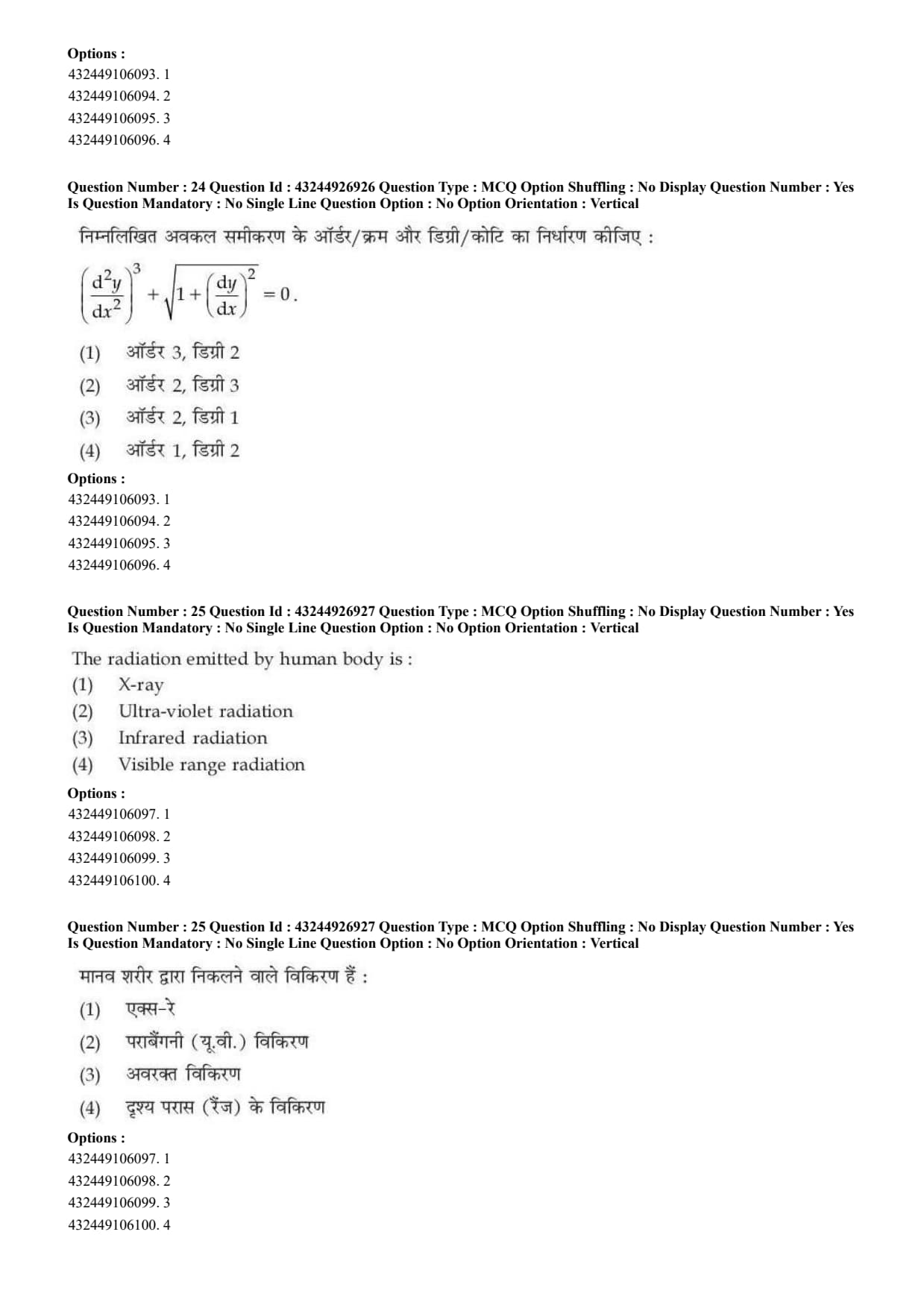
Determine the order and degree of the following differential equation: \(\left(\dfrac{d^2y}{dx^2}\right)^3 + \sqrt{1+\left(\dfrac{dy}{dx}\right)^2}=0.\)
View Solution
Concept:
The order of a differential equation is the order of the highest derivative present in the equation. The degree is the power of the highest order derivative when the equation is expressed in polynomial form with respect to derivatives.
Step 1: Write the given differential equation. \[ \left(\frac{d^2y}{dx^2}\right)^3 + \sqrt{1+\left(\frac{dy}{dx}\right)^2}=0 \]
Step 2: Identify the derivatives present.
The equation contains: \[ \frac{dy}{dx} \]
and \[ \frac{d^2y}{dx^2} \]
Step 3: Find the order.
The highest order derivative present is: \[ \frac{d^2y}{dx^2} \]
This is a second order derivative.
\[ Order = 2 \]
Step 4: Find the degree.
The highest order derivative is: \[ \frac{d^2y}{dx^2} \]
It appears with power \(3\): \[ \left(\frac{d^2y}{dx^2}\right)^3 \]
Therefore, \[ Degree = 3 \]
Thus, the order and degree are: \[ Order 2,\ Degree 3 \]
\[ \therefore Correct Answer is (B) \] Quick Tip: Order is decided by the highest derivative. Degree is decided by the power of the highest order derivative.
The radiation emitted by human body is:
View Solution
Concept:
Every object having temperature above absolute zero emits thermal radiation. The type of radiation emitted depends on the temperature of the object.
Step 1: Understand human body temperature.
The average temperature of the human body is approximately: \[ 37^\circ C \]
or about: \[ 310\ K \]
Step 2: Type of radiation emitted.
At this temperature, the human body emits radiation mainly in the infrared region of the electromagnetic spectrum.
Step 3: Eliminate other options.
Human body does not normally emit X-rays.
Human body does not normally emit ultraviolet radiation.
Visible radiation is emitted by very hot objects such as glowing metals or stars, not normally by the human body.
Therefore, the radiation emitted by the human body is: \[ Infrared radiation \]
\[ \therefore Correct Answer is (C) \] Quick Tip: Human body emits thermal radiation mainly in the infrared region. This is why thermal cameras detect humans using infrared radiation.
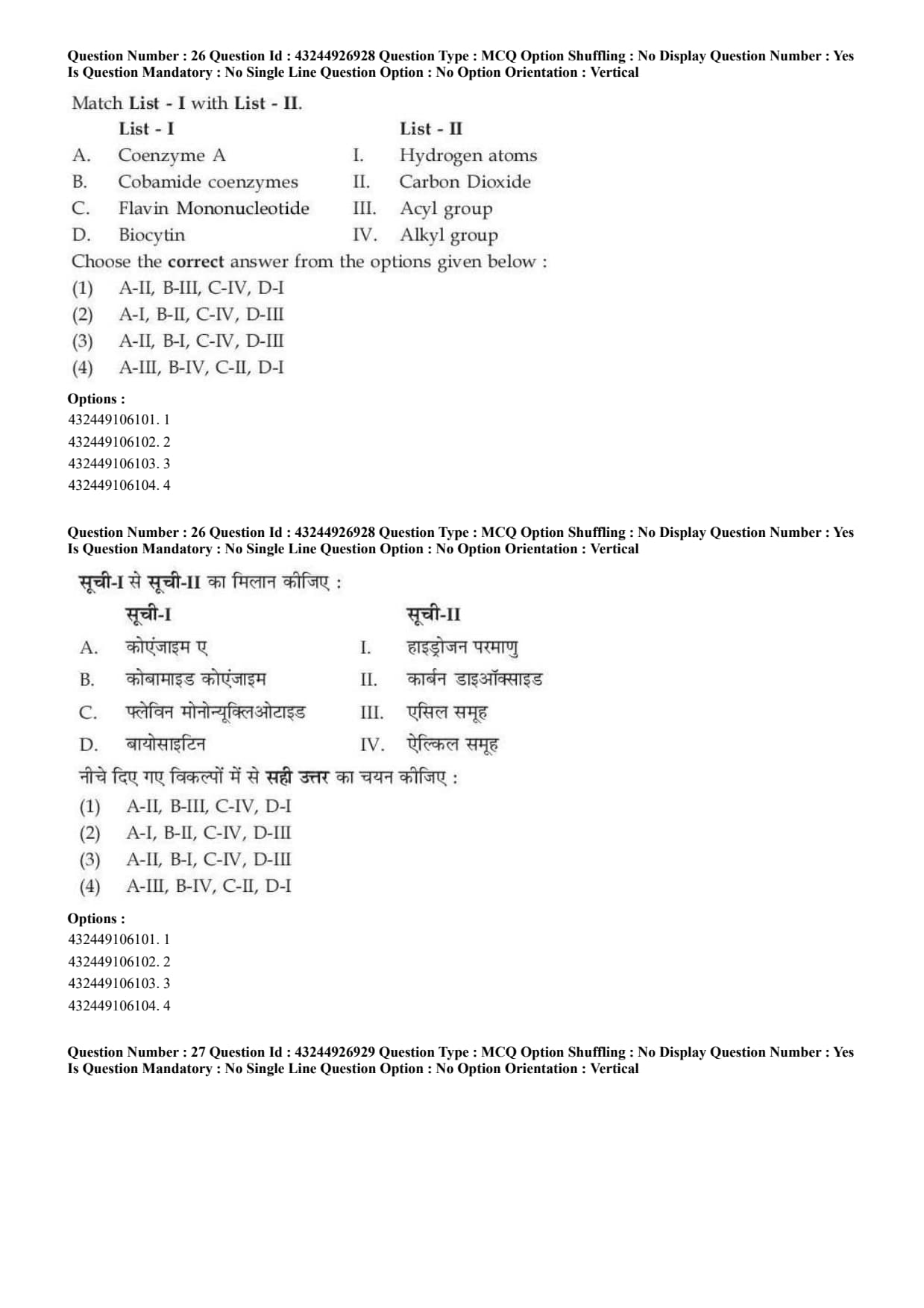
Match List-I with List-II.

View Solution
Concept:
Coenzymes help enzymes by carrying specific chemical groups during biochemical reactions.
Step 1: Match Coenzyme A.
Coenzyme A carries acyl groups during metabolism.
\[ A \rightarrow III \]
Step 2: Match Cobamide coenzymes.
Cobamide coenzymes, such as vitamin \(B_{12}\) derivatives, are involved in transfer of alkyl groups.
\[ B \rightarrow IV \]
Step 3: Match Flavin Mononucleotide.
Flavin mononucleotide is involved in oxidation-reduction reactions and carries hydrogen atoms or electrons.
\[ C \rightarrow I \]
Step 4: Match Biocytin.
Biocytin is involved in carboxylation reactions and carries carbon dioxide.
\[ D \rightarrow II \]
Therefore, the correct matching is: \[ A-III,\ B-IV,\ C-I,\ D-II \]
\[ \therefore Correct Answer is (D) \] Quick Tip: Remember: Coenzyme A carries acyl groups, FMN carries hydrogen/electrons, and biocytin carries carbon dioxide.
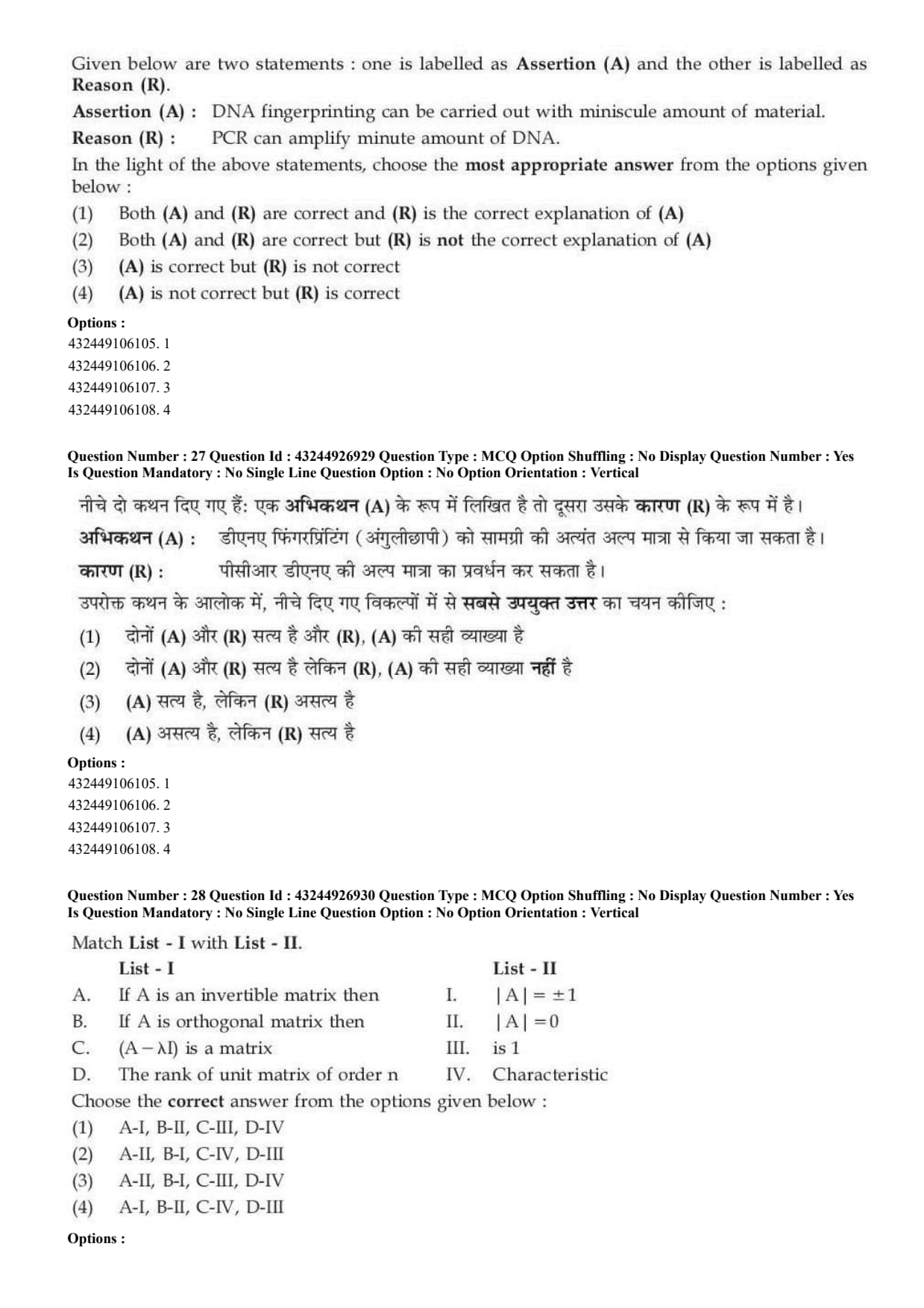
Given below are two statements:
Assertion (A): DNA fingerprinting can be carried out with minuscule amount of material.
Reason (R): PCR can amplify minute amount of DNA.
View Solution
Concept:
DNA fingerprinting is a molecular technique used to identify individuals based on their DNA patterns. PCR plays an important role because it can amplify very small amounts of DNA.
Step 1: Check Assertion (A).
DNA fingerprinting can be carried out using a very small amount of biological material such as blood, hair root, saliva, semen, or tissue.
\[ A is correct \]
Step 2: Check Reason (R).
PCR stands for Polymerase Chain Reaction. It can amplify minute amounts of DNA into millions of copies.
\[ R is correct \]
Step 3: Check whether R explains A.
DNA fingerprinting requires enough DNA for analysis. If the available DNA is very small, PCR can amplify it. Therefore, PCR explains why DNA fingerprinting can be done even with a very small amount of material.
\[ R correctly explains A \]
Therefore: \[ Both A and R are correct, and R is the correct explanation of A. \]
\[ \therefore Correct Answer is (A) \] Quick Tip: PCR is used to amplify small amounts of DNA, which makes DNA fingerprinting possible even from tiny biological samples.
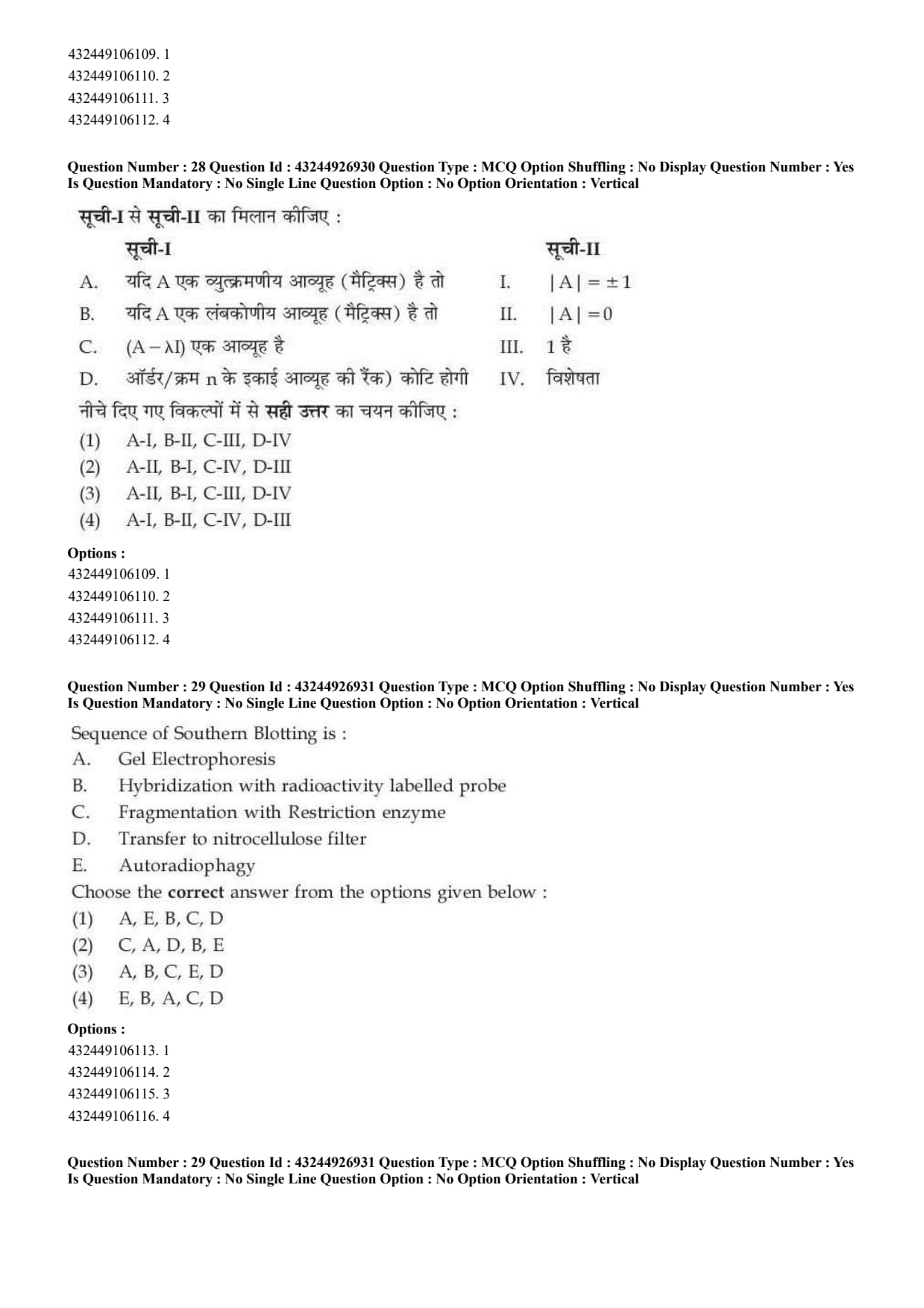
Match List-I with List-II.

View Solution
Concept:
This question is based on basic properties of matrices, determinant, orthogonal matrix, characteristic matrix, and rank of identity matrix.
Step 1: Match invertible matrix.
A matrix is invertible if its determinant is non-zero.
\[ |A| \ne 0 \]
Therefore, \[ A \rightarrow II \]
Step 2: Match orthogonal matrix.
For an orthogonal matrix \(A\): \[ A^T A = I \]
Taking determinant on both sides: \[ |A^T A| = |I| \] \[ |A^T||A| = 1 \] \[ |A|^2 = 1 \] \[ |A| = \pm 1 \]
Therefore, \[ B \rightarrow I \]
Step 3: Match \((A-\lambda I)\).
The matrix \((A-\lambda I)\) is called the characteristic matrix.
\[ C \rightarrow IV \]
Step 4: Match rank of unit matrix.
The unit matrix of order \(n\) has \(n\) linearly independent rows and columns. Therefore, its rank is \(n\).
\[ D \rightarrow III \]
Therefore, the correct matching is: \[ A-II,\ B-I,\ C-IV,\ D-III \]
\[ \therefore Correct Answer is (B) \] Quick Tip: Invertible matrix has non-zero determinant, orthogonal matrix has determinant \(\pm 1\), and rank of identity matrix of order \(n\) is \(n\).
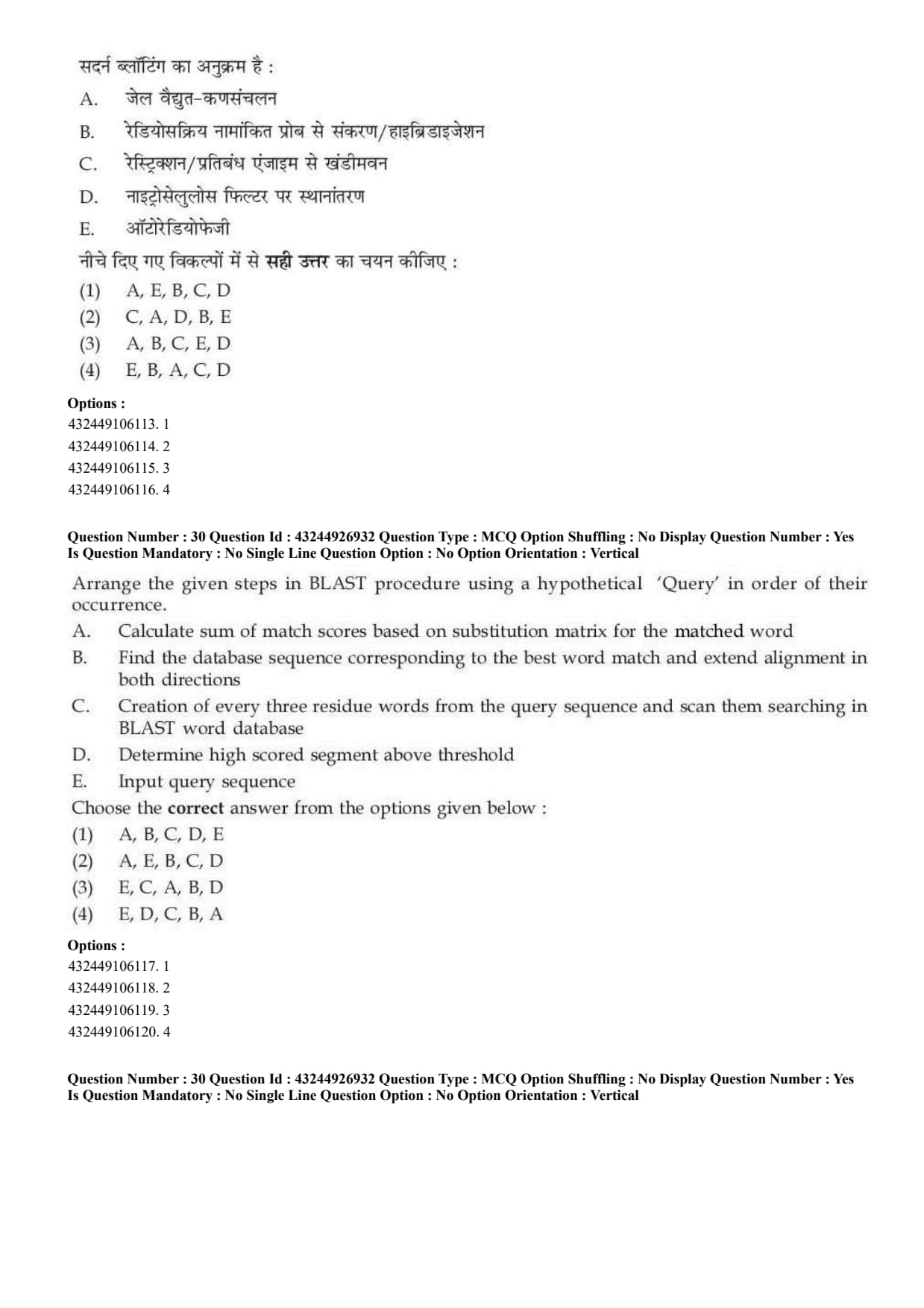
Sequence of Southern Blotting is:
A. Gel Electrophoresis
B. Hybridization with radioactivity labelled probe
C. Fragmentation with Restriction enzyme
D. Transfer to nitrocellulose filter
E. Autoradiophagy.
View Solution
Concept:
Southern blotting is a technique used to detect a specific DNA sequence in a DNA sample. It involves cutting DNA, separating fragments, transferring them to a membrane, hybridizing with a labelled probe, and detecting the signal.
Step 1: Fragmentation with restriction enzyme.
First, DNA is cut into smaller fragments using restriction enzymes.
\[ First step = C \]
Step 2: Gel electrophoresis.
The DNA fragments are separated according to size by gel electrophoresis.
\[ Second step = A \]
Step 3: Transfer to nitrocellulose filter.
The separated DNA fragments are transferred from the gel onto a nitrocellulose membrane or nylon membrane.
\[ Third step = D \]
Step 4: Hybridization with labelled probe.
A radioactive or labelled probe is added. It binds to the complementary DNA sequence.
\[ Fourth step = B \]
Step 5: Autoradiography.
Finally, autoradiography is used to detect the labelled DNA sequence.
\[ Fifth step = E \]
Therefore, the correct sequence is: \[ C, A, D, B, E \]
\[ \therefore Correct Answer is (B) \] Quick Tip: Southern blotting sequence: Restriction digestion \(\rightarrow\) Gel electrophoresis \(\rightarrow\) Transfer to membrane \(\rightarrow\) Probe hybridization \(\rightarrow\) Autoradiography.
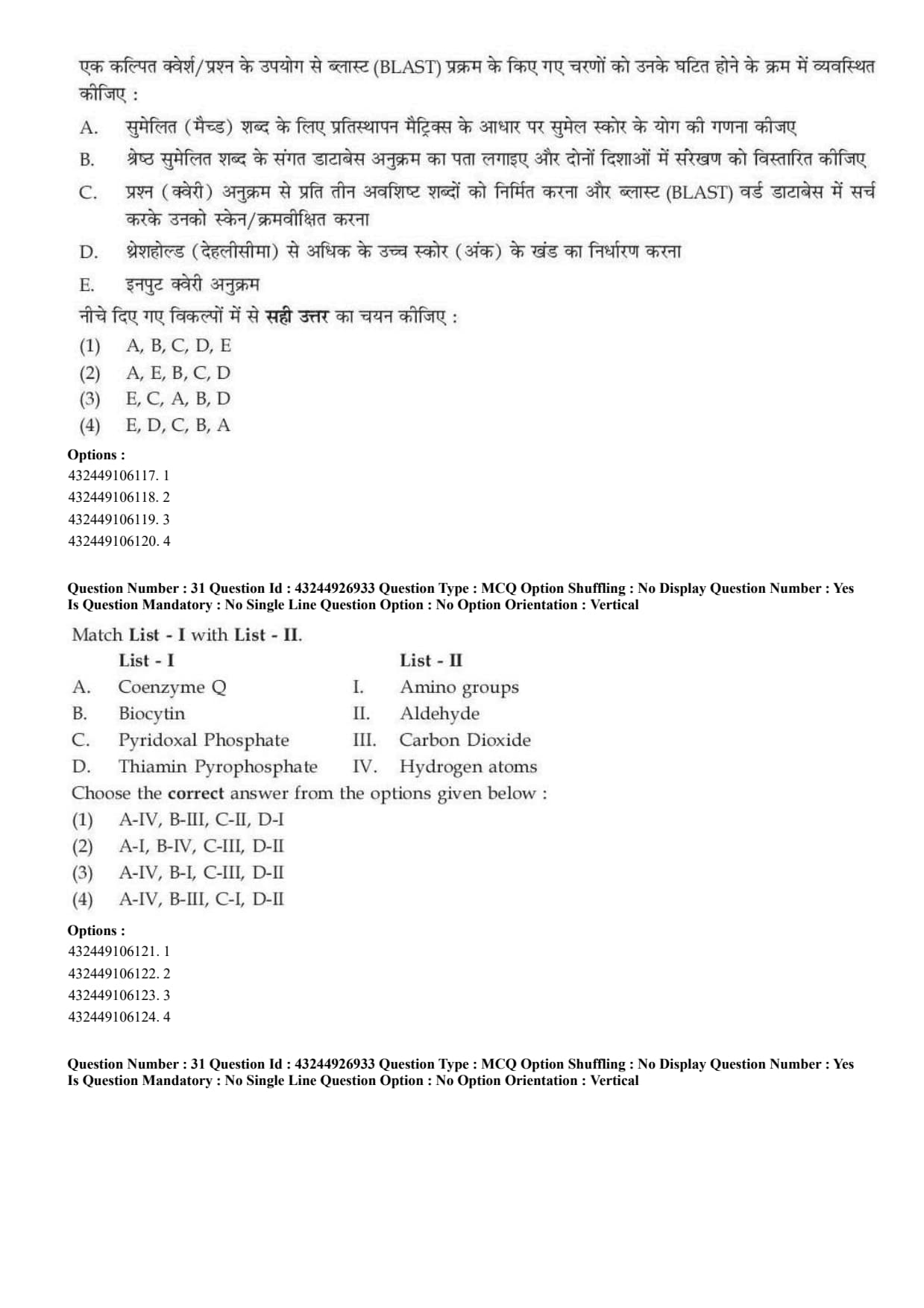
Arrange the given steps in BLAST procedure using a hypothetical Query in order of their occurrence.
A. Calculate sum of match scores based on substitution matrix for the matched word
B. Find the database sequence corresponding to the best word match and extend alignment in both directions
C. Creation of every three residue words from the query sequence and scan them searching in BLAST word database
D. Determine high scored segment above threshold
E. Input query sequence.
View Solution
Concept:
BLAST is a sequence similarity search tool. It compares a query sequence with sequences present in a database and identifies regions of local similarity.
Step 1: Input query sequence.
The BLAST process starts when the user enters a query sequence. This may be a DNA sequence, RNA sequence, or protein sequence.
\[ First step = E \]
Step 2: Create words from query sequence.
BLAST breaks the query sequence into short words. For protein BLAST, words of three residues are commonly considered.
\[ Second step = C \]
Step 3: Calculate match scores.
The words are compared using a substitution matrix. The sum of match scores is calculated for matched words.
\[ Third step = A \]
Step 4: Find database sequence and extend alignment.
BLAST finds the best matching words in database sequences and extends the alignment in both directions.
\[ Fourth step = B \]
Step 5: Determine high scoring segment.
Finally, high scoring segment pairs above the threshold are identified.
\[ Fifth step = D \]
Therefore, the correct sequence is: \[ E, C, A, B, D \]
\[ \therefore Correct Answer is (C) \] Quick Tip: BLAST procedure starts with query input, then word generation, scoring, extension of alignment, and finally identification of high scoring segments.
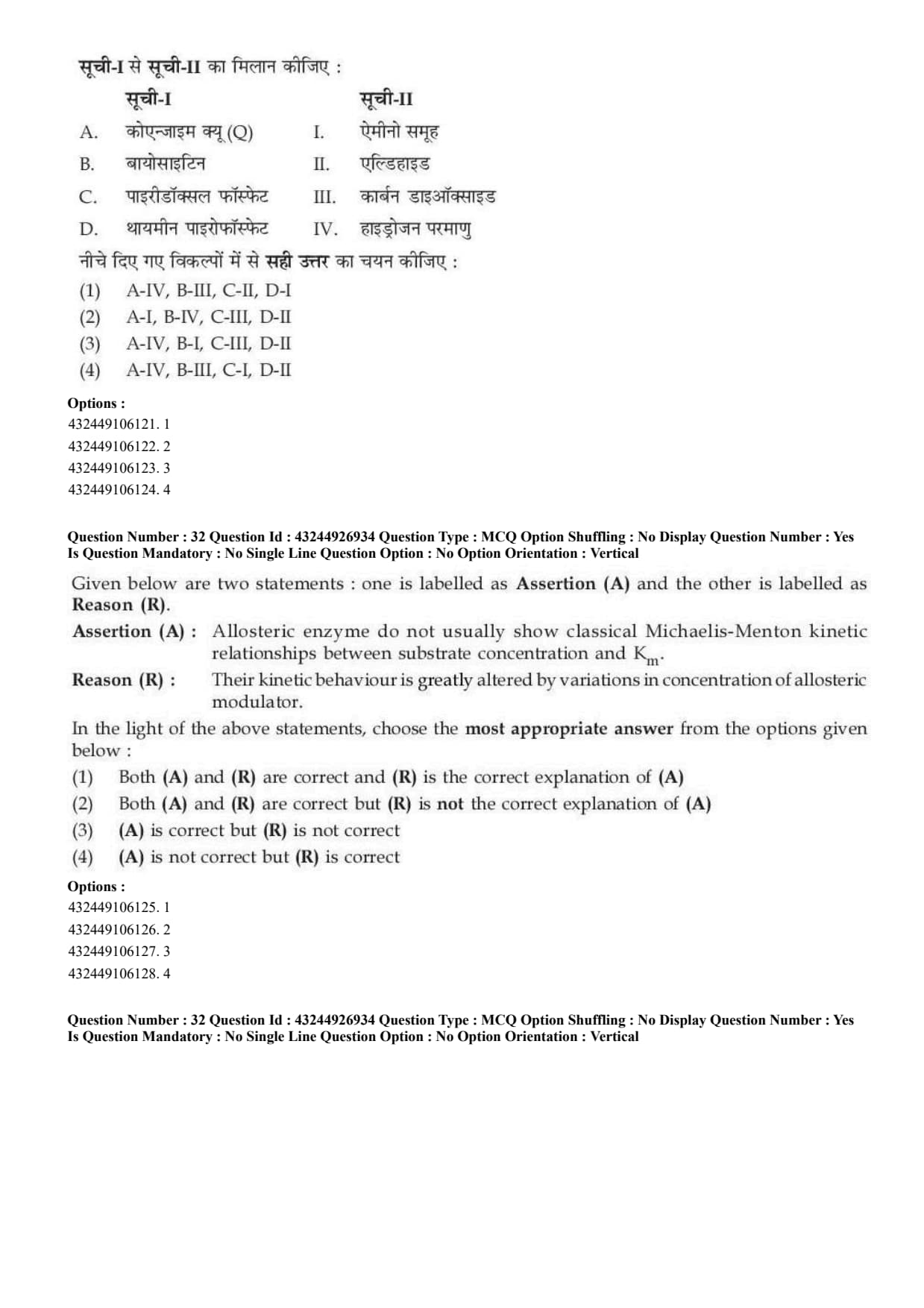
Match List-I with List-II.

View Solution
Concept:
Coenzymes are organic helper molecules that assist enzymes during biochemical reactions. Different coenzymes carry different chemical groups or atoms.
Step 1: Match Coenzyme Q.
Coenzyme Q is also called ubiquinone. It participates in oxidation-reduction reactions in the electron transport chain. It mainly carries hydrogen atoms or electrons.
\[ A \rightarrow IV \]
Step 2: Match Biocytin.
Biocytin is a coenzyme form associated with biotin. Biotin-containing enzymes are involved in carboxylation reactions and help in carrying carbon dioxide.
\[ B \rightarrow III \]
Step 3: Match Pyridoxal Phosphate.
Pyridoxal phosphate is the active form of vitamin \(B_6\). It is involved in amino acid metabolism and transfers amino groups.
\[ C \rightarrow I \]
Step 4: Match Thiamin Pyrophosphate.
Thiamin pyrophosphate is the active form of vitamin \(B_1\). It is involved in decarboxylation reactions and transfers aldehyde groups.
\[ D \rightarrow II \]
Thus, the correct matching is: \[ A-IV,\ B-III,\ C-I,\ D-II \]
\[ \therefore Correct Answer is (A) \] Quick Tip: Remember: Coenzyme Q carries hydrogen atoms, biocytin carries carbon dioxide, pyridoxal phosphate carries amino groups, and thiamin pyrophosphate carries aldehyde groups.
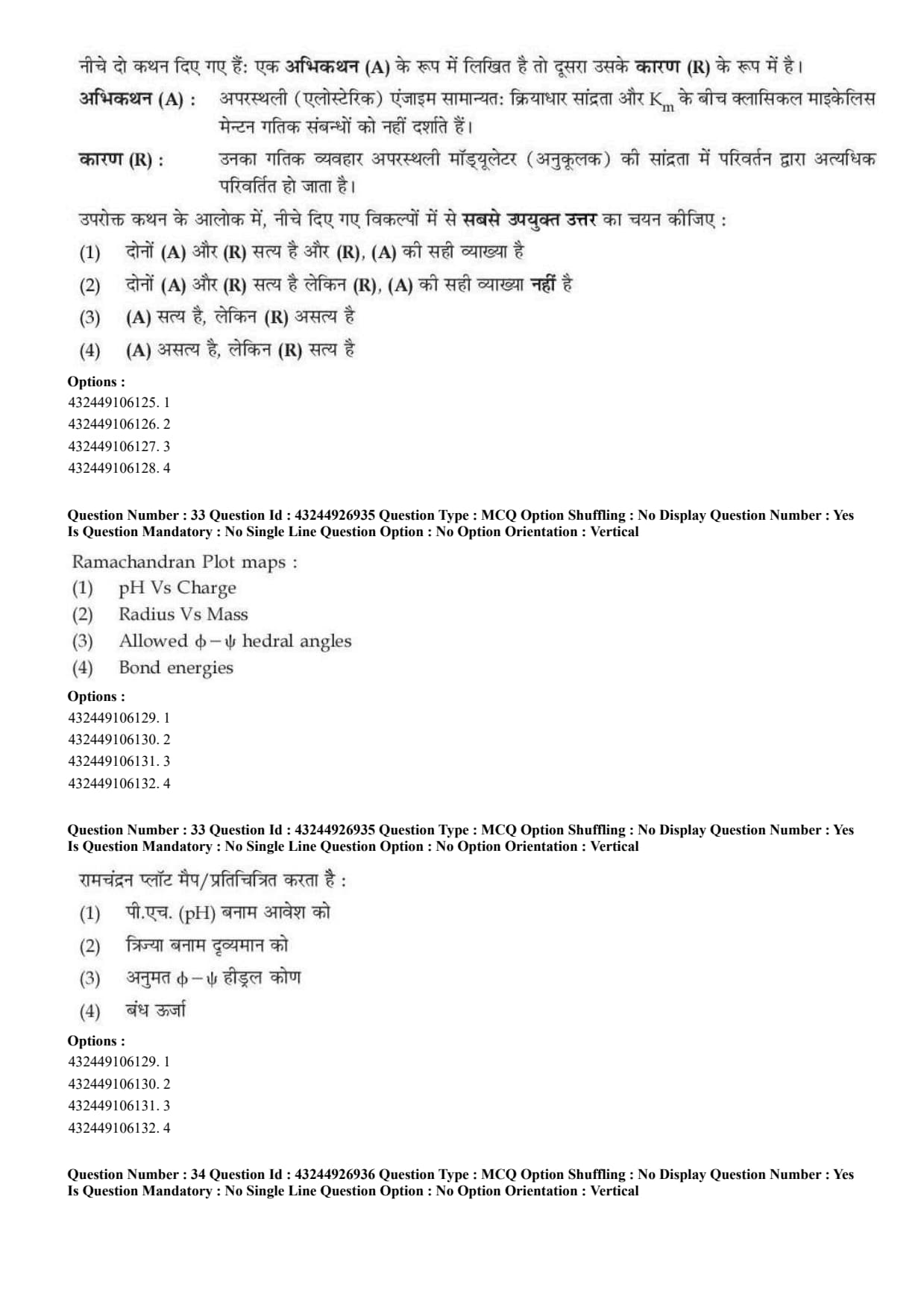
Given below are two statements:
Assertion (A): Allosteric enzyme do not usually show classical Michaelis-Menten kinetic relationships between substrate concentration and \(K_m\).
Reason (R): Their kinetic behaviour is greatly altered by variations in concentration of allosteric modulator.
View Solution
Concept:
Allosteric enzymes are enzymes whose activity is controlled by molecules binding at sites other than the active site. These regulatory molecules are called allosteric modulators.
Step 1: Check Assertion (A).
Classical Michaelis-Menten enzymes usually show a hyperbolic curve between reaction velocity and substrate concentration.
But allosteric enzymes usually show sigmoidal kinetics because their subunits show cooperative behavior.
\[ A is correct \]
Step 2: Check Reason (R).
Allosteric modulators can either activate or inhibit the enzyme. When the concentration of allosteric modulator changes, the enzyme activity changes significantly.
\[ R is correct \]
Step 3: Check explanation.
Allosteric enzymes do not follow classical Michaelis-Menten kinetics because their behavior is affected by allosteric modulators and cooperativity.
Therefore, Reason correctly explains the Assertion.
\[ \therefore Correct Answer is (A) \] Quick Tip: Allosteric enzymes usually show sigmoidal kinetics instead of classical Michaelis-Menten hyperbolic kinetics because of cooperativity and allosteric regulation.
Ramachandran Plot maps:
View Solution
Concept:
Ramachandran plot is an important tool used in protein structure analysis. It shows the allowed and disallowed conformations of amino acid residues in a protein.
Step 1: Understand protein backbone angles.
In a polypeptide chain, each amino acid residue has two important backbone dihedral angles: \[ \phi = phi angle \] \[ \psi = psi angle \]
Step 2: Meaning of Ramachandran plot.
The Ramachandran plot maps possible values of \(\phi\) and \(\psi\) angles. Some combinations are allowed because they do not cause steric clashes, while others are not allowed.
Step 3: Use of Ramachandran plot.
It is used to check the quality of protein structure and to understand whether a protein conformation is sterically possible.
Step 4: Select the correct option.
Since Ramachandran plot represents allowed \(\phi-\psi\) dihedral angles, option (C) is correct.
\[ \therefore Correct Answer is (C) \] Quick Tip: Ramachandran plot is used for protein backbone analysis and maps allowed \(\phi\) and \(\psi\) dihedral angles.
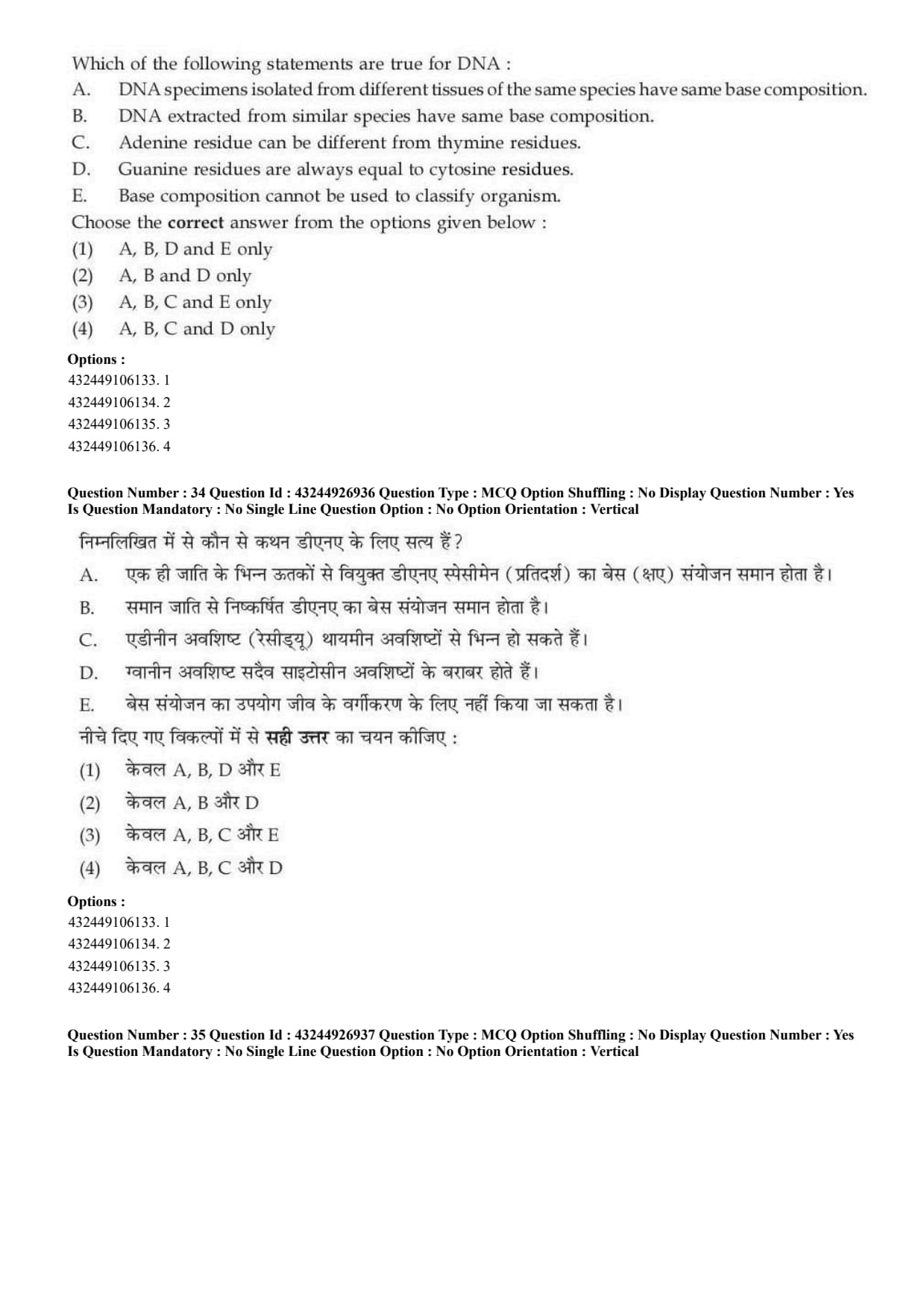
Which of the following statements are true for DNA:
A. DNA specimens isolated from different tissues of the same species have same base composition.
B. DNA extracted from similar species have same base composition.
C. Adenine residue can be different from thymine residues.
D. Guanine residues are always equal to cytosine residues.
E. Base composition cannot be used to classify organism.
View Solution
Concept:
DNA base composition follows Chargaff's rule. According to Chargaff's rule, in double-stranded DNA: \[ A = T \]
and \[ G = C \]
Step 1: Check statement A.
DNA isolated from different tissues of the same species has the same base composition because the genome is the same in different tissues.
\[ A is correct \]
Step 2: Check statement B.
Closely related or similar species may show similarity in base composition. Therefore, this statement is considered correct in the given context.
\[ B is correct \]
Step 3: Check statement C.
In double-stranded DNA, adenine pairs with thymine. Therefore, the amount of adenine is equal to thymine.
\[ A = T \]
So adenine residues cannot be different from thymine residues in normal double-stranded DNA.
\[ C is incorrect \]
Step 4: Check statement D.
Guanine pairs with cytosine. Therefore, guanine residues are equal to cytosine residues.
\[ G = C \]
\[ D is correct \]
Step 5: Check statement E.
Base composition can help in classification and comparison of organisms. Therefore, statement E is incorrect.
\[ E is incorrect \]
Thus, the correct statements are: \[ A,\ B and D \]
\[ \therefore Correct Answer is (B) \] Quick Tip: For double-stranded DNA, remember Chargaff's rule: \(A=T\) and \(G=C\). DNA base composition is useful for comparison and classification.
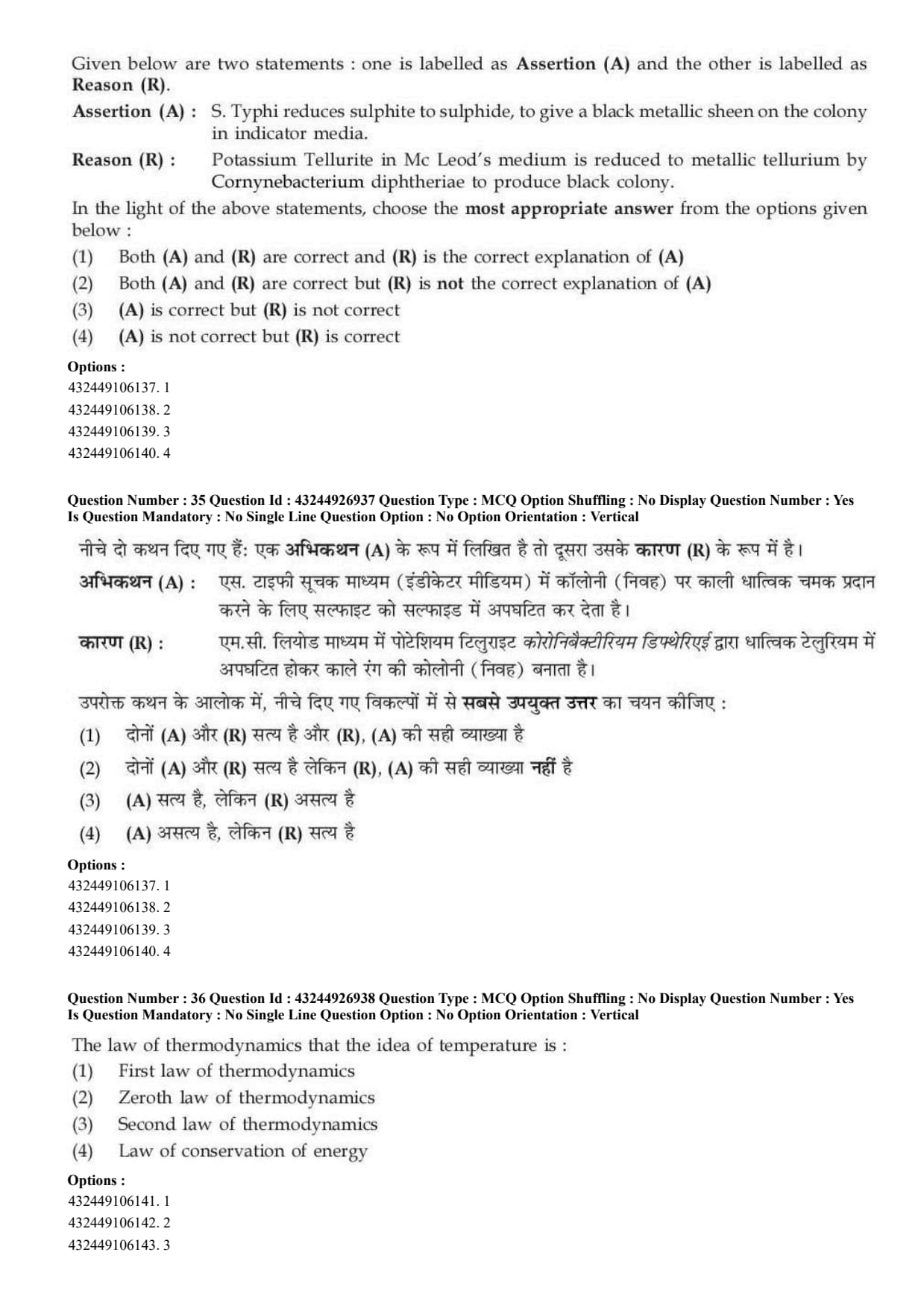
Given below are two statements:
Assertion (A): S. Typhi reduces sulphite to sulphide, to give a black metallic sheen on the colony in indicator media.
Reason (R): Potassium Tellurite in Mc Leod's medium is reduced to metallic tellurium by Corynebacterium diphtheriae to produce black colony.
View Solution
Concept:
In microbiology, selective and differential media are used to identify microorganisms based on their biochemical properties.
Step 1: Check Assertion (A).
\textit{Salmonella Typhi can reduce sulphite to sulphide. This reaction may produce black colonies or black metallic sheen in suitable indicator media.
\[ A is correct \]
Step 2: Check Reason (R).
\textit{Corynebacterium diphtheriae can reduce potassium tellurite to metallic tellurium in McLeod's medium, producing black colonies.
\[ R is correct \]
Step 3: Check whether R explains A.
Although both statements are correct, they describe two different organisms and two different biochemical reactions.
Assertion is about \textit{S. Typhi, while Reason is about \textit{Corynebacterium diphtheriae. Therefore, Reason does not explain Assertion.
\[ \therefore Correct Answer is (B) \] Quick Tip: In assertion-reason questions, both statements may be true, but always check whether the reason actually explains the assertion.
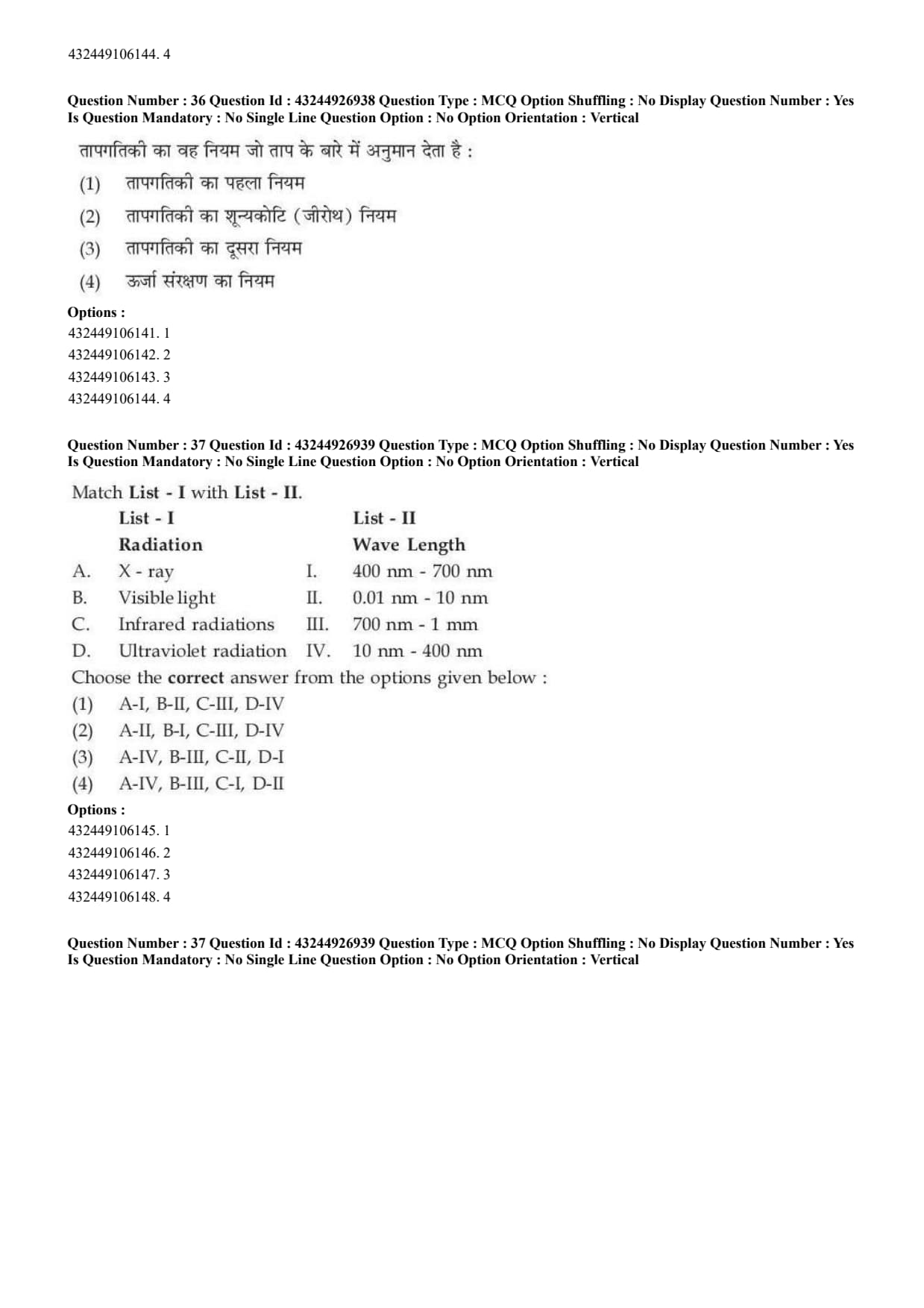
The law of thermodynamics that gives the idea of temperature is:
View Solution
Concept:
The zeroth law of thermodynamics introduces the concept of thermal equilibrium and forms the basis for temperature measurement.
Step 1: Understand zeroth law.
The zeroth law states that if two systems are each in thermal equilibrium with a third system, then they are in thermal equilibrium with each other.
Step 2: Relation with temperature.
Thermal equilibrium means that two bodies have the same temperature. Therefore, zeroth law gives the basic idea of temperature.
Step 3: Compare with other laws.
First law deals with conservation of energy.
Second law deals with direction of heat flow and entropy.
Zeroth law deals with temperature and thermal equilibrium.
Hence, the law that gives the idea of temperature is: \[ Zeroth law of thermodynamics \]
\[ \therefore Correct Answer is (B) \] Quick Tip: Zeroth law of thermodynamics is the basis of temperature measurement and thermal equilibrium.
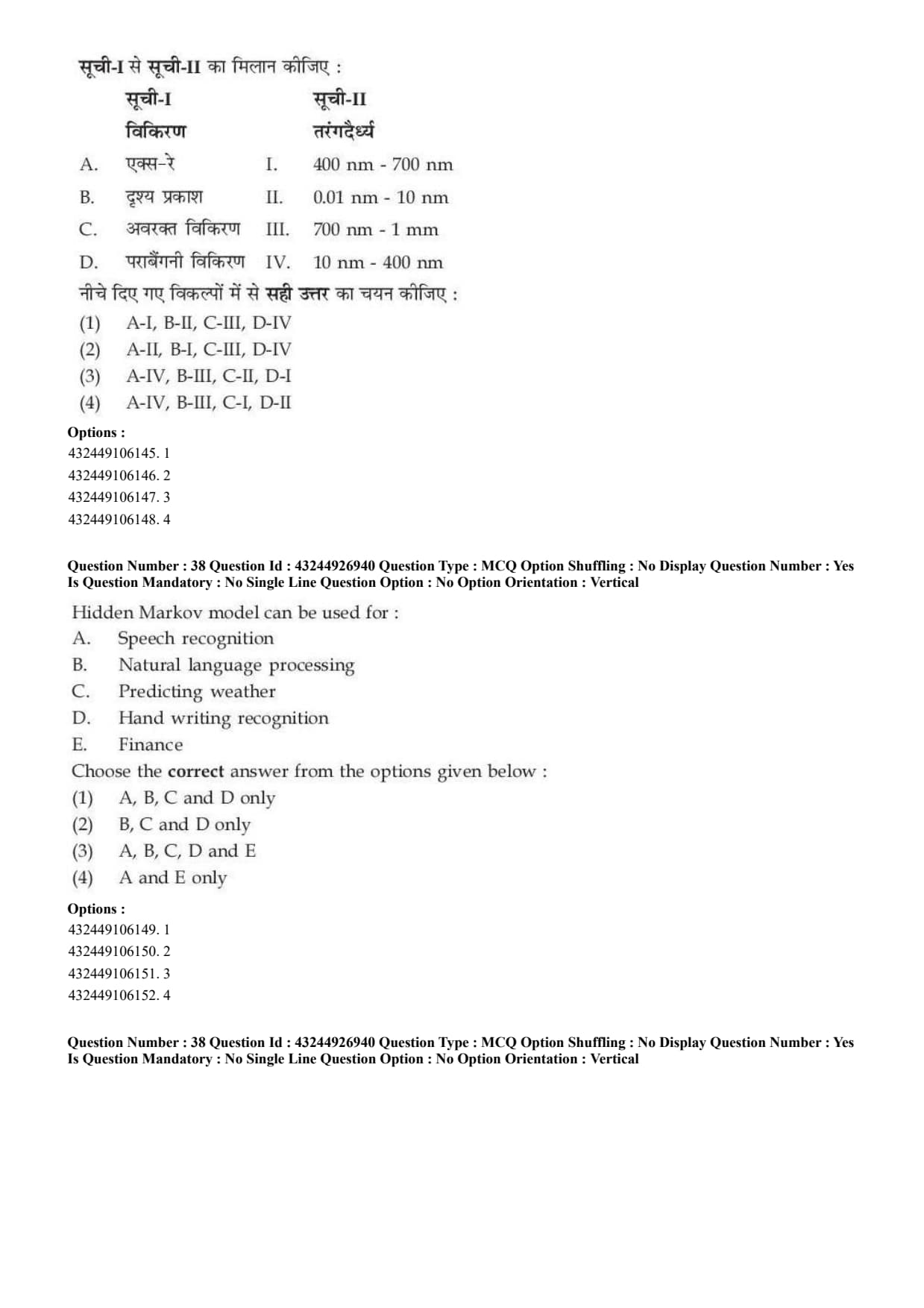
Match List-I with List-II.

View Solution
Concept:
Electromagnetic radiations are classified according to their wavelength. Different radiations occupy different wavelength ranges.
Step 1: Match X-ray.
X-rays have very short wavelength, generally: \[ 0.01\,nm-10\,nm \]
\[ A \rightarrow II \]
Step 2: Match visible light.
Visible light lies approximately in the range: \[ 400\,nm-700\,nm \]
\[ B \rightarrow I \]
Step 3: Match infrared radiation.
Infrared radiation has wavelength greater than visible light: \[ 700\,nm-1\,mm \]
\[ C \rightarrow III \]
Step 4: Match ultraviolet radiation.
Ultraviolet radiation lies approximately between: \[ 10\,nm-400\,nm \]
\[ D \rightarrow IV \]
Thus, the correct matching is: \[ A-II,\ B-I,\ C-III,\ D-IV \]
\[ \therefore Correct Answer is (B) \] Quick Tip: Visible light is \(400\,nm-700\,nm\). Infrared has longer wavelength than visible light, while ultraviolet and X-rays have shorter wavelengths.
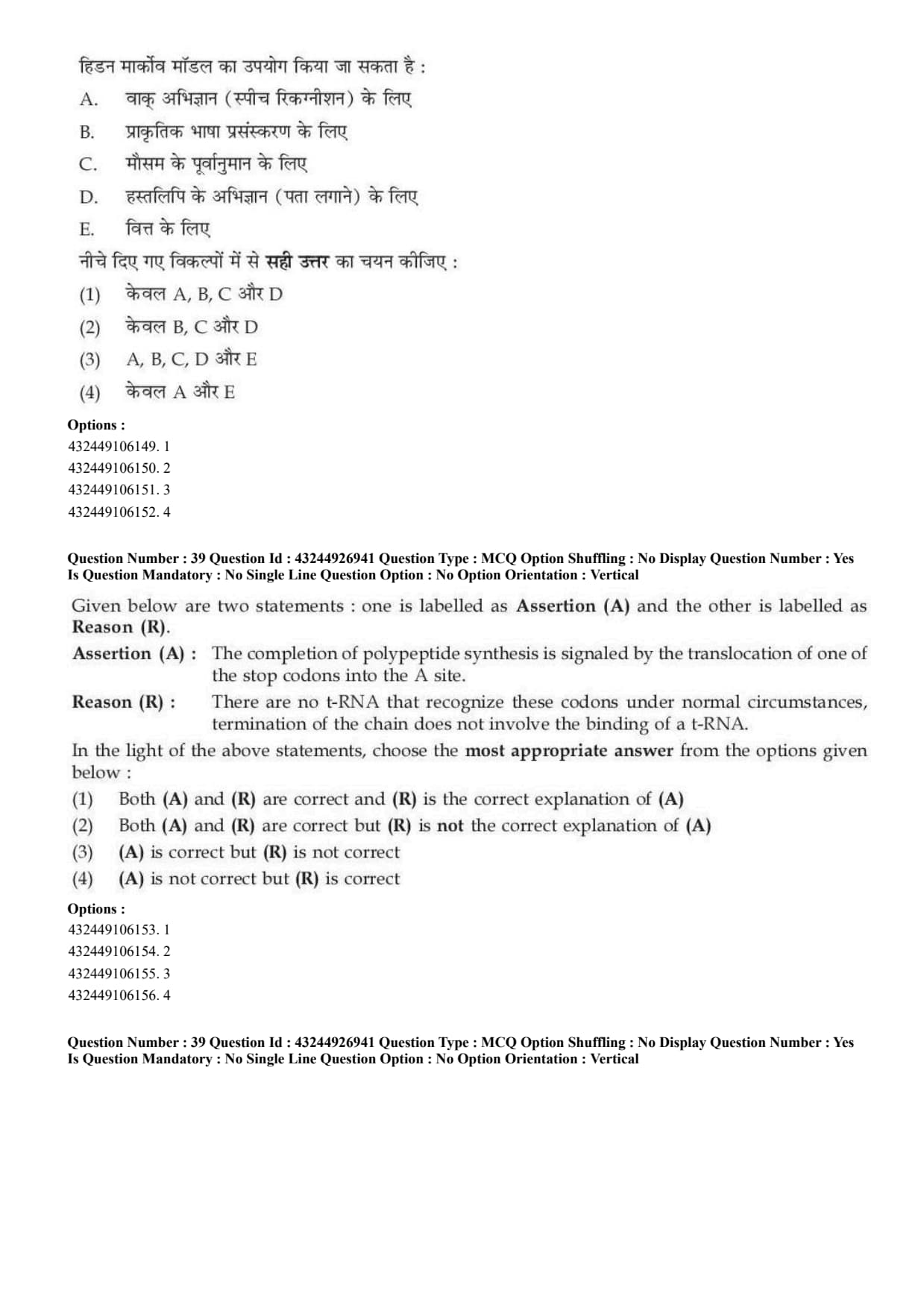
Hidden Markov model can be used for:
A. Speech recognition
B. Natural language processing
C. Predicting weather
D. Hand writing recognition
E. Finance.
View Solution
Concept:
Hidden Markov Model is a statistical model used for systems where the actual state is hidden, but observable outputs are available. It is useful in sequence-based prediction problems.
Step 1: Speech recognition.
Speech signals occur as sequences over time. Hidden Markov Models are used to model phonemes and speech patterns.
\[ A is correct \]
Step 2: Natural language processing.
Natural language processing often deals with sequences of words. HMMs are used in tagging, parsing, and language modeling.
\[ B is correct \]
Step 3: Weather prediction.
Weather has hidden states and observable conditions. HMMs can model such probabilistic transitions.
\[ C is correct \]
Step 4: Handwriting recognition.
Handwriting recognition is also sequence-based and can be modeled using HMMs.
\[ D is correct \]
Step 5: Finance.
Financial markets often have hidden states such as bullish, bearish, or stable trends. HMMs can be used to model such hidden states.
\[ E is correct \]
Therefore: \[ A,\ B,\ C,\ D and E \]
\[ \therefore Correct Answer is (C) \] Quick Tip: Hidden Markov Models are useful wherever hidden states and observable sequences are involved, such as speech, NLP, weather, handwriting, and finance.
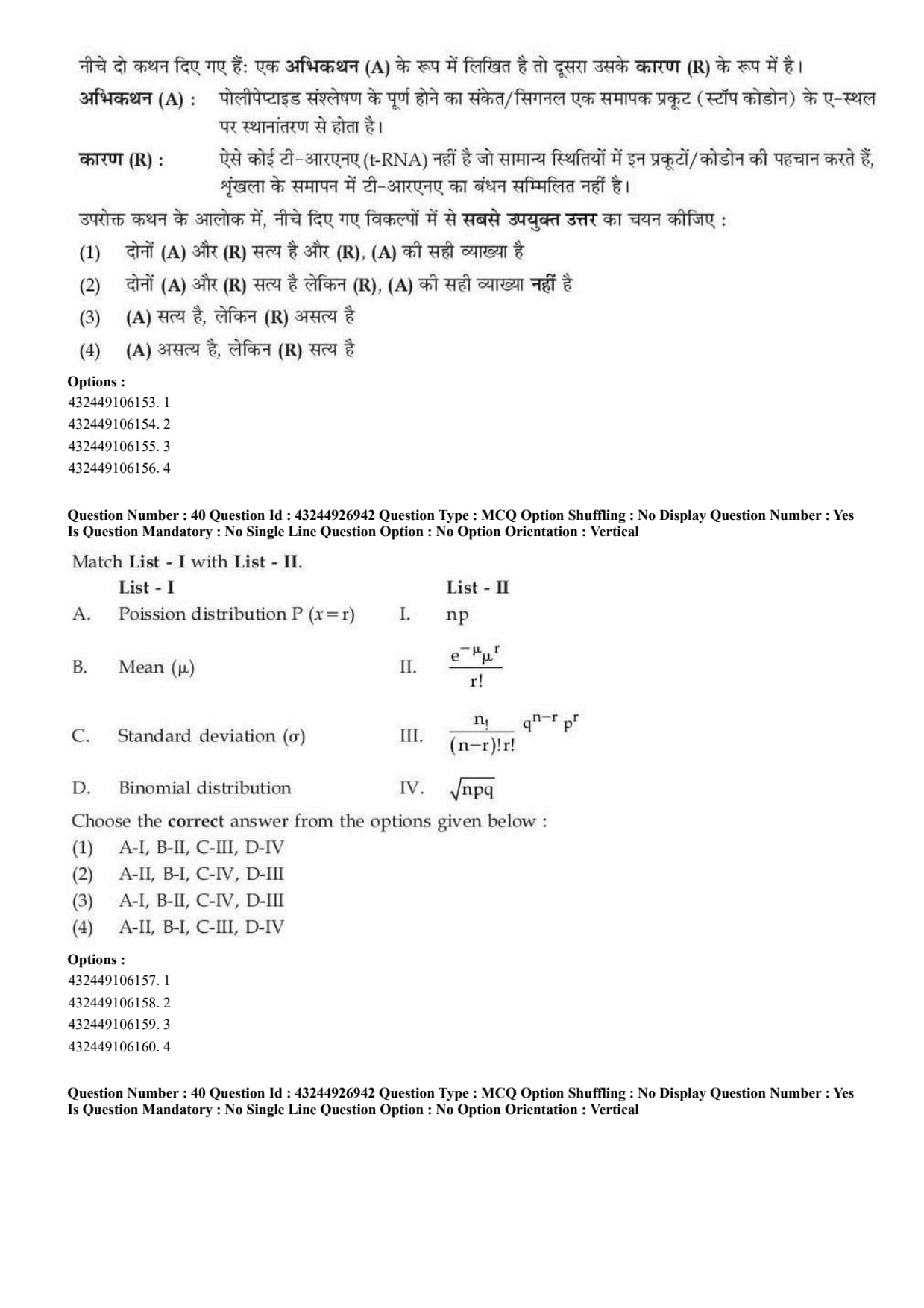
Given below are two statements:
Assertion (A): The completion of polypeptide synthesis is signaled by the translocation of one of the stop codons into the A site.
Reason (R): There are no t-RNA that recognize these codons under normal circumstances, termination of the chain does not involve the binding of a t-RNA.
View Solution
Concept:
Translation is the process of protein synthesis. It stops when a stop codon enters the A-site of the ribosome.
Step 1: Check Assertion (A).
Polypeptide synthesis is completed when a stop codon such as UAA, UAG, or UGA reaches the A-site of the ribosome.
\[ A is correct \]
Step 2: Check Reason (R).
There is no normal tRNA molecule that recognizes stop codons. Instead, release factors bind to the stop codon and terminate translation.
\[ R is correct \]
Step 3: Check explanation.
Because no tRNA recognizes stop codons, the arrival of stop codon at A-site signals termination of protein synthesis.
Thus, Reason correctly explains Assertion.
\[ \therefore Correct Answer is (A) \] Quick Tip: Stop codons do not code for amino acids and are not recognized by tRNA. They are recognized by release factors during translation termination.
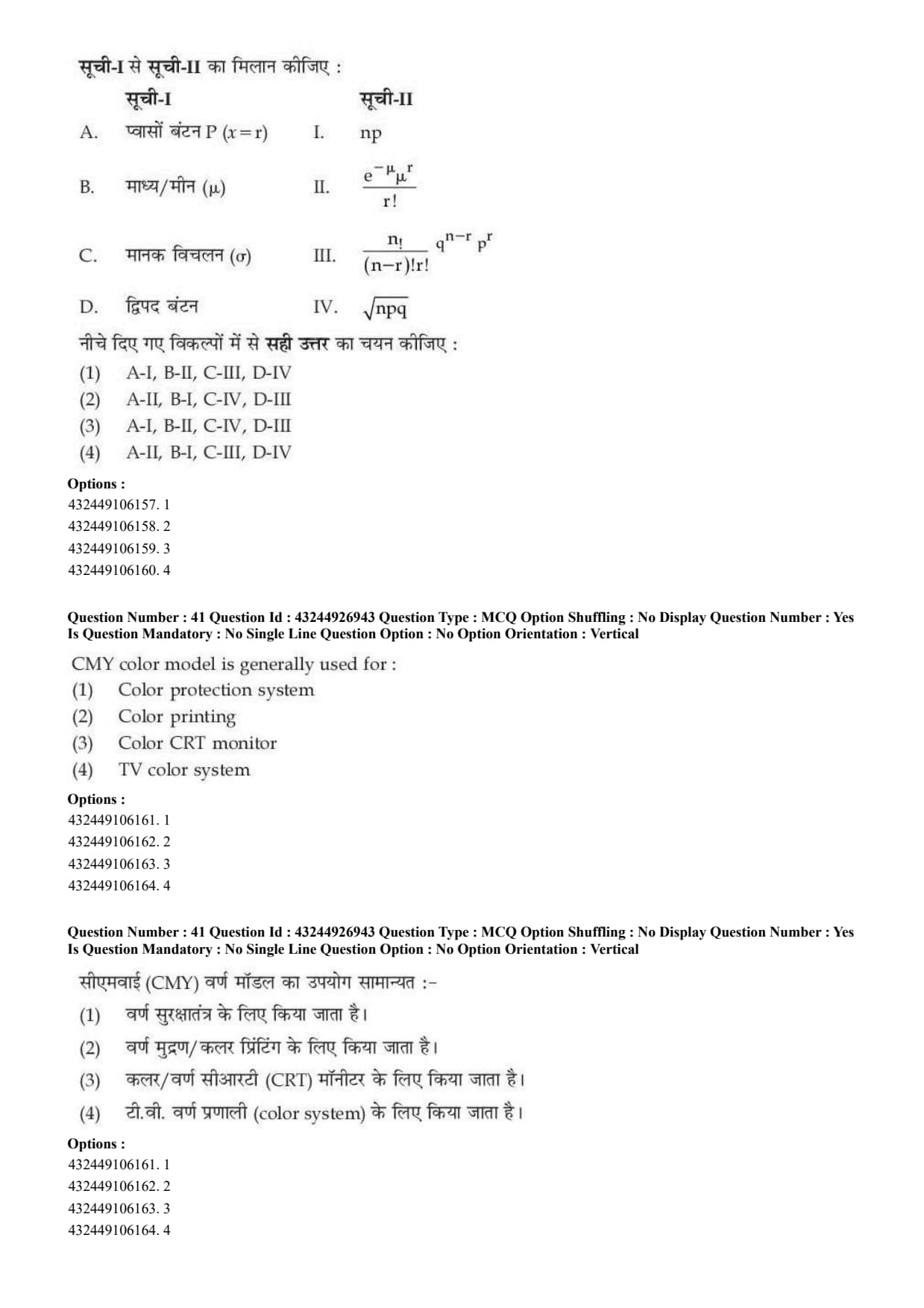
Match List-I with List-II.

View Solution
Concept:
This question is based on probability distributions and their standard formulas. Poisson and binomial distributions are common discrete probability distributions.
Step 1: Formula for mean.
For binomial distribution, the mean is: \[ \mu = np \]
So, \[ B \rightarrow I \]
Step 2: Formula for standard deviation.
For binomial distribution, the standard deviation is: \[ \sigma = \sqrt{npq} \]
So, \[ C \rightarrow IV \]
Step 3: Formula for Poisson distribution.
The probability mass function of Poisson distribution is: \[ P(x=r)=\frac{e^{-m}m^r}{r!} \]
So, \[ A \rightarrow II \]
Step 4: Formula for binomial distribution.
The probability mass function of binomial distribution is: \[ P(X=r)=\,^nC_rp^rq^{n-r} \]
So, \[ D \rightarrow III \]
Therefore, the correct matching is: \[ A-II,\ B-I,\ C-IV,\ D-III \]
\[ \therefore Correct Answer is (B) \] Quick Tip: For binomial distribution, mean is \(np\) and standard deviation is \(\sqrt{npq}\). For Poisson distribution, \(P(x=r)=\frac{e^{-m}m^r}{r!}\).
CMY color model is generally used for:
View Solution
Concept:
CMY stands for Cyan, Magenta, and Yellow. It is a subtractive color model.
Step 1: Understand subtractive color model.
In subtractive color models, colors are produced by subtracting or absorbing certain wavelengths of light.
Step 2: Use of CMY model.
CMY model is commonly used in printing because inks absorb light and produce colors on paper.
Step 3: Compare with RGB model.
RGB is used in display devices such as monitors and televisions. CMY is used in printers.
Therefore: \[ CMY color model \rightarrow Color printing \]
\[ \therefore Correct Answer is (B) \] Quick Tip: RGB is used for screens and displays, while CMY or CMYK is used for color printing.
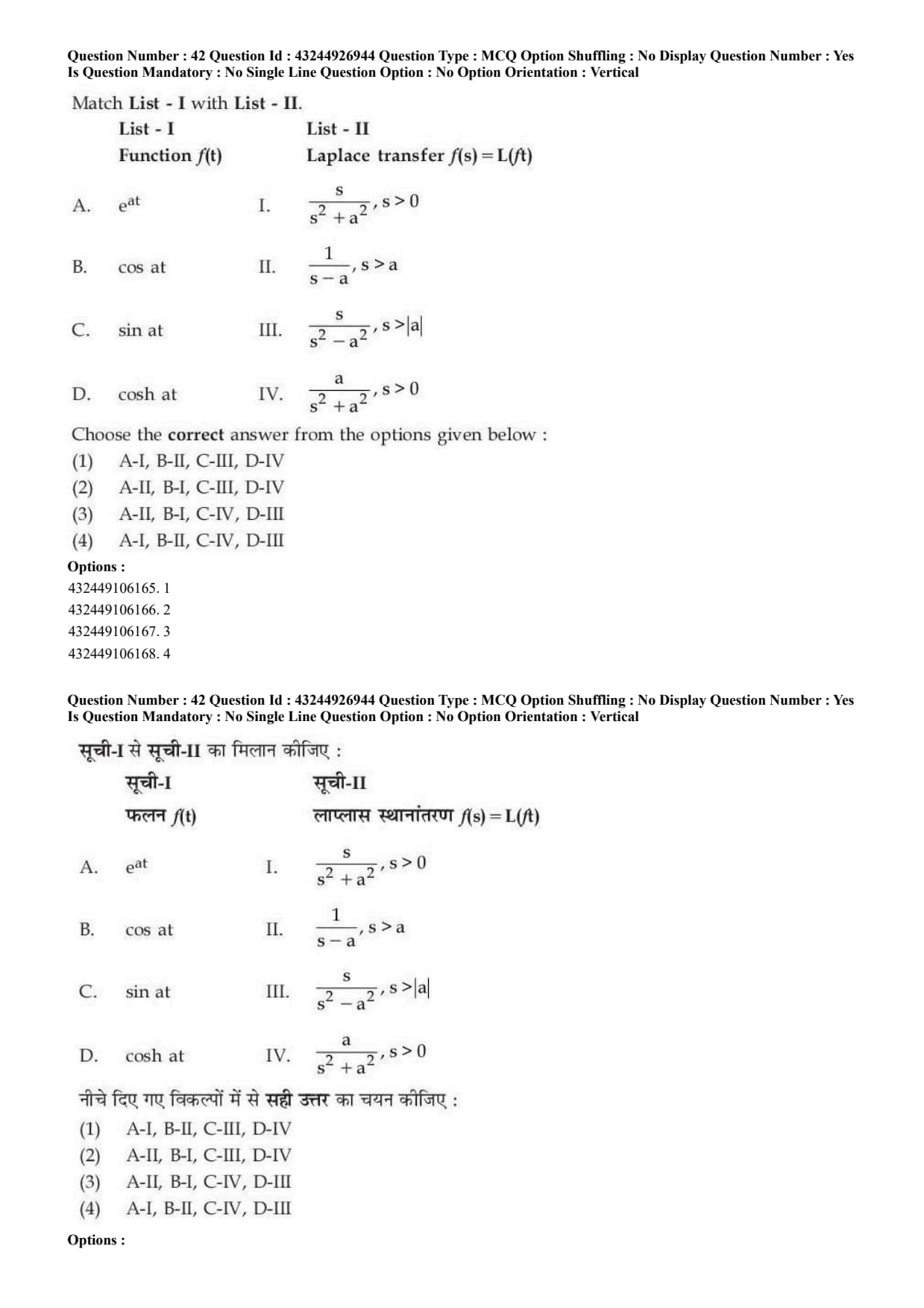
Match List-I with List-II.

View Solution
Concept:
Laplace transform is used to convert a function of time \(f(t)\) into a function of complex variable \(s\), written as: \[ F(s)=L\{f(t)\} \]
Step 1: Laplace transform of \(e^{at}\).
The standard formula is: \[ L\{e^{at}\}=\frac{1}{s-a} \]
So, \[ A \rightarrow II \]
Step 2: Laplace transform of \(\cos at\).
The standard formula is: \[ L\{\cos at\}=\frac{s}{s^2+a^2} \]
So, \[ B \rightarrow I \]
Step 3: Laplace transform of \(\sin at\).
The standard formula is: \[ L\{\sin at\}=\frac{a}{s^2+a^2} \]
So, \[ C \rightarrow IV \]
Step 4: Laplace transform of \(\cosh at\).
The standard formula is: \[ L\{\cosh at\}=\frac{s}{s^2-a^2} \]
So, \[ D \rightarrow III \]
Therefore: \[ A-II,\ B-I,\ C-IV,\ D-III \]
\[ \therefore Correct Answer is (C) \] Quick Tip: Remember the standard Laplace transforms: \(L\{e^{at}\}=\frac{1}{s-a}\), \(L\{\cos at\}=\frac{s}{s^2+a^2}\), \(L\{\sin at\}=\frac{a}{s^2+a^2}\), and \(L\{\cosh at\}=\frac{s}{s^2-a^2}\).
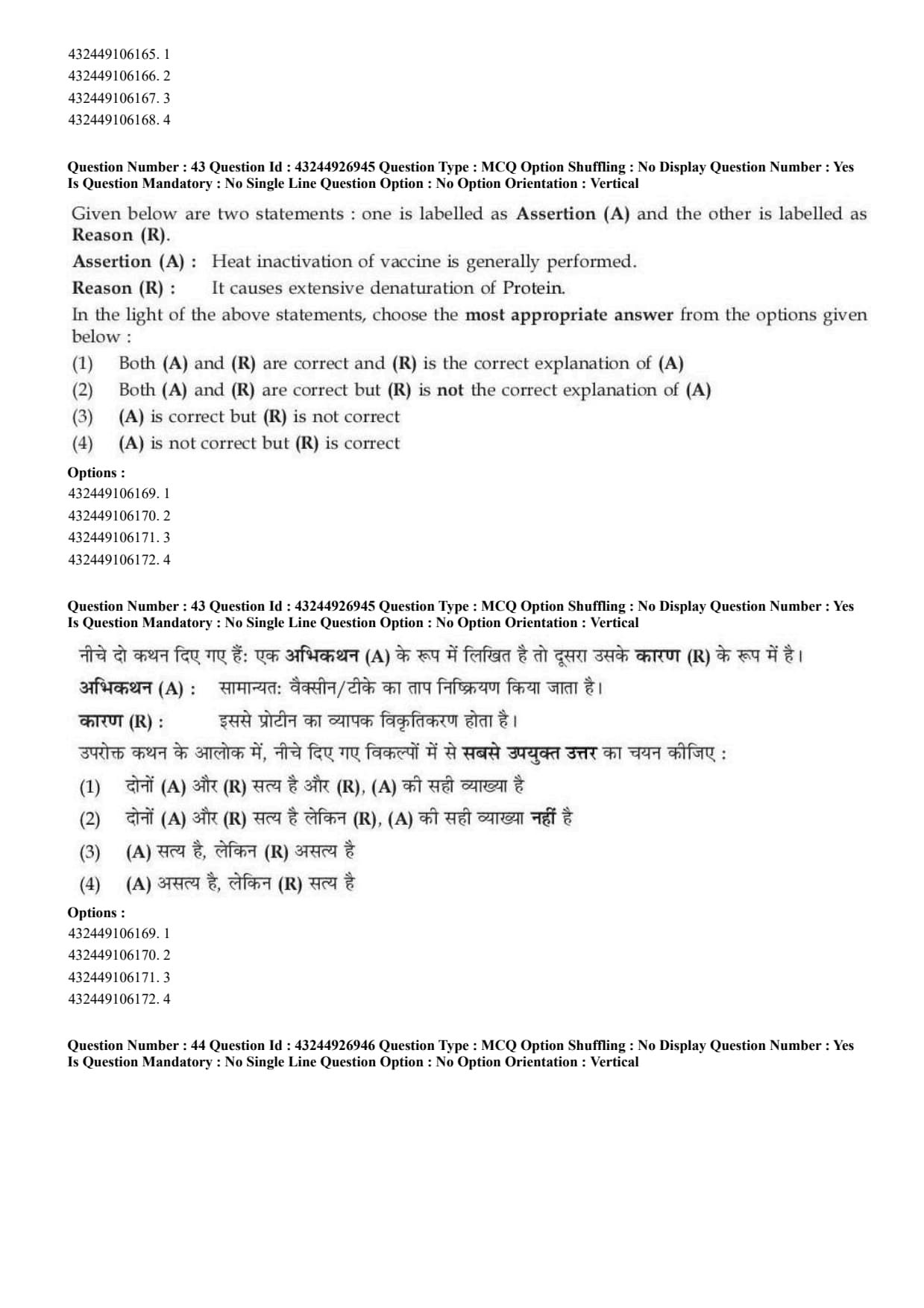
Given below are two statements:
Assertion (A): Heat inactivation of vaccine is generally performed.
Reason (R): It causes extensive denaturation of Protein.
View Solution
Concept:
Vaccines can be inactivated by physical or chemical methods. However, the method should preserve antigenic structure so that the immune system can recognize it.
Step 1: Check Assertion (A).
Heat inactivation is not generally preferred for vaccines because heating can damage the antigenic proteins.
\[ A is incorrect \]
Step 2: Check Reason (R).
Heat can cause extensive denaturation of proteins. Denaturation changes the structure of proteins and may destroy important antigenic sites.
\[ R is correct \]
Step 3: Final conclusion.
Since heat can denature proteins, heat inactivation is not generally performed as the preferred method for vaccine preparation.
Therefore: \[ (A) is not correct but (R) is correct \]
\[ \therefore Correct Answer is (D) \] Quick Tip: Heat can denature proteins and destroy antigenic properties. Therefore, vaccine inactivation is often done by controlled chemical methods rather than simple heating.
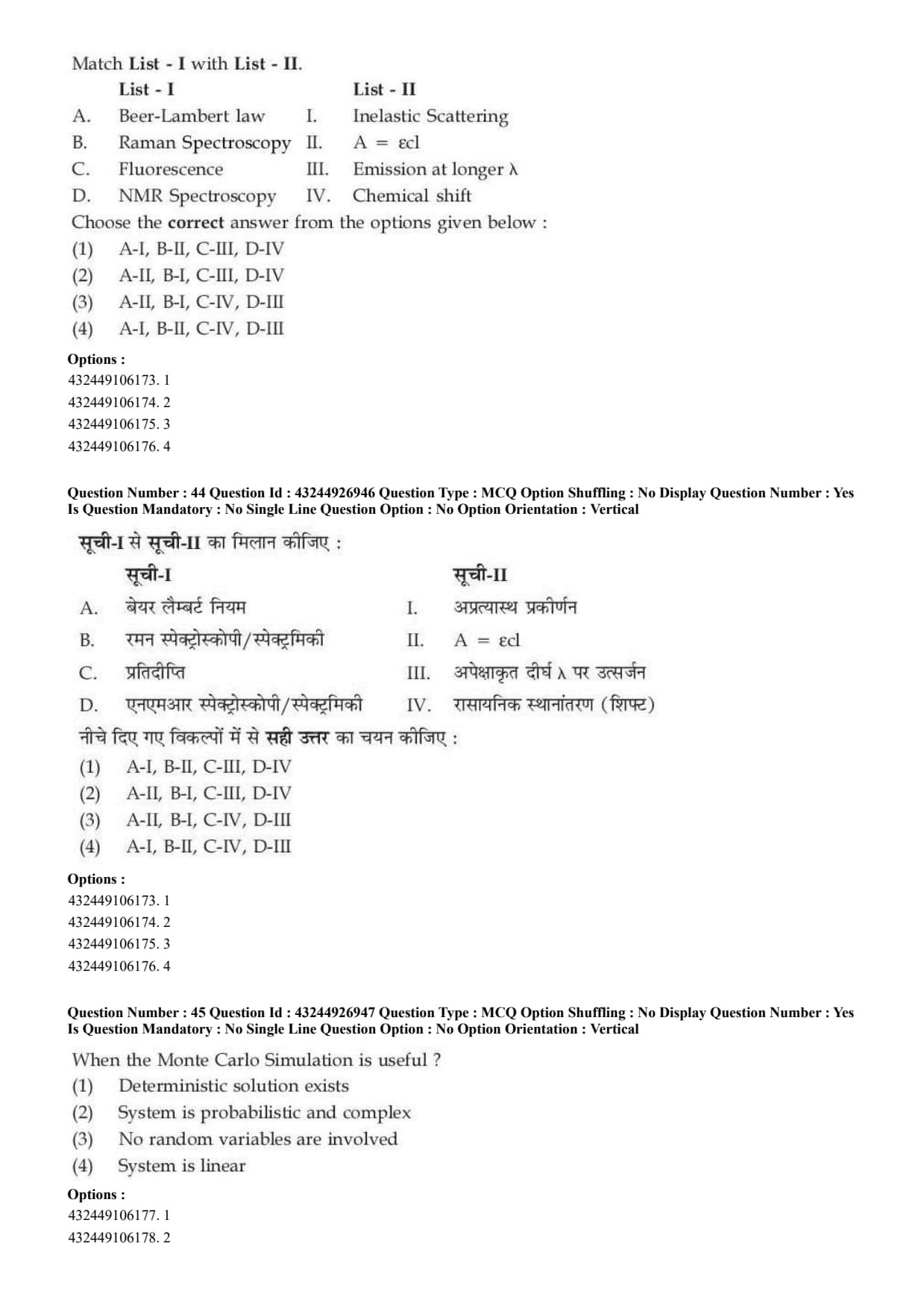
Match List-I with List-II.

View Solution
Concept:
Spectroscopic techniques are used to study molecules by their interaction with electromagnetic radiation.
Step 1: Match Beer-Lambert law.
Beer-Lambert law is written as: \[ A=\varepsilon cl \]
So, \[ A \rightarrow II \]
Step 2: Match Raman spectroscopy.
Raman spectroscopy is based on inelastic scattering of light.
\[ B \rightarrow I \]
Step 3: Match fluorescence.
Fluorescence involves absorption of light followed by emission at a longer wavelength.
\[ C \rightarrow III \]
Step 4: Match NMR spectroscopy.
NMR spectroscopy provides information using chemical shift values.
\[ D \rightarrow IV \]
Therefore: \[ A-II,\ B-I,\ C-III,\ D-IV \]
\[ \therefore Correct Answer is (B) \] Quick Tip: Beer-Lambert law is \(A=\varepsilon cl\), Raman spectroscopy involves inelastic scattering, fluorescence emits longer wavelength, and NMR uses chemical shift.
When the Monte Carlo Simulation is useful?
View Solution
Concept:
Monte Carlo simulation is a computational technique that uses random sampling to solve problems that are difficult to solve analytically.
Step 1: Understand Monte Carlo simulation.
Monte Carlo methods are useful when the system contains randomness or uncertainty.
Step 2: Identify suitable systems.
If a system is probabilistic, complex, and difficult to solve exactly, Monte Carlo simulation is useful.
Step 3: Eliminate incorrect options.
If a deterministic exact solution exists, Monte Carlo may not be necessary.
If no random variables are involved, Monte Carlo is not suitable.
If the system is simple and linear, direct mathematical methods may be enough.
Therefore: \[ Monte Carlo simulation is useful when the system is probabilistic and complex. \]
\[ \therefore Correct Answer is (B) \] Quick Tip: Monte Carlo simulation is best for complex systems involving probability, uncertainty, and random variables.
A protein unfolds when placed in \(8\,M\) urea, but regains activity when urea is removed. What does it show?
View Solution
Concept:
Protein folding is the process by which a polypeptide chain obtains its functional three-dimensional structure.
Step 1: Understand the role of urea.
Urea is a denaturant. It disrupts weak interactions such as hydrogen bonds and hydrophobic interactions, causing the protein to unfold.
Step 2: Removal of urea.
When urea is removed, the protein regains its original structure and activity. This means the protein can refold correctly.
Step 3: Interpretation.
If a protein can refold after removal of denaturant, it shows that the information required for folding is present in its amino acid sequence.
This conclusion is related to Anfinsen's experiment on protein folding.
\[ \therefore Correct Answer is (B) \] Quick Tip: If a denatured protein regains activity after removing denaturant, it shows that folding information is encoded in the amino acid sequence.
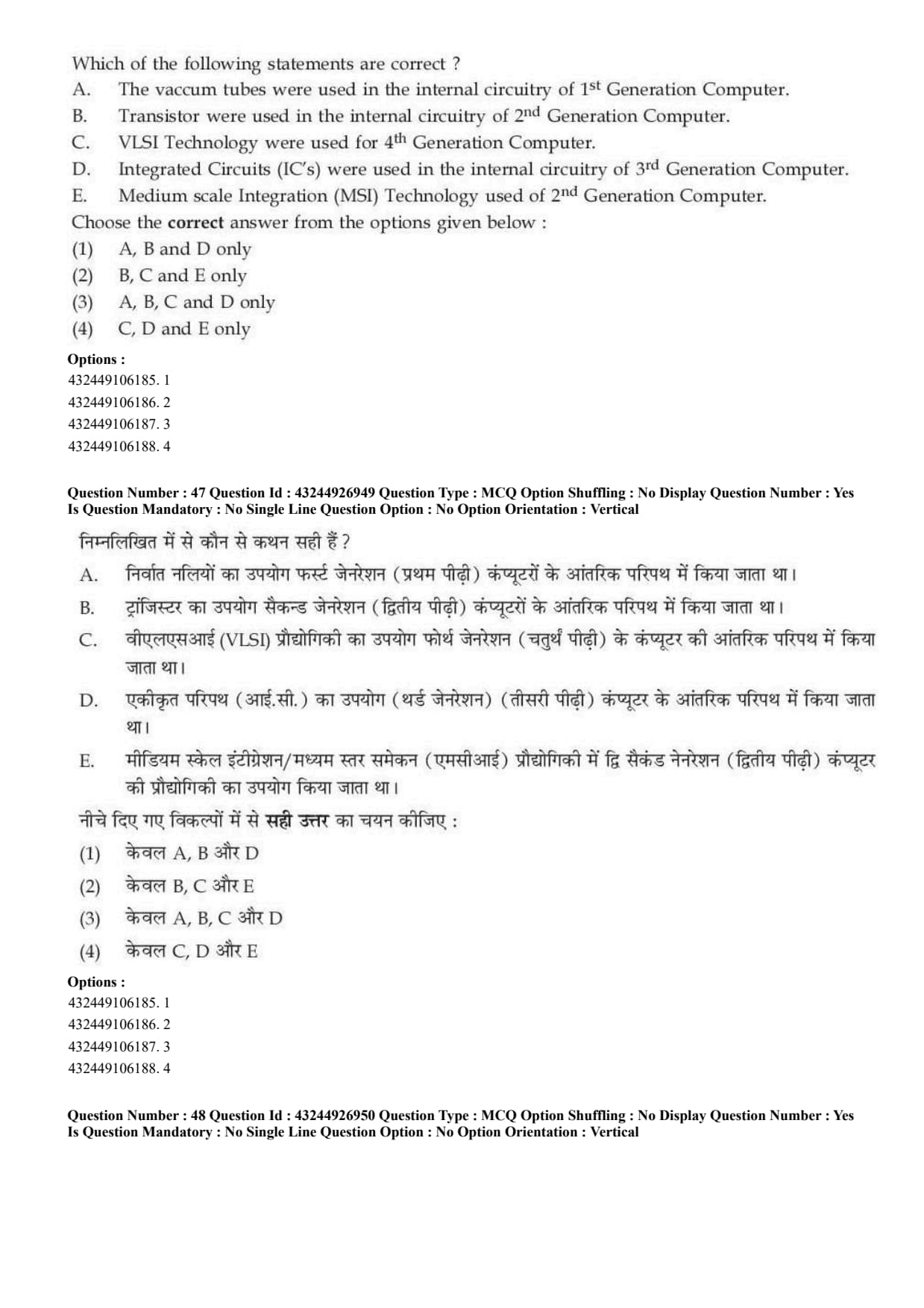
Which of the following statements are correct?
A. The vacuum tubes were used in the internal circuitry of 1st Generation Computer.
B. Transistor were used in the internal circuitry of 2nd Generation Computer.
C. VLSI Technology were used for 4th Generation Computer.
D. Integrated Circuits were used in the internal circuitry of 3rd Generation Computer.
E. Medium scale Integration Technology used of 2nd Generation Computer.
View Solution
Concept:
Generations of computers are classified based on the major technology used in their internal circuitry.
Step 1: First generation.
First generation computers used vacuum tubes.
\[ A is correct \]
Step 2: Second generation.
Second generation computers used transistors.
\[ B is correct \]
Step 3: Fourth generation.
Fourth generation computers used VLSI technology.
\[ C is correct \]
Step 4: Third generation.
Third generation computers used integrated circuits.
\[ D is correct \]
Step 5: Medium scale integration.
Medium scale integration is not the main technology of second generation computers. Second generation is mainly based on transistors.
\[ E is incorrect \]
Thus, the correct statements are: \[ A,\ B,\ C and D \]
\[ \therefore Correct Answer is (C) \] Quick Tip: Computer generations: 1st vacuum tubes, 2nd transistors, 3rd integrated circuits, 4th VLSI technology.
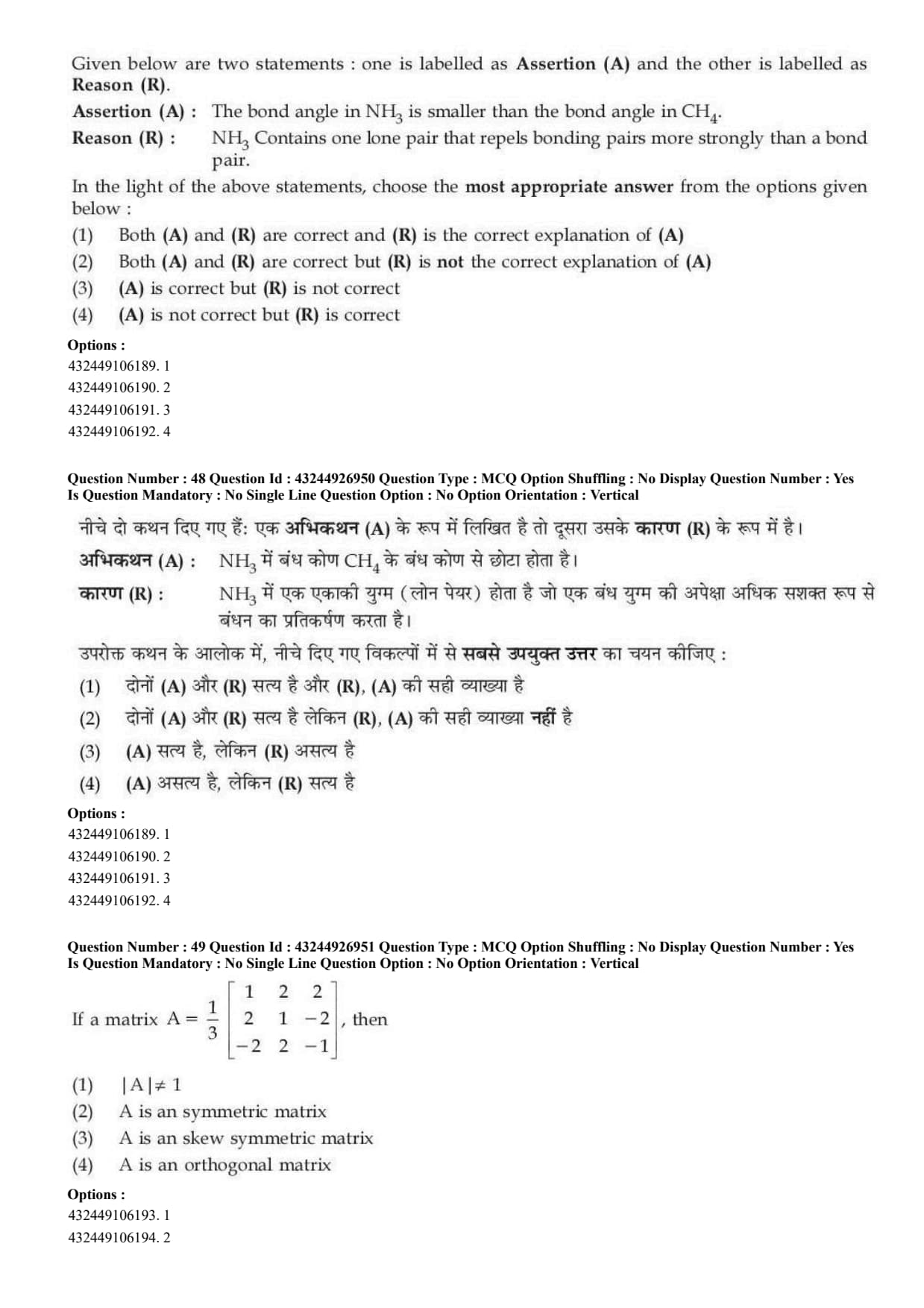
Given below are two statements:
Assertion (A): The bond angle in \(NH_3\) is smaller than the bond angle in \(CH_4\).
Reason (R): \(NH_3\) contains one lone pair that repels bonding pairs more strongly than a bond pair.
View Solution
Concept:
Bond angle is affected by electron pair repulsion. According to VSEPR theory, lone pair-bond pair repulsion is stronger than bond pair-bond pair repulsion.
Step 1: Bond angle in \(CH_4\).
Methane has tetrahedral geometry with bond angle: \[ 109.5^\circ \]
Step 2: Bond angle in \(NH_3\).
Ammonia has one lone pair on nitrogen. Due to this lone pair, the bond angle decreases to about: \[ 107^\circ \]
Step 3: Check Assertion.
Since \(107^\circ < 109.5^\circ\), the bond angle in \(NH_3\) is smaller than in \(CH_4\).
\[ A is correct \]
Step 4: Check Reason.
The lone pair in \(NH_3\) repels bonding pairs more strongly and compresses the bond angle.
\[ R is correct \]
Step 5: Check explanation.
The reason correctly explains why bond angle in \(NH_3\) is smaller than in \(CH_4\).
\[ \therefore Correct Answer is (A) \] Quick Tip: Lone pair-bond pair repulsion is stronger than bond pair-bond pair repulsion, so lone pairs reduce bond angles.
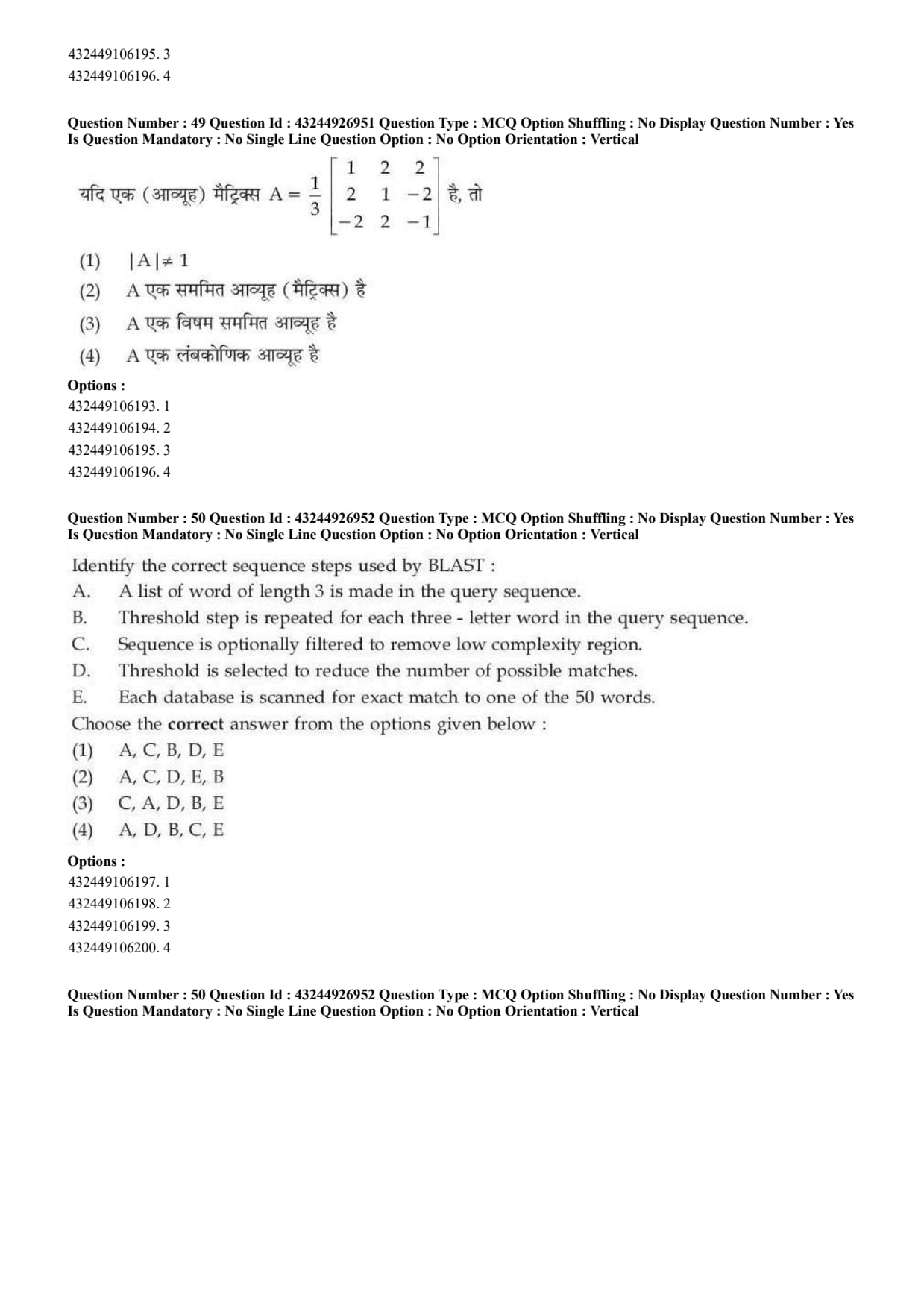
If a matrix \(A=\dfrac{1}{3}\begin{bmatrix}1&2&2 \\
2&1&-2 \\
-2&2&-1\end{bmatrix}\), then
View Solution
Concept:
A square matrix \(A\) is called orthogonal if: \[ A^TA=I \]
This means the rows or columns of the matrix are mutually perpendicular and have unit length.
Step 1: Write the given matrix. \[ A=\frac{1}{3}\begin{bmatrix} 1&2&2
2&1&-2
-2&2&-1 \end{bmatrix} \]
Step 2: Check row lengths before multiplication by \(\frac{1}{3}\).
First row: \[ 1^2+2^2+2^2=1+4+4=9 \]
Second row: \[ 2^2+1^2+(-2)^2=4+1+4=9 \]
Third row: \[ (-2)^2+2^2+(-1)^2=4+4+1=9 \]
After multiplying by \(\frac{1}{3}\), each row has length: \[ \sqrt{\frac{9}{9}}=1 \]
Step 3: Check perpendicularity of rows.
Dot product of first and second rows: \[ (1)(2)+(2)(1)+(2)(-2)=2+2-4=0 \]
Dot product of first and third rows: \[ (1)(-2)+(2)(2)+(2)(-1)=-2+4-2=0 \]
Dot product of second and third rows: \[ (2)(-2)+(1)(2)+(-2)(-1)=-4+2+2=0 \]
Step 4: Conclusion.
All rows are unit vectors and mutually perpendicular. Therefore: \[ A^TA=I \]
Hence, \(A\) is an orthogonal matrix.
\[ \therefore Correct Answer is (D) \] Quick Tip: To check an orthogonal matrix, verify that rows or columns are mutually perpendicular and each has unit length.
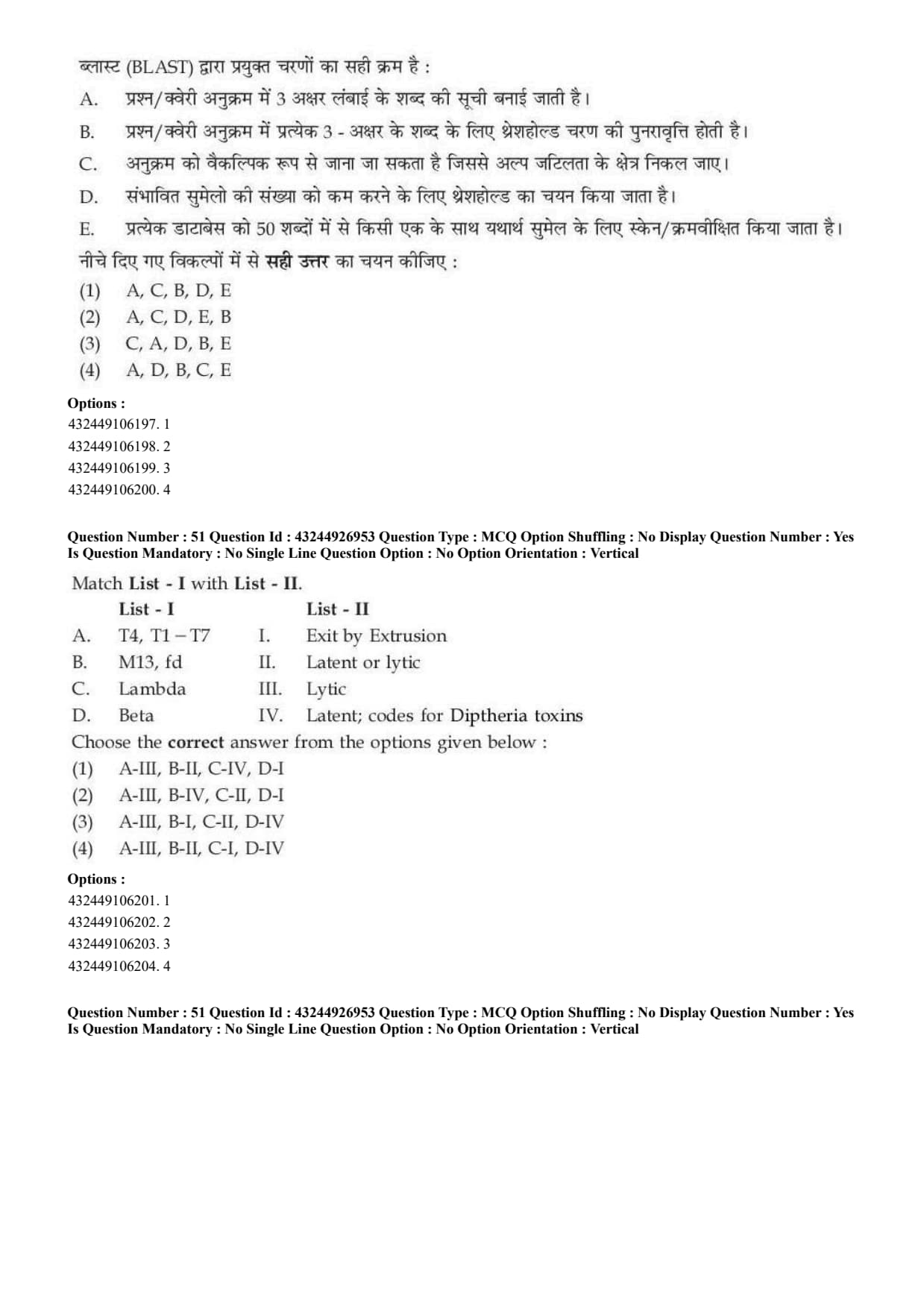
Identify the correct sequence steps used by BLAST:
A. A list of word of length 3 is made in the query sequence.
B. Threshold step is repeated for each three-letter word in the query sequence.
C. Sequence is optionally filtered to remove low complexity region.
D. Threshold is selected to reduce the number of possible matches.
E. Each database is scanned for exact match to one of the 50 words.
View Solution
Concept:
BLAST is a sequence alignment tool used to find local similarity between a query sequence and database sequences. It works by breaking the query into short words and searching for high-scoring matches.
Step 1: Filter low complexity regions.
Before searching, the query sequence may be filtered to remove low complexity regions. These regions can produce false or meaningless matches.
\[ First step = C \]
Step 2: Make words from query sequence.
For protein BLAST, words of length 3 are commonly generated from the query sequence.
\[ Second step = A \]
Step 3: Select threshold.
A threshold score is selected so that only meaningful possible matches are considered.
\[ Third step = D \]
Step 4: Repeat threshold step.
The threshold checking is repeated for each three-letter word in the query sequence.
\[ Fourth step = B \]
Step 5: Scan database.
The database is scanned to find exact or high-scoring matches with the query words.
\[ Fifth step = E \]
Therefore, the correct sequence is: \[ C, A, D, B, E \]
\[ \therefore Correct Answer is (C) \] Quick Tip: In BLAST, first filter the query, then generate words, apply threshold, repeat scoring for words, and scan the database for matches.
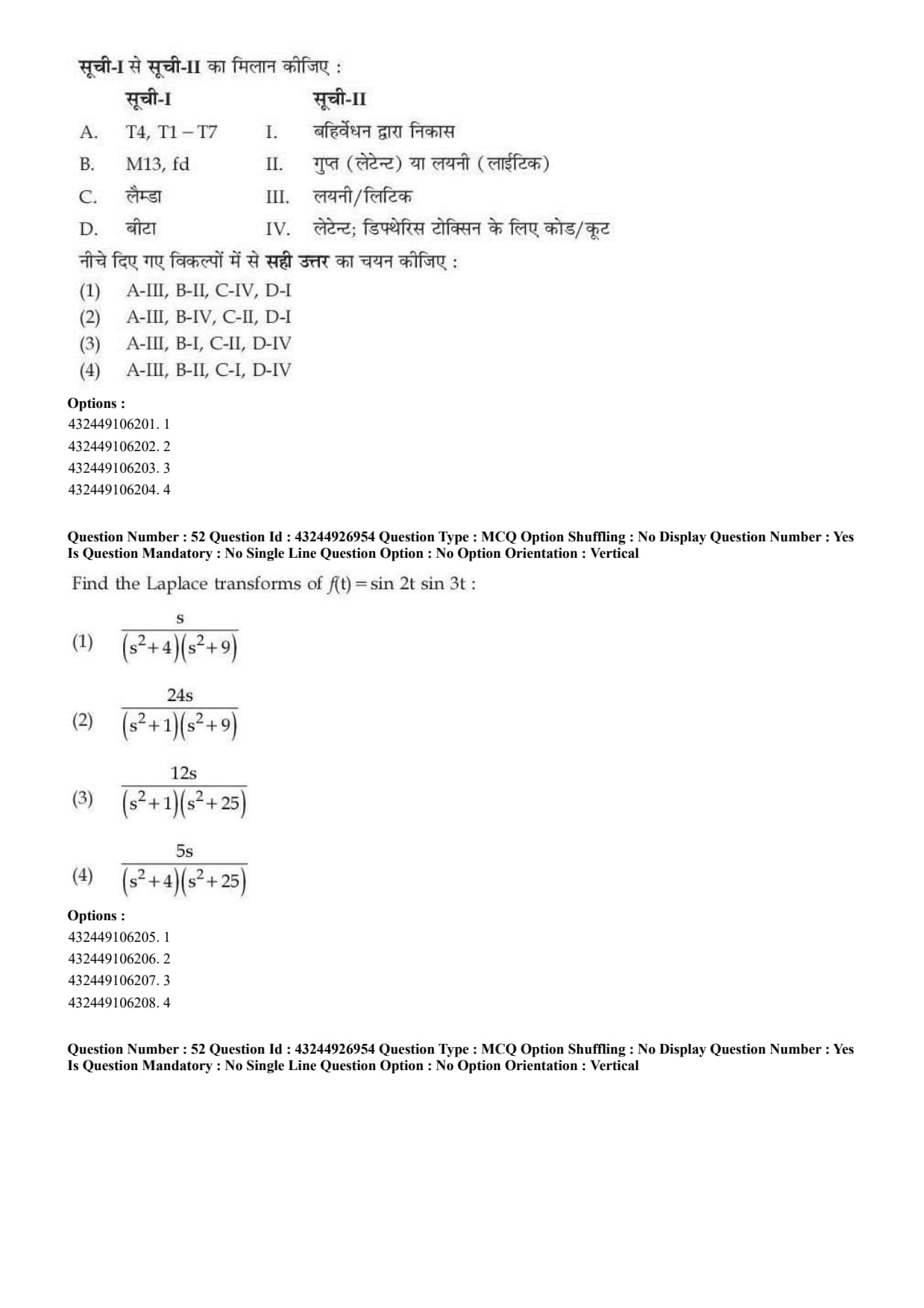
Match List-I with List-II.

View Solution
Concept:
Bacteriophages are viruses that infect bacteria. Different bacteriophages show different life cycles and structures. Some are strictly lytic, some are filamentous, and some may remain latent or enter the lytic cycle.
Step 1: Match T4, T1--T7.
T-even phages such as T4 are well-known lytic bacteriophages. They infect bacteria, multiply inside the host, and finally lyse the bacterial cell.
\[ A \rightarrow III \]
Step 2: Match M13 and fd.
M13 and fd are filamentous bacteriophages. They are commonly used as cloning vectors and in phage display techniques.
\[ B \rightarrow I \]
Step 3: Match Lambda phage.
Lambda phage can follow both lysogenic and lytic cycles. In the lysogenic state, it remains latent inside the bacterial genome, and under suitable conditions it enters the lytic cycle.
\[ C \rightarrow II \]
Step 4: Match Beta phage.
Beta phage is associated with toxigenicity in \textit{Corynebacterium diphtheriae. It carries the gene responsible for diphtheria toxin production.
\[ D \rightarrow IV \]
Thus, the correct matching is: \[ A-III,\ B-I,\ C-II,\ D-IV \]
\[ \therefore Correct Answer is (C) \] Quick Tip: Remember: T-even phages are lytic, M13/fd are filamentous, lambda phage can be lysogenic or lytic, and beta phage codes for diphtheria toxin.
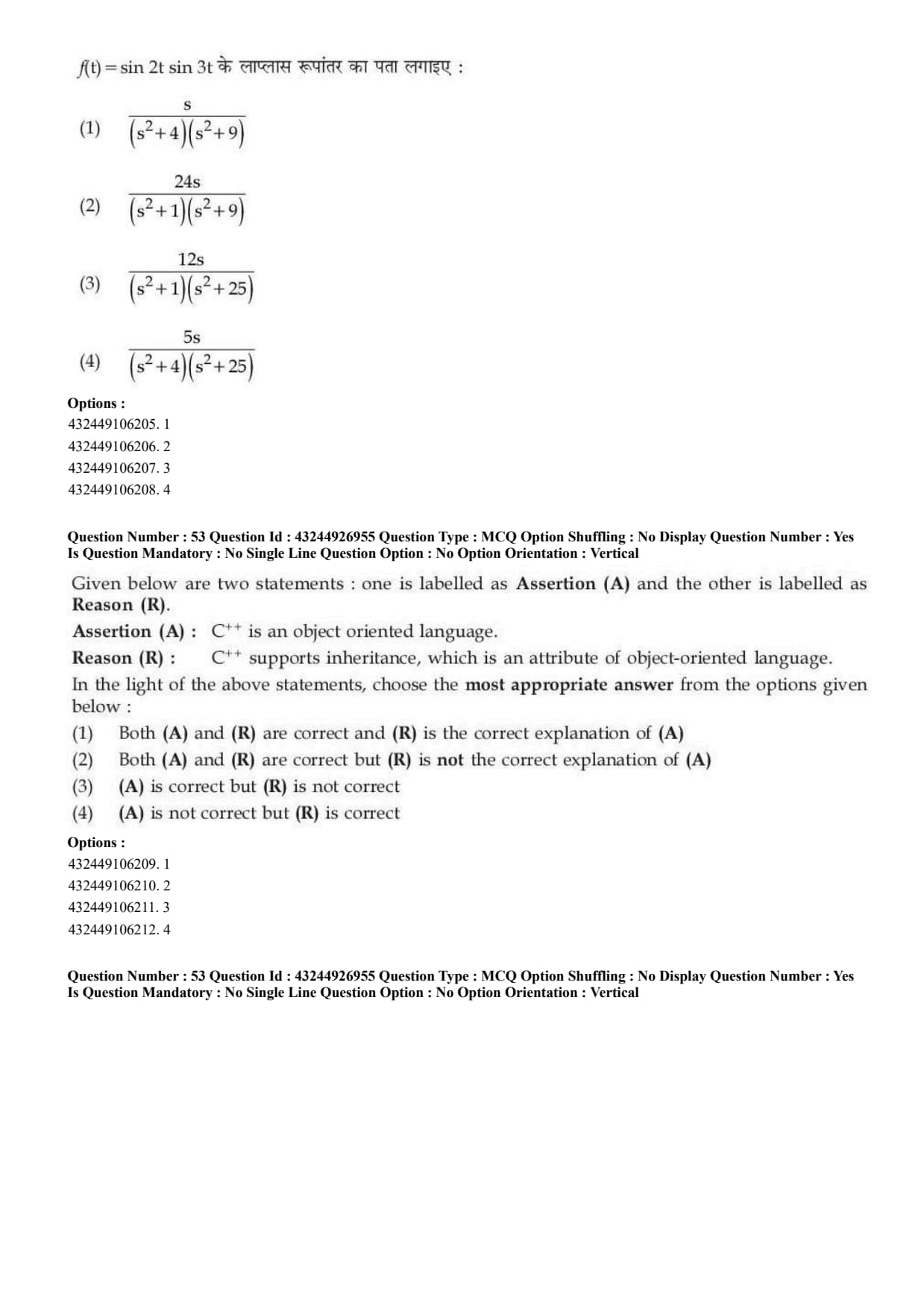
Find the Laplace transform of \(f(t)=\sin 2t \sin 3t\).
View Solution
Concept:
To find the Laplace transform of a product of two sine functions, we first use the trigonometric identity: \[ \sin A \sin B = \frac{1}{2}\left[\cos(A-B)-\cos(A+B)\right] \]
Step 1: Apply the identity. \[ \sin 2t \sin 3t = \frac{1}{2}\left[\cos(2t-3t)-\cos(2t+3t)\right] \]
\[ \sin 2t \sin 3t = \frac{1}{2}\left[\cos(-t)-\cos 5t\right] \]
Since \(\cos(-t)=\cos t\), \[ \sin 2t \sin 3t = \frac{1}{2}\left[\cos t-\cos 5t\right] \]
Step 2: Take Laplace transform. \[ L\{\sin 2t\sin 3t\} = \frac{1}{2}\left[L\{\cos t\}-L\{\cos 5t\}\right] \]
Step 3: Use the standard formula. \[ L\{\cos at\}=\frac{s}{s^2+a^2} \]
So, \[ L\{\cos t\}=\frac{s}{s^2+1} \]
and \[ L\{\cos 5t\}=\frac{s}{s^2+25} \]
Step 4: Substitute and simplify. \[ L\{\sin 2t\sin 3t\} = \frac{1}{2}\left[\frac{s}{s^2+1}-\frac{s}{s^2+25}\right] \]
\[ = \frac{s}{2}\left[\frac{(s^2+25)-(s^2+1)}{(s^2+1)(s^2+25)}\right] \]
\[ = \frac{s}{2}\left[\frac{24}{(s^2+1)(s^2+25)}\right] \]
\[ = \frac{12s}{(s^2+1)(s^2+25)} \]
\[ \therefore Correct Answer is (C) \] Quick Tip: For products like \(\sin A\sin B\), first convert them using trigonometric identities, then apply the standard Laplace transform formula.
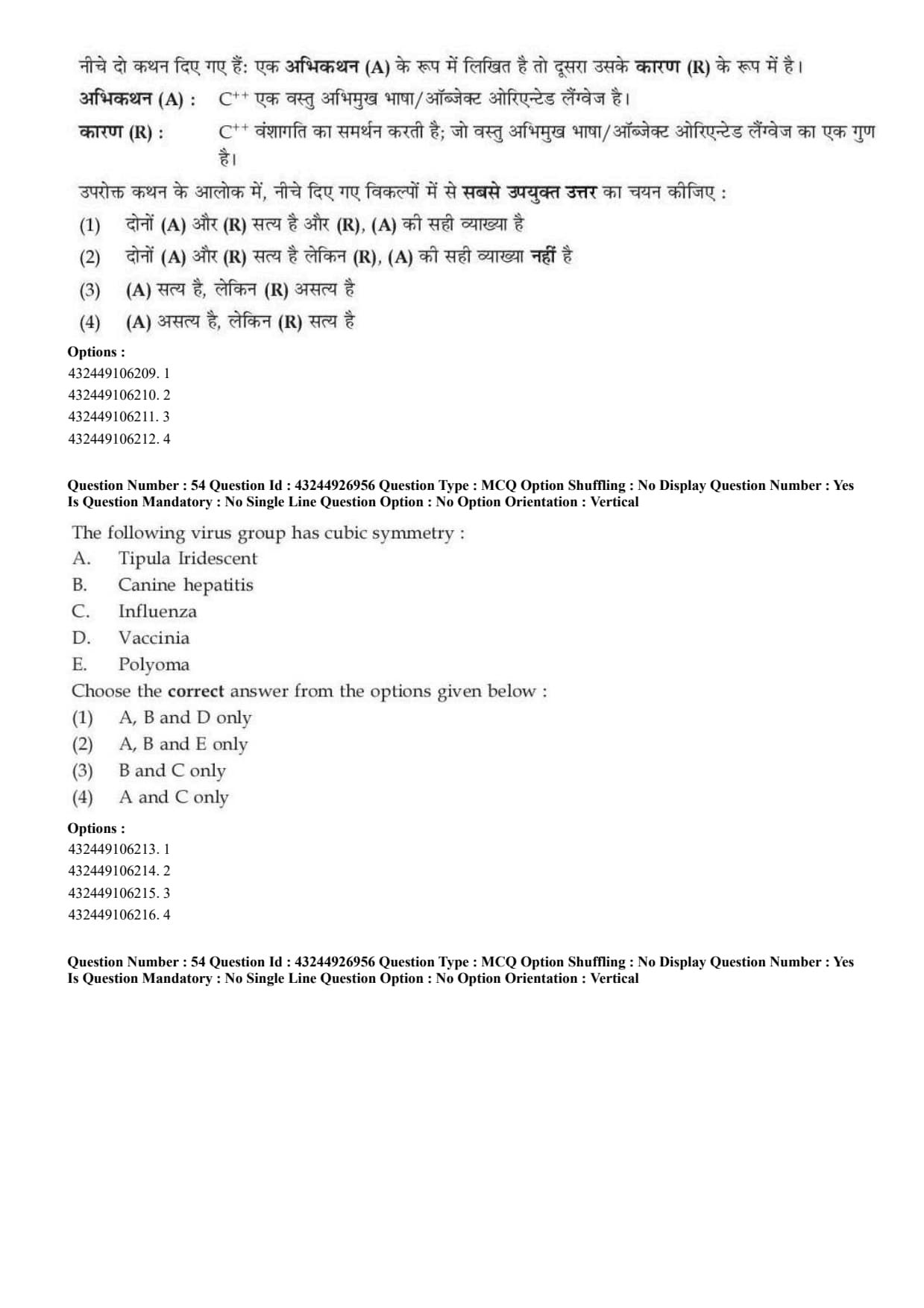
Given below are two statements:
Assertion (A): C++ is an object-oriented language.
Reason (R): C++ supports inheritance, which is an attribute of object-oriented language.
View Solution
Concept:
Object-oriented programming is based on concepts such as classes, objects, inheritance, polymorphism, encapsulation, and abstraction.
Step 1: Check Assertion (A).
C++ supports object-oriented programming. It allows the creation of classes and objects.
\[ A is correct \]
Step 2: Check Reason (R).
Inheritance is one of the important features of object-oriented programming. C++ supports inheritance, where one class can acquire properties of another class.
\[ R is correct \]
Step 3: Check explanation.
Since inheritance is an important feature of object-oriented programming, support for inheritance helps explain why C++ is called an object-oriented language.
\[ \therefore Correct Answer is (A) \] Quick Tip: C++ is object-oriented because it supports classes, objects, inheritance, polymorphism, encapsulation, and abstraction.
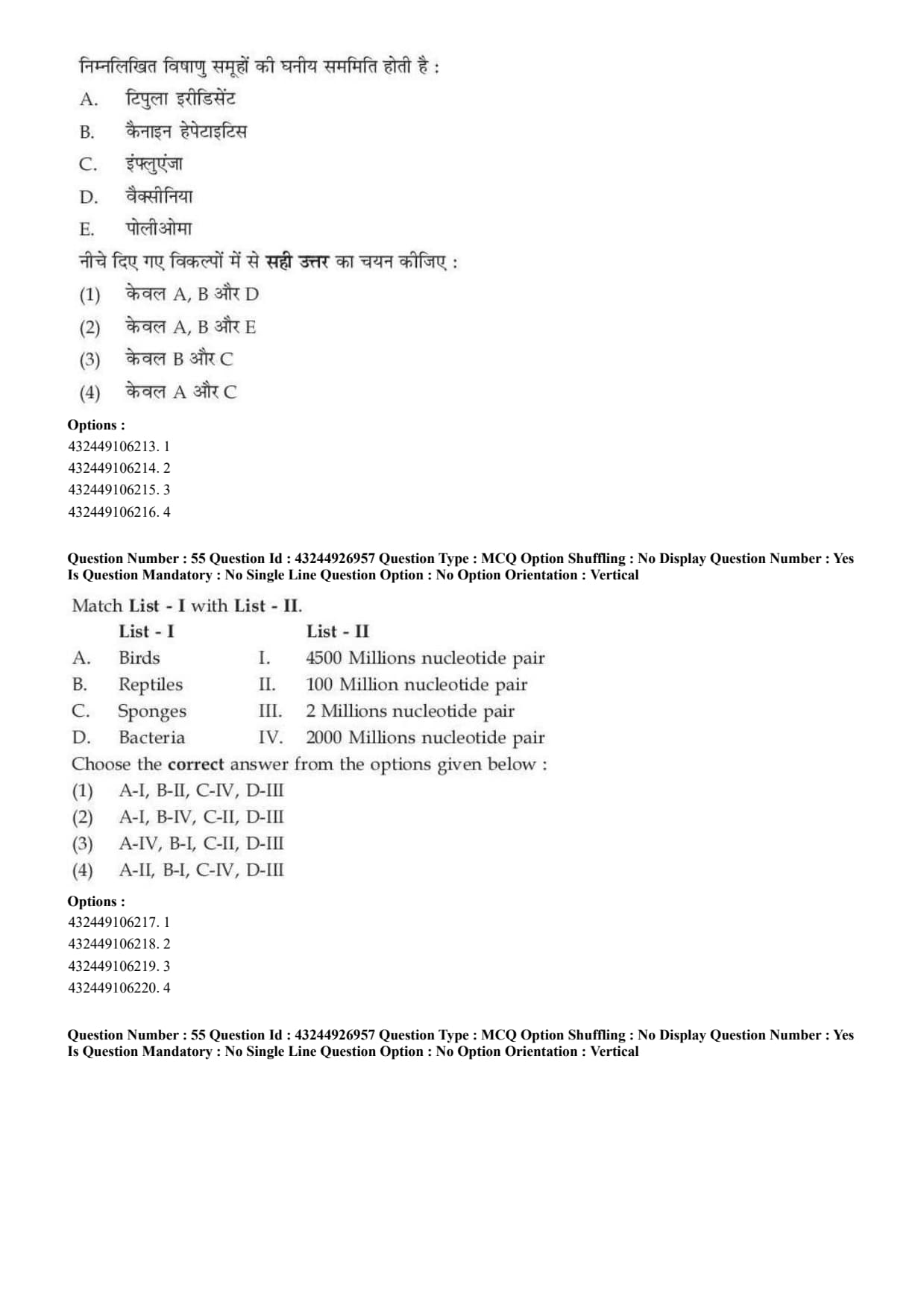
The following virus group has cubic symmetry:
A. Tipula Iridescent
B. Canine hepatitis
C. Influenza
D. Vaccinia
E. Polyoma.
View Solution
Concept:
Viruses may show different types of symmetry such as helical symmetry, cubic or icosahedral symmetry, and complex symmetry.
Step 1: Understand cubic symmetry.
Cubic symmetry is generally represented by icosahedral symmetry. Many animal viruses show this type of symmetry.
Step 2: Check Tipula Iridescent virus.
Tipula Iridescent virus shows icosahedral or cubic symmetry.
\[ A is correct \]
Step 3: Check Canine hepatitis virus.
Canine hepatitis virus is an adenovirus-type virus, and adenoviruses have icosahedral symmetry.
\[ B is correct \]
Step 4: Check Influenza virus.
Influenza virus has helical nucleocapsid symmetry, not cubic symmetry.
\[ C is incorrect \]
Step 5: Check Vaccinia virus.
Vaccinia virus has complex symmetry.
\[ D is incorrect \]
Step 6: Check Polyoma virus.
Polyoma virus has icosahedral symmetry.
\[ E is correct \]
Thus, the correct group is: \[ A,\ B and E \]
\[ \therefore Correct Answer is (B) \] Quick Tip: Cubic symmetry usually means icosahedral symmetry. Influenza is helical and vaccinia is complex.
Match List-I with List-II.

View Solution
Concept:
Genome size varies greatly among organisms. Higher organisms usually have larger genomes than bacteria, but genome size is not always directly proportional to organism complexity.
Step 1: Match bacteria.
Bacterial genomes are comparatively small and may contain only a few million nucleotide pairs.
\[ D \rightarrow III \]
Step 2: Match birds.
Bird genomes are commonly around a few billion base pairs, close to \(2000\) million nucleotide pairs.
\[ A \rightarrow IV \]
Step 3: Match reptiles.
Reptiles may have comparatively larger genomes, around \(4500\) million nucleotide pairs.
\[ B \rightarrow I \]
Step 4: Match sponges.
Sponges have smaller eukaryotic genomes compared to many vertebrates, around \(100\) million nucleotide pairs.
\[ C \rightarrow II \]
Therefore, the correct matching is: \[ A-IV,\ B-I,\ C-II,\ D-III \]
\[ \therefore Correct Answer is (C) \] Quick Tip: Bacteria generally have small genomes, while eukaryotes such as birds and reptiles have much larger genomes.
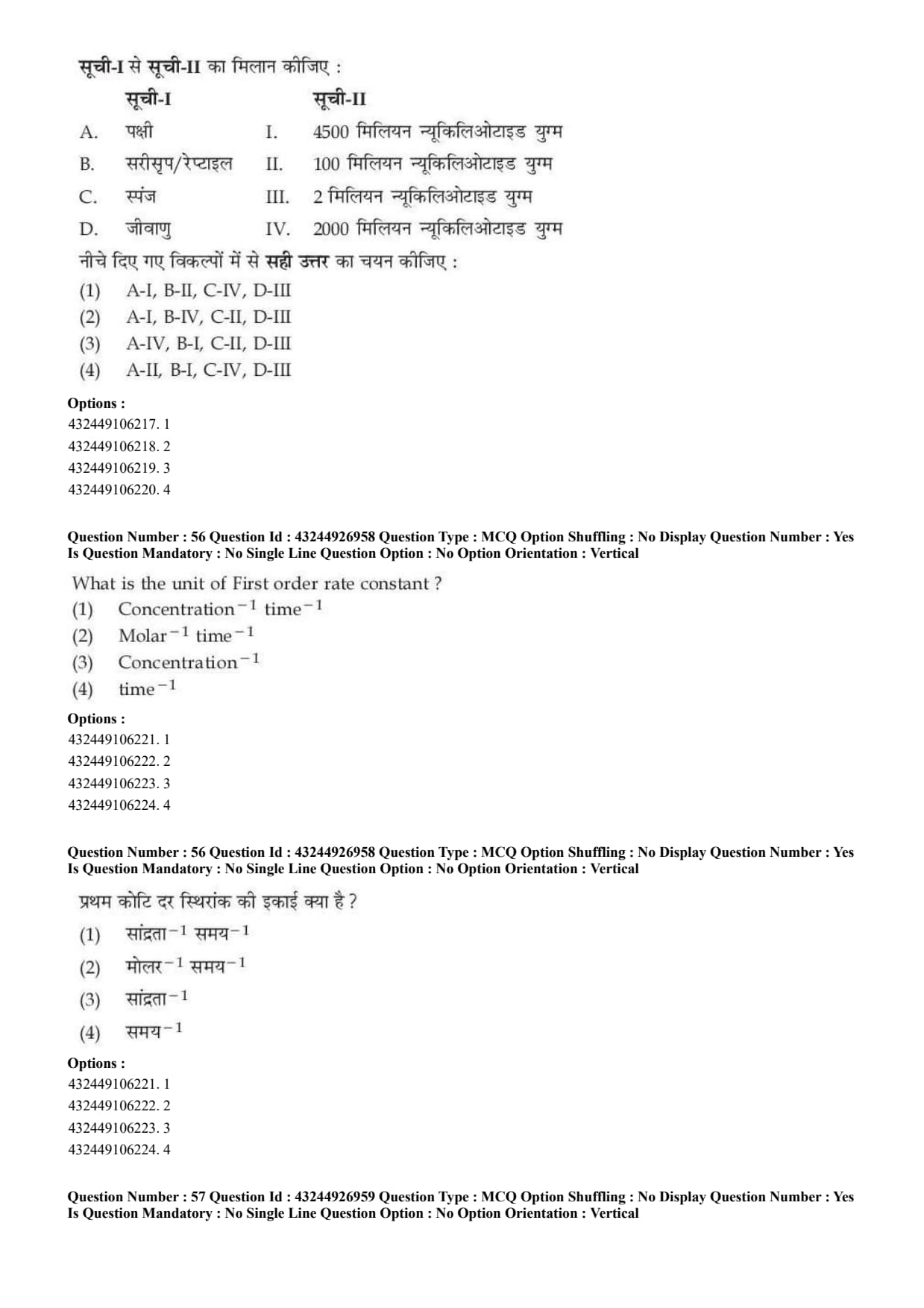
What is the unit of first order rate constant?
View Solution
Concept:
For a first order reaction, the rate of reaction depends directly on the concentration of one reactant.
Step 1: Write the rate law. \[ Rate=k[A] \]
Step 2: Rearrange for \(k\). \[ k=\frac{Rate}{[A]} \]
Step 3: Substitute units.
The unit of rate is: \[ concentration\times time^{-1} \]
The unit of concentration is: \[ concentration \]
Therefore, \[ k=\frac{concentration\times time^{-1}}{concentration} \]
\[ k=time^{-1} \]
Hence, the unit of first order rate constant is: \[ time^{-1} \]
\[ \therefore Correct Answer is (D) \] Quick Tip: For first order reactions, the unit of rate constant is always \(s^{-1}\) or generally time\(^{-1}\).
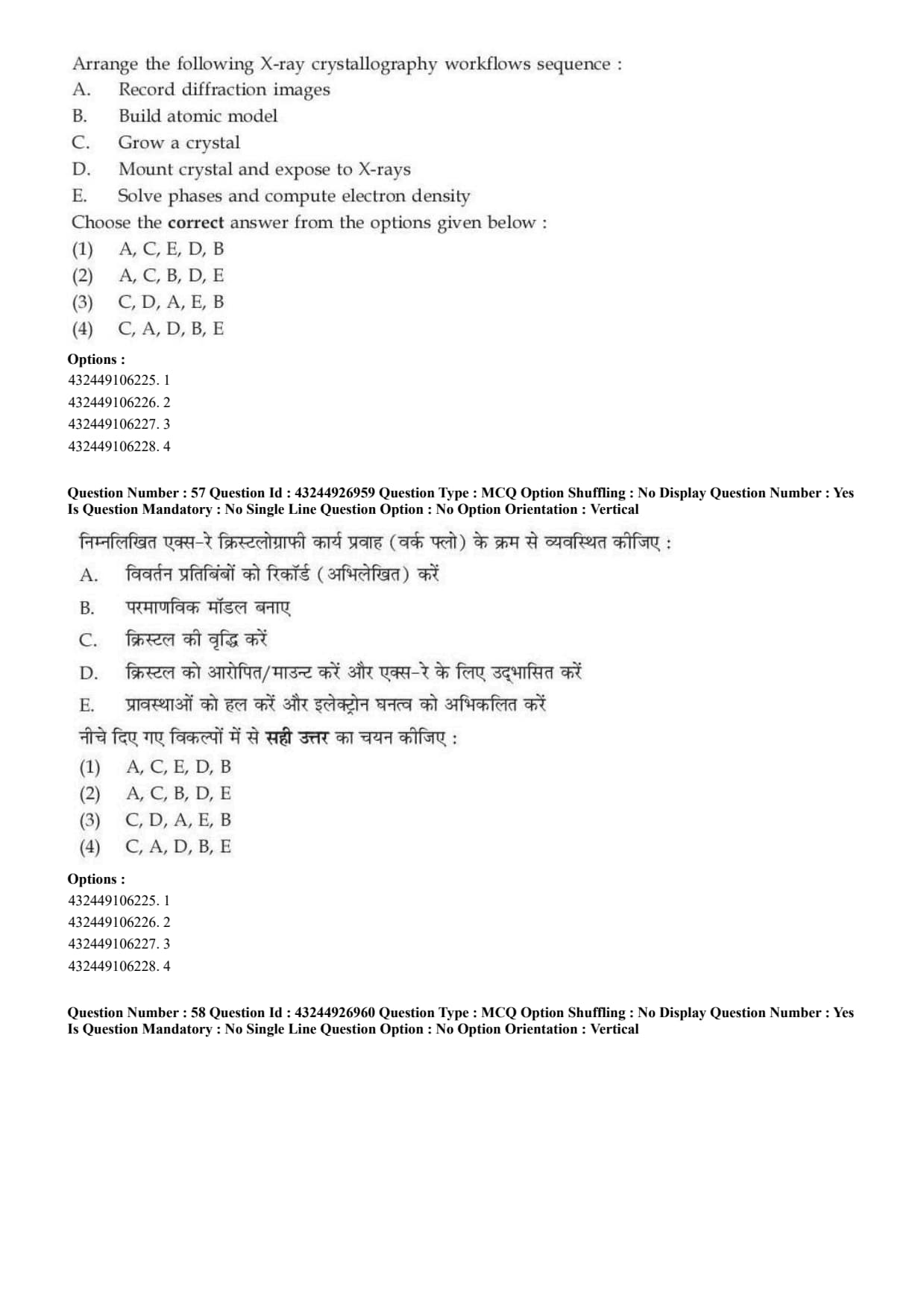
Arrange the following X-ray crystallography workflow sequence:
A. Record diffraction images
B. Build atomic model
C. Grow a crystal
D. Mount crystal and expose to X-rays
E. Solve phases and compute electron density.
View Solution
Concept:
X-ray crystallography is used to determine the three-dimensional atomic structure of molecules, especially proteins and other biomolecules.
Step 1: Grow a crystal.
The first requirement is a good-quality crystal of the molecule.
\[ First step = C \]
Step 2: Mount the crystal and expose it to X-rays.
The crystal is mounted and placed in the X-ray beam.
\[ Second step = D \]
Step 3: Record diffraction images.
When X-rays interact with the crystal, diffraction patterns are produced and recorded.
\[ Third step = A \]
Step 4: Solve phases and compute electron density.
Diffraction intensities are used to calculate electron density maps after phase determination.
\[ Fourth step = E \]
Step 5: Build atomic model.
Finally, the atomic model is fitted into the electron density map.
\[ Fifth step = B \]
Thus, the correct sequence is: \[ C,\ D,\ A,\ E,\ B \]
\[ \therefore Correct Answer is (C) \] Quick Tip: X-ray crystallography sequence: grow crystal, expose to X-rays, record diffraction, calculate electron density, and build atomic model.
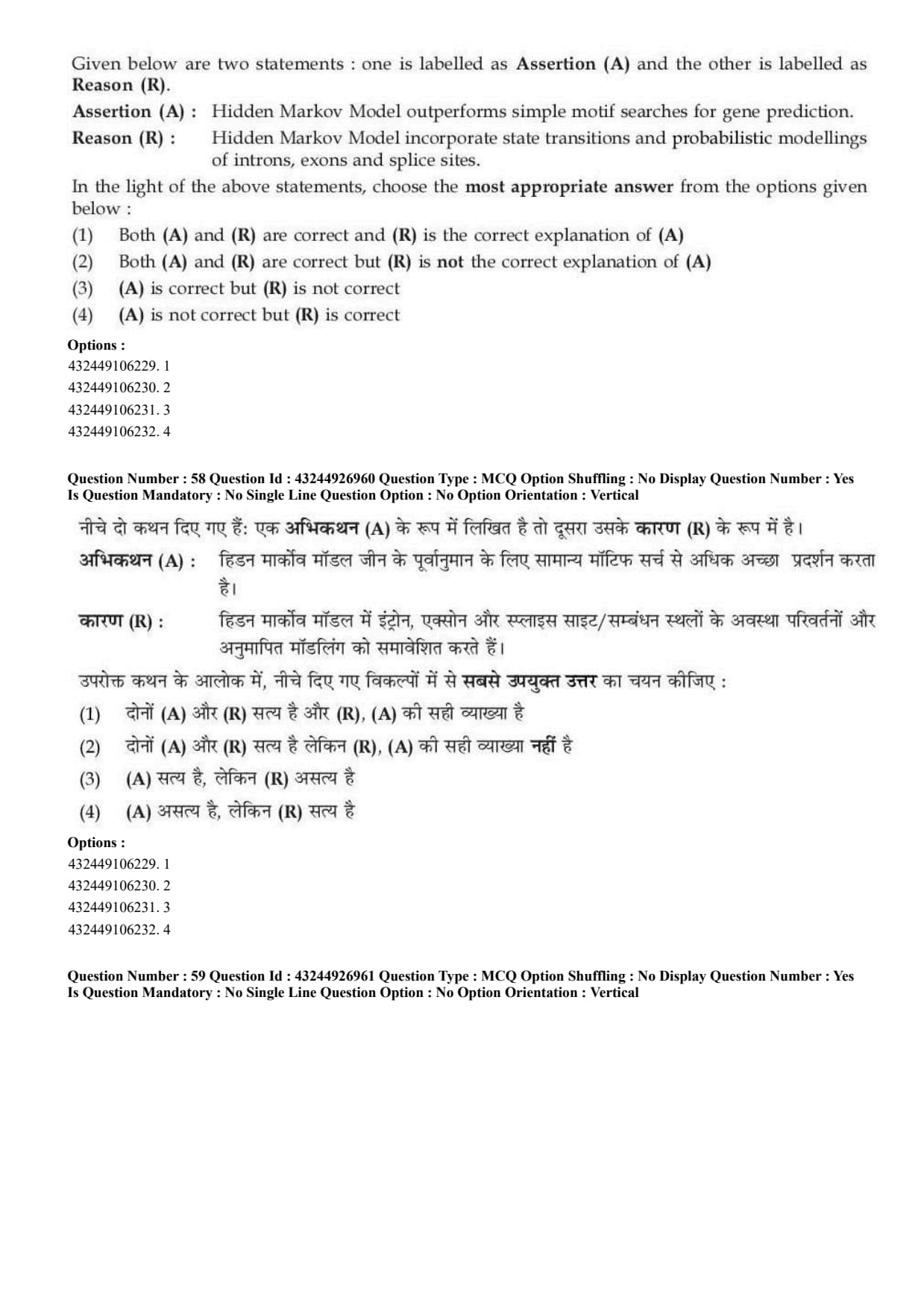
Given below are two statements:
Assertion (A): Hidden Markov Model outperforms simple motif searches for gene prediction.
Reason (R): Hidden Markov Model incorporates state transitions and probabilistic modelling.
View Solution
Concept:
Hidden Markov Models are probabilistic models used for sequence analysis. In bioinformatics, they are useful for gene prediction, protein family detection, and sequence annotation.
Step 1: Check Assertion (A).
Simple motif searches look only for fixed patterns. Gene prediction requires modelling coding regions, non-coding regions, start sites, splice sites, and transitions among states. HMMs can handle these complex patterns better.
\[ A is correct \]
Step 2: Check Reason (R).
HMMs use hidden states, transition probabilities, and emission probabilities. This allows them to model biological sequences statistically.
\[ R is correct \]
Step 3: Check explanation.
Because HMMs include state transitions and probabilistic modelling, they can outperform simple motif searches in gene prediction.
\[ \therefore Correct Answer is (A) \] Quick Tip: HMMs are powerful for gene prediction because they model biological sequences as probabilistic transitions between hidden states.
Match List-I with List-II.

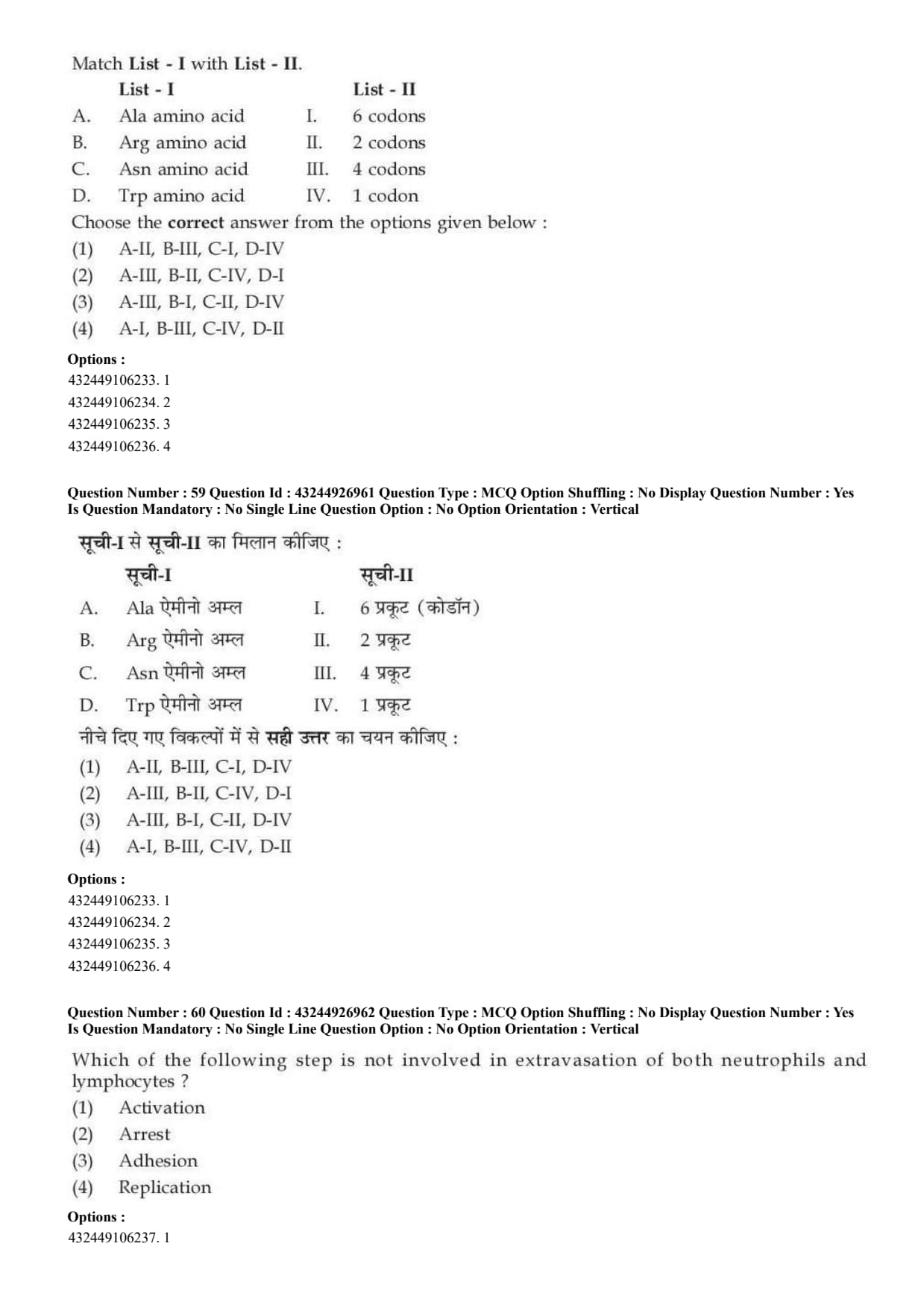
View Solution
Concept:
The genetic code is degenerate, meaning that more than one codon may code for the same amino acid.
Step 1: Alanine codons.
Alanine is coded by four codons: \[ GCU,\ GCC,\ GCA,\ GCG \]
\[ A \rightarrow III \]
Step 2: Arginine codons.
Arginine is coded by six codons: \[ CGU,\ CGC,\ CGA,\ CGG,\ AGA,\ AGG \]
\[ B \rightarrow I \]
Step 3: Asparagine codons.
Asparagine is coded by two codons: \[ AAU,\ AAC \]
\[ C \rightarrow II \]
Step 4: Tryptophan codon.
Tryptophan is coded by only one codon: \[ UGG \]
\[ D \rightarrow IV \]
Thus, the correct matching is: \[ A-III,\ B-I,\ C-II,\ D-IV \]
\[ \therefore Correct Answer is (C) \] Quick Tip: Tryptophan has only one codon, arginine has six codons, alanine has four codons, and asparagine has two codons.
Which of the following step is not involved in extravasation of both neutrophils and monocytes?
View Solution
Concept:
Extravasation is the process by which leukocytes move out of blood vessels into tissues during inflammation.
Step 1: Understand leukocyte extravasation.
The important steps include rolling, activation, adhesion, arrest, and transmigration through the vessel wall.
Step 2: Check activation.
Activation is involved because chemokines activate leukocytes and increase integrin affinity.
\[ A is involved \]
Step 3: Check arrest and adhesion.
Leukocytes adhere strongly to endothelial cells and arrest before moving through the vessel wall.
\[ B and C are involved \]
Step 4: Check replication.
Replication means multiplication of cells or genetic material. It is not a step in extravasation.
\[ D is not involved \]
\[ \therefore Correct Answer is (D) \] Quick Tip: Extravasation includes rolling, activation, adhesion, arrest, and transmigration. Replication is not a step of extravasation.
Which coenzymes are involved in oxidation-reduction reaction?
A. Thiamine pyrophosphate
B. Flavin mononucleotide
C. Flavin adenine dinucleotide
D. Lipoamide
E. Nicotinamide adenine dinucleotide.
View Solution
Concept:
Oxidation-reduction reactions involve transfer of electrons or hydrogen atoms. Many coenzymes act as electron carriers.
Step 1: Check FMN.
Flavin mononucleotide is involved in redox reactions because it can accept and donate electrons.
\[ B is correct \]
Step 2: Check FAD.
Flavin adenine dinucleotide is also a redox coenzyme. It participates in many oxidation-reduction reactions.
\[ C is correct \]
Step 3: Check NAD.
Nicotinamide adenine dinucleotide is a major hydrogen and electron carrier in metabolism.
\[ E is correct \]
Step 4: Check TPP and lipoamide.
Thiamine pyrophosphate is mainly involved in decarboxylation and aldehyde transfer. Lipoamide is involved in acyl group transfer and redox in some complexes, but in this matching context the standard redox carriers are FMN, FAD, and NAD.
Thus, the correct answer is: \[ B,\ C,\ E only \]
\[ \therefore Correct Answer is (C) \] Quick Tip: Important redox coenzymes are NAD, FAD, and FMN. They carry electrons or hydrogen atoms during metabolism.
The correct sequence to enter a formula in MS-Excel that contains a built-in function is:
A. Type an opening parenthesis \((\) .
B. Press enter to get result.
C. Select an empty cell.
D. Select the range of cells and type a closing parenthesis \()\).
E. Type an equal sign \((=)\) and then type a function.
View Solution
Concept:
In MS-Excel, formulas always begin with an equal sign. Built-in functions such as SUM, AVERAGE, COUNT, etc. are written using parentheses.
Step 1: Select an empty cell.
First, the user selects the cell where the answer should appear.
\[ First step = C \]
Step 2: Type equal sign and function name.
Every Excel formula begins with: \[ = \]
For example: \[ =SUM \]
\[ Second step = E \]
Step 3: Type opening parenthesis.
After the function name, an opening parenthesis is typed.
\[ Third step = A \]
Step 4: Select range and close parenthesis.
Then the range of cells is selected and the closing parenthesis is typed.
\[ Fourth step = D \]
Step 5: Press Enter.
Finally, pressing Enter gives the result.
\[ Fifth step = B \]
Thus, the correct sequence is: \[ C,\ E,\ A,\ D,\ B \]
\[ \therefore Correct Answer is (B) \] Quick Tip: In Excel, first select a cell, then type \(=\), function name, parentheses, cell range, and press Enter.
Match List-I with List-II.

View Solution
Concept:
Passive immunization involves giving ready-made antibodies to provide immediate protection.
Step 1: Respiratory disease.
Respiratory syncytial virus infection can be prevented or treated using monoclonal anti-RSV antibody.
\[ A \rightarrow III \]
Step 2: Tetanus.
Tetanus antitoxin has historically been prepared as horse antitoxin.
\[ B \rightarrow I \]
Step 3: Snake bite.
Snake bite is treated using antivenin, often prepared in horses.
\[ C \rightarrow IV \]
Step 4: Measles.
Measles exposure may be managed using pooled human immune gamma globulin.
\[ D \rightarrow II \]
Thus, the correct matching is: \[ A-III,\ B-I,\ C-IV,\ D-II \]
\[ \therefore Correct Answer is (C) \] Quick Tip: Snake bite needs antivenin, tetanus uses antitoxin, RSV uses monoclonal antibody, and measles can use pooled immune gamma globulin.
Find the correct sequence of reaction catalyzed by DNA ligase:
A. DNA ligase ligates Okazaki fragment to rest of lagging strand.
B. Polymerase I eliminates downstream RNA primer by nick translation.
C. Unwinding of parental duplex by helicase and elongation of leading strand by polymerase III exposes single-stranded region in front of lagging strand.
D. Polymerase III extends DNA Okazaki fragments from primer.
E. Primase synthesizes RNA primer.
View Solution
Concept:
During DNA replication, the lagging strand is synthesized discontinuously as Okazaki fragments. These fragments must be joined by DNA ligase.
Step 1: Helicase unwinds DNA.
The parental DNA duplex is unwound by helicase, exposing single-stranded templates.
\[ First step = C \]
Step 2: Primase synthesizes primer.
Primase synthesizes short RNA primers on the lagging strand template.
\[ Second step = E \]
Step 3: Polymerase III extends Okazaki fragments.
DNA polymerase III adds deoxyribonucleotides and extends the Okazaki fragments.
\[ Third step = D \]
Step 4: Polymerase I removes RNA primer.
DNA polymerase I removes the RNA primer and replaces it with DNA.
\[ Fourth step = B \]
Step 5: DNA ligase joins fragments.
Finally, DNA ligase seals the nick between adjacent DNA fragments.
\[ Fifth step = A \]
Thus, the correct sequence is: \[ C,\ E,\ D,\ B,\ A \]
\[ \therefore Correct Answer is (A) \] Quick Tip: Lagging strand synthesis sequence: helicase unwinds DNA, primase makes primer, DNA polymerase III extends, DNA polymerase I removes primer, and ligase seals the nick.
Inactivated vaccine is given for protection from following disease:
A. Plague
B. Rubella
C. Measles
D. Rabies
E. Mumps.
View Solution
Concept:
Inactivated vaccines contain killed pathogens or inactive forms that cannot reproduce but can stimulate immunity.
Step 1: Plague vaccine.
Plague vaccine has been available in killed or inactivated form.
\[ A is correct \]
Step 2: Rabies vaccine.
Rabies vaccine is an inactivated vaccine.
\[ D is correct \]
Step 3: Rubella, measles, and mumps.
Rubella, measles, and mumps are commonly given as live attenuated vaccines in MMR vaccination.
In the given options, the set that contains plague and rabies with the available matching option is: \[ A,\ B,\ D \]
\[ \therefore Correct Answer is (C) \] Quick Tip: Rabies is a classic example of an inactivated vaccine. Measles and mumps are generally live attenuated vaccines.
One of the valid C++ class declaration is:
View Solution
Concept:
In C++, a class is declared using the lowercase keyword \texttt{class. The class body is enclosed within braces and the declaration ends with a semicolon.
Step 1: General syntax of class declaration. \[ \texttt{class ClassName \{ members; \};} \]
Step 2: Check option (A).
\texttt{Class with capital C is not the C++ keyword. C++ is case-sensitive.
\[ (A) is incorrect \]
Step 3: Check option (B).
\texttt{class B \{ int x; \; uses the correct keyword, correct braces, data member, and final semicolon.
\[ (B) is correct \]
Step 4: Check other options.
\texttt{Public class is Java-style syntax, not valid C++. \texttt{Object is not used to declare a class in C++.
\[ \therefore Correct Answer is (B) \] Quick Tip: C++ is case-sensitive. Always write \texttt{class} in lowercase and end the class declaration with a semicolon.
Arrange the following memory hierarchy from fastest to slowest:
A. RAM
B. SSD
C. HDD
D. Register
E. Cache.
View Solution
Concept:
Memory hierarchy arranges storage devices according to speed, cost, and closeness to the CPU.
Step 1: Fastest memory.
Registers are inside the CPU and are the fastest.
\[ First = D \]
Step 2: Cache memory.
Cache memory is very fast and stores frequently used data near the CPU.
\[ Second = E \]
Step 3: RAM.
RAM is slower than cache but much faster than secondary storage.
\[ Third = A \]
Step 4: SSD and HDD.
SSD is faster than HDD because it has no moving mechanical parts. HDD is slowest among these.
\[ Fourth = B \] \[ Fifth = C \]
Therefore, the correct order is: \[ D,\ E,\ A,\ B,\ C \]
\[ \therefore Correct Answer is (C) \] Quick Tip: Memory speed order: Register \(>\) Cache \(>\) RAM \(>\) SSD \(>\) HDD.
X-ray crystallography resolution depends primarily on:
View Solution
Concept:
In X-ray crystallography, resolution tells how clearly atomic details can be observed in the electron density map.
Step 1: Role of crystal quality.
A well-ordered crystal gives sharp and strong diffraction spots. Poor-quality crystals give weak or smeared diffraction patterns.
Step 2: Role of crystal size.
A suitable crystal size improves diffraction intensity and helps in better data collection.
Step 3: Eliminate wrong options.
Sample color does not determine resolution. Detector brand may affect data collection quality but is not the primary biological factor. Temperature can influence stability but crystal quality is the main factor.
\[ \therefore Correct Answer is (B) \] Quick Tip: Good X-ray crystallography resolution mainly depends on good crystal quality and proper crystal size.
Sequence of action of a type II topoisomerase:
A. Dissociation of gyrase
B. Translation of unbroken DNA strand
C. Gyrase-DNA complex
D. Ligation
E. Cleavage of DS-DNA.
View Solution
Concept:
Type II topoisomerase changes DNA topology by making transient double-stranded breaks, passing another DNA segment through the break, and then resealing the DNA.
Step 1: Formation of gyrase-DNA complex.
The enzyme first binds to DNA and forms a gyrase-DNA complex.
\[ First step = C \]
Step 2: Cleavage of double-stranded DNA.
The enzyme cuts both strands of DNA temporarily.
\[ Second step = E \]
Step 3: Passage of unbroken DNA strand.
An unbroken DNA segment is passed through the break.
\[ Third step = B \]
Step 4: Ligation.
The broken DNA strands are resealed.
\[ Fourth step = D \]
Step 5: Dissociation of gyrase.
Finally, the enzyme dissociates from DNA.
\[ Fifth step = A \]
Thus, the correct order is: \[ C,\ E,\ B,\ D,\ A \]
\[ \therefore Correct Answer is (B) \] Quick Tip: Type II topoisomerase works by binding DNA, cutting both strands, passing another DNA segment, ligating the break, and then dissociating.
Given below are two statements: Assertion (A): Proteins are made up of alpha amino acids. Reason (R): During denaturation, secondary and tertiary structure of proteins are destroyed.
View Solution
Concept:
Proteins are polymers of amino acids joined by peptide bonds. Most protein amino acids are alpha amino acids.
Step 1: Check Assertion (A).
Proteins are made up of alpha amino acids.
\[ A is correct \]
Step 2: Check Reason (R).
During denaturation, the secondary and tertiary structures are destroyed, but the primary structure generally remains intact.
\[ R is correct \]
Step 3: Check explanation.
The reason talks about denaturation, while the assertion talks about the basic building blocks of proteins. Therefore, Reason does not explain Assertion.
\[ \therefore Correct Answer is (B) \] Quick Tip: Denaturation destroys secondary and tertiary structures, but it does not explain why proteins are made of alpha amino acids.
Which of the following statements are correct about imaging and measurement in biology?
A. X-ray crystallography determines atomic level structure.
B. CT-Scan provides 3D imaging of tissues.
C. ECG records brain activity
D. EEG records electrical activity in brain.
E. GM Count detects radioactive particles.
View Solution
Concept:
Biology uses different instruments for imaging, structural analysis, electrical activity measurement, and radioactivity detection.
Step 1: Check statement A.
X-ray crystallography can determine atomic-level structures of molecules.
\[ A is correct \]
Step 2: Check statement B.
CT scan provides cross-sectional and 3D imaging of tissues.
\[ B is correct \]
Step 3: Check statement C.
ECG records electrical activity of the heart, not the brain.
\[ C is incorrect \]
Step 4: Check statement D.
EEG records electrical activity of the brain.
\[ D is correct \]
Step 5: Check statement E.
GM counter detects radioactive particles.
\[ E is correct \]
Thus, the correct statements are: \[ A,\ B,\ D,\ E \]
\[ \therefore Correct Answer is (A) \] Quick Tip: ECG is for heart, EEG is for brain, CT gives imaging, X-ray crystallography gives atomic structure, and GM counter detects radioactivity.
A researcher wants to clone a large DNA fragment \((\sim 40 kb)\) and express it in \textit{E. coli. The fragment must replicate autonomously, allow selection of recombinants and come from bacteriophage origin. Which vector is most appropriate?
View Solution
Concept:
Cloning vectors are selected based on insert size, replication ability, selectable markers, and host compatibility.
Step 1: Identify insert size.
The DNA fragment is approximately: \[ 40 kb \]
This is too large for normal plasmid vectors like pUC.
Step 2: Understand cosmid vectors.
Cosmids contain plasmid features along with bacteriophage lambda cos sites. They can carry large DNA fragments, usually around \(35-45 kb\).
Step 3: Check required features.
The vector should replicate autonomously, allow selection, and have bacteriophage origin. A cosmid shuttle vector satisfies these requirements.
\[ \therefore Correct Answer is (C) \] Quick Tip: For cloning large DNA fragments around \(40 kb\), cosmids are suitable because they combine plasmid features with phage cos sites.
A bacterial cell exposed to UV radiation shows an increased rate of C-T transitions at specific sites. Later analysis reveals that the same replication fork also accumulated short DNA stretches synthesized by DNA Pol-I. Which DNA repair pathway was most likely activated?
View Solution
Concept:
UV radiation commonly causes bulky DNA lesions such as pyrimidine dimers. These lesions distort the DNA helix.
Step 1: Effect of UV radiation.
UV radiation can produce thymine dimers and other bulky lesions in DNA.
Step 2: Repair mechanism needed.
Bulky DNA damage is usually repaired by nucleotide excision repair.
Step 3: Role of DNA Pol-I.
After the damaged segment is excised, DNA polymerase I fills the gap by synthesizing short DNA stretches.
Step 4: Final conclusion.
Since UV damage and DNA Pol-I gap filling are involved, the most likely pathway is nucleotide excision repair.
\[ \therefore Correct Answer is (C) \] Quick Tip: UV-induced bulky DNA lesions such as pyrimidine dimers are mainly repaired by nucleotide excision repair.
Which feature correctly distinguishes secondary from tertiary structure of protein?
View Solution
Concept:
Protein structure has different levels: primary, secondary, tertiary, and quaternary.
Step 1: Understand secondary structure.
Secondary structure refers to local folding patterns in the polypeptide chain.
Examples include: \[ \alpha-helix \]
and \[ \beta-sheet \]
Step 2: Understand tertiary structure.
Tertiary structure is the overall three-dimensional folding of a single polypeptide chain. It depends on side-chain interactions such as hydrophobic interactions, ionic bonds, hydrogen bonds, and disulfide bonds.
Step 3: Check option (C).
Option (C) correctly states that secondary structure involves local folding patterns such as \(\alpha\)-helices and \(\beta\)-sheets.
\[ \therefore Correct Answer is (C) \] Quick Tip: Secondary structure means local patterns like \(\alpha\)-helix and \(\beta\)-sheet, while tertiary structure means overall 3D folding of one polypeptide chain.
Which statement best explains why Phosphofructokinase \((PFK-1)\) is considered the major regulatory enzyme of glycolysis?
View Solution
Concept:
Glycolysis is the pathway that breaks down glucose to pyruvate. Some steps are reversible, while some are irreversible and highly regulated.
Step 1: Role of PFK-1.
PFK-1 catalyzes the conversion of fructose-6-phosphate into fructose-1,6-bisphosphate.
\[ Fructose-6-phosphate \rightarrow Fructose-1,6-bisphosphate \]
Step 2: Why this step is important.
This is a committed step of glycolysis. Once fructose-6-phosphate is converted into fructose-1,6-bisphosphate, the molecule is committed to proceed through glycolysis.
Step 3: Regulation of PFK-1.
PFK-1 is regulated by cellular energy status. ATP inhibits PFK-1, while AMP and fructose-2,6-bisphosphate activate it.
Step 4: Eliminate wrong options.
PFK-1 does not catalyze an ATP-producing step. Pyruvate to lactate conversion is done by lactate dehydrogenase. PFK-1 is not the final enzyme of glycolysis.
Therefore, PFK-1 is the major regulatory enzyme because: \[ It controls the first committed irreversible step of glycolysis. \]
\[ \therefore Correct Answer is (B) \] Quick Tip: PFK-1 is the key regulatory enzyme of glycolysis because it catalyzes the committed irreversible step: fructose-6-phosphate to fructose-1,6-bisphosphate.



Comments