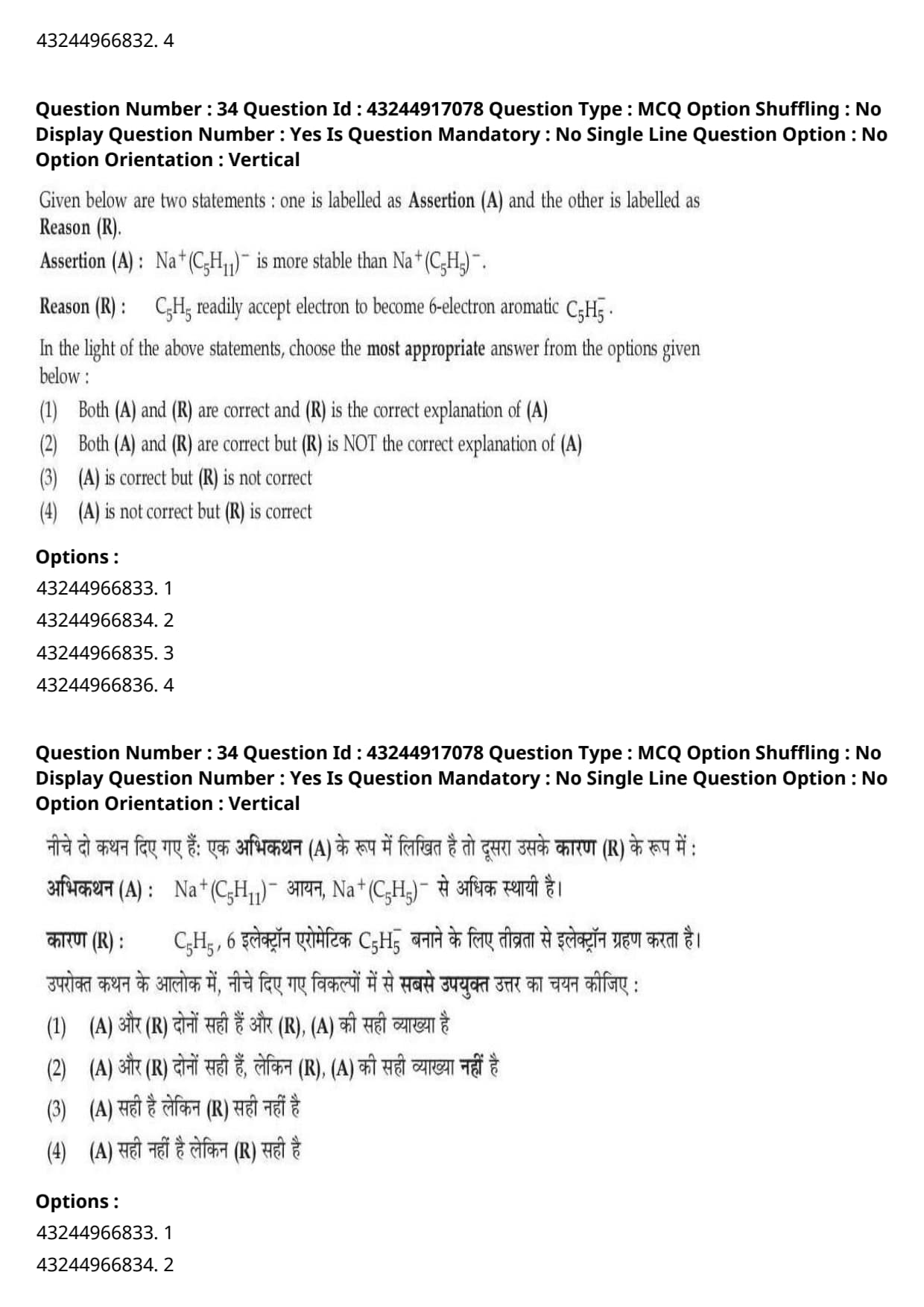
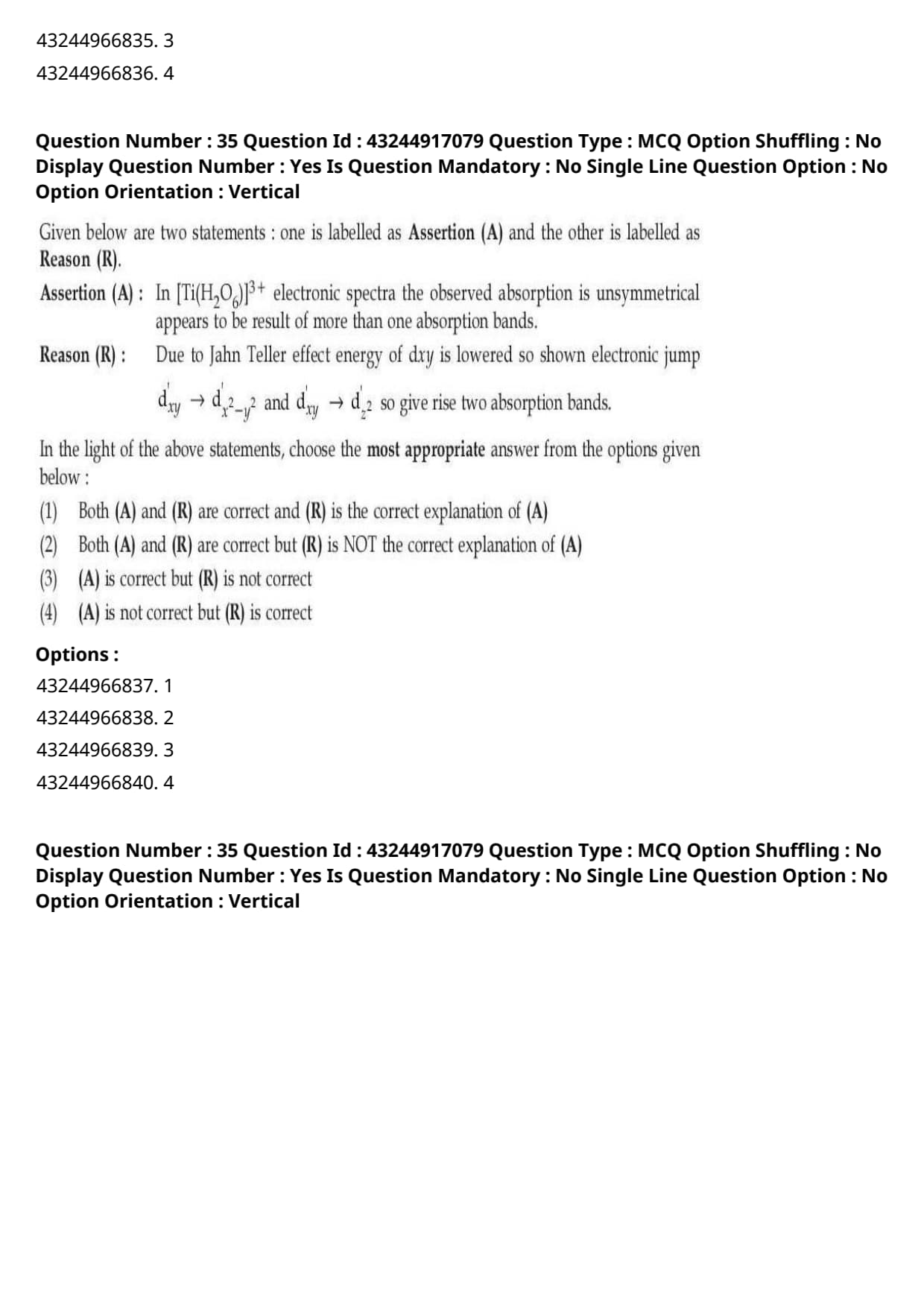
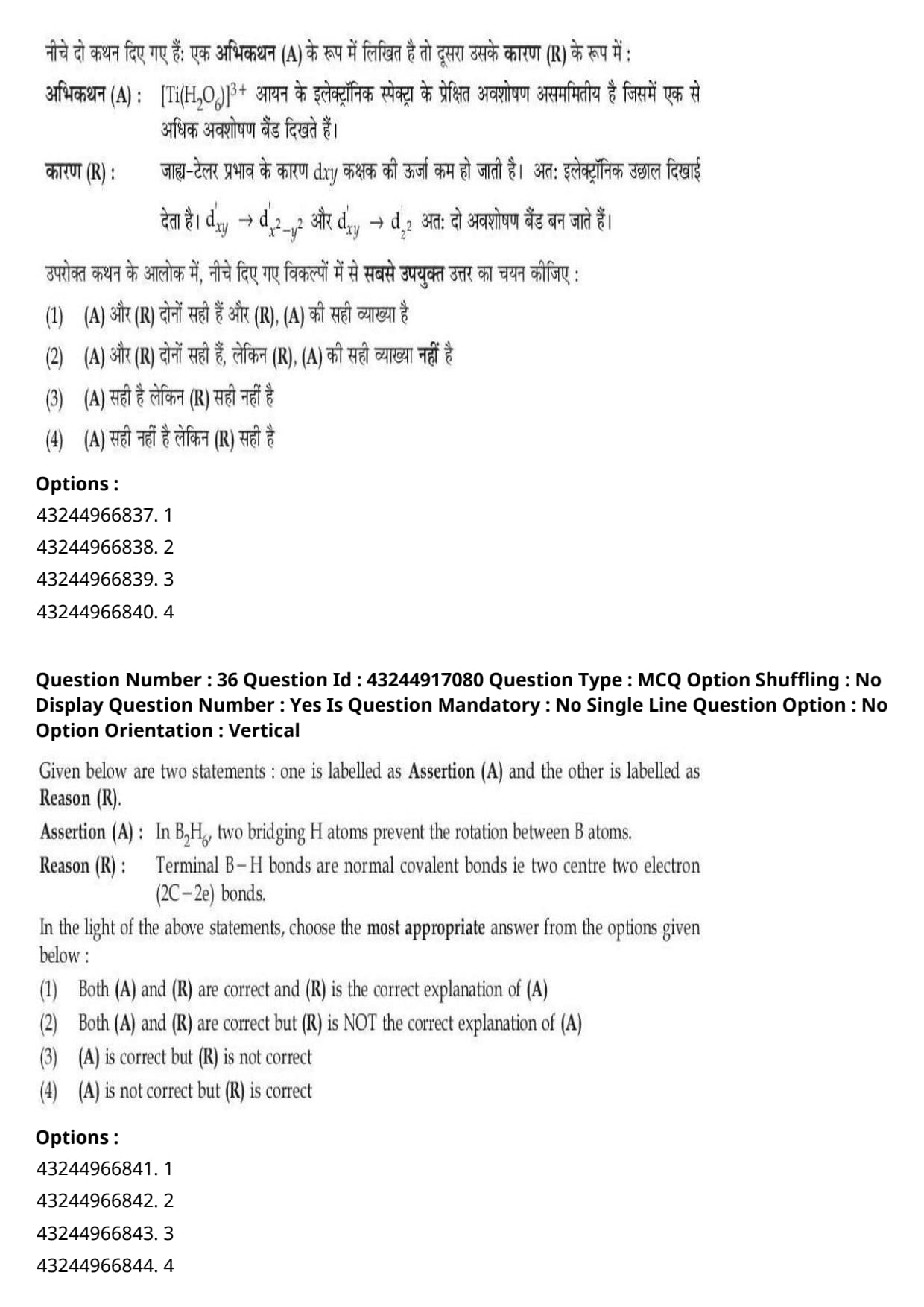
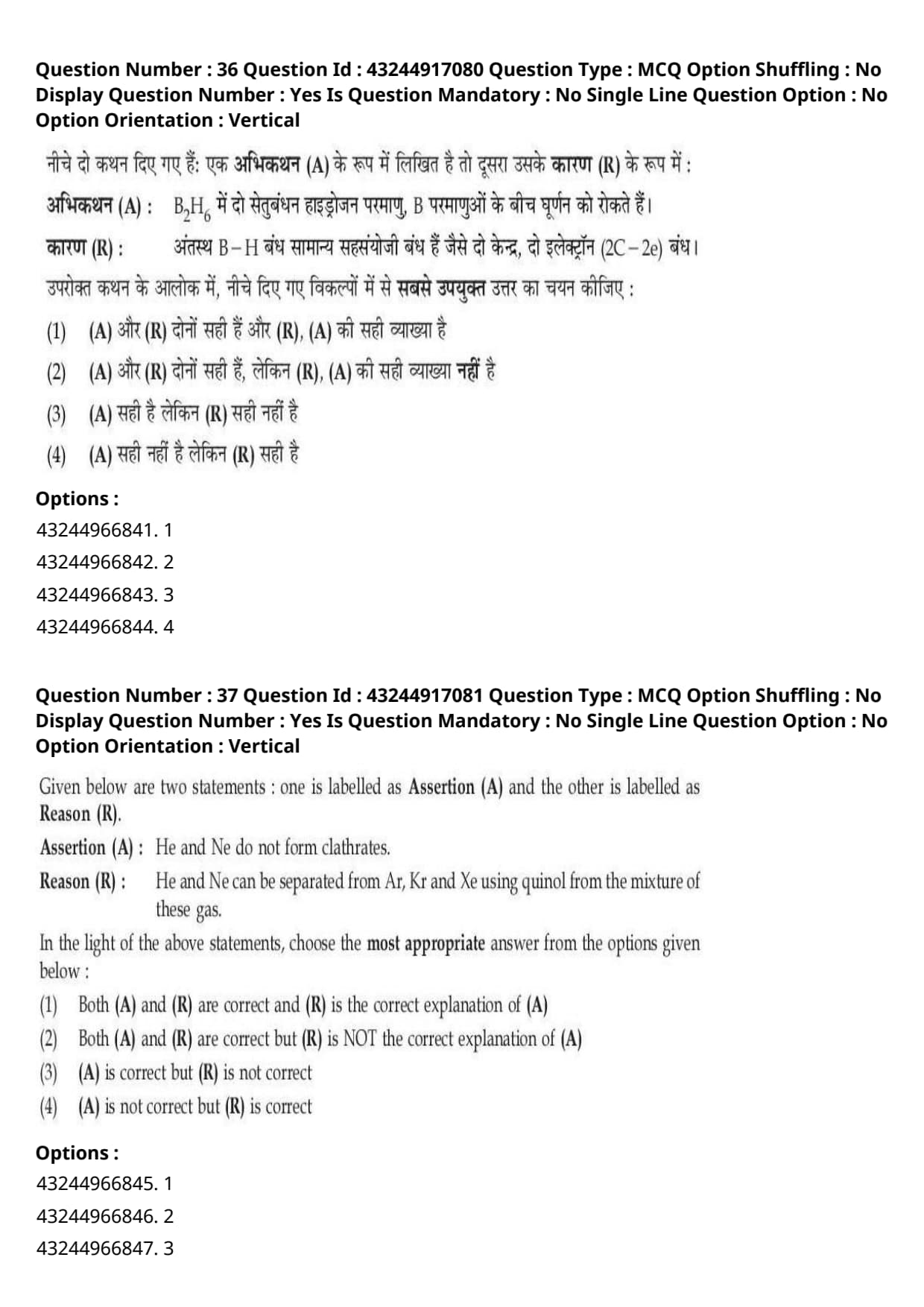
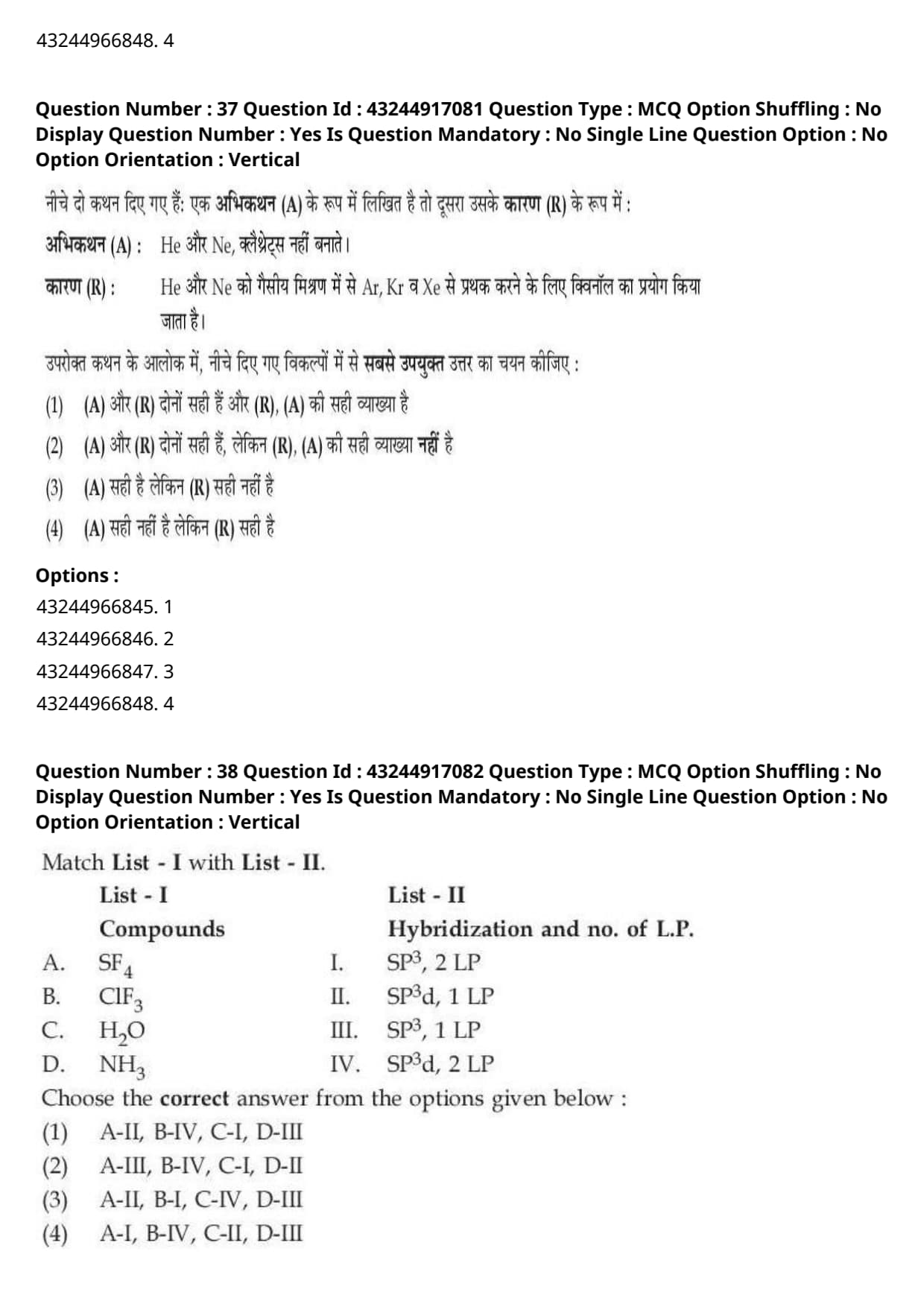
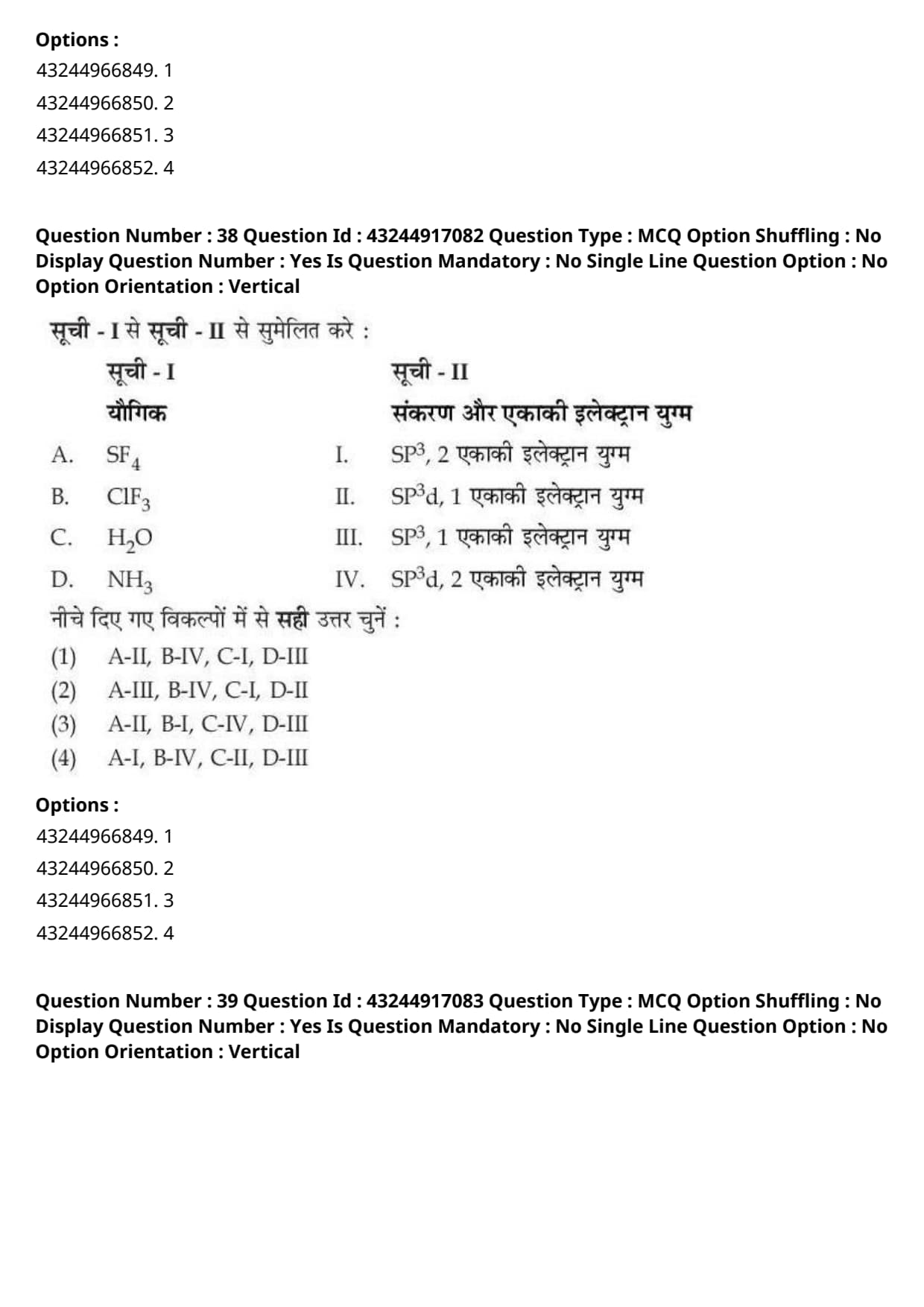
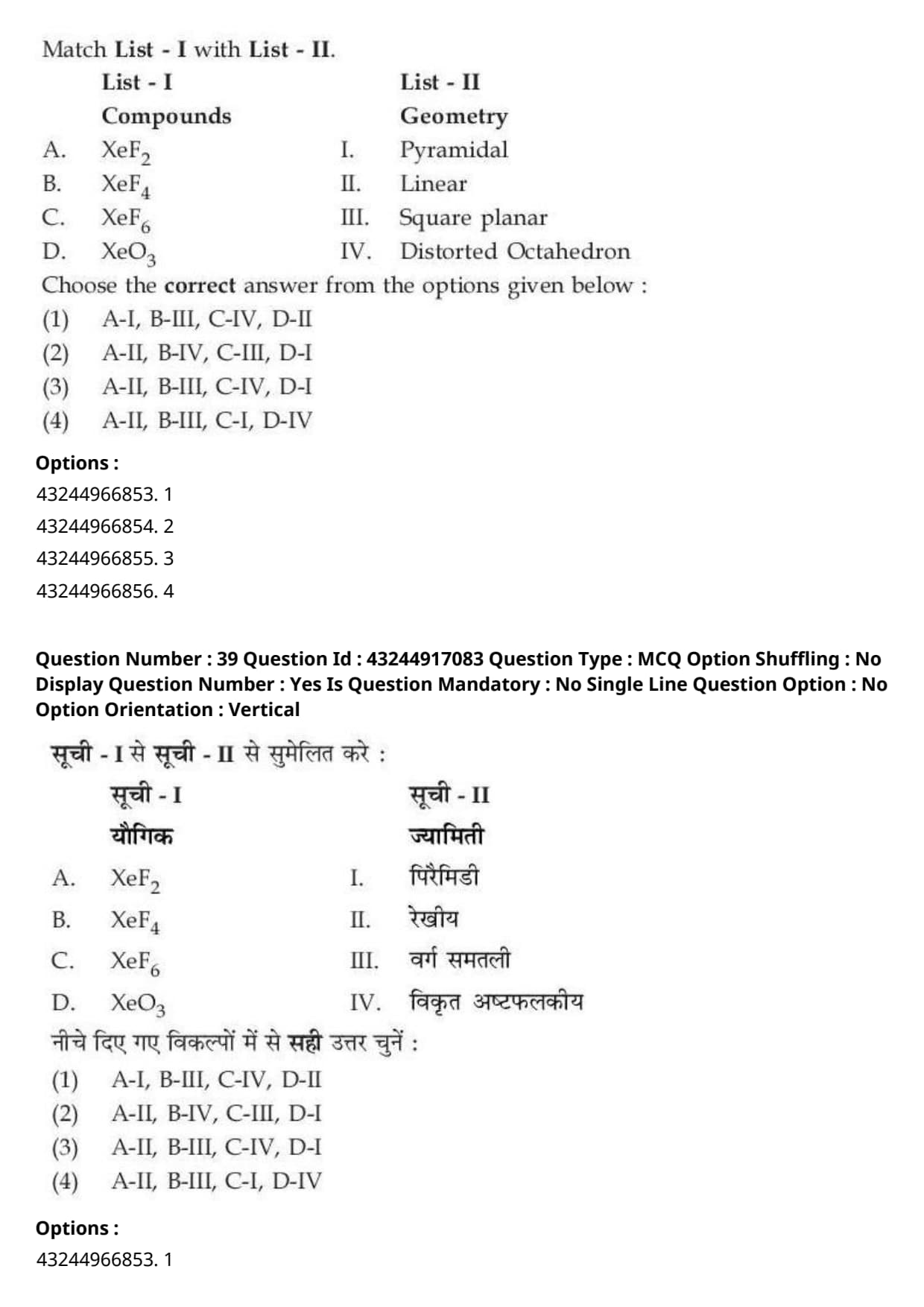
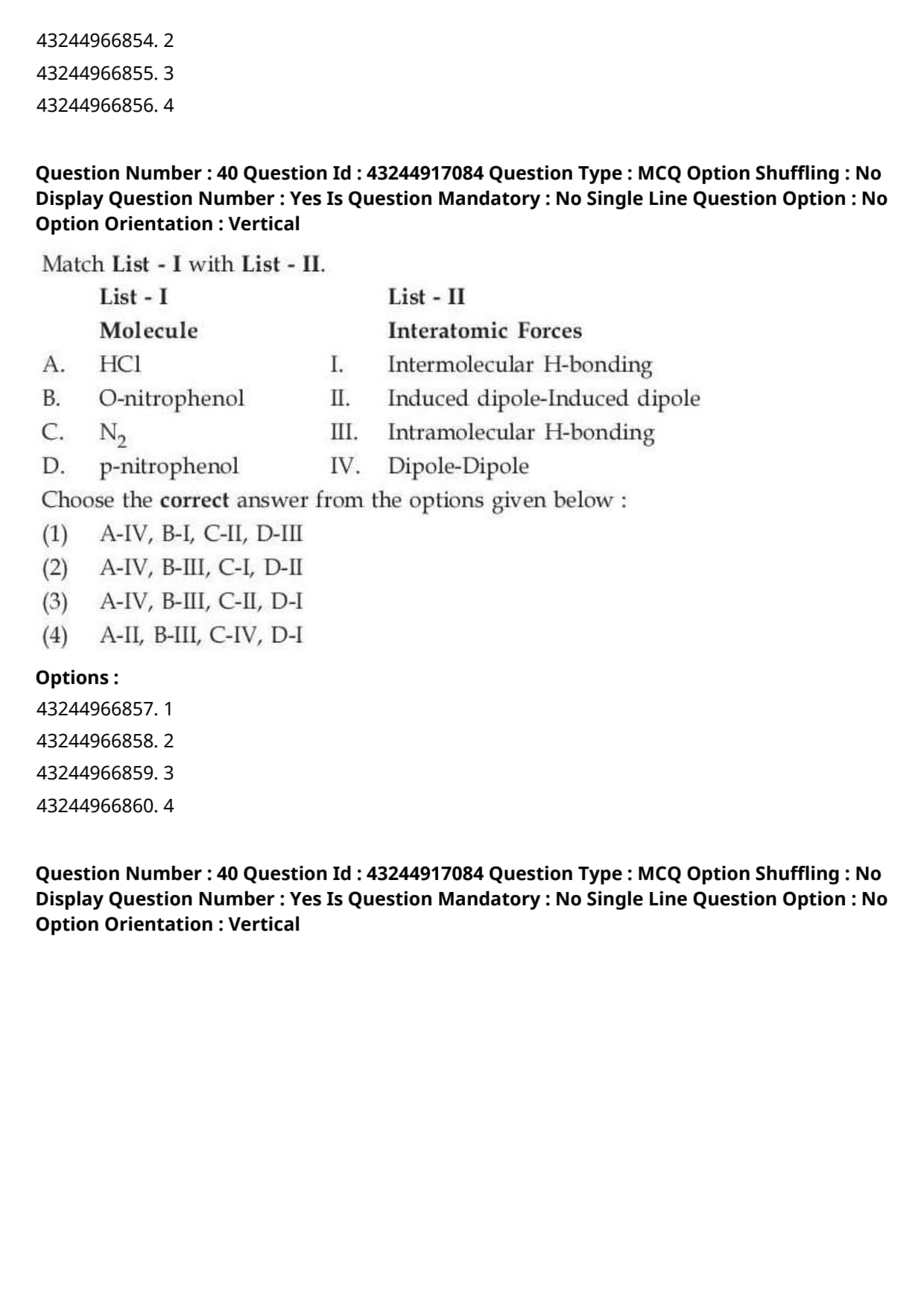
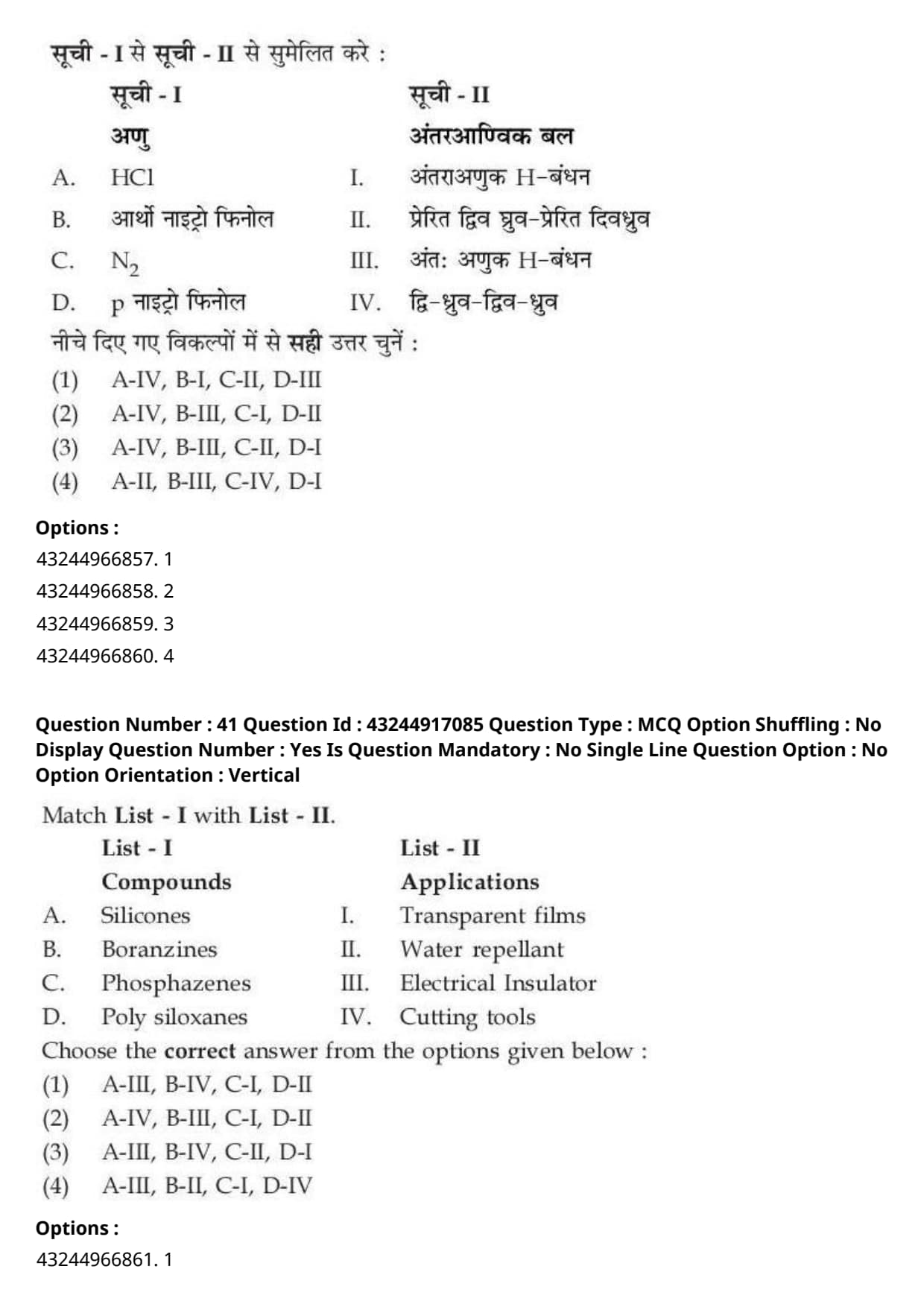
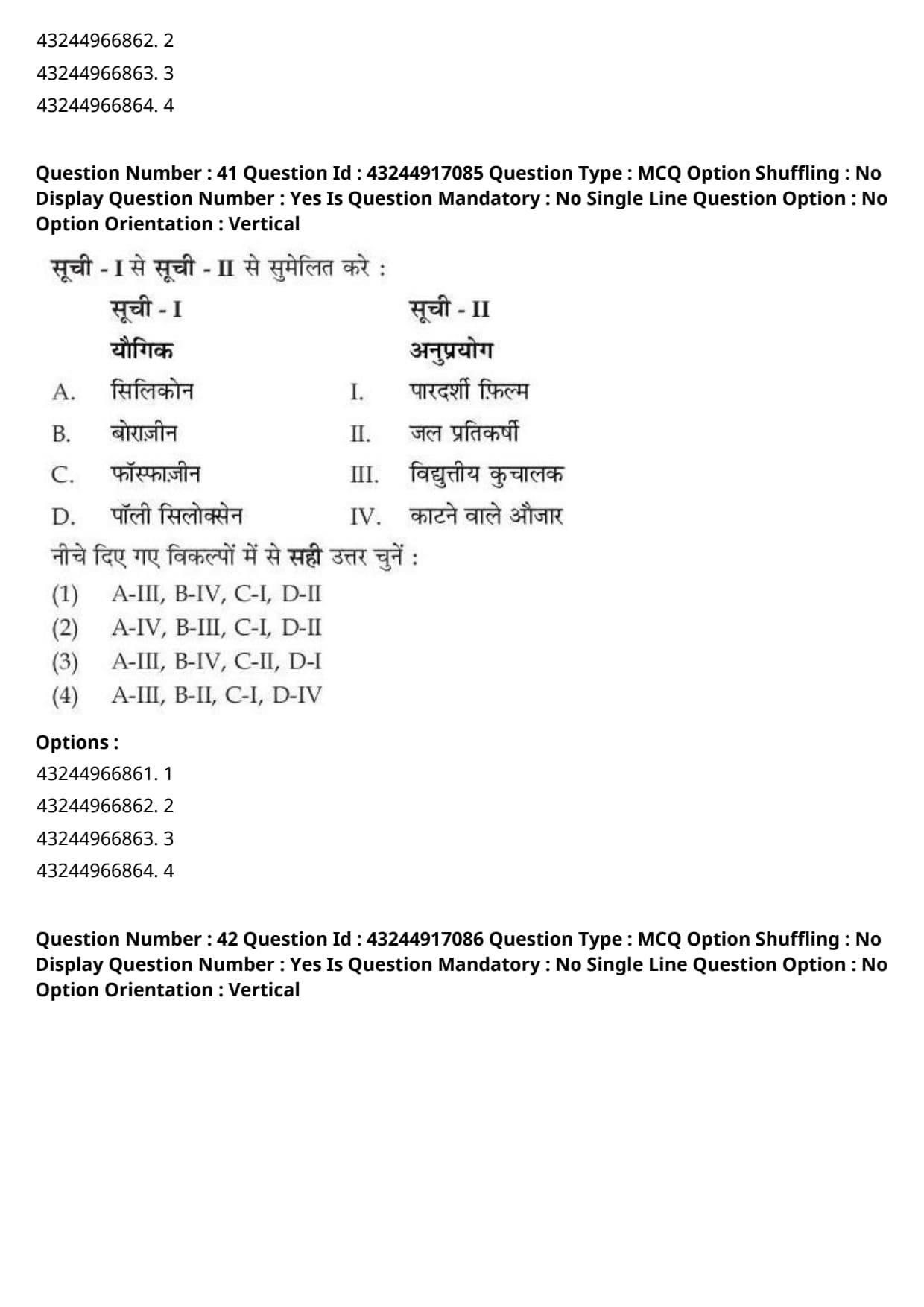
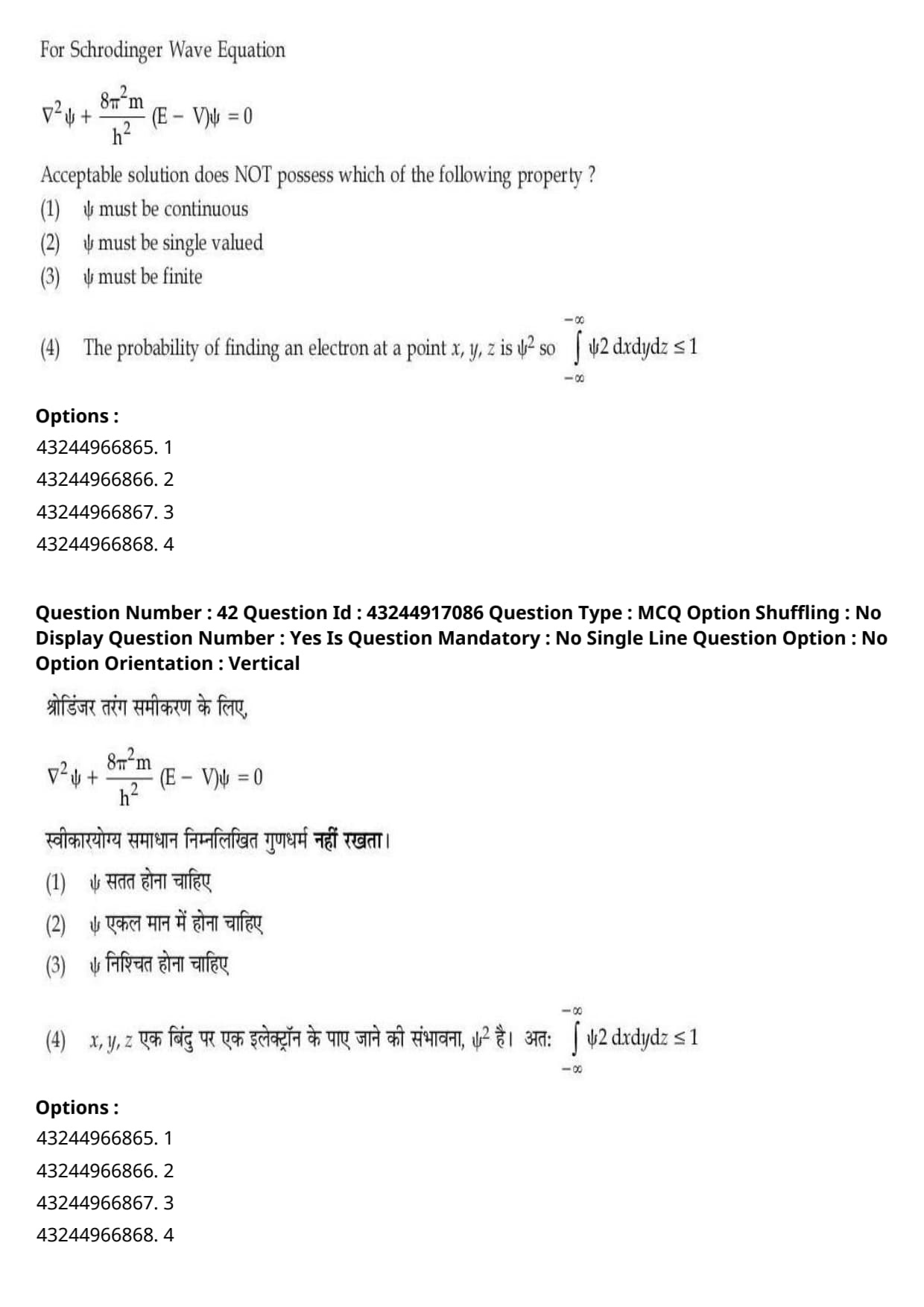
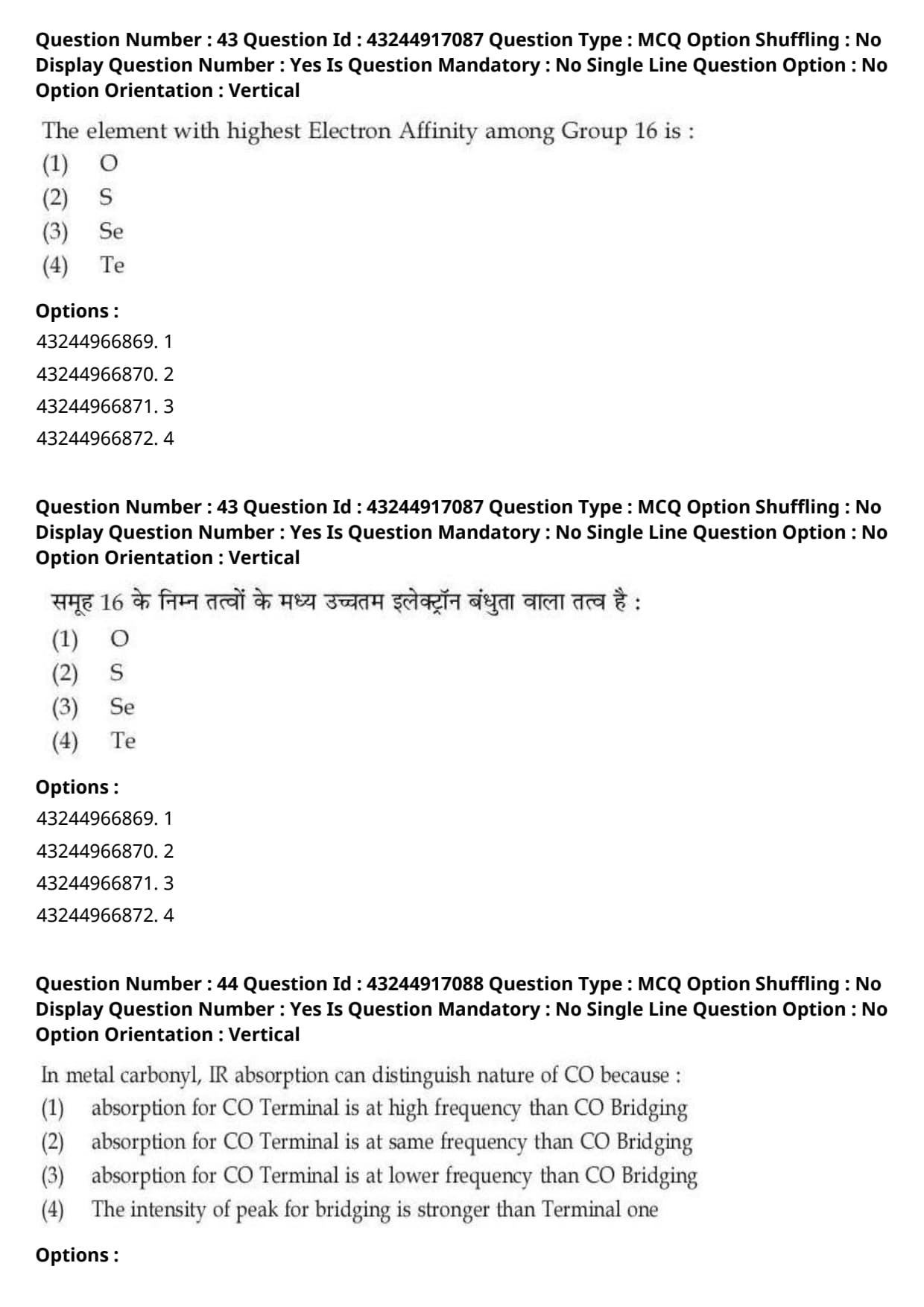
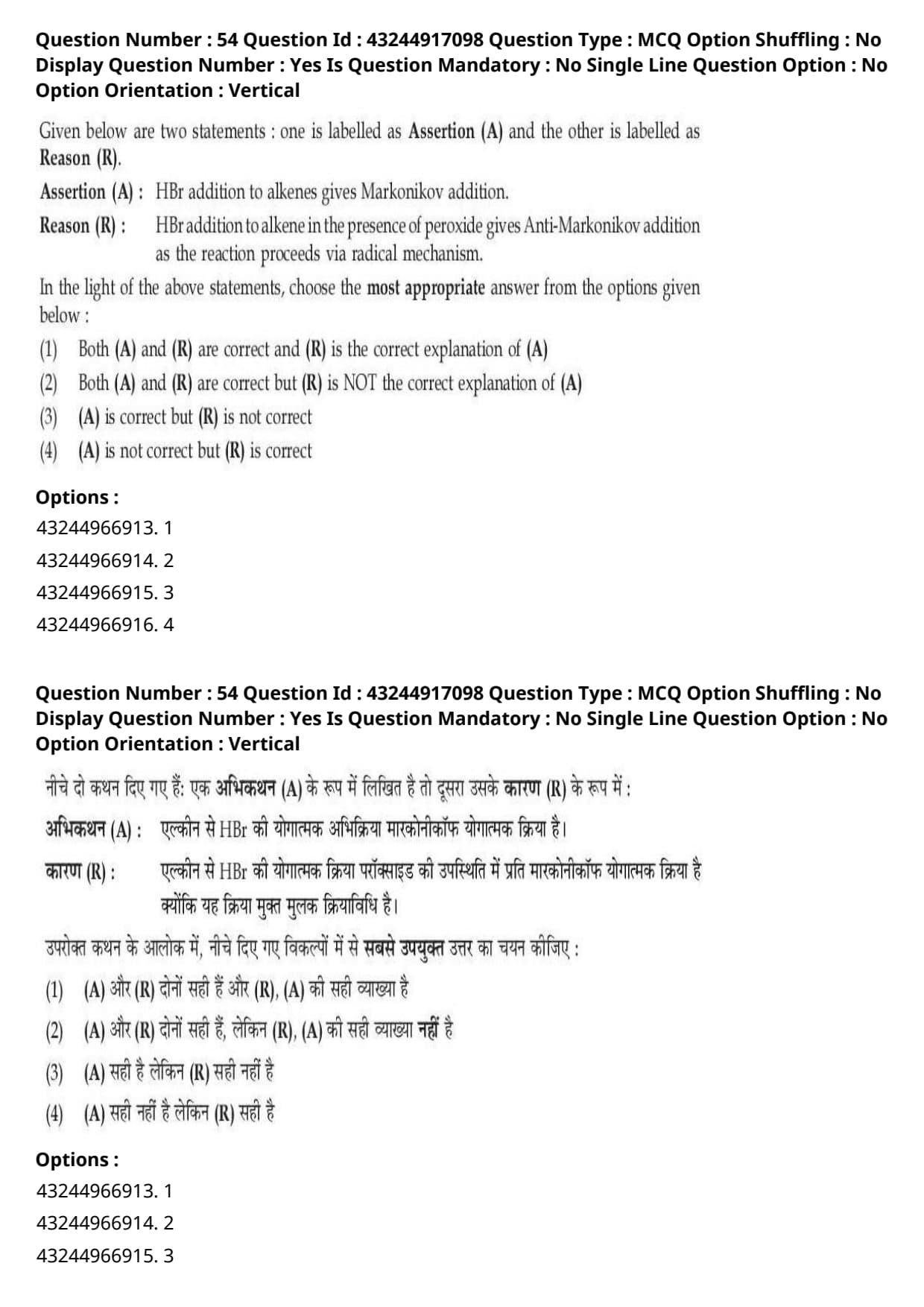
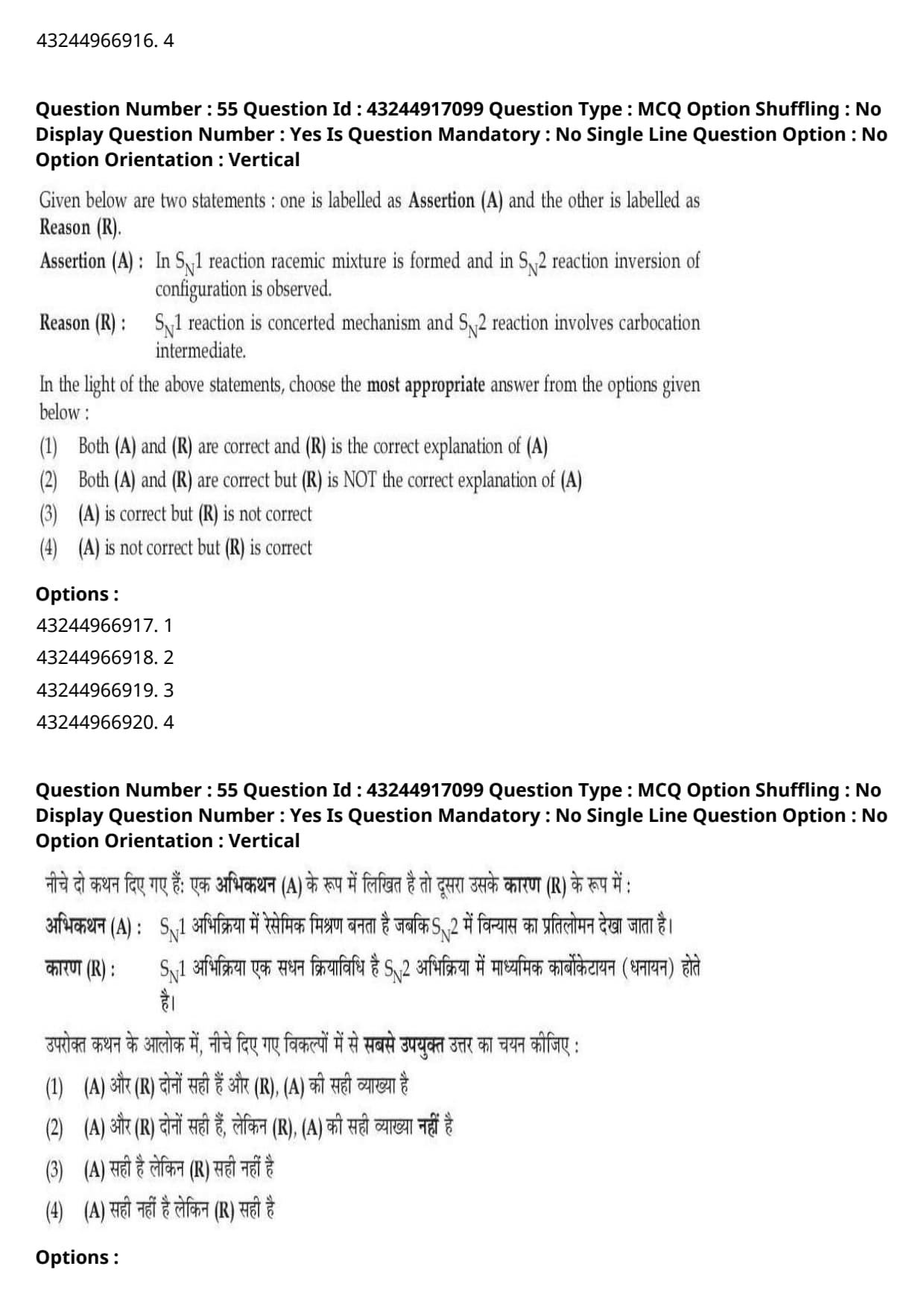
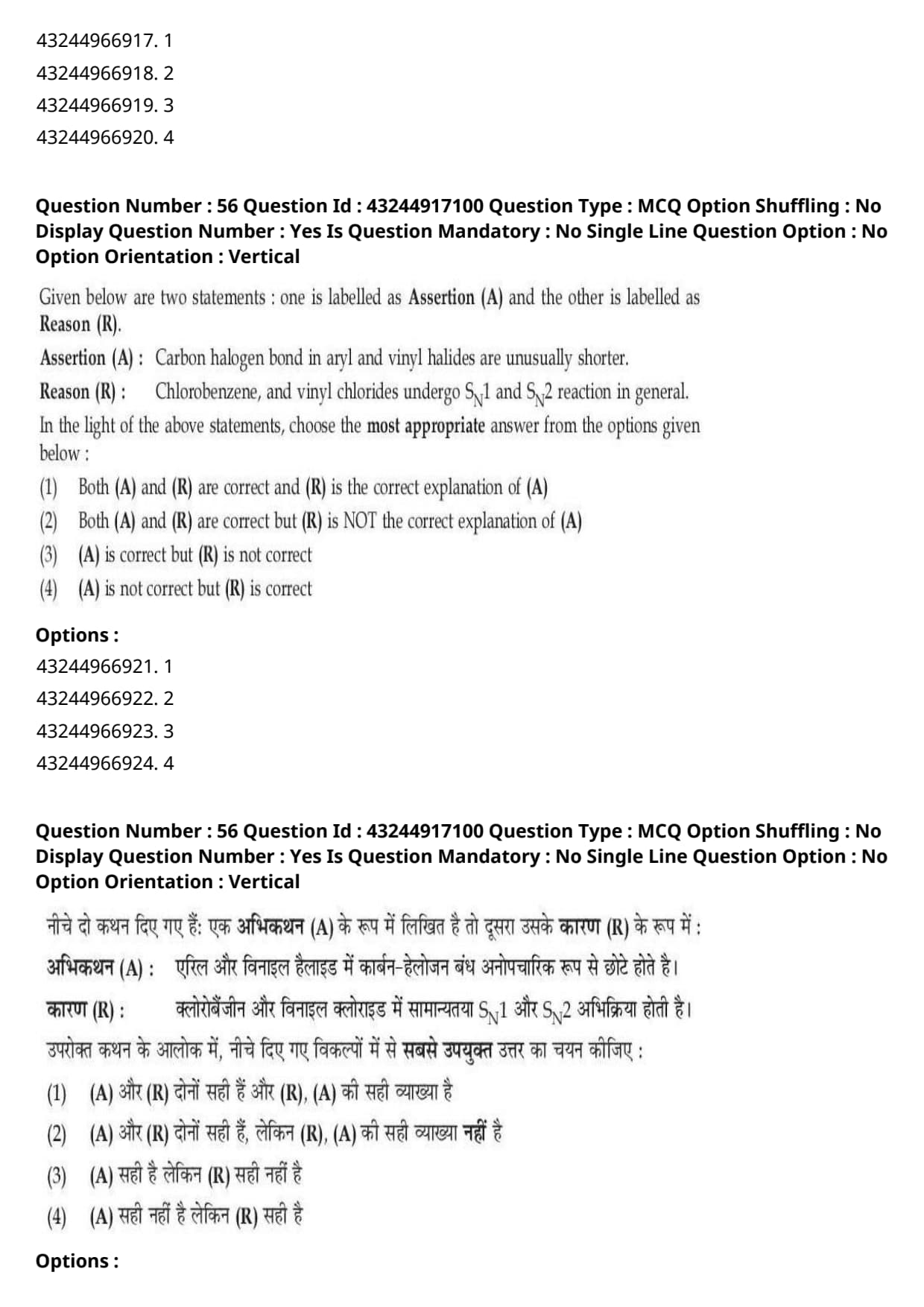
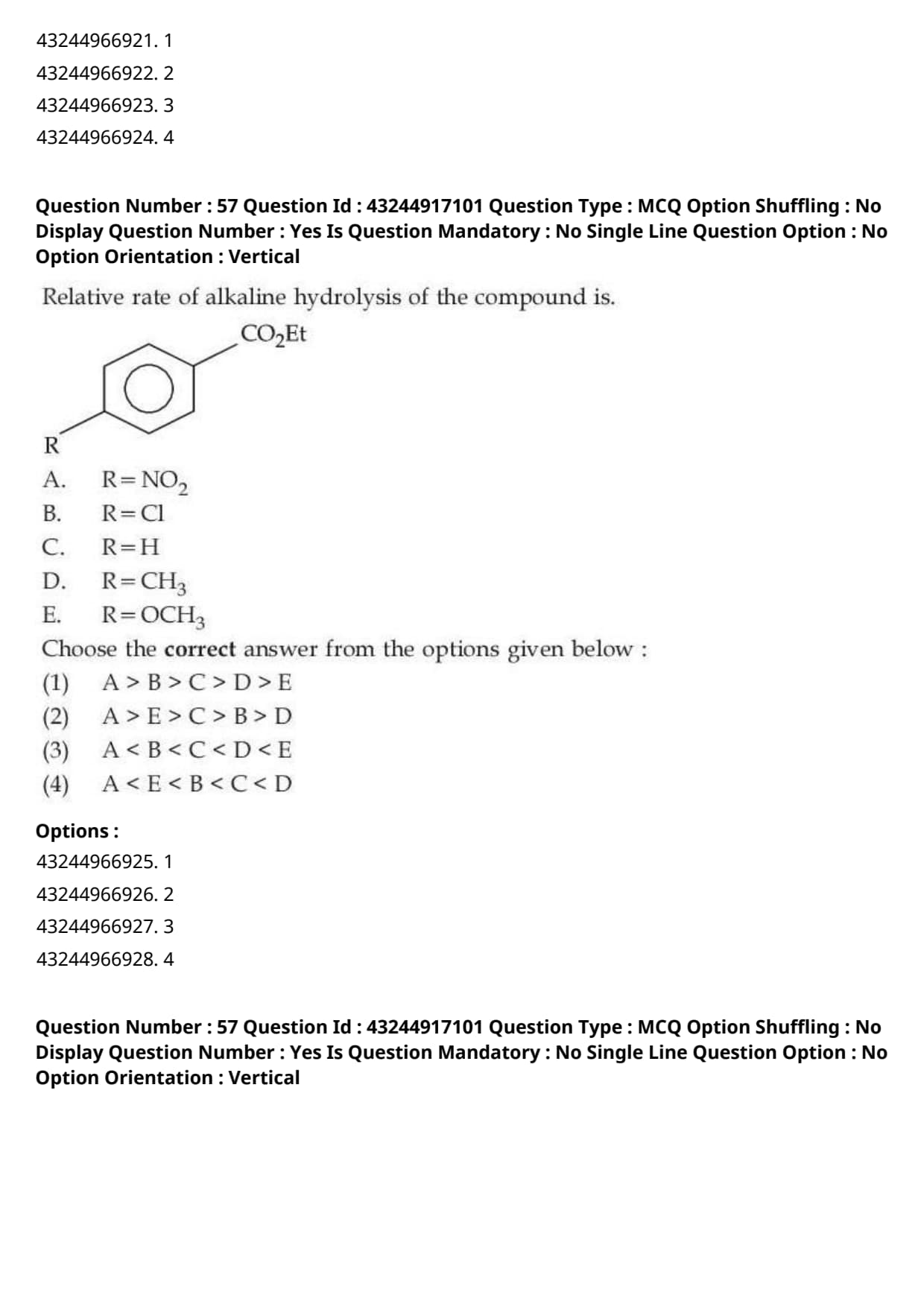
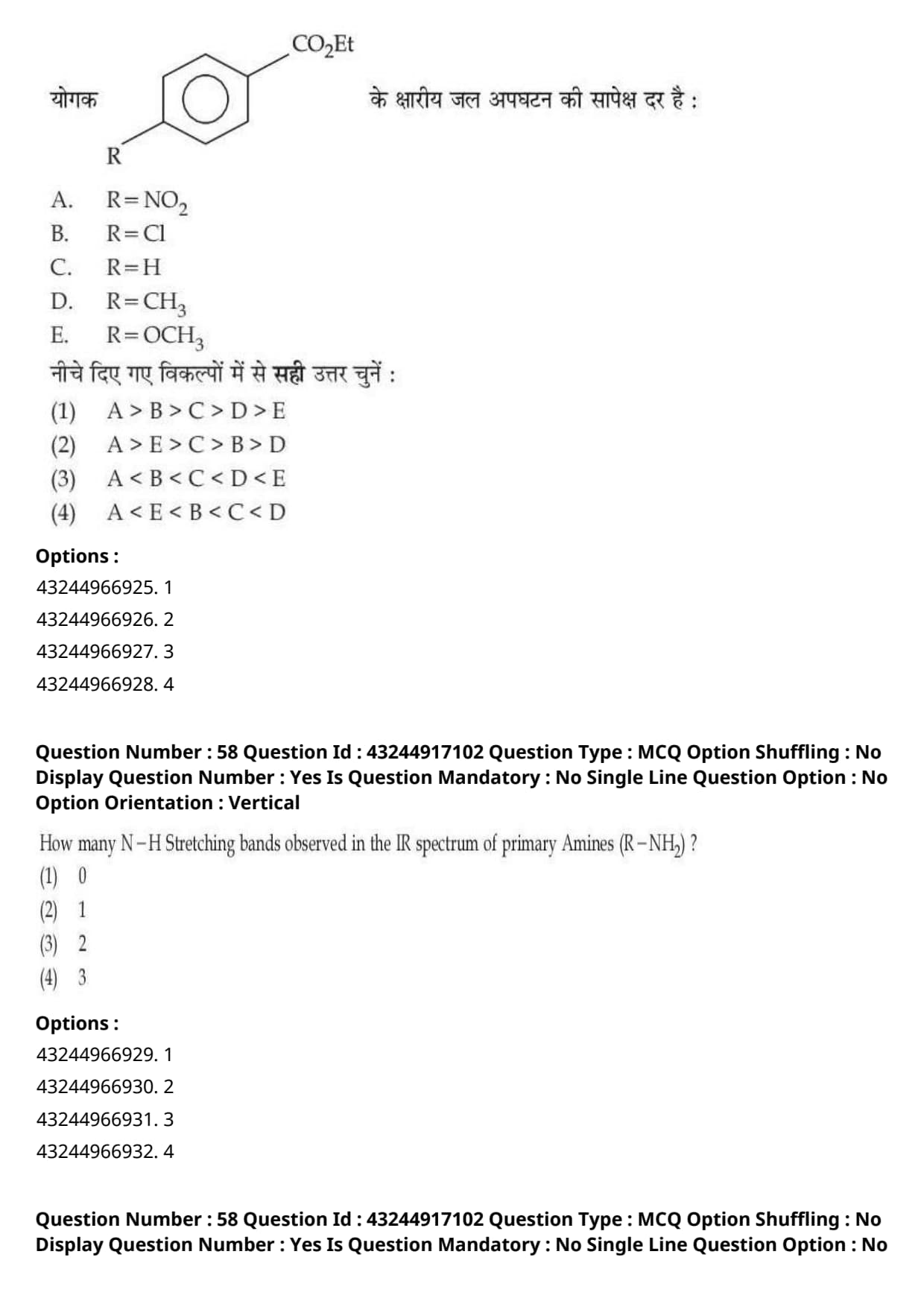
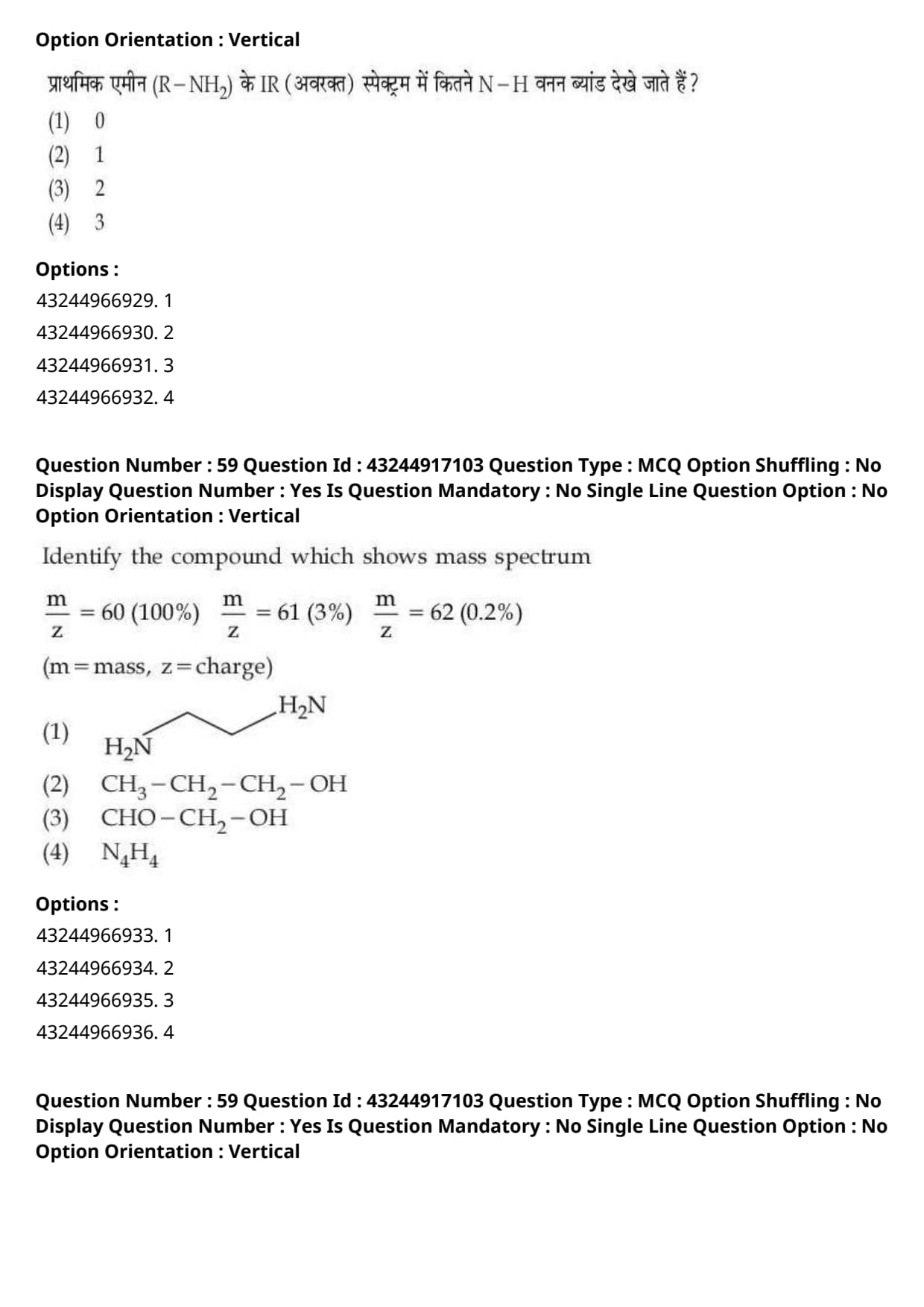
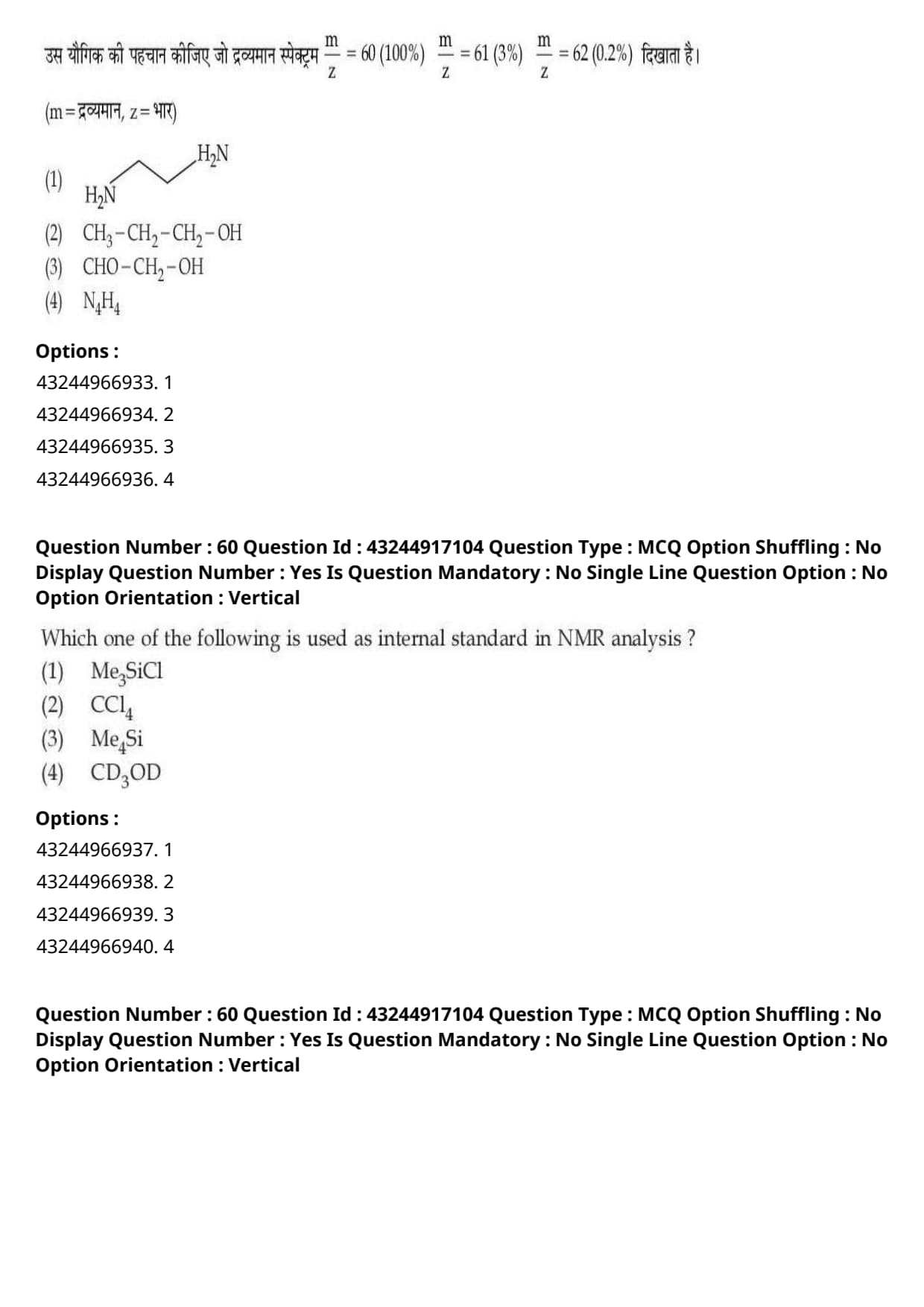
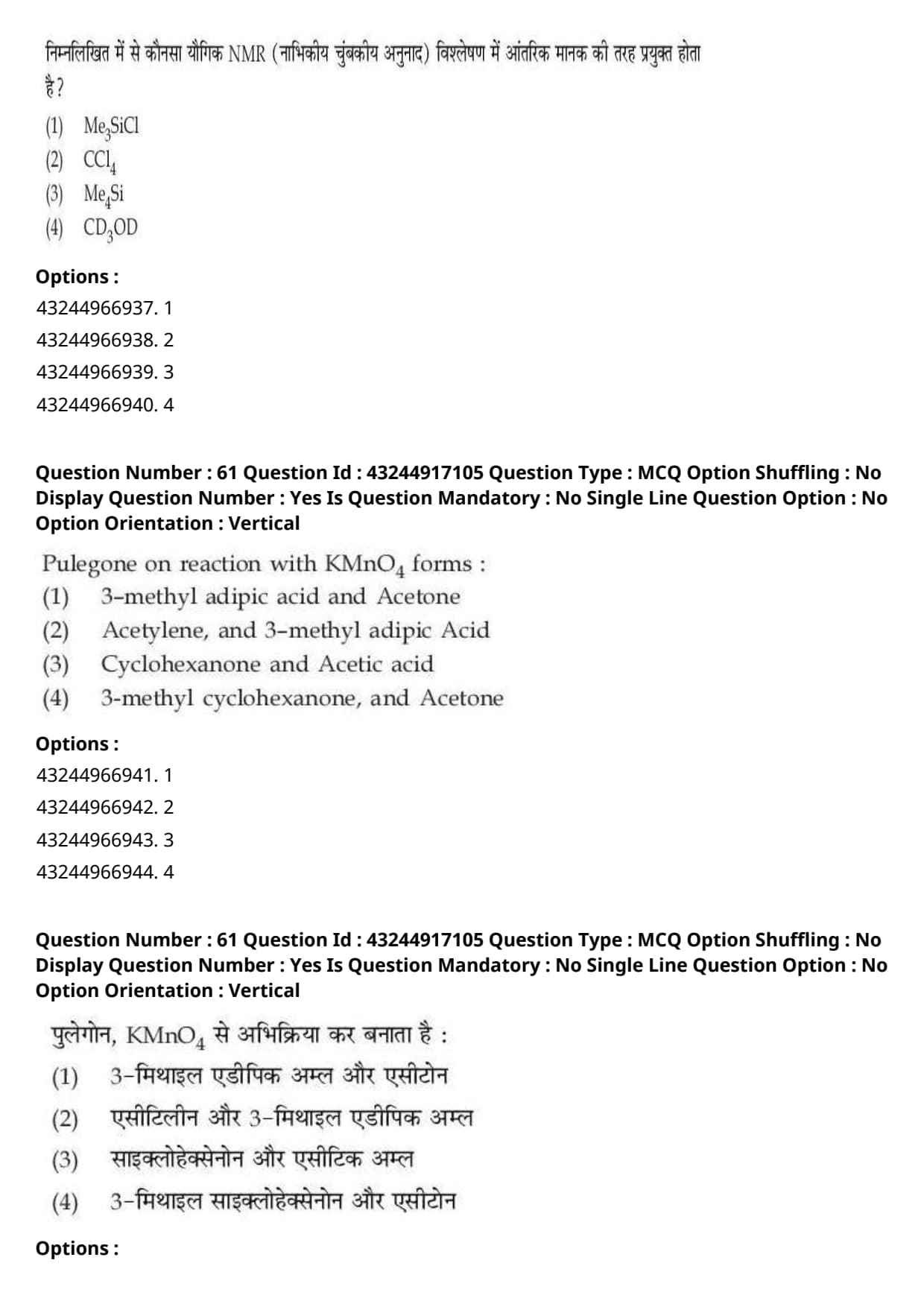
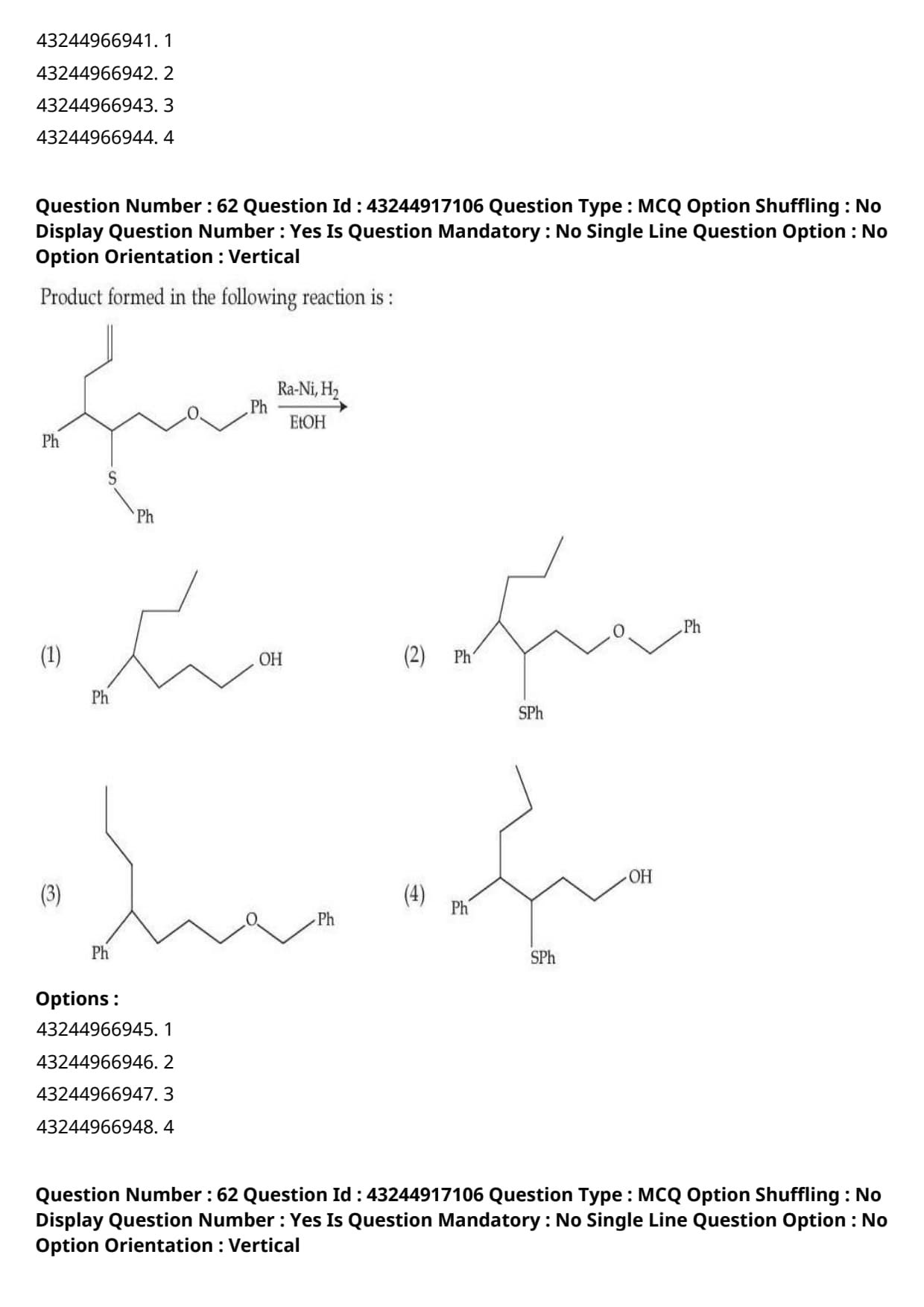
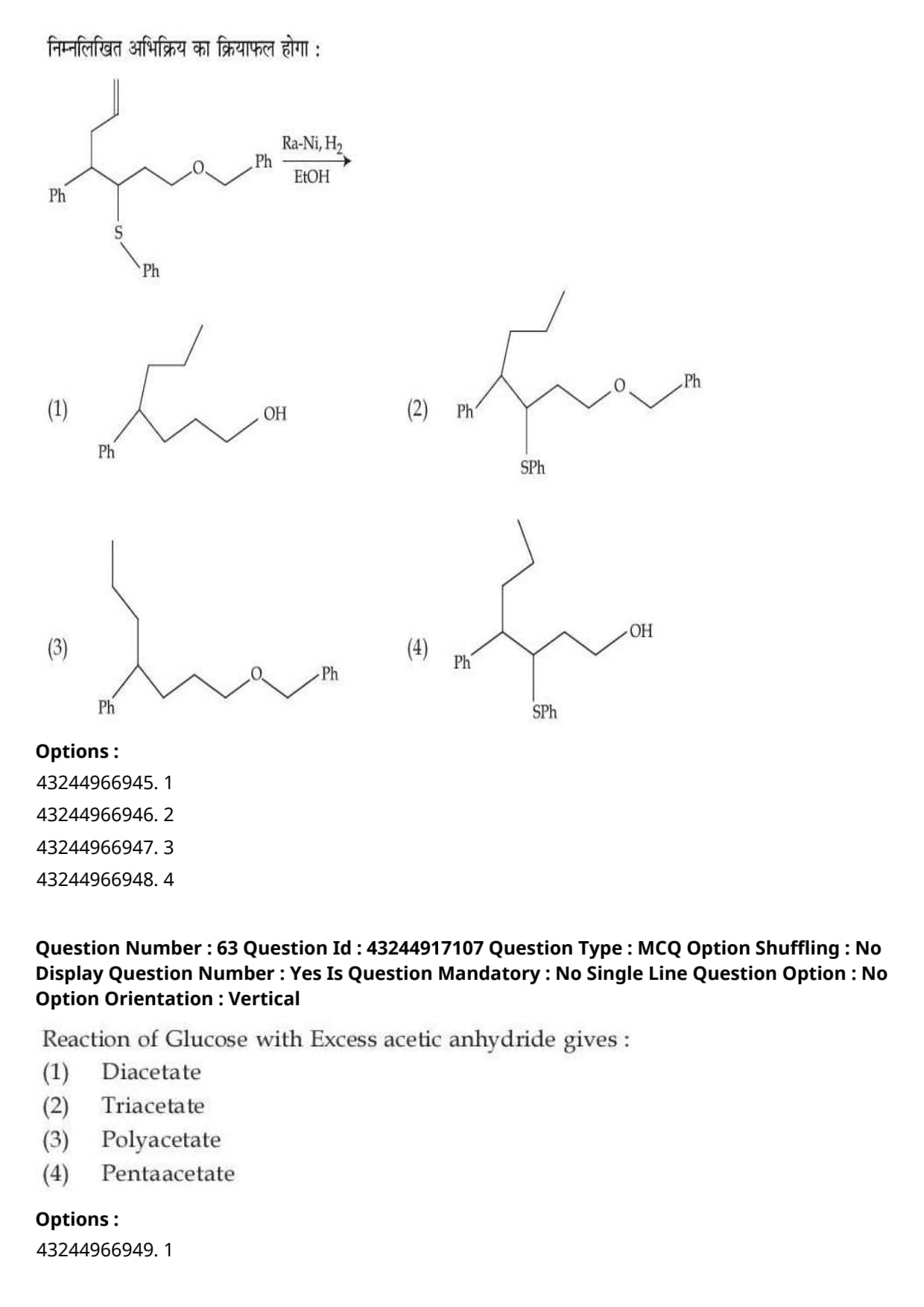
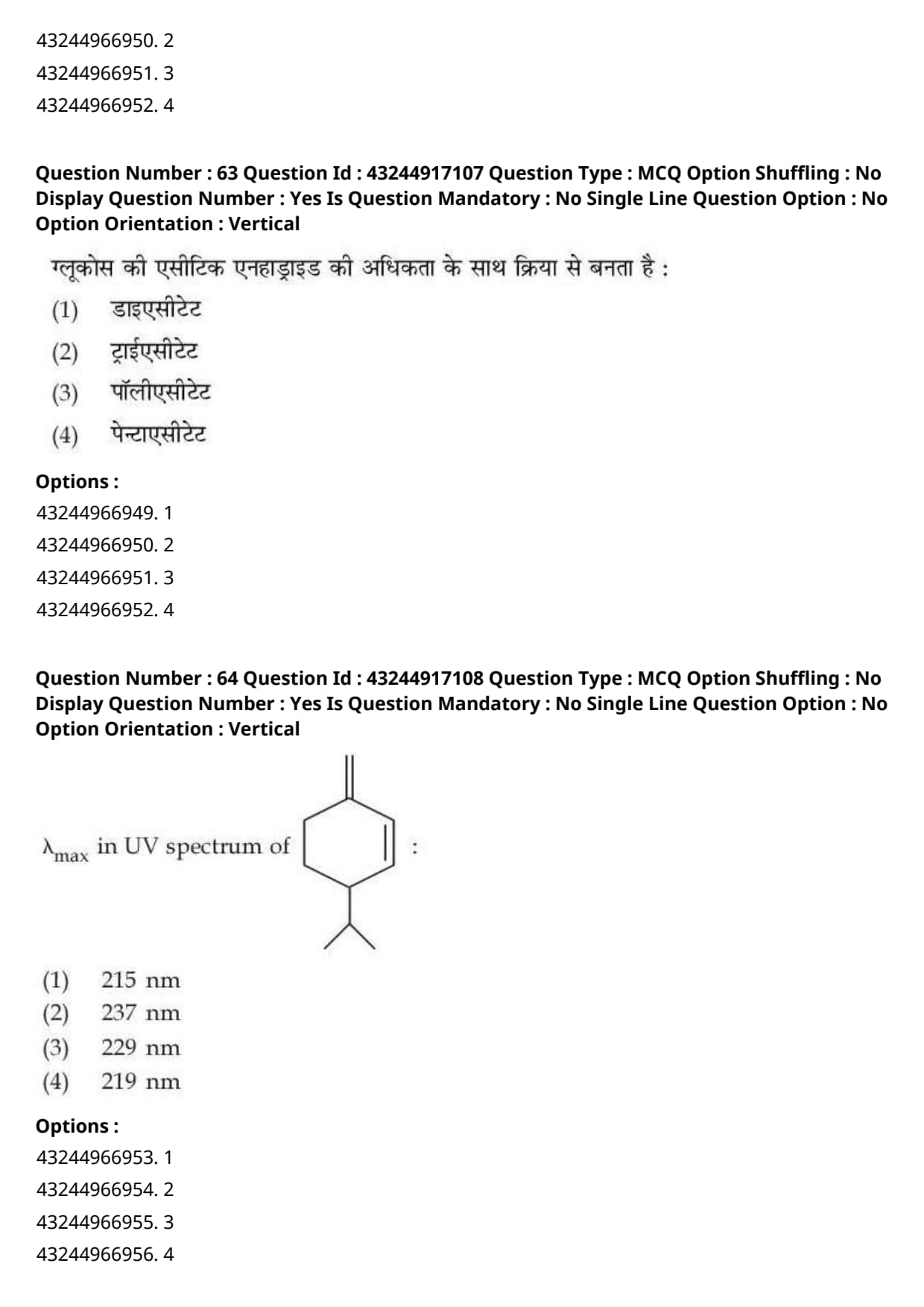
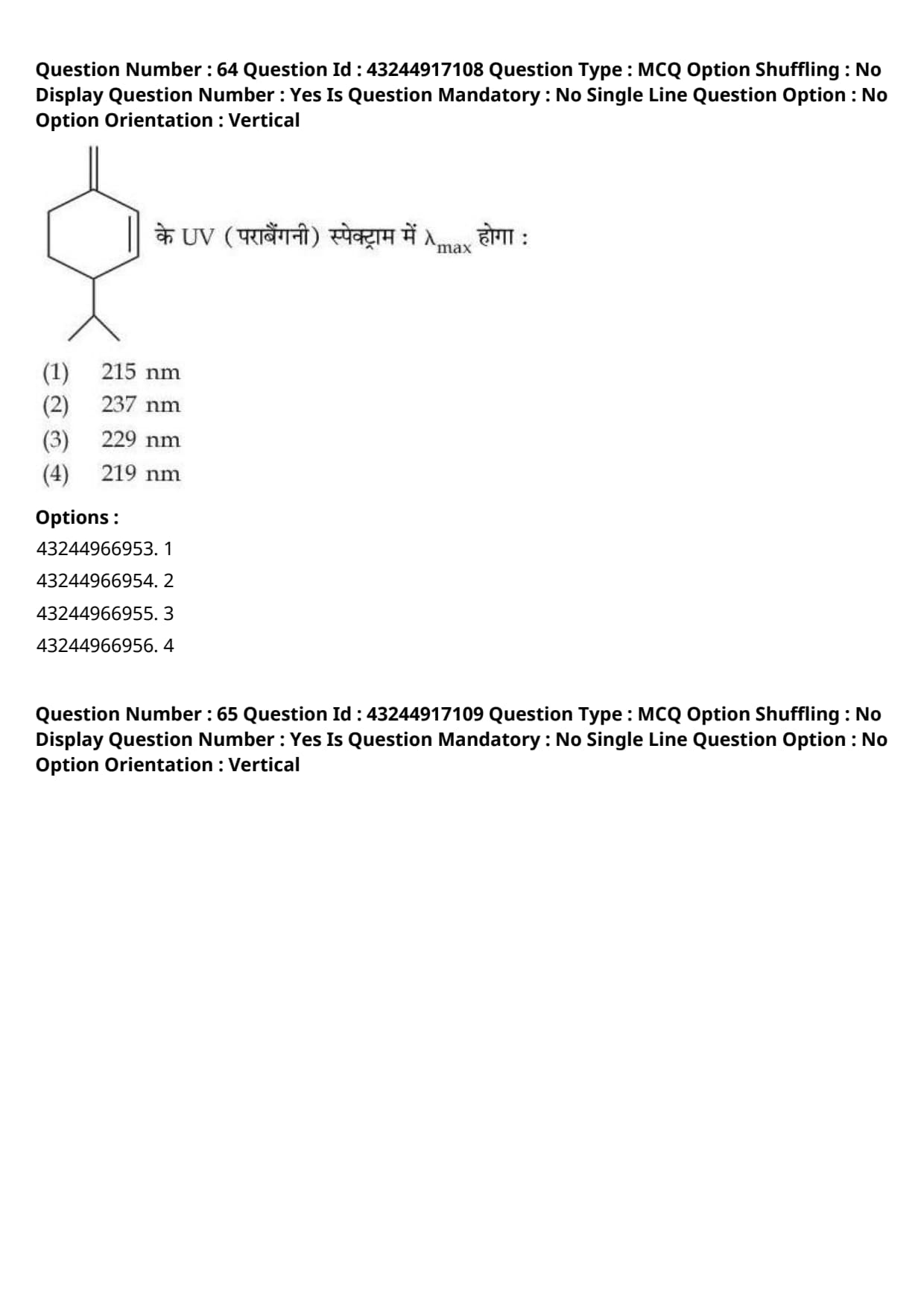
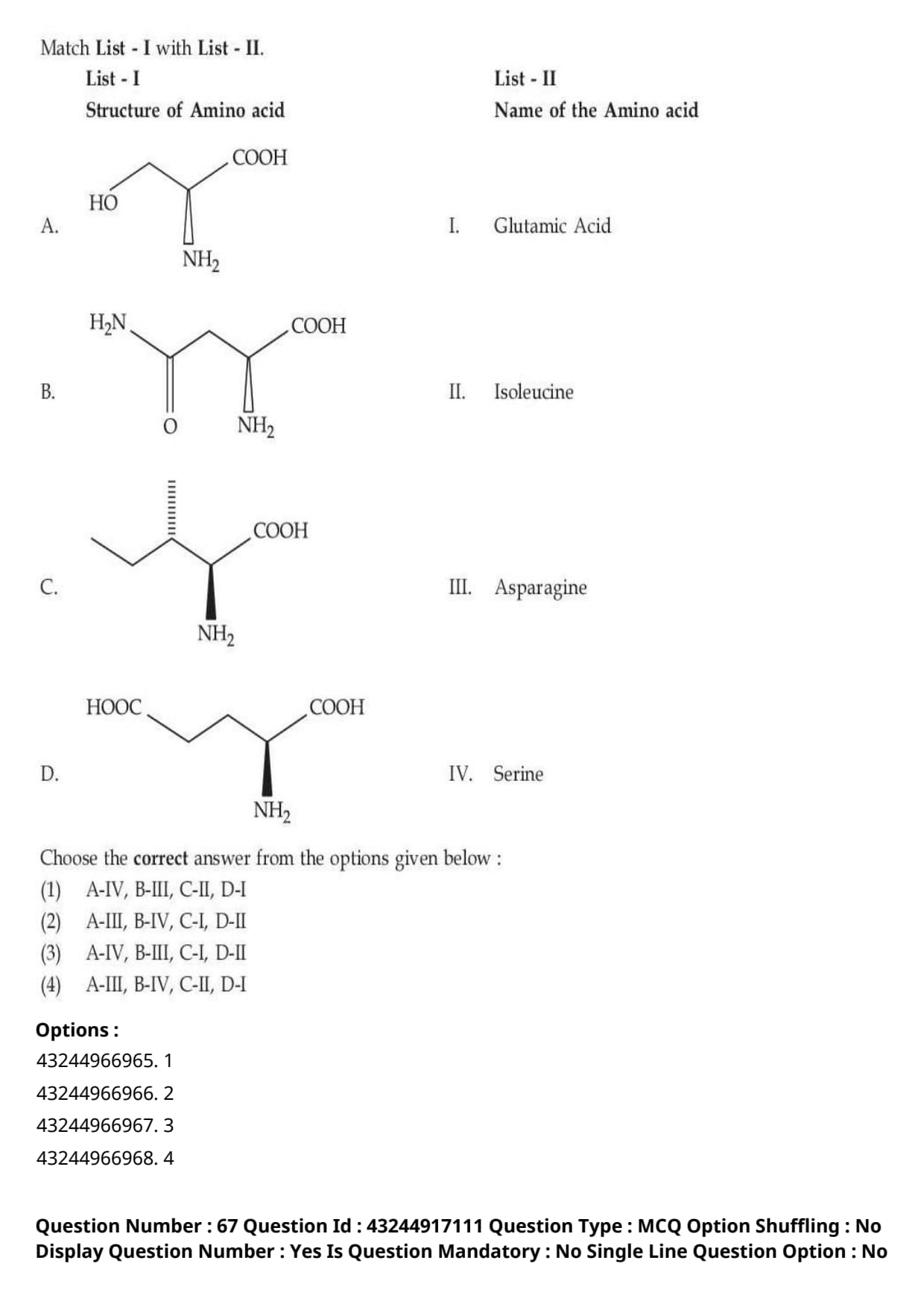
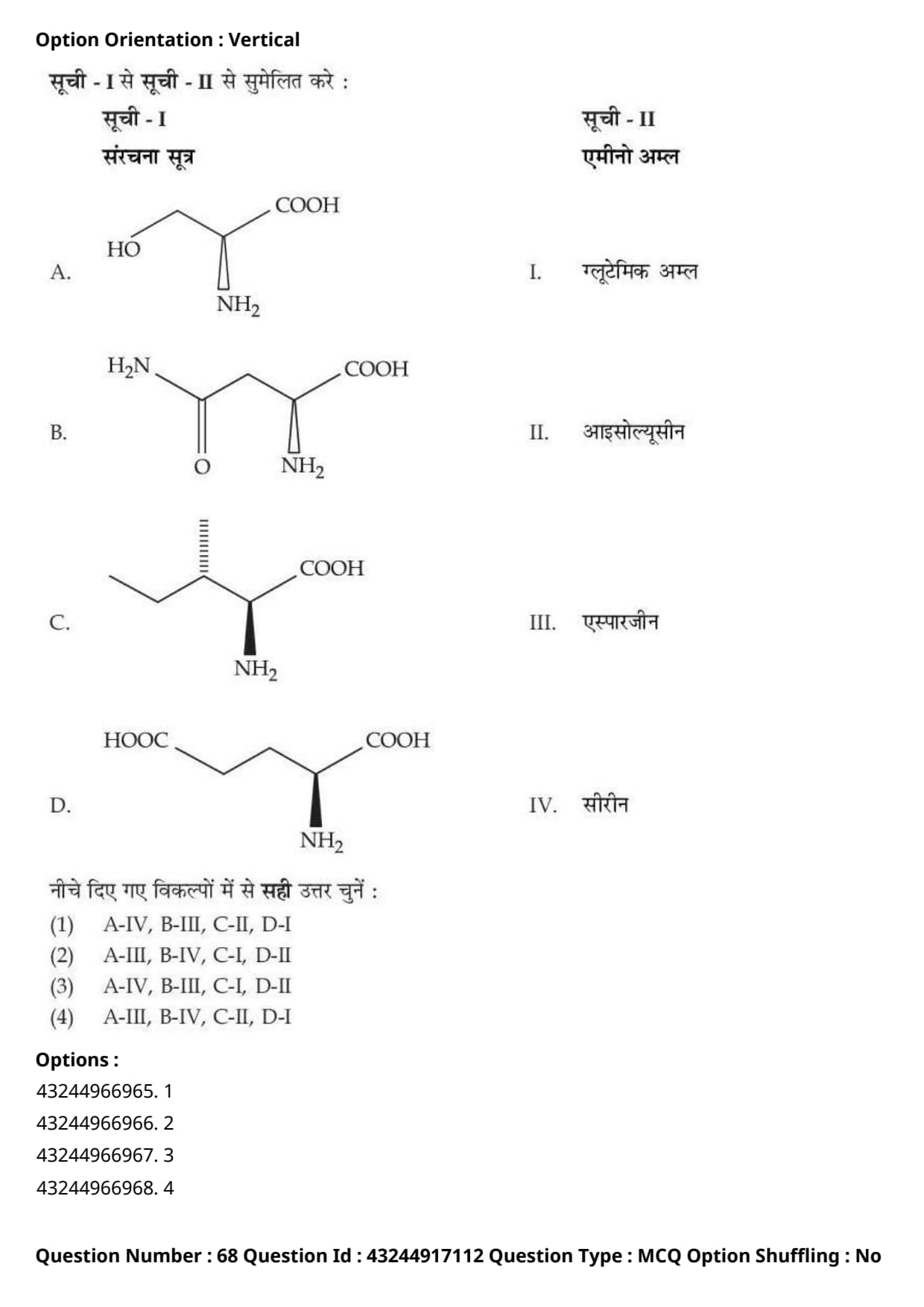
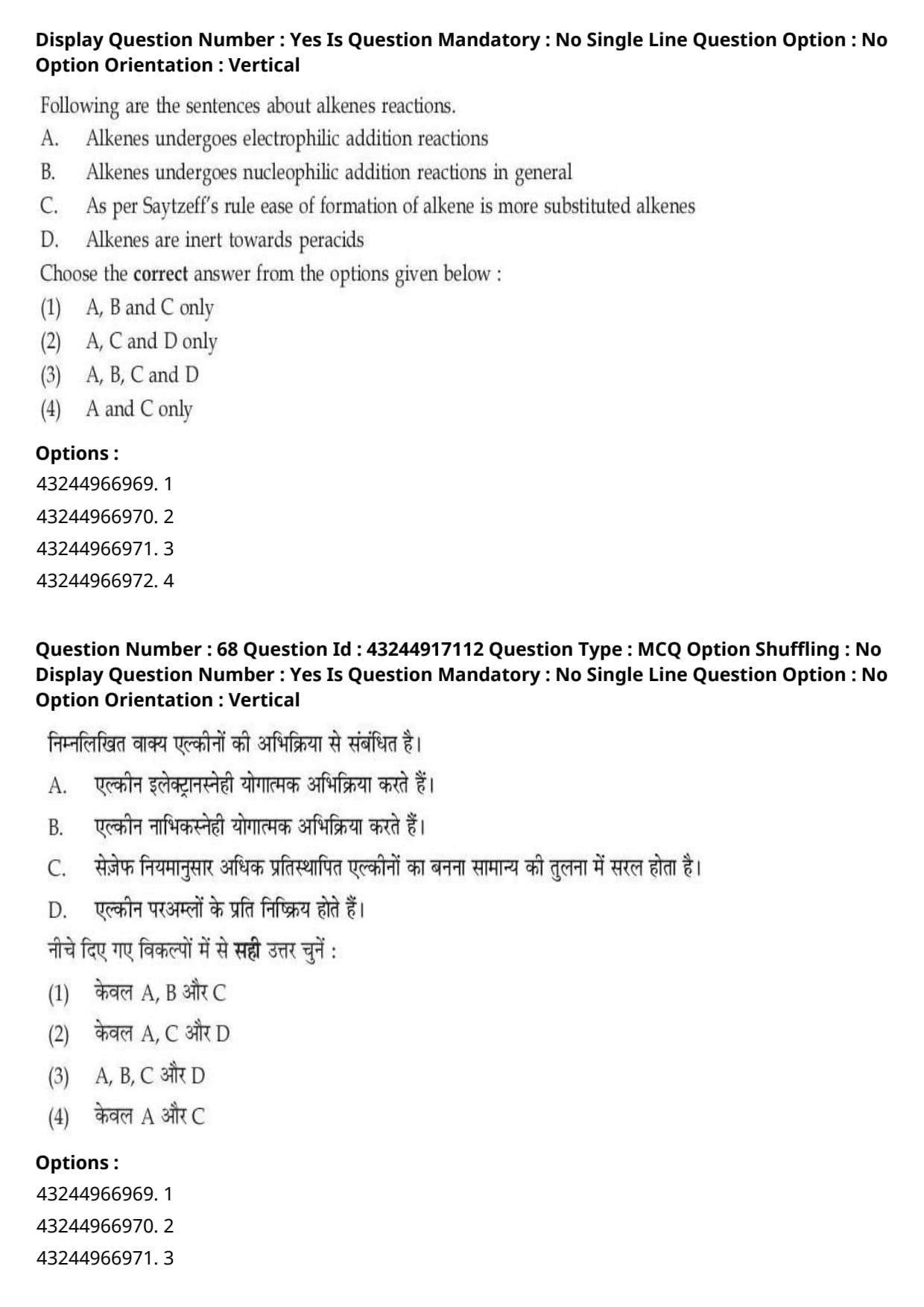
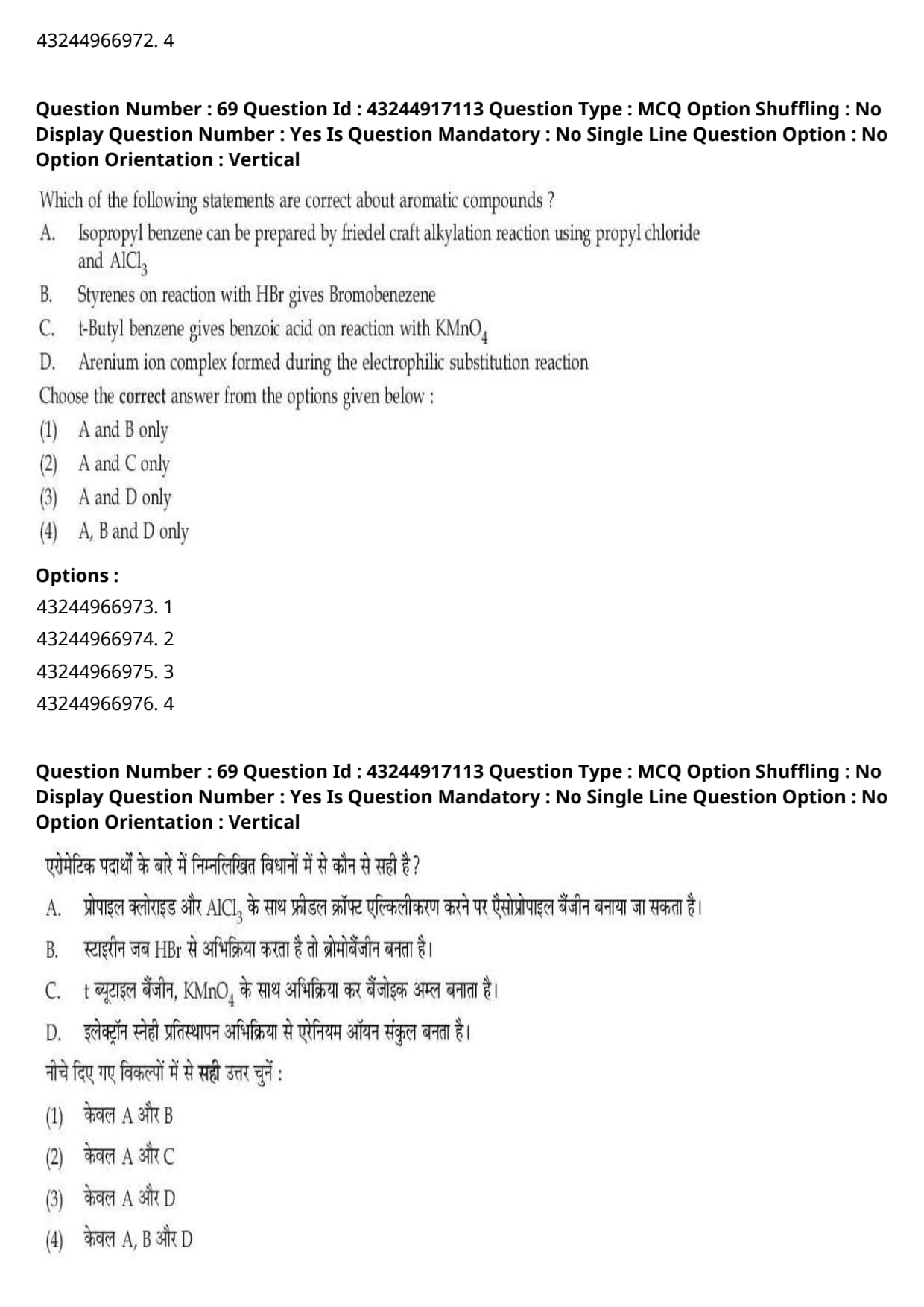
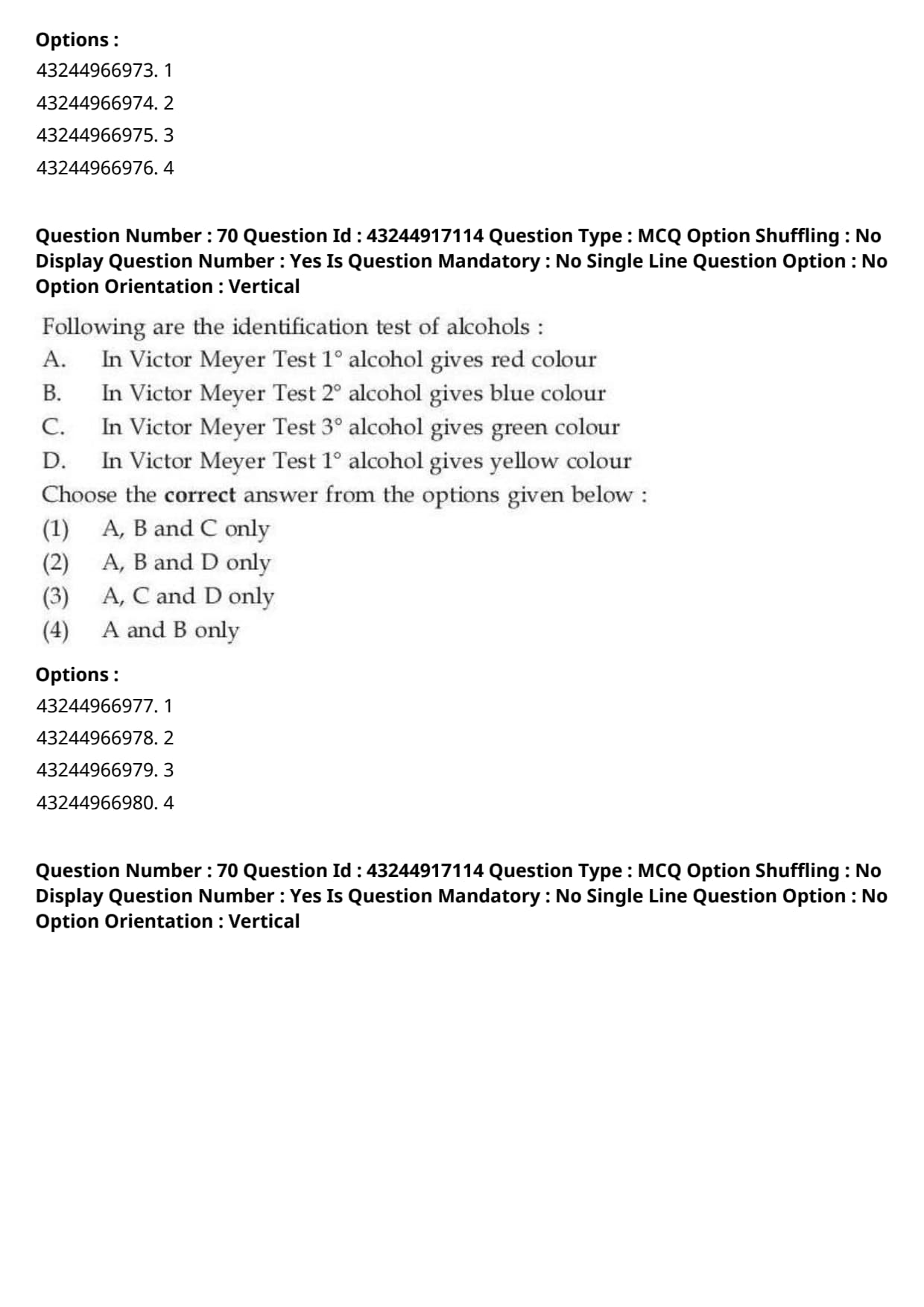
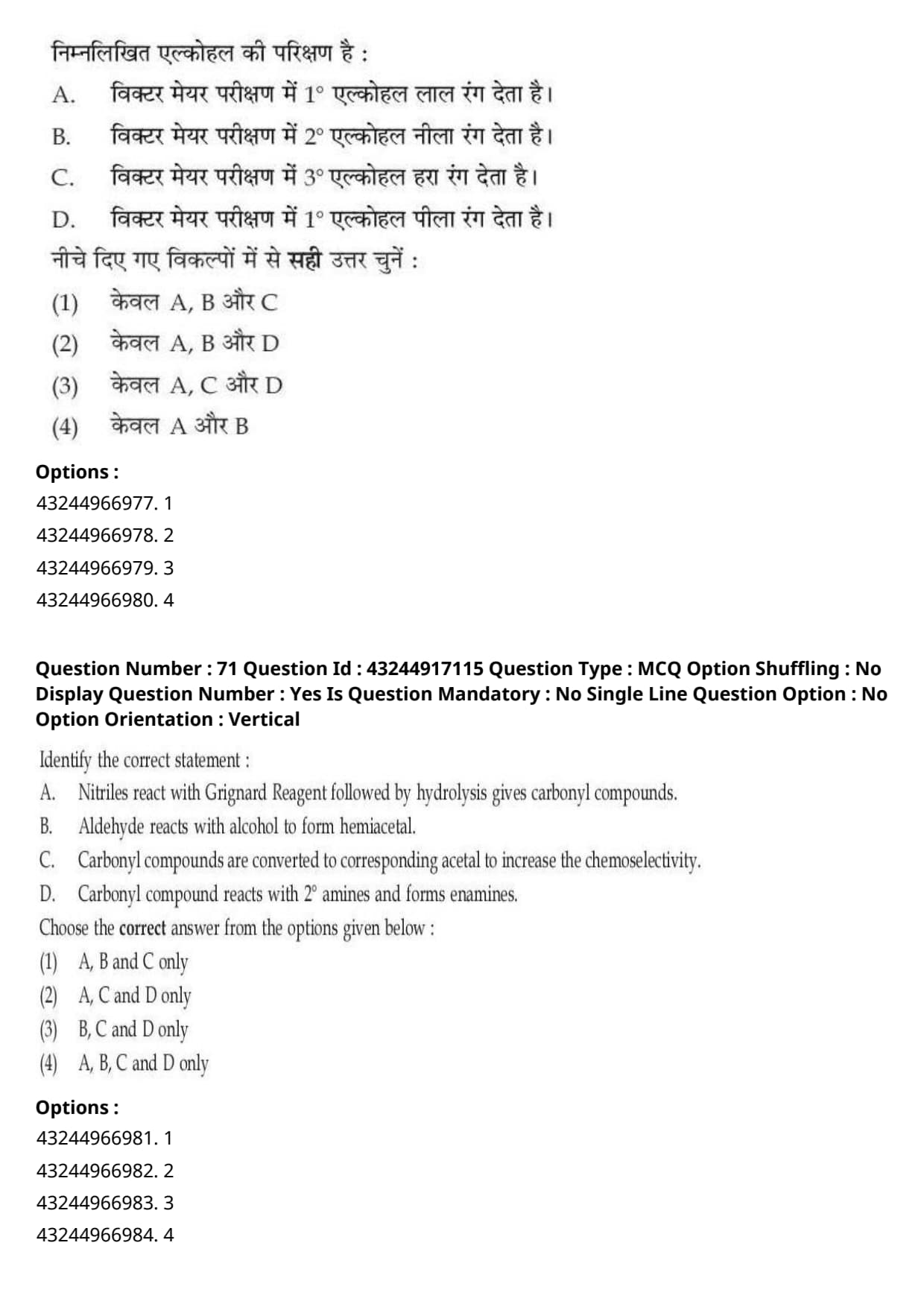
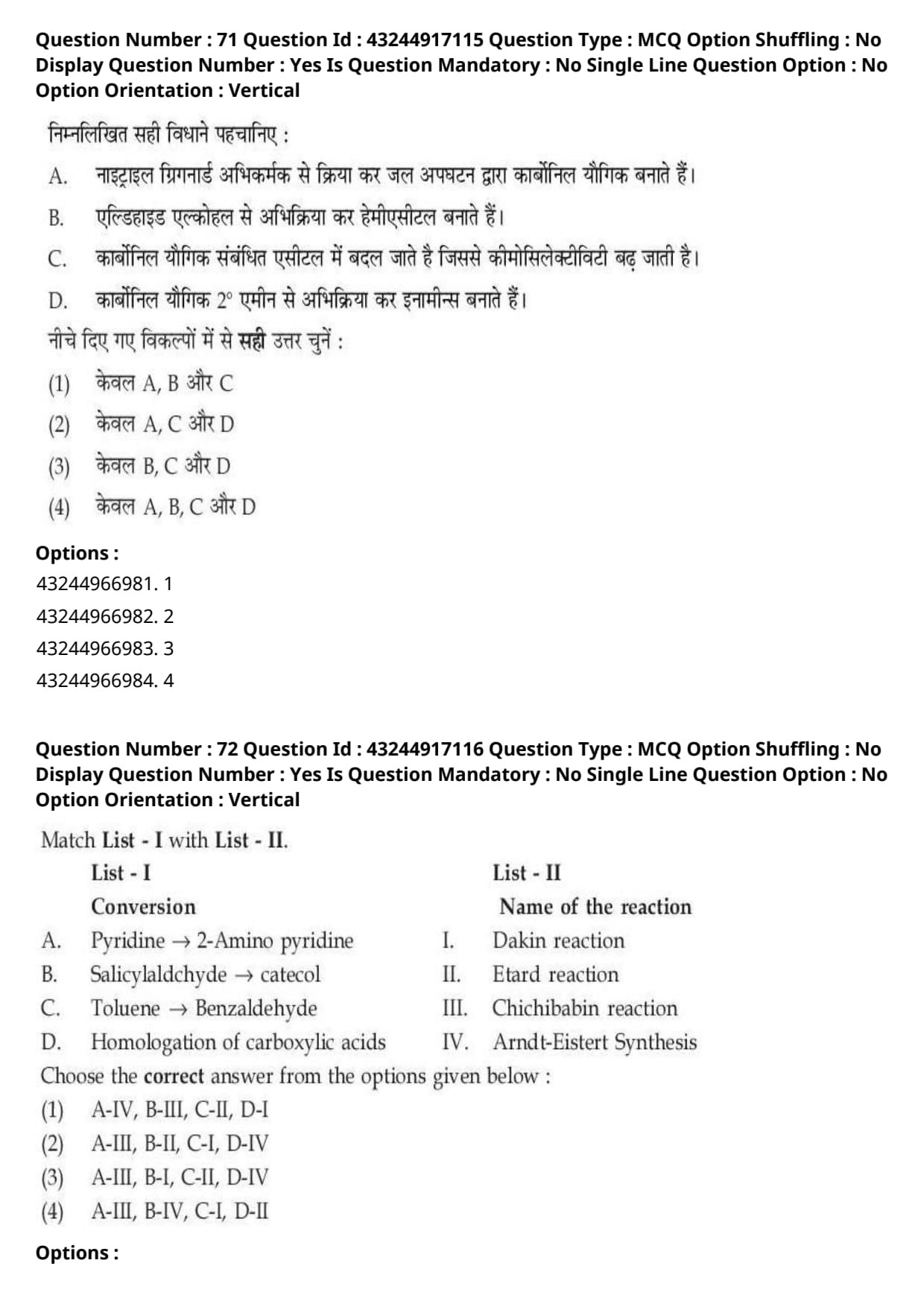
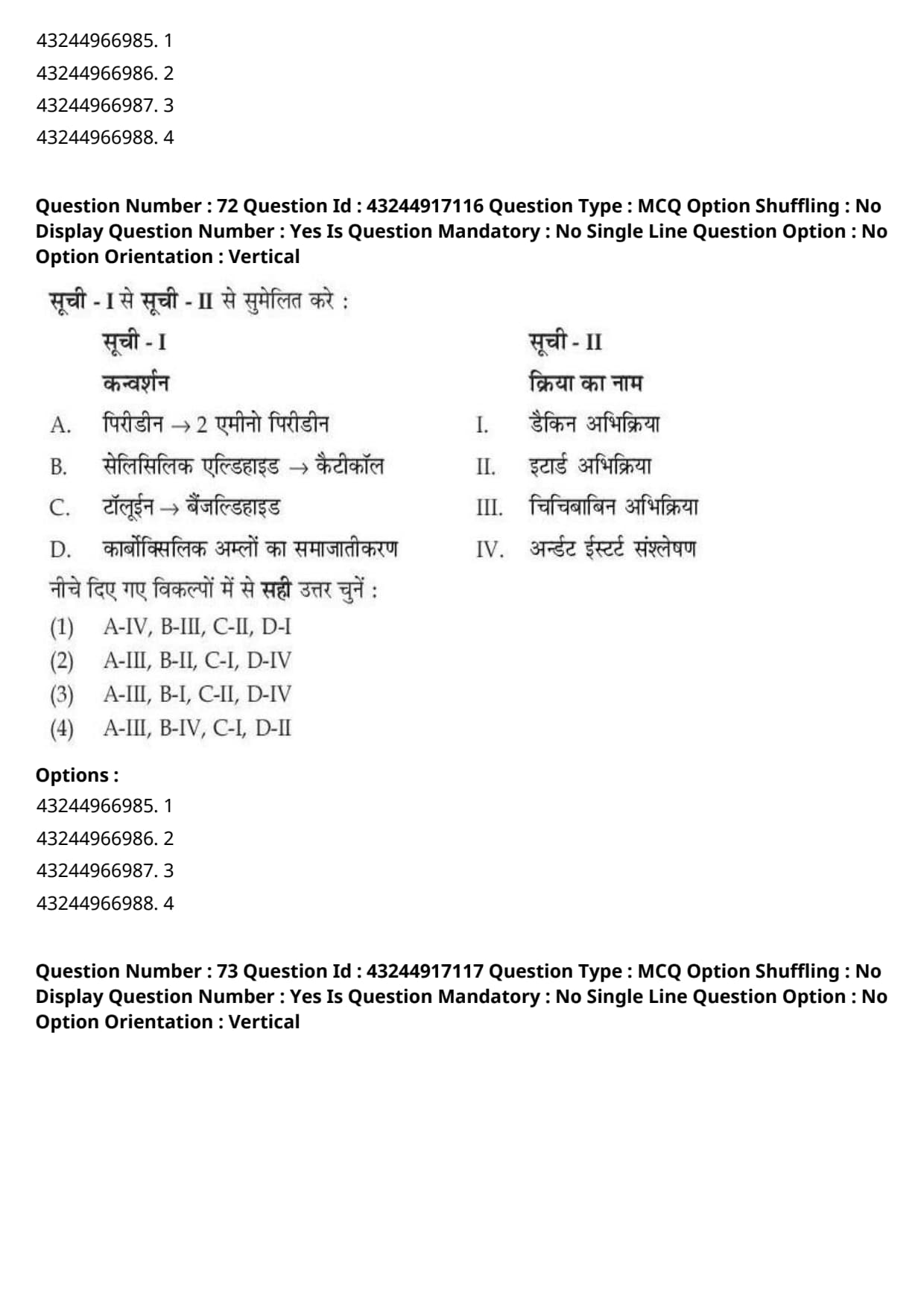
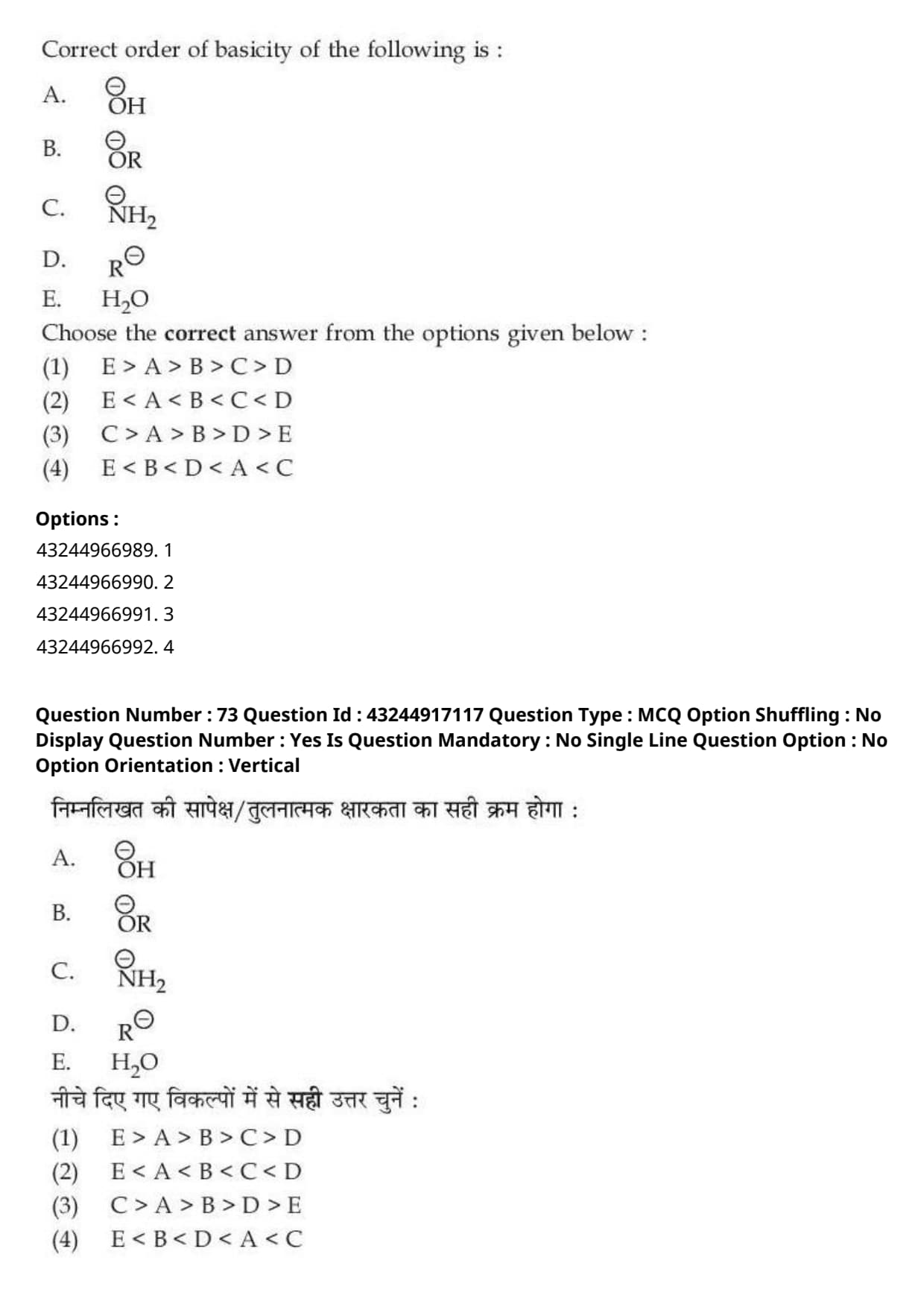
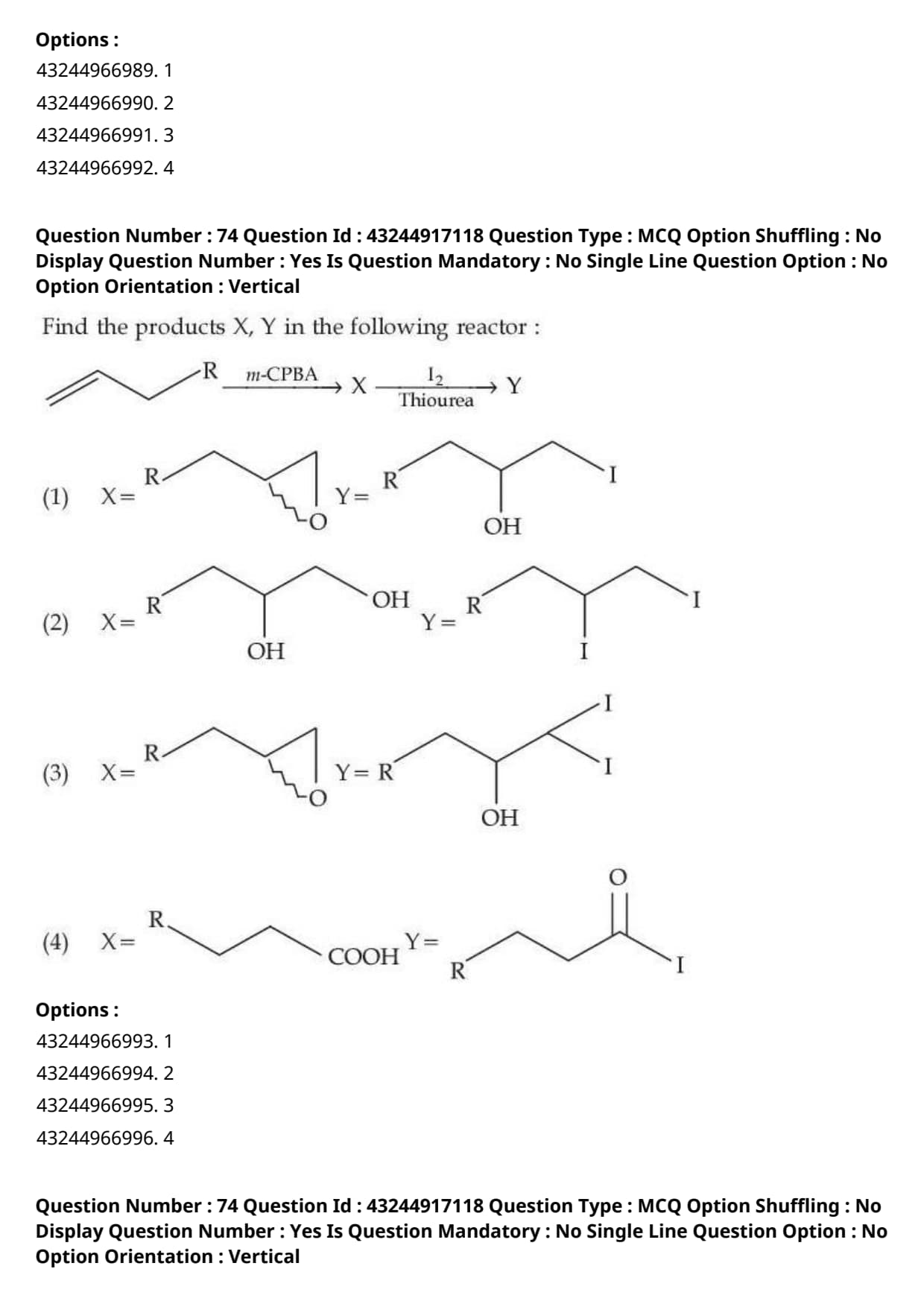
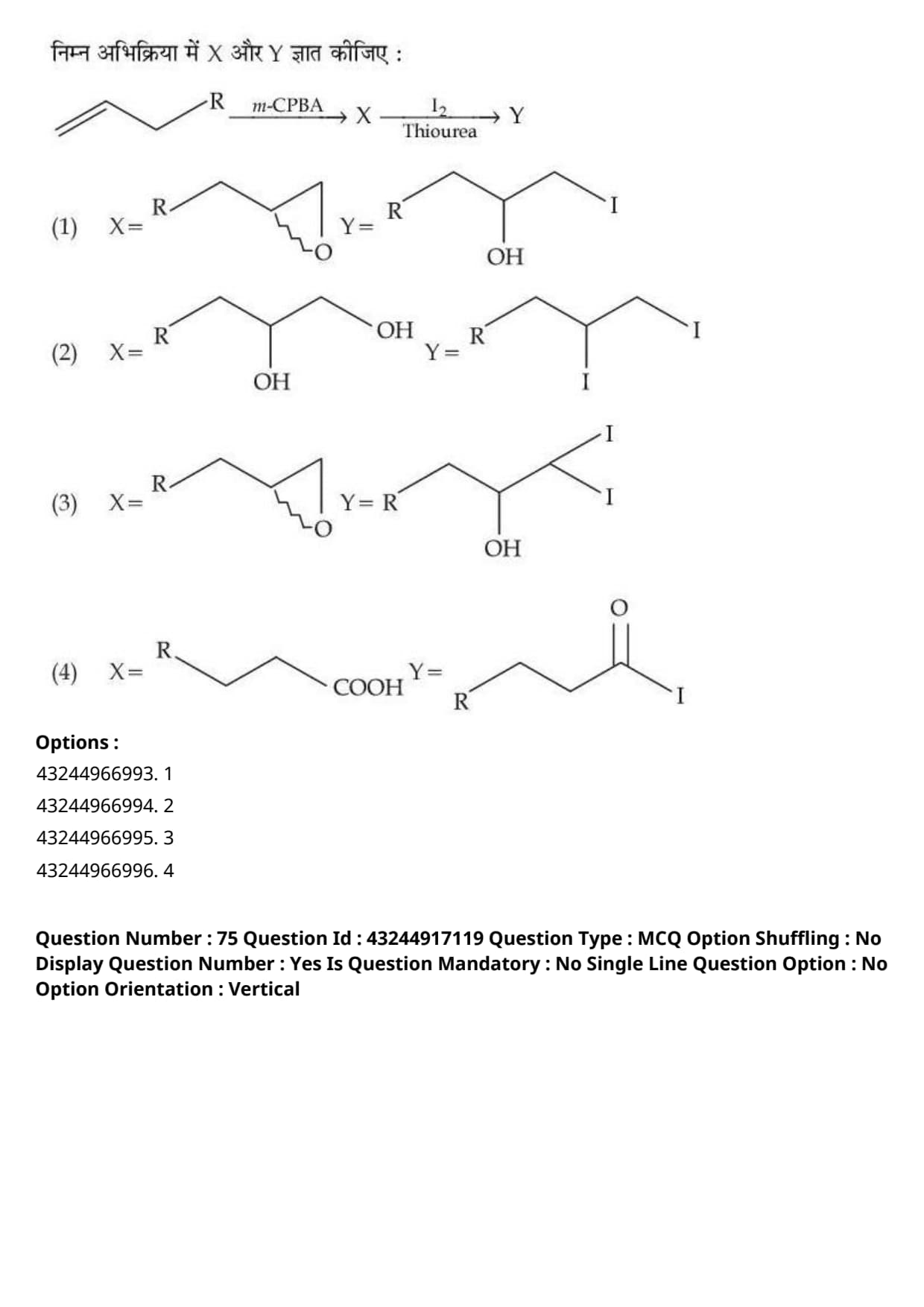
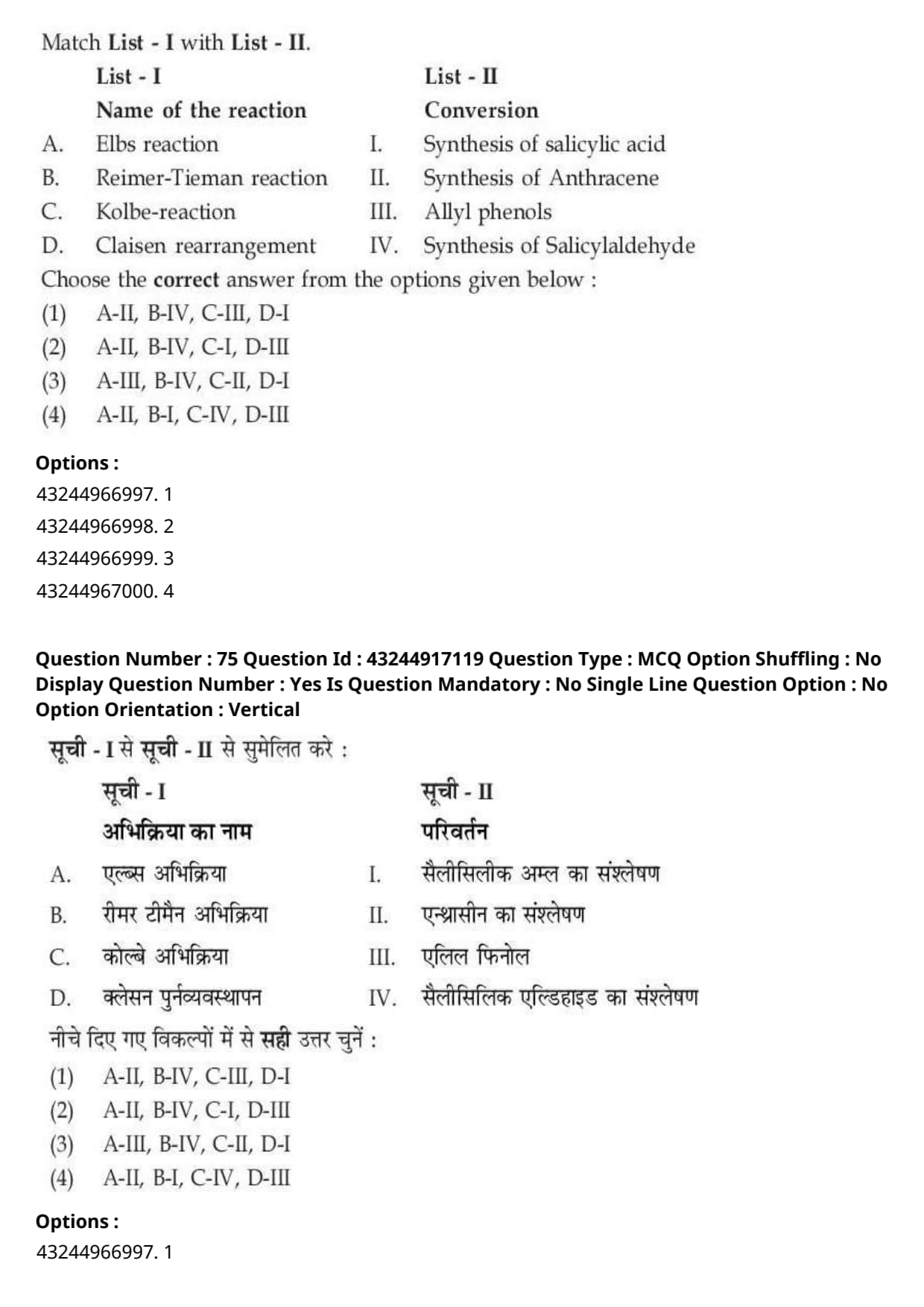
CUET PG 2026 Chemistry Question Paper is available for download here. The National Testing Agency (NTA) conducted the CUET PG 2026 Chemistry (SCQP08) examination on March 11, 2026, during Shift 3 from 04:00 PM to 05:30 PM.
CUET PG 2026 Chemistry Question Paper with Solutions PDF
| CUET PG 2026 Chemistry Question Paper | Download PDF | Check Solutions |
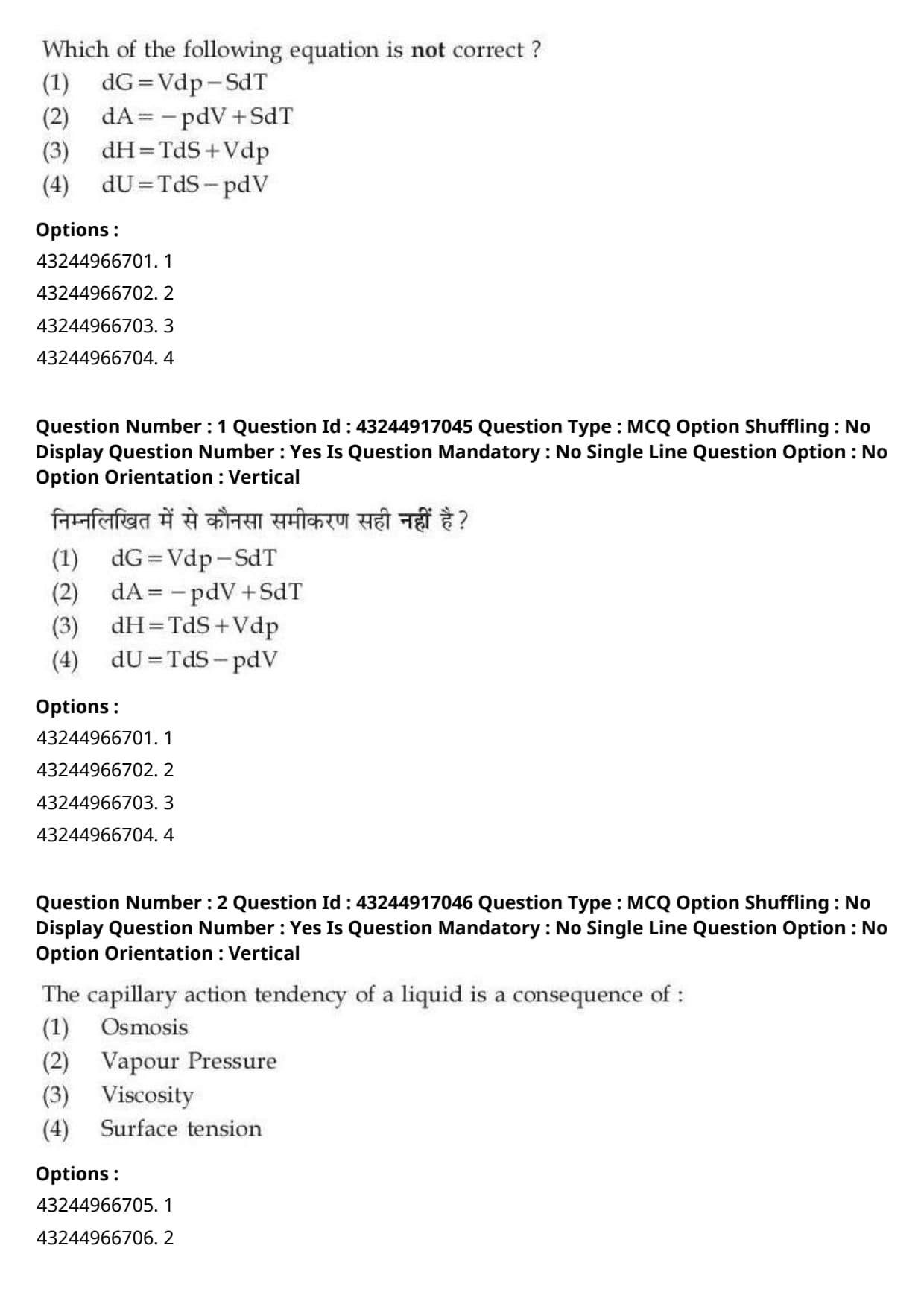
Which of the following equation is not correct?
View Solution
Step 1: Understanding the Question:
The topic of this question is fundamental thermodynamic equations and Maxwell's relations.
These relations represent the mathematical expressions for change in thermodynamic potentials (\(U\), \(H\), \(A\), and \(G\)) in terms of state variables (\(P\), \(V\), \(T\), and \(S\)).
Step 2: Key Formula or Approach:
The fundamental thermodynamic equations are derived from the first and second laws of thermodynamics:
Internal Energy (\(U\)): \(dU = TdS - pdV\)
Enthalpy (\(H\)): \(H = U + pV \implies dH = TdS + Vdp\)
Helmholtz Free Energy (\(A\)): \(A = U - TS \implies dA = -pdV - SdT\)
Gibbs Free Energy (\(G\)): \(G = H - TS \implies dG = VdP - SdT\)
Step 3: Detailed Explanation:
Let us evaluate each option based on thermodynamic relations:
Option (A) states \(dG = VdP - SdT\). This is the correct thermodynamic relation for Gibbs free energy, where pressure and temperature are natural variables.
Option (B) states \(dA = -pdV + SdT\). This is mathematically incorrect.
Let us derive the expression for Helmholtz free energy:
\[ A = U - TS \]
Differentiating both sides gives:
\[ dA = dU - TdS - SdT \]
Substituting \(dU = TdS - pdV\) into the equation:
\[ dA = (TdS - pdV) - TdS - SdT \] \[ dA = -pdV - SdT \]
Therefore, the correct coefficient of \(SdT\) must be negative (\(-SdT\)), making option (B) incorrect.
Option (C) states \(dH = TdS + Vdp\). This is correct as \(dH = dU + pdV + Vdp = (TdS - pdV) + pdV + Vdp = TdS + Vdp\).
Option (D) states \(dU = TdS - pdV\). This is the standard form of the first law of thermodynamics for a reversible process.
Step 4: Final Answer
Equation (B) is incorrect because the coefficient of \(SdT\) is positive instead of negative.
Quick Tip: A quick way to remember thermodynamic equations is using the thermodynamic square:
"Good Physicists Have Studied Under Very Active Teachers"
The direction of arrows determines the sign of the variables.
Always remember that Helmholtz energy (\(A\)) decreases with both temperature and volume, so \(dA = -SdT - pdV\).
The capillary action tendency of a liquid is a consequence of:
View Solution
Step 1: Understanding the Question:
The topic of this question is the physical properties of liquids, specifically surface tension and capillary action.
Capillary action is the rise or fall of a liquid in a narrow tube.
Step 2: Key Formula or Approach:
Capillary rise or depression can be quantitatively described by Jurin's Law:
\[ h = \frac{2\gamma \cos\theta}{\rho g r} \]
where:
\(h\) is the liquid height.
\(\gamma\) is the surface tension of the liquid.
\(\theta\) is the contact angle.
\(\rho\) is the density of the liquid.
\(g\) is the acceleration due to gravity.
\(r\) is the radius of the capillary tube.
Step 3: Detailed Explanation:
Capillary action occurs due to the interplay of two types of forces: cohesive forces (intermolecular forces within the liquid itself) and adhesive forces (attractive forces between the liquid molecules and the solid wall of the capillary tube).
When adhesive forces are stronger than cohesive forces (e.g., water in glass), the liquid wets the surface, creating a concave meniscus.
To minimize the surface area, surface tension forces pull the liquid upward along the walls of the tube.
Conversely, if cohesive forces are stronger than adhesive forces (e.g., mercury in glass), the liquid does not wet the wall, resulting in a convex meniscus and capillary depression.
Thus, surface tension is the key thermodynamic driving force that enables the liquid to sustain the capillary column against gravity.
Osmosis, vapour pressure, and viscosity affect liquid transport and dynamics, but capillary action itself is a direct consequence of surface tension and adhesion.
Step 4: Final Answer
Capillary action is a direct consequence of surface tension of the liquid.
Quick Tip: Capillary rise (\(h\)) is directly proportional to the surface tension (\(\gamma\)).
Without surface tension, there would be no force pulling the liquid meniscus upward in the capillary tube.
Always correlate capillary action with surface tension and wetting properties.
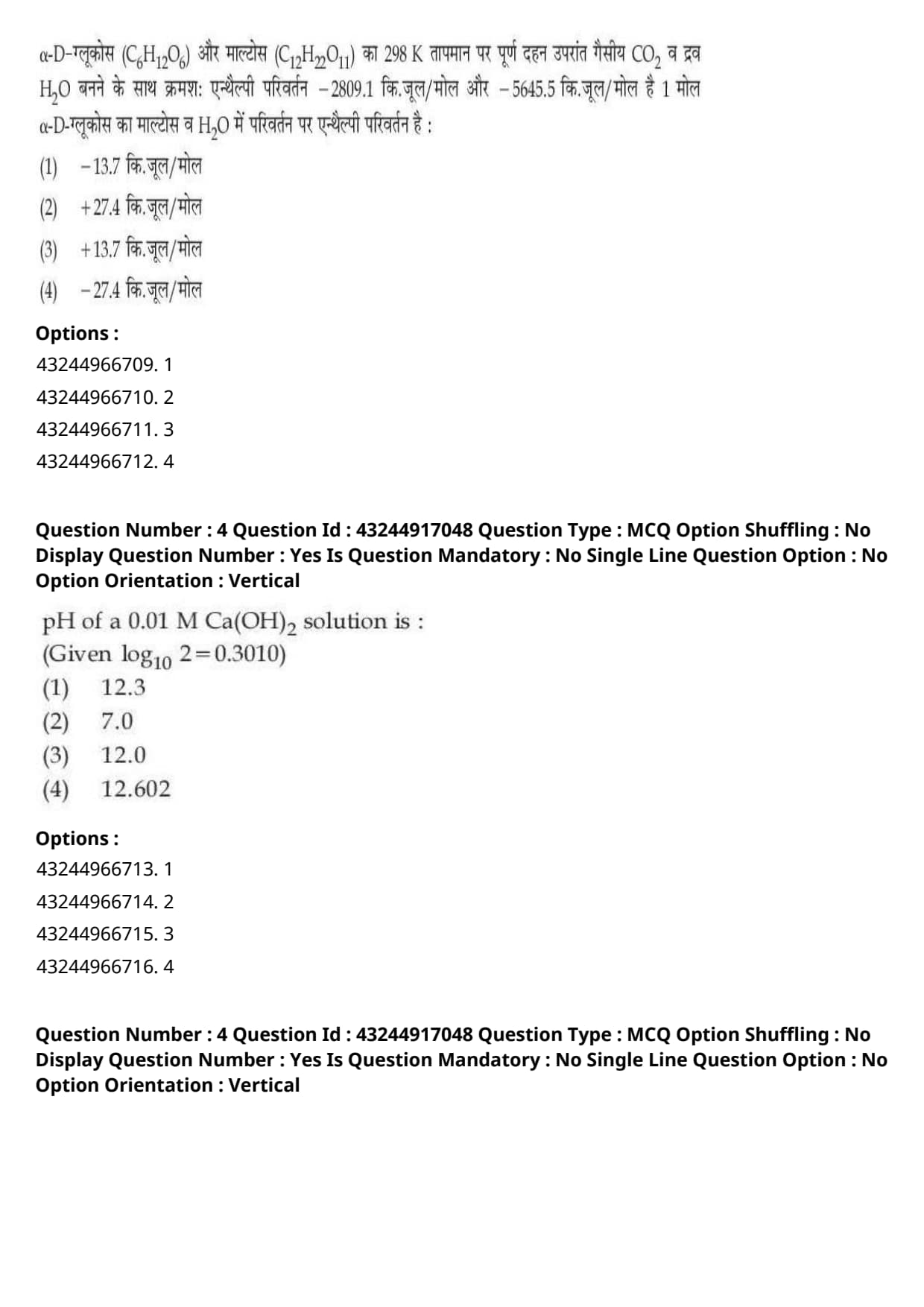
The enthalpy change in the complete combustion of \(\alpha\)-D-glucose (\(C_6H_{12}O_6\)) and maltose (\(C_{12}H_{22}O_{11}\)) at \(298 K\), with the formation of gaseous \(CO_2\) and liquid \(H_2O\), are \(-2809.1 kJ mol^{-1}\) and \(-5645.5 kJ mol^{-1}\) respectively. The enthalpy change accompanying the conversion of \(1 mol\) of \(\alpha\)-D-glucose to maltose and \(H_2O\) is:
View Solution
Step 1: Understanding the Question:
The topic of this question is thermochemistry, specifically the application of Hess's Law to calculate reaction enthalpy using standard enthalpies of combustion.
Step 2: Key Formula or Approach:
Using Hess's Law, the enthalpy change of a reaction can be calculated from the enthalpies of combustion (\(\Delta H_c^\circ\)) of reactants and products:
\[ \Delta H_{reaction} = \sum \Delta H_c^\circ(reactants) - \sum \Delta H_c^\circ(products) \]
Step 3: Detailed Explanation:
Let us write the balanced chemical equation for the dimerization of \(\alpha\)-D-glucose to form maltose and water:
\[ 2C_6H_{12}O_6(s) \rightarrow C_{12}H_{22}O_{11}(s) + H_2O(l) \]
Let us calculate the enthalpy change for this dimerization process (\(\Delta H_{dimer}\)):
\[ \Delta H_{dimer} = [2 \times \Delta H_c(glucose)] - [\Delta H_c(maltose) + \Delta H_c(H_2O)] \]
Water (\(H_2O(l)\)) is already fully oxidized, so its heat of combustion is zero: \(\Delta H_c(H_2O) = 0\).
Substitute the given values into the equation:
\[ \Delta H_{dimer} = [2 \times (-2809.1 kJ mol^{-1})] - (-5645.5 kJ mol^{-1}) \] \[ \Delta H_{dimer} = -5618.2 + 5645.5 = +27.3 kJ \]
This \(\Delta H_{dimer} = +27.3 kJ\) is for the conversion of \(2 moles\) of glucose.
The question asks for the enthalpy change per \(1 mole\) of \(\alpha\)-D-glucose.
Therefore, we divide the calculated enthalpy by 2:
\[ \Delta H_{per mole glucose} = \frac{+27.3 kJ}{2} = +13.65 kJ mol^{-1} \approx +13.7 kJ mol^{-1} \]
Step 4: Final Answer
The enthalpy change accompanying the conversion of 1 mol of \(\alpha\)-D-glucose is \(+13.7 kJ mol^{-1}\).
Quick Tip: Always double-check the stoichiometry of the target reaction.
Hess's Law calculations using combustion data are always \((reactants) - (products)\), whereas calculations using formation data are \((products) - (reactants)\).
Be mindful of whether the question asks for the enthalpy per mole of reactant or per mole of product.
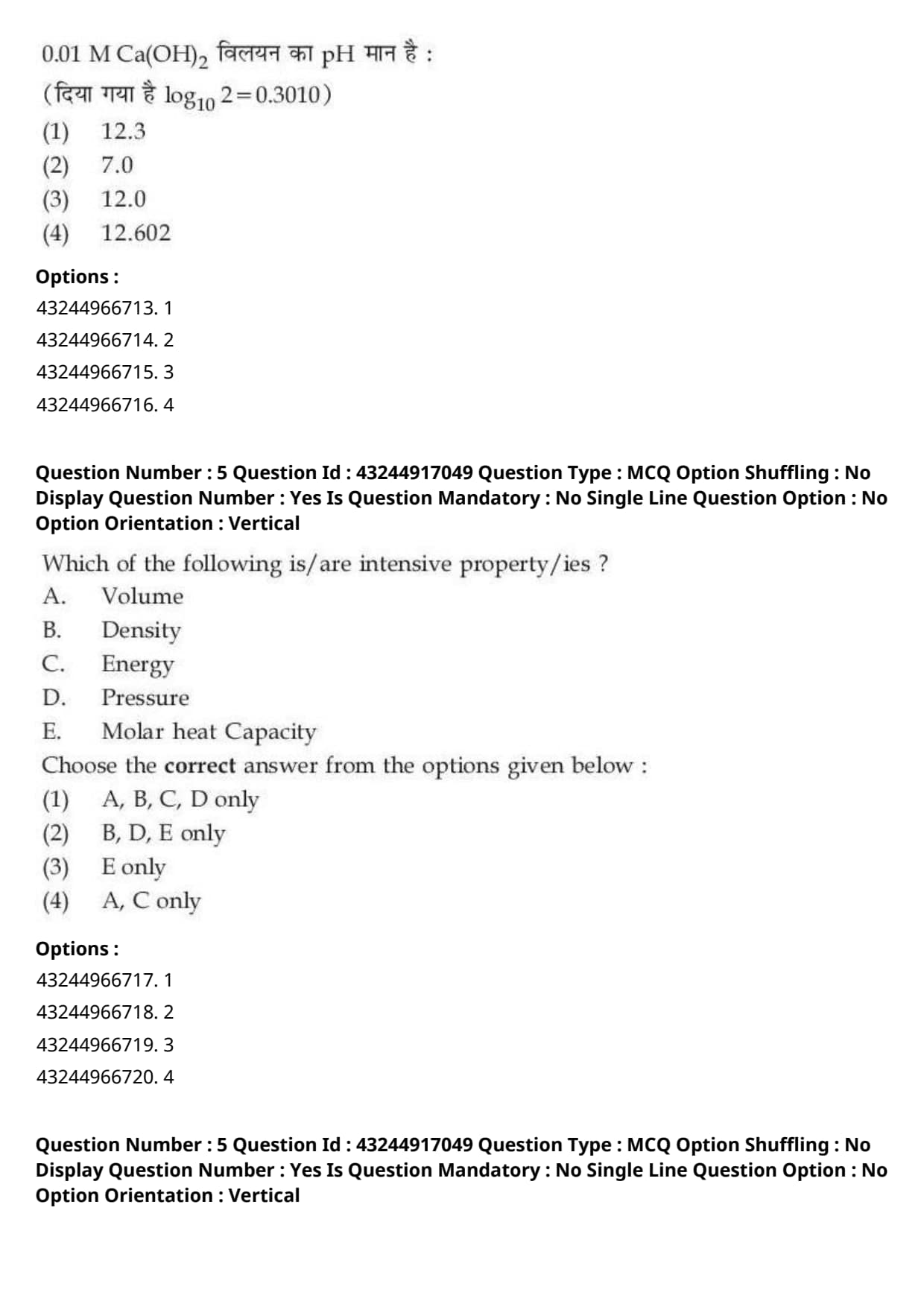
pH of a \(0.01 M Ca(OH)_2\) solution is: (Given \(\log_{10} 2 = 0.3010\))
View Solution
Step 1: Understanding the Question:
The topic of this question is ionic equilibrium, specifically the calculation of pH for a strong diacidic base.
Step 2: Key Formula or Approach:
Dissociation of strong diacidic base: \(Ca(OH)_2 \rightarrow Ca^{2+} + 2OH^-\)
Hydroxide ion concentration: \([OH^-] = 2 \times M_{base}\)
pOH calculation: \(pOH = -\log_{10}[OH^-]\)
pH calculation: \(pH = 14 - pOH\)
Step 3: Detailed Explanation:
Calcium hydroxide is a strong electrolyte and dissociates completely in aqueous solution:
\[ Ca(OH)_2(aq) \rightarrow Ca^{2+}(aq) + 2OH^-(aq) \]
Given concentration of \(Ca(OH)_2 = 0.01 M = 10^{-2} M\).
The concentration of hydroxide ions is:
\[ [OH^-] = 2 \times 0.01 M = 0.02 M = 2 \times 10^{-2} M \]
Now, let us calculate the pOH of the solution:
\[ pOH = -\log_{10}(2 \times 10^{-2}) \] \[ pOH = -[\log_{10} 2 + \log_{10} 10^{-2}] \] \[ pOH = -[0.3010 - 2] = 2 - 0.3010 = 1.6990 \]
Using the relation between pH and pOH at \(298 K\):
\[ pH + pOH = 14 \] \[ pH = 14 - 1.6990 = 12.3010 \approx 12.3 \]
Step 4: Final Answer
The pH of \(0.01 M Ca(OH)_2\) solution is \(12.3\).
Quick Tip: Never forget the acidity factor of the base.
For \(Ca(OH)_2\), the factor is 2, so the concentration of \(OH^-\) is twice the molarity.
Quick check: pH of strong bases is always well above 7.
If you directly did \(-\log(10^{-2}) = 2\) and \(14-2=12\), you would miss the factor of 2, leading to incorrect option (C).
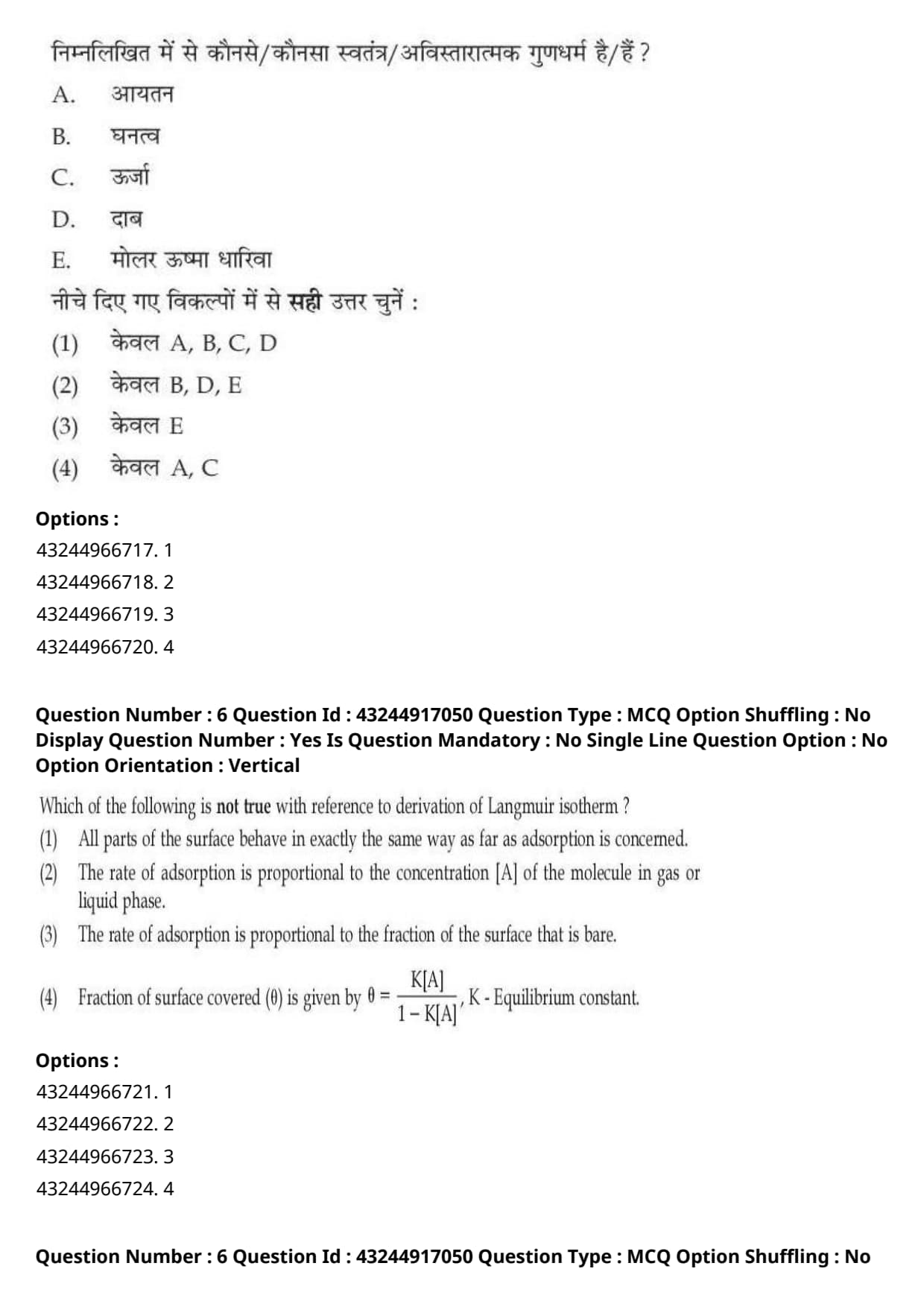
Which of the following is/are intensive property/ies?
A. Volume
B. Density
C. Energy
D. Pressure
E. Molar heat Capacity
Choose the correct answer from the options given below:
View Solution
Step 1: Understanding the Question:
The topic of this question is thermodynamic properties.
Thermodynamic properties are classified as intensive or extensive based on their dependence on the mass or size of the system.
Step 2: Key Formula or Approach:
Extensive property: A property whose value depends on the quantity or size of matter present in the system.
Intensive property: A property whose value is independent of the quantity or size of matter present in the system.
Note: The ratio of two extensive properties is always an intensive property.
Step 3: Detailed Explanation:
Let us analyze each property given in the list:
A. Volume: Depends on the quantity of matter. If we double the amount of substance, its volume doubles. Thus, it is an extensive property.
B. Density: Density is mass divided by volume (\(\rho = m/V\)). Both mass and volume are extensive, but their ratio is independent of sample size. Thus, density is an intensive property.
C. Energy: Total energy (internal energy, enthalpy, gibbs free energy, etc.) depends directly on the mass of the substance. Thus, it is an extensive property.
D. Pressure: Pressure does not depend on the total quantity of matter in a uniform system. Thus, it is an intensive property.
E. Molar heat Capacity: Heat capacity (\(C\)) is extensive, but molar heat capacity (\(C_m = C/n\)) is defined per mole of substance. Hence, it is independent of the total quantity of substance and is an intensive property.
Therefore, B, D, and E are intensive properties, while A and C are extensive properties.
Step 4: Final Answer
The intensive properties among the given choices are B, D, and E only.
Quick Tip: To easily identify intensive properties, imagine dividing a system in half.
Properties that remain unchanged in each half (like temperature, pressure, density) are intensive.
Properties that are halved (like volume, mass, energy) are extensive.
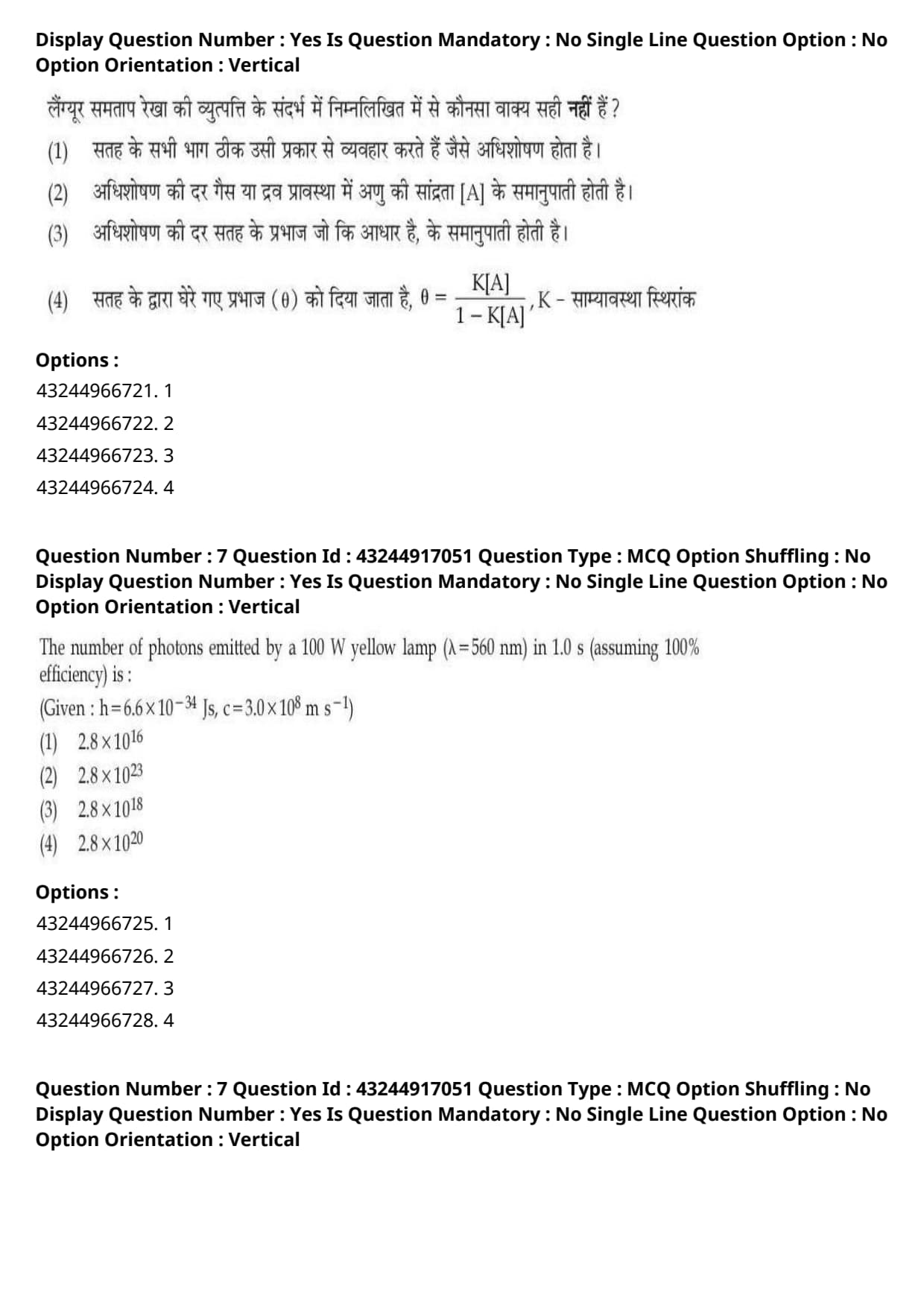
Which of the following is not true with reference to derivation of Langmuir isotherm?
View Solution
Step 1: Understanding the Question:
The topic of this question is surface chemistry, specifically the postulates and derivation of the Langmuir adsorption isotherm.
Step 2: Key Formula or Approach:
The Langmuir adsorption model relies on the dynamic equilibrium between adsorption and desorption.
The rate of adsorption (\(r_a\)) is proportional to pressure (\(P\) or concentration \([A]\)) and the fraction of unoccupied bare surface (\(1-\theta\)).
The rate of desorption (\(r_d\)) is proportional to the fraction of occupied surface (\(\theta\)).
Step 3: Detailed Explanation:
Let us evaluate each statement based on the Langmuir theory:
Option (A) states: "All parts of the surface behave in exactly the same way as far as adsorption is concerned." This represents the assumption of a homogeneous surface with equivalent adsorption sites, which is a core postulate of the Langmuir model.
Option (B) states: "The rate of adsorption is proportional to the concentration \([A]\) of the molecule in gas or liquid phase." This is correct because the collision frequency of adsorbate molecules with the surface increases linearly with pressure or concentration.
Option (C) states: "The rate of adsorption is proportional to the fraction of the surface that is bare." This is correct since adsorption can only take place on unoccupied sites. Thus, \(r_a \propto (1-\theta)\).
Option (D) states: "Fraction of surface covered (\(\theta\)) is given by \(\theta = \frac{K[A]}{1 - K[A]}\)".
Let us derive the correct relation. At equilibrium, the rate of adsorption equals the rate of desorption:
\[ k_a [A] (1-\theta) = k_d \theta \] \[ k_a [A] - k_a [A]\theta = k_d \theta \] \[ k_a [A] = \theta (k_d + k_a [A]) \] \[ \theta = \frac{k_a [A]}{k_d + k_a [A]} \]
Dividing both numerator and denominator by \(k_d\) and substituting \(K = k_a/k_d\):
\[ \theta = \frac{K[A]}{1 + K[A]} \]
Therefore, the denominator must have a plus sign (\(1 + K[A]\)) rather than a minus sign (\(1 - K[A]\)), making statement (D) false.
Step 4: Final Answer
The incorrect equation in the options is statement (D).
Quick Tip: The Langmuir adsorption isotherm formula always has a plus sign in the denominator: \(\theta = \frac{KP}{1 + KP}\).
This ensures that as \(P \rightarrow \infty\), \(\theta \rightarrow 1\) (complete monolayer coverage).
A minus sign would lead to a mathematical singularity, which is physically impossible.
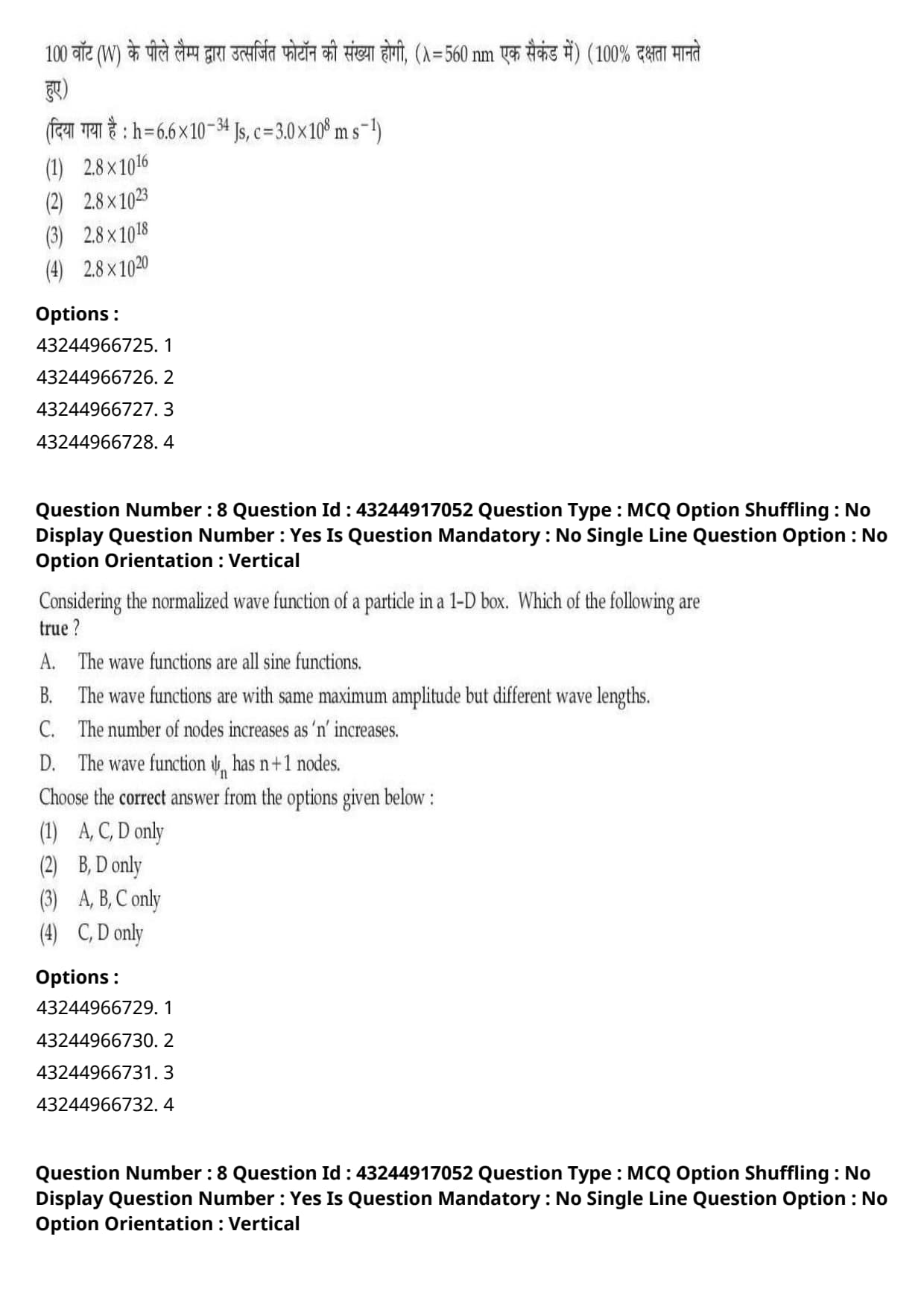
The number of photons emitted by a \(100 W\) yellow lamp (\(\lambda = 560 nm\)) in \(1.0 s\) (assuming \(100%\) efficiency) is: (Given: \(h = 6.6 \times 10^{-34} Js\), \(c = 3.0 \times 10^8 ms^{-1}\))
View Solution
Step 1: Understanding the Question:
The topic of this question is atomic structure and quantum mechanics, specifically the dual nature of electromagnetic radiation and Planck's quantum theory.
Step 2: Key Formula or Approach:
Energy of a single photon: \(E_{photon} = \frac{hc}{\lambda}\)
Power is energy per unit time: \(Power (P) = \frac{Total Energy (E_{total})}{t}\)
Total energy emitted in time \(t\): \(E_{total} = P \times t\)
Number of photons (\(N\)): \(N = \frac{E_{total}}{E_{photon}}\)
Step 3: Detailed Explanation:
Let us write down the given values:
\(Power (P) = 100 W = 100 J s^{-1}\)
\(Time (t) = 1.0 s\)
\(Wavelength (\lambda) = 560 nm = 560 \times 10^{-9} m\)
\(h = 6.6 \times 10^{-34} J s\)
\(c = 3.0 \times 10^8 m s^{-1}\)
Calculate the total energy emitted in \(1.0 s\):
\[ E_{total} = 100 J s^{-1} \times 1.0 s = 100 J \]
Calculate the energy of a single photon:
\[ E_{photon} = \frac{6.6 \times 10^{-34} J s \times 3.0 \times 10^8 m s^{-1}}{560 \times 10^{-9} m} \] \[ E_{photon} = \frac{1.98 \times 10^{-25}}{5.6 \times 10^{-7}} \] \[ E_{photon} \approx 3.5357 \times 10^{-19} J \]
Now, calculate the total number of photons (\(N\)):
\[ N = \frac{E_{total}}{E_{photon}} = \frac{100 J}{3.5357 \times 10^{-19} J} \] \[ N = 2.828 \times 10^{20} \approx 2.8 \times 10^{20} \]
Step 4: Final Answer
The number of photons emitted by the yellow lamp in \(1.0 s\) is \(2.8 \times 10^{20}\).
Quick Tip: For quick calculations in competitive exams:
\(hc \approx 2 \times 10^{-25} J m\).
Here, \(E_{photon} \approx \frac{2 \times 10^{-25}}{5.6 \times 10^{-7}} \approx 3.57 \times 10^{-19} J\).
Then \(N \approx \frac{100}{3.57 \times 10^{-19}} \approx 2.8 \times 10^{20}\).
This approximation saves precious time without losing precision.
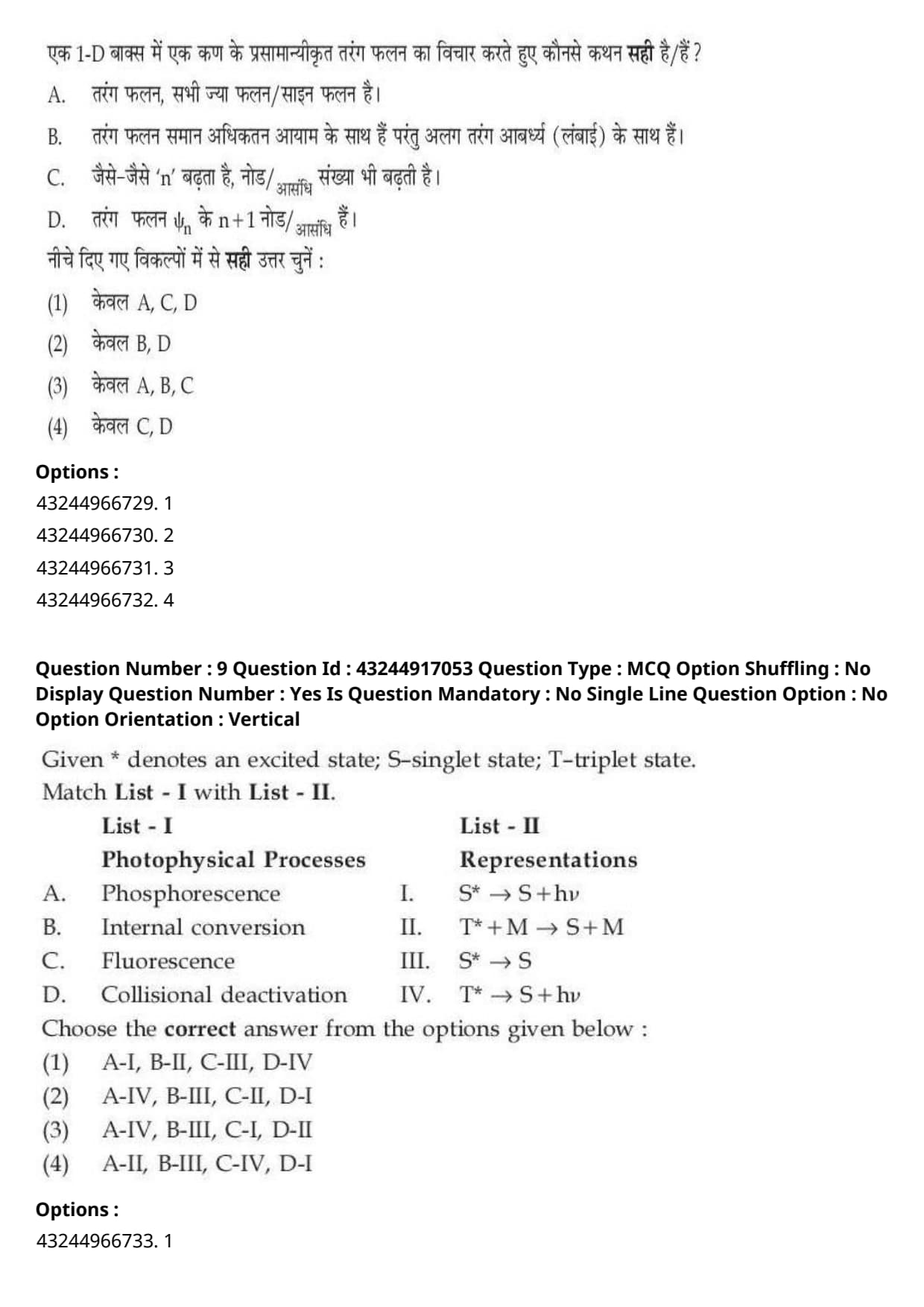
Considering the normalized wave function of a particle in a 1-D box. Which of the following are true?
A. The wave functions are all sine functions.
B. The wave functions are with same maximum amplitude but different wave lengths.
C. The number of nodes increases as '\(n\)' increases.
D. The wave function \(\psi_n\) has \(n+1\) nodes.
Choose the correct answer from the options given below:
View Solution
Step 1: Understanding the Question:
The topic of this question is quantum mechanics, specifically the solution to the Schrödinger wave equation for a particle in a one-dimensional box.
Step 2: Key Formula or Approach:
For a 1-D box of length \(L\) from \(x=0\) to \(x=L\):
Normalized wave function: \(\psi_n(x) = \sqrt{\frac{2}{L}} \sin\left(\frac{n\pi x}{L}\right)\) for \(n = 1, 2, 3, \dots\)
Wavelength: \(\lambda_n = \frac{2L}{n}\)
Internal nodes: \(N_{nodes} = n - 1\)
Step 3: Detailed Explanation:
Let us analyze each statement:
Statement A: "The wave functions are all sine functions."
As seen in the solution to the Schrödinger equation with boundary conditions \(\psi(0) = \psi(L) = 0\), the spatial part consists purely of sine terms: \(\psi_n(x) = \sqrt{\frac{2}{L}} \sin\left(\frac{n\pi x}{L}\right)\). Thus, Statement A is true.
Statement B: "The wave functions are with same maximum amplitude but different wave lengths."
The maximum amplitude is \(\sqrt{\frac{2}{L}}\) for all values of \(n\) because the maximum value of the sine term is \(1\). The wavelength \(\lambda_n = \frac{2L}{n}\) is inversely proportional to \(n\), hence different for different states. Thus, Statement B is true.
Statement C: "The number of nodes increases as '\(n\)' increases."
The number of internal nodes is \(n-1\). For \(n=1\), nodes \(= 0\). For \(n=2\), nodes \(= 1\). For \(n=3\), nodes \(= 2\). Thus, the number of nodes increases as \(n\) increases. Statement C is true.
Statement D: "The wave function \(\psi_n\) has \(n+1\) nodes."
By convention, nodes refer to points inside the boundary where the probability of finding the particle is zero. This is given by \(n-1\). Even if boundary points are included, the total zero-crossings are \((n-1) + 2 = n+1\). However, boundary points are not considered nodes. Therefore, \(\psi_n\) has \(n-1\) nodes, making Statement D false.
Thus, statements A, B, and C are correct.
Step 4: Final Answer
The correct options are A, B, and C only.
Quick Tip: Remember that for any 1-D potential system:
The ground state (\(n=1\)) has zero nodes.
The first excited state (\(n=2\)) has one node.
In general, the \(n\)-th state has \(n-1\) nodes.
Knowing this rule immediately helps identify that Statement D is incorrect.
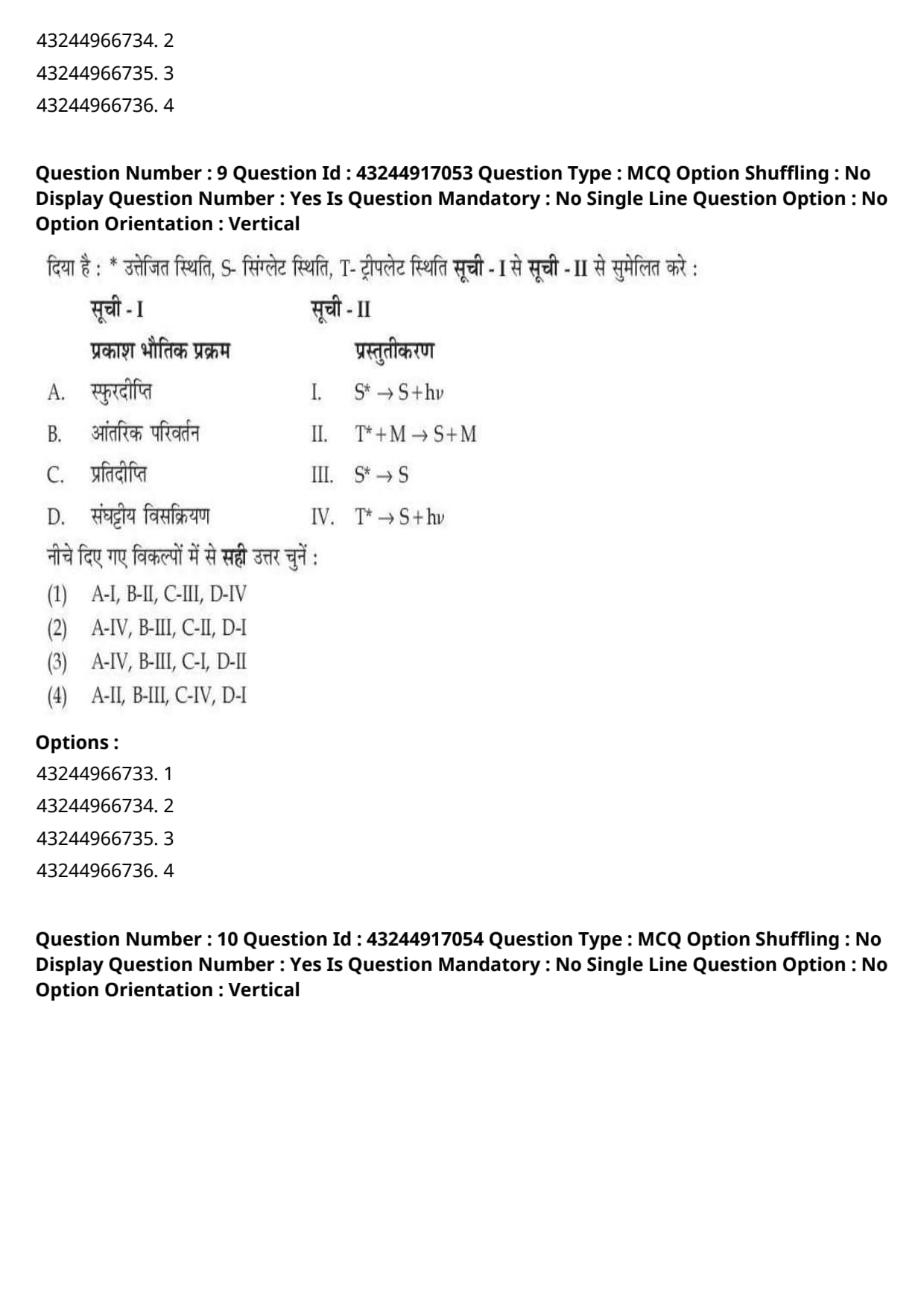
Given * denotes an excited state; S-singlet state; T-triplet state.
Choose the correct answer from the options given below:
View Solution
Step 1: Understanding the Question:
The topic of this question is photochemistry, specifically the radiative and non-radiative photophysical transitions represented on a Jablonski diagram.
Step 2: Key Formula or Approach:
Radiative transition with same spin multiplicity (\(S^* \rightarrow S + h\nu\)) is Fluorescence.
Radiative transition with different spin multiplicity (\(T^* \rightarrow S + h\nu\)) is Phosphorescence.
Non-radiative transition with same spin multiplicity (\(S^* \rightarrow S\)) is Internal Conversion (IC).
De-excitation through collisions with surrounding molecules (\(T^* + M \rightarrow S + M\)) is Collisional Deactivation.
Step 3: Detailed Explanation:
Let us match each process:
A. Phosphorescence: This is a spin-forbidden radiative transition from an excited triplet state (\(T^*\)) to the singlet ground state (\(S\)). It involves emission of light of longer wavelength and has a longer lifetime. This corresponds to expression IV (\(T^* \rightarrow S + h\nu\)).
B. Internal Conversion (IC): This is a non-radiative transition between electronic states of the same spin multiplicity (e.g., \(S_1 \rightarrow S_0\)). No photon is emitted. This corresponds to expression III (\(S^* \rightarrow S\)).
C. Fluorescence: This is a spin-allowed radiative transition from an excited singlet state (\(S^*\)) to the ground singlet state (\(S\)). This corresponds to expression I (\(S^* \rightarrow S + h\nu\)).
D. Collisional Deactivation: This is a non-radiative process where the excited triplet state molecule (\(T^*\)) transfers its excess vibrational energy to a surrounding molecule (\(M\)) via collision, returning to the ground state. This corresponds to expression II (\(T^* + M \rightarrow S + M\)).
Thus, the correct matching is: A-IV, B-III, C-I, D-II.
Step 4: Final Answer
The correct match matches option (C).
Quick Tip: Remember:
"Fluorescence" \(\rightarrow\) Singlet to Singlet (\(S^* \rightarrow S + h\nu\))
"Phosphorescence" \(\rightarrow\) Triplet to Singlet (\(T^* \rightarrow S + h\nu\))
"Conversion" (Internal) \(\rightarrow\) No emission, same multiplicity (\(S^* \rightarrow S\)).
This simple rule lets you find the correct option instantly by matching just A and C.
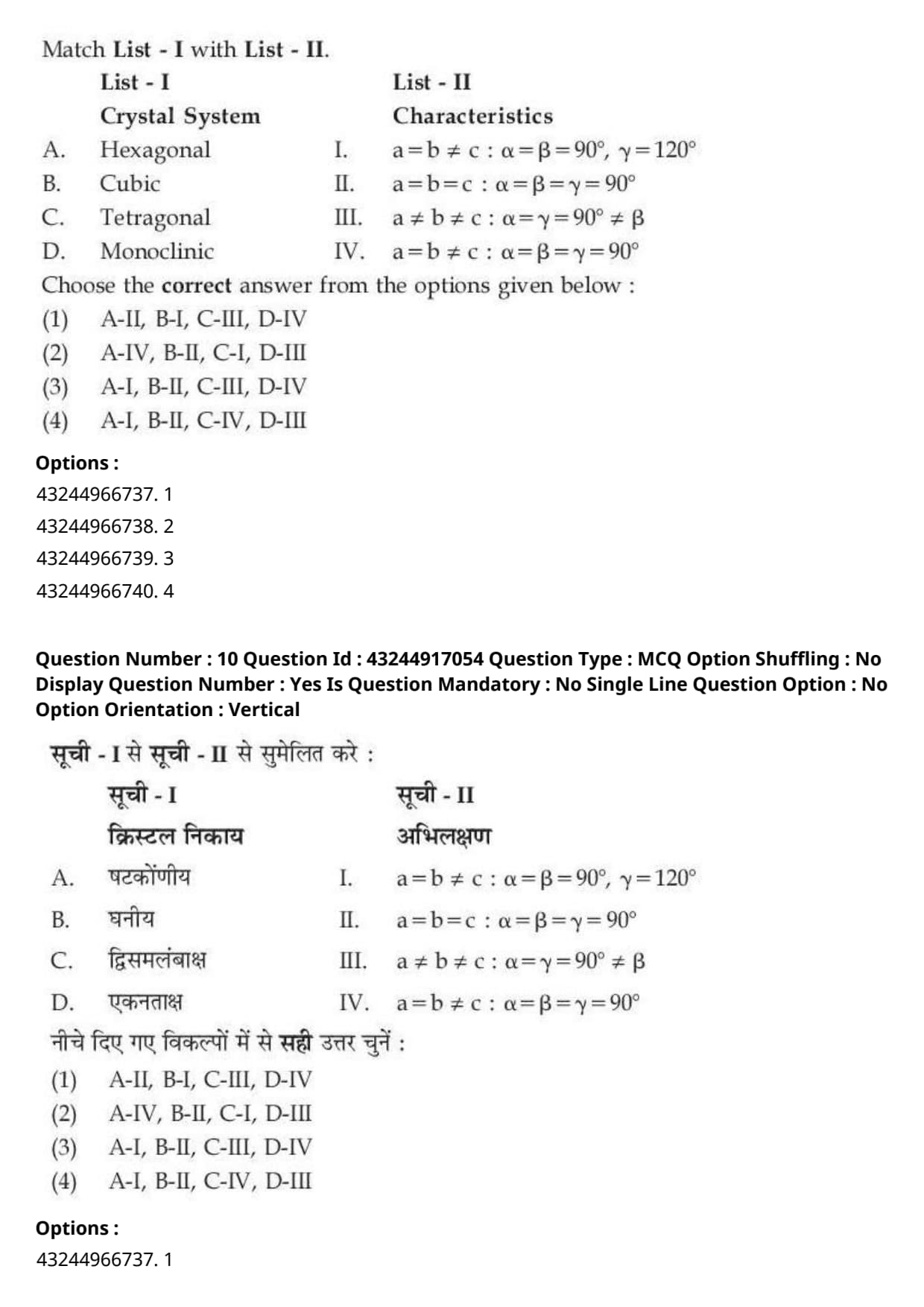
Match List - I with List - II.
Choose the correct answer from the options given below:
View Solution
Step 1: Understanding the Question:
The topic of this question is solid state chemistry, specifically the classification of the 7 crystal systems based on their axial parameters (edge lengths \(a\), \(b\), \(c\)) and interaxial angles (\(\alpha\), \(\beta\), \(\gamma\)).
Step 2: Key Formula or Approach:
We match the geometric parameters defined for each of the 14 Bravais lattices belonging to the 7 crystal classes.
Step 3: Detailed Explanation:
Let us analyze the parameters for each crystal system in the list:
A. Hexagonal System: In a hexagonal crystal, two axes are of equal length in a single plane, and the third axis is perpendicular to them and of different length.
The parameters are: \(a = b \neq c\) and \(\alpha = \beta = 90^\circ\), \(\gamma = 120^\circ\).
This matches List-II item I.
B. Cubic System: This is the most symmetrical system, with all three axes of equal length and all angles equal to \(90^\circ\).
The parameters are: \(a = b = c\) and \(\alpha = \beta = \gamma = 90^\circ\).
This matches List-II item II.
C. Tetragonal System: This system has two axes of equal length, and all three angles are equal to \(90^\circ\).
The parameters are: \(a = b \neq c\) and \(\alpha = \beta = \gamma = 90^\circ\).
This matches List-II item IV.
D. Monoclinic System: This system has all three axes of unequal length. Two of the angles are \(90^\circ\), and the third angle is not \(90^\circ\).
The parameters are: \(a \neq b \neq c\) and \(\alpha = \gamma = 90^\circ\), \(\beta \neq 90^\circ\).
This matches List-II item III.
Thus, the correct matching is: A-I, B-II, C-IV, D-III.
Step 4: Final Answer
The correct option is (D).
Quick Tip: Remember the axial angle mnemonic:
Cubic, Tetragonal, Orthorhombic all have \(\alpha = \beta = \gamma = 90^\circ\).
Cubic has \(a = b = c\).
Tetragonal has \(a = b \neq c\).
Orthorhombic has \(a \neq b \neq c\).
Hexagonal is unique with \(\gamma = 120^\circ\).
This easily distinguishes Tetragonal (IV) from Hexagonal (I).
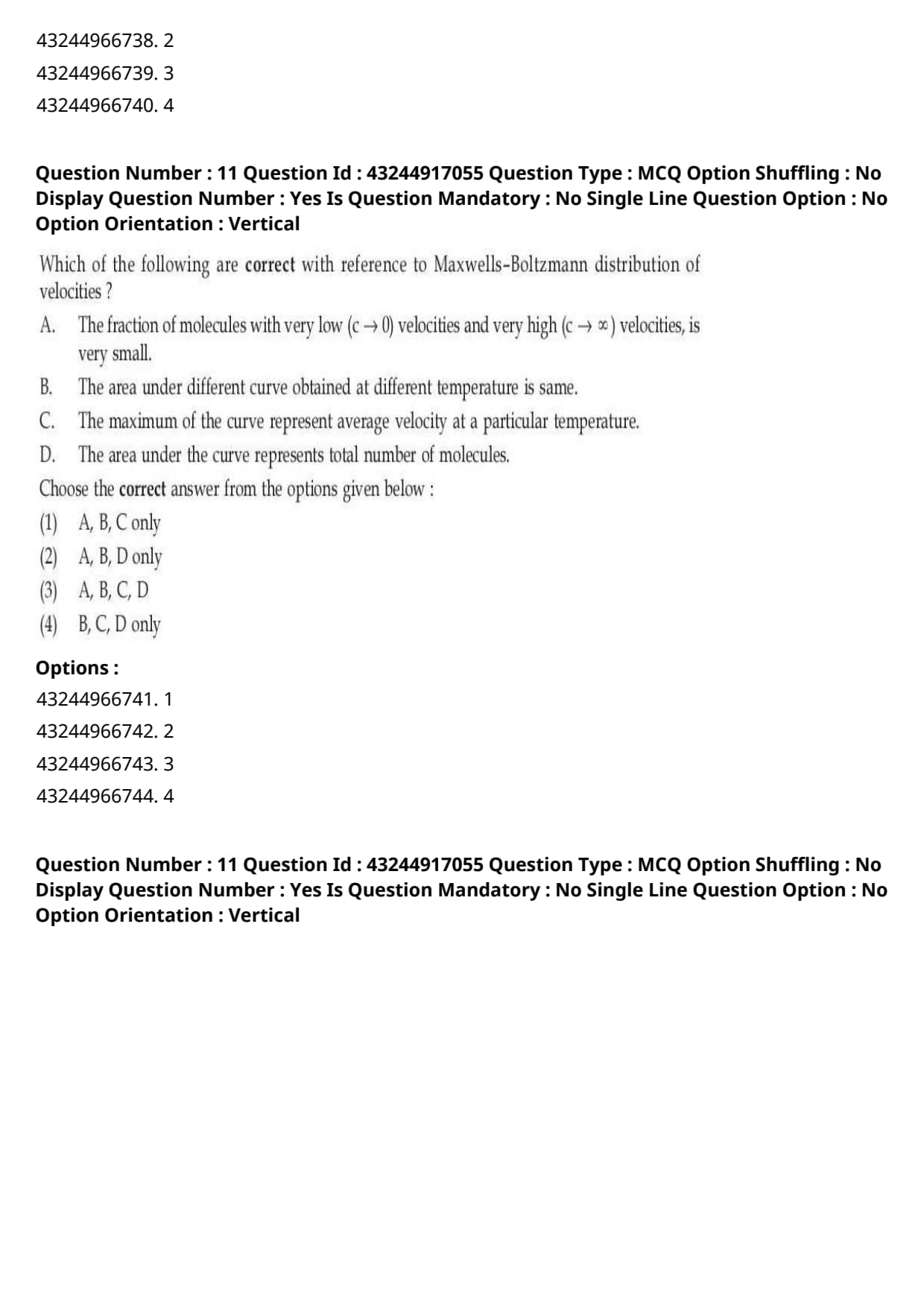
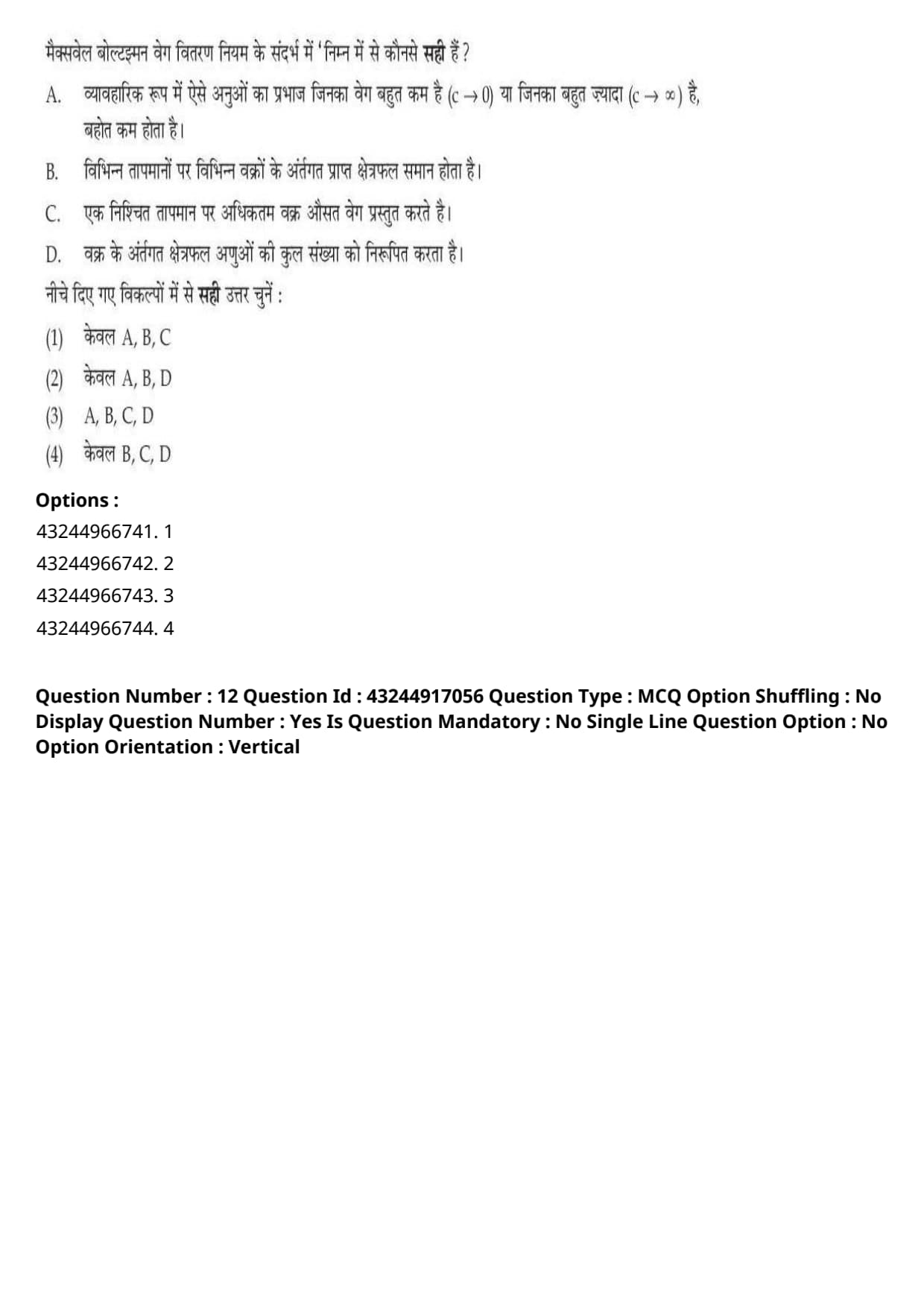
Which of the following are correct with reference to Maxwells-Boltzmann distribution of velocities?
A. The fraction of molecules with very low (\(c \rightarrow 0\)) velocities and very high (\(c \rightarrow \infty\)) velocities, is very small.
B. The area under different curve obtained at different temperature is same.
C. The maximum of the curve represent average velocity at a particular temperature.
D. The area under the curve represents total number of molecules.
Choose the correct answer from the options given below:
View Solution
Step 1: Understanding the Question:
The topic of this question is the kinetic theory of gases, specifically the characteristics of the Maxwell-Boltzmann distribution of molecular speeds.
Step 2: Key Formula or Approach:
The fraction of molecules moving with a velocity between \(c\) and \(c+dc\) is given by:
\[ \frac{dN}{N} = 4\pi \left(\frac{m}{2\pi k_B T}\right)^{3/2} c^2 e^{-mc^2/2k_B T} dc \]
Step 3: Detailed Explanation:
Let us analyze each statement:
Statement A: "The fraction of molecules with very low (\(c \rightarrow 0\)) velocities and very high (\(c \rightarrow \infty\)) velocities, is very small."
For \(c \rightarrow 0\), the \(c^2\) factor dominates and brings the probability density to 0.
For \(c \rightarrow \infty\), the exponential factor \(e^{-mc^2/2k_B T}\) dominates and brings the density to 0. Thus, Statement A is correct.
Statement B: "The area under different curve obtained at different temperature is same."
The total fraction of molecules is normalized to \(1\), which means \(\int_0^\infty \frac{1}{N} \frac{dN}{dc} dc = 1\). This area represents the total probability and is always equal to 1, independent of temperature. Thus, Statement B is correct.
Statement C: "The maximum of the curve represents average velocity at a particular temperature."
The peak (maximum) of the curve corresponds to the most probable speed (\(v_{mp} = \sqrt{\frac{2RT}{M}}\)). The average speed (\(v_{avg} = \sqrt{\frac{8RT}{\pi M}}\)) is slightly higher and lies to the right of the peak. Thus, Statement C is incorrect.
Statement D: "The area under the curve represents total number of molecules."
If we plot the distribution as \(dN/dc\) versus \(c\), the area under the curve is \(\int_0^\infty \frac{dN}{dc} dc = N\) (total number of molecules). Thus, Statement D is correct.
Therefore, statements A, B, and D are correct, while statement C is incorrect.
Step 4: Final Answer
The correct options are A, B, and D only.
Quick Tip: Remember the order of molecular speeds:
\(v_{mp} < v_{avg} < v_{rms}\).
Since \(v_{mp}\) is the lowest of the three, it corresponds to the peak (maximum) of the curve.
This immediately identifies Statement C as false.
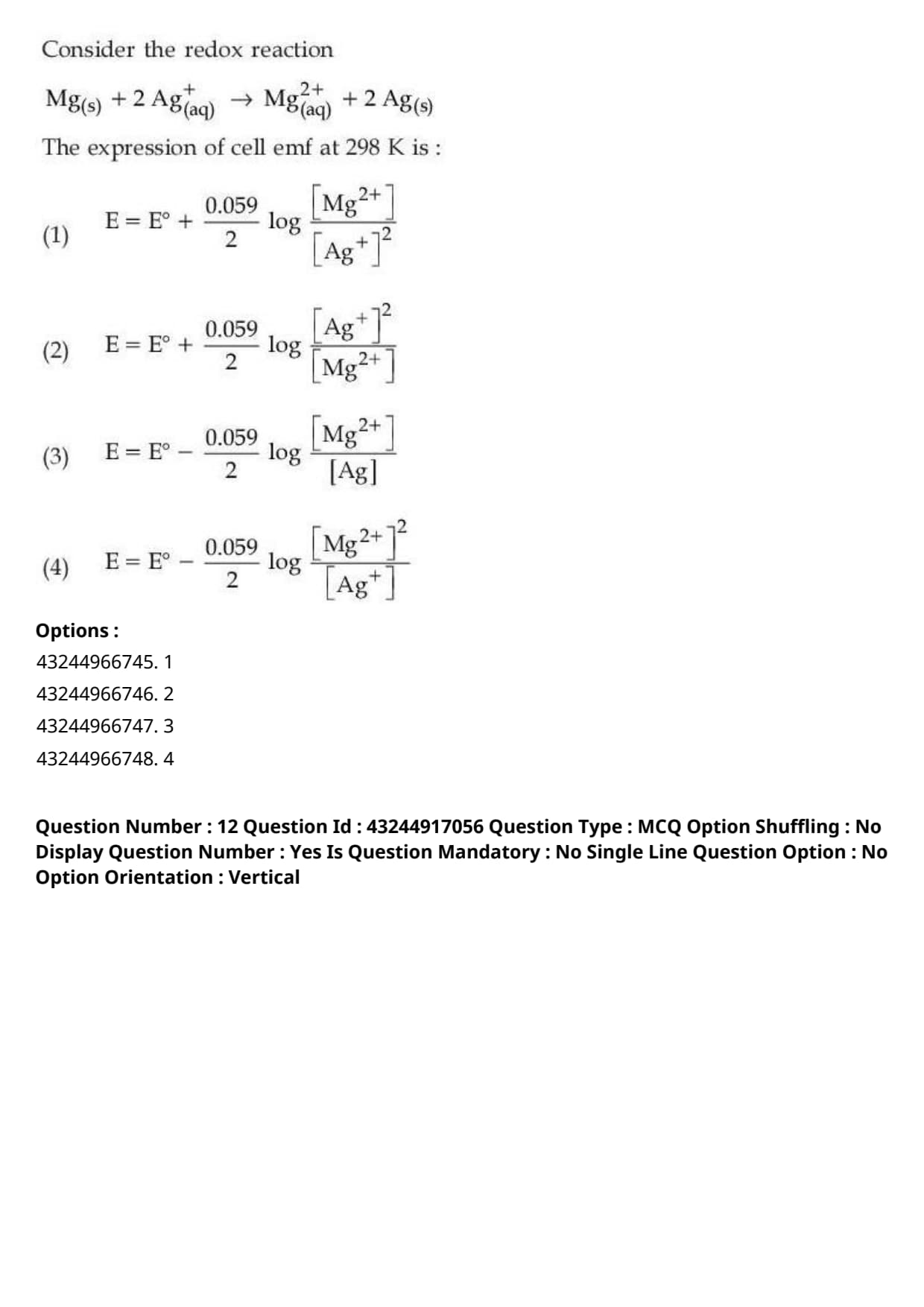
Consider the redox reaction \(Mg(s) + 2Ag^+(aq) \rightarrow Mg^{2+}(aq) + 2Ag(s)\). The expression of cell emf at \(298 K\) is:
View Solution
Step 1: Understanding the Question:
The topic of this question is electrochemistry, specifically writing the Nernst equation for a given cell reaction at standard temperature (\(298 K\)).
Step 2: Key Formula or Approach:
The Nernst equation at \(298 K\) is:
\[ E = E^\circ - \frac{0.0591}{n} \log_{10} Q \]
where:
\(n\) is the number of electrons transferred in the balanced redox reaction.
\(Q\) is the reaction quotient, defined as the ratio of active masses of products to reactants.
Active mass of pure solids like \(Mg(s)\) and \(Ag(s)\) is taken as \(1\).
Step 3: Detailed Explanation:
Let us write the half-cell reactions to find the number of electrons (\(n\)):
Anode (Oxidation): \(Mg(s) \rightarrow Mg^{2+}(aq) + 2e^-\)
Cathode (Reduction): \(2Ag^+(aq) + 2e^- \rightarrow 2Ag(s)\)
Since 2 moles of electrons are transferred, \(n = 2\).
The reaction quotient \(Q\) is:
\[ Q = \frac{[Mg^{2+}][Ag]^2}{[Mg][Ag^+]^2} \]
Since \([Mg] = 1\) and \([Ag] = 1\):
\[ Q = \frac{[Mg^{2+}]}{[Ag^+]^2} \]
Substituting \(n = 2\) and \(Q\) into the Nernst equation:
\[ E = E^\circ - \frac{0.059}{2} \log \left(\frac{[Mg^{2+}]}{[Ag^+]^2}\right) \]
Let us convert the negative sign to a positive sign by inverting the argument of the logarithm (\(\log(1/x) = -\log(x)\)):
\[ E = E^\circ + \frac{0.059}{2} \log \left(\frac{[Ag^+]^2}{[Mg^{2+}]}\right) \]
This matches option (B).
Step 4: Final Answer
The correct expression is given in Option (B).
Quick Tip: Using properties of logarithms:
\(-\log\left(\frac{A}{B^2}\right) = +\log\left(\frac{B^2}{A}\right)\).
Always check the sign in front of the log term along with the concentrations to avoid silly mistakes.
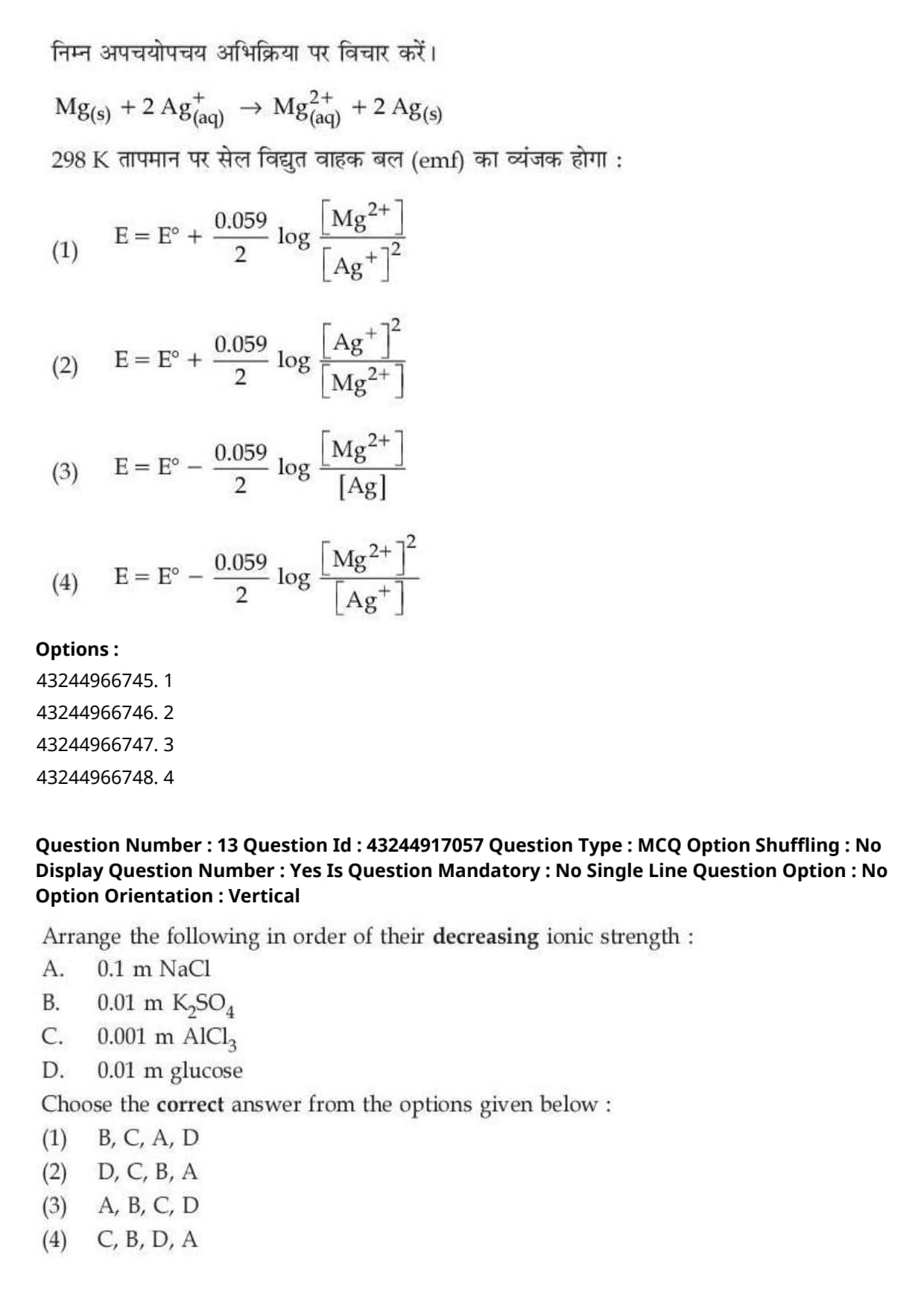
Arrange the following in order of their decreasing ionic strength:
A. \(0.1 m NaCl\)
B. \(0.01 m K_2SO_4\)
C. \(0.001 m AlCl_3\)
D. \(0.01 m glucose\)
Choose the correct answer from the options given below:
View Solution
Step 1: Understanding the Question:
The topic of this question is electrolyte solutions, specifically the calculation of ionic strength of different salt solutions.
Step 2: Key Formula or Approach:
The ionic strength (\(I\)) of a solution is given by:
\[ I = \frac{1}{2} \sum_{i} m_i z_i^2 \]
where:
\(m_i\) is the molality of ion \(i\).
\(z_i\) is the charge of ion \(i\).
Step 3: Detailed Explanation:
Let us calculate the ionic strength for each solution:
A. \(0.1 m NaCl\):
\(NaCl\) dissociates into \(Na^+\) (\(0.1 m\), charge \(+1\)) and \(Cl^-\) (\(0.1 m\), charge \(-1\)).
\[ I_A = \frac{1}{2} [ (0.1 \times 1^2) + (0.1 \times (-1)^2) ] = \frac{1}{2} [ 0.1 + 0.1 ] = 0.1 m \]
B. \(0.01 m K_2SO_4\):
\(K_2SO_4\) dissociates into \(2K^+\) (\(0.02 m\), charge \(+1\)) and \(SO_4^{2-}\) (\(0.01 m\), charge \(-2\)).
\[ I_B = \frac{1}{2} [ (0.02 \times 1^2) + (0.01 \times (-2)^2) ] = \frac{1}{2} [ 0.02 + 0.04 ] = 0.03 m \]
C. \(0.001 m AlCl_3\):
\(AlCl_3\) dissociates into \(Al^{3+}\) (\(0.001 m\), charge \(+3\)) and \(3Cl^-\) (\(0.003 m\), charge \(-1\)).
\[ I_C = \frac{1}{2} [ (0.001 \times 3^2) + (0.003 \times (-1)^2) ] = \frac{1}{2} [ 0.009 + 0.003 ] = 0.006 m \]
D. \(0.01 m glucose\):
Glucose is a non-electrolyte and does not dissociate into ions.
\[ I_D = 0 m \]
Comparing the calculated ionic strengths:
\[ I_A (0.1) > I_B (0.03) > I_C (0.006) > I_D (0) \]
Thus, the decreasing order is A, B, C, D.
Step 4: Final Answer
The decreasing order of ionic strength is A, B, C, D.
Quick Tip: For a given concentration, salts with highly charged ions contribute much more to ionic strength because the charge is squared (\(z_i^2\)).
However, do not forget to multiply by concentration.
Here, \(0.1 m\) of a 1:1 electrolyte (\(0.1\)) is still larger than \(0.01 m\) of a 1:2 electrolyte (\(0.03\)).
Non-electrolytes always have an ionic strength of 0.
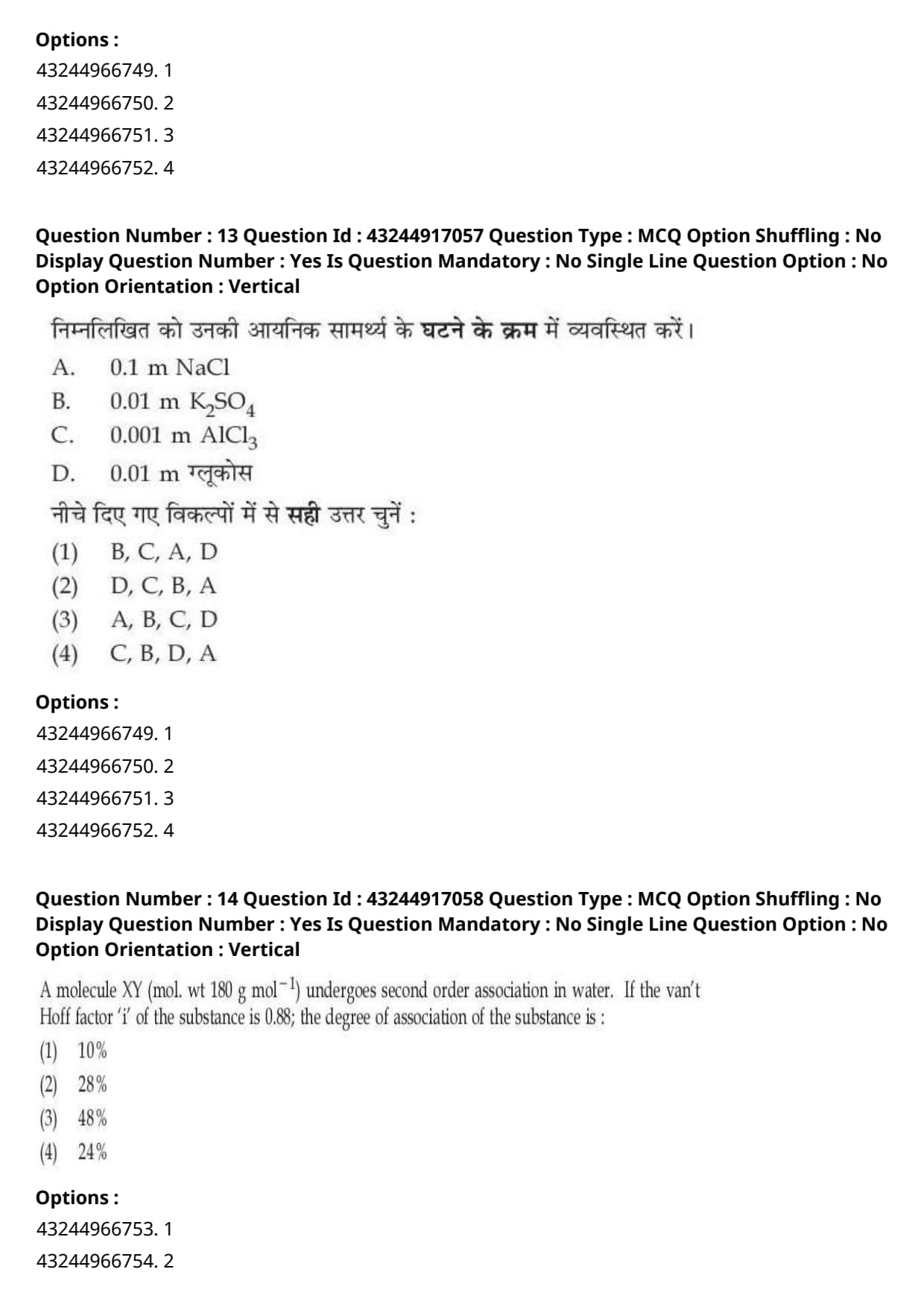
A molecule \(XY\) (mol. wt \(180 g mol^{-1}\)) undergoes second order association in water. If the van't Hoff factor '\(i\)' of the substance is \(0.88\); the degree of association of the substance is:
View Solution
Step 1: Understanding the Question:
The topic of this question is colligative properties, specifically the van't Hoff factor (\(i\)) and its relation to the degree of association (\(\alpha\)).
Step 2: Key Formula or Approach:
For association of \(n\) molecules to form a polymer:
\[ n XY \rightarrow (XY)_n \]
The relation between the van't Hoff factor (\(i\)) and the degree of association (\(\alpha\)) is:
\[ i = 1 - \alpha \left(1 - \frac{1}{n}\right) \]
Step 3: Detailed Explanation:
Given that the molecule undergoes "second order association", which means dimerization (\(n = 2\)):
\[ 2XY \rightarrow (XY)_2 \]
Let us write down the relation for \(n = 2\):
\[ i = 1 - \alpha \left(1 - \frac{1}{2}\right) \] \[ i = 1 - \frac{\alpha}{2} \]
We are given \(i = 0.88\). Substitute this value into the equation:
\[ 0.88 = 1 - \frac{\alpha}{2} \]
Rearranging the terms to solve for \(\alpha\):
\[ \frac{\alpha}{2} = 1 - 0.88 \] \[ \frac{\alpha}{2} = 0.12 \] \[ \alpha = 0.24 \]
Converting \(\alpha\) to a percentage:
\[ Percentage association = 0.24 \times 100 = 24% \]
Step 4: Final Answer
The degree of association of the substance is \(24%\).
Quick Tip: For dimerization, the simple formula is:
\(i = 1 - \frac{\alpha}{2}\).
This translates to:
\(\alpha = 2(1 - i)\).
Substituting \(i = 0.88\) gives:
\(\alpha = 2(0.12) = 0.24 = 24%\).
This formula allows you to find the answer within seconds.
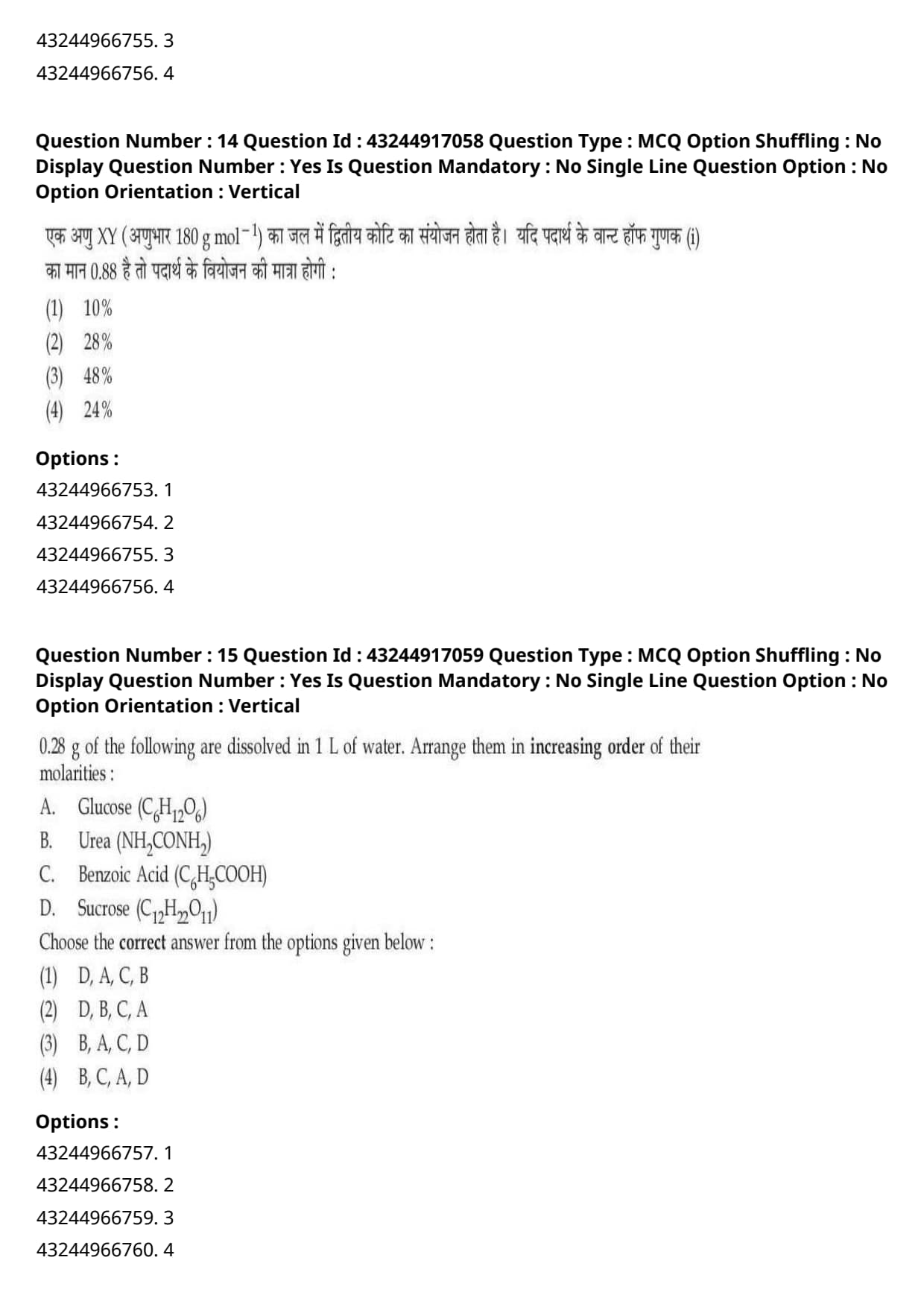
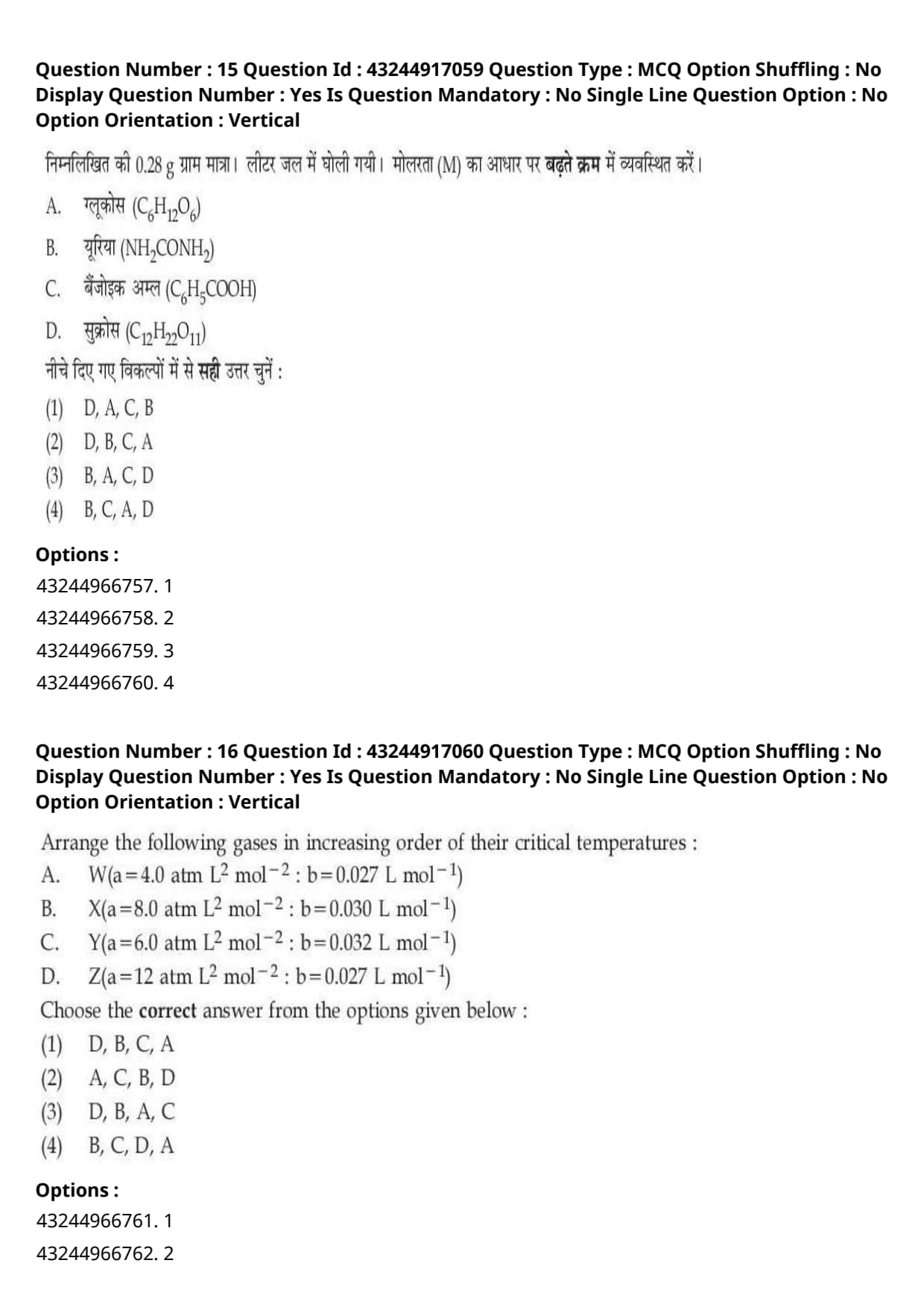
\(0.28 g\) of the following are dissolved in \(1 L\) of water. Arrange them in increasing order of their molarities:
A. Glucose (\(C_6H_{12}O_6\))
B. Urea (\(NH_2CONH_2\))
C. Benzoic Acid (\(C_6H_5COOH\))
D. Sucrose (\(C_{12}H_{22}O_{11}\))
Choose the correct answer from the options given below:
View Solution
Step 1: Understanding the Question:
The topic of this question is concentration terms of solutions, specifically molarity.
Step 2: Key Formula or Approach:
Molarity (\(M\)) is defined as:
\[ M = \frac{moles of solute}{Volume of solution (L)} = \frac{mass of solute (w)}{Molar mass (M_w) \times Volume (V)} \]
Since the mass of solute (\(w = 0.28 g\)) and the volume of solution (\(V = 1 L\)) are identical for all cases:
\[ M \propto \frac{1}{M_w} \]
Molarity is inversely proportional to the molar mass of the solute.
Step 3: Detailed Explanation:
Let us calculate/recall the molar masses of the given compounds:
A. Glucose (\(C_6H_{12}O_6\)):
\[ M_w = (6 \times 12) + (12 \times 1) + (6 \times 16) = 72 + 12 + 96 = 180 g mol^{-1} \]
B. Urea (\(NH_2CONH_2\)):
\[ M_w = (2 \times 14) + (4 \times 1) + 12 + 16 = 28 + 4 + 12 + 16 = 60 g mol^{-1} \]
C. Benzoic Acid (\(C_6H_5COOH\)):
\[ M_w = (7 \times 12) + (6 \times 1) + (2 \times 16) = 84 + 6 + 32 = 122 g mol^{-1} \]
D. Sucrose (\(C_{12}H_{22}O_{11}\)):
\[ M_w = (12 \times 12) + (22 \times 1) + (11 \times 16) = 144 + 22 + 176 = 342 g mol^{-1} \]
Let us compare the molar masses:
\[ Sucrose (342) > Glucose (180) > Benzoic Acid (122) > Urea (60) \]
Since molarity is inversely proportional to molar mass, the increasing order of their molarities is:
\[ Molarity(Sucrose) < Molarity(Glucose) < Molarity(Benzoic Acid) < Molarity(Urea) \] \[ D < A < C < B \]
Step 4: Final Answer
The increasing order of molarities is D, A, C, B.
Quick Tip: For equal masses of different solutes in equal volumes:
The lighter the molecule, the more moles it has.
The more moles, the higher its molarity.
Therefore, order of molarity is the reverse order of molecular mass.
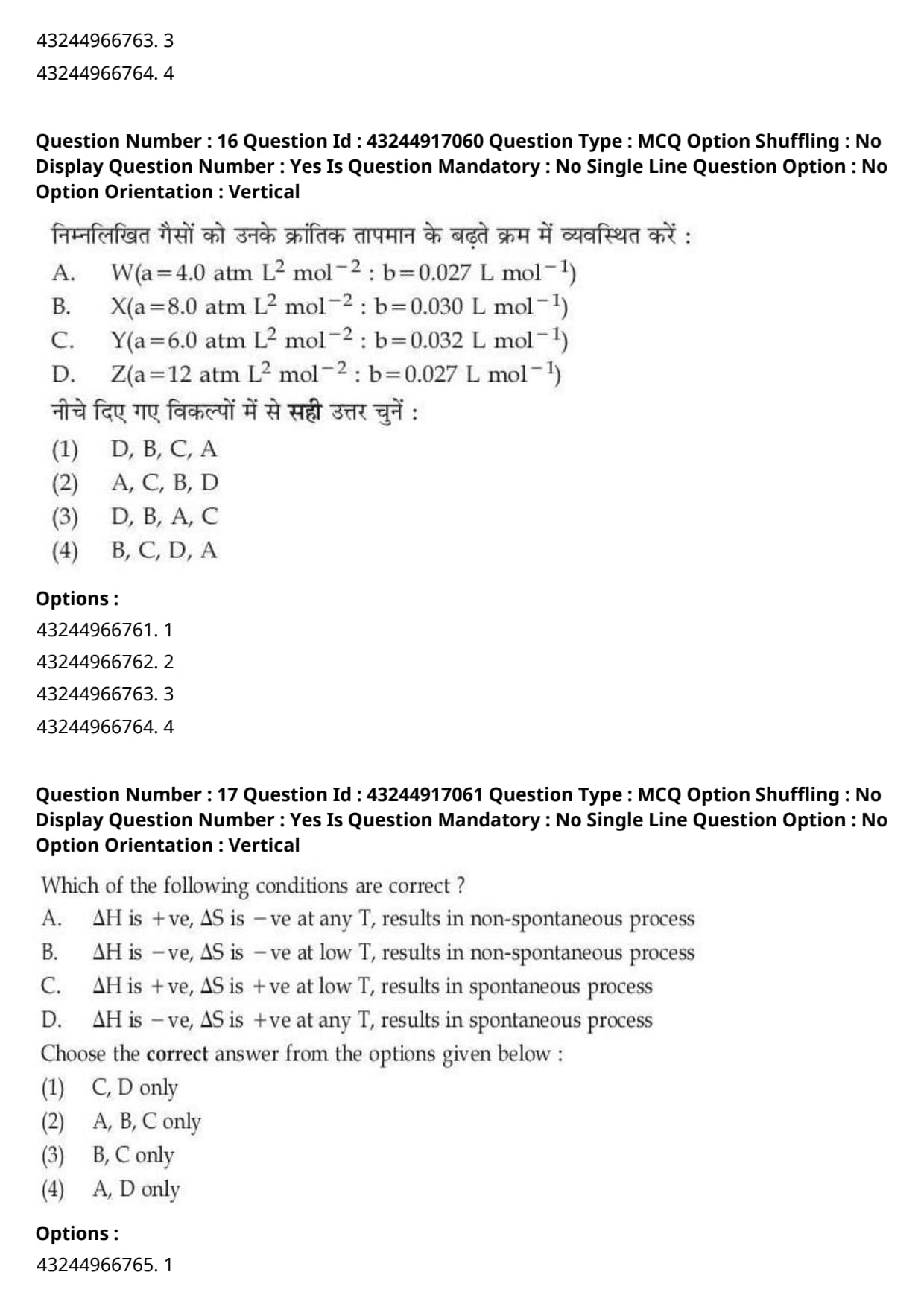
Arrange the following gases in increasing order of their critical temperatures:
A. \(W (a = 4.0 atm L^2 mol^{-2}; b = 0.027 L mol^{-1})\)
B. \(X (a = 8.0 atm L^2 mol^{-2}; b = 0.030 L mol^{-1})\)
C. \(Y (a = 6.0 atm L^2 mol^{-2}; b = 0.032 L mol^{-1})\)
D. \(Z (a = 12 atm L^2 mol^{-2}; b = 0.027 L mol^{-1})\)
Choose the correct answer from the options given below:
View Solution
Step 1: Understanding the Question:
The topic of this question is real gases and van der Waals equation of state, specifically critical constants and their relationship with van der Waals constants \(a\) and \(b\).
Step 2: Key Formula or Approach:
The critical temperature (\(T_c\)) of a van der Waals gas is given by:
\[ T_c = \frac{8a}{27Rb} \]
Since \(R\) and the fraction \(8/27\) are constants:
\[ T_c \propto \frac{a}{b} \]
Thus, the critical temperature is directly proportional to the ratio of \(a/b\).
Step 3: Detailed Explanation:
Let us calculate the ratio of \(a/b\) for each gas:
For Gas W:
\[ \frac{a}{b} = \frac{4.0}{0.027} = \frac{4000}{27} \approx 148.15 \]
For Gas X:
\[ \frac{a}{b} = \frac{8.0}{0.030} = \frac{800}{3} \approx 266.67 \]
For Gas Y:
\[ \frac{a}{b} = \frac{6.0}{0.032} = \frac{6000}{32} = 187.5 \]
For Gas Z:
\[ \frac{a}{b} = \frac{12.0}{0.027} = \frac{12000}{27} \approx 444.44 \]
Let us arrange these ratios in increasing order:
\[ 148.15 (W) < 187.5 (Y) < 266.67 (X) < 444.44 (Z) \]
Since \(T_c \propto a/b\), the increasing order of critical temperatures is:
\[ W < Y < X < Z \]
This corresponds to the sequence A, C, B, D.
Step 4: Final Answer
The increasing order of critical temperatures is A, C, B, D.
Quick Tip: Critical temperature represents the ease of liquefaction of a gas.
A higher \(a\) value (stronger intermolecular attractions) and lower \(b\) value (smaller excluded volume) favor liquefaction and increase \(T_c\).
So, look for high \(a/b\) ratio to find high \(T_c\).
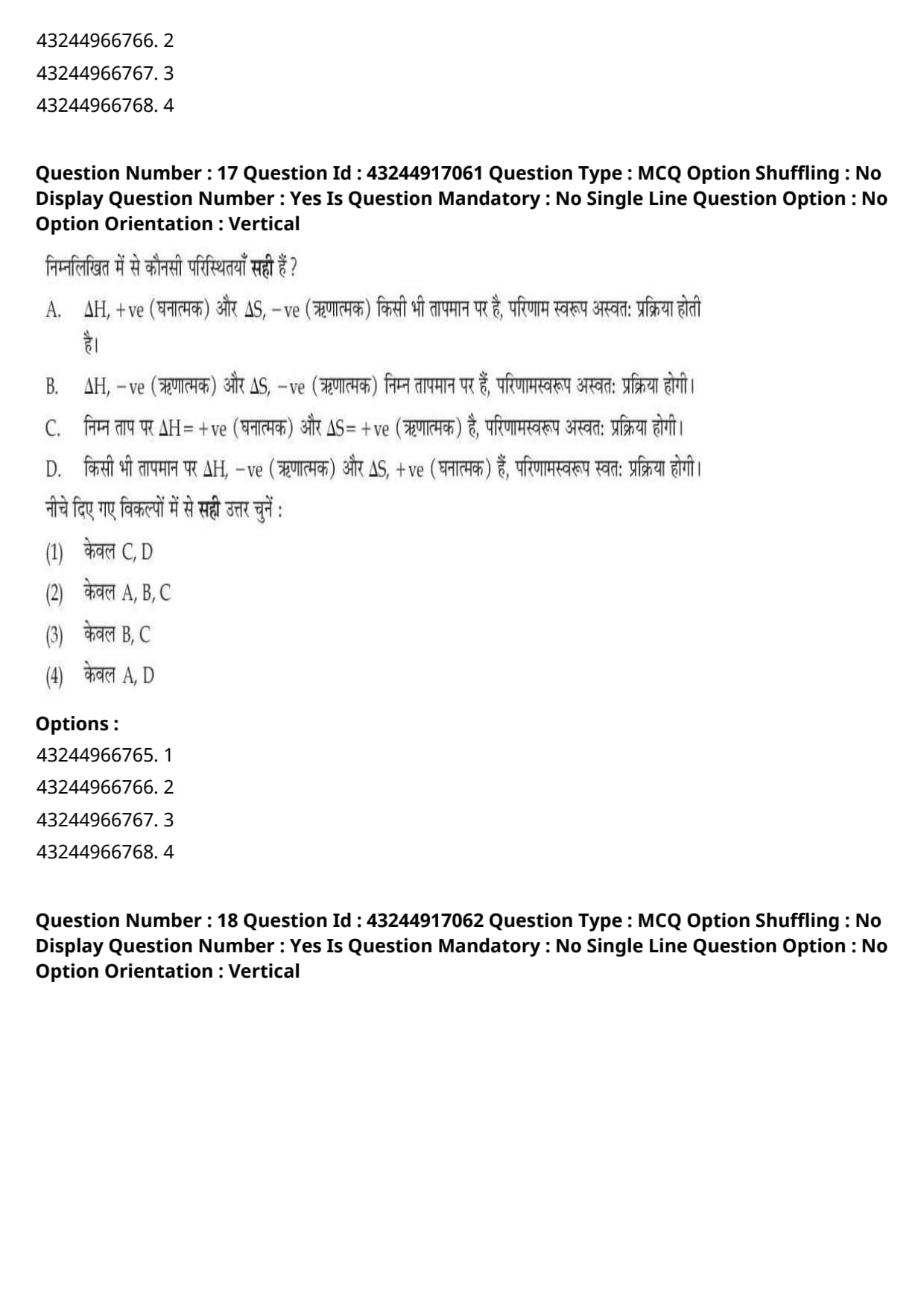
Which of the following conditions are correct?
A. \(\Delta H\) is \(+ve\), \(\Delta S\) is \(-ve\) at any \(T\), results in non-spontaneous process
B. \(\Delta H\) is \(-ve\), \(\Delta S\) is \(-ve\) at low \(T\), results in non-spontaneous process
C. \(\Delta H\) is \(+ve\), \(\Delta S\) is \(+ve\) at low \(T\), results in spontaneous process
D. \(\Delta H\) is \(-ve\), \(\Delta S\) is \(+ve\) at any \(T\), results in spontaneous process
Choose the correct answer from the options given below:
View Solution
Step 1: Understanding the Question:
The topic of this question is chemical thermodynamics, specifically the criteria for spontaneity of a process using the Gibbs free energy change (\(\Delta G\)).
Step 2: Key Formula or Approach:
The spontaneity of a process at constant temperature and pressure is determined by the Gibbs-Helmholtz equation:
\[ \Delta G = \Delta H - T\Delta S \]
If \(\Delta G < 0\), the process is spontaneous.
If \(\Delta G > 0\), the process is non-spontaneous.
If \(\Delta G = 0\), the process is at equilibrium.
Step 3: Detailed Explanation:
Let us analyze each condition:
Condition A: \(\Delta H\) is \(+ve\), \(\Delta S\) is \(-ve\) at any \(T\).
Substituting signs: \(\Delta G = (+) - T(-)\) which is always positive (\(\Delta G > 0\)) at any temperature. This results in a non-spontaneous process. Thus, statement A is correct.
Condition B: \(\Delta H\) is \(-ve\), \(\Delta S\) is \(-ve\) at low \(T\).
Substituting signs: \(\Delta G = (-) - T(-)\). At low temperatures, \(| \Delta H | > | T\Delta S |\), so \(\Delta G\) is negative (\(\Delta G < 0\)). This results in a spontaneous process. Thus, statement B is incorrect.
Condition C: \(\Delta H\) is \(+ve\), \(\Delta S\) is \(+ve\) at low \(T\).
Substituting signs: \(\Delta G = (+) - T(+)\). At low temperatures, \(| \Delta H | > | T\Delta S |\), so \(\Delta G\) is positive (\(\Delta G > 0\)). This results in a non-spontaneous process. Thus, statement C is incorrect.
Condition D: \(\Delta H\) is \(-ve\), \(\Delta S\) is \(+ve\) at any \(T\).
Substituting signs: \(\Delta G = (-) - T(+)\) which is always negative (\(\Delta G < 0\)) at all temperatures. This results in a spontaneous process. Thus, statement D is correct.
Therefore, only conditions A and D are correct.
Step 4: Final Answer
The correct conditions are A and D only.
Quick Tip: Keep this simple grid in mind:
- \(\Delta H < 0, \Delta S > 0 \implies\) Always spontaneous (\(\Delta G < 0\)).
- \(\Delta H > 0, \Delta S < 0 \implies\) Always non-spontaneous (\(\Delta G > 0\)).
- \(\Delta H < 0, \Delta S < 0 \implies\) Spontaneous at low \(T\).
- \(\Delta H > 0, \Delta S > 0 \implies\) Spontaneous at high \(T\).
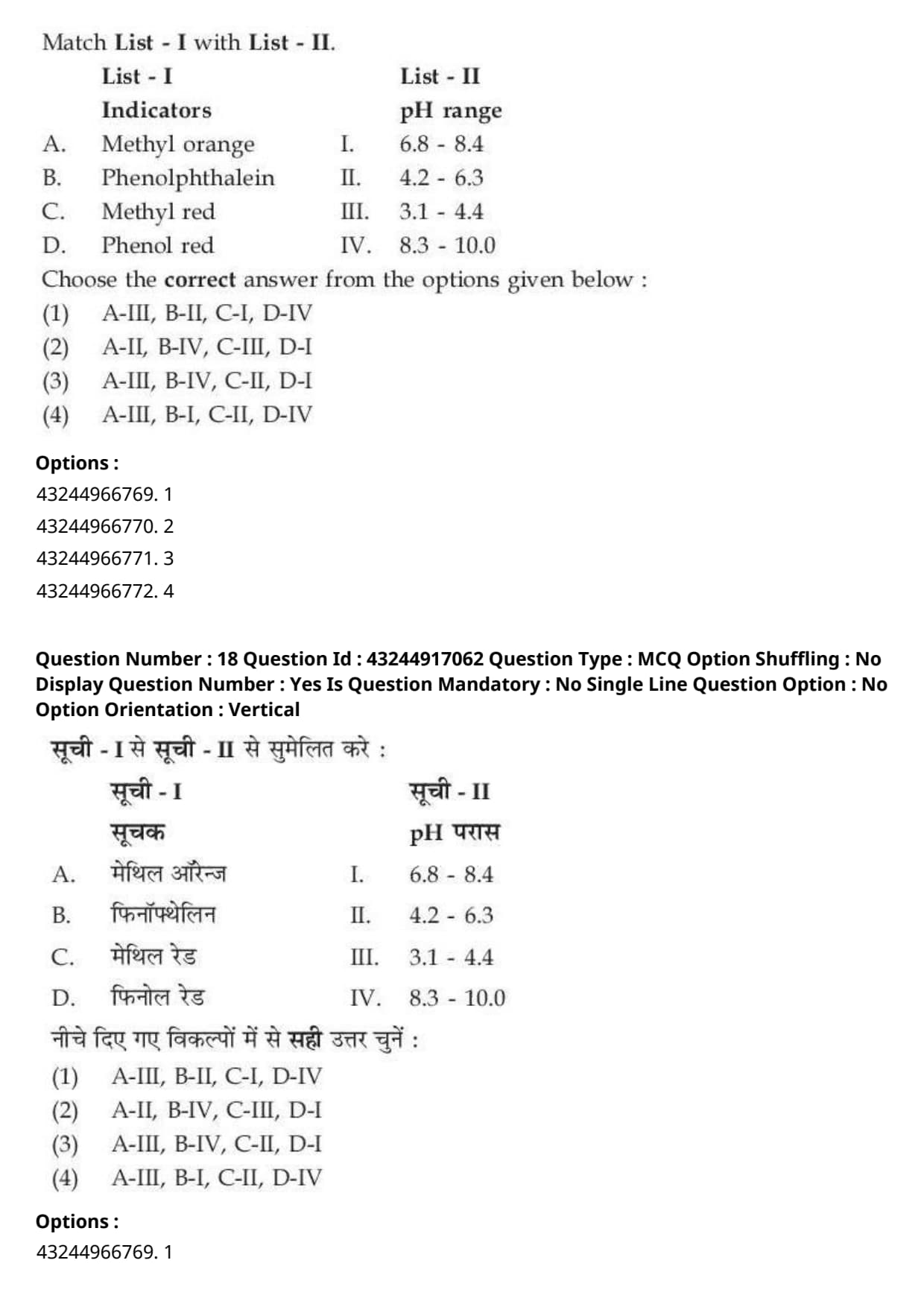
Match List - I with List - II.
Choose the correct answer from the options given below:
View Solution
Step 1: Understanding the Question:
The topic of this question is ionic equilibrium and analytical chemistry, specifically the pH transition ranges of common acid-base indicators used in titrations.
Step 2: Key Formula or Approach:
An indicator is a weak acid or weak base whose protonated and unprotonated forms have different colors. The transition range is approximately:
\[ pH = pK_{In} \pm 1 \]
Step 3: Detailed Explanation:
Let us analyze each indicator and its standard pH range:
A. Methyl orange: A weak base indicator useful for titrating strong acids with weak bases. Its color change occurs in highly acidic regions.
The standard transition pH range is \(3.1 - 4.4\).
This matches List-II item III.
B. Phenolphthalein: A weak acid indicator useful for strong base titrations. Its color transition occurs in alkaline regions.
The standard transition pH range is \(8.3 - 10.0\).
This matches List-II item IV.
C. Methyl red: A weak acid indicator that changes color in slightly acidic regions.
The standard transition pH range is \(4.2 - 6.3\).
This matches List-II item II.
D. Phenol red: A weak acid indicator that transitions around neutral pH.
The standard transition pH range is \(6.8 - 8.4\).
This matches List-II item I.
Thus, the correct matching is: A-III, B-IV, C-II, D-I.
Step 4: Final Answer
The correct matching is given in option (C).
Quick Tip: Remember the general order of indicators from acidic to basic pH ranges:
Methyl Orange (\(3.1-4.4\)) \(<\) Methyl Red (\(4.2-6.3\)) \(<\) Phenol Red (\(6.8-8.4\)) \(<\) Phenolphthalein (\(8.3-10.0\)).
Sorting them in increasing order of pH range makes matching straightforward.
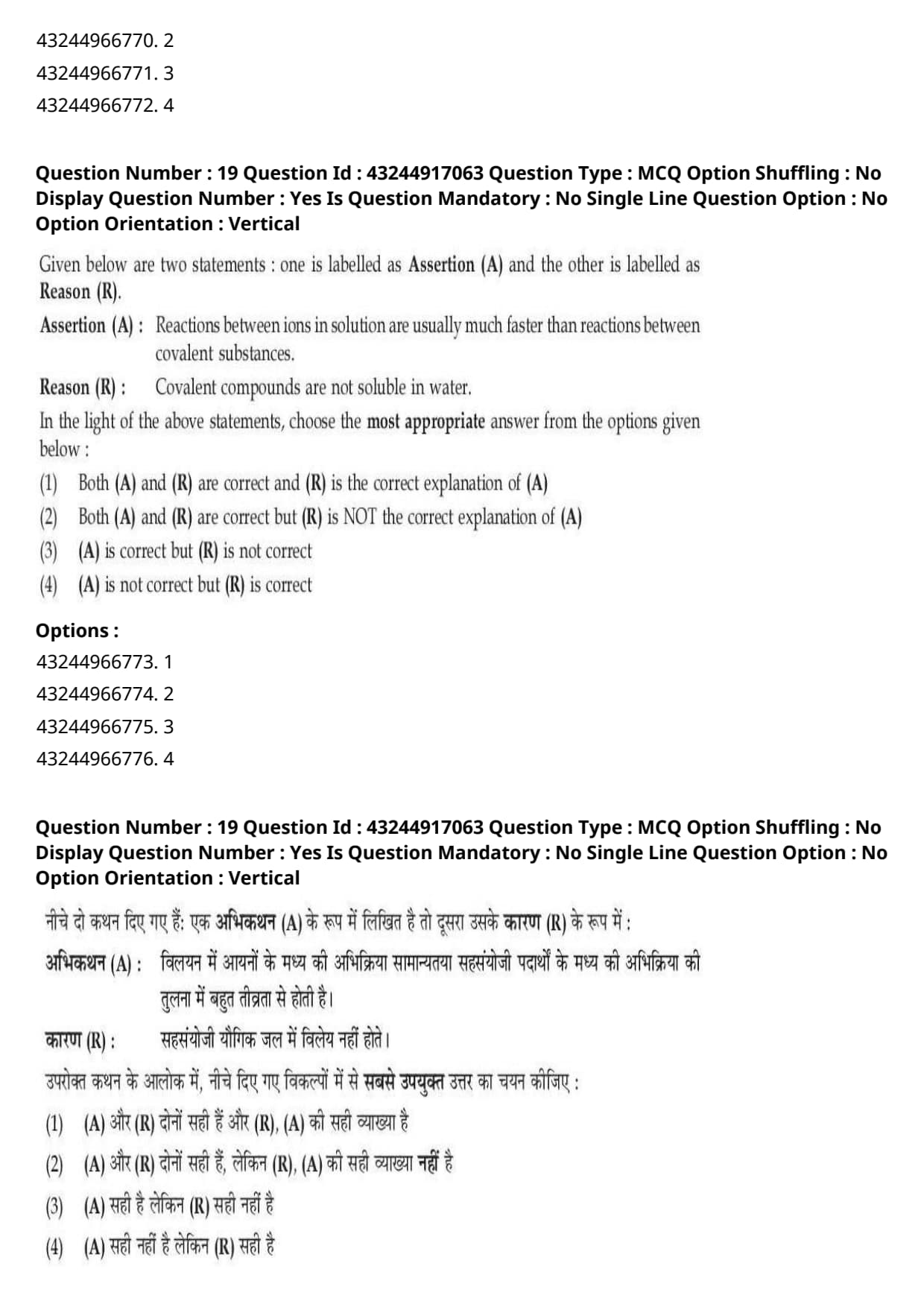
Given below are two statements : one is labelled as Assertion (A) and the other is labelled as Reason (R).
Assertion (A) : Reactions between ions in solution are usually much faster than reactions between covalent substances.
Reason (R) : Covalent compounds are not soluble in water.
In the light of the above statements, choose the most appropriate answer from the options given below :
View Solution
Step 1: Understanding the Question:
The topic of this question is chemical kinetics and chemical bonding, specifically comparing the rates of reactions of ionic and covalent compounds and understanding their physical properties.
Step 2: Key Formula or Approach:
Reactions occur through the breaking of existing bonds and the formation of new bonds. The rate depends on the activation energy required for bond cleavage.
Step 3: Detailed Explanation:
Let us evaluate the Assertion (A):
"Reactions between ions in solution are usually much faster than reactions between covalent substances."
Ionic reactions in solution involve species that are already dissociated into free ions (e.g., \(Ag^+(aq) + Cl^-(aq) \rightarrow AgCl(s)\)).
Since no chemical bonds need to be broken and the process is driven by strong electrostatic attraction, the activation energy is nearly zero. Thus, ionic reactions are extremely fast (often instantaneous).
On the other hand, covalent reactions involve the breaking of strong covalent bonds, which requires significant activation energy. Thus, covalent reactions are generally slower.
Therefore, Assertion (A) is correct.
Let us evaluate the Reason (R):
"Covalent compounds are not soluble in water."
This statement is incorrect as a general rule. While many nonpolar covalent compounds are insoluble in water, many polar covalent compounds (e.g., ethanol, glucose, urea, ammonia, hydrogen chloride) are highly soluble in water because they can form hydrogen bonds or interact strongly with water molecules.
Therefore, Reason (R) is incorrect.
Step 4: Final Answer
Assertion (A) is correct, but Reason (R) is incorrect. This corresponds to option (C).
Quick Tip: Never generalize solubility rules too strictly.
Covalent compounds like sugar (glucose) and alcohol (ethanol) dissolve extremely well in water.
Therefore, saying "covalent compounds are insoluble in water" is always a false statement.
This allows you to confidently eliminate options (A), (B), and (D).
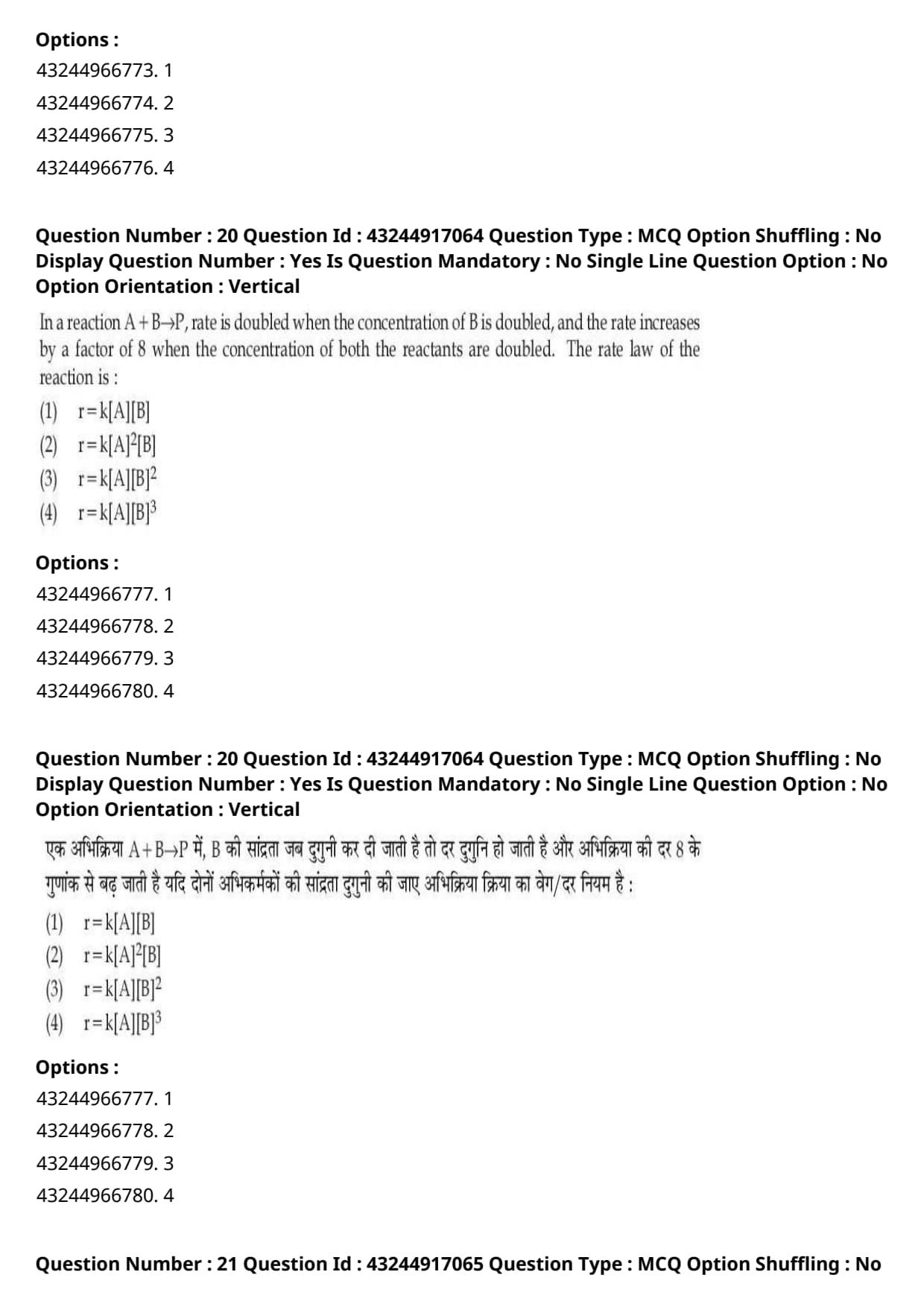
In a reaction \(A + B \rightarrow P\), rate is doubled when the concentration of B is doubled, and the rate increases by a factor of 8 when the concentration of both the reactants are doubled. The rate law of the reaction is:
View Solution
Step 1: Understanding the Question:
The topic of this question is chemical kinetics, specifically the determination of reaction order and rate law using the initial rates method.
Step 2: Key Formula or Approach:
Let the rate law for the reaction be:
\[ r = k[A]^x [B]^y \]
where:
\(x\) is the order of the reaction with respect to \(A\).
\(y\) is the order of the reaction with respect to \(B\).
Step 3: Detailed Explanation:
Let us write down the mathematical relations based on the given observations:
Case 1: Initial rate:
\[ r_1 = k[A]^x [B]^y \]
Case 2: When the concentration of B is doubled, the rate is doubled (\(r_2 = 2r_1\)):
\[ r_2 = k[A]^x (2[B])^y = 2^y \cdot k[A]^x [B]^y = 2^y \cdot r_1 \]
Since \(r_2 = 2r_1\):
\[ 2^y = 2 \implies y = 1 \]
Thus, the order with respect to B is \(1\).
Case 3: When the concentration of both reactants is doubled, the rate increases by a factor of 8 (\(r_3 = 8r_1\)):
\[ r_3 = k(2[A])^x (2[B])^y = 2^x \cdot 2^y \cdot k[A]^x [B]^y = 2^{x+y} \cdot r_1 \]
Since \(r_3 = 8r_1\):
\[ 2^{x+y} = 8 \implies 2^{x+y} = 2^3 \implies x + y = 3 \]
Substituting \(y = 1\) into the equation:
\[ x + 1 = 3 \implies x = 2 \]
Thus, the order with respect to A is \(2\).
Combining the individual orders, the rate law is:
\[ r = k[A]^2 [B] \]
Step 4: Final Answer
The rate law is \(r = k[A]^2[B]\).
Quick Tip: If doubling \([B]\) doubles the rate, the reaction is \(1^{st}\) order in \(B\) (\(y=1\)).
If doubling both \([A]\) and \([B]\) increases the rate by 8, then:
\(2^{total order} = 8 \implies total order = 3\).
Since order of \(B\) is 1, order of \(A\) must be \(3 - 1 = 2\).
Thus, rate \(= k[A]^2[B]\).
This simple mental math can be performed in under 10 seconds.
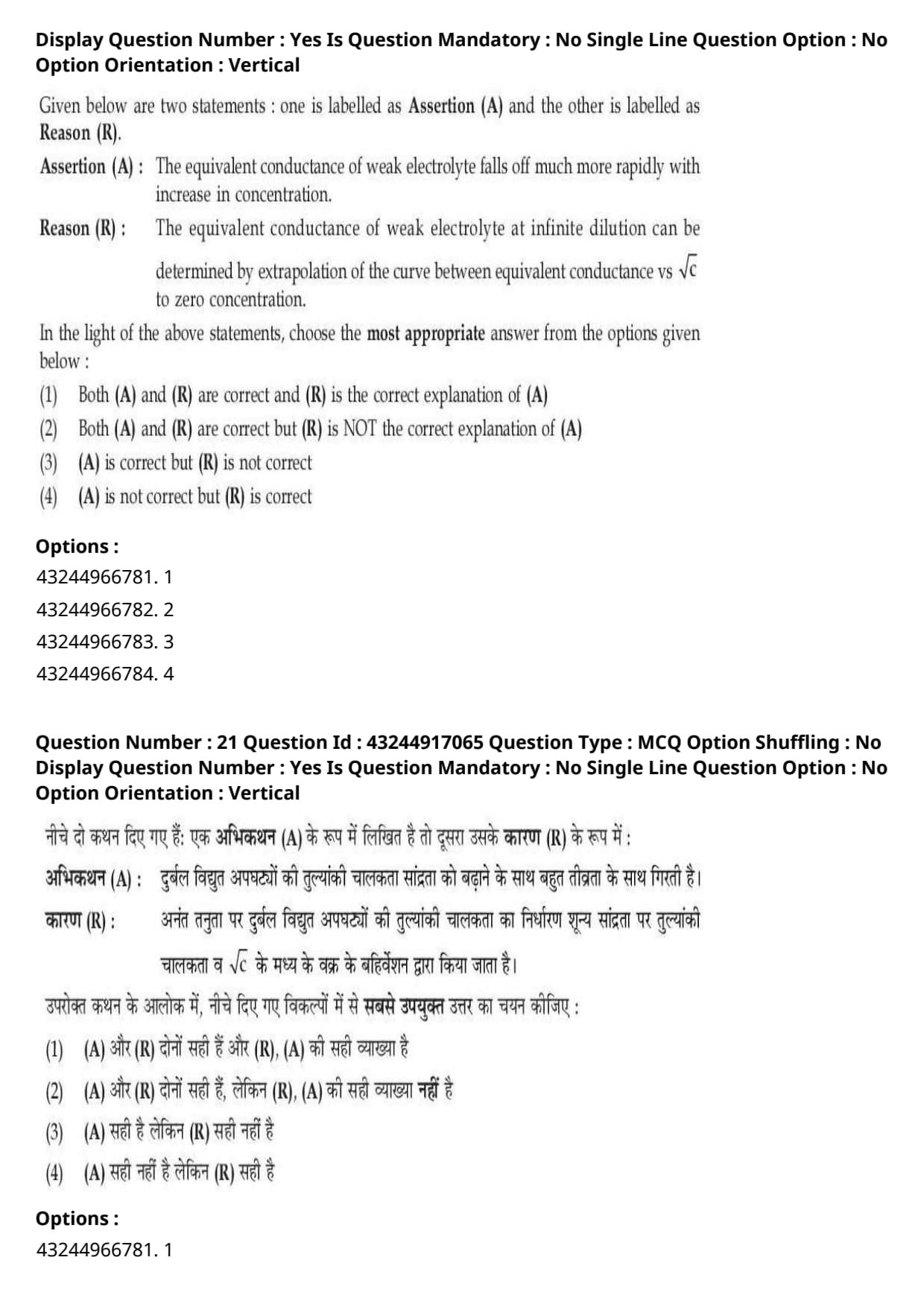
Given below are two statements : one is labelled as Assertion (A) and the other is labelled as Reason (R).
Assertion (A) : The equivalent conductance of weak electrolyte falls off much more rapidly with increase in concentration.
Reason (R) : The equivalent conductance of weak electrolyte at infinite dilution can be determined by extrapolation of the curve between equivalent conductance vs \(\sqrt{c}\) to zero concentration.
In the light of the above statements, choose the most appropriate answer from the options given below :
View Solution
Step 1: Understanding the Question:
The topic of this question is electrochemistry, specifically the conductance behavior of weak electrolytes and the determination of their equivalent conductance at infinite dilution (\(\Lambda_0\)).
Step 2: Key Formula or Approach:
According to Ostwald's dilution law for weak electrolytes, the degree of dissociation (\(\alpha\)) decreases sharply with increasing concentration:
\[ \alpha \approx \sqrt{\frac{K_a}{c}} \]
The equivalent conductance is proportional to the degree of dissociation (\(\Lambda \approx \alpha \Lambda_0\)).
Step 3: Detailed Explanation:
Let us evaluate Assertion (A):
"The equivalent conductance of weak electrolyte falls off much more rapidly with increase in concentration."
For a weak electrolyte (e.g., acetic acid), dissociation is incomplete. As concentration increases, the degree of dissociation (\(\alpha\)) drops very sharply, leading to a significant decrease in the number of active conducting ions per unit volume.
Therefore, the equivalent conductance decreases very rapidly with concentration.
Thus, Assertion (A) is correct.
Let us evaluate Reason (R):
"The equivalent conductance of weak electrolyte at infinite dilution can be determined by extrapolation of the curve between equivalent conductance vs \(\sqrt{c}\) to zero concentration."
For a weak electrolyte, at very low concentrations, the equivalent conductance increases so steeply that the plot of \(\Lambda\) versus \(\sqrt{c}\) becomes nearly parallel to the vertical axis.
Hence, it is impossible to obtain a reliable intercept (\(\Lambda_0\)) by direct extrapolation of the experimental curve to \(c \rightarrow 0\).
Instead, Kohlrausch's law of independent migration of ions is used to indirectly calculate \(\Lambda_0\) of weak electrolytes.
Therefore, Reason (R) is incorrect.
Step 4: Final Answer
Assertion (A) is correct, but Reason (R) is incorrect. This corresponds to option (C).
Quick Tip: Always remember that direct extrapolation works ONLY for strong electrolytes (Debye-Huckel-Onsager equation: \(\Lambda = \Lambda_0 - A\sqrt{c}\)).
For weak electrolytes, extrapolation fails entirely because of the steep curve near zero concentration.
Thus, Kohlrausch's law is the only way to find \(\Lambda_0\) for weak electrolytes.
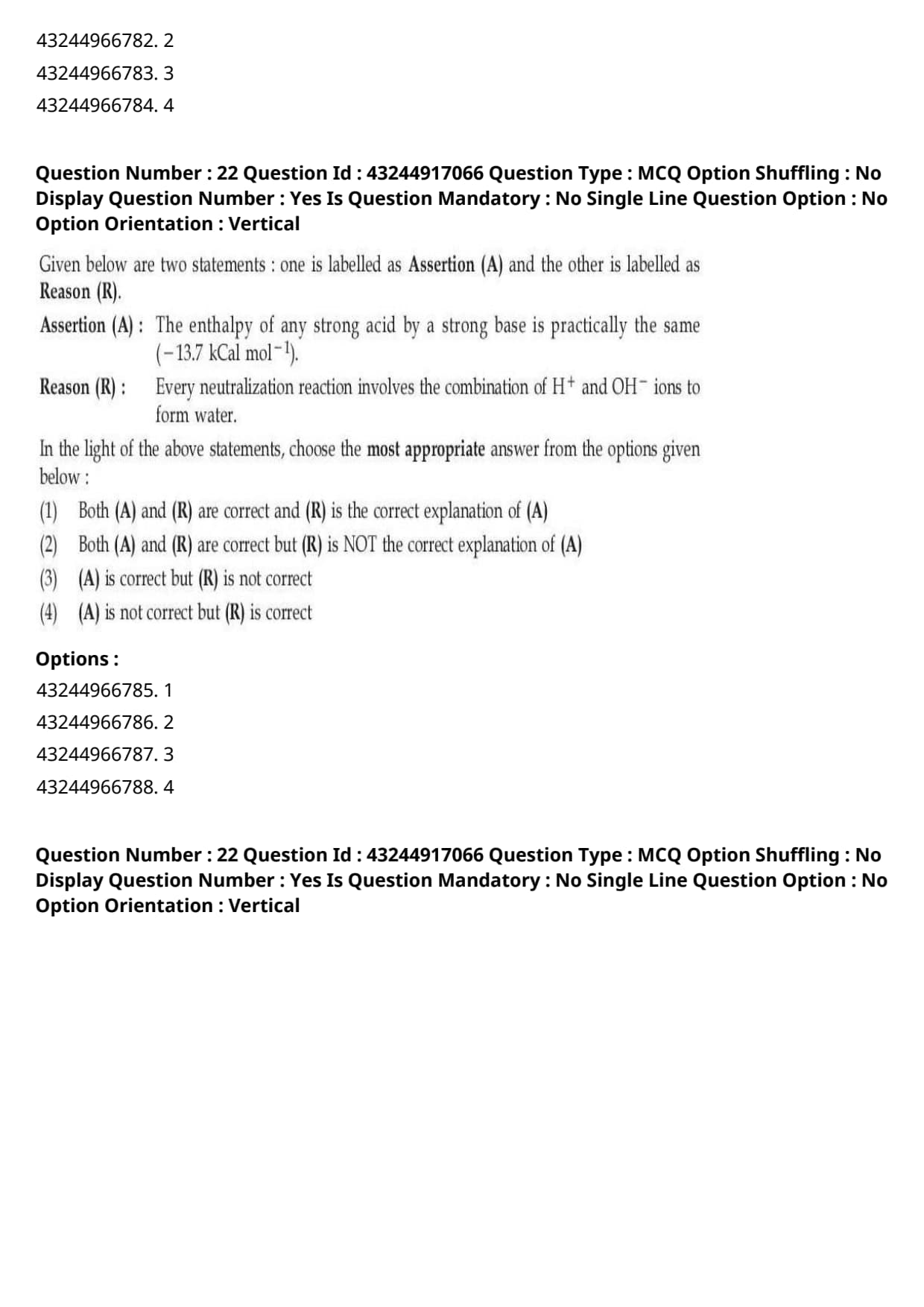
Given below are two statements : one is labelled as Assertion (A) and the other is labelled as Reason (R).
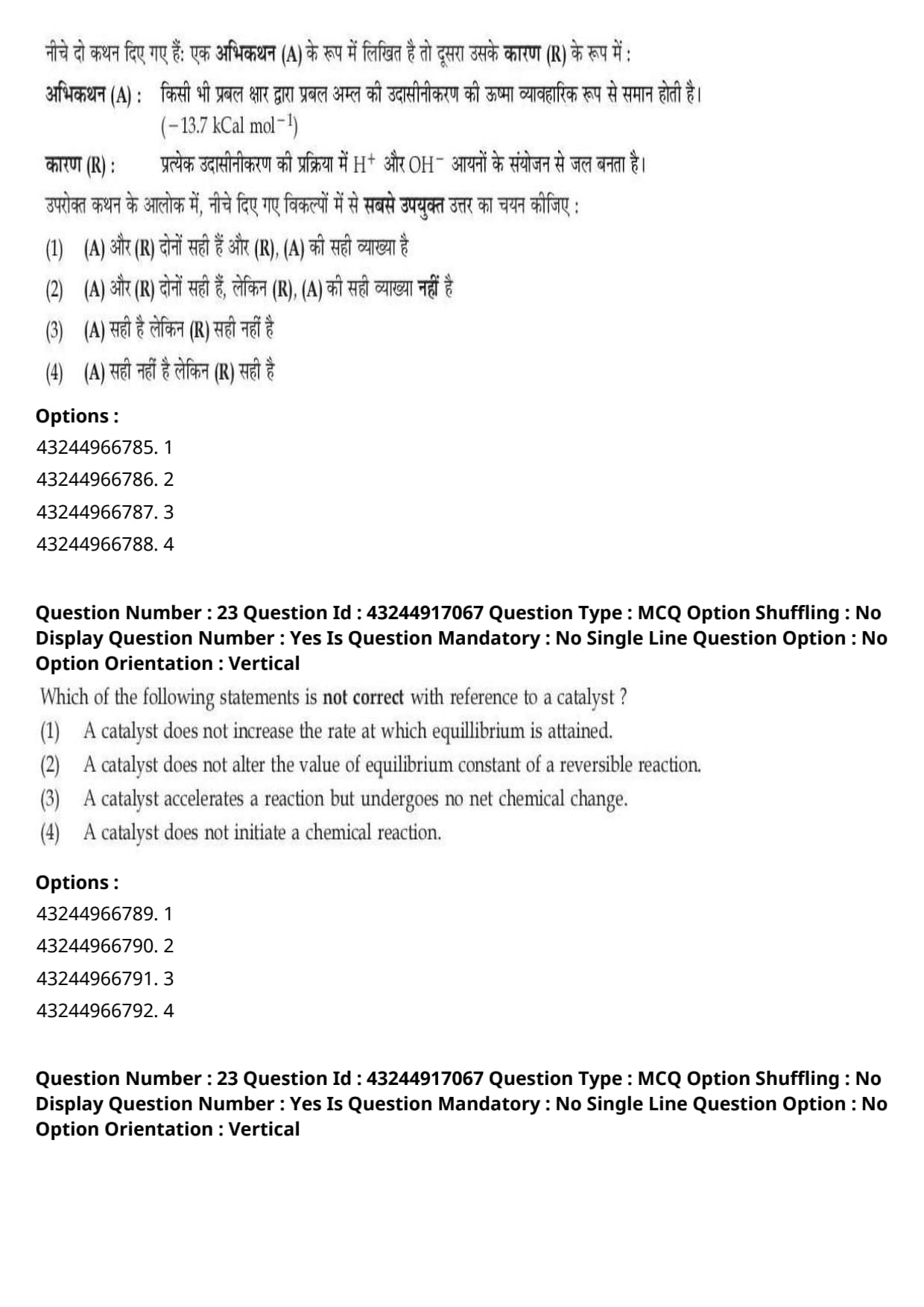
Assertion (A) : The enthalpy of any strong acid by a strong base is practically the same (\(-13.7 kCal mol^{-1}\)).
Reason (R) : Every neutralization reaction involves the combination of \(H^+\) and \(OH^-\) ions to form water.
In the light of the above statements, choose the most appropriate answer from the options given below :
View Solution
Step 1: Understanding the Question:
The topic of this question is thermochemistry, specifically the enthalpy of neutralization of acids and bases in aqueous solutions.
Step 2: Key Formula or Approach:
Neutralization is the reaction between an acid and a base. For a strong acid and a strong base, both are fully dissociated in aqueous solution.
The net ionic reaction is:
\[ H^+(aq) + OH^-(aq) \rightarrow H_2O(l) \]
The enthalpy change (\(\Delta H\)) associated with this reaction is constant at \(-13.7 kcal mol^{-1}\) (or \(-57.3 kJ mol^{-1}\)).
Step 3: Detailed Explanation:
Let us evaluate Assertion (A):
"The enthalpy of any strong acid by a strong base is practically the same (\(-13.7 kCal mol^{-1}\))."
When any strong acid (like \(HCl\), \(HNO_3\), \(H_2SO_4\)) reacts with any strong base (like \(NaOH\), \(KOH\)), they are already completely ionized in dilute aqueous solutions.
The spectator ions (like \(Na^+\), \(Cl^-\), \(K^+\), \(NO_3^-\)) do not take part in the reaction.
Thus, the actual reaction that occurs is always the combination of \(H^+\) and \(OH^-\) ions to form water, which always releases \(13.7 kcal mol^{-1}\) of heat. Hence, Assertion (A) is correct.
Let us evaluate Reason (R):
"Every neutralization reaction involves the combination of \(H^+\) and \(OH^-\) ions to form water."
For all strong acid-strong base neutralizations, the net chemical process is indeed the formation of water from \(H^+\) and \(OH^-\):
\[ H^+(aq) + OH^-(aq) \rightarrow H_2O(l) \quad \Delta H = -13.7 kcal mol^{-1} \]
This identical net chemical change is the precise reason why the enthalpy of neutralization remains constant. Thus, Reason (R) is correct and explains Assertion (A).
Step 4: Final Answer
Both (A) and (R) are correct and (R) is the correct explanation of (A). This corresponds to option (A).
Quick Tip: If weak acids or weak bases are neutralized, the enthalpy of neutralization is numerically less than \(-13.7 kcal mol^{-1}\).
This is because a portion of the released energy is consumed in the complete dissociation of the weak electrolyte (enthalpy of ionization).
For strong-strong pairs, no such energy is consumed, keeping the value constant.
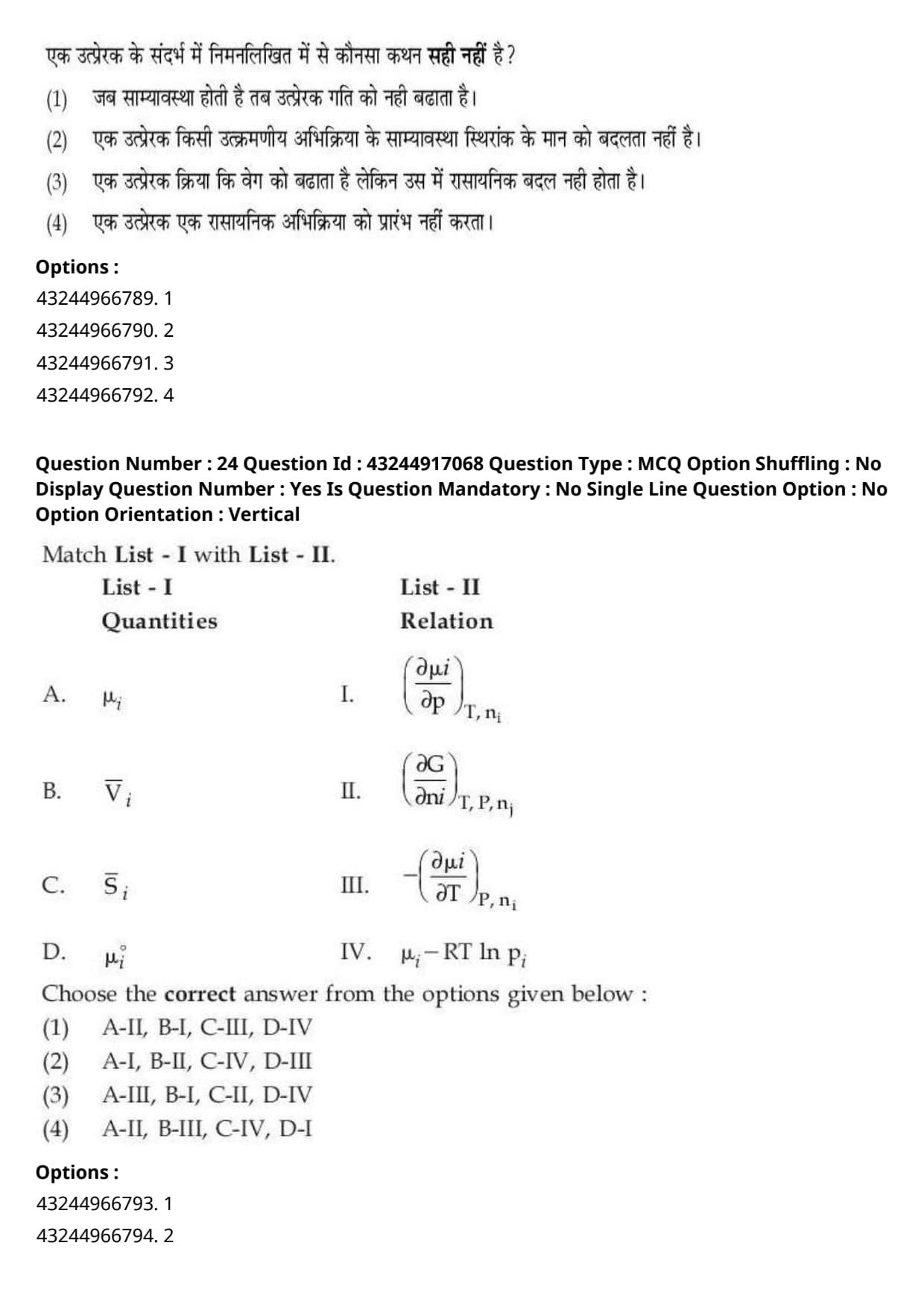
Which of the following statements is not correct with reference to a catalyst?
View Solution
Step 1: Understanding the Question:
The topic of this question is chemical kinetics and chemical equilibrium, specifically the role and characteristics of a catalyst in a reaction.
Step 2: Key Formula or Approach:
A catalyst increases the rate of a chemical reaction by providing an alternative pathway with a lower activation energy (\(E_a\)).
Step 3: Detailed Explanation:
Let us evaluate each statement to find the incorrect one:
Statement (A): "A catalyst does not increase the rate at which equilibrium is attained."
This is incorrect. A catalyst decreases the activation energy of both the forward and the backward reactions by the same extent.
As a result, both the forward and backward rates increase equally, allowing the system to reach the state of dynamic equilibrium much faster. Therefore, a catalyst *does* increase the rate of attaining equilibrium.
Statement (B): "A catalyst does not alter the value of equilibrium constant of a reversible reaction."
This is correct. Since the forward and backward rate constants (\(k_f\) and \(k_b\)) are increased by the same factor, their ratio (\(K_{eq} = k_f / k_b\)) remains unchanged.
Statement (C): "A catalyst accelerates a reaction but undergoes no net chemical change."
This is correct. By definition, a catalyst participates in the reaction mechanism but is regenerated completely in its original chemical form at the end of the process.
Statement (D): "A catalyst does not initiate a chemical reaction."
This is correct. A catalyst can only accelerate a reaction that is already thermodynamically feasible (\(\Delta G < 0\)). It cannot start a reaction that has no thermodynamic driving force.
Step 4: Final Answer
Statement (A) is incorrect.
Quick Tip: Remember that a catalyst changes the kinetics (how fast equilibrium is reached) but does not change the thermodynamics (the position of equilibrium or the value of \(K_{eq}\)).
Therefore, a catalyst accelerates the rate of reaching equilibrium, making Statement A false.
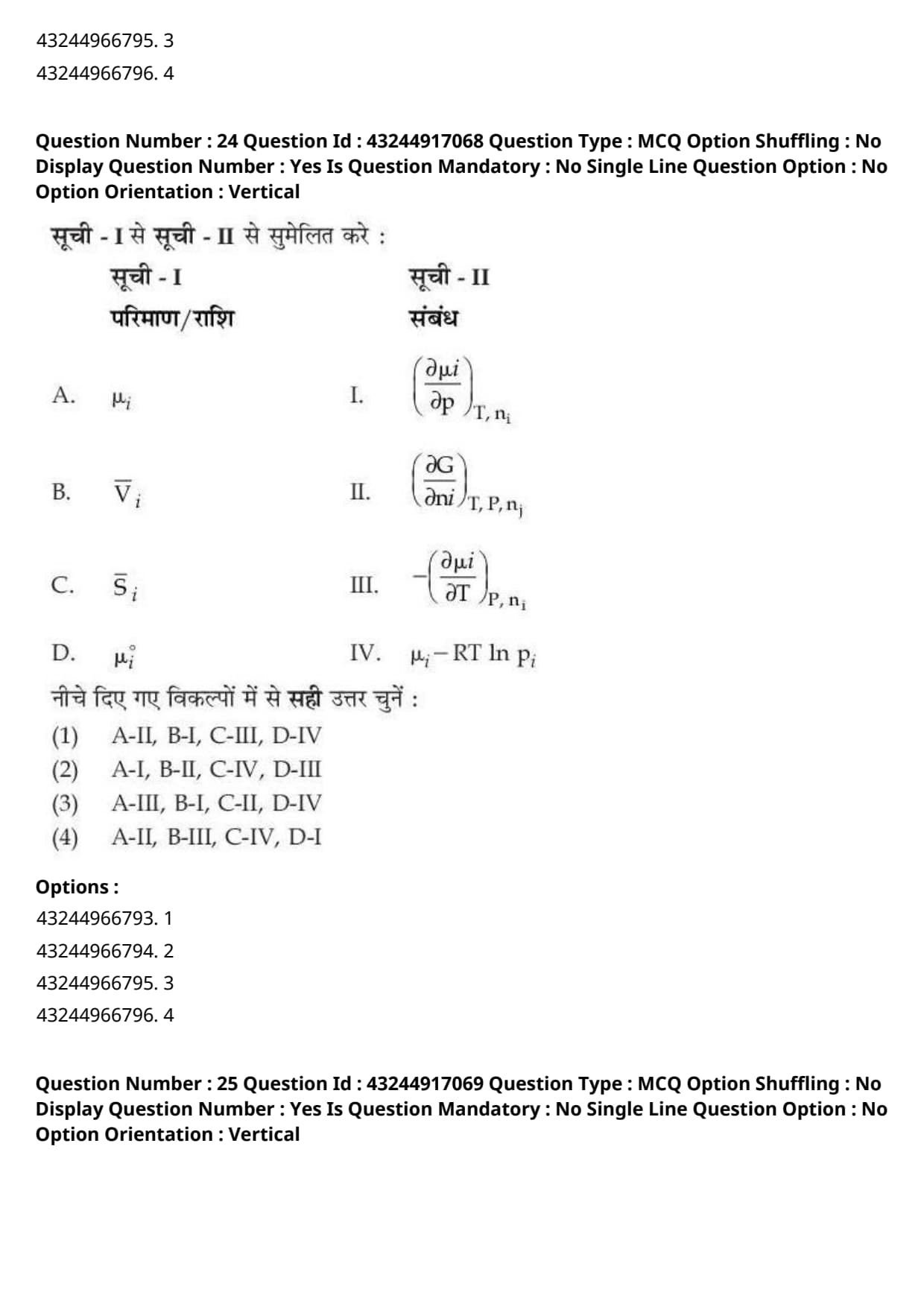
Match List - I with List - II.
Choose the correct answer from the options given below :
View Solution
Step 1: Understanding the Question:
The topic of this question is thermodynamics of open systems, specifically partial molar quantities and the chemical potential (\(\mu_i\)).
Step 2: Key Formula or Approach:
Partial molar properties are defined as the change in an extensive property when one mole of component \(i\) is added to an infinitely large amount of mixture at constant temperature and pressure.
For any extensive variable \(Y\):
\[ \overline{Y}_i = \left(\frac{\partial Y}{\partial n_i}\right)_{T, P, n_{j \neq i}} \]
Step 3: Detailed Explanation:
Let us match each item from List-I with its corresponding thermodynamic relationship in List-II:
A. Chemical Potential (\(\mu_i\)): This is the partial molar Gibbs free energy. It is defined as:
\[ \mu_i = \left(\frac{\partial G}{\partial n_i}\right)_{T, P, n_j} \]
This matches List-II item II.
B. Partial Molar Volume (\(\overline{V}_i\)): By definition:
\[ \overline{V}_i = \left(\frac{\partial V}{\partial n_i}\right)_{T, P, n_j} \]
Using the Maxwell relation on Gibbs free energy \(dG = VdP - SdT + \sum \mu_i dn_i\), we get:
\[ \overline{V}_i = \left(\frac{\partial \mu_i}{\partial p}\right)_{T, n_i} \]
This matches List-II item I.
C. Partial Molar Entropy (\(\overline{S}_i\)): By definition:
\[ \overline{S}_i = \left(\frac{\partial S}{\partial n_i}\right)_{T, P, n_j} \]
Using the Maxwell relation on Gibbs free energy, we get:
\[ \overline{S}_i = -\left(\frac{\partial \mu_i}{\partial T}\right)_{P, n_i} \]
This matches List-II item III.
D. Standard Chemical Potential (\(\mu_i^\circ\)): For an ideal gas:
\[ \mu_i = \mu_i^\circ + RT \ln p_i \implies \mu_i^\circ = \mu_i - RT \ln p_i \]
This matches List-II item IV.
Thus, the correct matching is: A-II, B-I, C-III, D-IV.
Step 4: Final Answer
The correct option is (A).
Quick Tip: Remember that chemical potential (\(\mu_i\)) is the derivative of Gibbs free energy with respect to moles (\(\partial G / \partial n_i\)).
So, A matches with II.
Since \(dG = VdP - SdT\), volume is related to pressure derivative (\(\partial \mu_i / \partial p\)), and entropy is related to negative temperature derivative (\(-\partial \mu_i / \partial T\)).
This matches B with I, and C with III.
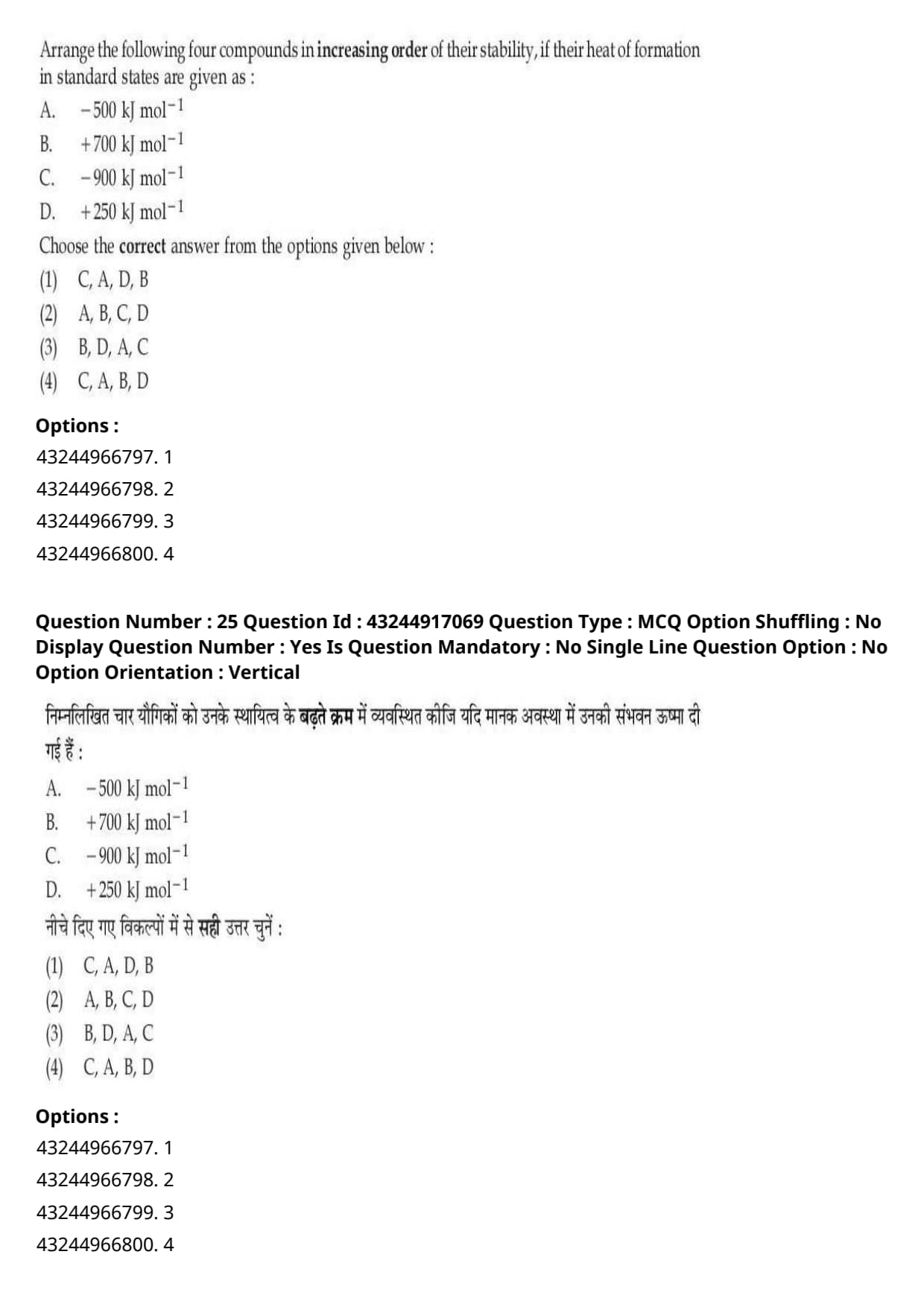
Arrange the following four compounds in increasing order of their stability, if their heat of formation in standard states are given as : A. \(-500 kJ mol^{-1}\), B. \(+700 kJ mol^{-1}\), C. \(-900 kJ mol^{-1}\), D. \(+250 kJ mol^{-1}\). Choose the correct answer from the options given below :
View Solution
Step 1: Understanding the Question:
The topic of this question is chemical thermodynamics, specifically relating standard enthalpy of formation (\(\Delta H_f^\circ\)) of compounds to their thermodynamic stability.
Step 2: Key Formula or Approach:
A lower energy state corresponds to higher thermodynamic stability.
If standard enthalpy of formation (\(\Delta H_f^\circ\)) of a compound is highly negative (exothermic), it indicates that a large amount of energy was released during its formation, putting it in a highly stable, low-energy state.
Conversely, if \(\Delta H_f^\circ\) is positive (endothermic), the compound is at a high-energy state and is thermodynamically unstable.
Thus:
\[ Stability \propto -\Delta H_f^\circ \]
Step 3: Detailed Explanation:
Let us list the compounds and their heats of formation:
A: \(-500 kJ mol^{-1}\)
B: \(+700 kJ mol^{-1}\)
C: \(-900 kJ mol^{-1}\)
D: \(+250 kJ mol^{-1}\)
Let us order these values from highest energy (most positive \(\Delta H_f^\circ\)) to lowest energy (most negative \(\Delta H_f^\circ\)):
\[ +700 kJ mol^{-1} (B) > +250 kJ mol^{-1} (D) > -500 kJ mol^{-1} (A) > -900 kJ mol^{-1} (C) \]
The compound with the highest energy (B) is the least stable, and the compound with the lowest energy (C) is the most stable.
Therefore, the increasing order of stability (from least stable to most stable) is:
\[ B < D < A < C \]
This matches Option (C).
Step 4: Final Answer
The increasing order of stability is B, D, A, C.
Quick Tip: Highly negative standard heat of formation means the compound is highly stable (exothermic formation).
Highly positive standard heat of formation means the compound is unstable (endothermic formation).
Therefore, the stability order is simply the reverse of the numerical value of \(\Delta H_f^\circ\) sorted from highest to lowest.
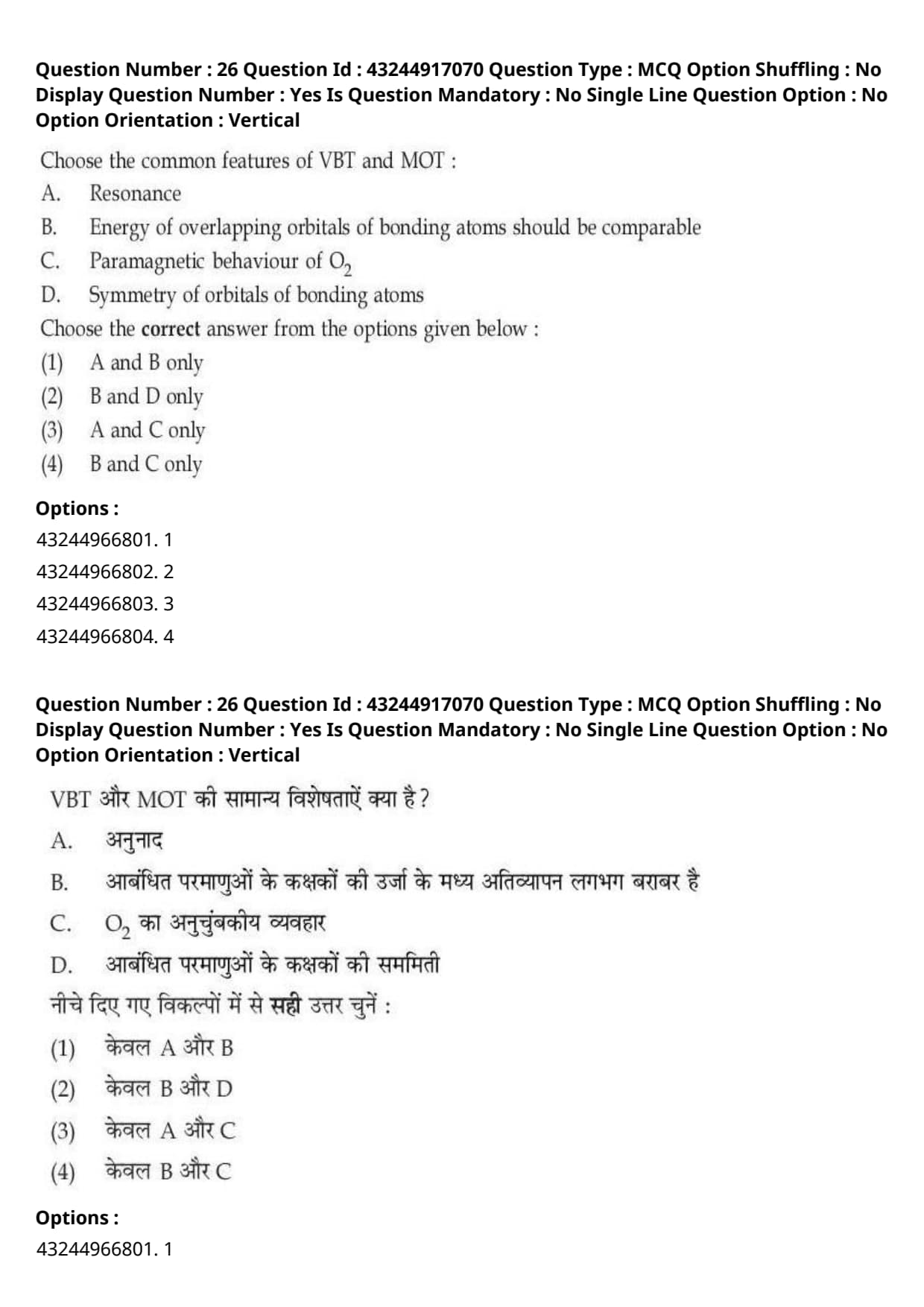
Choose the common features of VBT and MOT:
A. Resonance
B. Energy of overlapping orbitals of bonding atoms should be comparable
C. Paramagnetic behaviour of \(O_2\)
D. Symmetry of orbitals of bonding atoms
Choose the correct answer from the options given below:
View Solution
Step 1: Understanding the Question:
The topic of this question is chemical bonding, specifically comparing the fundamental principles, similarities, and differences of Valence Bond Theory (VBT) and Molecular Orbital Theory (MOT).
Step 2: Key Formula or Approach:
Both theories are quantum mechanical models used to explain covalent chemical bonding, but they have distinct methodologies and shared physical requirements for orbital overlap.
Step 3: Detailed Explanation:
Let us analyze each feature to determine if it is common to both VBT and MOT:
A. Resonance: This is a concept unique to Valence Bond Theory. In VBT, localized electron pairs are assumed, and resonance structures are introduced to explain molecules with delocalized electrons. In MOT, electron delocalization is naturally explained by multicenter molecular orbitals, making resonance unnecessary. Thus, resonance is not a common feature.
B. Energy of overlapping orbitals of bonding atoms should be comparable: In both theories, effective combination/overlap of atomic orbitals can occur only if the participating atomic orbitals have nearly comparable energies. If the energy gap is too large, no stable bond is formed. Thus, this is a common feature.
C. Paramagnetic behavior of \(O_2\): This is a classic success of Molecular Orbital Theory, which easily explains the two unpaired electrons in the \(\pi^*_{2p}\) antibonding orbitals. Valence Bond Theory incorrectly predicts \(O_2\) to be diamagnetic (with all electrons paired). Thus, this is not a common feature.
D. Symmetry of orbitals of bonding atoms: For effective bonding to occur, the overlapping atomic orbitals must have the same symmetry with respect to the molecular axis (e.g., \(s\) and \(p_z\) can overlap to form a \(\sigma\) bond, but \(s\) and \(p_x\) cannot because their overlap integral is zero). This rule of symmetry is fundamental to both VBT (orbital overlap) and MOT (Linear Combination of Atomic Orbitals - LCAO). Thus, this is a common feature.
Therefore, features B and D are common to both theories.
Step 4: Final Answer
The common features of VBT and MOT are B and D only.
Quick Tip: For any orbital-based chemical bonding model, two golden rules must always be satisfied for bonding to occur:
1. Comparable energy of combining orbitals.
2. Correct symmetry of combining orbitals.
These two criteria (B and D) are mandatory for both LCAO-MOT and standard VBT.
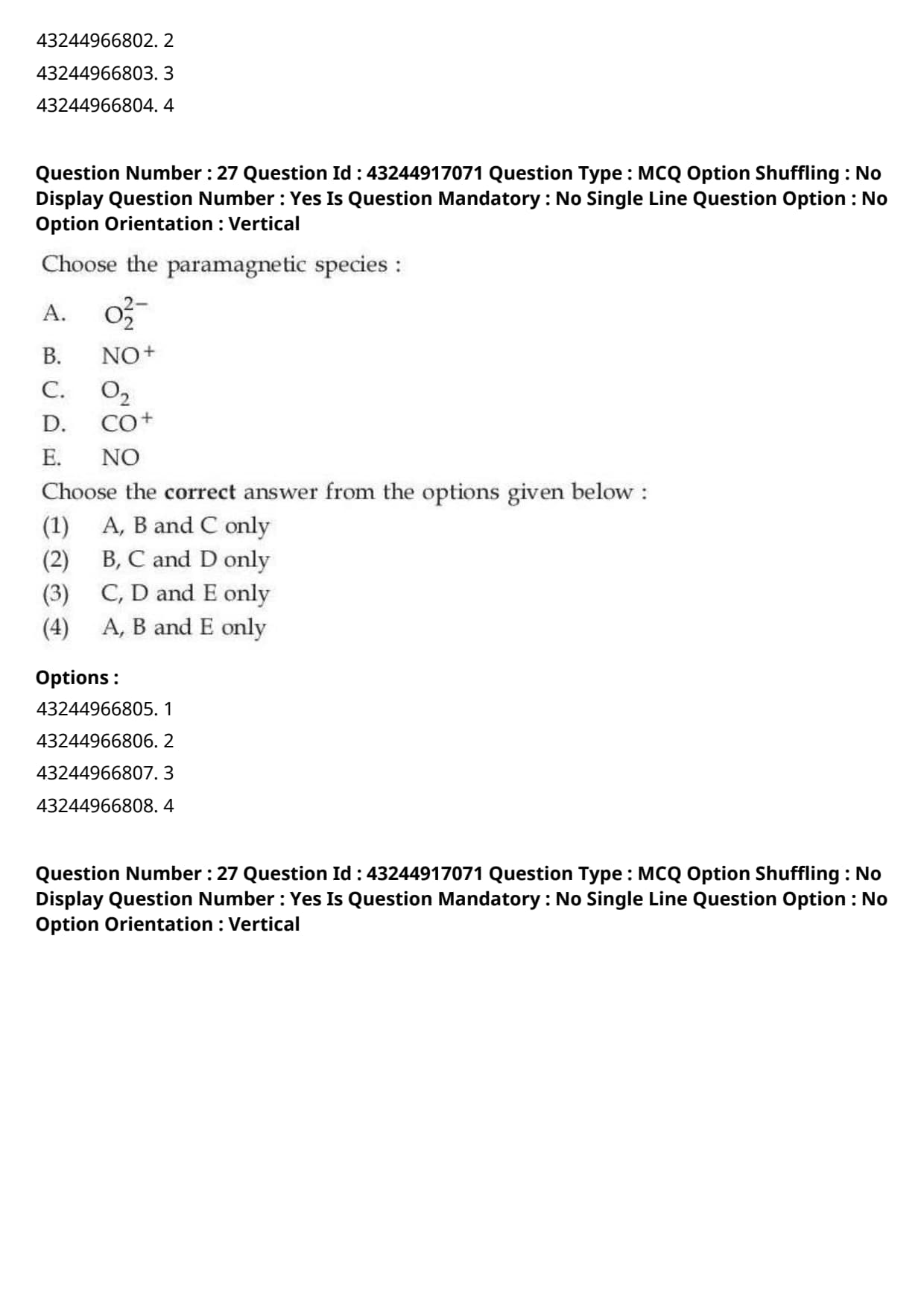
Choose the paramagnetic species:
A. \(O_2^{2-}\)
B. \(NO^+\)
C. \(O_2\)
D. \(CO^+\)
E. \(NO\)
Choose the correct answer from the options given below:
View Solution
Step 1: Understanding the Question:
The topic of this question is molecular orbital theory (MOT) and magnetic properties of diatomic species.
A molecular species is paramagnetic if it possesses one or more unpaired electrons in its molecular orbitals, whereas it is diamagnetic if all of its electrons are paired.
Step 2: Key Formula or Approach:
The magnetic behavior can be predicted by determining the total number of electrons in the species and writing down their molecular orbital electronic configurations:
Odd-electron species are always paramagnetic because at least one electron must remain unpaired.
Even-electron species are generally diamagnetic, with notable exceptions like \(O_2\) and \(B_2\), which have unpaired electrons in degenerate orbitals due to Hund's rule.
Step 3: Detailed Explanation:
Let us analyze each given species individually:
A. \(O_2^{2-}\) (Peroxide ion):
The total number of electrons \(= 8 + 8 + 2 = 18\) electrons.
Its molecular orbital configuration is similar to \(F_2\):
\(\sigma_{1s}^2 \sigma^*_{1s}^2 \sigma_{2s}^2 \sigma^*_{2s}^2 \sigma_{2p_z}^2 (\pi_{2p_x}^2 = \pi_{2p_y}^2) (\pi^*_{2p_x}^2 = \pi^*_{2p_y}^2)\).
Since all molecular orbitals are completely filled, there are no unpaired electrons. Therefore, it is diamagnetic.
B. \(NO^+\) (Nitrosonium ion):
The total number of electrons \(= 7 + 8 - 1 = 14\) electrons.
It is isoelectronic with \(N_2\) and has the configuration:
\(\sigma_{1s}^2 \sigma^*_{1s}^2 \sigma_{2s}^2 \sigma^*_{2s}^2 (\pi_{2p_x}^2 = \pi_{2p_y}^2) \sigma_{2p_z}^2\).
All electrons are paired, so it is diamagnetic.
C. \(O_2\) (Oxygen molecule):
The total number of electrons \(= 16\) electrons.
Its molecular orbital configuration is:
\(\sigma_{1s}^2 \sigma^*_{1s}^2 \sigma_{2s}^2 \sigma^*_{2s}^2 \sigma_{2p_z}^2 (\pi_{2p_x}^2 = \pi_{2p_y}^2) (\pi^*_{2p_x}^1 = \pi^*_{2p_y}^1)\).
According to Hund's rule, the two electrons in the degenerate \(\pi^*_{2p}\) antibonding orbitals remain unpaired with parallel spins. Thus, it is paramagnetic.
D. \(CO^+\) (Carbon monoxide cation):
The total number of electrons \(= 6 + 8 - 1 = 13\) electrons.
Since it has an odd number of electrons, it must contain at least one unpaired electron. Thus, it is paramagnetic.
E. \(NO\) (Nitric oxide):
The total number of electrons \(= 7 + 8 = 15\) electrons.
Its configuration contains one unpaired electron in the antibonding \(\pi^*_{2p}\) orbital:
\(\sigma_{1s}^2 \sigma^*_{1s}^2 \sigma_{2s}^2 \sigma^*_{2s}^2 \sigma_{2p_z}^2 (\pi_{2p_x}^2 = \pi_{2p_y}^2) (\pi^*_{2p_x}^1 = \pi^*_{2p_y}^0)\).
With one unpaired electron, it is paramagnetic.
Therefore, the paramagnetic species are C, D, and E.
Step 4: Final Answer
The paramagnetic species are C, D, and E only, which matches option (C).
Quick Tip: An extremely useful shortcut for magnetic properties is to check the total number of electrons:
- If total electrons \(=\) odd, the species is ALWAYS paramagnetic (e.g., \(CO^+ = 13e^-\), \(NO = 15e^-\)).
- If total electrons \(=\) even, it is usually diamagnetic, EXCEPT for \(10e^-\) (\(B_2\)) and \(16e^-\) (\(O_2\)).
Using this rule, you can solve this question within 10 seconds.
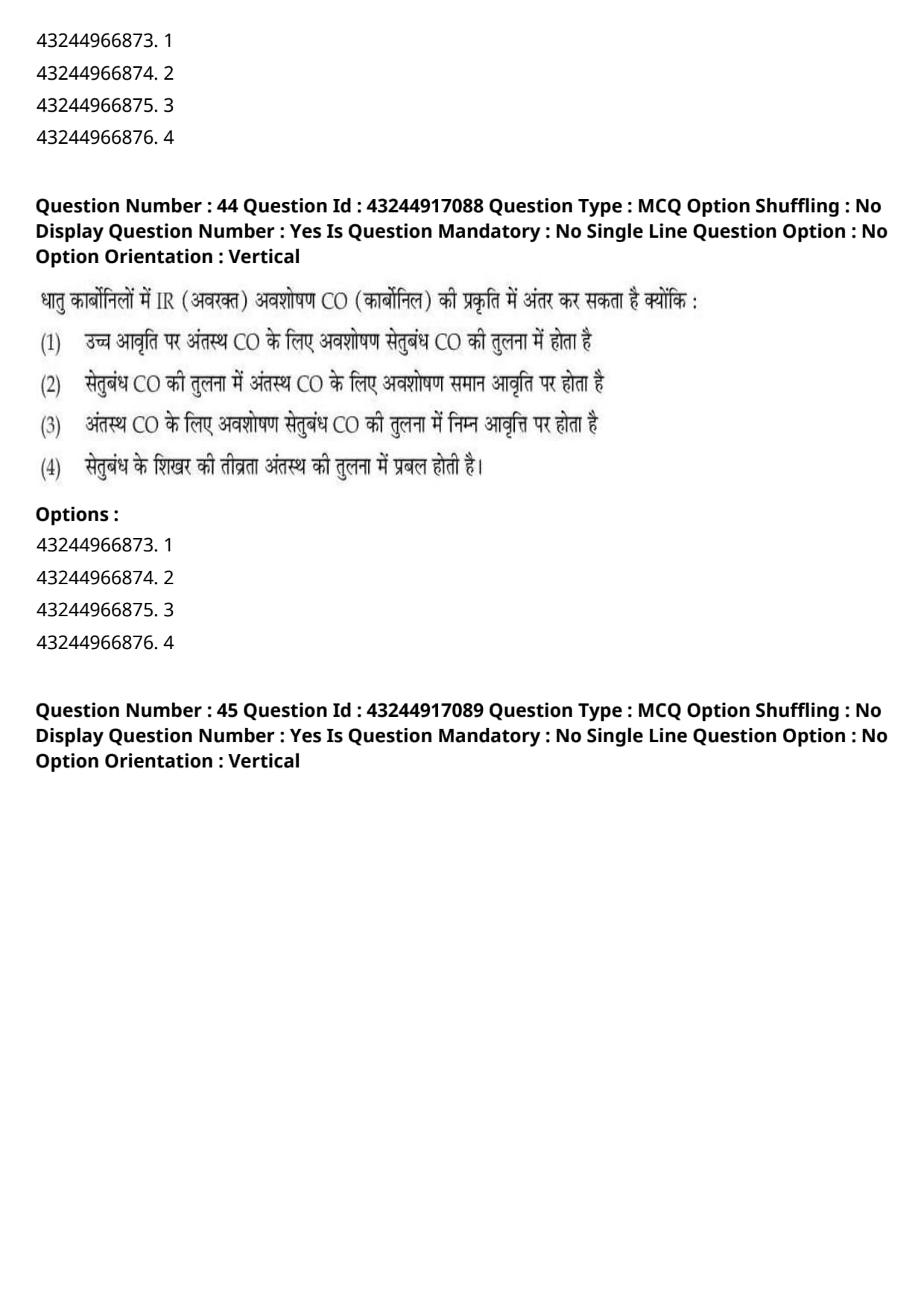
IR absorption spectra of metal carbonyl determine:
A. Geometry of mononuclear metal carbonyls
B. Determine bond order of CO bond
C. Differentiating between terminal and bridging CO
D. Enantiomerism in metal carbonyls
E. Study of Reaction Rates of Substitution reactions
Choose the correct answer from the options given below:
View Solution
Step 1: Understanding the Question:
The topic of this question is the applications of Infrared (IR) spectroscopy in characterizing organometallic metal carbonyl complexes.
IR spectroscopy is highly sensitive to the \(C\equivO\) stretching frequency (\(\nu_{CO}\)) due to its strong dipole moment change during vibration.
Step 2: Key Formula or Approach:
According to Hooke's Law, the stretching frequency (\(\nu\)) is related to the force constant (\(k\)) and reduced mass (\(\mu\)):
\[ \nu = \frac{1}{2\pi c} \sqrt{\frac{k}{\mu}} \]
The number of IR-active bands depends on the symmetry of the molecular complex, which can be determined using group theory and selection rules.
Step 3: Detailed Explanation:
Let us analyze each application listed:
A. Geometry of mononuclear metal carbonyls:
The number of \(C-O\) stretching bands observed in the IR spectrum is determined by the molecular symmetry (point group) of the complex. For example, octahedral \(Cr(CO)_6\) (\(O_h\)) shows only one IR-active band (\(T_{1u}\)), whereas trigonal bipyramidal \(Fe(CO)_5\) (\(D_{3h}\)) shows two bands (\(A_2''\) and \(E'\)). Thus, IR spectra can determine geometry. Statement A is correct.
B. Determine bond order of CO bond:
The stretching frequency \(\nu_{CO}\) is directly proportional to the square root of the force constant (\(k\)), which is a measure of the \(C-O\) bond strength and bond order. Stronger \(M\rightarrowC\) back-bonding populates the \(\pi^*\) antibonding orbital of \(CO\), lowering both the bond order and \(\nu_{CO}\). Hence, IR can determine CO bond order. Statement B is correct.
C. Differentiating between terminal and bridging CO:
Terminal \(CO\) ligands typically absorb in the range of \(1850 - 2120 cm^{-1}\). Doubly bridging (\(\mu_2\)-\(CO\)) carbonyls absorb in the lower range of \(1700 - 1850 cm^{-1}\), and triply bridging (\(\mu_3\)-\(CO\)) absorb even lower (\(1600 - 1700 cm^{-1}\)). Thus, IR easily differentiates them. Statement C is correct.
D. Enantiomerism in metal carbonyls:
Enantiomers are non-superimposable mirror images and have identical vibrational frequencies in isotropic environments. Standard IR spectroscopy cannot distinguish between a pair of enantiomers. Only vibrational circular dichroism (VCD) can do so. Thus, Statement D is incorrect.
E. Study of Reaction Rates of Substitution reactions:
Since different metal carbonyls have distinct and sharp absorption bands, the progress of a substitution reaction (e.g., \(Mo(CO)_6 + L \rightarrow Mo(CO)_5L + CO\)) can be monitored quantitatively by measuring the intensity of the reactant and product peaks over time. This enables kinetic studies of reaction rates. Statement E is correct.
Therefore, A, B, C, and E are correct applications, while D is not.
Step 4: Final Answer
The correct options are A, B, C, and E only, which matches option (B).
Quick Tip: Enantiomers have the same physical properties like boiling point, density, and standard IR spectra because mirror-image molecules have identical bond strengths and vibrational frequencies.
Knowing that standard IR cannot differentiate enantiomers allows you to immediately eliminate any option containing D (options A, C, and D).
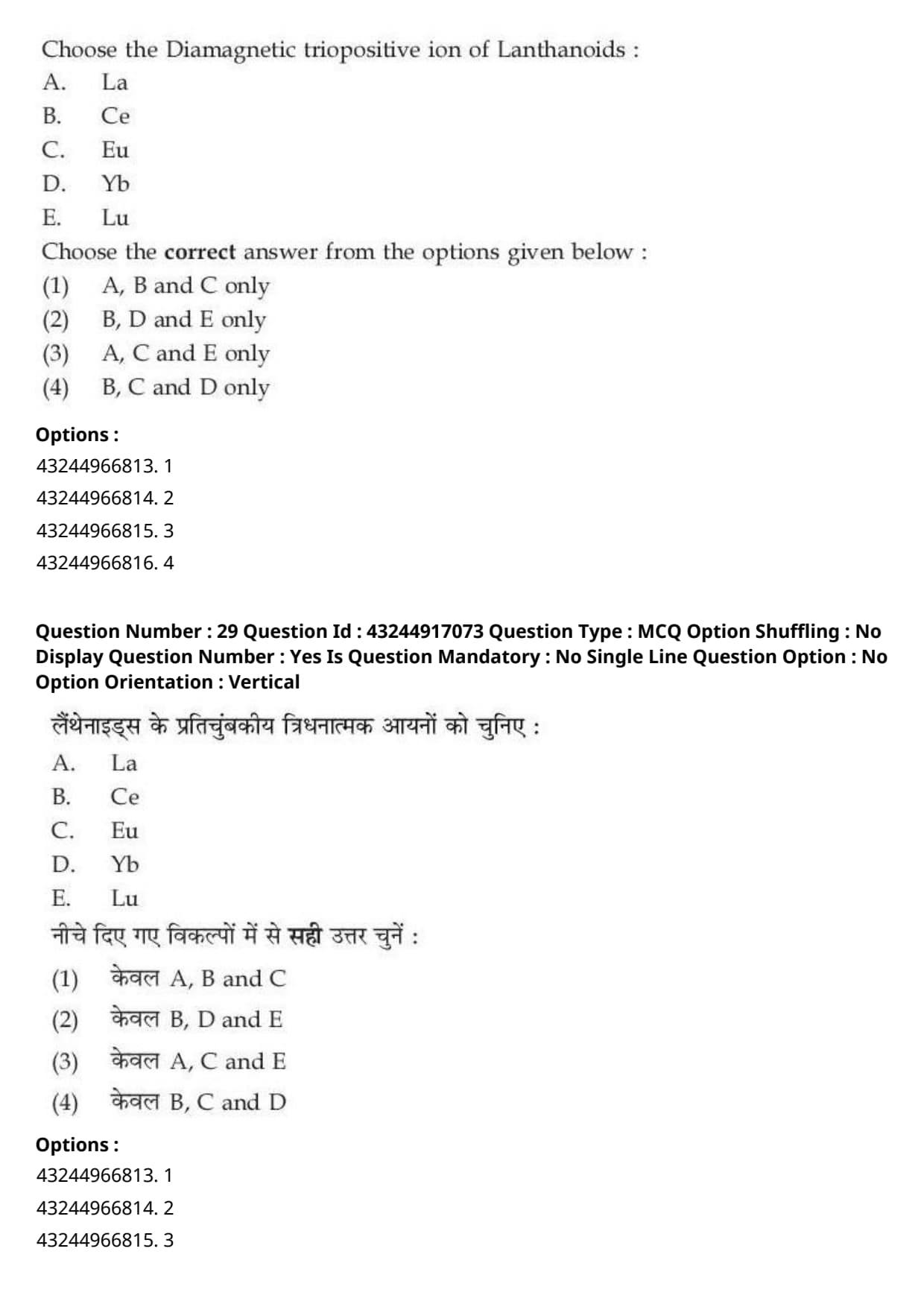
Choose the Diamagnetic tripositive ion of Lanthanoids :
A. La
B. Ce
C. Eu
D. Yb
E. Lu
Choose the correct answer from the options given below :
View Solution
Step 1: Understanding the Question:
The topic of this question is the electronic configurations and magnetic properties of lanthanoid tripositive ions (\(Ln^{3+}\)).
A species is diamagnetic if it contains no unpaired electrons (\(4f^0\) or \(4f^{14}\) configuration).
Step 2: Key Formula or Approach:
Let us write the general electronic configuration of Lanthanoids in their \(+3\) oxidation state:
\(La^{3+}\): \([Xe] 4f^0\) (No unpaired electrons)
\(Lu^{3+}\): \([Xe] 4f^{14}\) (Completely filled, no unpaired electrons)
Any other configuration \(4f^n\) (where \(1 \leq n \leq 13\)) typically contains unpaired electrons and exhibits paramagnetism.
Step 3: Detailed Explanation:
Let us evaluate each lanthanoid ion listed:
A. Lanthanum (\(La^{3+}\)):
Neutral \(La\) is \([Xe] 5d^1 6s^2\). Loss of three electrons yields \(La^{3+}\) with a \([Xe] 4f^0\) configuration. Since there are no \(f\) electrons, there are no unpaired electrons, making it strictly diamagnetic.
E. Lutetium (\(Lu^{3+}\)):
Neutral \(Lu\) is \([Xe] 4f^{14} 5d^1 6s^2\). Loss of three electrons yields \(Lu^{3+}\) with a \([Xe] 4f^{14}\) configuration. All orbitals in the \(4f\) subshell are fully paired, making it strictly diamagnetic.
B. Cerium (\(Ce^{3+}\)):
\(Ce^{3+}\) has a \(4f^1\) configuration. The single unpaired electron makes it paramagnetic.
D. Ytterbium (\(Yb^{3+}\)):
\(Yb^{3+}\) has a \(4f^{13}\) configuration. It has one unpaired electron, making it paramagnetic.
C. Europium (\(Eu^{3+}\)):
\(Eu^{3+}\) has a \(4f^6\) configuration. Ground state term symbol calculations show its ground state is \(^7F_0\), where the total angular momentum quantum number \(J = 0\). At absolute zero (\(0 K\)), a state with \(J=0\) has zero magnetic moment and does not show normal paramagnetism. Although it displays temperature-independent van Vleck paramagnetism and becomes paramagnetic at room temperature due to thermal population of low-lying excited states (\(^7F_1\), \(^7F_2\)), it is grouped along with \(La^{3+}\) and \(Lu^{3+}\) as a special case in many textbooks.
Since both \(La^{3+}\) (A) and \(Lu^{3+}\) (E) must be present in the correct option, only option (C) contains both A and E.
Step 4: Final Answer
The diamagnetic tripositive ions under appropriate conditions are represented by A, C, and E, matching option (C).
Quick Tip: The only two absolutely diamagnetic tripositive ions in the lanthanoid series at all temperatures are \(La^{3+}\) (\(f^0\)) and \(Lu^{3+}\) (\(f^{14}\)).
Looking at the options, only Option (C) contains both A (\(La\)) and E (\(Lu\)).
This allows you to quickly select the correct option without worrying about the complex magnetic behavior of \(Eu^{3+}\).
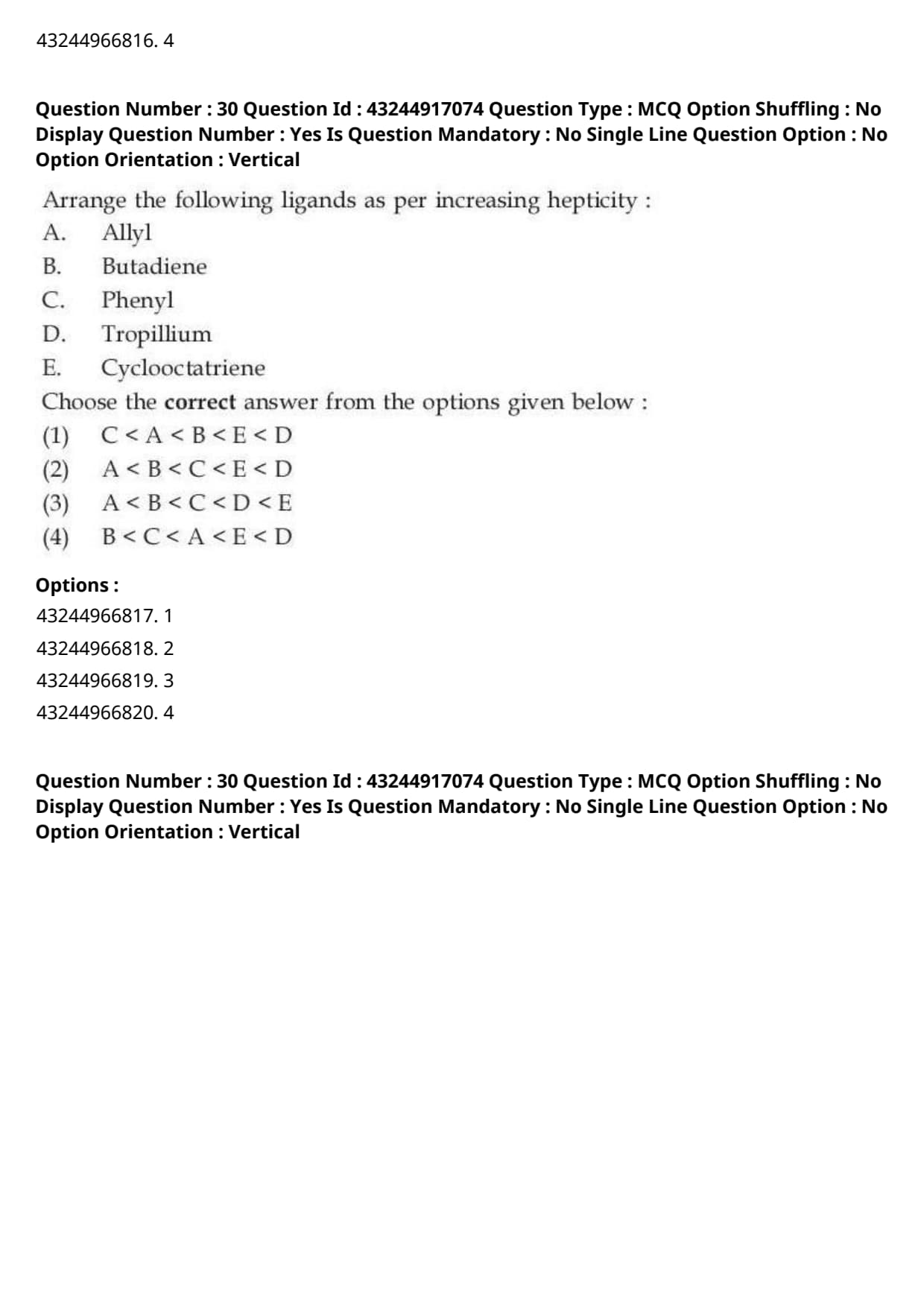
Arrange the following ligands as per increasing hapticity :
A. Allyl
B. Butadiene
C. Phenyl
D. Tropylium
E. Cyclooctatriene
Choose the correct answer from the options given below :
View Solution
Step 1: Understanding the Question:
The topic of this question is coordination and organometallic chemistry, specifically the hapticity (\(\eta\)) of organic ligands in transition metal complexes.
Hapticity refers to the number of contiguous atoms of a ligand that are directly bonded to the central metal atom.
Step 2: Key Formula or Approach:
Let us evaluate the standard hapticity (\(\eta^n\)) values for each ligand when they act as fully coordinated systems:
Phenyl (\(C_6H_5^-\)): typically coordinates as a \(\sigma\)-donor through \(1\) carbon atom (\(\eta^1\)).
Allyl (\(C_3H_5^-\)): coordinates via its \(\pi\)-system spanning over \(3\) carbon atoms (\(\eta^3\)).
Butadiene (\(C_4H_6\)): coordinates via its conjugated diene system spanning over \(4\) carbon atoms (\(\eta^4\)).
Cyclooctatriene (\(C_8H_{10}\)): typically coordinates via three conjugated double bonds involving \(6\) carbon atoms (\(\eta^6\)).
Tropylium (\(C_7H_7^+\)): coordinates as a planar, aromatic ring system using all \(7\) carbon atoms (\(\eta^7\)).
Step 3: Detailed Explanation:
Let us arrange the ligands in increasing order of their hapticities:
C. Phenyl: Standard coordination is \(\eta^1\)-phenyl. (Hapticity \(= 1\))
A. Allyl: Standard coordination is \(\eta^3\)-allyl. (Hapticity \(= 3\))
B. Butadiene: Standard coordination is \(\eta^4\)-butadiene. (Hapticity \(= 4\))
E. Cyclooctatriene: Coordinates as a \(6\pi\)-electron donor, \(\eta^6\)-cyclooctatriene. (Hapticity \(= 6\))
D. Tropylium: Coordinates as a highly stable \(6\pi\)-aromatic system spanning all seven carbons, \(\eta^7\)-tropylium. (Hapticity \(= 7\))
Thus, the increasing order of hapticity is:
\[ Phenyl (\eta^1) < Allyl (\eta^3) < Butadiene (\eta^4) < Cyclooctatriene (\eta^6) < Tropylium (\eta^7) \] \[ C < A < B < E < D \]
Step 4: Final Answer
The correct increasing order is C \(<\) A \(<\) B \(<\) E \(<\) D, which corresponds to option (A).
Quick Tip: The prefix \(\eta^n\) represents hapticity.
The number of carbon atoms involved in the conjugated system is a direct indicator of maximum hapticity:
Phenyl (\(1C\)) \(<\) Allyl (\(3C\)) \(<\) Butadiene (\(4C\)) \(<\) Cyclooctatriene (\(6C\)) \(<\) Tropylium (\(7C\)).
This simple count gives the correct order instantly.
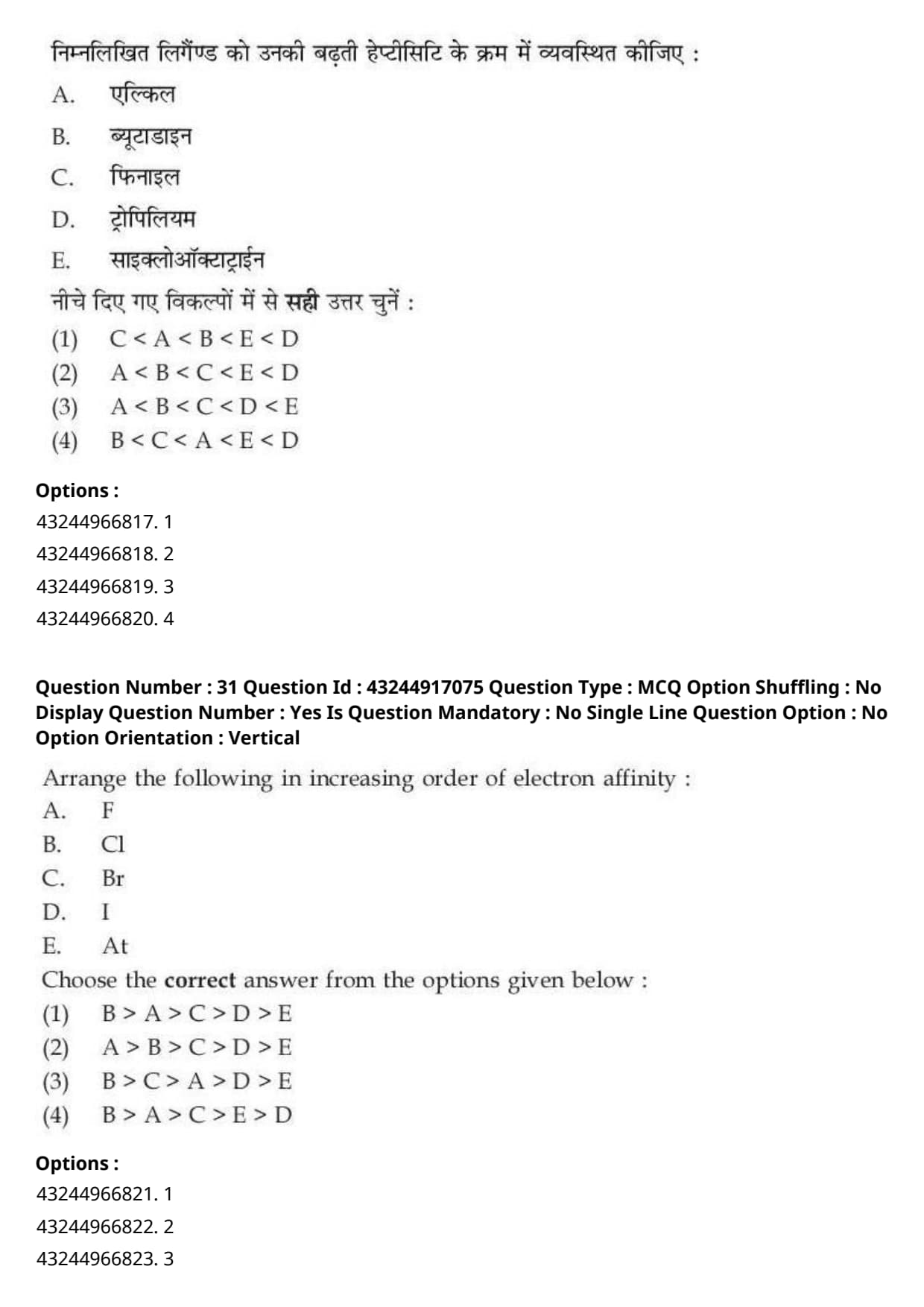
Arrange the following in increasing order of electron affinity :
A. F
B. Cl
C. Br
D. I
E. At
Choose the correct answer from the options given below :
View Solution
Step 1: Understanding the Question:
The topic of this question is periodic properties, specifically the trends in electron affinity (electron gain enthalpy) among the Group 17 halogen elements.
Step 2: Key Formula or Approach:
The electron affinity represents the energy released when an electron is added to a neutral gaseous atom.
Generally, electron affinity decreases down a group due to increasing atomic size. However, there is a prominent anomaly between the second-period and third-period elements.
Step 3: Detailed Explanation:
Let us analyze the trends in Group 17:
Typically, as we go down the group from chlorine to astatine, the atomic size increases, the incoming electron is added to a shell further away from the nucleus, and thus the electron affinity decreases:
\[ Cl > Br > I > At \]
However, fluorine (\(F\)) has an exceptionally small atomic size.
The \(2p\) subshell of fluorine is highly compact, leading to high inter-electronic repulsion among the seven valence electrons already present.
Consequently, when an incoming electron is added to a fluorine atom, it experiences significant repulsion, which reduces the net attractive force from the nucleus and lowers the energy released.
In contrast, chlorine (\(Cl\)) has a larger \(3p\) subshell, which easily accommodates the incoming electron with minimal inter-electronic repulsion.
Thus, the electron affinity of chlorine is greater than that of fluorine:
\[ Cl > F \]
The overall decreasing order of electron affinity for Group 17 is:
\[ Cl (B) > F (A) > Br (C) > I (D) > At (E) \] \[ B > A > C > D > E \]
Step 4: Final Answer
The correct decreasing order of electron affinity is B \(>\) A \(>\) C \(>\) D \(>\) E, which matches option (A).
Quick Tip: Chlorine (\(Cl\)) has the highest electron affinity of all elements in the periodic table.
Therefore, the correct sequence must start with B (\(Cl > \dots\)).
Since Fluorine (\(F\)) is second, the sequence is \(Cl > F > Br > I > At\).
This is one of the most frequently asked questions in competitive exams.
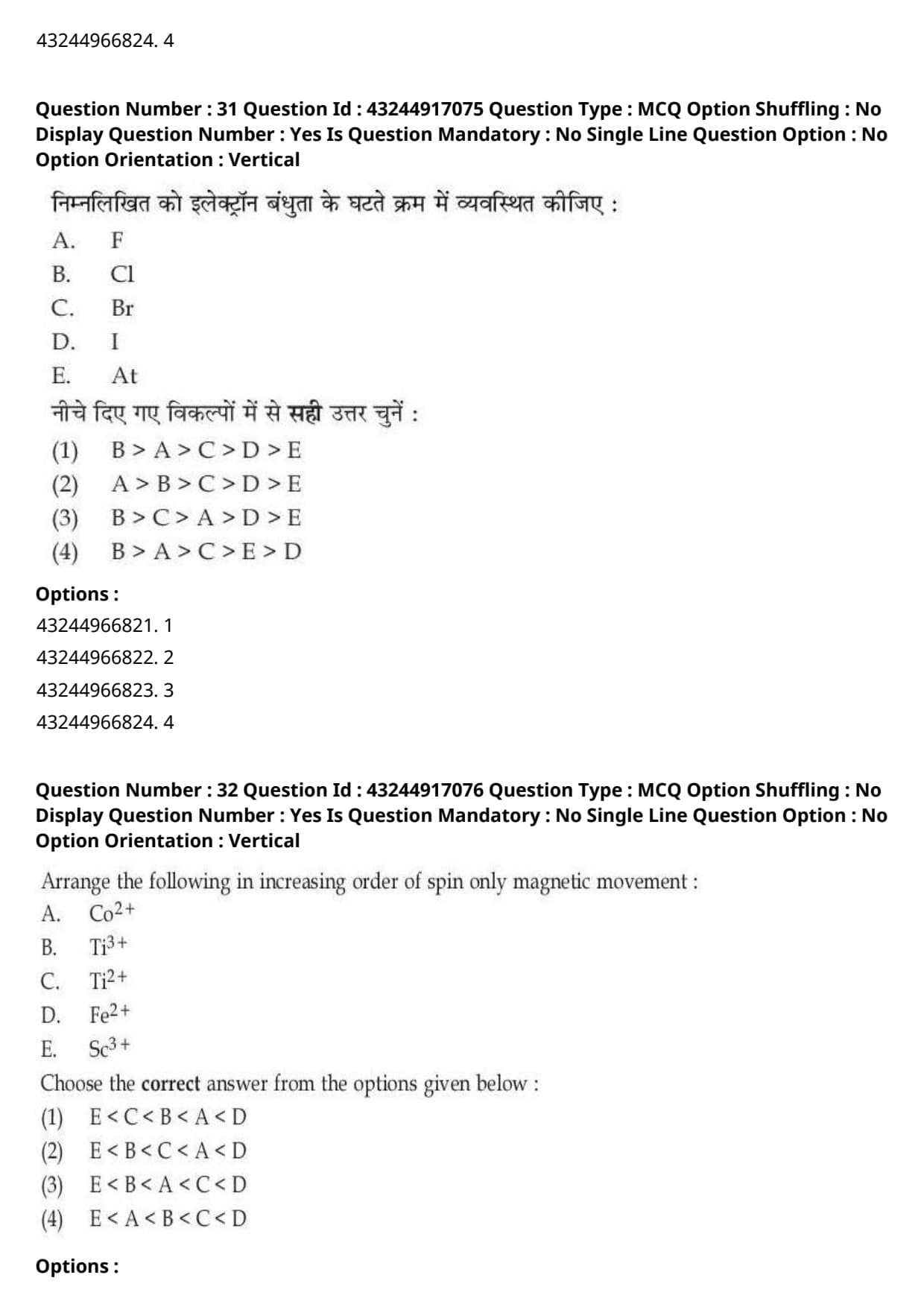
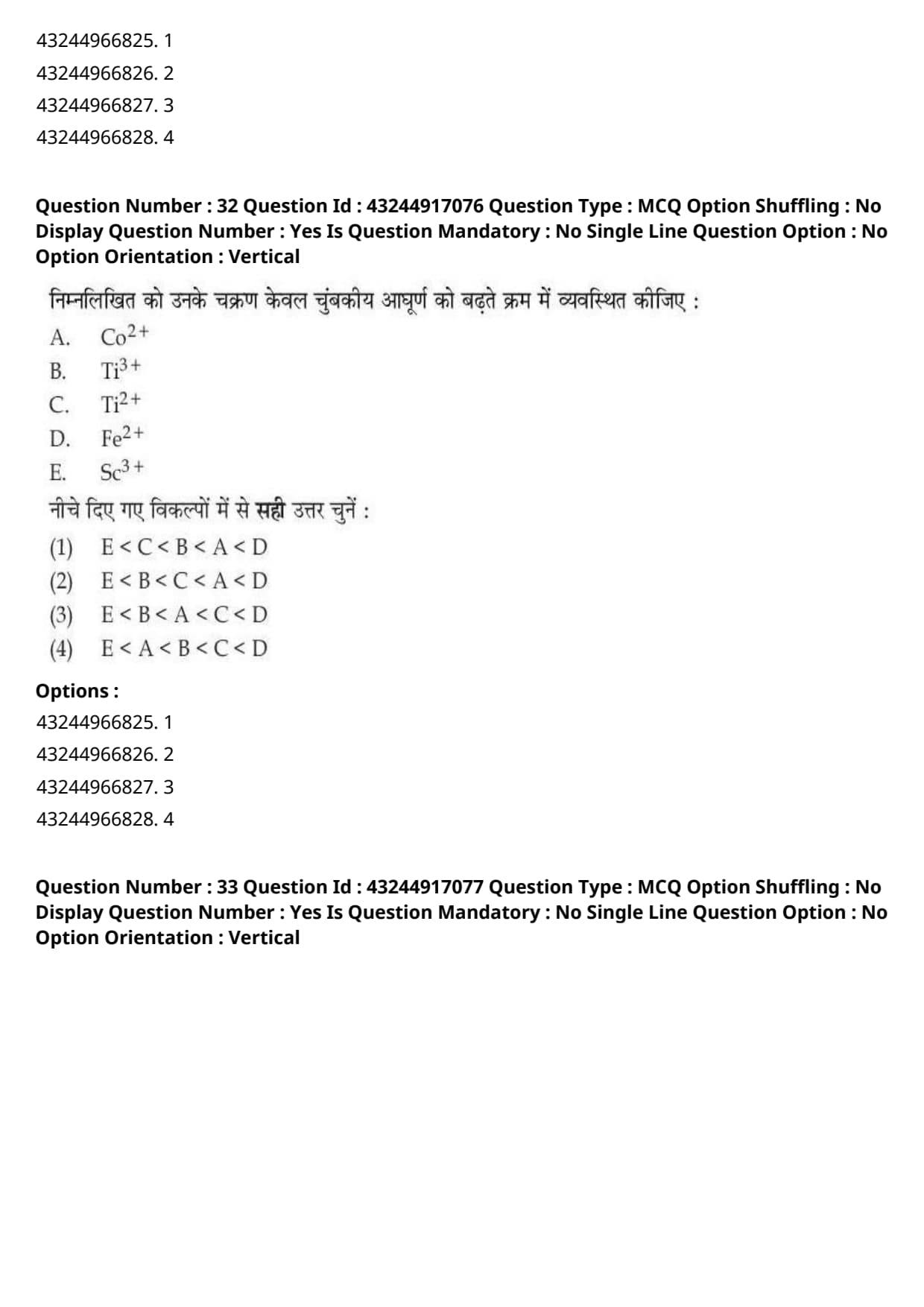
Arrange the following in increasing order of spin only magnetic movement :
A. \(Co^{2+}\)
B. \(Ti^{3+}\)
C. \(Ti^{2+}\)
D. \(Fe^{2+}\)
E. \(Sc^{3+}\)
Choose the correct answer from the options given below :
View Solution
Step 1: Understanding the Question:
The topic of this question is coordination chemistry and transition metal chemistry, specifically the calculation of the spin-only magnetic moment (\(\mu_{so}\)) of \(3d\) transition metal ions.
Step 2: Key Formula or Approach:
The spin-only magnetic moment is given by:
\[ \mu_{so} = \sqrt{n(n+2)} BM \]
where \(n\) is the number of unpaired electrons in the \(d\)-orbitals of the transition metal ion.
Since \(\mu_{so}\) is directly proportional to \(n\), we only need to determine the number of unpaired electrons for each ion.
Step 3: Detailed Explanation:
Let us determine the electronic configuration and number of unpaired electrons (\(n\)) for each ion:
E. \(Sc^{3+}\):
Neutral \(Sc\) is \([Ar] 3d^1 4s^2\). Loss of three electrons yields \(Sc^{3+}\) with a \(3d^0\) configuration.
Unpaired electrons, \(n = 0 \implies \mu_{so} = 0 BM\).
B. \(Ti^{3+}\):
Neutral \(Ti\) is \([Ar] 3d^2 4s^2\). Loss of three electrons yields \(Ti^{3+}\) with a \(3d^1\) configuration.
Unpaired electrons, \(n = 1 \implies \mu_{so} = \sqrt{1(3)} = 1.73 BM\).
C. \(Ti^{2+}\):
Loss of two electrons from \(Ti\) yields \(Ti^{2+}\) with a \(3d^2\) configuration.
Unpaired electrons, \(n = 2 \implies \mu_{so} = \sqrt{2(4)} = 2.83 BM\).
A. \(Co^{2+}\):
Neutral \(Co\) is \([Ar] 3d^7 4s^2\). \(Co^{2+}\) has a \(3d^7\) configuration.
In a weak-field (high-spin) state: \(t_{2g}^5 e_g^2\).
Unpaired electrons, \(n = 3 \implies \mu_{so} = \sqrt{3(5)} = 3.87 BM\).
D. \(Fe^{2+}\):
Neutral \(Fe\) is \([Ar] 3d^6 4s^2\). \(Fe^{2+}\) has a \(3d^6\) configuration.
In a weak-field (high-spin) state: \(t_{2g}^4 e_g^2\).
Unpaired electrons, \(n = 4 \implies \mu_{so} = \sqrt{4(6)} = 4.90 BM\).
Comparing the values of \(n\):
\[ n(Sc^{3+}) < n(Ti^{3+}) < n(Ti^{2+}) < n(Co^{2+}) < n(Fe^{2+}) \] \[ E (0) < B (1) < C (2) < A (3) < D (4) \]
Step 4: Final Answer
The increasing order of spin-only magnetic moment is E \(<\) B \(<\) C \(<\) A \(<\) D, which corresponds to option (B).
Quick Tip: A quick relationship between the number of unpaired electrons (\(n\)) and the magnetic moment (\(\mu\)) is:
The value of \(\mu\) is always "\(n.something\)" BM.
- \(n=1 \implies \mu \approx 1.7 BM\)
- \(n=2 \implies \mu \approx 2.8 BM\)
- \(n=3 \implies \mu \approx 3.8 BM\)
- \(n=4 \implies \mu \approx 4.9 BM\)
Thus, just counting the unpaired electrons immediately gives you the correct relative order.
The correct sequence of Extraction of Lanthanoids from monazite sand is :
A. Treat with cold water
B. Dilute and adjust pH in alkaline range
C. Digest with Conc. \(H_2SO_4\) at 200°C
D. Separation by ion Exchange method
E. Add \(Na_2SO_4\)
Choose the correct answer from the options given below :
View Solution
Step 1: Understanding the Question:
The topic of this question is metallurgy and extraction of lanthanoids from their primary commercial ore, monazite sand (a phosphate mineral containing orthophosphates of rare-earth elements, thorium, and silica).
Step 2: Key Formula or Approach:
The commercial process of extracting lanthanoids from monazite involves chemical digestion with concentrated acid, separation of thorium and other impurities, precipitation of lanthanoid double sulfates, and finally individual separation.
Step 3: Detailed Explanation:
Let us trace the step-by-step extraction procedure:
Step 1 (C): Digestion with Acid:
Finely ground monazite sand is digested with concentrated sulfuric acid (\(H_2SO_4\)) at \(200^\circC\). This converts insoluble metal phosphates into soluble sulfates of lanthanoids, thorium, etc.
Step 2 (A): Water Treatment:
The digested mass is treated with cold water, which dissolves the soluble metal sulfates while leaving silica and other insoluble residues behind.
Step 3 (B): pH Adjustment:
The acidic solution containing metal sulfates is diluted, and its pH is adjusted in the alkaline range (by adding ammonia or bases). This selectively precipitates thorium as thorium hydroxide (\(Th(OH)_4\)) and removes it.
Step 4 (E): Double Sulfate Precipitation:
Sodium sulfate (\(Na_2SO_4\)) is added to the filtrate. This selectively precipitates the light lanthanoids (like La, Ce, Pr, Nd) as insoluble double sulfates, \(Ln_2(SO_4)_3 \cdot Na_2SO_4 \cdot xH_2O\), separating them from heavy lanthanoids.
Step 5 (D): Ion-Exchange Separation:
Finally, the individual lanthanoids are separated with high purity using modern ion-exchange chromatography or solvent extraction.
Therefore, the correct sequence of steps is: C \(\rightarrow\) A \(\rightarrow\) B \(\rightarrow\) E \(\rightarrow\) D.
Step 4: Final Answer
The correct sequence matches option (D).
Quick Tip: The extraction of any mineral ore always begins with strong digestion (using concentrated acid or base at high temperatures) to break down the refractory mineral lattice.
Therefore, the process must start with Step C.
The ultimate separation of individual rare earth elements is highly challenging and is always the final step using modern chromatographic methods (Step D).
Thus, the correct sequence must start with C and end with D, which is uniquely found in option (D).
Given below are two statements : one is labelled as Assertion (A) and the other is labelled as Reason (R).
Assertion (A) : \(Na^+(C_5H_{11})^-\) is more stable than \(Na^+(C_5H_5)^-\).
Reason (R) : \(C_5H_5\) readily accept electron to become 6-electron aromatic \(C_5H_5^-\).
In the light of the above statements, choose the most appropriate answer from the options given below :
View Solution
Step 1: Understanding the Question:
The topic of this question is organic intermediates and aromaticity, specifically comparing the thermodynamic stability of carbanions.
Step 2: Key Formula or Approach:
According to Hückel's rule, a cyclic, planar, fully conjugated system with \((4n+2)\pi\) electrons (\(n=0, 1, 2, \dots\)) is aromatic and possesses exceptional thermodynamic stability.
Step 3: Detailed Explanation:
Let us analyze Assertion (A):
"\(Na^+(C_5H_{11})^-\) is more stable than \(Na^+(C_5H_5)^-\)."
The cyclopentadienyl anion (\(C_5H_5^-\)) is a cyclic, planar ring with \(6\pi\) electrons (aromatic system with \(n=1\)). This aromatic resonance stabilization makes the anion exceptionally stable.
The pentyl anion (\(C_5H_{11}^-\)) is a simple aliphatic carbanion. It is non-aromatic, highly reactive, and lacks any resonance stabilization.
Therefore, \(Na^+(C_5H_5)^-\) is vastly more stable than \(Na^+(C_5H_{11})^-\).
Thus, Assertion (A) is completely incorrect.
Let us analyze Reason (R):
"\(C_5H_5\) readily accept electron to become 6-electron aromatic \(C_5H_5^-\)."
The cyclopentadienyl radical (\(C_5H_5^\bullet\)) has \(5\pi\) electrons and is highly reactive. By accepting an electron, it gains a closed-shell \(6\pi\)-electron aromatic configuration (\(C_5H_5^-\)). This thermodynamic driving force makes the process highly favorable.
Similarly, cyclopentadiene (\(C_5H_6\)) has a highly acidic \(CH_2\) proton (\(pKa \approx 16\)) because losing a proton yields the highly stable, aromatic \(C_5H_5^-\) anion.
Thus, Reason (R) is correct.
Step 4: Final Answer
Assertion (A) is incorrect, but Reason (R) is correct. This corresponds to option (D).
Quick Tip: The cyclopentadienyl anion (\(Cp^-\)) is one of the classic examples of aromatic systems in organic and organometallic chemistry.
Since it is highly stabilized by aromaticity, any statement claiming that an aliphatic carbanion (like pentyl anion) is more stable than \(Cp^-\) must be false.
This immediately lets you eliminate options (A), (B), and (C).
Given below are two statements : one is labelled as Assertion (A) and the other is labelled as Reason (R).
Assertion (A) : In \([Ti(H_2O)_6]^{3+}\) electronic spectra the observed absorption is unsymmetrical appears to be result of more than one absorption bands.
Reason (R) : Due to Jahn Teller effect energy of \(d_{xy}\) is lowered so shown electronic jump \(d_{xy} \rightarrow d_{x^2-y^2}\) and \(d_{xy} \rightarrow d_{z^2}\) so give rise to two absorption bands.
In the light of the above statements, choose the most appropriate answer from the options given below :
View Solution
Step 1: Understanding the Question:
The topic of this question is coordination chemistry, specifically the electronic spectra of transition metal complexes and the Jahn-Teller distortion.
Step 2: Key Formula or Approach:
The Jahn-Teller theorem states that any non-linear molecular system in a degenerate electronic state will undergo a geometrical distortion that lowers its symmetry and removes the degeneracy.
Step 3: Detailed Explanation:
Let us evaluate Assertion (A):
"In \([Ti(H_2O)_6]^{3+}\) electronic spectra the observed absorption is unsymmetrical appears to be result of more than one absorption bands."
For a \(d^1\) octahedral complex like \([Ti(H_2O)_6]^{3+}\), one would expect a single, symmetrical absorption band corresponding to the spin-allowed transition \(t_{2g} \rightarrow e_g\). However, the experimental absorption spectrum shows a broad, unsymmetrical band with a distinct shoulder. This indicates that the band is actually composed of two overlapping transitions. Thus, Assertion (A) is correct.
Let us evaluate Reason (R):
"Due to Jahn Teller effect energy of \(d_{xy}\) is lowered so shown electronic jump \(d_{xy} \rightarrow d_{x^2-y^2}\) and \(d_{xy} \rightarrow d_{z^2}\) so give rise to two absorption bands."
The ground state is \(^2T_{2g}\) with one electron in the \(t_{2g}\) set. Due to Jahn-Teller effect, the complex undergoes tetragonal distortion (elongation or compression of the metal-ligand bonds along the z-axis).
Assuming tetragonal elongation, the \(t_{2g}\) orbitals split into \(e_g(d_{xz}, d_{yz})\) and a lower-energy \(b_{2g}(d_{xy})\) orbital. The \(e_g\) orbitals split into \(a_{1g}(d_{z^2})\) and a higher-energy \(b_{1g}(d_{x^2-y^2})\) orbital.
The single electron resides in the lowest-energy \(d_{xy}\) orbital.
Consequently, two distinct electronic transitions can occur:
1) \(d_{xy} \rightarrow d_{z^2}\) (lower energy)
2) \(d_{xy} \rightarrow d_{x^2-y^2}\) (higher energy)
These two transitions have slightly different energies, leading to two closely spaced absorption bands that overlap to form the observed broad, unsymmetrical band with a shoulder. Thus, Reason (R) is correct and explains Assertion (A).
Step 4: Final Answer
Both (A) and (R) are correct and (R) is the correct explanation of (A). This corresponds to option (A).
Quick Tip: The asymmetric absorption peak of \([Ti(H_2O)_6]^{3+}\) at around \(20300 cm^{-1}\) with a shoulder at \(17400 cm^{-1}\) is a textbook example of Jahn-Teller splitting in the excited state.
Whenever you see "asymmetric peak", "shoulder", and "\(Ti^{3+}\)", directly associate it with the Jahn-Teller effect.
Given below are two statements : one is labelled as Assertion (A) and the other is labelled as Reason (R).
Assertion (A) : In \(B_2H_6\), two bridging H atoms prevent the rotation between B atoms.
Reason (R) : Terminal B-H bonds are normal covalent bonds ie two centre two electron (2C-2e) bonds.
In the light of the above statements, choose the most appropriate answer from the options given below :
View Solution
Step 1: Understanding the Question:
The topic of this question is the chemistry of boron hydrides, specifically the structure and bonding of diborane (\(B_2H_6\)).
Step 2: Key Formula or Approach:
Diborane contains two types of bonds:
Four terminal \(2\)-centre-\(2\)-electron (\(2C-2e\)) standard covalent \(B-H\) bonds.
Two bridging \(3\)-centre-\(2\)-electron (\(3C-2e\)) \(B-H-B\) "banana" bonds.
Step 3: Detailed Explanation:
Let us evaluate Assertion (A):
"In \(B_2H_6\), two bridging H atoms prevent the rotation between B atoms."
Diborane has a rigid, planar geometry. The two boron atoms and the four terminal hydrogen atoms lie in one plane, whereas the two bridging hydrogen atoms lie in a plane perpendicular to this plane, forming a bridge.
Any relative rotation of the boron atoms about the boron-boron axis would require the breaking of the strong, multicenter \(B-H-B\) bridging bonds. This rigid, cyclic bridge structure completely locks the molecular conformation and prevents free rotation. Thus, Assertion (A) is correct.
Let us evaluate Reason (R):
"Terminal B-H bonds are normal covalent bonds ie two centre two electron (2C-2e) bonds."
The four terminal hydrogen atoms are bonded to the boron atoms by standard, localized \(2\)-centre-\(2\)-electron (\(2C-2e\)) covalent \(sp^3-s\) bonds. This is a true statement of fact. Thus, Reason (R) is correct.
Now, let us check if Reason (R) is the correct explanation for Assertion (A):
The prevention of rotation is entirely a consequence of the rigid, bridged, multicenter \(3\)-centre-\(2\)-electron (\(3C-2e\)) bonds formed by the bridging hydrogen atoms. The terminal \(2C-2e\) bonds have no role in restricting the rotation of the boron atoms.
Therefore, Reason (R) is not the correct explanation for Assertion (A).
Step 4: Final Answer
Both (A) and (R) are correct, but (R) is not the correct explanation of (A). This corresponds to option (B).
Quick Tip: Diborane \(B_2H_6\) can be visualized as having a rigid four-membered \(B_2H_2\) ring.
Just like in cyclobutane or other small rings, free rotation is restricted due to ring strain and the need to maintain orbital overlap.
Thus, the restricted rotation is due to the bridge (\(3C-2e\)), not the terminal (\(2C-2e\)) bonds.
Given below are two statements : one is labelled as Assertion (A) and the other is labelled as Reason (R).
Assertion (A) : He and Ne do not form clathrates.
Reason (R) : He and Ne can be separated from Ar, Kr and Xe using quinol from the mixture of these gas.
In the light of the above statements, choose the most appropriate answer from the options given below :
View Solution
Step 1: Understanding the Question:
The topic of this question is the chemistry of noble gases (Group 18), specifically the formation of clathrate compounds and their use in the separation of noble gases.
Step 2: Key Formula or Approach:
Clathrates are host-guest complexes where guest molecules are trapped inside the cavities of a host crystal lattice (like quinol or ice) by physical confinement rather than chemical bonding.
Step 3: Detailed Explanation:
Let us evaluate Assertion (A):
"He and Ne do not form clathrates."
The atomic sizes of Helium (\(He\)) and Neon (\(Ne\)) are extremely small, and they have very low polarizabilities.
Because of their small size, they can easily slip through the cavities of the host lattice (such as quinol) and escape, failing to be physically trapped. Thus, they do not form stable clathrates. Thus, Assertion (A) is correct.
Let us evaluate Reason (R):
"He and Ne can be separated from Ar, Kr and Xe using quinol from the mixture of these gas."
Argon (\(Ar\)), Krypton (\(Kr\)), and Xenon (\(Xe\)) have larger atomic sizes and higher polarizabilities. When passed through organic host matrices like quinol under high pressure, they are securely trapped in the cavities to form stable clathrate compounds.
Helium and Neon, due to their inability to form clathrates, pass through the matrix completely unreacted.
By filtering/separating the solid clathrates and heating them, the pure \(Ar\), \(Kr\), and \(Xe\) can be regenerated. This makes quinol a highly effective agent for separating \(He\) and \(Ne\) from the heavier noble gases. Thus, Reason (R) is correct.
Now, let us check if Reason (R) is the correct explanation for Assertion (A):
The explanation for why \(He\) and \(Ne\) do not form clathrates is their exceptionally small atomic size and low polarizability. The chemical separation process is an *application* of this property, not its *cause*.
Therefore, Reason (R) is not the correct explanation for Assertion (A).
Step 4: Final Answer
Both (A) and (R) are correct, but (R) is not the correct explanation of (A). This corresponds to option (B).
Quick Tip: Clathrates are not true chemical compounds because there is no chemical bonding between the host and the guest.
The guest is simply trapped in a cage.
If the guest is too small (like \(He\) or \(Ne\)), it escapes.
This difference in trapping ability is the basis of their separation.
Match List - I with List - II.
Choose the correct answer from the options given below :
View Solution
Step 1: Understanding the Question:
The topic of this question is chemical bonding and molecular structure, specifically determining the hybridization and number of lone pairs on the central atom using Valence Shell Electron Pair Repulsion (VSEPR) theory.
Step 2: Key Formula or Approach:
The steric number (\(SN\)) is calculated to find the hybridization:
\[ SN = \frac{1}{2} [ V + M - C + A ] \]
where:
\(V\) is the number of valence electrons of the central atom.
\(M\) is the number of monovalent atoms bonded to it.
\(C\) is the cationic charge.
\(A\) is the anionic charge.
Number of Lone Pairs (\(LP\)) \(= SN - number of surrounding atoms\).
Step 3: Detailed Explanation:
Let us analyze each compound:
A. Sulfur Tetrafluoride (\(SF_4\)):
Central atom: \(S\) (\(V = 6\)). Surrounding atoms: \(4 F\).
\[ SN = \frac{1}{2} [ 6 + 4 ] = 5 \implies sp^3d hybridization \]
Number of lone pairs, \(LP = 5 - 4 = 1 LP\).
This matches List-II item II.
B. Chlorine Trifluoride (\(ClF_3\)):
Central atom: \(Cl\) (\(V = 7\)). Surrounding atoms: \(3 F\).
\[ SN = \frac{1}{2} [ 7 + 3 ] = 5 \implies sp^3d hybridization \]
Number of lone pairs, \(LP = 5 - 3 = 2 LP\).
This matches List-II item IV.
C. Water (\(H_2O\)):
Central atom: \(O\) (\(V = 6\)). Surrounding atoms: \(2 H\).
\[ SN = \frac{1}{2} [ 6 + 2 ] = 4 \implies sp^3 hybridization \]
Number of lone pairs, \(LP = 4 - 2 = 2 LP\).
This matches List-II item I.
D. Ammonia (\(NH_3\)):
Central atom: \(N\) (\(V = 5\)). Surrounding atoms: \(3 H\).
\[ SN = \frac{1}{2} [ 5 + 3 ] = 4 \implies sp^3 hybridization \]
Number of lone pairs, \(LP = 4 - 3 = 1 LP\).
This matches List-II item III.
Therefore, the correct matching is: A-II, B-IV, C-I, D-III.
Step 4: Final Answer
The correct option is (A).
Quick Tip: To find hybridization quickly, just count total valence electrons in the outer shell of the central atom:
- \(S\) (\(6e^-\)): uses \(4e^-\) for \(4F\) bonds, leaving \(2e^-\) (\(1 LP\)). Total domains \(= 4 + 1 = 5 \implies sp^3d\) with 1 LP.
- \(Cl\) (\(7e^-\)): uses \(3e^-\) for \(3F\) bonds, leaving \(4e^-\) (\(2 LP\)). Total domains \(= 3 + 2 = 5 \implies sp^3d\) with 2 LP.
This quick calculation helps save valuable time.
Match List - I with List - II.
Choose the correct answer from the options given below :
View Solution
Step 1: Understanding the Question:
The topic of this question is inorganic chemistry, specifically the molecular geometry and shapes of xenon compounds predicted using VSEPR theory.
Step 2: Key Formula or Approach:
Molecular shape is determined by the spatial arrangement of bonding pairs around the central atom, while lone pairs occupy positions that minimize electrostatic repulsion.
Step 3: Detailed Explanation:
Let us analyze each xenon compound:
A. Xenon Difluoride (\(XeF_2\)):
Central atom: \(Xe\) has 8 valence electrons. It forms 2 single covalent bonds with fluorine atoms, leaving \(8 - 2 = 6\) non-bonding electrons (\(3\) lone pairs).
Steric number, \(SN = 2 BP + 3 LP = 5\) (trigonal bipyramidal electron geometry).
To minimize repulsion, the 3 lone pairs occupy the equatorial positions, leaving the 2 bonding pairs in the axial positions. Thus, the molecular shape is linear.
This matches List-II item II.
B. Xenon Tetrafluoride (\(XeF_4\)):
Central atom: \(Xe\) forms 4 single covalent bonds with fluorine atoms, leaving \(8 - 4 = 4\) non-bonding electrons (\(2\) lone pairs).
Steric number, \(SN = 4 BP + 2 LP = 6\) (octahedral electron geometry).
The 2 lone pairs occupy opposing axial positions, leaving the 4 bonding pairs in the equatorial plane. Thus, the shape is square planar.
This matches List-II item III.
C. Xenon Hexafluoride (\(XeF_6\)):
Central atom: \(Xe\) forms 6 single bonds with fluorine atoms, leaving \(8 - 6 = 2\) non-bonding electrons (\(1\) lone pair).
Steric number, \(SN = 6 BP + 1 LP = 7\) (pentagonal bipyramidal electron geometry).
The presence of the lone pair distorts the regular octahedral symmetry, resulting in a distorted octahedron geometry.
This matches List-II item IV.
D. Xenon Trioxide (\(XeO_3\)):
Central atom: \(Xe\) forms 3 double bonds with oxygen atoms, using \(6\) valence electrons and leaving \(8 - 6 = 2\) non-bonding electrons (\(1\) lone pair).
Steric number, \(SN = 3 BP + 1 LP = 4\) (tetrahedral electron geometry).
With one lone pair, the molecular shape is pyramidal.
This matches List-II item I.
Therefore, the correct matching is: A-II, B-III, C-IV, D-I.
Step 4: Final Answer
The correct matching corresponds to option (C).
Quick Tip: Xenon fluorides are classical examples of VSEPR theory:
- \(XeF_2\) (\(2\) bonds, \(3\) LPs) \(\implies\) Linear (II).
- \(XeF_4\) (\(4\) bonds, \(2\) LPs) \(\implies\) Square Planar (III).
Matching just these two instantly points to Option (C).
Match List - I with List - II.
Choose the correct answer from the options given below :
View Solution
Step 1: Understanding the Question:
The topic of this question is intermolecular forces of attraction, specifically dipole-dipole interactions, London dispersion forces, and intramolecular versus intermolecular hydrogen bonding.
Step 2: Key Formula or Approach:
Identify the polarity, molecular symmetry, and functional groups of each molecule to determine the dominant intermolecular forces.
Step 3: Detailed Explanation:
Let us analyze each molecule:
A. Hydrogen Chloride (\(HCl\)):
\(HCl\) is a heteronuclear diatomic molecule. Chlorine is significantly more electronegative than hydrogen, resulting in a permanent molecular dipole. Thus, the dominant forces of attraction between neighboring \(HCl\) molecules are dipole-dipole forces.
This matches List-II item IV.
B. ortho-Nitrophenol:
In ortho-nitrophenol, the acidic \(-OH\) group and the electronegative \(-NO_2\) group are situated adjacent to each other on the benzene ring. This close proximity allows the hydrogen atom of the hydroxyl group to form a stable six-membered ring via a hydrogen bond within the same molecule. This is intramolecular hydrogen bonding.
This matches List-II item III.
C. Nitrogen (\(N_2\)):
\(N_2\) is a homonuclear, non-polar diatomic molecule. Since it has no permanent dipole moment, the only forces of attraction between \(N_2\) molecules are temporary, fluctuating dipoles known as London dispersion forces or induced dipole-induced dipole forces.
This matches List-II item II.
D. para-Nitrophenol:
In para-nitrophenol, the \(-OH\) and \(-NO_2\) groups are on opposite ends of the benzene ring and are too far apart to interact within the same molecule. Instead, the \(-OH\) group of one molecule forms a hydrogen bond with the \(-NO_2\) group of an adjacent molecule, linking them into a polymeric network. This is intermolecular hydrogen bonding.
This matches List-II item I.
Therefore, the correct matching is: A-IV, B-III, C-II, D-I.
Step 4: Final Answer
The correct matching corresponds to option (C).
Quick Tip: Remember:
- "ortho" isomer \(\implies\) groups are adjacent \(\implies\) "Intra"molecular hydrogen bonding.
- "para" isomer \(\implies\) groups are far apart \(\implies\) "Inter"molecular hydrogen bonding.
This distinction is extremely important and is frequently tested.
Match List - I with List - II.
Choose the correct answer from the options given below :
View Solution
Step 1: Understanding the Question:
The topic of this question is inorganic polymers and main-group compounds, specifically their industrial and commercial applications.
Step 2: Key Formula or Approach:
We match each inorganic macromolecule or compound to its characteristic physical property and primary industrial application.
Step 3: Detailed Explanation:
Let us analyze each compound and its corresponding application:
A. Silicones:
Silicones are synthetic organosilicon polymers. They have high thermal stability, chemical inertness, and high dielectric strength. Because they do not conduct electricity even at high temperatures, they are widely used as excellent electrical insulators in high-voltage machinery.
This matches List-II item III.
B. Borazines:
Borazine (\(B_3N_3H_6\)), often called "inorganic benzene", is a highly volatile compound. Upon heating and pyrolysis, it decomposes to form boron nitride (\(BN\)). Boron nitride is extremely hard (especially the cubic \(\beta\)-BN form, which is comparable to diamond) and is used in manufacturing high-speed cutting tools and abrasives.
This matches List-II item IV.
C. Phosphazenes:
Phosphazenes (such as polyphosphazenes) are inorganic polymers with a backbone of alternating phosphorus and nitrogen atoms (\(-P=N-\)). They can be synthesized as highly flexible elastomers and plastics that have optical clarity. They are used to fabricate flexible, biostable, and transparent films and membranes.
This matches List-II item I.
D. Poly siloxanes:
Polysiloxanes (silicone oils/polymers) have a backbone of repeating \(-Si-O-Si-\) units with organic side groups. These organic groups point outward, creating a hydrophobic shield. Thus, polysiloxanes are extensively used to treat fabrics and surfaces to make them water repellant.
This matches List-II item II.
Therefore, the correct matching is: A-III, B-IV, C-I, D-II.
Step 4: Final Answer
The correct matching corresponds to option (A).
Quick Tip: Silicones and polysiloxanes are closely related.
Silicones are excellent dielectric materials, making them standard electrical insulators (A-III).
The hydrocarbon side-chains of polysiloxanes make them highly hydrophobic, which makes them perfect water repellents (D-II).
Matching these two instantly guides you to Option (A).
For Schrodinger Wave Equation \(\nabla^2\psi + \frac{8\pi^2 m}{h^2}(E - V)\psi = 0\). Acceptable solution does NOT possess which of the following property ?
View Solution
Step 1: Understanding the Question:
The topic of this question is quantum mechanics, specifically the postulates and boundary conditions for a mathematically acceptable (well-behaved) wave function (\(\psi\)) that solves the Schrödinger wave equation.
Step 2: Key Formula or Approach:
A physically meaningful wave function must represent a real physical probability distribution. Therefore, it must satisfy specific mathematical boundary conditions:
It must be continuous and have continuous first derivatives.
It must be single-valued.
It must be finite everywhere (non-singular).
It must be normalized over all space: \(\int_{-\infty}^{\infty} |\psi|^2 d\tau = 1\).
Step 3: Detailed Explanation:
Let us evaluate each option:
Option (A): "\(\psi\) must be continuous."
This is a mandatory requirement. If \(\psi\) has discontinuities, its derivative (representing momentum) would be undefined at those points, which is physically impossible. This is a correct property.
Option (B): "\(\psi\) must be single-valued."
At any given point in space, there can only be one unique probability value of finding the particle. If \(\psi\) had multiple values at one point, it would lead to multiple probabilities at the same position, which is physically absurd. This is a correct property.
Option (C): "\(\psi\) must be finite."
If \(\psi \rightarrow \infty\) at any point, the probability of finding the particle at that point would become infinite, which is mathematically and physically invalid. This is a correct property.
Option (D): "The probability of finding an electron at a point \(x, y, z\) is \(\psi^2\) so \(\int_{-\infty}^{\infty} \psi^2 dxdydz \leq 1\)."
The total probability of finding the particle somewhere in the entire universe must be exactly \(100%\), which corresponds to the mathematical normalization condition:
\[ \int_{-\infty}^{\infty} \psi^2 dxdydz = 1 \]
Stating that the integral can be less than or equal to \(1\) (\(\leq 1\)) is incorrect for a bound state wave function, where the total probability must be exactly equal to 1. Thus, this is not a property possessed by an acceptable solution.
Step 4: Final Answer
The incorrect property is given in Option (D).
Quick Tip: For any physically bound particle, the normalization condition is a strict equality:
\(\int_{-\infty}^{\infty} |\psi|^2 d\tau = 1\).
The probability of finding the particle somewhere in all of space is exactly 1 (100% certainty).
The inequality symbol (\(\leq\)) in Option (D) immediately highlights it as mathematically incorrect.
The element with highest Electron Affinity among Group 16 is :
View Solution
Step 1: Understanding the Question:
The topic of this question is periodic properties, specifically the trends in electron affinity (electron gain enthalpy) among the chalcogens (Group 16 elements).
Step 2: Key Formula or Approach:
Similar to Group 17, electron affinity generally decreases down Group 16 due to increasing atomic radius, but there is an anomaly between the second-period element (Oxygen) and the third-period element (Sulfur).
Step 3: Detailed Explanation:
Let us look at the Group 16 elements: Oxygen (\(O\)), Sulfur (\(S\)), Selenium (\(Se\)), and Tellurium (\(Te\)).
Oxygen (\(O\)):
Oxygen belongs to the second period and has an extremely small atomic size.
Its valence electrons are packed into a compact \(2p\) subshell, resulting in high electron density and strong inter-electronic repulsion.
When an incoming electron is added, this strong repulsion opposes the nuclear attraction, releasing less energy. Consequently, oxygen has an unexpectedly low electron affinity.
Sulfur (\(S\)):
Sulfur belongs to the third period and has a larger atomic size.
The \(3p\) subshell is more diffuse and can easily accommodate the incoming electron with much less inter-electronic repulsion.
Therefore, the addition of an electron to sulfur is highly exothermic, giving it the highest electron affinity in Group 16.
Down the group from sulfur to tellurium, the atomic size continues to increase, reducing the attractive force of the nucleus on the incoming electron. Thus, electron affinity decreases:
\[ S > Se > Te > O \]
Among all the Group 16 elements, Sulfur has the highest electron affinity.
Step 4: Final Answer
The element with the highest electron affinity in Group 16 is Sulfur, which corresponds to option (B).
Quick Tip: For both Group 16 (chalcogens) and Group 17 (halogens), the second-period elements (\(O\) and \(F\)) have lower electron affinities than the third-period elements (\(S\) and \(Cl\)) due to small size and inter-electronic repulsion.
Therefore, the maximum electron affinity always lies with the third-period element:
- Group 17 \(\implies\) Chlorine (\(Cl\)).
- Group 16 \(\implies\) Sulfur (\(S\)).
In metal carbonyl, IR absorption can distinguish nature of CO because :
View Solution
Step 1: Understanding the Question:
The topic of this question is coordination chemistry and IR spectroscopy of metal carbonyl complexes.
We use IR spectroscopy to determine the coordination mode of carbon monoxide (\(CO\)) ligands.
Step 2: Key Formula or Approach:
The stretching frequency (\(\nu_{CO}\)) is directly related to the \(C-O\) bond order.
As the extent of \(\pi\) back-donation from the metal \(d\)-orbitals to the \(\pi^*\) antibonding orbitals of \(CO\) increases, the \(C-O\) bond is weakened (bond order decreases), and the stretching frequency decreases.
Step 3: Detailed Explanation:
Let us compare terminal and bridging carbonyl ligands:
Terminal CO (\(M-C\equivO\)):
The carbonyl group is bonded to a single metal atom. The back-donation of electron density occurs from only one metal atom.
As a result, the \(C-O\) bond retains significant triple-bond character (bond order \(\approx 2.5\)).
Terminal CO groups absorb at high frequencies, typically in the range of \(1850 - 2120 cm^{-1}\).
Bridging CO (\(M-CO-M\) or \(\mu_2\)-\(CO\)):
The carbonyl group is shared between two (or more) metal atoms. Back-donation of electron density occurs from multiple metal centers into the same \(\pi^*\) orbital of \(CO\).
This significantly weakens the \(C-O\) bond, reducing its character toward a double bond (organic ketone-like, bond order \(\approx 2.0\)).
Bridging CO groups absorb at lower frequencies, typically in the range of \(1700 - 1850 cm^{-1}\).
Conclusion:
Because terminal CO absorbs at a much higher frequency than bridging CO, we can easily distinguish the two bonding modes in an IR spectrum.
Step 4: Final Answer
The absorption for terminal CO is at a higher frequency than bridging CO, which matches option (A).
Quick Tip: Remember:
\(CO\) gas \(\approx 2143 cm^{-1}\)
Terminal \(M-CO \approx 2000 cm^{-1}\)
Bridging \(M_2-CO \approx 1800 cm^{-1}\)
Face-bridging \(M_3-CO \approx 1650 cm^{-1}\)
As the number of metal atoms sharing the CO increases, back-bonding increases, and the IR frequency drops.
Using Pourbaix Diagram choose the Incorrect statement :
View Solution
Step 1: Understanding the Question:
The topic of this question is electrochemistry and transition metal chemistry, specifically the interpretation of a Pourbaix diagram (potential-pH diagram) for Iron.
Step 2: Key Formula or Approach:
On a Pourbaix diagram:
Horizontal lines represent pure redox reactions that do not involve \(H^+\) or \(OH^-\) ions (pH-independent).
Vertical lines represent pure acid-base or precipitation reactions that do not involve electron transfer (potential-independent).
Sloped lines represent redox reactions that involve both electron transfer and \(H^+\) or \(OH^-\) ions (pH-dependent).
Step 3: Detailed Explanation:
Let us analyze each statement based on the diagram and chemical equations:
Statement (A): \(Fe^{3+}_{(aq)} + e^- \rightarrow Fe^{2+}_{(aq)}\)
This reaction is a pure reduction reaction. It does not involve any \(H^+\) or \(OH^-\) ions. On the Pourbaix diagram, the boundary between \(Fe^{3+}\) and \(Fe^{2+}\) is a flat horizontal line at \(+0.77 V\). This confirms that the potential is independent of pH. Thus, this statement is correct.
Statement (B): \(Fe^{3+}_{(aq)} + 3H_2O \rightarrow Fe(OH)_3(s) + 3H^+_{(aq)}\)
This is a hydrolysis/precipitation reaction. According to Le Chatelier's principle, increasing the pH (which decreases the concentration of \(H^+\) ions) shifts the equilibrium to the right, favoring the precipitation of \(Fe(OH)_3\). This is represented by a vertical boundary line at lower pH on the diagram. Thus, this statement is correct.
Statement (C): \(Fe^{3+}_{(aq)} + 3H_2O(l) \rightarrow Fe(OH)_2(s) + 2H^+_{(aq)}\) (or similar precipitation of \(Fe(II)\) species at high pH).
Hydroxide precipitation is always favored at higher pH (more basic conditions). Thus, this statement is correct.
Statement (D): \(Fe(OH)_3(s) + H^+_{(aq)} + e^- \rightarrow Fe(OH)_2(s) + H_2O(l)\)
This reaction involves the transfer of both an electron (\(e^-\)) and a proton (\(H^+\)). According to the Nernst equation:
\[ E = E^\circ - 0.0591 \log \left(\frac{1}{[H^+]}\right) = E^\circ - 0.0591 \times pH \]
The potential depends directly on the pH of the solution. On the Pourbaix diagram, the boundary between \(Fe(OH)_3\) and \(Fe(OH)_2\) is represented by a sloped line, which clearly indicates pH dependence. Therefore, the statement claiming this reaction is independent of pH is incorrect.
Step 4: Final Answer
The incorrect statement is Option (D).
Quick Tip: Any reaction that has \(H^+\) or \(OH^-\) in its balanced equation MUST have a pH-dependent potential.
In the Pourbaix diagram, this is shown as a sloped line.
Looking at Statement (D), the equation contains \(H^+_{(aq)}\), yet the text claims it is "independent of pH", which is a direct contradiction.
The Radial wave function for \(2 p\) orbital is :
View Solution
Step 1: Understanding the Question:
The topic of this question is quantum mechanics and atomic structure, specifically identifying the correct expression for the radial wave function (\(R_{n,l}\)) of a hydrogen-like atom for the \(2p\) orbital.
Step 2: Key Formula or Approach:
For a given hydrogenic orbital with principal quantum number \(n\) and azimuthal quantum number \(l\):
The number of radial nodes \(= n - l - 1\).
For the \(2p\) orbital (\(n=2\), \(l=1\)), the number of radial nodes \(= 2 - 1 - 1 = 0\).
The radial wave function has the general functional form:
\[ R_{n,l}(r) \propto r^l \times Laguerre Polynomial \times e^{-Zr/na_0} \]
Since \(l=1\), the wave function must be proportional to \(r^1\) (or \(\sigma^1\)), and the exponential term must be \(e^{-\sigma/2}\) where \(\sigma = \frac{Zr}{a_0}\).
Step 3: Detailed Explanation:
Let us write down the standard normalized radial wave function for a \(2p\) orbital:
\[ R_{2,1}(r) = \frac{1}{2\sqrt{6}} \left(\frac{Z}{a_0}\right)^{5/2} r e^{-Zr/2a_0} \]
Let us express this in terms of the dimensionless variable \(\sigma = \frac{Zr}{a_0}\) (or \(r = \frac{\sigma a_0}{Z}\)):
\[ R_{2,1}(r) = \frac{1}{2\sqrt{6}} \left(\frac{Z}{a_0}\right)^{5/2} \left(\frac{\sigma a_0}{Z}\right) e^{-\sigma/2} \] \[ R_{2,1}(r) = \frac{1}{2\sqrt{6}} \left(\frac{Z}{a_0}\right)^{3/2} \sigma e^{-\sigma/2} \]
The value of the constant factor \(\frac{1}{2\sqrt{6}}\) is approximately \(0.20\).
In simplified representations, the pre-factor is sometimes written with different normalization normalization schemes or scaled variables, but the key structural components are:
- A linear term in \(\sigma\) (representing \(r^l\) for \(l=1\)).
- An exponential term \(e^{-\sigma/2}\).
- A normalization constant term containing \(\left(\frac{Z}{a_0}\right)^{3/2}\).
Looking at the options, only Option (C) matches this exact functional form:
\[ 2^{-1}\left(\frac{Z}{a_0}\right)^{3/2} \sigma e^{-\sigma/2} \]
Option (D) represents a \(2s\) orbital wave function because it contains the polynomial \((1-\sigma)\) which indicates \(1\) radial node (\(2-0-1=1\)).
Step 4: Final Answer
The correct radial wave function for the \(2p\) orbital is given in Option (C).
Quick Tip: To identify hydrogenic radial wave functions, look at the power of \(r\) (or \(\sigma\)) outside the exponential:
- It must go as \(r^l\).
- For a \(p\) orbital (\(l=1\)), the term must contain \(\sigma^1 = \sigma\). This eliminates Options (A), (B), and (D).
This simple check instantly isolates the correct answer.
What type of bonding is present in clathrate compounds ?
View Solution
Step 1: Understanding the Question:
The topic of this question is host-guest chemistry, specifically the nature of the interaction and bonding in clathrate compounds.
Step 2: Key Formula or Approach:
Clathrates are defined as cage-like inclusion compounds. A host molecule forms a crystal lattice containing cavities, and a guest molecule fits physically inside these cavities.
Step 3: Detailed Explanation:
Let us analyze the nature of the host-guest interaction in clathrates:
In a classic clathrate (such as noble gases trapped in a quinol or water-ice lattice), the guest molecules (e.g., argon, krypton, xenon) are physically imprisoned within the cages of the host lattice.
There is no formal chemical bonding between the host molecules and the guest molecules.
No electrons are shared (which rules out covalent bonding).
No coordinate bonds are formed (which rules out coordinate bonding).
No charge transfer or electrostatic ions are formed (which rules out ionic bonding).
The guest molecules are held in place solely by weak, non-directional physical forces such as Van der Waals forces (dispersion forces) and steric confinement.
Therefore, no chemical bond formation takes place between the host and the guest.
Step 4: Final Answer
There is no chemical bond formation in clathrate compounds, which matches option (D).
Quick Tip: Clathrates are also called "cage compounds".
Just like a bird trapped inside a cage is not chemically bonded to the bars of the cage, the guest molecule is simply physically trapped.
Therefore, "No bond formation" is the correct description of the host-guest relation.
Which of following organometallic complex do NOT OBEY 18 EAN Rule
View Solution
Step 1: Understanding the Question:
The topic of this question is organometallic chemistry, specifically the 18-electron rule (Effective Atomic Number or EAN rule) used to predict the stability of transition metal organometallic complexes.
Step 2: Key Formula or Approach:
According to the neutral atom method:
\[ Total Electron Count (TEC) = Valence electrons of metal + electrons donated by ligands \]
An organometallic complex is highly stable if its total electron count is exactly \(18\).
Step 3: Detailed Explanation:
Let us calculate the total electron count for each complex shown in the options:
Complex (1): \(Fe(CO)_3(\eta^4-C_4H_4)\):
- Iron (\(Fe\)) is in Group 8: \(8\) valence electrons.
- Three carbonyl (\(CO\)) ligands: \(3 \times 2 = 6\) electrons.
- Cyclobutadiene (\(\eta^4-C_4H_4\)) is a \(4\)-electron donor.
- Total Electron Count \(= 8 + 6 + 4 = 18\) electrons. (Obeys the 18-electron rule).
Complex (2): \(Fe(CO)_2(\eta^5-C_5H_5)(\eta^1-C_5H_5)\):
- Iron (\(Fe\)): \(8\) valence electrons.
- Two carbonyl (\(CO\)) ligands: \(2 \times 2 = 4\) electrons.
- One \(\eta^5\)-cyclopentadienyl ligand: \(5\) electrons.
- One \(\eta^1\)-cyclopentadienyl ligand: \(1\) electron.
- Total Electron Count \(= 8 + 4 + 5 + 1 = 18\) electrons. (Obeys the 18-electron rule).
Complex (4): \(Co(CO)_3(\eta^3-C_3H_5)\):
- Cobalt (\(Co\)) is in Group 9: \(9\) valence electrons.
- Three carbonyl (\(CO\)) ligands: \(3 \times 2 = 6\) electrons.
- One \(\eta^3\)-allyl ligand: \(3\) electrons.
- Total Electron Count \(= 9 + 6 + 3 = 18\) electrons. (Obeys the 18-electron rule).
Complex (3): \(Co(CO)_3(\eta^5-C_5H_5)\) (represented with a Cp ring or similar high-hapticity ligand):
- Cobalt (\(Co\)): \(9\) valence electrons.
- Three carbonyl (\(CO\)) ligands: \(3 \times 2 = 6\) electrons.
- One \(\eta^5\)-cyclopentadienyl ligand: \(5\) electrons.
- Total Electron Count \(= 9 + 6 + 5 = 20\) electrons.
- Since the electron count is \(20\) (or \(23\) if coordinated with benzene \(\eta^6\)), this complex violates the 18-electron rule and is highly unstable.
Step 4: Final Answer
Complex (3) does not obey the 18-electron rule, matching option (C).
Quick Tip: To do these calculations rapidly, remember:
- \(Fe\) group metals want to add \(10\) electrons from ligands.
- \(Co\) group metals want to add \(9\) electrons from ligands.
In Complex (3), Cobalt (\(9e^-\)) is bonded to \(3 CO\) (\(6e^-\)) and \(Cp\) (\(5e^-\)), which gives \(6+5=11\) electrons from ligands.
Since \(9 + 11 = 20 \neq 18\), it is a clear violation.
The Interhalogen compound used in the estimation of iodine number in fats and oils is :
View Solution
Step 1: Understanding the Question:
The topic of this question is analytical biochemistry and main-group chemistry, specifically using interhalogen compounds to determine the degree of unsaturation (iodine value) in fats and oils.
Step 2: Key Formula or Approach:
The iodine value is the mass of iodine in grams consumed by 100 grams of a chemical substance. It is used to measure the number of double bonds (unsaturation) in fatty acids.
Step 3: Detailed Explanation:
Let us analyze the analytical method for determining iodine value:
The most widely used method is the Wijs method.
The active reagent in the Wijs method is Wijs' reagent, which is a solution of the interhalogen compound Iodine Monochloride (\(ICl\)) dissolved in glacial acetic acid.
When Wijs' reagent is added to a sample of fat or oil, the highly polar \(ICl\) molecule undergoes rapid electrophilic addition across the carbon-carbon double bonds (\(C=C\)):
\[ -CH=CH- + ICl \rightarrow -CH(I)-CH(Cl)- \]
The unreacted \(ICl\) is then treated with potassium iodide (\(KI\)) to release free iodine (\(I_2\)), which is quantitatively titrated against a standard sodium thiosulfate (\(Na_2S_2O_3\)) solution using starch indicator:
\[ ICl + KI \rightarrow KCl + I_2 \] \[ I_2 + 2Na_2S_2O_3 \rightarrow 2NaI + Na_2S_4O_6 \]
This allows the calculation of the amount of halogen added across the double bonds, yielding the iodine value.
Step 4: Final Answer
The interhalogen compound used in this estimation is \(ICl\) (Iodine monochloride), which matches option (A).
Quick Tip: Remember:
- Wijs' reagent \(=\) \(ICl\) (Iodine Monochloride) in acetic acid.
- Hanus' reagent \(=\) \(IBr\) (Iodine Monobromide) in acetic acid.
Since the standard and globally preferred method is the Wijs method, \(ICl\) is the correct answer.
Natural Mechanism in human body to inhibit the heavy metal ion poisoning is by :
View Solution
Step 1: Understanding the Question:
The topic of this question is bioinorganic chemistry, specifically the natural detoxification pathways in the human body to combat toxic heavy metal ion poisoning (such as cadmium, mercury, lead, and arsenic).
Step 2: Key Formula or Approach:
The body utilizes specialized cysteine-rich proteins that have a strong affinity for soft, heavy metal ions to bind and neutralize them before they can damage vital cellular enzymes.
Step 3: Detailed Explanation:
Let us analyze each option:
B. Thioneins (Metallothioneins):
Metallothioneins (MTs) are a family of low-molecular-weight, cysteine-rich proteins synthesized naturally in the liver and kidneys.
About \(30%\) of their amino acid residues are cysteine, which contains highly nucleophilic sulfhydryl (\(-SH\)) groups. These \(-SH\) groups act as soft Lewis bases that bind very tightly to soft, toxic heavy metal ions like \(Cd^{2+}\), \(Hg^{2+}\), and \(Pb^{2+}\).
By chelating these toxic ions into stable metal-thiolate clusters, thioneins prevent the metals from binding to other critical physiological proteins, serving as the body's primary natural defense mechanism. Thus, this is the correct answer.
A. Cysteine / C. Glutathione:
While cysteine and glutathione contain thiol groups and participate in redox defense, they are small molecules and do not serve as the dedicated, primary macromolecular natural defense system for heavy metal sequestration compared to thioneins.
D. 2,3-dimercatoproponol (BAL):
This is a synthetic chelating agent administered as an external drug therapy (antidote) for arsenic and mercury poisoning. It is not a natural mechanism produced by the human body.
Step 4: Final Answer
The natural mechanism to inhibit heavy metal poisoning is mediated by thioneins, which matches option (B).
Quick Tip: Remember the distinction:
- "Thioneins" (Metallothioneins) \(\implies\) NATURAL, internal protein mechanism of the body.
- "Dimercaprol" (BAL / 2,3-dimercatopropanol) \(\implies\) SYNTHETIC drug administered externally during medical emergencies.
The question asks for the "Natural Mechanism", which makes thioneins the correct choice.
IUPAC name of the following compound is :
View Solution
Step 1: Understanding the Question:
The question asks us to determine the IUPAC name of a bridged polycyclic alkane.
The compound shown is a tricyclic hydrocarbon commonly known as nortricyclene, which contains a total of seven carbon atoms.
Step 2: Key Formula or Approach:
For naming polycyclic (specifically tricyclic) compounds according to IUPAC rules:
Determine the number of rings in the system. For a tricyclic system, the prefix is "tricyclo".
Select a main bicyclic system that contains the maximum number of carbon atoms.
Identify the two main bridgehead atoms and count the number of carbons in the three bridges connecting them, arranging them in descending order: \([x, y, z]\).
Identify any additional independent bonds (secondary bridges) that form the third ring. These are denoted as \(w^{a, b}\) where \(w\) is the number of intervening carbons (typically 0 for a direct bond) and the superscripts \(a, b\) represent the locants of the atoms being connected.
Count the total number of carbon atoms in the entire skeleton to designate the parent alkane name.
Step 3: Detailed Explanation:
The given compound has a total of 7 carbon atoms, so the parent name is heptane.
We can select C-1 and C-4 as the main bridgehead atoms of the underlying bicyclic system:
Bridge 1 (via C-2 and C-3) contains 2 carbons.
Bridge 2 (via C-6 and C-5) contains 2 carbons.
Bridge 3 (via C-7, the top bridge) contains 1 carbon.
This yields a base system of bicyclo[2.2.1]heptane (the norbornane skeleton).
To complete the tricyclic system, there is an additional direct bond linking C-2 and C-6.
Because this is a direct bond containing no intervening carbons, the length of this secondary bridge is 0.
The locants of the carbons connected by this secondary bridge are 2 and 6, which are denoted in the superscript as \(^{2,6}\) (or \(0^{2,6}\)).
Combining these values in descending order inside the brackets gives the name:
\[ tricyclo[2, 2, 1, 0^{2, 6}]heptane \]
Step 4: Final Answer:
The correct IUPAC name is tricyclo \([2, 2, 1, 0^{2, 6}]\) heptane, which corresponds to option (1).
Quick Tip: To name tricyclic molecules easily, look for a familiar bicyclic skeleton first.
Here, identifying the norbornane (bicyclo[2.2.1]heptane) core simplifies the process, leaving only the direct \(C2-C6\) bond to be represented as \(0^{2,6}\).
Find the product X, Y in the following reaction:
View Solution
Step 1: Understanding the Question:
The question asks us to identify the intermediates and products formed during a two-step reaction starting from a nitrogen-containing heterocyclic precursor.
The first step involves pyrolysis at a high temperature (\(400\ ^\circC\)), and the second step involves nucleophilic addition using an alkyl thiol (\(R-SH\)).
Step 2: Detailed Explanation:
Thermal extrusion: Under high-temperature conditions (\(400\ ^\circC\)), heterocyclic systems like quinazolines, cinnolines, or phthalazines undergo thermal decomposition.
This process extrudes small, highly stable gaseous molecules (such as nitrogen, \(N_2\), or hydrogen cyanide/nitrile, \(RCN\)).
The extrusion of these leaving groups results in the formation of the highly reactive aryne intermediate, Benzyne (\(X\)).
Nucleophilic addition: Benzyne (\(X\)) has a highly strained and reactive carbon-carbon triple bond.
When benzyne reacts with a thiol (\(R-SH\)), the sulfur atom acts as a nucleophile and attacks one of the triply-bonded carbon atoms.
Subsequent proton transfer from the thiol to the adjacent carbanion completes the addition, yielding the monosubstituted product, phenyl sulfide (\(Y = Ph-SR\)).
Step 3: Final Answer:
The thermal treatment produces Benzyne (\(X\)), which then reacts with the thiol to yield phenyl sulfide (\(Y\)) as the monosubstituted addition product. This corresponds to option (1).
Quick Tip: Pyrolytic extrusion of stable gases like \(N_2\) or nitriles is a classic synthetic pathway to generate highly reactive benzyne intermediates in situ.
Once generated, benzyne undergoes rapid nucleophilic addition with proton-donating nucleophiles like thiols to give monosubstituted products.
Given below are two statements: one is labelled as Assertion (A) and the other is labelled as Reason (R).
Assertion (A): Enantiomers are inseparable on simple column chromatography.
Reason (R): Enantiomer binds achiral stationary phase with equal affinity and Enantiomers can be separated by using chiral stationary phase.
In the light of the above statements, choose the most appropriate answer from the options given below:
View Solution
Step 1: Understanding the Question:
The question tests the conceptual understanding of enantiomers, their physical properties, and the principles governing their chromatographic separation.
Step 2: Detailed Explanation:
Enantiomers are non-superimposable mirror images of each other.
In an achiral environment, enantiomers possess identical physical and chemical properties, such as boiling point, melting point, density, and solubility.
Simple column chromatography utilizes an achiral stationary phase (such as silica gel or alumina) and an achiral mobile phase.
Because the stationary phase is achiral, both enantiomers interact with it with identical binding affinities. Consequently, they elute at the same rate and cannot be separated (making Assertion A correct).
To achieve separation, a chiral stationary phase (CSP) must be employed.
In a chiral environment, enantiomers form transient, diastereomeric complexes with the stationary phase.
These diastereomeric complexes have different stabilities and different binding energies, allowing the enantiomers to be eluted at different rates and successfully separated (making Reason R correct).
Since the equal affinity for an achiral phase explains why simple column chromatography fails, Reason R is the correct explanation for Assertion A.
Step 3: Final Answer:
Both statements are correct, and the Reason provides the exact logical explanation for the Assertion.
Quick Tip: Enantiomers behave identically in any achiral environment. To separate or differentiate them, you must introduce a chiral component (chiral stationary phase, chiral solvent, or chiral reagent).
Given below are two statements: one is labelled as Assertion (A) and the other is labelled as Reason (R).
Assertion (A): HBr addition to alkenes gives Markonikov addition.
Reason (R): HBr addition to alkene in the presence of peroxide gives Anti-Markonikov addition as the reaction proceeds via radical mechanism.
In the light of the above statements, choose the most appropriate answer from the options given below:
View Solution
Step 1: Understanding the Question:
This question examines the mechanisms of the addition of hydrobromic acid (\(HBr\)) to alkenes under polar (Markovnikov) and free-radical (anti-Markovnikov) pathways.
Step 2: Detailed Explanation:
Polar addition: In the absence of peroxides, the addition of \(HBr\) to an unsymmetrical alkene proceeds via an electrophilic addition mechanism.
The rate-determining step is the protonation of the alkene to yield the more stable carbocation intermediate (tertiary \(>\) secondary \(>\) primary).
The subsequent attack of the bromide ion (\(Br^-\)) yields the Markovnikov addition product, where the bromine atom attaches to the more substituted carbon (making Assertion A correct).
Radical addition: In the presence of organic peroxides, the reaction mechanism shifts to a free-radical chain process (the Kharasch effect).
The organic peroxides thermally decompose to generate alkoxy radicals, which react with \(HBr\) to generate bromine radicals (\(Br^\bullet\)).
The bromine radical attacks the alkene first to produce the more stable carbon-centered radical. This leads to the formation of the anti-Markovnikov addition product (making Reason R correct).
Relationship: While both statements describe correct chemical phenomena, the radical mechanism of peroxide-induced addition (R) does not explain why the polar addition in the absence of peroxides yields the Markovnikov product (A).
The polar pathway is explained by carbocation stability, not free-radical stability.
Step 3: Final Answer:
Both statements are true, but Reason (R) is not the explanation for Assertion (A).
Quick Tip: Always check the mechanisms: Markovnikov addition of \(HBr\) is driven by carbocation stability, whereas anti-Markovnikov addition is a free-radical process initiated by peroxides.
Because they operate via entirely different intermediates, one cannot serve as the mechanical explanation for the other.
Given below are two statements: one is labelled as Assertion (A) and the other is labelled as Reason (R).
Assertion (A): In \(S_N1\) reaction racemic mixture is formed and in \(S_N2\) reaction inversion of configuration is observed.
Reason (R): \(S_N1\) reaction is concerted mechanism and \(S_N2\) reaction involves carbocation intermediate.
In the light of the above statements, choose the most appropriate answer from the options given below:
View Solution
Step 1: Understanding the Question:
The question tests key kinetic and stereochemical features of unimolecular (\(S_N1\)) and bimolecular (\(S_N2\)) nucleophilic substitution reactions.
Step 2: Detailed Explanation:
Stereochemistry of \(S_N1\): The \(S_N1\) mechanism begins with the slow, rate-determining dissociation of the leaving group to yield a planar, \(sp^2\)-hybridized carbocation intermediate.
Because this carbocation is flat, the nucleophile can attack from either the front side or the back side with equal probability, leading to racemization (formation of a racemic mixture).
Stereochemistry of \(S_N2\): The \(S_N2\) mechanism is a single-step, concerted process.
The nucleophile attacks the carbon atom from the side opposite to the leaving group (backside attack) to minimize electrostatic repulsion. This results in a complete inversion of configuration (Walden inversion). Thus, Assertion A is correct.
Mechanistic mismatch in Reason: Reason R states that \(S_N1\) is a concerted mechanism and \(S_N2\) involves a carbocation intermediate.
This statement is completely false. In reality, \(S_N1\) is a stepwise mechanism involving a carbocation intermediate, and \(S_N2\) is a concerted, single-step mechanism. Thus, Reason R is incorrect.
Step 3: Final Answer:
Assertion (A) is true, but Reason (R) is false.
Quick Tip: Remember:
\(S_N1 \implies\) Unimolecular \(\implies\) Stepwise \(\implies\) Carbocation intermediate \(\implies\) Racemization.
\(S_N2 \implies\) Bimolecular \(\implies\) Concerted \(\implies\) Backside attack \(\implies\) Inversion.
Given below are two statements: one is labelled as Assertion (A) and the other is labelled as Reason (R).
Assertion (A): Carbon halogen bond in aryl and vinyl halides are unusually shorter.
Reason (R): Chlorobenzene, and vinyl chlorides undergo \(S_N1\) and \(S_N2\) reaction in general.
In the light of the above statements, choose the most appropriate answer from the options given below:
View Solution
Step 1: Understanding the Question:
This question evaluates the bonding characteristics and chemical reactivity of aryl and vinyl halides towards standard nucleophilic substitution pathways.
Step 2: Detailed Explanation:
Hybridization and Resonance: In aryl and vinyl halides, the halogen atom is bonded to an \(sp^2\)-hybridized carbon atom.
An \(sp^2\)-hybridized carbon has greater \(s\)-character (\(33.3%\)) than an \(sp^3\)-hybridized carbon (\(25%\)), making it more electronegative and holding the bonding pair of electrons more tightly.
Furthermore, the lone pairs of electrons on the halogen atom undergo resonance with the \(\pi\)-system of the benzene ring or the double bond.
This resonance introduces partial double-bond character to the carbon-halogen bond, significantly shortening and strengthening it (making Assertion A correct).
Substitution Reactivity: Reason R asserts that chlorobenzene and vinyl chlorides undergo \(S_N1\) and \(S_N2\) reactions in general. This is chemically incorrect.
Because of the partial double-bond character of the C-X bond, breaking it is energetically unfavorable.
Additionally, the formation of phenyl or vinyl carbocations (required for the \(S_N1\) pathway) is extremely difficult due to their high instability.
Backside attack (required for \(S_N2\)) is prevented by steric hindrance in aryl rings and electrostatic repulsion from the \(\pi\)-electron cloud. Hence, aryl and vinyl halides are extremely unreactive towards standard \(S_N1\) and \(S_N2\) pathways (making Reason R incorrect).
Step 3: Final Answer:
Assertion (A) is correct, but Reason (R) is false.
Quick Tip: Aaryl and vinyl halides do not undergo nucleophilic substitution (\(S_N1\) or \(S_N2\)) under standard conditions.
They require harsh conditions (e.g., Dow process) or the presence of strong electron-withdrawing groups at ortho/para positions to undergo substitution via the nucleophilic aromatic substitution (\(S_NAr\)) pathway.
Relative rate of alkaline hydrolysis of the compound is:
A. \(R = NO_2\)
B. \(R = Cl\)
C. \(R = H\)
D. \(R = CH_3\)
E. \(R = OCH_3\)
Choose the correct answer from the options given below:
View Solution
Step 1: Understanding the Question:
This question asks for the relative rates of basic (alkaline) ester hydrolysis for a series of meta- or para-substituted ethyl benzoate derivatives.
Step 2: Detailed Explanation:
Mechanism of alkaline hydrolysis: Alkaline hydrolysis of esters (saponification) involves a rate-determining nucleophilic attack of the hydroxide ion (\(OH^-\)) on the carbonyl carbon.
This forms a negatively charged tetrahedral intermediate.
Substituent effects: Any substituent that stabilizes this negatively charged transition state/intermediate will increase the rate of reaction.
Electron-Withdrawing Groups (EWGs) stabilize the developing negative charge via inductive (\(-I\)) and resonance (\(-M\)) effects, thereby increasing the rate of hydrolysis.
Electron-Donating Groups (EDGs) destabilize the intermediate by increasing electron density via inductive (\(+I\)) and resonance (\(+M\)) effects, thereby decreasing the rate of hydrolysis.
Let's evaluate the substituents:
\(R = NO_2\) (A): A very powerful electron-withdrawing group (\(-I, -M\)). It stabilizes the intermediate most effectively, leading to the fastest hydrolysis rate.
\(R = Cl\) (B): Halogens are net electron-withdrawing due to their strong inductive effect (\(-I > +M\)). The rate is faster than that of the unsubstituted ester but slower than \(NO_2\).
\(R = H\) (C): The unsubstituted reference compound.
\(R = CH_3\) (D): An alkyl group, which is weakly electron-donating via inductive effect (\(+I\)) and hyperconjugation. This decreases the reaction rate relative to hydrogen.
\(R = OCH_3\) (E): The methoxy group is a strong electron-donating group through resonance (\(+M > -I\)). It destabilizes the intermediate most severely, giving the slowest hydrolysis rate.
Thus, the order of relative rate of alkaline hydrolysis is: \(A > B > C > D > E\).
Step 3: Final Answer:
The correct order matches option (1).
Quick Tip: For any nucleophilic addition to a carbonyl group (such as ester hydrolysis or aldehyde/ketone addition), electron-withdrawing groups (EWGs) accelerate the rate, while electron-donating groups (EDGs) decelerate it.
How many N--H Stretching bands observed in the IR spectrum of primary Amines (\(R-NH_2\))?
View Solution
Step 1: Understanding the Question:
The question asks for the number of characteristic absorption bands associated with N--H stretching vibrations in the infrared (IR) spectrum of a primary amine.
Step 2: Detailed Explanation:
Primary amines (\(R-NH_2\)) possess two identical N--H bonds connected to a single nitrogen atom.
In the IR spectrum, the N--H stretching vibrations appear in the region of \(3300 - 3500 cm^{-1}\).
Because the two N--H bonds are equivalent and share the same nitrogen atom, they couple and vibrate in two distinct modes:
Symmetric stretching: Both N--H bonds stretch and compress in phase simultaneously.
Asymmetric stretching: One N--H bond stretches while the other compresses out of phase.
These two coupled vibrational modes occur at slightly different energy levels, resulting in two distinct absorption bands (often appearing as a doublet) in the IR spectrum.
In contrast:
Secondary amines (\(R_2NH\)) contain only one N--H bond and display exactly one N--H stretch band.
Tertiary amines (\(R_3N\)) do not have any N--H bonds and show no absorption in this region.
Step 3: Final Answer:
Primary amines exhibit exactly 2 N--H stretching bands. This corresponds to option (3).
Quick Tip: To distinguish amines in IR spectroscopy:
Primary amine (\(R-NH_2\)) \(\implies\) Doublet (two peaks in \(3300-3500 cm^{-1}\) region).
Secondary amine (\(R_2NH\)) \(\implies\) Singlet (one peak in the same region).
Tertiary amine (\(R_3N\)) \(\implies\) No peaks in the N--H stretching region.
Identify the compound which shows mass spectrum: \(m/z = 60\ (100%)\), \(m/z = 61\ (3%)\), \(m/z = 62\ (0.2%)\) (m = mass, z = charge)
View Solution
Step 1: Understanding the Question:
We are given the relative abundances of the isotopic peaks (\(M, M+1, M+2\)) of an organic compound with a molecular mass of approximately 60. We need to identify the compound that best matches this specific isotopic profile.
Step 2: Detailed Explanation:
Let's calculate the molecular weights of the given options:
Ethylenediamine (\(H_2N-CH_2-CH_2-NH_2\), formula \(C_2H_8N_2\)): \(2 \times 12 + 8 \times 1 + 2 \times 14 = 60 g/mol\).
Propan-1-ol (\(CH_3-CH_2-CH_2-OH\), formula \(C_3H_8O\)): \(3 \times 12 + 8 \times 1 + 16 = 60 g/mol\).
Glycolaldehyde (\(CHO-CH_2-OH\), formula \(C_2H_4O_2\)): \(2 \times 12 + 4 \times 1 + 32 = 60 g/mol\).
Let's analyze the isotopic abundance ratios to differentiate these structures:
Carbon-13 (\(^{13}C\)) has a natural abundance of approximately \(1.11%\).
The relative abundance of the \(M+1\) peak is primarily determined by the number of carbon atoms (\(N_C\)) in the molecule:
\[ % (M+1) \approx N_C \times 1.1% \]
For Propan-1-ol (\(C_3H_8O\)):
\[ % (M+1) \approx 3 \times 1.1% = 3.3% \]
This aligns well with the observed value of \(3%\).
For Ethylenediamine (\(C_2H_8N_2\)), the contribution is lower:
\[ % (M+1) \approx 2 \times 1.1% + 2 \times 0.38% (for N) \approx 2.96% \]
Let's look at the \(M+2\) peak. Oxygen-18 (\(^{18}O\)) has a natural abundance of approximately \(0.20%\).
Any compound containing exactly one oxygen atom will show an \(M+2\) peak of approximately \(0.2%\), directly reflecting the isotopic abundance of \(^{18}O\).
Propan-1-ol contains exactly one oxygen atom, which matches the observed \(M+2\) abundance of \(0.2%\).
Glycolaldehyde contains two oxygen atoms, so its \(M+2\) abundance would be roughly \(2 \times 0.2% = 0.4%\).
Ethylenediamine contains no oxygen atoms, meaning its \(M+2\) abundance is extremely low (less than \(0.05%\)).
Hence, the experimental mass spectrum perfectly matches Propan-1-ol.
Step 3: Final Answer:
The compound corresponding to the given mass spectrum is Propan-1-ol, which is option (2).
Quick Tip: Remember these key isotopic abundances for mass spectrometry:
Each Carbon atom (\(^{13}C\)) adds \(\approx 1.1%\) to the \(M+1\) peak.
Each Oxygen atom (\(^{18}O\)) adds \(\approx 0.2%\) to the \(M+2\) peak.
These values allow for rapid determination of elemental formulas directly from mass spectral data.
Which one of the following is used as internal standard in NMR analysis?
View Solution
Step 1: Understanding the Question:
The question asks for the standard chemical substance used as an internal reference standard for calibrating chemical shifts (\(\delta\)) in NMR spectroscopy.
Step 2: Detailed Explanation:
Tetramethylsilane (\(Me_4Si\), commonly known as TMS) is universally used as the internal standard in both proton (\(^1H\)) and carbon-13 (\(^{13}C\)) NMR spectroscopy.
TMS is chosen because of several ideal physical and chemical properties:
Highly shielded: Silicon is less electronegative than carbon, which heavily shields the surrounding methyl protons. Consequently, the TMS protons resonate at a very high field, well clear of almost all organic proton signals. This position is defined arbitrarily as \(0.0 ppm\).
Intense singlet: All 12 protons in the four methyl groups are chemically and magnetically equivalent, yielding a single, very sharp, and highly intense singlet peak even at low concentrations.
Chemically inert: It does not react with the sample or solvent molecules.
Volatile: It has a very low boiling point (\(\approx 26\ ^\circC\)), meaning it can be easily evaporated to recover the pure sample after analysis.
Soluble: It is highly soluble in most organic solvents.
Step 3: Final Answer:
Tetramethylsilane (\(Me_4Si\)) is the internal standard, corresponding to option (3).
Quick Tip: TMS is the standard reference peak in NMR defined at \(0.0 ppm\).
Its 12 identical protons provide a strong, single-resonance line that makes calibration precise and straightforward.
Pulegone on reaction with \(KMnO_4\) forms:
View Solution
Step 1: Understanding the Question:
This question asks for the organic products formed when the monoterpene ketone pulegone is subjected to oxidative cleavage using potassium permanganate (\(KMnO_4\)).
Step 2: Detailed Explanation:
Pulegone is a monoterpene ketone containing a cyclohexanone ring with a methyl substituent at C-3 and an exocyclic isopropylidene double bond conjugated with the carbonyl group.
Treatment with a strong oxidizing agent like potassium permanganate (\(KMnO_4\)) under alkaline or acidic conditions cleaves carbon-carbon double bonds oxidatively.
The exocyclic double bond of the isopropylidene group is cleaved.
This cleavage divides the molecule into two fragments:
The isopropylidene fragment (\(=C(CH_3)_2\)) is oxidized to Acetone (\(CH_3-CO-CH_3\)).
The ring carbon that was part of the double bond is oxidized to a carboxylic acid group, opening the ring structure to yield a dicarboxylic acid containing a methyl substituent, specifically 3-methyladipic acid.
Thus, the products formed are 3-methyladipic acid and acetone.
Step 3: Final Answer:
The correct products are 3-methyladipic acid and acetone, corresponding to option (1).
Quick Tip: Oxidative cleavage of an exocyclic alkene double bond (\(=CMe_2\)) with strong oxidants like \(KMnO_4\) or ozone (\(O_3\)) always generates acetone as a co-product, while opening the adjacent ring to form carboxylic acids.
Product formed in the following reaction is:
View Solution
Step 1: Understanding the Question:
The question asks us to predict the product when a multi-functional organic compound is treated with Raney Nickel (\(Ra-Ni\)) and hydrogen gas (\(H_2\)) in ethanol.
Step 2: Detailed Explanation:
Let's analyze the functional groups present in the starting material:
A terminal alkene group (\(CH=CH_2\)).
A benzylic thioether group (\(CH-SPh\)).
A benzyl ether group (\(O-CH_2-Ph\)).
Raney Nickel is an active catalyst containing adsorbed hydrogen. It is highly effective for desulfurization (the selective hydrogenolysis of carbon-sulfur bonds).
In this reaction:
The carbon-sulfur bond of the thioether group (\(CH-SPh\)) is cleaved, replacing the \(-SPh\) group with a hydrogen atom.
The terminal alkene (\(CH=CH_2\)) is hydrogenated to a saturated propyl group.
Chemoselectivity: Under typical mild desulfurization conditions, benzyl ethers (\(O-CH_2-Ph\) or \(O-Bn\)) are stable to Raney Nickel.
Unlike palladium-catalyzed hydrogenolysis (\(Pd/C, H_2\)), which readily cleaves benzyl ethers, Raney Nickel is selective for sulfur removal and leaves the benzyl protecting group intact.
Therefore, the benzyl ether moiety remains unchanged in the final product.
Step 3: Final Answer:
The product is a saturated ether containing an intact benzyl protecting group, corresponding to option (3).
Quick Tip: Raney Nickel (\(Ra-Ni\)) is the reagent of choice for desulfurization because it leaves benzyl ethers and other standard protecting groups intact under mild conditions.
Remember: \(Ra-Ni\) desulfurizes, while \(Pd/C\) debenzylates.
Reaction of Glucose with Excess acetic anhydride gives:
View Solution
Step 1: Understanding the Question:
The question asks for the product formed when glucose undergoes complete acetylation using excess acetic anhydride.
Step 2: Detailed Explanation:
D-Glucose exists primarily in cyclic hemiacetal forms (either \(\alpha\)- or \(\beta\)-glucopyranose) in solution.
Glucopyranose contains five hydroxyl (\(--OH\)) groups:
Four secondary hydroxyl groups situated at C-1 (anomeric carbon), C-2, C-3, and C-4.
One primary hydroxyl group situated at C-6.
When treated with excess acetic anhydride in the presence of a catalyst or basic solvent (like pyridine), all five hydroxyl groups undergo nucleophilic acyl substitution.
Each hydroxyl oxygen attacks the carbonyl carbon of an acetic anhydride molecule, resulting in the substitution of the hydrogen atom of the hydroxyl group by an acetyl group (\(--COCH_3\)).
Because there are exactly five reactive hydroxyl groups, the reaction results in the formation of glucose pentaacetate.
Step 3: Final Answer:
Complete acetylation of glucose yields glucose pentaacetate, corresponding to option (4).
Quick Tip: The formation of a pentaacetate derivative is a classic chemical proof of the presence of five hydroxyl groups in the glucose molecule.
\(\lambda_{\max}\) in UV spectrum of:
View Solution
Step 1: Understanding the Question:
The question requires the calculation of the ultraviolet absorption maximum (\(\lambda_{\max}\)) for a conjugated diene system using the Woodward-Fieser rules.
Step 2: Detailed Explanation:
The given compound contains a six-membered ring with one endocyclic double bond and one exocyclic double bond that are conjugated.
Let's apply the Woodward-Fieser rules for conjugated dienes:
Base value for a heteroannular or simple conjugated diene: \(214 nm\).
Substituents (Ring Residues):
A ring residue is a single bond of the ring connected to one of the double-bonded carbon atoms that is not part of the conjugated diene system.
There is one ring residue at the C-1 position (the C1-C6 bond), contributing \(+5 nm\).
There is one ring residue at the C-3 position (the C3-C4 bond), contributing \(+5 nm\).
Total contribution from ring residues: \(2 \times 5 = 10 nm\).
Exocyclic double bond:
The double bond attached to C-1 is exocyclic to the six-membered ring, contributing \(+5 nm\).
The endocyclic double bond is inside the ring and is not exocyclic to any other ring.
Summing the contributions:
\[ \lambda_{\max} = Base Value + Ring Residues + Exocyclic Double Bond \]
\[ \lambda_{\max} = 214 nm + 10 nm + 5 nm = 229 nm \]
Step 3: Final Answer:
The calculated \(\lambda_{\max}\) is \(229 nm\), which corresponds to option (3).
Quick Tip: When using Woodward-Fieser rules, remember to identify all double bonds exocyclic to any rings, as each contributes \(+5 nm\).
A ring residue is simply any single bond in the ring connected to a diene carbon that extends away from the conjugated system.
Correct order of pKa values of following acid is:
Choose the correct answer from the options given below:
View Solution
Step 1: Understanding the Question:
The question asks for the correct order of the \(pK_a\) values for a list of carboxylic acids.
We must relate molecular structure to acidity, keeping in mind that a stronger acid has a lower \(pK_a\) value.
Step 2: Detailed Explanation:
Acidity depends on the stability of the conjugate base (carboxylate anion).
Electron-Withdrawing Groups (EWGs) stabilize the negative charge of the carboxylate anion, increasing acidity and lowering \(pK_a\).
Electron-Donating Groups (EDGs) destabilize the carboxylate anion, decreasing acidity and raising \(pK_a\).
Let's evaluate the given acids:
\(CCl_3-COOH\) (C): The three highly electronegative chlorine atoms exert a very strong electron-withdrawing inductive (\(-I\)) effect. This heavily stabilizes the carboxylate anion, making it the strongest acid in the group (\(pK_a \approx 0.6\)).
\(HCOOH\) (A): Formic acid is stronger than aliphatic carboxylic acids because it has only a hydrogen atom attached to the carboxyl group instead of an electron-donating alkyl group (\(pK_a \approx 3.75\)).
\(m\)-chlorobenzoic acid (E): The chlorine atom at the meta position exerts an electron-withdrawing inductive (\(-I\)) effect, making it more acidic than benzoic acid (\(pK_a \approx 3.82\)).
Benzoic acid (D): The phenyl ring acts as a weak electron-withdrawing group via induction but can donate electron density via resonance, resulting in a moderate acidity (\(pK_a \approx 4.2\)).
\(H_3C-(CH_2)_8-COOH\) (B): This long-chain aliphatic acid (decanoic acid) contains a large electron-donating alkyl group (\(+I\) effect), which destabilizes the conjugate base. Thus, it is the weakest acid (\(pK_a \approx 4.8\)).
Comparing acidity (most acidic to least acidic):
\[ C > A > E > D > B \]
Since \(pK_a\) is inversely proportional to acidity, the order of \(pK_a\) values (highest to lowest) is:
\[ B > D > E > A > C \]
Step 3: Final Answer:
The correct \(pK_a\) order is \(B > D > E > A > C\), corresponding to option (1).
Quick Tip: Always read the question carefully:
Acidity Order \(\implies\) Strongest Acid to Weakest Acid (Lowest \(pK_a\) to Highest \(pK_a\)).
\(pK_a\) Order \(\implies\) Highest \(pK_a\) to Lowest \(pK_a\) (Weakest Acid to Strongest Acid).
Relative reactivity of the following compound is towards displacement reaction is:
Choose the correct answer from the options given below:
View Solution
Step 1: Understanding the Question:
The question asks for the relative reactivity of carboxylic acid derivatives towards nucleophilic acyl substitution (displacement reaction).
Step 2: Detailed Explanation:
Nucleophilic acyl substitution occurs via addition of a nucleophile to the carbonyl carbon, forming a tetrahedral intermediate, followed by elimination of a leaving group.
The rate of this reaction is governed by two main factors:
The electron-withdrawing capability of the group attached to the carbonyl, which increases the electrophilicity of the carbonyl carbon.
The leaving group ability (basicity) of the substituent. Weak bases are stable, excellent leaving groups.
Comparing the leaving groups:
\(Cl^-\): Highly stable, conjugate base of a strong acid (\(HCl\)), excellent leaving group. Thus, acid chlorides (A) are the most reactive.
\(RCOO^-\): Moderately stable, conjugate base of a carboxylic acid, good leaving group. Thus, acid anhydrides (B) are highly reactive.
\(OR'^-\)/\(OH^-\): Stronger bases, poor leaving groups. Esters (C) and carboxylic acids (E) are less reactive.
\(NH_2^-\): Extremely strong base, very poor leaving group. Amides (D) are very stable and show low reactivity.
Thus, the standard chemical reactivity order of these derivatives is:
\[ Acid Chloride (A) > Acid Anhydride (B) > Ester (C) > Amide (D) > Carboxylic Acid (E) \]
Note: Many competitive chemistry exams contain small typographical shifts in the listed options (e.g., swapping C and D in option 1), but theoretically, the sequence decreases from halide to anhydride to ester to amide to carboxylate.
Step 3: Final Answer:
This matches option (1) under the standard comparative layout.
Quick Tip: Acyl substitution reactivity is inversely proportional to the basicity of the leaving group:
Weakest Base (\(Cl^-\)) \(\implies\) Best Leaving Group \(\implies\) Highest Reactivity.
Strongest Base (\(NH_2^-\)) \(\implies\) Worst Leaving Group \(\implies\) Lowest Reactivity.
Match List - I with List - II.
Choose the correct answer from the options given below:
View Solution
Step 1: Understanding the Question:
The question requires matching structural formulas of different amino acids (List-I) with their respective names (List-II).
Step 2: Detailed Explanation:
Let's analyze each amino acid structure:
Structure A: \(HO-CH_2-CH(NH_2)-COOH\). This amino acid has a hydroxymethyl side chain (\(--CH_2OH\)), which is characteristic of Serine. Thus, A matches with IV.
Structure B: \(H_2N-CO-CH_2-CH(NH_2)-COOH\). This structure contains a primary amide group (\(--CONH_2\)) in its side chain, which is characteristic of Asparagine. Thus, B matches with III.
Structure C: \(CH_3-CH_2-CH(CH_3)-CH(NH_2)-COOH\). This hydrocarbon side chain is an isomer of leucine, specifically a sec-butyl group, which represents Isoleucine. Thus, C matches with II.
Structure D: \(HOOC-CH_2-CH_2-CH(NH_2)-COOH\). This has a carboxylic acid group at the terminal end of a two-carbon side chain, representing Glutamic Acid. Thus, D matches with I.
Combining these results, the correct matching is: A-IV, B-III, C-II, D-I.
Step 3: Final Answer:
The matching matches option (1).
Quick Tip: Remember key functional groups of amino acid side chains:
Serine \(\implies\) alcohol (\(--OH\)).
Asparagine \(\implies\) amide (\(--CONH_2\)).
Glutamic Acid \(\implies\) carboxylic acid (\(--COOH\)).
Isoleucine \(\implies\) branched alkyl group.
Following are the sentences about alkenes reactions.
A. Alkenes undergoes electrophilic addition reactions
B. Alkenes undergoes nucleophilic addition reactions in general
C. As per Saytzeff's rule ease of formation of alkene is more substituted alkenes
D. Alkenes are inert towards peracids
Choose the correct answer from the options given below:
View Solution
Step 1: Understanding the Question:
The question tests general knowledge about the chemical reactivity and elimination/addition rules of alkenes.
Step 2: Detailed Explanation:
Let's evaluate each statement carefully:
Statement A: Alkenes contain a \(\pi\)-bond, which represents a region of high electron density. Therefore, they behave as nucleophiles and readily undergo electrophilic addition reactions with electrophiles like halogens or hydrogen halides. (Statement A is correct).
Statement B: Because alkenes are electron-rich, they repel nucleophiles and do not undergo nucleophilic addition reactions in general, unless they are activated by strong conjugating electron-withdrawing groups (such as in \(\alpha,\beta\)-unsaturated carbonyls). (Statement B is incorrect).
Statement C: Saytzeff's rule (or Zaitsev's rule) states that in elimination reactions, the highly substituted alkene is formed preferentially because more substituted alkenes are thermodynamically more stable. (Statement C is correct).
Statement D: Alkenes react readily with peracids (like \(m\)-CPBA) to yield epoxides (oxiranes) through a concerted epoxidation mechanism. They are definitely not inert. (Statement D is incorrect).
Thus, only statements A and C are correct.
Step 3: Final Answer:
The correct choice is Option (4).
Quick Tip: Alkenes are nucleophiles because of their \(\pi\)-electrons, so they undergo electrophilic addition.
More substituted alkenes are more stable due to hyperconjugation and steric factors, which is the basis of Saytzeff's rule.
Which of the following statements are correct about aromatic compounds?
A. Isopropyl benzene can be prepared by friedel craft alkylation reaction using propyl chloride and \(AlCl_3\)
B. Styrenes on reaction with HBr gives Bromobenzene
C. t-Butyl benzene gives benzoic acid on reaction with \(KMnO_4\)
D. Arenium ion complex formed during the electrophilic substitution reaction
Choose the correct answer from the options given below:
View Solution
Step 1: Understanding the Question:
The question tests various reactions of benzene derivatives, specifically focusing on alkylation rearrangements, oxidation limits, and substitution intermediate structures.
Step 2: Detailed Explanation:
Let's evaluate each statement:
Statement A: When benzene reacts with propyl chloride and \(AlCl_3\), the primary carbocation formed initially is unstable. It undergoes a 1,2-hydride shift to form the more stable secondary isopropyl carbocation.
This electrophile then attacks benzene to yield isopropylbenzene (cumene) as the major product. Thus, Statement A is correct.
Statement B: The reaction of styrene (\(Ph-CH=CH_2\)) with \(HBr\) is an electrophilic addition across the alkene double bond, yielding (1-bromoethyl)benzene, not bromobenzene. Thus, Statement B is incorrect.
Statement C: Alkylbenzenes can be oxidized to benzoic acid by strong oxidizing agents like \(KMnO_4\) only if they have at least one hydrogen atom attached to the benzylic carbon.
Since t-butylbenzene (\(Ph-C(CH_3)_3\)) lacks benzylic hydrogens, it is highly resistant to oxidation and does not give benzoic acid. Thus, Statement C is incorrect.
Statement D: Electrophilic aromatic substitution proceeds via the formation of a cationic intermediate called the arenium ion (or \(\sigma\)-complex / Wheland intermediate), which is resonance-stabilized. Thus, Statement D is correct.
Thus, statements A and D are correct.
Step 3: Final Answer:
The correct statements are A and D, corresponding to option (3).
Quick Tip: To oxidize an alkyl side chain on a benzene ring to a carboxylic acid (\(--COOH\)) using \(KMnO_4\), at least one benzylic hydrogen must be present.
Tertiary butyl benzene cannot be oxidized because it has zero benzylic hydrogens.
Following are the identification test of alcohols:
A. In Victor Meyer Test \(1^\circ\) alcohol gives red colour
B. In Victor Meyer Test \(2^\circ\) alcohol gives blue colour
C. In Victor Meyer Test \(3^\circ\) alcohol gives green colour
D. In Victor Meyer Test \(1^\circ\) alcohol gives yellow colour
Choose the correct answer from the options given below:
View Solution
Step 1: Understanding the Question:
The question tests the characteristic color reactions observed in the Victor Meyer test, which is used to differentiate between primary, secondary, and tertiary alcohols.
Step 2: Detailed Explanation:
The Victor Meyer test involves converting alcohols into nitroalkanes through a series of steps (\(Alcohol \rightarrow Alkyl Iodide \rightarrow Nitroalkane\)), followed by reaction with nitrous acid (\(HNO_2\)) and subsequent treatment with an alkali like sodium hydroxide (\(NaOH\)).
Let's analyze the reactions and colors produced:
Primary (\(1^\circ\)) alcohols: React to form nitrolic acids. When treated with \(NaOH\), these nitrolic acids form soluble sodium salts that exhibit a blood-red color. (Statement A is correct, Statement D is incorrect).
Secondary (\(2^\circ\)) alcohols: React to form pseudonitroles. Since pseudonitroles do not have an acidic hydrogen, they do not dissolve in \(NaOH\) as salts but exhibit a deep blue color. (Statement B is correct).
Tertiary (\(3^\circ\)) alcohols: Do not react with nitrous acid because they lack \(\alpha\)-hydrogens. The solution remains colorless (not green). (Statement C is incorrect).
Thus, only statements A and B are correct.
Step 3: Final Answer:
The correct choice is Option (4).
Quick Tip: A simple mnemonic to remember the Victor Meyer test colors is RBC:
R \(\implies\) Red (\(1^\circ\) Alcohol)
B \(\implies\) Blue (\(2^\circ\) Alcohol)
C \(\implies\) Colorless (\(3^\circ\) Alcohol)
Identify the correct statement:
A. Nitriles react with Grignard Reagent followed by hydrolysis gives carbonyl compounds
B. Aldehyde reacts with alcohol to form hemiacetal
C. Carbonyl compounds are converted to corresponding acetal to increase the chemoselectivity
D. Carbonyl compound reacts with \(2^\circ\) amines and forms enamines
Choose the correct answer from the options given below:
View Solution
Step 1: Understanding the Question:
The question requires us to evaluate the chemical accuracy of four separate organic chemistry statements involving carbonyl chemistry, nucleophilic additions, and protecting groups.
Step 2: Detailed Explanation:
Let's evaluate each statement individually:
Statement A: Grignard reagents (\(R'-MgX\)) add to the highly polar carbon-nitrogen triple bond of nitriles (\(R-C\equiv N\)) to produce magnesium imine salts. Subsequent acid hydrolysis of these imine intermediates yields ketones (which are carbonyl compounds). (Statement A is correct).
Statement B: Aldehydes react with one equivalent of an alcohol in the presence of an acid or base catalyst to yield a hemiacetal (a carbon bonded to both an \(--OH\) and an \(--OR\) group). (Statement B is correct).
Statement C: Acetals are stable under basic and nucleophilic conditions. Converting highly reactive carbonyl groups into acetals serves as a transient protecting group, allowing chemical transformations to be performed chemoselectively on other parts of a complex molecule without side reactions at the carbonyl. (Statement C is correct).
Statement D: When aldehydes or ketones with at least one \(\alpha\)-hydrogen react with secondary (\(2^\circ\)) amines, the reaction cannot form an imine due to the absence of a second N-H bond. Instead, elimination of water yields an enamine (vinyl amine). (Statement D is correct).
Since all statements A, B, C, and D are correct, they are all part of the final answer.
Step 3: Final Answer:
The correct choice is Option (4).
Quick Tip: Carbonyl + \(1^\circ\) amine \(\implies\) Imine (\(C=N\)).
Carbonyl + \(2^\circ\) amine \(\implies\) Enamine (\(C=C-N\)).
Remember this distinction, as it is a common topic in competitive organic chemistry exams.
Match List - I with List - II.
Choose the correct answer from the options given below:
View Solution
Step 1: Understanding the Question:
The question requires matching synthetic conversions (List-I) with the official names of the chemical reactions that carry out these transformations (List-II).
Step 2: Detailed Explanation:
Let's examine each conversion and match it:
Conversion A: The direct amination of pyridine at the 2-position using sodium amide (\(NaNH_2\)) is a nucleophilic aromatic substitution known as the Chichibabin reaction. Thus, A matches with III.
Conversion B: The oxidation of ortho-hydroxybenzaldehydes (such as salicylaldehyde) or ketones with alkaline hydrogen peroxide (\(H_2O_2\)) to form catechol is the Dakin reaction. Thus, B matches with I.
Conversion C: The selective partial oxidation of the methyl group of toluene to benzaldehyde using chromyl chloride (\(CrO_2Cl_2\)) is the Etard reaction. Thus, C matches with II.
Conversion D: The chemical process used to convert a carboxylic acid to its next higher homologue (adding a \(--CH_2--\) group) via an acid chloride, diazomethane, and rearrangement is the Arndt-Eistert Synthesis. Thus, D matches with IV.
Combining these: A-III, B-I, C-II, D-IV.
Step 3: Final Answer:
The matched sequence corresponds to option (3).
Quick Tip: Dakin reaction is specifically used for ortho/para-hydroxy or amino benzaldehydes/ketones to yield benzenediols.
The Arndt-Eistert synthesis is the primary method for the step-up homologation of carboxylic acids.
Correct order of basicity of the following is:
A. \(^\ominus OH\)
B. \(^\ominus OR\)
C. \(^\ominus NH_2\)
D. \(R^\ominus\)
E. \(H_2O\)
Choose the correct answer from the options given below:
View Solution
Step 1: Understanding the Question:
The question asks for the correct order of basicity among the given anionic and neutral chemical species.
Step 2: Detailed Explanation:
Basicity refers to the affinity of a species to donate its lone pair of electrons to a proton.
Basicity is inversely proportional to the electronegativity of the atom bearing the negative charge (across a period) and directly related to the \(pK_a\) of the conjugate acid.
Let's evaluate the conjugate acids of each species and their approximate \(pK_a\) values:
For \(R^\ominus\) (D), the conjugate acid is an alkane (\(R-H\), \(pK_a \approx 50\)). Because alkanes are exceptionally weak acids, the carbanion is an extremely powerful base.
For \(^\ominus NH_2\) (C), the conjugate acid is ammonia (\(NH_3\), \(pK_a \approx 38\)). Nitrogen is more electronegative than carbon but less than oxygen, making it a very strong base.
For \(^\ominus OR\) (B), the conjugate acid is an alcohol (\(R-OH\), \(pK_a \approx 16-18\)).
For \(^\ominus OH\) (A), the conjugate acid is water (\(H_2O\), \(pK_a = 15.7\)). Because of the electron-donating alkyl group (\(+I\)) in alkoxides, \(^\ominus OR\) is a slightly stronger base than \(^\ominus OH\).
For \(H_2O\) (E), the conjugate acid is the hydronium ion (\(H_3O^+\), \(pK_a = -1.7\)), meaning water is a weak base.
Therefore, the basicity order is:
\[ R^\ominus (D) >\ ^\ominus NH_2 (C) >\ ^\ominus OR (B) >\ ^\ominus OH (A) > H_2O (E) \]
Writing this using the less-than sign (\(<\)):
\[ E < A < B < C < D \]
Step 3: Final Answer:
The correct basicity sequence is \(E < A < B < C < D\), corresponding to option (2).
Quick Tip: Across a period in the periodic table (C, N, O), basicity decreases as electronegativity increases because more electronegative atoms hold their electrons more tightly:
\(C^\ominus > N^\ominus > O^\ominus\).
Find the products X, Y in the following reactor:
View Solution
Step 1: Understanding the Question:
The question asks for the structures of intermediate \(X\) and final product \(Y\) in a two-step reaction starting from a terminal alkene.
Step 2: Detailed Explanation:
Step 1: Epoxidation. When a terminal alkene (\(CH_2=CH-CH_2-\dots\)) is treated with a peracid like \(m\)-CPBA, it undergoes electrophilic stereospecific epoxidation.
This reaction converts the alkene double bond into a cyclic three-membered ether, forming the terminal epoxide (\(X\)).
Step 2: Nucleophilic ring opening. The epoxide (\(X\)) is treated with iodine (\(I_2\)) and thiourea.
This combination generates nucleophilic iodide (\(I^-\)) ions in solution.
Epoxides are highly strained three-membered rings that easily undergo ring-opening reactions.
Under neutral or basic conditions, the nucleophilic attack of the iodide ion occurs regioseletively at the less sterically hindered carbon atom (the terminal carbon).
This nucleophilic attack opens the epoxide ring to produce an iodohydrin (\(Y\)), where the iodine atom (\(--I\)) is attached to the terminal carbon, and the hydroxyl group (\(--OH\)) remains at the more substituted, internal carbon.
Therefore, \(X\) is the epoxide and \(Y\) is the terminal iodohydrin, as shown in Option (1).
Step 3: Final Answer:
The structures of \(X\) and \(Y\) match option (1).
Quick Tip: Epoxide ring-opening is highly regioselective:
Under basic/neutral conditions, nucleophiles attack the less substituted, less hindered carbon.
Under strongly acidic conditions, the attack occurs predominantly at the more substituted carbon due to partial carbocation stabilization.
Match List - I with List - II.
Choose the correct answer from the options given below:
View Solution
Step 1: Understanding the Question:
The question requires matching named reactions in organic chemistry (List-I) with their primary synthetic products or conversions (List-II).
Step 2: Detailed Explanation:
Let's analyze each reaction:
Reaction A: The Elbs reaction is an organic pyrolysis reaction that converts ortho-methyl diaryl ketones into anthracenes. Thus, A matches with II.
Reaction B: The Reimer-Tiemann reaction involves treating phenol with chloroform in the presence of a strong base (like \(KOH\)) to synthesize salicylaldehyde (ortho-hydroxybenzaldehyde). Thus, B matches with IV.
Reaction C: The Kolbe-Schmitt reaction involves reacting sodium phenoxide with carbon dioxide under pressure, followed by acidification, to yield salicylic acid (ortho-hydroxybenzoic acid). Thus, C matches with I.
Reaction D: The Claisen rearrangement is a thermally driven, concerted [3,3]-sigmatropic rearrangement of allyl phenyl ethers to produce ortho-allyl phenols. Thus, D matches with III.
Combining these matches: A-II, B-IV, C-I, D-III.
Step 3: Final Answer:
The correct matching sequence corresponds to option (2).
Quick Tip: Remember:
Reimer-Tiemann \(\implies\) Phenol \(\rightarrow\) Salicylaldehyde (using chloroform, \(CHCl_3\)).
Kolbe-Schmitt \(\implies\) Phenol \(\rightarrow\) Salicylic acid (using carbon dioxide, \(CO_2\)).
These two phenols tests are high-yield questions on competitive exams.


Comments