




The National Testing Agency (NTA) conducted the CUET PG 2026 Environmental Sciences (SCQP11) examination on March 24, 2026, during Shift 1 from 09:00 AM to 10:30 AM.
Students who appeared for the exam reported that the overall difficulty level of the paper was moderate. CUET PG 2026 Environmental Sciences Question Paper with Solutions PDF is available here for download. The marking scheme is +4 for correct answers and -1 for wrong answers, totaling 300 marks.
CUET PG 2026 Environmental Sciences Question Paper with Solutions PDF
| CUET PG 2026 Environmental Sciences Question Paper | Download PDF | Check Solutions |
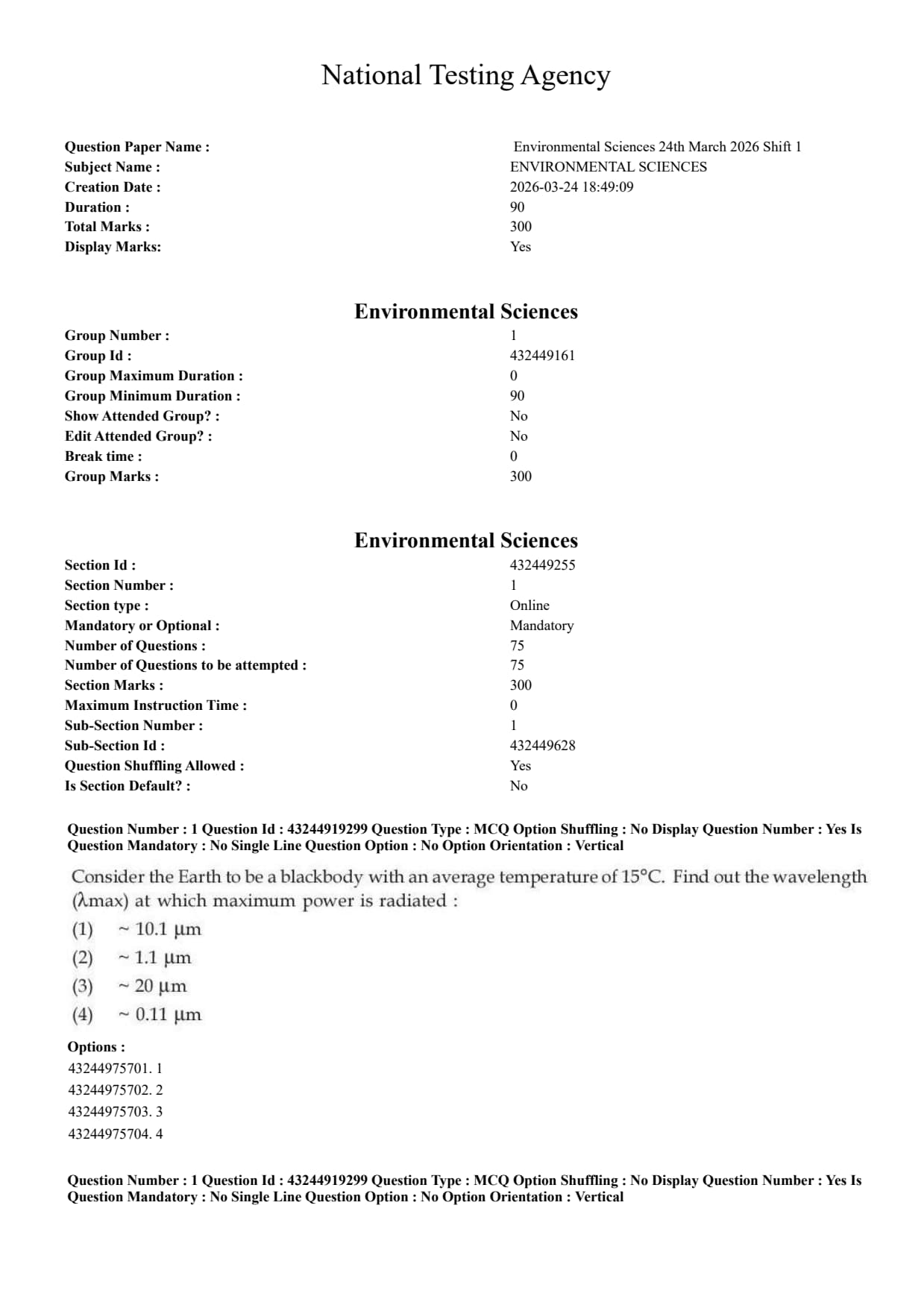
Consider the Earth to be a blackbody with an average temperature of \(15 °C\). Find out the wavelength (\(\lambda_{max}\)) at which maximum power is radiated :
View Solution
Step 1: Understanding the Question:
The question asks for the wavelength of maximum spectral radiance (\(\lambda_{max}\)) emitted by the Earth, assuming it behaves as an ideal blackbody with a surface temperature of \(15^\circC\).
This physical scenario is governed by Wien's Displacement Law, which describes the inverse relationship between the thermodynamic temperature of a blackbody and its peak emission wavelength.
Step 2: Key Formula or Approach:
Wien's Displacement Law is expressed mathematically as:
\[ \lambda_{max} \cdot T = b \]
where:
- \(\lambda_{max}\) is the peak emission wavelength in meters (\(m\)).
- \(T\) is the absolute temperature of the body in Kelvin (\(K\)).
- \(b\) is Wien's displacement constant, approximately equal to \(2898\ \mum\cdotK\) or \(2.898 \times 10^{-3}\ m\cdotK\).
Step 3: Detailed Explanation:
Temperature Conversion:
First, convert the given temperature from Celsius to Kelvin:
\[ T = 15^\circC + 273.15 = 288.15\ K \]
Calculation of Peak Wavelength:
Substitute the absolute temperature \(T = 288.15\ K\) into Wien's formula:
\[ \lambda_{max} = \frac{b}{T} = \frac{2898\ \mum\cdotK}{288.15\ K} \]
\[ \lambda_{max} \approx 10.057\ \mum \approx 10.1\ \mum \]
Environmental Significance:
The wavelength of peak terrestrial radiation lies in the thermal infrared region (\(\sim 10.1\ \mum\)).
This longwave radiation is absorbed by atmospheric greenhouse gases such as water vapor and carbon dioxide, leading to the natural greenhouse effect.
Step 4: Final Answer:
The wavelength at which maximum power is radiated by the Earth is approximately \(10.1\ \mum\).
Quick Tip: Remember that hot bodies (like the Sun at \(\sim 5800\ K\)) emit shortwave radiation (\(\lambda_{max} \approx 0.5\ \mum\)), whereas cooler bodies (like the Earth at \(\sim 288\ K\)) emit longwave thermal radiation (\(\lambda_{max} \approx 10.1\ \mum\)).
Always convert temperatures to Kelvin before applying Wien's law!
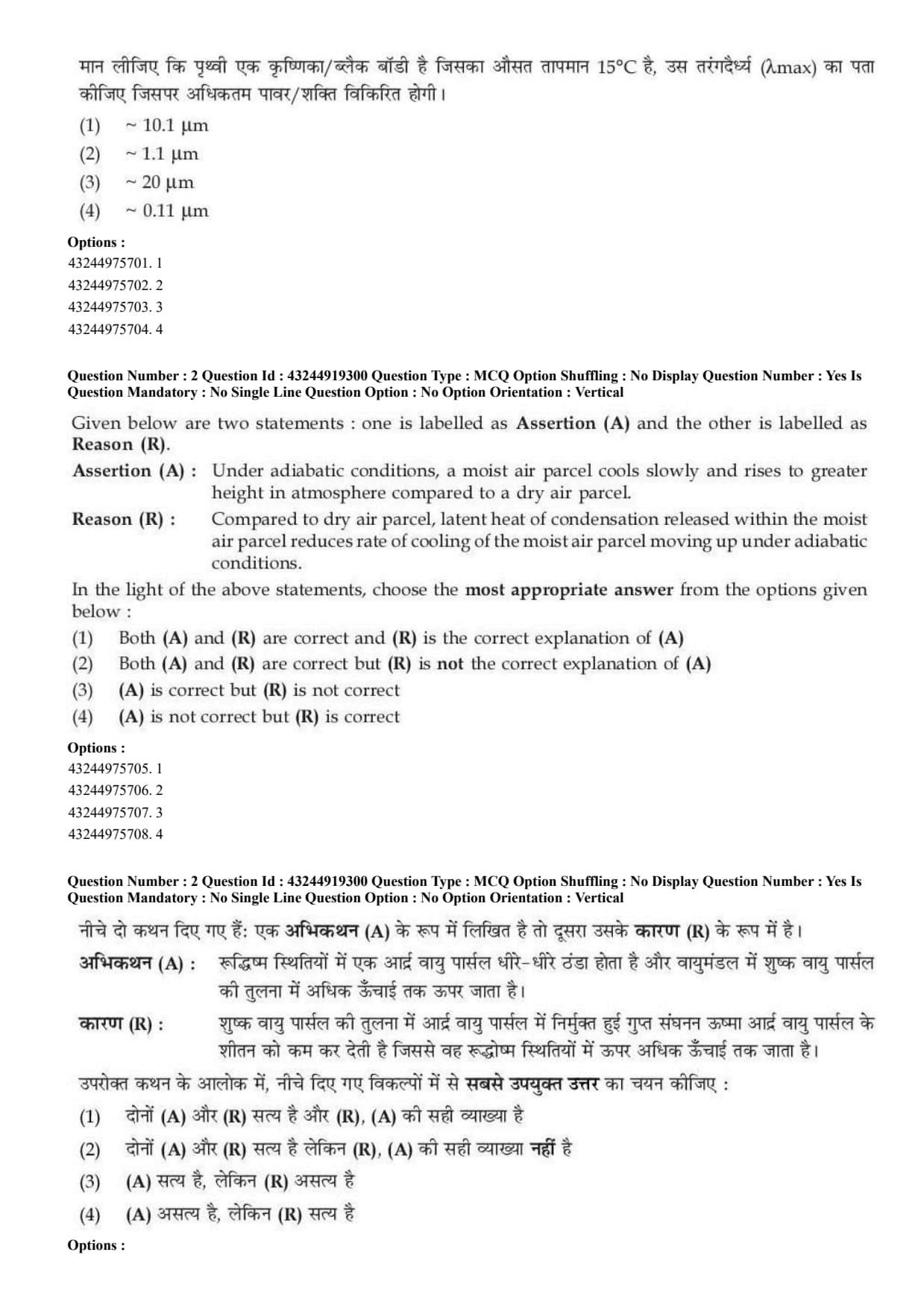
Given below are two statements : one is labelled as Assertion (A) and the other is labelled as Reason (R).
Assertion (A) : Under adiabatic conditions, a moist air parcel cools slowly and rises to greater height in atmosphere compared to a dry air parcel.
Reason (R) : Compared to dry air parcel, latent heat of condensation released within the moist air parcel reduces rate of cooling of the moist air parcel moving up under adiabatic conditions.
In the light of the above statements, choose the most appropriate answer from the options given below :
View Solution
Step 1: Understanding the Question:
The question evaluates atmospheric stability and thermodynamics by comparing the behaviour of dry and moist air parcels rising vertically under adiabatic conditions.
It tests the concept of adiabatic lapse rates and the thermal impact of latent heat release during phase changes of water vapor.
Step 2: Key Formula or Approach:
- Dry Adiabatic Lapse Rate (DALR): Rate of cooling for an unsaturated air parcel, approximately \(9.8^\circC/km\).
- Moist/Saturated Adiabatic Lapse Rate (SALR or MALR): Rate of cooling for a saturated air parcel, typically around \(6.0^\circC/km\).
Step 3: Detailed Explanation:
Analysis of Assertion (A):
As an unsaturated (dry) air parcel rises, it expands and cools at the DALR (\(9.8^\circC/km\)).
When a moist air parcel rises and reaches saturation, water vapor condenses into liquid droplets.
This condensation slows down the rate of cooling (SALR \(\approx 6^\circC/km\)), making the moist air parcel warmer and less dense than surrounding dry air at similar altitudes.
Consequently, the moist air parcel retains its buoyancy for a longer vertical displacement and reaches greater atmospheric heights.
Thus, Assertion (A) is correct.
Analysis of Reason (R):
Phase change of water from vapor to liquid releases latent heat of condensation into the air parcel.
This internal heat input offsets part of the cooling caused by adiabatic expansion, directly lowering the lapse rate from DALR to SALR.
Thus, Reason (R) provides the exact thermodynamic mechanism that explains Assertion (A).
Step 4: Final Answer:
Both (A) and (R) are correct, and (R) is the correct explanation of (A).
Quick Tip: Because SALR (\(6^\circC/km\)) \(<\) DALR (\(9.8^\circC/km\)), moist air parcels remain warmer than dry air parcels at higher altitudes, driving instability and cloud formation!
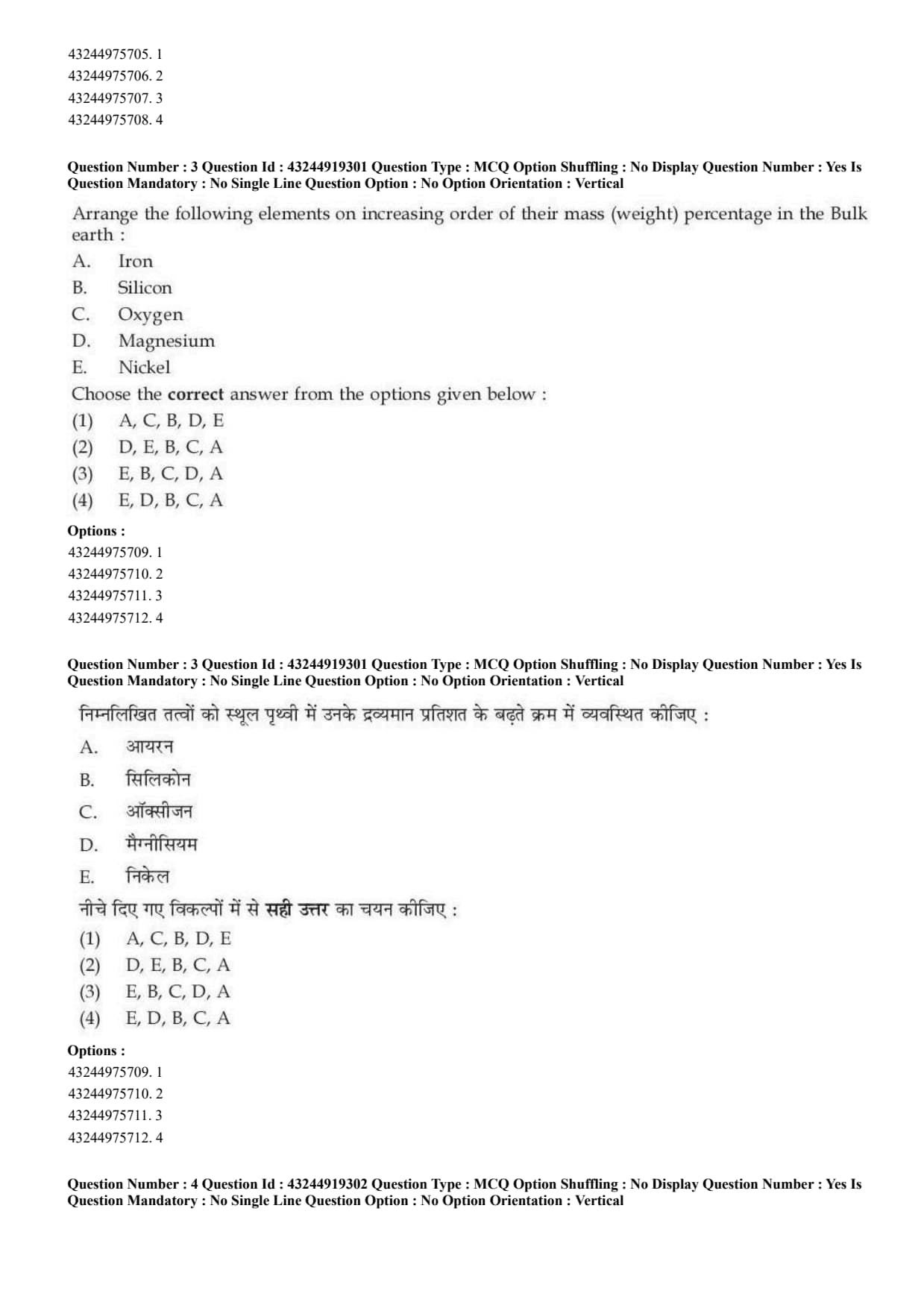
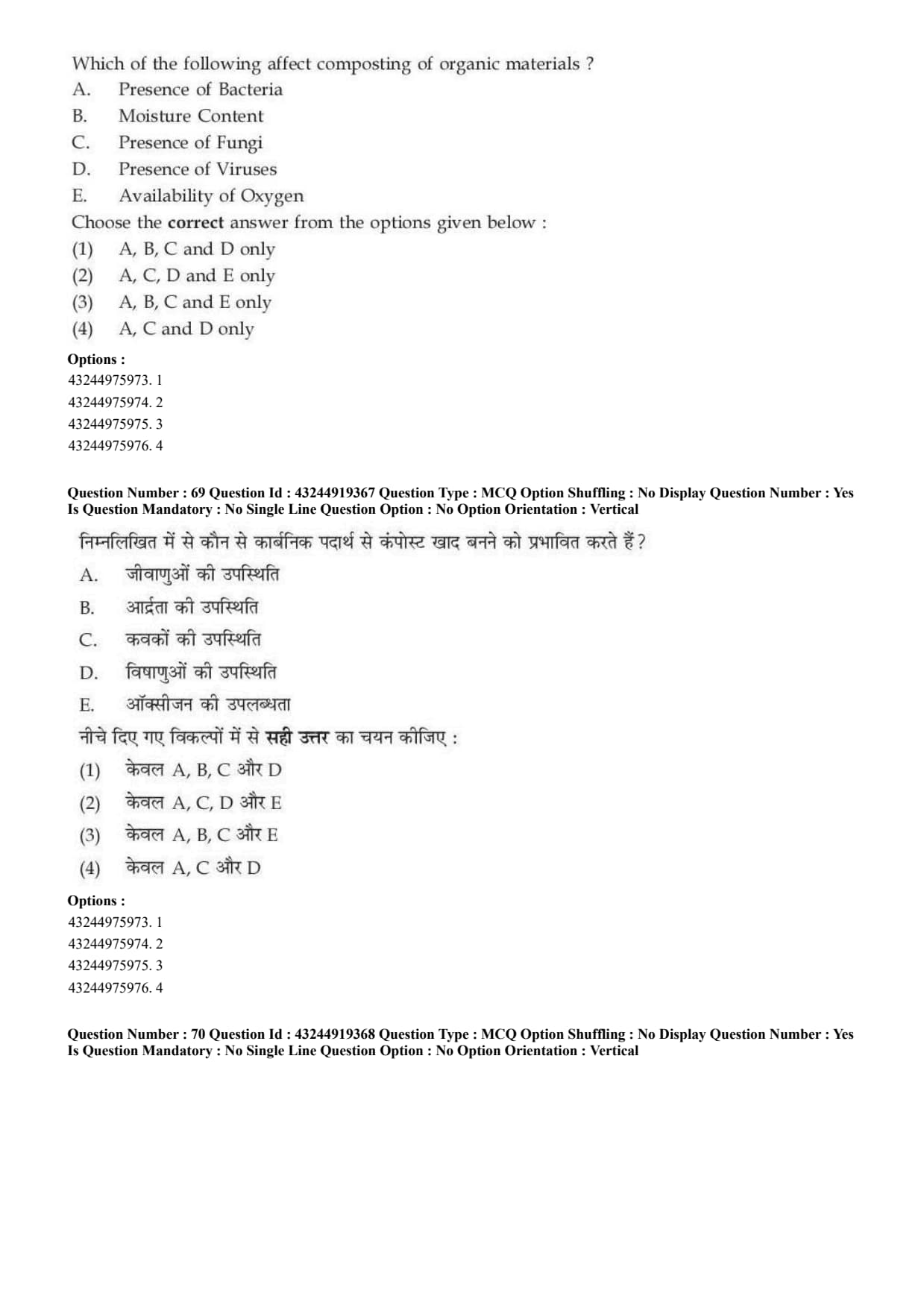
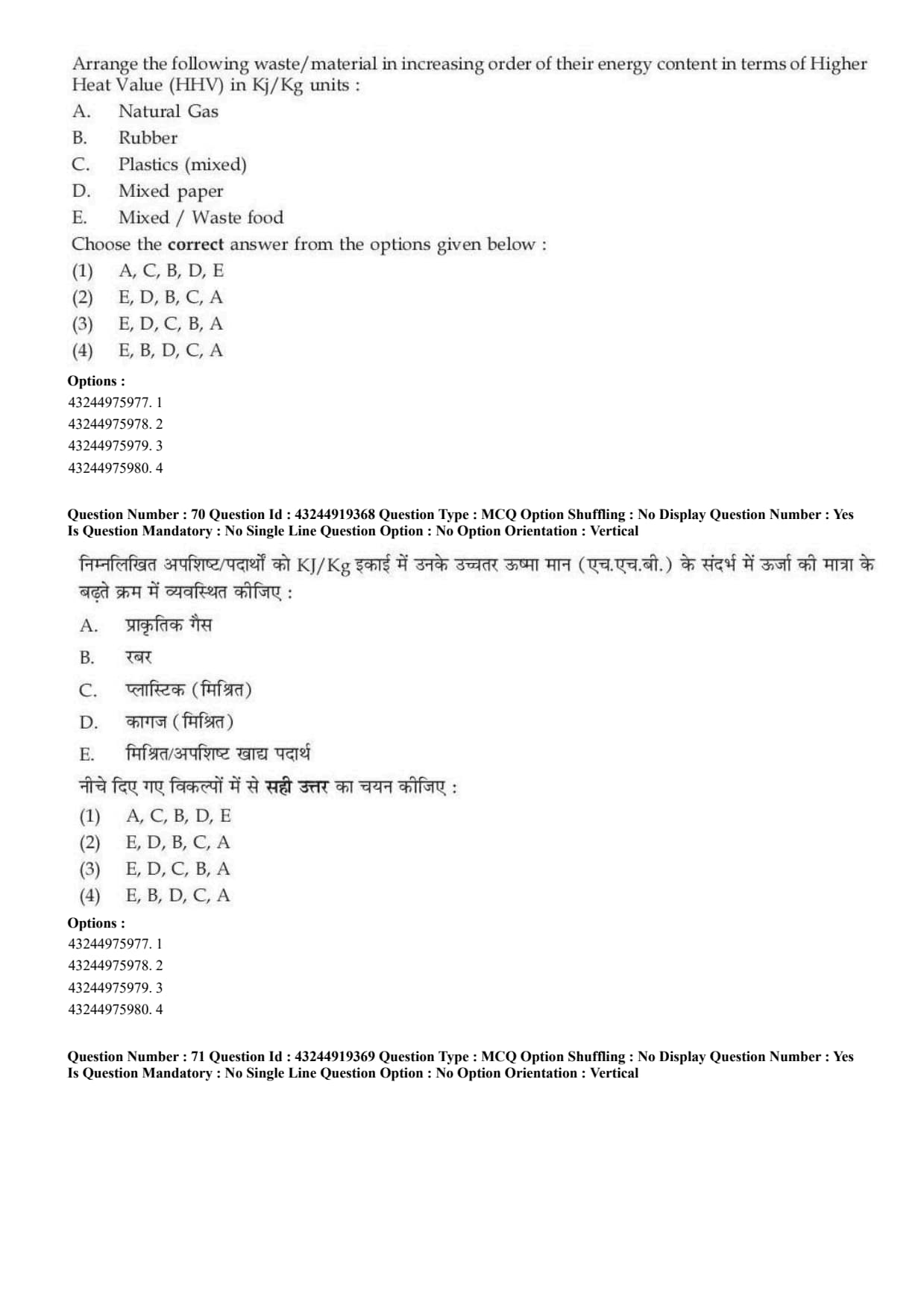
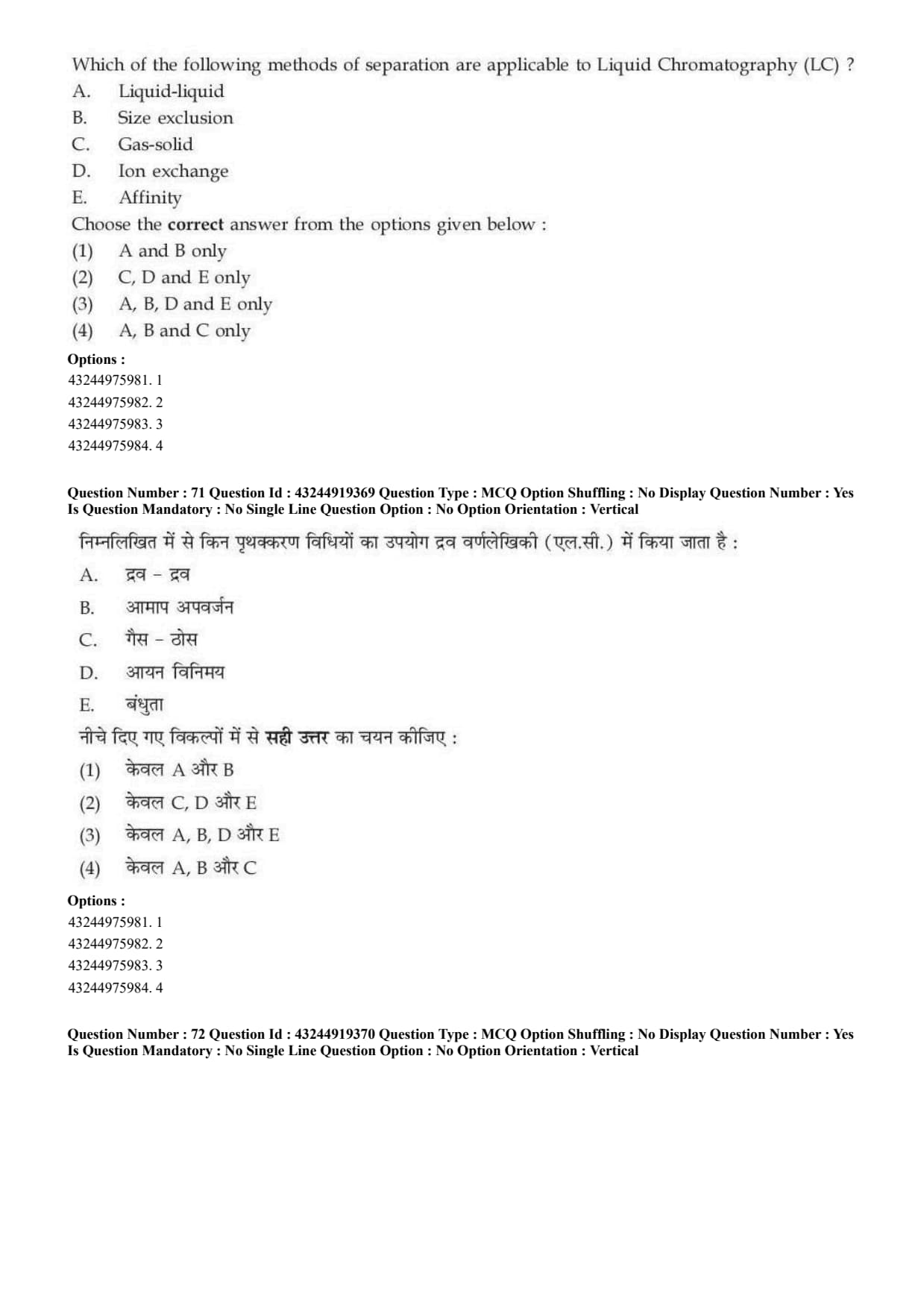
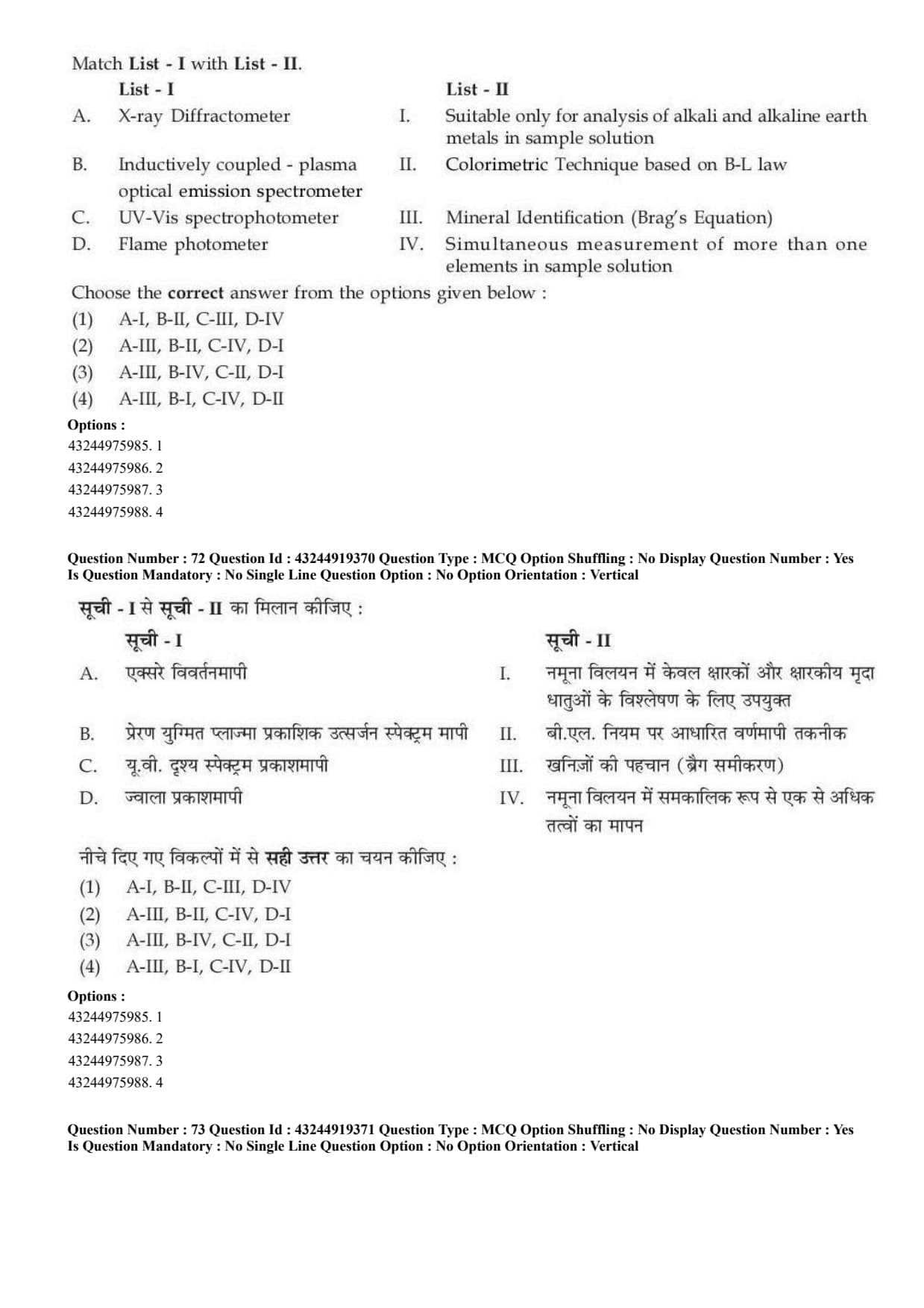
Arrange the following elements on increasing order of their mass (weight) percentage in the Bulk earth :
A. Iron
B. Silicon
C. Oxygen
D. Magnesium
E. Nickel
Choose the correct answer from the options given below :
View Solution
Step 1: Understanding the Question:
The question requires arranging major chemical elements forming the Bulk Earth (including core, mantle, and crust) in increasing order of their abundance by mass percentage.
Step 2: Key Formula or Approach:
Identify the elemental composition of the entire Earth by mass percentage based on geochemical models (e.g., McDonough and Sun, 1995):
- Iron (\(Fe\)): \(\sim 32.1%\)
- Oxygen (\(O\)): \(\sim 30.1%\)
- Silicon (\(Si\)): \(\sim 15.1%\)
- Magnesium (\(Mg\)): \(\sim 13.9%\)
- Nickel (\(Ni\)): \(\sim 1.8%\)
Step 3: Detailed Explanation:
Elemental Abundances in Bulk Earth:
- Nickel (E): Accounts for about \(1.8%\) of the total mass, primarily residing in the metallic core.
- Magnesium (D): Accounts for about \(13.9%\) of the mass, dominant in silicate mantle minerals like olivine and pyroxene.
- Silicon (B): Accounts for about \(15.1%\) of the mass, present as silicates throughout the mantle and crust.
- Oxygen (C): Accounts for about \(30.1%\) of the mass, forming the primary anion in oxides and silicates.
- Iron (A): Accounts for about \(32.1%\) of the total mass, forming the predominant constituent of the core and a major cation in mantle silicates.
Arrangement in Increasing Order:
\text{Nickel (E, 1.8%) \(<\) \text{Magnesium (D, 13.9%) \(<\) \text{Silicon (B, 15.1%) \(<\) \text{Oxygen (C, 30.1%) \(<\) \text{Iron (A, 32.1%)
Therefore, the correct sequence is E, D, B, C, A.
Step 4: Final Answer:
The correct option is (D) corresponding to the order E, D, B, C, A.
Quick Tip: Distinguish between Bulk Earth and Earth's Crust!
For Bulk Earth: Iron \(>\) Oxygen \(>\) Silicon \(>\) Magnesium \(>\) Nickel.
For Earth's Crust: Oxygen \(>\) Silicon \(>\) Aluminium \(>\) Iron.
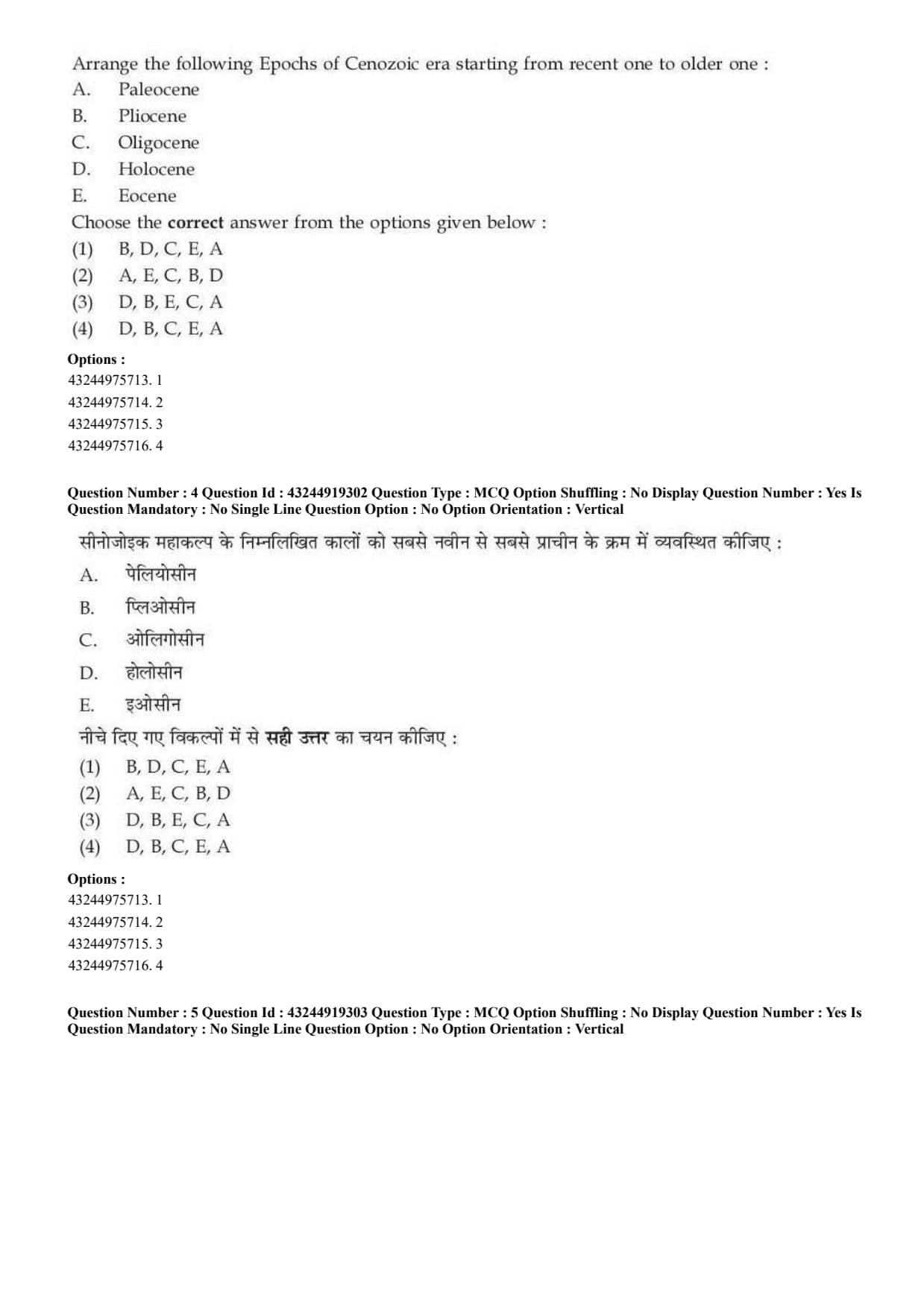
Arrange the following Epochs of Cenozoic era starting from recent one to older one :
A. Paleocene
B. Pliocene
C. Oligocene
D. Holocene
E. Eocene
Choose the correct answer from the options given below :
View Solution
Step 1: Understanding the Question:
This question asks for the chronostratigraphic ordering of epochs belonging to the Cenozoic Era, starting from the most recent epoch to the oldest one.
Step 2: Key Formula or Approach:
Recall the standard Geologic Time Scale for the Cenozoic Era:
- Quaternary Period: Holocene (\(\sim 0.0117\ Ma\) to present), Pleistocene (\(\sim 2.58 - 0.0117\ Ma\)).
- Neogene Period: Pliocene (\(\sim 5.33 - 2.58\ Ma\)), Miocene (\(\sim 23.03 - 5.33\ Ma\)).
- Paleogene Period: Oligocene (\(\sim 33.9 - 23.03\ Ma\)), Eocene (\(\sim 56.0 - 33.9\ Ma\)), Paleocene (\(\sim 66.0 - 56.0\ Ma\)).
Step 3: Detailed Explanation:
Chronological Order (Recent to Oldest):
1. Holocene (D): The current epoch, starting approximately \(11,700\) years ago.
2. Pliocene (B): Spans \(5.33\) to \(2.58\) million years ago.
3. Oligocene (C): Spans \(33.9\) to \(23.03\) million years ago.
4. Eocene (E): Spans \(56.0\) to \(33.9\) million years ago.
5. Paleocene (A): Spans \(66.0\) to \(56.0\) million years ago (immediately following the Cretaceous-Paleogene extinction).
Sequence Verification:
Starting from recent to older: Holocene (D) \(\rightarrow\) Pliocene (B) \(\rightarrow\) Oligocene (C) \(\rightarrow\) Eocene (E) \(\rightarrow\) Paleocene (A).
This corresponds to the sequence D, B, C, E, A.
Step 4: Final Answer:
The correct order from youngest to oldest epoch is D, B, C, E, A, given by option (D).
Quick Tip: Use a mnemonic for Cenozoic epochs (oldest to youngest): \textbf{P}aleocene, \textbf{E}ocene, \textbf{O}ligocene, \textbf{M}iocene, \textbf{P}liocene, \textbf{P}leistocene, \textbf{H}olocene ("\textbf{P}lease \textbf{E}arly Oiled \textbf{M}achines \textbf{P}roduce \textbf{P}erfect \textbf{H}eat"). Reverse it when asked from recent to old!
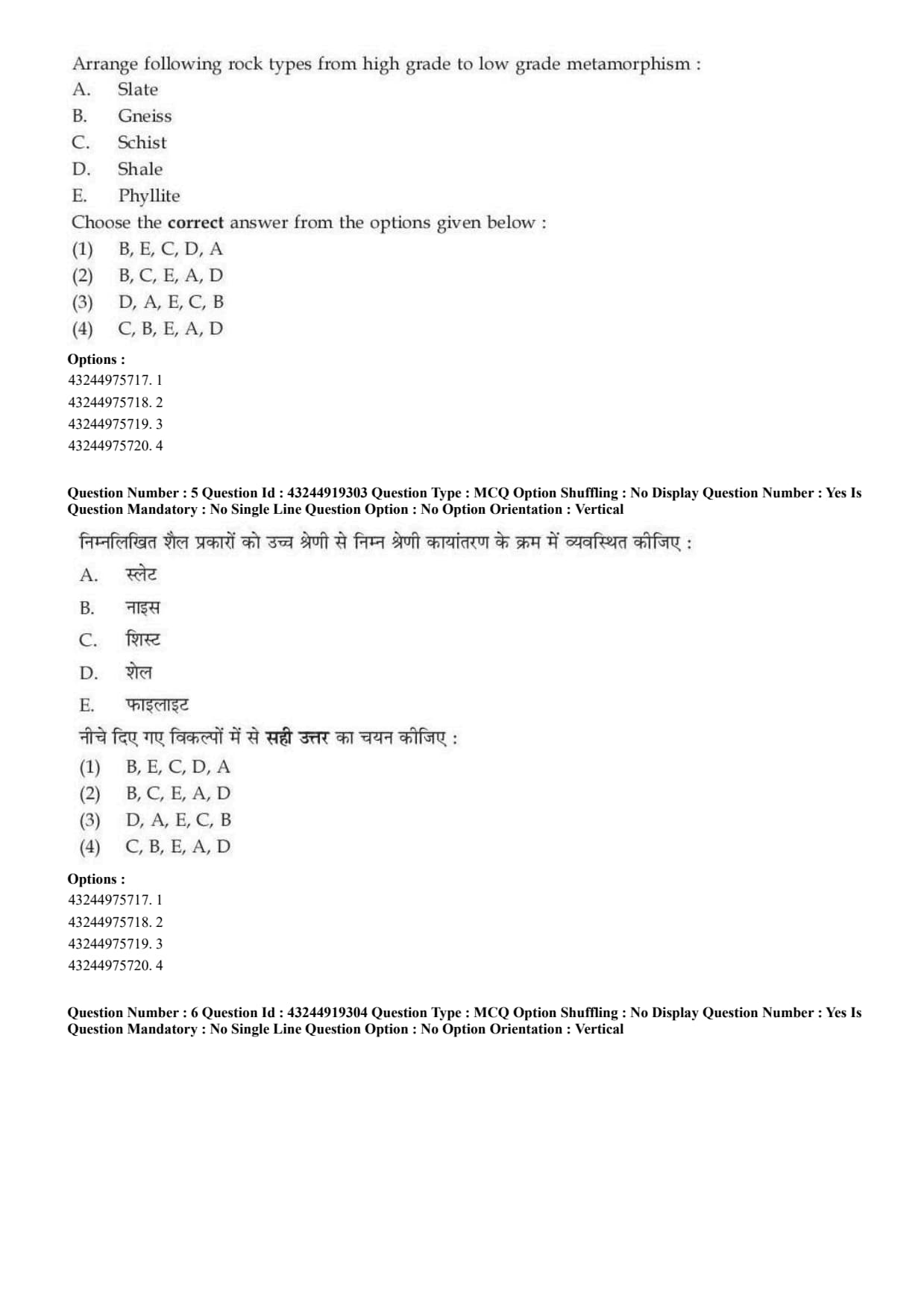
Arrange following rock types from high grade to low grade metamorphism :
A. Slate
B. Gneiss
C. Schist
D. Shale
E. Phyllite
Choose the correct answer from the options given below :
View Solution
Step 1: Understanding the Question:
The question asks to arrange a series of pelitic rocks according to their metamorphic grade, starting from the highest intensity of temperature/pressure (high grade) down to the lowest (unmetamorphosed parent rock).
Step 2: Key Formula or Approach:
Progressive metamorphism of shale (clay-rich sedimentary rock) under increasing temperature and pressure follows a well-established sequence:
\(Shale (Unmetamorphosed) \rightarrow Slate (Low grade) \rightarrow Phyllite (Low-medium grade) \rightarrow Schist (Medium-high grade) \rightarrow Gneiss (High grade)\).
Step 3: Detailed Explanation:
Analysis of Metamorphic Grades:
- Gneiss (B): High-grade metamorphic rock formed under intense pressures and temperatures (\(> 600^\circC\)), characterized by compositional banding of dark and light minerals.
- Schist (C): Medium-to-high grade metamorphic rock with prominent foliation and visible platy minerals like mica (\(400^\circC - 600^\circC\)).
- Phyllite (E): Low-to-medium grade metamorphic rock featuring a glossy sheen due to microscopic mica recrystallization (\(300^\circC - 400^\circC\)).
- Slate (A): Low-grade metamorphic rock characterized by slaty cleavage formed under mild pressures and temperatures (\(200^\circC - 300^\circC\)).
- Shale (D): Unmetamorphosed parent sedimentary rock consisting of compacted fine clay particles.
High Grade to Low Grade Sequence:
\(Gneiss (B) \rightarrow Schist (C) \rightarrow Phyllite (E) \rightarrow Slate (A) \rightarrow Shale (D)\).
Thus, the correct arrangement is B, C, E, A, D.
Step 4: Final Answer:
The correct order from high grade to low grade metamorphism is B, C, E, A, D, which corresponds to option (B).
Quick Tip: Remember the progressive metamorphic order for mudrocks:
\textbf{Shale} \(\rightarrow\) \textbf{Slate} \(\rightarrow\) \textbf{Phyllite} \(\rightarrow\) \textbf{Schist} \(\rightarrow\) \textbf{Gneiss}.
Pay attention to whether the question requests low-to-high or high-to-low order!
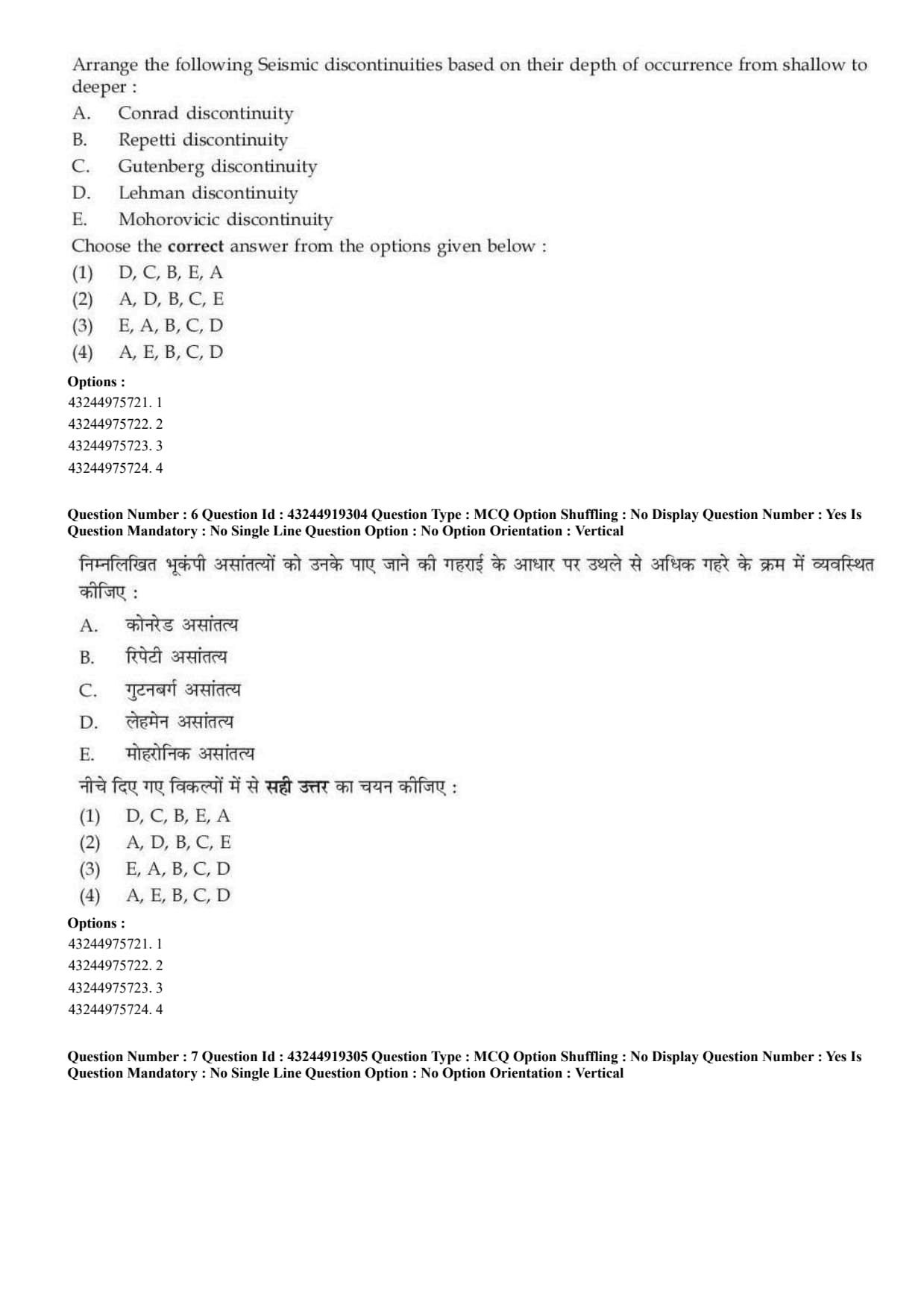
Arrange the following Seismic discontinuities based on their depth of occurrence from shallow to deeper :
A. Conrad discontinuity
B. Repetti discontinuity
C. Gutenberg discontinuity
D. Lehman discontinuity
E. Mohorovicic discontinuity
Choose the correct answer from the options given below :
View Solution
Step 1: Understanding the Question:
The question asks to arrange major seismic boundaries (discontinuities) inside the Earth based on their average depth from the Earth's surface, starting from shallowest to deepest.
Step 2: Key Formula or Approach:
Identify the characteristic depth of each seismic discontinuity:
- Conrad discontinuity: \(\sim 15 - 20\ km\) (Boundary between upper and lower continental crust)
- Mohorovicic discontinuity (Moho): \(\sim 35\ km\) (Boundary between Earth's crust and mantle)
- Repetti discontinuity: \(\sim 660\ km\) (Boundary between upper mantle and lower mantle)
- Gutenberg discontinuity: \(\sim 2890\ km\) (Boundary between mantle and outer liquid core)
- Lehman discontinuity: \(\sim 5150\ km\) (Boundary between outer liquid core and inner solid core)
Step 3: Detailed Explanation:
Detailed Breakdown by Depth:
1. Conrad Discontinuity (A): Found at depths of \(15-20\ km\), separating granitic upper crust from basaltic lower crust.
2. Mohorovicic Discontinuity (E): Located at an average depth of \(35\ km\) beneath continents, marking the density increase from crustal rocks to mantle peridotite.
3. Repetti Discontinuity (B): Situated at approximately \(660\ km\) depth, separating upper transition mantle from lower mantle due to mineral phase transformations.
4. Gutenberg Discontinuity (C): Situated at approximately \(2890\ km\) depth, where S-waves disappear as they enter the liquid outer core.
5. Lehman Discontinuity (D): Located at roughly \(5150\ km\) depth, marking the transition from the liquid outer core to the solid iron-nickel inner core.
Shallow to Deep Sequence:
\(Conrad (A) \rightarrow Mohorovicic (E) \rightarrow Repetti (B) \rightarrow Gutenberg (C) \rightarrow Lehman (D)\).
This corresponds to the sequence A, E, B, C, D.
Step 4: Final Answer:
The correct order from shallow to deeper depth is A, E, B, C, D, which matches option (D).
Quick Tip: Remember the top-to-bottom sequence of Earth's discontinuities:
\textbf{C}onrad \(\rightarrow\) \textbf{M}ohorovicic \(\rightarrow\) \textbf{R}epetti \(\rightarrow\) \textbf{G}utenberg \(\rightarrow\) \textbf{L}ehman (\textbf{C}an \textbf{M}en \textbf{R}each \textbf{G}reat \textbf{L}imits).
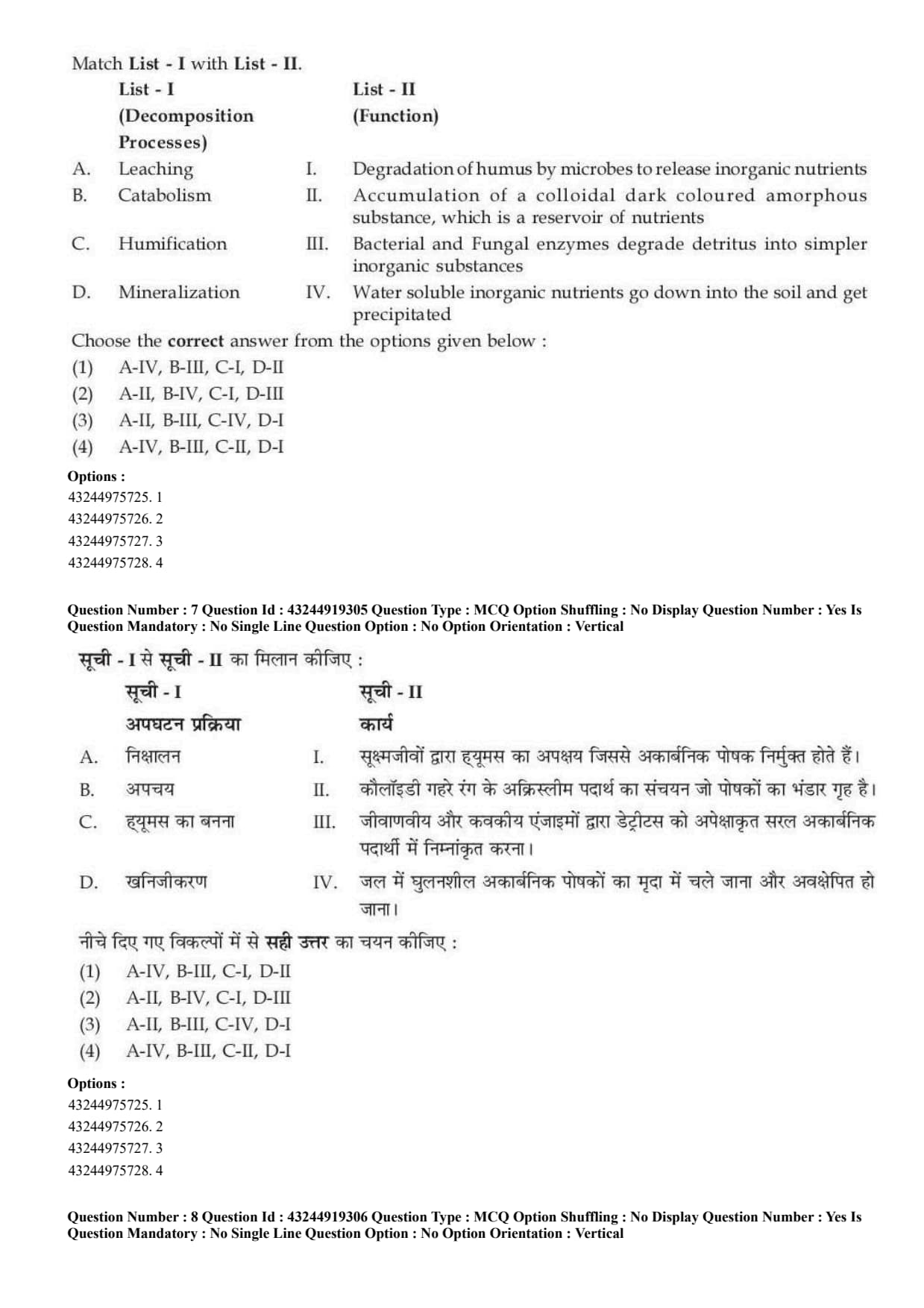
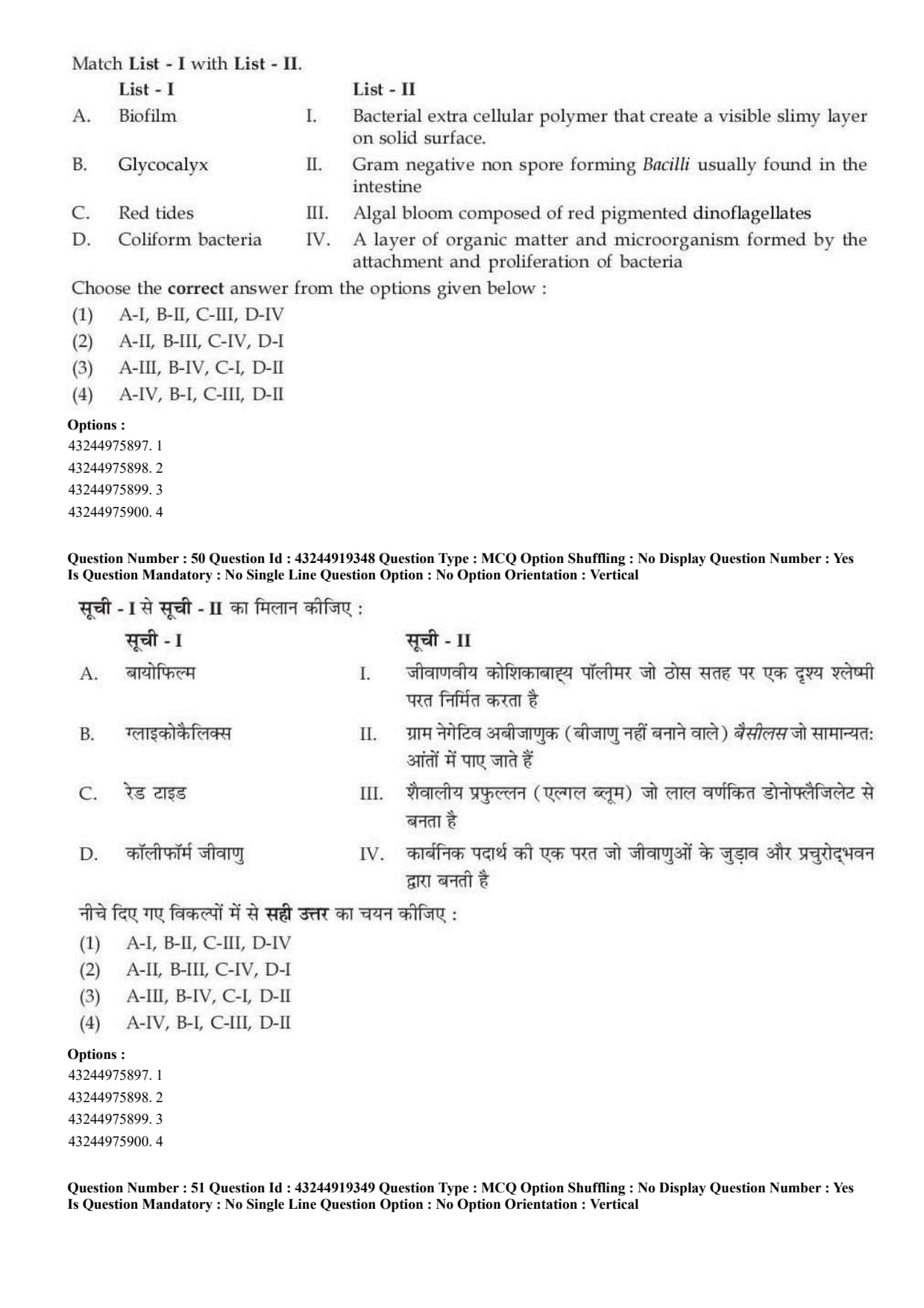
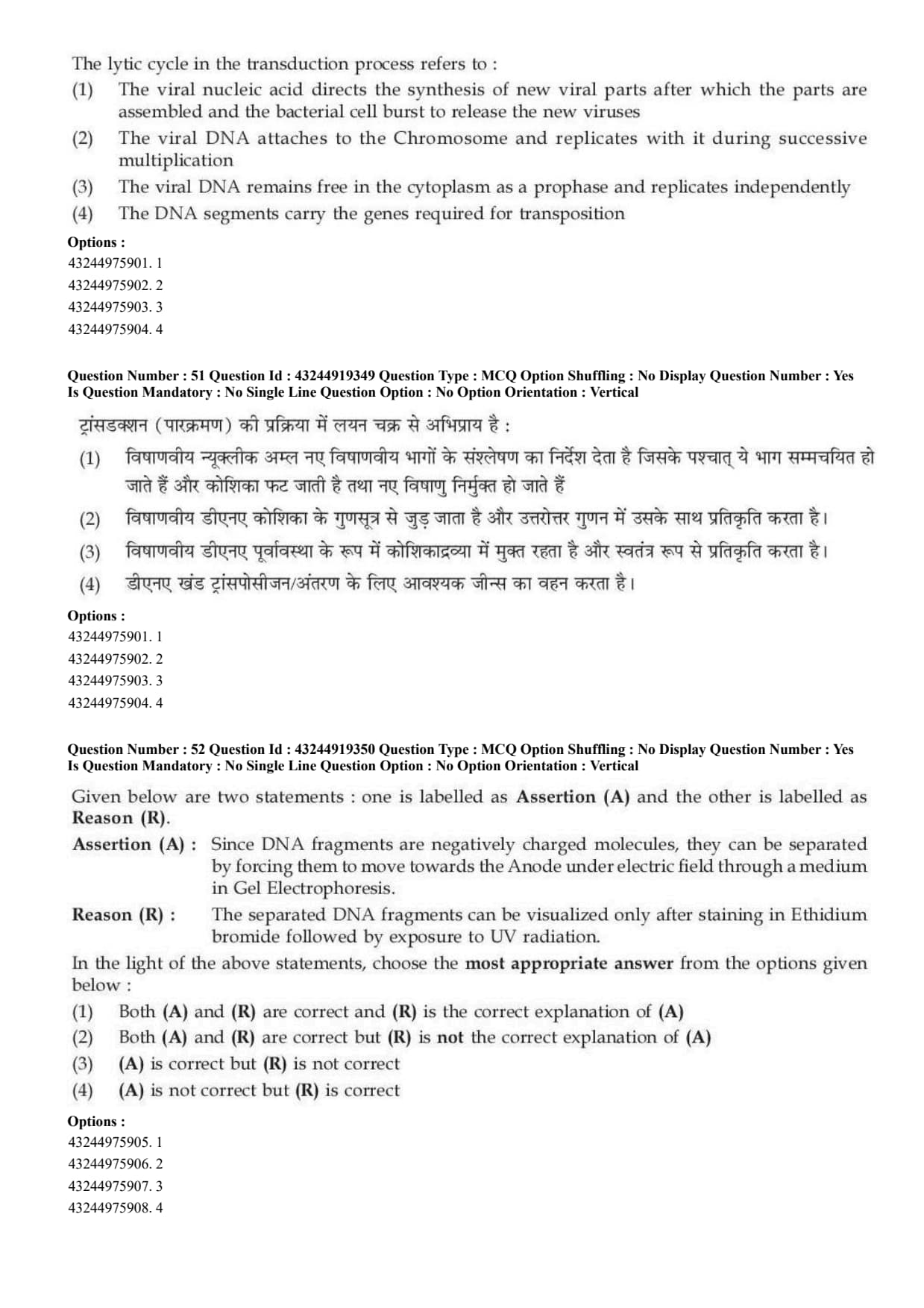
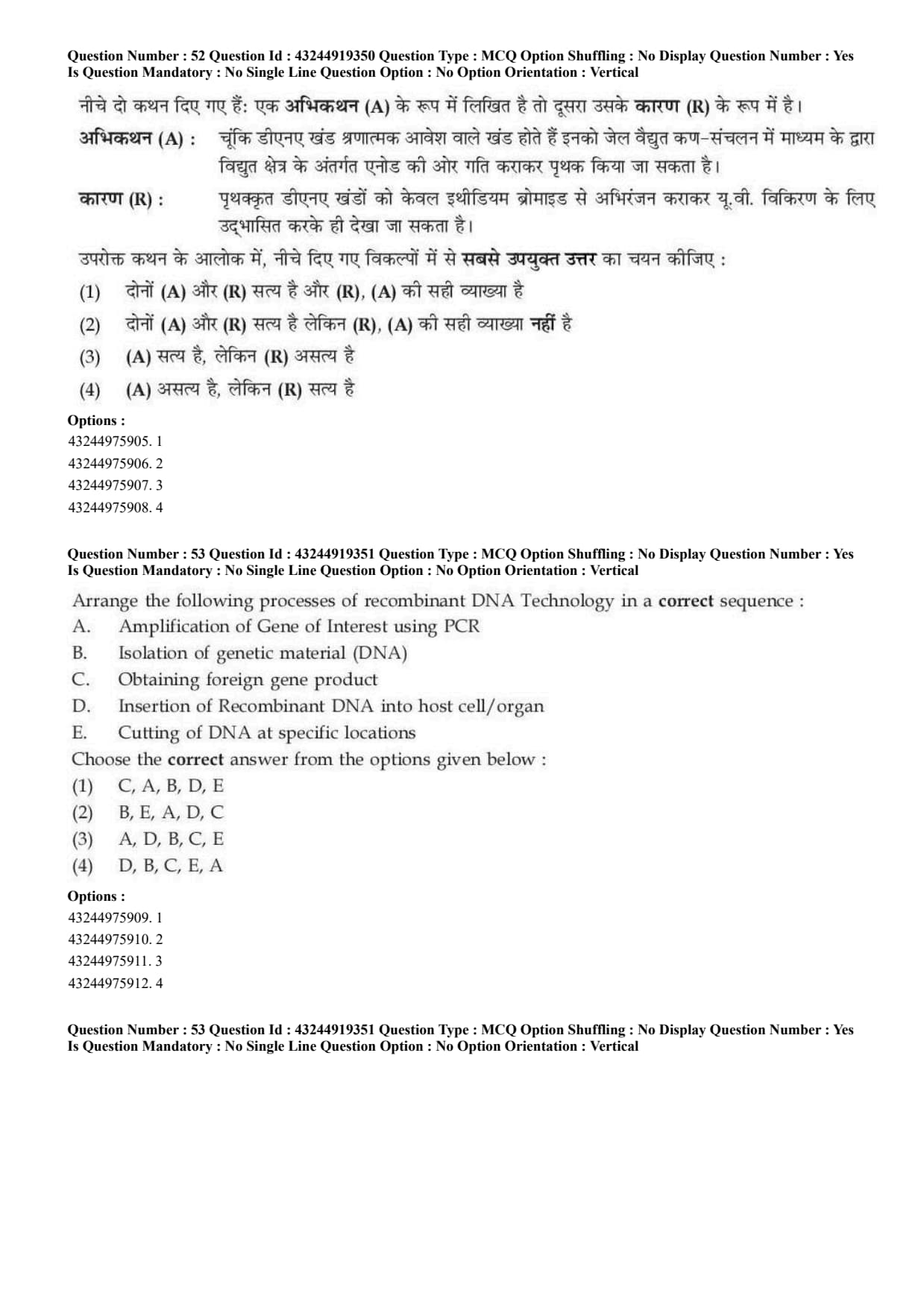
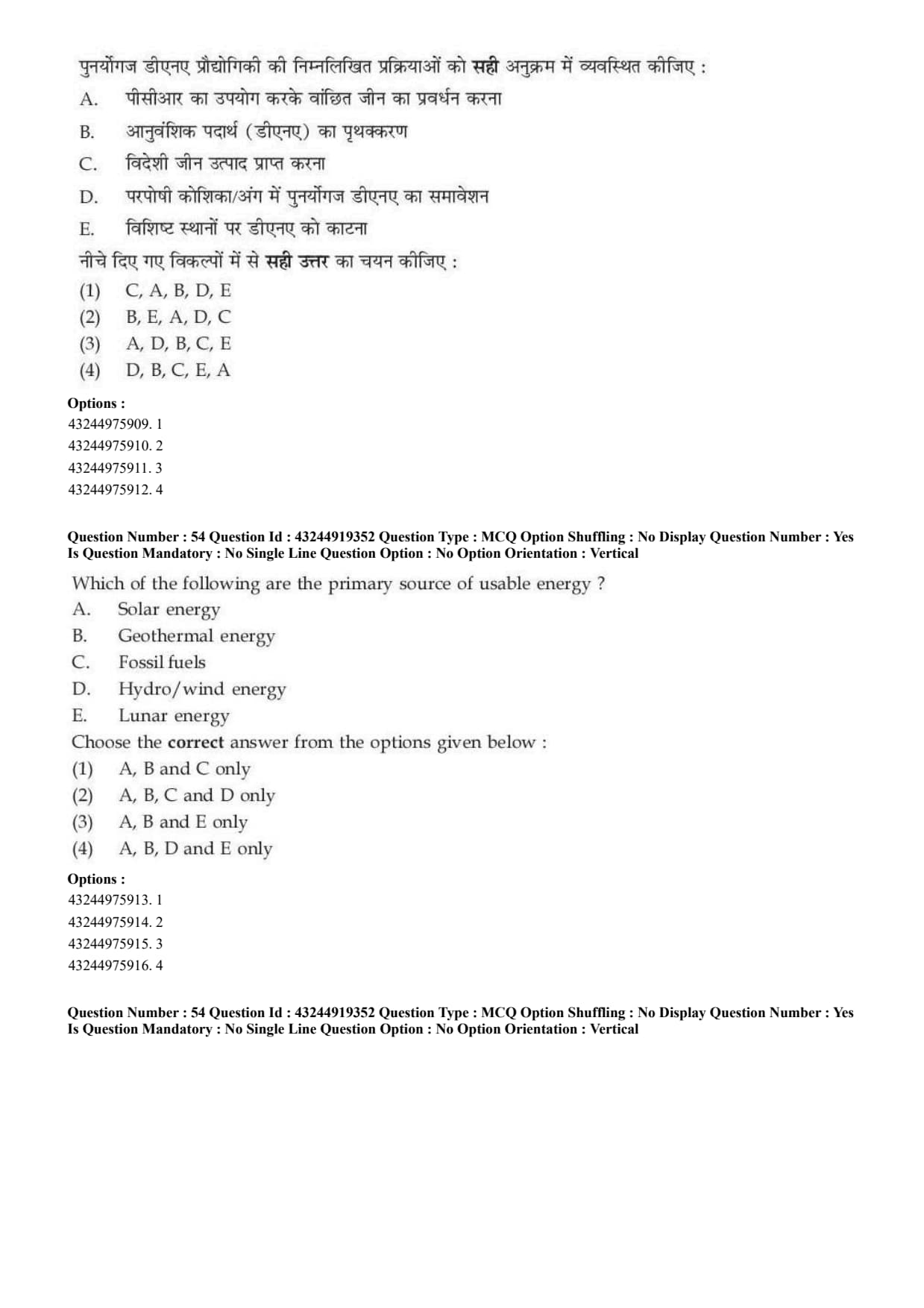
Match List - I with List - II.

Choose the correct answer from the options given below :
View Solution
Step 1: Understanding the Question:
The question asks to match key steps of the decomposition process in ecosystems with their respective defining functions.
Step 2: Key Formula or Approach:
Decomposition of detritus involves fragmentation, leaching, catabolism, humification, and mineralization:
- Leaching: Downward movement of water-soluble inorganic nutrients.
- Catabolism: Enzymatic breakdown of detritus into simpler compounds.
- Humification: Formation and accumulation of colloidal dark humus.
- Mineralization: Release of inorganic nutrients from humus by microbial activity.
Step 3: Detailed Explanation:
A. Leaching (IV): Process by which water-soluble inorganic nutrients seep down into deeper soil horizons via percolating water and become precipitated as unavailable salts.
B. Catabolism (III): Process where saprophytic bacteria and fungi secrete digestive enzymes to convert complex detritus into simpler inorganic substances.
C. Humification (II): Process leading to the accumulation of humus—a dark-coloured, amorphous, highly resistant colloidal substance that serves as a reservoir of nutrients.
D. Mineralization (I): Final step where humus is further degraded by specialized microbes to release mineralized inorganic elements back into the soil solution.
Matching Summary:
A \(\rightarrow\) IV, B \(\rightarrow\) III, C \(\rightarrow\) II, D \(\rightarrow\) I.
Step 4: Final Answer:
The correct matching is given by option (D).
Quick Tip: Humification builds up the nutrient-rich organic reservoir (Humus), while Mineralization breaks down humus to release mineral ions (\(NO_3^-\), \(PO_4^{3-}\), etc.) back to plants!
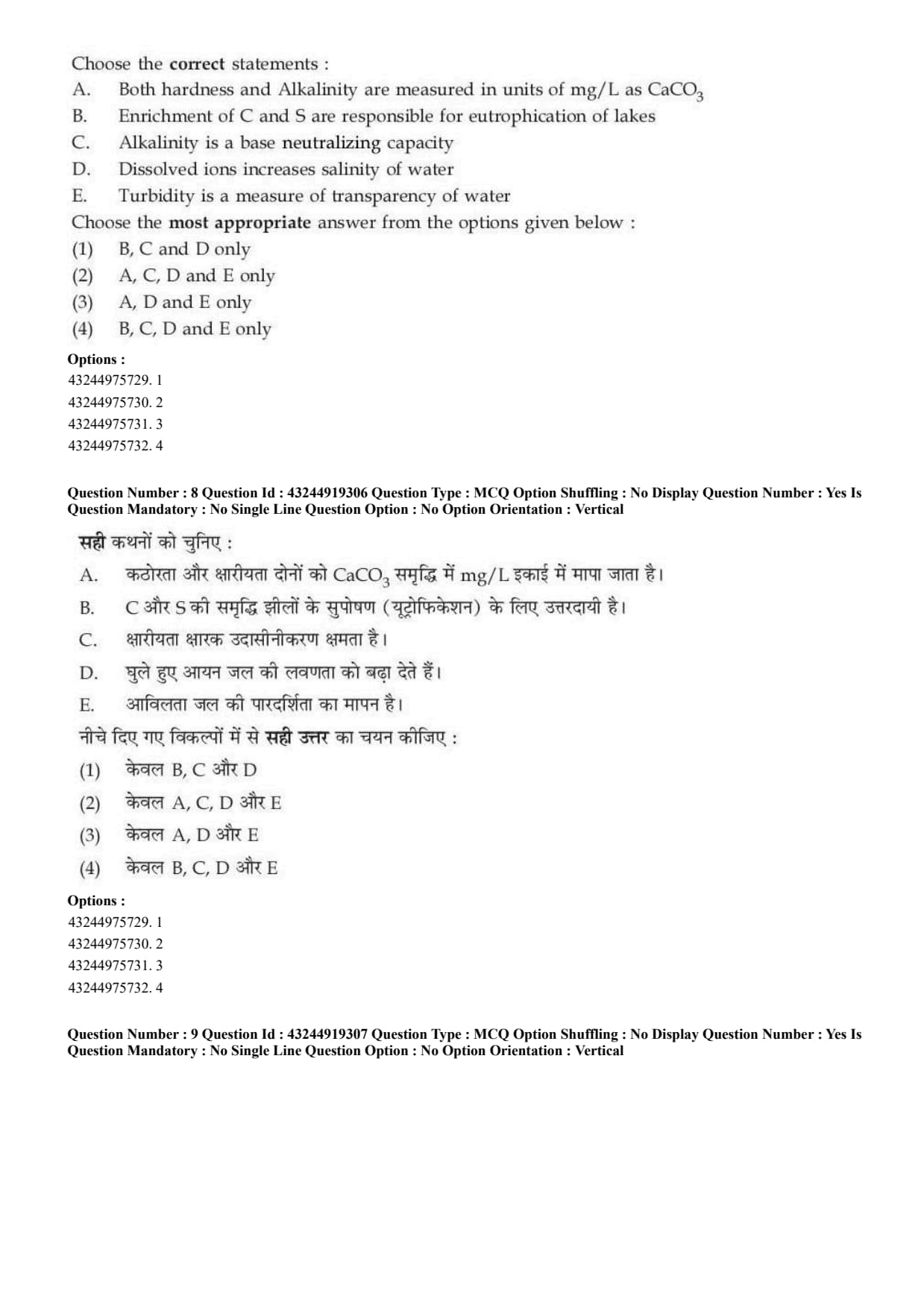
Choose the correct statements :
A. Both hardness and Alkalinity are measured in units of mg/L as \(CaCO_3\)
B. Enrichment of C and S are responsible for eutrophication of lakes
C. Alkalinity is a base neutralizing capacity
D. Dissolved ions increases salinity of water
E. Turbidity is a measure of transparency of water
Choose the most appropriate answer from the options given below :
View Solution
Step 1: Understanding the Question:
The question asks to identify the correct statements regarding water chemistry, water quality parameters, and limnological principles.
Step 2: Key Formula or Approach:
Evaluate each statement individually based on standard aquatic chemistry principles.
Step 3: Detailed Explanation:
Statement A: Both hardness and Alkalinity are measured in units of mg/L as \(CaCO_3\).
This is correct. Standard water quality reporting expresses both total hardness (multivalent cations like \(Ca^{2+\) and \(Mg^{2+}\)) and alkalinity (acid-neutralizing ions like \(HCO_3^-\), \(CO_3^{2-}\), and \(OH^-\)) in terms of equivalent mass of calcium carbonate (\(mg/L as CaCO_3\)).
Statement B: Enrichment of C and S are responsible for eutrophication of lakes.
This is incorrect. Eutrophication is caused by the excessive nutrient enrichment of Nitrogen (\(N\)) and Phosphorus (\(P\)), which are the primary limiting nutrients in aquatic ecosystems.
Statement C: \textit{Alkalinity is a base neutralizing capacity.
This is incorrect. Alkalinity is defined as the acid-neutralizing capacity of water (ability to resist \(pH\) drop upon acid addition). Acidity is the base-neutralizing capacity.
Statement D: \textit{Dissolved ions increases salinity of water.
This is correct. Salinity is a direct measure of total dissolved inorganic salts and ions (\(Na^+\), \(Cl^-\), \(SO_4^{2-\), \(Ca^{2+}\), etc.) present in water.
Statement E: \textit{Turbidity is a measure of transparency of water.
This is correct. Turbidity quantifies the clarity or loss of transparency in water caused by suspended particulate matter scattering light.
Conclusion:
Statements A, D, and E are correct.
Step 4: Final Answer:
The correct choice is option (C), which contains A, D and E only.
Quick Tip: Remember:
- Alkalinity = Acid Neutralizing Capacity (\(ANC\)).
- Limiting Nutrients for Eutrophication = Nitrogen (\(N\)) and Phosphorus (\(P\)).
- Standard Units for Hardness/Alkalinity = \(mg/L as CaCO_3\).
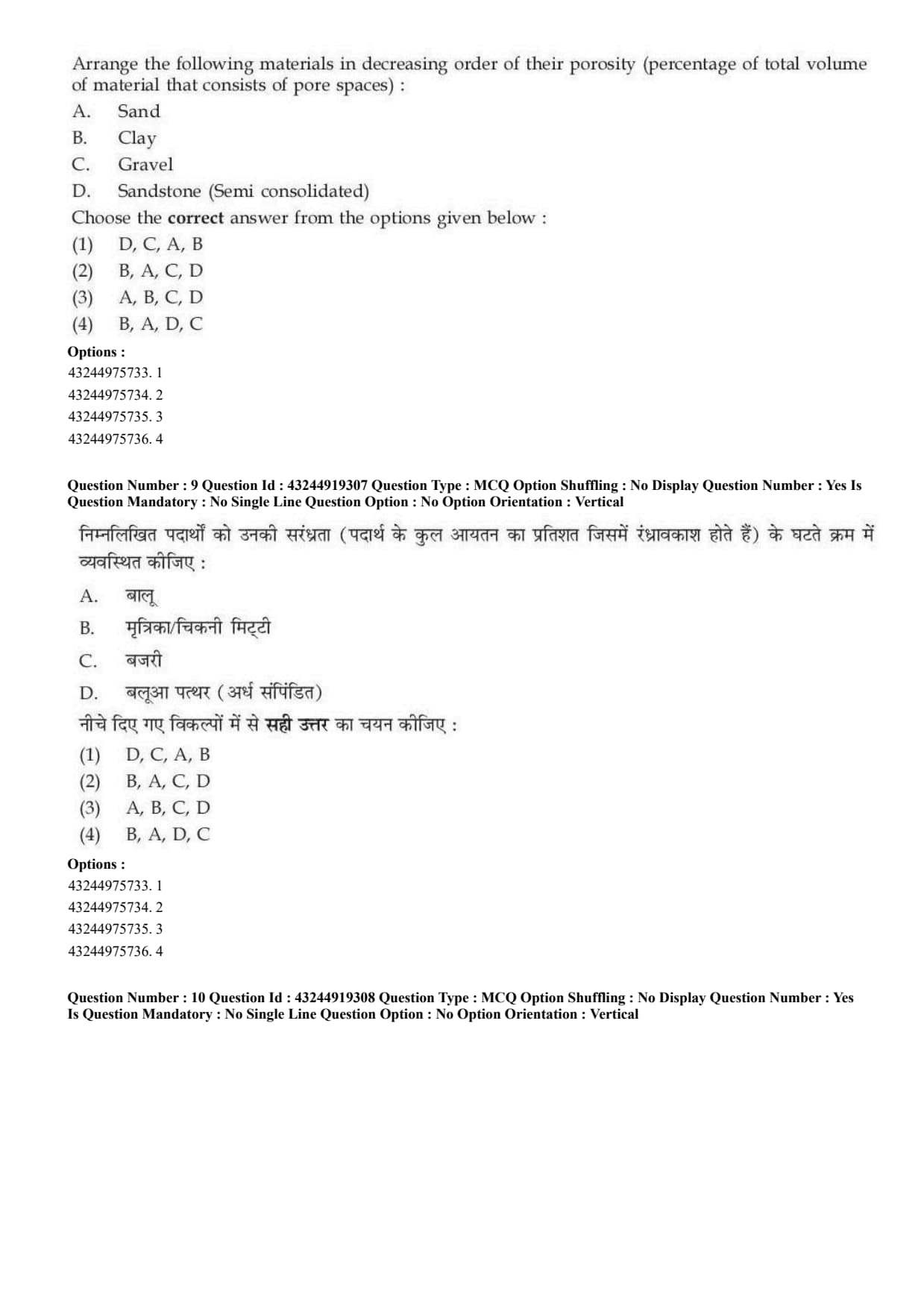
Arrange the following materials in decreasing order of their porosity (percentage of total volume of material that consists of pore spaces) :
A. Sand
B. Clay
C. Gravel
D. Sandstone (Semi consolidated)
Choose the correct answer from the options given below :
View Solution
Step 1: Understanding the Question:
The question asks to arrange geological materials according to their total porosity (fraction of total volume occupied by void space) in decreasing order.
Step 2: Key Formula or Approach:
Porosity (\(\eta\)) is defined as:
\[ \eta = \frac{V_{void}}{V_{total}} \times 100% \]
Typical porosity ranges for standard geologic materials are:
- Clay: \(40% - 60%\)
- Sand: \(30% - 50%\)
- Gravel: \(25% - 40%\)
- Sandstone (semi-consolidated rock): \(10% - 30%\)
Step 3: Detailed Explanation:
Analysis of Material Porosity:
- Clay (B): Possesses the highest porosity (\(45% - 60%\)) because fine, sheet-like clay mineral grains create abundant microscopic interstitial voids, even though individual pores are tiny.
- Sand (A): Unconsolidated medium grains exhibit well-sorted porosity ranging between \(35% - 45%\).
- Gravel (C): Coarse particles pack together efficiently, leaving larger individual pores but a slightly lower overall percentage of total void space (\(30% - 40%\)).
- Sandstone (D): Consolidation and mineral cementation fill initial intergranular pores, lowering total porosity to around \(10% - 25%\).
Decreasing Order Sequence:
\(Clay (B) > Sand (A) > Gravel (C) > Sandstone (D)\).
This corresponds to the sequence B, A, C, D.
Step 4: Final Answer:
The correct order of decreasing porosity is B, A, C, D, which corresponds to option (B).
Quick Tip: Do not confuse porosity with permeability!
Clay has high porosity but extremely low permeability due to tiny pore throat sizes. Gravel has moderate porosity but very high permeability!
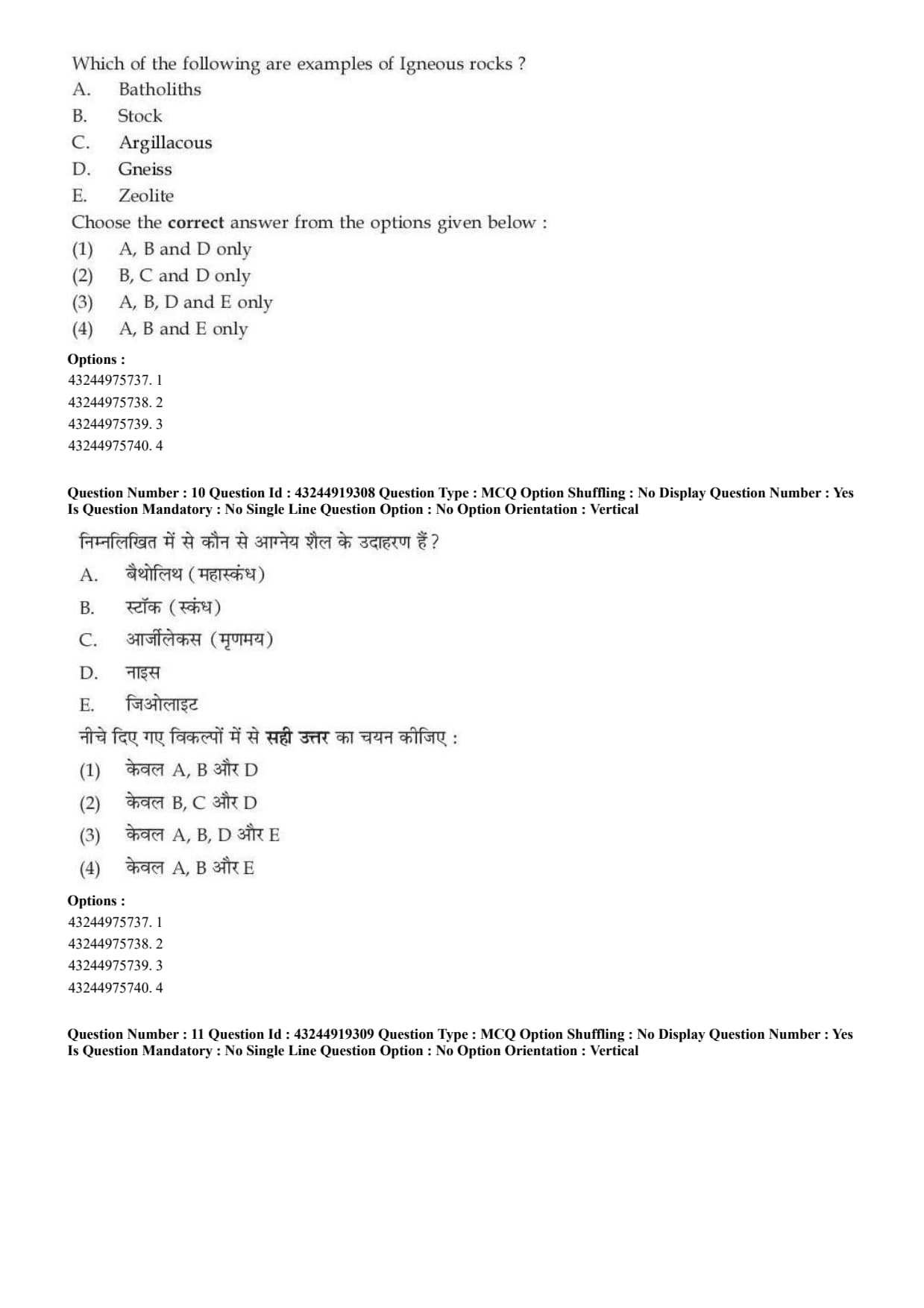
Which of the following are examples of Igneous rocks / bodies ?
A. Batholiths
B. Stock
C. Argillaceous
D. Gneiss
E. Zeolite
Choose the correct answer from the options given below :
View Solution
Step 1: Understanding the Question:
The question asks to identify which options among the listed items represent igneous rock bodies, structures, or minerals associated with igneous origin.
Step 2: Key Formula or Approach:
Categorize each option based on petrological classification:
- Intrusive Igneous Bodies: Batholiths, Stocks, Laccoliths, Dykes, Sills.
- Sedimentary: Argillaceous rocks (clay-rich sedimentary rocks like shale/mudstone).
- Metamorphic: Gneiss (high-grade foliated metamorphic rock).
- Volcanic/Igneous Minerals: Zeolites (hydrous aluminosilicates forming in vesicular volcanic basalts).
Step 3: Detailed Explanation:
A. Batholiths: Large intrusive igneous rock bodies (\(> 100\ km^2\) area) formed by the cooling of magma deep within Earth's crust. (Igneous)
B. Stock: A smaller intrusive plutonic igneous body (\(< 100\ km^2\) surface exposure). (Igneous)
C. Argillaceous: Pertains to clay-rich sedimentary rocks (e.g., shale, siltstone). (Not Igneous)
D. Gneiss: High-grade metamorphic rock formed from regional metamorphism of granite or sedimentary rocks. (Not Igneous)
E. Zeolite: Micro-porous aluminosilicate minerals that crystallize primarily inside volcanic igneous cavities and low-grade altered igneous matrices. (Igneous association)
Selection of Options:
A, B, and E belong to igneous formations and mineral associations, while C is sedimentary and D is metamorphic.
Step 4: Final Answer:
The correct combination is A, B and E only, given by option (D).
Quick Tip: Plutons (Batholith, Stock, Laccolith, Lopolith, Dyke, Sill) are intrusive igneous features. Eliminate metamorphic rocks like Gneiss and sedimentary types like Argillaceous directly!
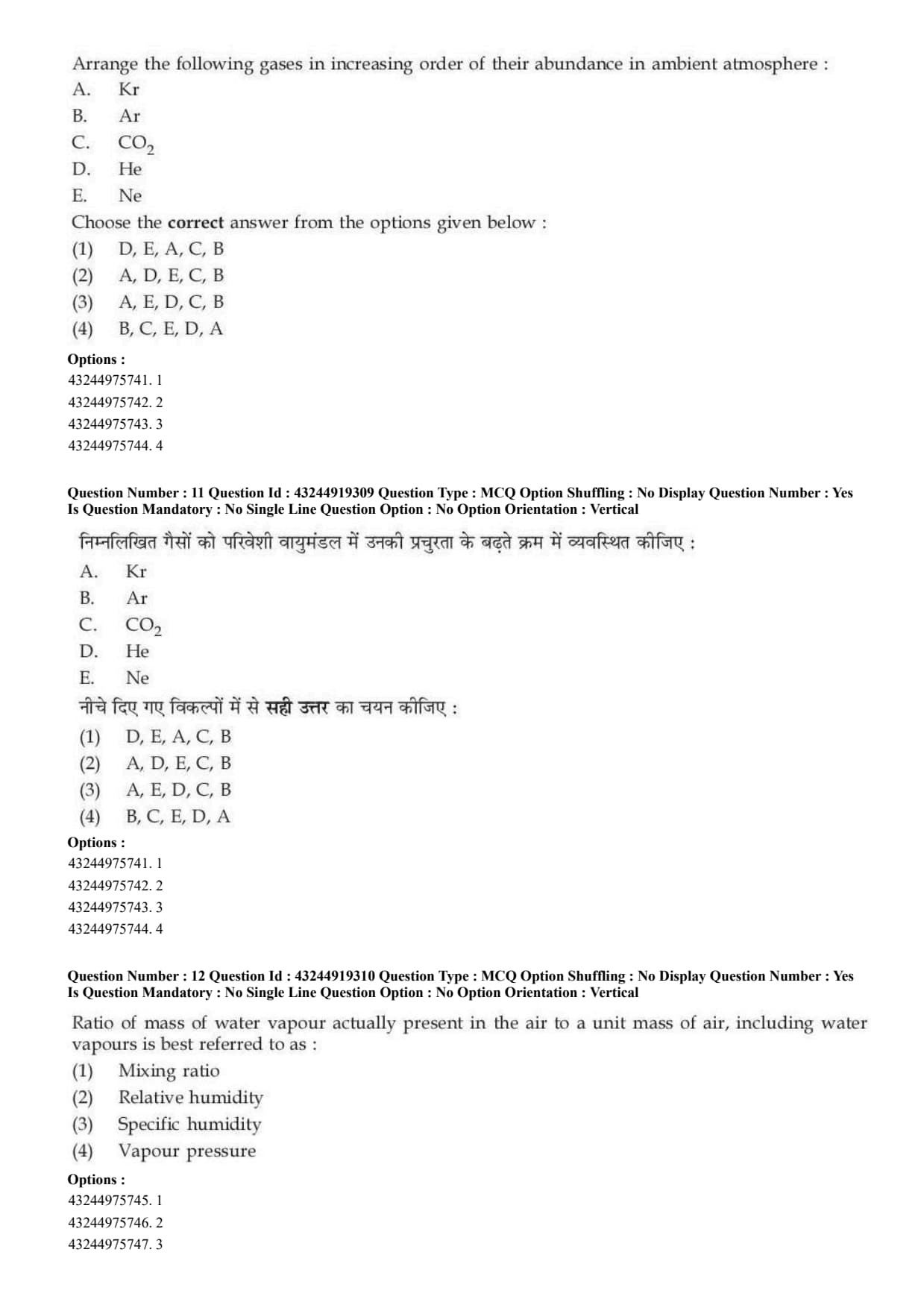
Arrange the following gases in increasing order of their abundance in ambient atmosphere :
A. Kr
B. Ar
C. \(CO_2\)
D. He
E. Ne
Choose the correct answer from the options given below :
View Solution
Step 1: Understanding the Question:
The question requires arranging atmospheric trace gases in increasing order of their concentration (volume percentage or parts per million, ppm) in the unpolluted ambient atmosphere.
Step 2: Key Formula or Approach:
List the standard volumetric concentrations of these gases in dry air:
- Krypton (\(Kr\)): \(\sim 1.14\ ppmv\)
- Helium (\(He\)): \(\sim 5.24\ ppmv\)
- Neon (\(Ne\)): \(\sim 18.18\ ppmv\)
- Carbon dioxide (\(CO_2\)): \(\sim 420\ ppmv\) (\(0.042%\))
- Argon (\(Ar\)): \(\sim 9340\ ppmv\) (\(0.934%\))
Step 3: Detailed Explanation:
Gas Volumetric Concentration Analysis:
1. Krypton (A): Trace noble gas present at \(\sim 1.14\ ppmv\).
2. Helium (D): Trace noble gas present at \(\sim 5.24\ ppmv\).
3. Neon (E): Noble gas present at \(\sim 18.18\ ppmv\).
4. Carbon Dioxide (C): Major trace greenhouse gas present at \(\sim 420\ ppmv\).
5. Argon (B): Third most abundant atmospheric constituent overall, at \(\sim 9340\ ppmv\) (\(0.934%\)).
Increasing Order Sequence:
Kr (A, 1.14\ \text{ppm) \(<\) \text{He (D, 5.24\ \text{ppm) \(<\) \text{Ne (E, 18.18\ \text{ppm) \(<\) \text{CO_2\text{ (C, 420\ \text{ppm) \(<\) \text{Ar (B, 9340\ \text{ppm)
This corresponds to the sequence A, D, E, C, B.
Step 4: Final Answer:
The correct order from lowest to highest concentration is A, D, E, C, B, matching option (B).
Quick Tip: Atmospheric composition sequence (highest to lowest abundance):
\(\text{N_2\ (78%) > O_2\ (21%) > Ar\ (0.93%) > CO_2\ (0.04%) > Ne > He > CH_4 > Kr\).
Ratio of mass of water vapour actually present in the air to a unit mass of air, including water vapours is best referred to as :
View Solution
Step 1: Understanding the Question:
The question asks to identify the precise meteorological term defined by the ratio of the mass of water vapor present in an air parcel to the total mass of the moist air parcel (including dry air plus water vapor).
Step 2: Key Formula or Approach:
Define fundamental atmospheric humidity parameters:
- Specific Humidity (\(q\)): \[ q = \frac{m_v}{m_v + m_d} = \frac{m_v}{m_{total}} \]
where \(m_v\) is mass of water vapor and \(m_d\) is mass of dry air.
- Mixing Ratio (\(r\)): \[ r = \frac{m_v}{m_d} \]
- Relative Humidity (\(RH\)): \[ RH = \frac{e}{e_s} \times 100% \]
Step 3: Detailed Explanation:
Specific Humidity Definition:
By definition, specific humidity represents the ratio of the mass of water vapor (\(m_v\)) to the overall total mass of moist air (\(m_{total} = m_v + m_d\)).
It is usually expressed in units of grams of water vapor per kilogram of moist air (\(g/kg\)).
Comparison with Mixing Ratio:
Unlike specific humidity, the mixing ratio considers the mass of water vapor relative only to dry air (\(m_d\)), ignoring the vapor mass in the denominator.
Conservation Property:
Specific humidity remains constant when an air parcel expands or contracts, provided no moisture is added or removed, making it a robust conservative tracer in meteorology.
Step 4: Final Answer:
The specified ratio describes Specific humidity, corresponding to option (C).
Quick Tip: Key distinction:
- Water vapor / \textbf{Total moist air} = \textbf{Specific Humidity}.
- Water vapor / \textbf{Dry air} = \textbf{Mixing Ratio}.
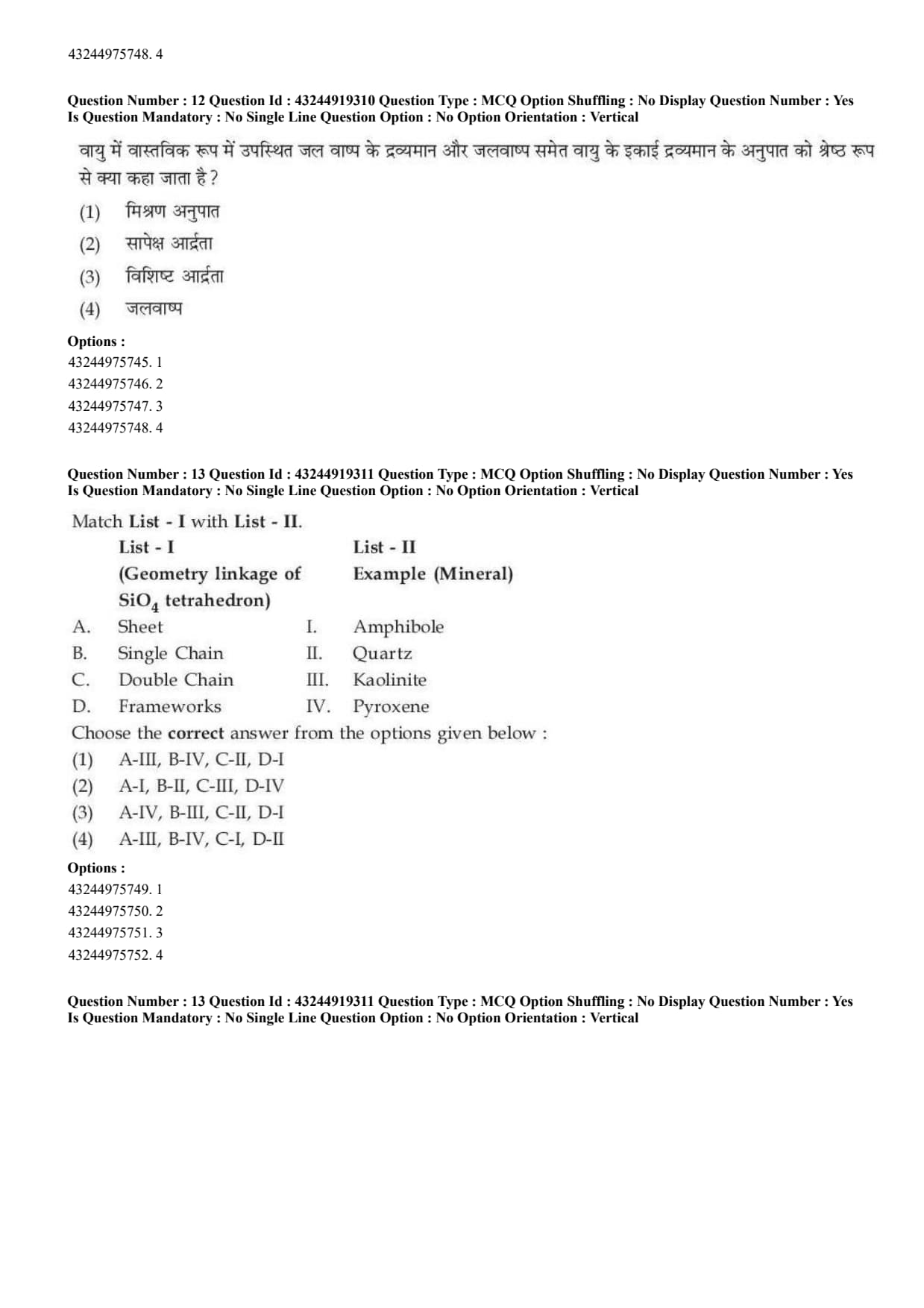
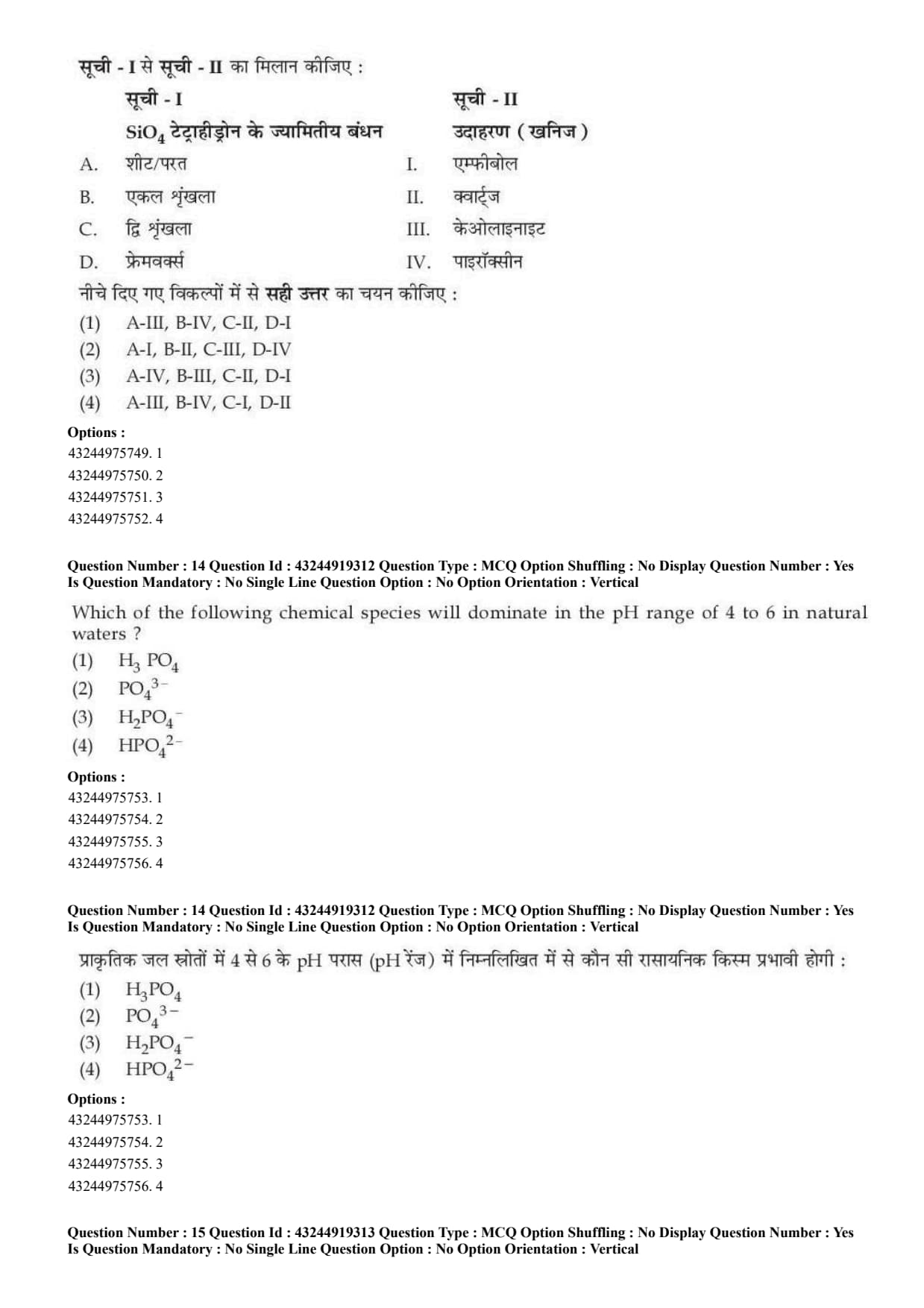
Match List - I with List - II.

Choose the correct answer from the options given below :
View Solution
Step 1: Understanding the Question:
The question requires matching silicate structural classes (based on the geometry of \(SiO_4^{4-}\) tetrahedra linkages) with representative mineral examples.
Step 2: Key Formula or Approach:
Classification of silicates:
- Sheet Silicates (Phyllosilicates): 3 oxygen atoms shared (\(Si_2O_5^{2-}\) ratio). Examples: Kaolinite, Micas, Talc, Serpentine.
- Single Chain Silicates (Inosilicates): 2 oxygen atoms shared (\(SiO_3^{2-}\) ratio). Example: Pyroxene group (e.g., Augite).
- Double Chain Silicates (Inosilicates): Alternating 2 and 3 oxygens shared (\(Si_4O_{11}^{6-}\) ratio). Example: Amphibole group (e.g., Hornblende).
- Framework Silicates (Tectosilicates): All 4 oxygen atoms shared (\(SiO_2\) ratio). Examples: Quartz, Feldspars, Zeolites.
Step 3: Detailed Explanation:
A. Sheet Structure (III): Shared corner oxygens form 2D sheets. Kaolinite (\(Al_2Si_2O_5(OH)_4\)) is a classic phyllosilicate clay mineral.
B. Single Chain Structure (IV): Tetrahedra link end-to-end in single chains. Pyroxenes are single-chain inosilicates.
C. Double Chain Structure (I): Two single chains link together by sharing oxygens. Amphiboles are double-chain inosilicates.
D. Framework Structure (II): 3D continuous network sharing all four oxygen vertices. Quartz (\(SiO_2\)) is a pure tectosilicate.
Matching Summary:
A \(\rightarrow\) III, B \(\rightarrow\) IV, C \(\rightarrow\) I, D \(\rightarrow\) II.
Step 4: Final Answer:
The correct matching is option (D).
Quick Tip: Remember key silicate pairs:
- Single Chain = Pyroxene.
- Double Chain = Amphibole.
- Sheet = Kaolinite / Mica.
- Framework = Quartz / Feldspar.
Which of the following chemical species will dominate in the pH range of 4 to 6 in natural waters ?
View Solution
Step 1: Understanding the Question:
The question asks to identify the dominant dissolved phosphate species present in natural waters within an acidic-to-slightly-acidic \(pH\) range of \(4\) to \(6\).
Step 2: Key Formula or Approach:
Phosphoric acid (\(H_3PO_4\)) is a triprotic acid with three stepwise dissociation constants (\(pK_a\) values at \(25^\circC\)):
1. \(H_3PO_4 \rightleftharpoons H^+ + H_2PO_4^-\) \quad (\(pK_{a1} \approx 2.15\))
2. \(H_2PO_4^- \rightleftharpoons H^+ + HPO_4^{2-}\) \quad (\(pK_{a2} \approx 7.20\))
3. \(HPO_4^{2-} \rightleftharpoons H^+ + PO_4^{3-}\) \quad (\(pK_{a3} \approx 12.35\))
Step 3: Detailed Explanation:
Aqueous Speciation Analysis:
- For \(pH < 2.15\): \(H_3PO_4\) is the primary neutral species.
- For \(2.15 < pH < 7.20\): The dihydrogen phosphate anion (\(H_2PO_4^-\)) is the predominant species.
- For \(7.20 < pH < 12.35\): The hydrogen phosphate anion (\(HPO_4^{2-}\)) dominates.
- For \(pH > 12.35\): The fully deprotonated orthophosphate ion (\(PO_4^{3-}\)) dominates.
Application to pH Range 4 to 6:
Since the range \(pH 4 - 6\) falls strictly between \(pK_{a1}\ (2.15)\) and \(pK_{a2}\ (7.20)\), \(H_2PO_4^-\) is by far the most dominant chemical species.
Step 4: Final Answer:
The dominant species in the \(pH\) range \(4\) to \(6\) is \(H_2PO_4^-\), corresponding to option (C).
Quick Tip: At \(pH = pK_a\), the concentrations of conjugate acid and base are equal.
Between \(pK_{a1}\ (2.15)\) and \(pK_{a2}\ (7.2)\), \(H_2PO_4^-\) dominates. Around neutral \(pH\ (\sim 7-8)\), both \(H_2PO_4^-\) and \(HPO_4^{2-}\) coexist in significant amounts!
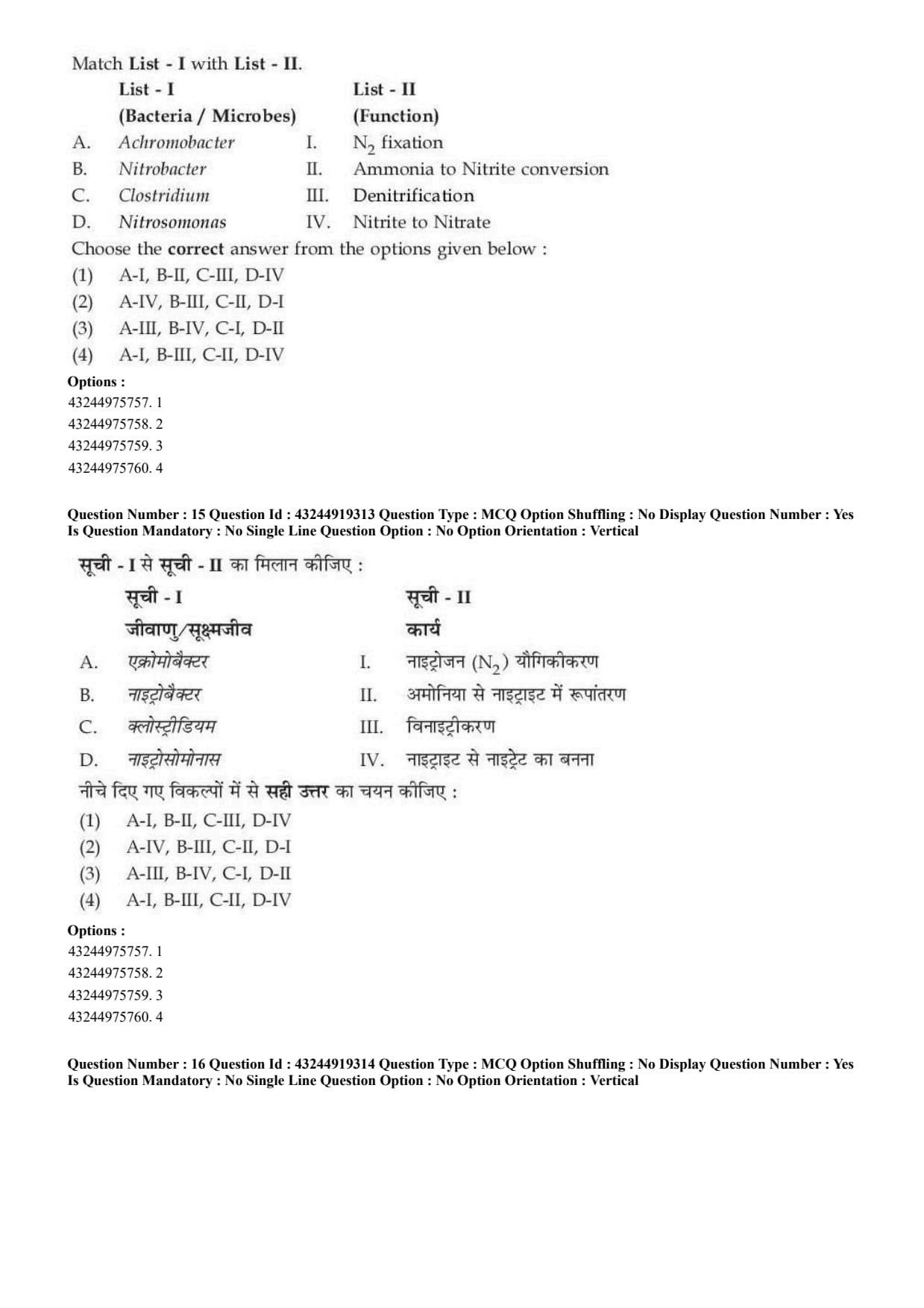
Match List - I with List - II.

Choose the correct answer from the options given below :
View Solution
Step 1: Understanding the Question:
The question requires matching specific soil and aquatic bacteria with their key metabolic functions in the nitrogen cycle.
Step 2: Key Formula or Approach:
Review major steps and microbial agents of the Nitrogen Cycle:
- Biological Nitrogen Fixation (\(N_2 \rightarrow NH_3/NH_4^+\)): Free-living anaerobic bacteria like Clostridium, aerobic \textit{Azotobacter, and symbiotic \textit{Rhizobium.
- Nitritation (\(NH_4^+ \rightarrow NO_2^-\)): Ammonia-oxidizing bacteria like \textit{Nitrosomonas.
- Nitratation (\(NO_2^- \rightarrow NO_3^-\)): Nitrite-oxidizing bacteria like \textit{Nitrobacter.
- Denitrification (\(NO_3^- \rightarrow N_2O/N_2\)): Facultative anaerobic bacteria like \textit{Pseudomonas, \textit{Achromobacter, and \textit{Thiobacillus.
Step 3: Detailed Explanation:
A. Achromobacter (III): Participates in anaerobic denitrification, reducing nitrate (\(NO_3^-\)) back to gaseous dinitrogen (\(N_2\)).
B. Nitrobacter (IV): Chemolithotrophic nitrifying bacterium that oxidizes nitrite (\(NO_2^-\)) into nitrate (\(NO_3^-\)).
C. Clostridium (I): Free-living, obligate anaerobic bacterium capable of atmospheric nitrogen fixation (\(N_2 fixation\)).
D. Nitrosomonas (II): Chemolithotrophic bacterium responsible for converting ammonia (\(NH_3/NH_4^+\)) to nitrite (\(NO_2^-\)).
Matching Summary:
A \(\rightarrow\) III, B \(\rightarrow\) IV, C \(\rightarrow\) I, D \(\rightarrow\) II.
Step 4: Final Answer:
The correct option is (C).
Quick Tip: Easy Nitrification Memory Rule:
\textbf{Nitrosomonas: Ammonia (\(NH_3\)) \(\rightarrow\) Nitrite (\(NO_2^-\)).
\textbf{Nitrobacter}: Nitrite (\(NO_2^-\)) \(\rightarrow\) Nitrate (\(NO_3^-\)).
"S comes before B, just like Nitrosomonas comes before Nitrobacter!"
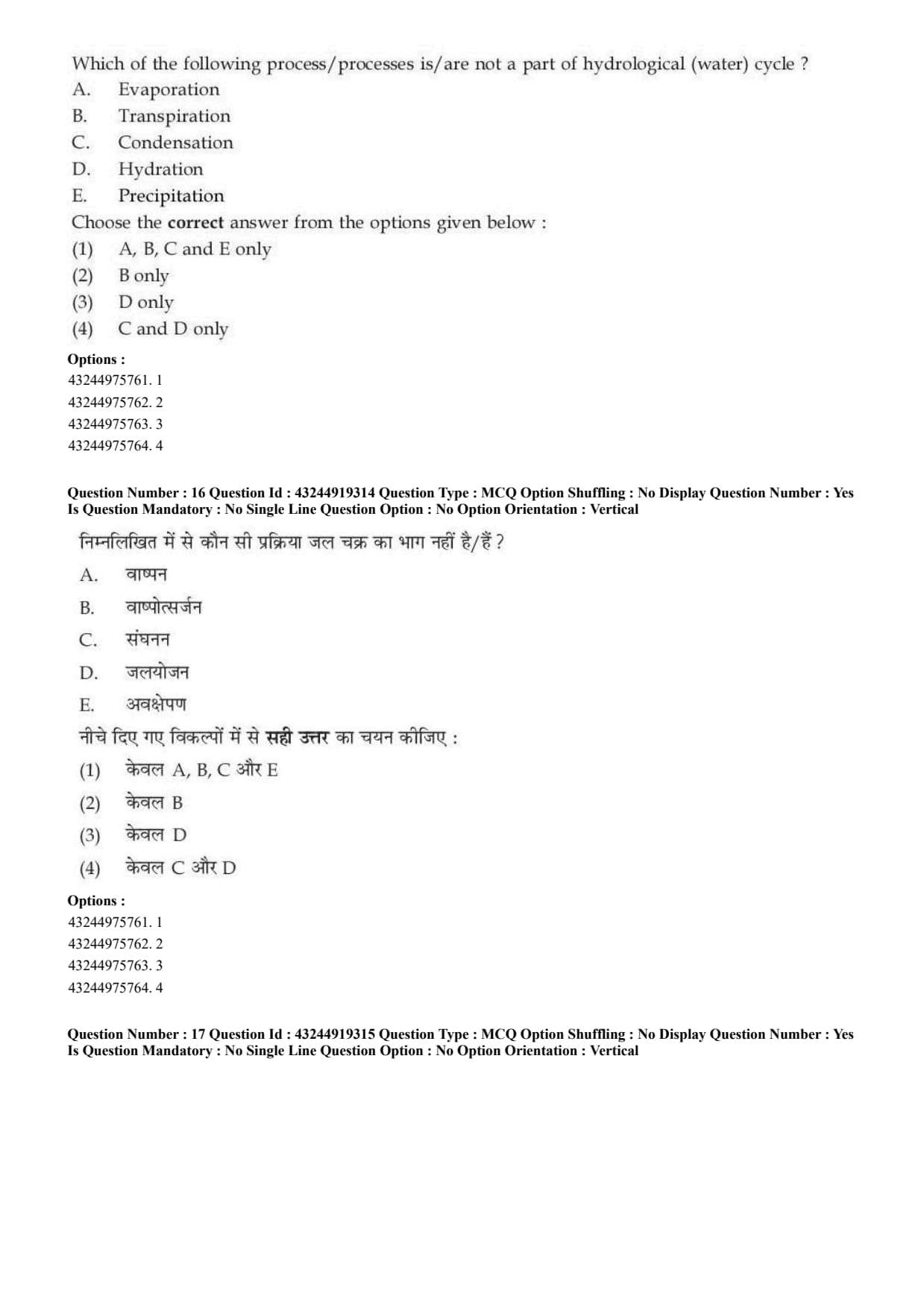
Which of the following process/processes is/are not a part of hydrological (water) cycle ?
A. Evaporation
B. Transpiration
C. Condensation
D. Hydration
E. Precipitation
Choose the correct answer from the options given below :
View Solution
Step 1: Understanding the Question:
The question asks to identify which of the given processes is not a direct physical phase change or transport component of the global hydrological (water) cycle.
Step 2: Key Formula or Approach:
Identify standard processes of the hydrological cycle vs chemical rock weathering:
- Hydrological cycle processes: Evaporation, Transpiration, Evapotranspiration, Condensation, Precipitation, Infiltration, Percolation, Runoff.
- Chemical weathering process: Hydration (chemical addition of water molecules to mineral lattices).
Step 3: Detailed Explanation:
Processes of Hydrological Cycle:
- Evaporation (A): Phase change of surface water into atmospheric water vapor driven by solar heat.
- Transpiration (B): Release of water vapor from plant stomata into the atmosphere.
- Condensation (C): Phase change of water vapor into water droplets forming clouds.
- Precipitation (E): Fall of moisture (rain, snow, hail) from clouds to the surface.
Process outside Hydrological Cycle:
- Hydration (D): A chemical weathering process where mineral structures combine chemically with water (e.g., transformation of Anhydrite \(CaSO_4\) to Gypsum \(CaSO_4 \cdot 2H_2O\)). It is a geological reaction, not a pathway driving the physical circulation of water through the Earth system.
Step 4: Final Answer:
Process D (Hydration) is not a part of the hydrological cycle, making option (C) correct.
Quick Tip: Do not confuse physical water transport steps (evaporation, condensation, precipitation) with chemical weathering reactions (hydration, hydrolysis, oxidation)!
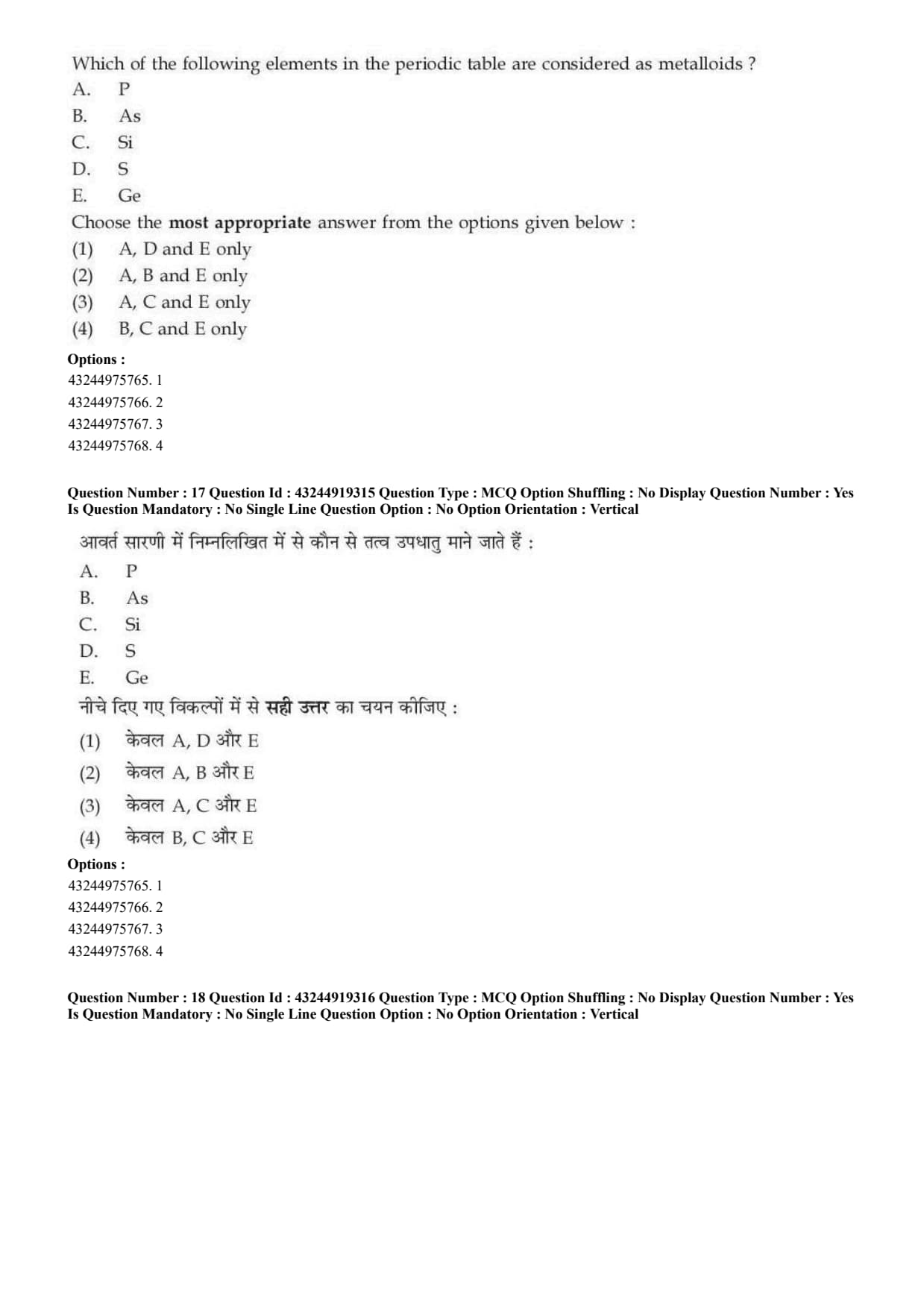
Which of the following elements in the periodic table are considered as metalloids ?
A. P
B. As
C. Si
D. S
E. Ge
Choose the most appropriate answer from the options given below :
View Solution
Step 1: Understanding the Question:
The question asks to identify the elements among the given options that are classified as metalloids (semimetals) in the periodic table.
Step 2: Key Formula or Approach:
Recall the recognized metalloids lying along the diagonal staircase dividing metals and non-metals in the periodic table:
- Boron (\(B\))
- Silicon (\(Si\))
- Germanium (\(Ge\))
- Arsenic (\(As\))
- Antimony (\(Sb\))
- Tellurium (\(Te\))
- Polonium (\(Po\))
Step 3: Detailed Explanation:
Evaluation of Given Elements:
- P (Phosphorus): Group 15 non-metal. (Not a metalloid)
- As (Arsenic): Group 15 metalloid exhibiting intermediate metallic and non-metallic properties. (Metalloid)
- Si (Silicon): Group 14 metalloid extensively used as a semiconductor. (Metalloid)
- S (Sulfur): Group 16 reactive non-metal. (Not a metalloid)
- Ge (Germanium): Group 14 metalloid with semiconducting properties. (Metalloid)
Selection:
The metalloids among the options are Arsenic (B), Silicon (C), and Germanium (E).
Step 4: Final Answer:
The correct combination is B, C and E only, corresponding to option (D).
Quick Tip: Remember the main metalloids along the p-block diagonal:
\textbf{B}, \textbf{Si}, \textbf{Ge}, \textbf{As}, \textbf{Sb}, \textbf{Te}.
Non-metals like P, S, N, O, C are completely outside the metalloid line.
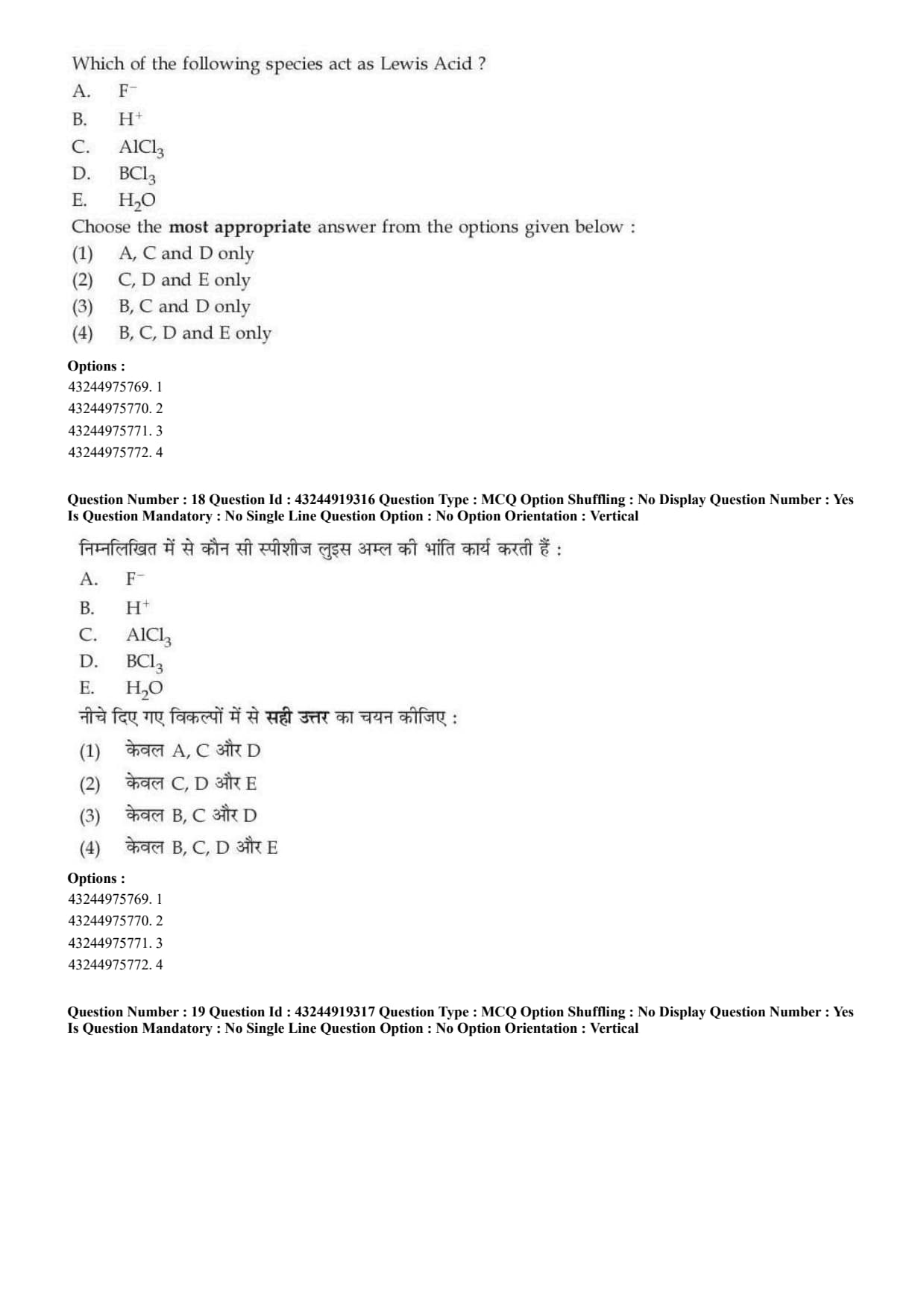
Which of the following species act as Lewis Acid ?
A. \(F^-\)
B. \(H^+\)
C. \(AlCl_3\)
D. \(BCl_3\)
E. \(H_2O\)
Choose the most appropriate answer from the options given below :
View Solution
Step 1: Understanding the Question:
The question asks to identify which of the given chemical species act as Lewis acids according to the Lewis acid-base theory.
Step 2: Key Formula or Approach:
- Lewis Acid: An electron-pair acceptor (has vacant orbitals or incomplete valence octet).
- Lewis Base: An electron-pair donor (has non-bonding lone pairs or negative charge).
Step 3: Detailed Explanation:
A. \(F^-\) (Fluoride Ion): Contains unshared lone electron pairs and a negative charge, acting as an electron-pair donor (\(Lewis Base\)).
B. \(H^+\) (Proton): Possesses an entirely empty \(1s\) orbital, making it a powerful electron-pair acceptor (\(Lewis Acid\)).
C. \(AlCl_3\) (Aluminium Chloride): Aluminium has only 6 valence electrons in its outer shell (electron-deficient octet) and an empty \(3p\) orbital, allowing it to accept an electron pair (\(Lewis Acid\)).
D. \(BCl_3\) (Boron Trichloride): Boron has 6 valence electrons (incomplete octet) and accepts a lone pair into its vacant \(2p\) orbital (\(Lewis Acid\)).
E. \(H_2O\) (Water): Oxygen possesses two non-bonding lone pairs, enabling it to act as an electron-pair donor (\(Lewis Base\)).
Conclusion:
\(H^+\) (B), \(AlCl_3\) (C), and \(BCl_3\) (D) are Lewis acids.
Step 4: Final Answer:
The correct combination is B, C and D only, given by option (C).
Quick Tip: Species with incomplete octets (\(BF_3\), \(BCl_3\), \(AlCl_3\), \(FeCl_3\)) or positive charges (\(H^+\), \(Cu^{2+}\)) are classic Lewis Acids!
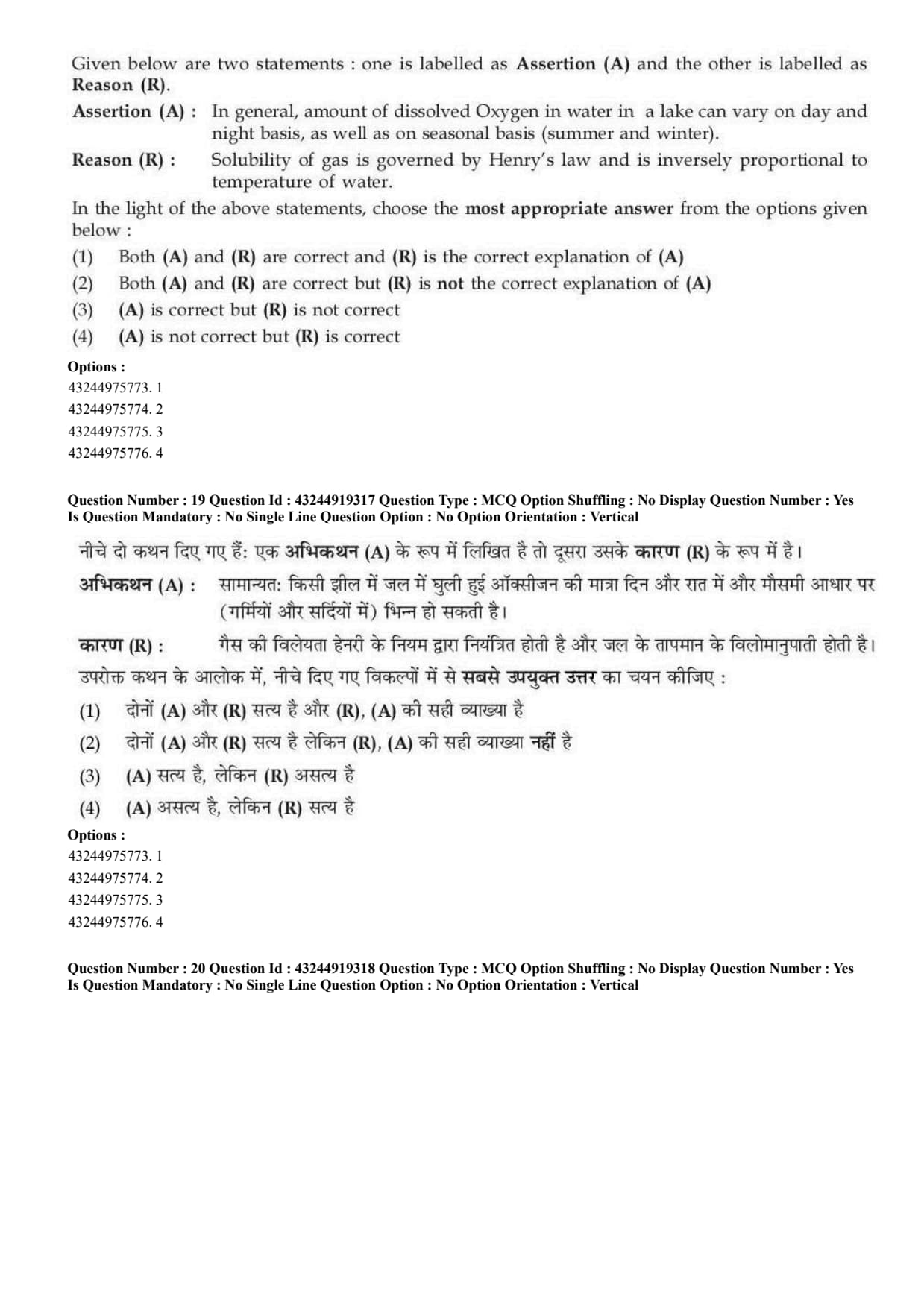
Given below are two statements : one is labelled as Assertion (A) and the other is labelled as Reason (R).
Assertion (A) : In general, amount of dissolved Oxygen in water in a lake can vary on day and night basis, as well as on seasonal basis (summer and winter).
Reason (R) : Solubility of gas is governed by Henry's law and is inversely proportional to temperature of water.
In the light of the above statements, choose the most appropriate answer from the options given below :
View Solution
Step 1: Understanding the Question:
The question evaluates the diurnal and seasonal dynamics of Dissolved Oxygen (\(DO\)) in lake systems and tests whether gas solubility laws fully explain both variation timescales.
Step 2: Key Formula or Approach:
- Henry's Law: \(C = k_H \cdot P_{gas}\), where \(k_H\) decreases as temperature increases. Gas solubility is inversely proportional to water temperature.
- Biological Dynamics: Photosynthesis produces \(O_2\) during daylight, while respiration consumes \(O_2\) continuously day and night.
Step 3: Detailed Explanation:
Analysis of Assertion (A):
Dissolved oxygen in lakes shows clear diurnal cycles (peaking in late afternoon due to aquatic photosynthesis and reaching a minimum before dawn due to biological respiration).
\(DO\) also varies seasonally due to water temperature changes, stratification, and seasonal biological productivity peaks.
Thus, Assertion (A) is correct.
Analysis of Reason (R):
Henry's law governs gas dissolution, and gas solubility decreases at elevated temperatures (cooler winter water holds more dissolved oxygen than warmer summer water).
Thus, Reason (R) is correct.
Evaluation of Explanation:
While temperature dependence (Reason R) explains the seasonal thermodynamic capacity of water to dissolve oxygen, the diurnal (day/night) variation is driven primarily by the metabolic balance between photosynthesis and community respiration, not by day-night temperature changes alone.
Therefore, (R) is a true statement but does not serve as the comprehensive explanation for (A).
Step 4: Final Answer:
Both (A) and (R) are correct, but (R) is not the correct explanation of (A), corresponding to option (B).
Quick Tip: Diurnal \(DO\) swings \(\rightarrow\) Driven by Photosynthesis vs Respiration balance!
Seasonal \(DO\) saturation limit \(\rightarrow\) Driven by Water Temperature via Henry's Law!
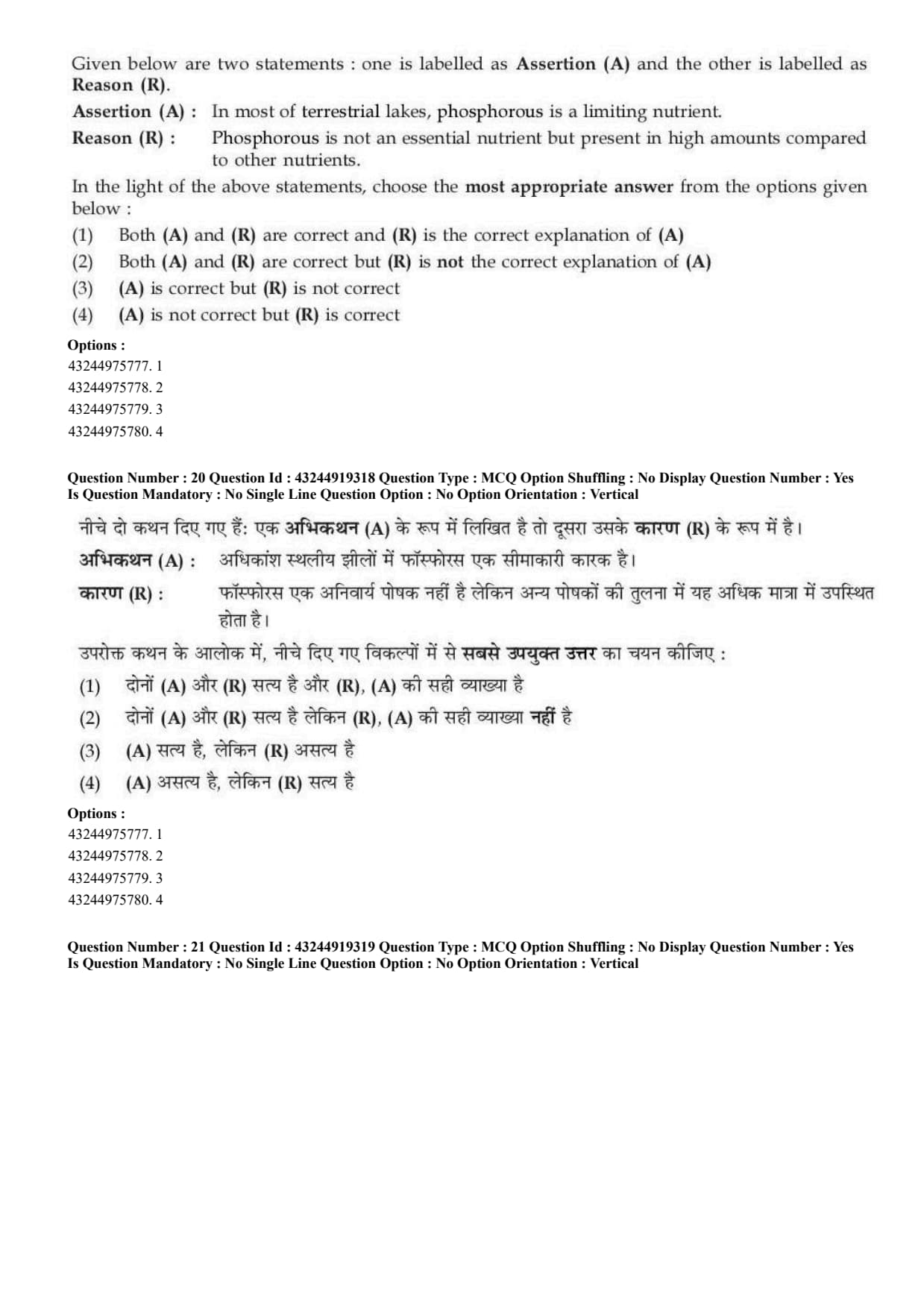
Given below are two statements : one is labelled as Assertion (A) and the other is labelled as Reason (R).
Assertion (A) : In most of terrestrial lakes, phosphorous is a limiting nutrient.
Reason (R) : Phosphorous is not an essential nutrient but present in high amounts compared to other nutrients.
In the light of the above statements, choose the most appropriate answer from the options given below :
View Solution
Step 1: Understanding the Question:
The question examines nutrient limitation concepts in freshwater lake ecosystems, specifically evaluating the role and essentiality of phosphorus.
Step 2: Key Formula or Approach:
- Liebig's Law of the Minimum: Primary production is controlled by the nutrient supplied in the lowest relative quantity compared to cellular demands.
- Redfield Ratio: The elemental atomic ratio of C:N:P in aquatic biomass is roughly \(106:16:1\).
Step 3: Detailed Explanation:
Analysis of Assertion (A):
In most freshwater terrestrial lakes, phosphorus is the primary limiting nutrient controlling algal growth and primary productivity.
Adding phosphate typically triggers rapid algal blooms and eutrophication because natural background phosphorus concentrations are extremely low relative to organismal requirements.
Thus, Assertion (A) is correct.
Analysis of Reason (R):
Phosphorus is an essential macronutrient required for nucleic acids (\(DNA\), \(RNA\)), energy transfer molecules (\(ATP\)), and cell membranes (phospholipids).
Furthermore, phosphorus is naturally present in very low amounts (scarce supply due to slow weathering of apatite rocks and strong sorption to soil minerals), not high amounts.
Thus, Reason (R) is completely incorrect.
Step 4: Final Answer:
Assertion (A) is correct, but Reason (R) is incorrect, matching option (C).
Quick Tip: Freshwater systems \(\rightarrow\) Phosphorus (\(P\)) limited!
Marine/Estuarine systems \(\rightarrow\) Nitrogen (\(N\)) limited!
Phosphorus is ALWAYS an essential nutrient for life.
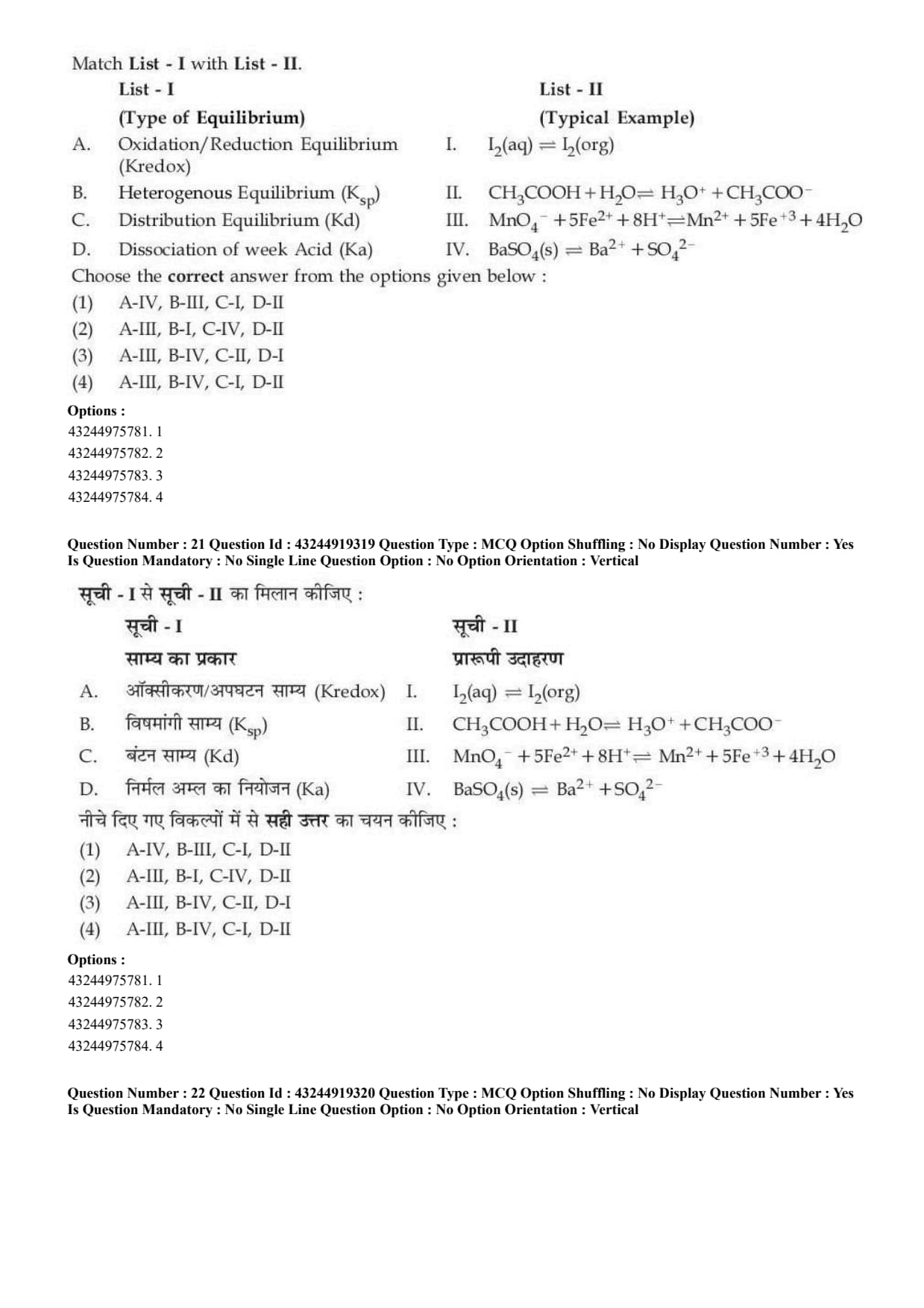
Match List - I with List - II.

Choose the correct answer from the options given below :
View Solution
Step 1: Understanding the Question:
The question requires matching different types of chemical equilibria with their characteristic chemical reaction equations.
Step 2: Key Formula or Approach:
Identify each chemical equilibrium type based on reaction characteristics:
- Redox Equilibrium: Involves electron transfer between oxidized and reduced species.
- Heterogeneous Equilibrium (\(K_{sp}\)): Solubility product involving phase change between solid precipitate and dissolved ions.
- Distribution Equilibrium (\(K_d\)): Partitioning of a solute between two immiscible liquid phases.
- Weak Acid Dissociation (\(K_a\)): Partial proton transfer reaction of a weak acid in aqueous solution.
Step 3: Detailed Explanation:
A. Oxidation/Reduction Equilibrium (III): Reaction involving oxidation state changes (\(Mn^{+7} \rightarrow Mn^{+2}\) and \(Fe^{+2} \rightarrow Fe^{+3}\)).
B. Heterogeneous Equilibrium (\(K_{sp}\)) (IV): Dissolution equilibrium of sparingly soluble solid barium sulfate into its aqueous ions (\(BaSO_4(s) \rightleftharpoons Ba^{2+} + SO_4^{2-}\)).
C. Distribution Equilibrium (\(K_d\)) (I): Partitioning equilibrium of iodine solute between aqueous and organic solvents (\(I_2(aq) \rightleftharpoons I_2(org)\)).
D. Weak Acid Dissociation (\(K_a\)) (II): Ionization equilibrium of acetic acid in water (\(CH_3COOH + H_2O \rightleftharpoons H_3O^+ + CH_3COO^-\)).
Matching Summary:
A \(\rightarrow\) III, B \(\rightarrow\) IV, C \(\rightarrow\) I, D \(\rightarrow\) II.
Step 4: Final Answer:
The correct matching sequence is given by option (D).
Quick Tip: - Solid \(\rightleftharpoons\) Dissolved Ions \(\rightarrow\) \(K_{sp}\) (Solubility Product).
- Organic Phase \(\rightleftharpoons\) Aqueous Phase \(\rightarrow\) \(K_d\) (Partition Coefficient).
- Proton Transfer \(\rightarrow\) \(K_a\) (Acid Dissociation Constant).
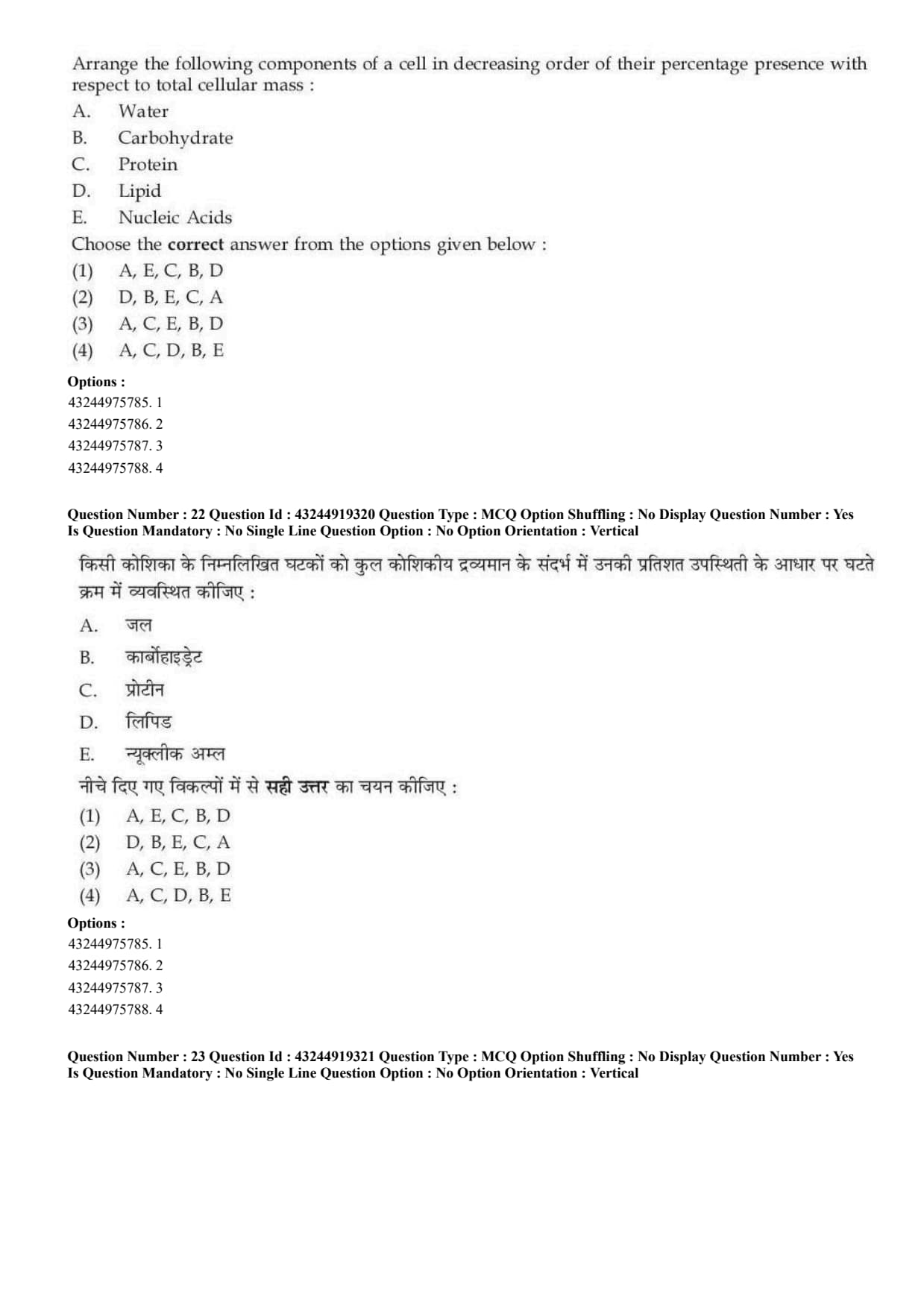
Arrange the following components of a cell in decreasing order of their percentage presence with respect to total cellular mass :
A. Water
B. Carbohydrate
C. Protein
D. Lipid
E. Nucleic Acids
Choose the correct answer from the options given below :
View Solution
Step 1: Understanding the Question:
The question requires arranging the major biochemical constituents of a typical cell in decreasing order based on their percentage contribution to total cellular mass.
Step 2: Key Formula or Approach:
Recall the average chemical composition of a cell (by weight percentage):
- Water (\(A\)): \(70% - 90%\)
- Proteins (\(C\)): \(10% - 15%\)
- Nucleic Acids (\(E\)): \(5% - 7%\)
- Carbohydrates (\(B\)): \(3%\)
- Lipids (\(D\)): \(2%\)
- Inorganic Ions: \(1%\)
Step 3: Detailed Explanation:
Water (A): Serves as the universal solvent and major cellular constituent, accounting for \(70% - 90%\) of total mass.
Proteins (C): Represent the most abundant organic macromolecules in cells, contributing \(10% - 15%\) of total weight as structural components, enzymes, and transport agents.
Nucleic Acids (E): Include \(DNA\) and \(RNA\), constituting approximately \(5% - 7%\) of mass, essential for genetic storage and protein synthesis.
Carbohydrates (B): Make up about \(3%\) of cellular mass as primary energy substrates and structural elements (e.g., cell wall components).
Lipids (D): Account for roughly \(2%\) of cellular mass, forming plasma membrane bilayers and storage droplets.
Decreasing Order Sequence:
Water (A, 70-90%) \(>\) \text{Protein (C, 10-15%) \(>\) \text{Nucleic Acids (E, 5-7%) \(>\) \text{Carbohydrate (B, 3%) \(>\) \text{Lipid (D, 2%)
This yields the sequence A, C, E, B, D.
Step 4: Final Answer:
The correct arrangement in decreasing order of percentage cellular presence is A, C, E, B, D, corresponding to option (C).
Quick Tip: Standard Cellular Mass Percentages:
\textbf{Water (\(70-90%\)) \(>\) \textbf{Proteins} (\(10-15%\)) \(>\) \textbf{Nucleic Acids} (\(5-7%\)) \(>\) \textbf{Carbohydrates} (\(3%\)) \(>\) \textbf{Lipids} (\(2%\)) \(>\) \textbf{Ions} (\(1%\)).
Memmerize this standard biochemical composition table!
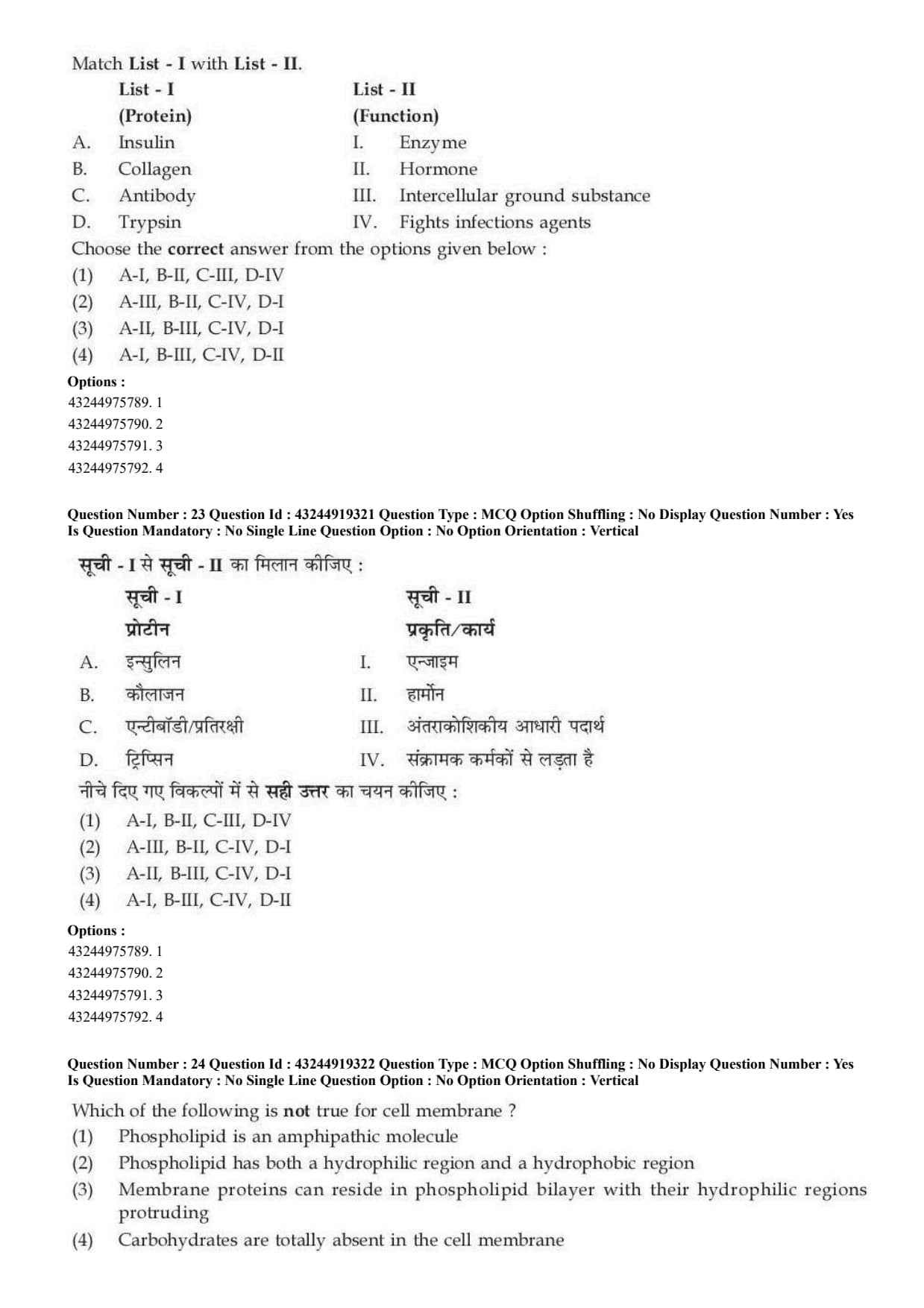
Match List - I with List - II.

Choose the correct answer from the options given below :
View Solution
Step 1: Understanding the Question:
The question asks to match specific biological proteins with their corresponding functions or structural roles in living organisms.
Step 2: Key Formula or Approach:
Review the biological functions of functional proteins:
- Insulin: Peptide hormone regulating blood glucose levels.
- Collagen: Structural fibrous protein forming connective tissue matrix and intercellular ground substance.
- Antibody (Immunoglobulin): Defensive protein produced by B-lymphocytes that neutralizes pathogens.
- Trypsin: Digestive proteolytic enzyme secreted by the pancreas.
Step 3: Detailed Explanation:
A. Insulin (II): A peptide hormone secreted by pancreatic beta cells that regulates carbohydrate and fat metabolism.
B. Collagen (III): The most abundant fibrous protein in animal tissues, acting as the main structural component of extracellular matrix and intercellular ground substance.
C. Antibody (IV): Specialized Y-shaped immune protein (immunoglobulin) that specifically binds to non-self antigens to neutralize infectious pathogens.
D. Trypsin (I): A serine protease enzyme present in the digestive system that hydrolyzes proteins into smaller peptides.
Matching Summary:
A \(\rightarrow\) II, B \(\rightarrow\) III, C \(\rightarrow\) IV, D \(\rightarrow\) I.
Step 4: Final Answer:
The correct matching sequence is given by option (C).
Quick Tip: Key Protein Roles:
- Collagen \(\rightarrow\) Structural ground substance.
- Insulin \(\rightarrow\) Endocrine hormone.
- Trypsin \(\rightarrow\) Catalytic enzyme.
- Antibody \(\rightarrow\) Immune defense.
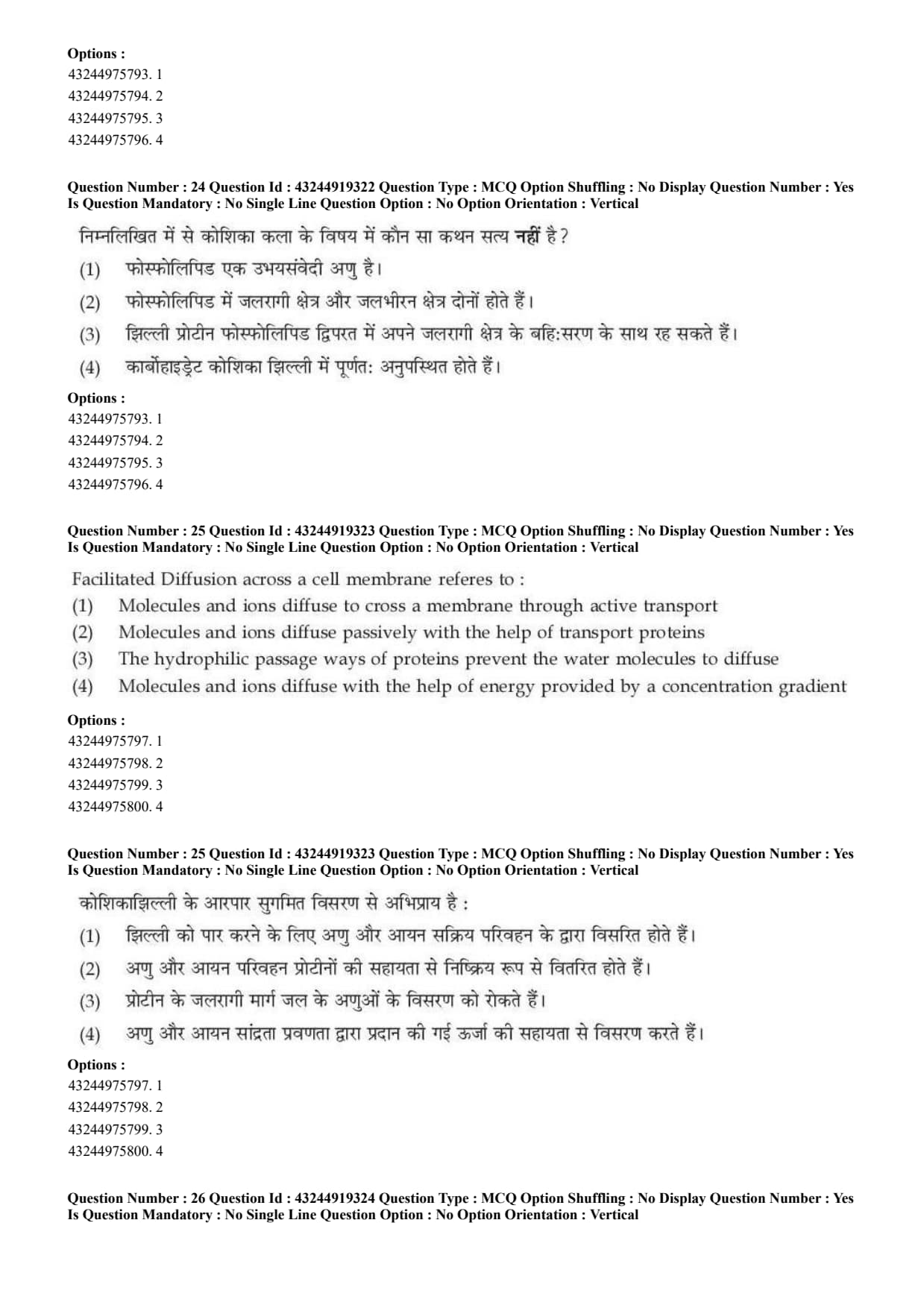
Which of the following is not true for cell membrane ?
View Solution
Step 1: Understanding the Question:
The question asks to identify the statement that is false regarding the structure, molecular composition, and fluid mosaic model of biological cell membranes.
Step 2: Key Formula or Approach:
According to the Fluid Mosaic Model (Singer and Nicolson, 1972):
- Plasma membrane consists of a phospholipid bilayer embedded with proteins and carbohydrates.
- Phospholipids are amphipathic, containing hydrophilic glycerol-phosphate heads and hydrophobic fatty acid tails.
- Carbohydrates are covalently attached to lipids (glycolipids) or proteins (glycoproteins) on the outer surface, forming the glycocalyx (\(2% - 10%\) of membrane mass).
Step 3: Detailed Explanation:
Statement (A): \textit{Phospholipid is an amphipathic molecule.
This is true. Phospholipids contain both polar (water-attracting) and non-polar (water-repelling) chemical domains within the same molecule.
Statement (B): \textit{Phospholipid has both a hydrophilic region and a hydrophobic region.
This is true. The charged phosphate head is hydrophilic and faces outward toward water, whereas the non-polar hydrocarbon tails are hydrophobic and face inward.
Statement (C): \textit{Membrane proteins can reside in phospholipid bilayer with their hydrophilic regions protruding.
This is true. Integral transmembrane proteins have hydrophobic middle domains spanning the lipid core and hydrophilic terminal domains extending into aqueous environments inside and outside the cell.
Statement (D): \textit{Carbohydrates are totally absent in the cell membrane.
This statement is false. Carbohydrates are essential components of plasma membranes, forming glycolipids and glycoproteins that participate in cell-cell recognition, cell adhesion, and receptor activity.
Step 4: Final Answer:
Statement (D) is incorrect regarding the cell membrane, so option (D) is the correct answer.
Quick Tip: Cell membranes are NOT purely lipid-protein structures!
They contain \(2% - 10%\) carbohydrates on their extracellular face (glycocalyx), playing critical roles in immunity and cellular recognition.
Facilitated Diffusion across a cell membrane refers to :
View Solution
Step 1: Understanding the Question:
The question asks for the standard biological definition and mechanism of facilitated diffusion across plasma membranes.
Step 2: Key Formula or Approach:
Compare membrane transport mechanisms:
- Simple Diffusion: Passive movement of non-polar molecules directly through the lipid bilayer down concentration gradient.
- Facilitated Diffusion: Passive movement of polar or charged solutes down concentration gradient mediated by specific carrier or channel transmembrane proteins without cellular energy (\(ATP\)).
- Active Transport: Movement of solutes against concentration gradient requiring metabolic energy (\(ATP\)).
Step 3: Detailed Explanation:
Mechanistic Characteristics of Facilitated Diffusion:
1. It is a passive transport process; transport occurs spontaneously down a electrochemical or concentration gradient (\(\Delta C > 0\)).
2. Hydrophilic or charged species (such as glucose, amino acids, \(Na^+\), \(K^+\)) cannot freely cross the hydrophobic core of the lipid bilayer.
3. Specific transmembrane proteins (channel proteins like aquaporins or carrier proteins like glucose transporters) facilitate their transport by providing a hydrophilic pathway.
4. No metabolic energy (\(ATP\)) expenditure is required.
Evaluation of Options:
Option (B) accurately describes facilitated diffusion as passive transport mediated by specialized membrane transport proteins.
Step 4: Final Answer:
Facilitated diffusion is defined by option (B).
Quick Tip: Remember:
- Simple Diffusion = Passive, down gradient, NO transport protein needed.
- Facilitated Diffusion = Passive, down gradient, REQUIRES transport protein.
- Active Transport = Active, AGAINST gradient, REQUIRES \(ATP\) and transport protein!
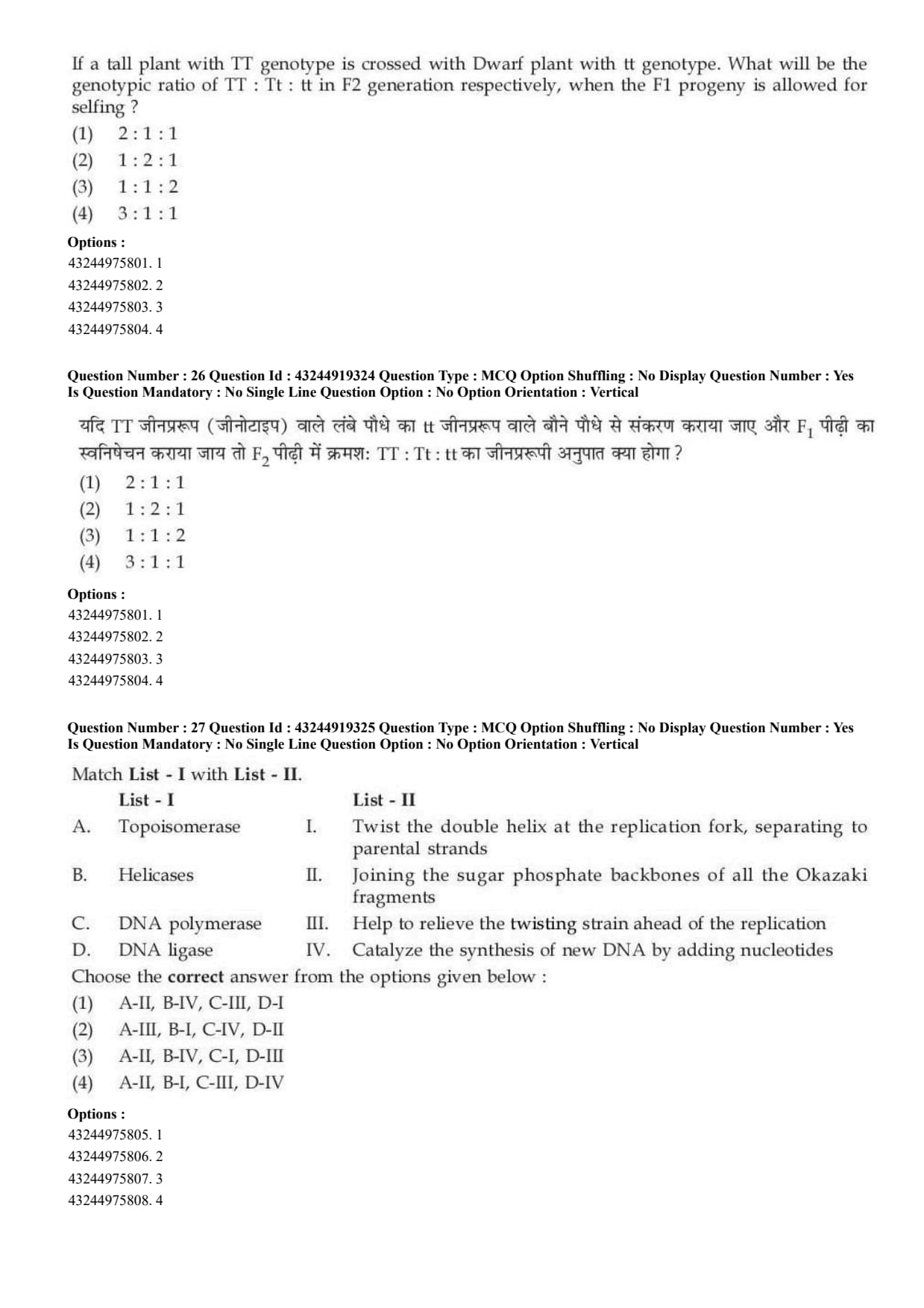
If a tall plant with TT genotype is crossed with Dwarf plant with tt genotype. What will be the genotypic ratio of TT : Tt : tt in F2 generation respectively, when the F1 progeny is allowed for selfing ?
View Solution
Step 1: Understanding the Question:
The question asks for the genotypic ratio of homozygous dominant (\(TT\)), heterozygous (\(Tt\)), and homozygous recessive (\(tt\)) offspring in the \(F_2\) generation resulting from a classical Mendelian monohybrid cross.
Step 2: Key Formula or Approach:
Perform step-by-step Mendelian monohybrid cross calculations:
- Parental Generation (\(P\)): \(TT (Homozygous Tall) \times tt (Homozygous Dwarf)\)
- Gametes: \(T\) and \(t\)
- \(F_1\) Generation: \(Tt (100% Heterozygous Tall)\)
- Selfing \(F_1\): \(Tt \times Tt\)
Step 3: Detailed Explanation:
Punnett Square Analysis for \(F_2\) Generation (\(Tt \times Tt\)):
Constructing the \(2 \times 2\) matrix for gametes \(T\) and \(t\):
\[ \begin{array}{c|c|c} & T & t
\hline T & TT & Tt
\hline t & Tt & tt
\end{array} \]
Genotypic Frequencies in \(F_2\):
- Homozygous dominant (\(TT\)): \(1/4\) (\(25%\))
- Heterozygous (\(Tt\)): \(2/4\) (\(50%\))
- Homozygous recessive (\(tt\)): \(1/4\) (\(25%\))
Ratio Formation:
\[ Genotypic Ratio (TT : Tt : tt) = 1 : 2 : 1 \]
(Note: Phenotypic ratio is \(3\ Tall : 1\ Dwarf\)).
Step 4: Final Answer:
The genotypic ratio of \(TT : Tt : tt\) in the \(F_2\) generation is \(1 : 2 : 1\), matching option (B).
Quick Tip: For any classic Mendelian monohybrid cross:
- \(F_2\) \textbf{Genotypic Ratio} = \(1\ TT : 2\ Tt : 1\ tt\) (\(1:2:1\)).
- \(F_2\) \textbf{Phenotypic Ratio} = \(3\ Tall : 1\ Dwarf\) (\(3:1\)).
Always double check if the question asks for genotypic or phenotypic ratio!
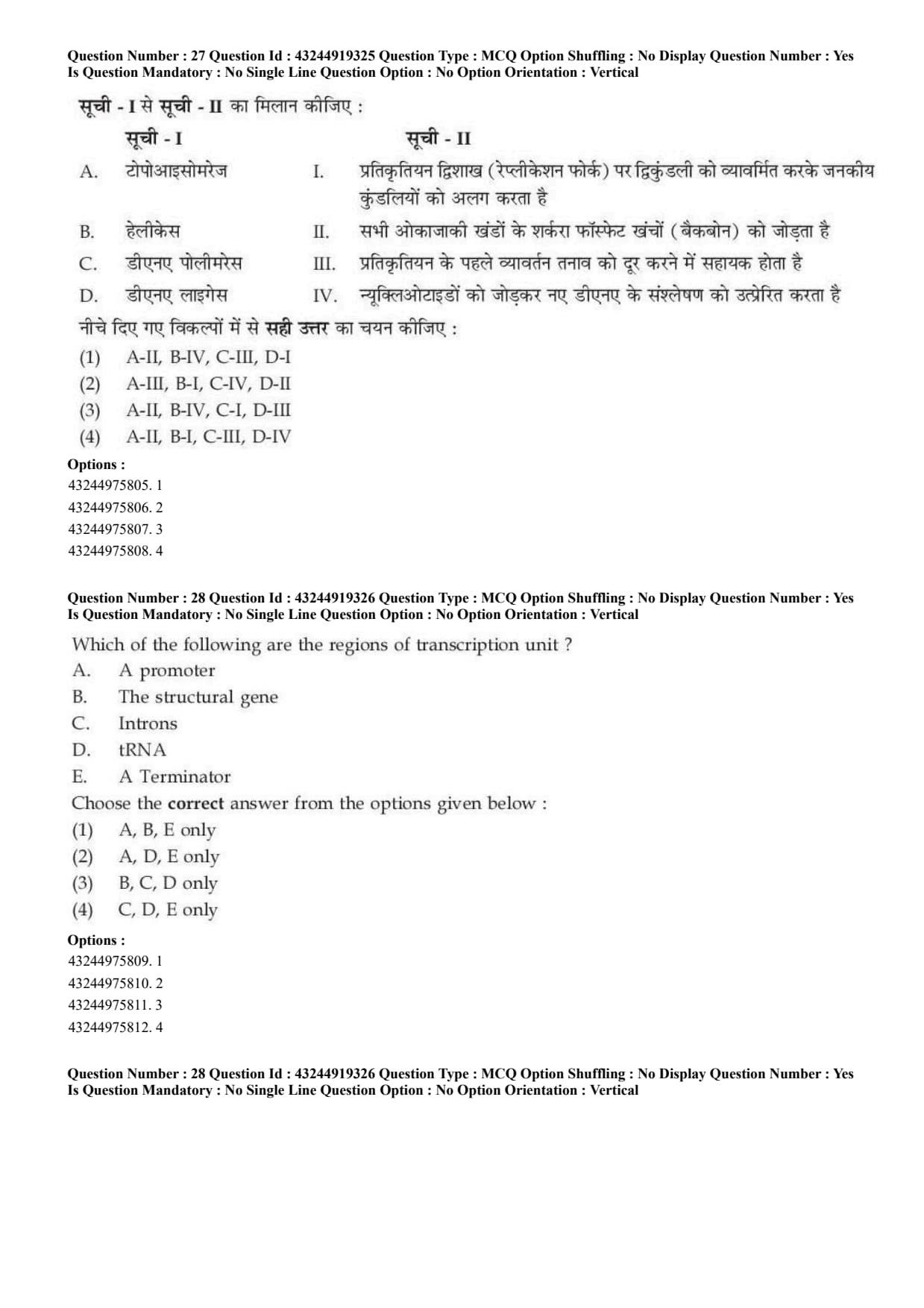
Match List - I with List - II.

Choose the correct answer from the options given below :
View Solution
Step 1: Understanding the Question:
The question requires matching major enzymes involved in \(DNA\) replication with their specific enzymatic mechanisms and catalytic functions.
Step 2: Key Formula or Approach:
Review catalytic roles during \(DNA\) replication:
- Topoisomerase (DNA Gyrase): Relieves torsional strain and supercoiling ahead of advancing replication fork.
- DNA Helicase: Unwinds and separates double-stranded \(DNA\) parental strands at replication fork by breaking hydrogen bonds.
- DNA Polymerase: Synthesizes complementary daughter \(DNA\) strands by adding deoxyribonucleotides in \(5' \rightarrow 3'\) direction.
- DNA Ligase: Forms phosphodiester bonds to join adjacent Okazaki fragments on lagging strand.
Step 3: Detailed Explanation:
A. Topoisomerase (III): Prevents supercoiling and relieves torsional strain caused by unwinding ahead of replication fork by cutting, swiveling, and rejoining \(DNA\) strands.
B. Helicases (I): Enzymes that bind at origin of replication and break hydrogen bonds between base pairs, unwinding parental double helix to expose template strands.
C. DNA Polymerase (IV): Main polymerase enzyme that catalyzes phosphodiester bond formation between free \(3'-OH\) group of primer/growing strand and incoming dNTPs.
D. DNA Ligase (II): Catalyzes covalent phosphodiester linkage between \(3'-OH\) and \(5'\)-phosphate ends of Okazaki fragments, sealing nick in sugar-phosphate backbone.
Matching Summary:
A \(\rightarrow\) III, B \(\rightarrow\) I, C \(\rightarrow\) IV, D \(\rightarrow\) II.
Step 4: Final Answer:
The correct matching sequence is given by option (B).
Quick Tip: Replication Enzymes Summary:
- Helicase = Unwinds double helix.
- Topoisomerase = Relieves torsional strain.
- Polymerase = Synthesizes new strand (\(5' \rightarrow 3'\)).
- Ligase = Joins sugar-phosphate backbone of fragments.
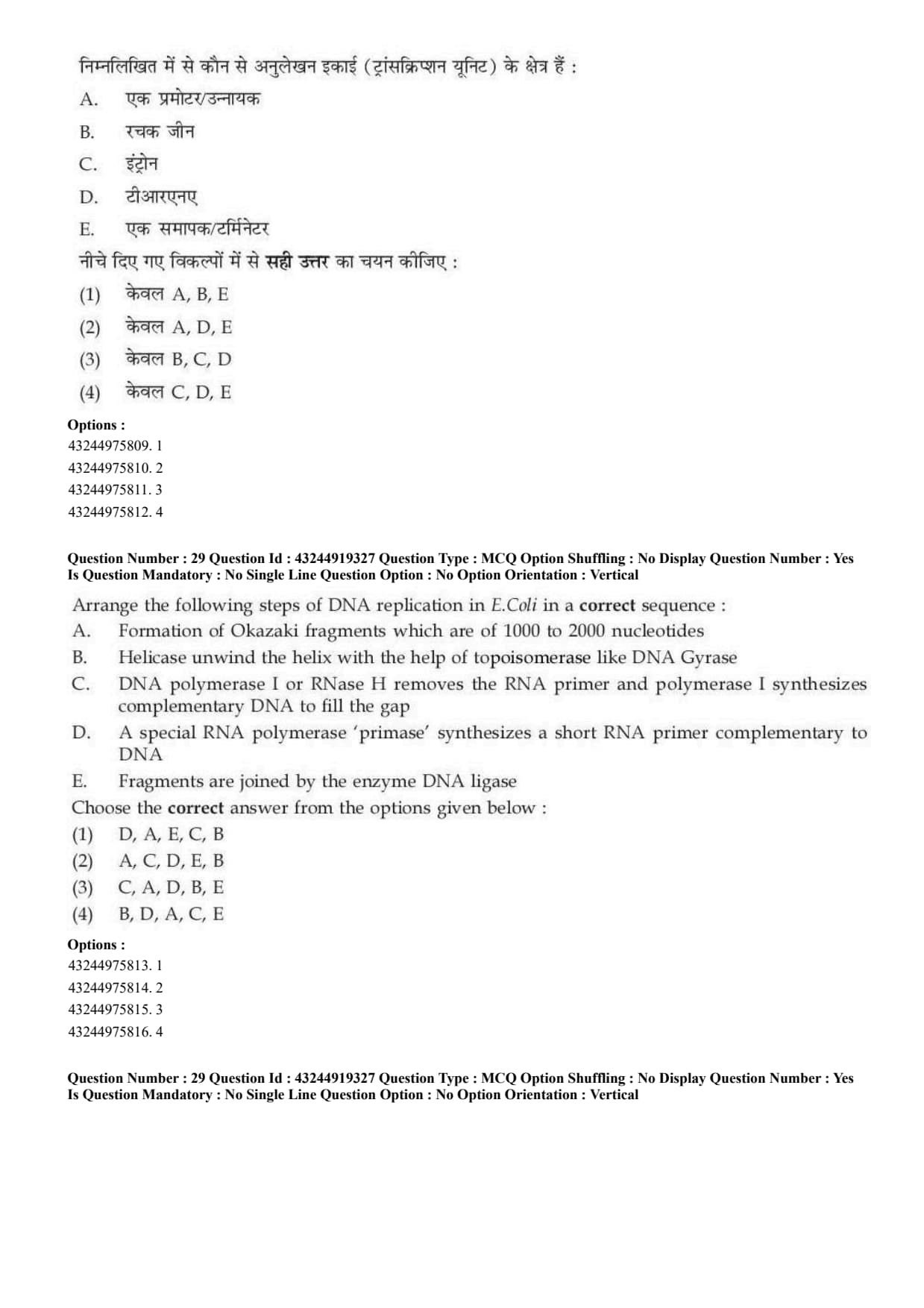
Which of the following are the regions of transcription unit ?
A. A promoter
B. The structural gene
C. Introns
D. tRNA
E. A Terminator
Choose the correct answer from the options given below :
View Solution
Step 1: Understanding the Question:
The question asks to identify the fundamental structural components defining a functional \(DNA\) transcription unit involved in gene expression.
Step 2: Key Formula or Approach:
A standard transcription unit in \(DNA\) is defined by three functional regions along the gene:
1. Promoter: Regulatory sequence located upstream (\(5'\) end) where \(RNA\) polymerase binds to initiate transcription.
2. Structural Gene: Sequence region bounded by promoter and terminator that acts as template for \(RNA\) synthesis.
3. Terminator: Sequence located downstream (\(3'\) end) that signals transcription termination.
Step 3: Detailed Explanation:
A. A Promoter: Essential upstream regulatory region containing consensus sequences (such as TATA box in eukaryotes or Pribnow box in prokaryotes) that direct \(RNA\) polymerase binding.
B. The Structural Gene: The region transcribed into primary \(RNA\) transcript.
E. A Terminator: Sequence at downstream end defining where transcription stops and \(RNA\) transcript detaches.
Evaluation of non-primary elements:
- Introns (C) are non-coding sequences present within eukaryotic structural genes, but they are not defined as structural regions defining the basic transcription unit itself.
- tRNA (D) is a type of non-coding RNA molecule, not a structural boundary region of a transcription unit.
Conclusion:
The three functional defined parts of a transcription unit are A (Promoter), B (Structural gene), and E (Terminator).
Step 4: Final Answer:
The correct combination is A, B, E only, matching option (A).
Quick Tip: Transcription Unit Triad:
\textbf{Promoter} (\(5'\) upstream) \(\rightarrow\) \textbf{Structural Gene} (Middle template) \(\rightarrow\) \textbf{Terminator} (\(3'\) downstream).
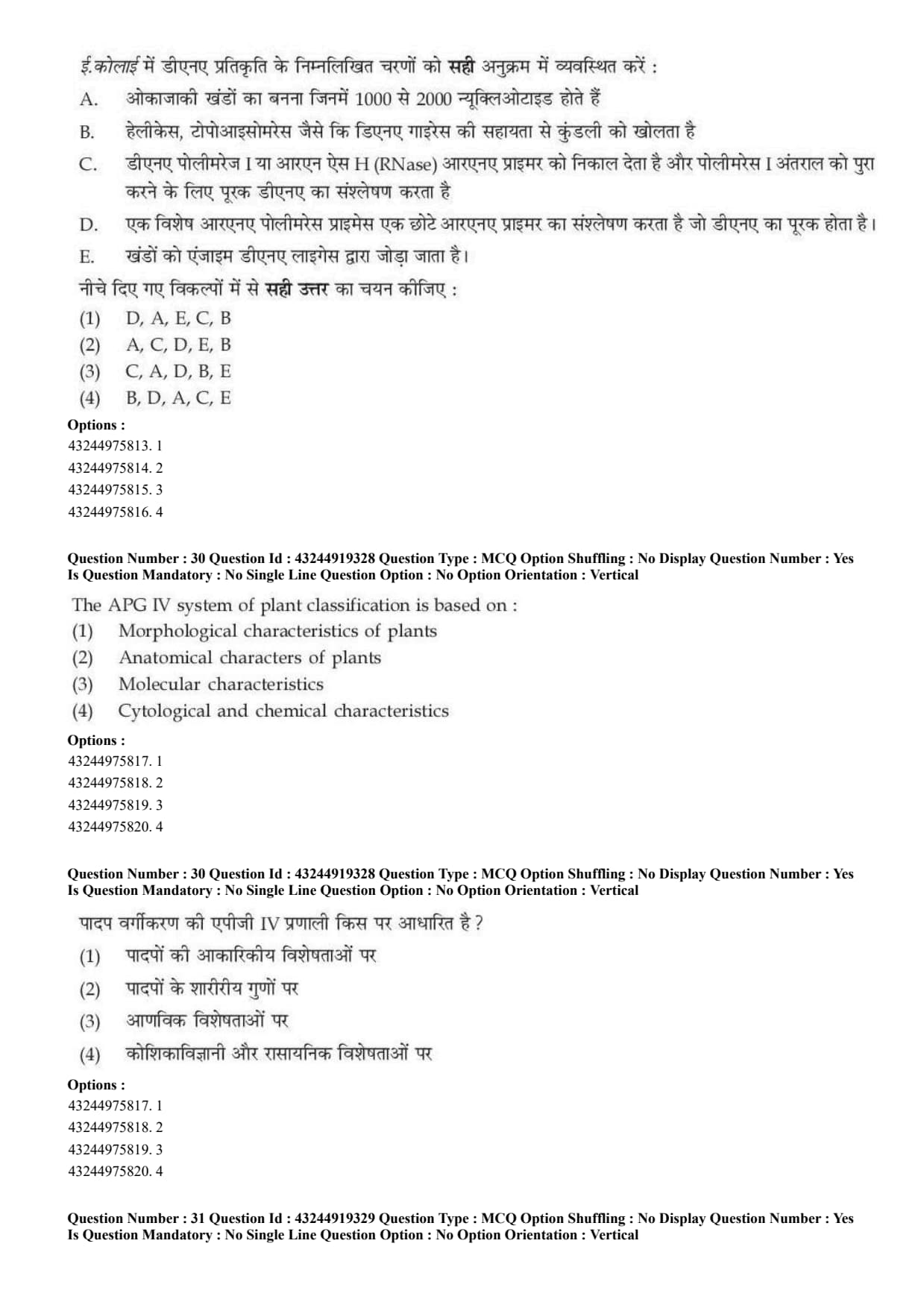
Arrange the following steps of DNA replication in E.Coli in a correct sequence :
A. Formation of Okazaki fragments which are of 1000 to 2000 nucleotides
B. Helicase unwind the helix with the help of topoisomerase like DNA Gyrase
C. DNA polymerase I or RNase H removes the RNA primer and polymerase I synthesizes complementary DNA to fill the gap
D. A special RNA polymerase 'primase' synthesizes a short RNA primer complementary to DNA
E. Fragments are joined by the enzyme DNA ligase
Choose the correct answer from the options given below :
View Solution
Step 1: Understanding the Question:
The question asks to arrange the sequential molecular steps of \(DNA\) replication in prokaryotes (Escherichia coli) in correct chronological order.
Step 2: Key Formula or Approach:
Replication mechanism in \textit{E. coli:
1. Unwinding and initiation by Helicase and DNA Gyrase (Topoisomerase).
2. Primer synthesis by Primase (RNA Polymerase).
3. Elongation and Okazaki fragment synthesis on lagging strand by DNA Polymerase III.
4. Primer removal and gap filling by DNA Polymerase I / RNase H.
5. Ligation of Okazaki fragments by DNA Ligase.
Step 3: Detailed Explanation:
Step 1 (B): Helicase breaks hydrogen bonds to unwind parental \(DNA\) strands, while \(DNA\) Gyrase (Topoisomerase) relieves torsional supercoiling ahead of replication fork.
Step 2 (D): Primase synthesizes short complementary \(RNA\) primers (\(10-12\) nucleotides) providing free \(3'-OH\) ends.
Step 3 (A): \(DNA\) Polymerase III extends from primers to synthesize Okazaki fragments (\(1000-2000\) nucleotides long in prokaryotes) along discontinuous lagging strand.
Step 4 (C): \(DNA\) Polymerase I removes \(RNA\) primers using its \(5' \rightarrow 3'\) exonuclease activity and fills gaps with complementary deoxyribonucleotides.
Step 5 (E): \(DNA\) Ligase forms phosphodiester bonds between adjacent fragments to create a continuous \(DNA\) strand.
Sequence Order: B \(\rightarrow\) D \(\rightarrow\) A \(\rightarrow\) C \(\rightarrow\) E.
Step 4: Final Answer:
The correct sequence is B, D, A, C, E, which matches option (D).
Quick Tip: Replication Chronology:
\textbf{Unwind (Helicase/Gyrase) \(\rightarrow\) \textbf{Prime} (Primase) \(\rightarrow\) \textbf{Synthesize} (Polymerase III) \(\rightarrow\) \textbf{Clean up primers} (Polymerase I) \(\rightarrow\) \textbf{Seal} (Ligase).
The APG IV system of plant classification is based on :
View Solution
Step 1: Understanding the Question:
The question asks for the primary underlying basis of the Angiosperm Phylogeny Group IV (\(APG IV\)) system of flowering plant classification.
Step 2: Key Formula or Approach:
- APG System: Modern phylogenetic classification system for angiosperms established by an international group of systematic botanists.
- APG IV (2016): Based primarily on cladistic analyses of molecular nucleotide sequences (e.g., chloroplast genes rbcL, \textit{atpB, \textit{matK, and nuclear ribosomal \(18S\) \(rDNA\)).
Step 3: Detailed Explanation:
Historical Context vs APG:
Traditional classifications (e.g., Bentham and Hooker, Engler and Prantl) relied on gross morphological, floral, or anatomical characters.
In contrast, the Angiosperm Phylogeny Group system replaces subjective morphological grouping with objective phylogenetic trees derived from molecular DNA sequence data.
Key Features of APG IV:
Published in 2016, APG IV uses multi-gene phylogenetic analysis to reconstruct evolutionary relationships among flowering plants, establishing monophyletic clades like basal angiosperms, magnoliids, monocots, and eudicots.
Step 4: Final Answer:
The APG IV system is based on Molecular characteristics, matching option (C).
Quick Tip: Bentham \& Hooker \(\rightarrow\) Natural system based on Floral Morphology.
APG (I, II, III, IV) \(\rightarrow\) Modern Phylogenetic system based on \textbf{DNA / Molecular Sequences!
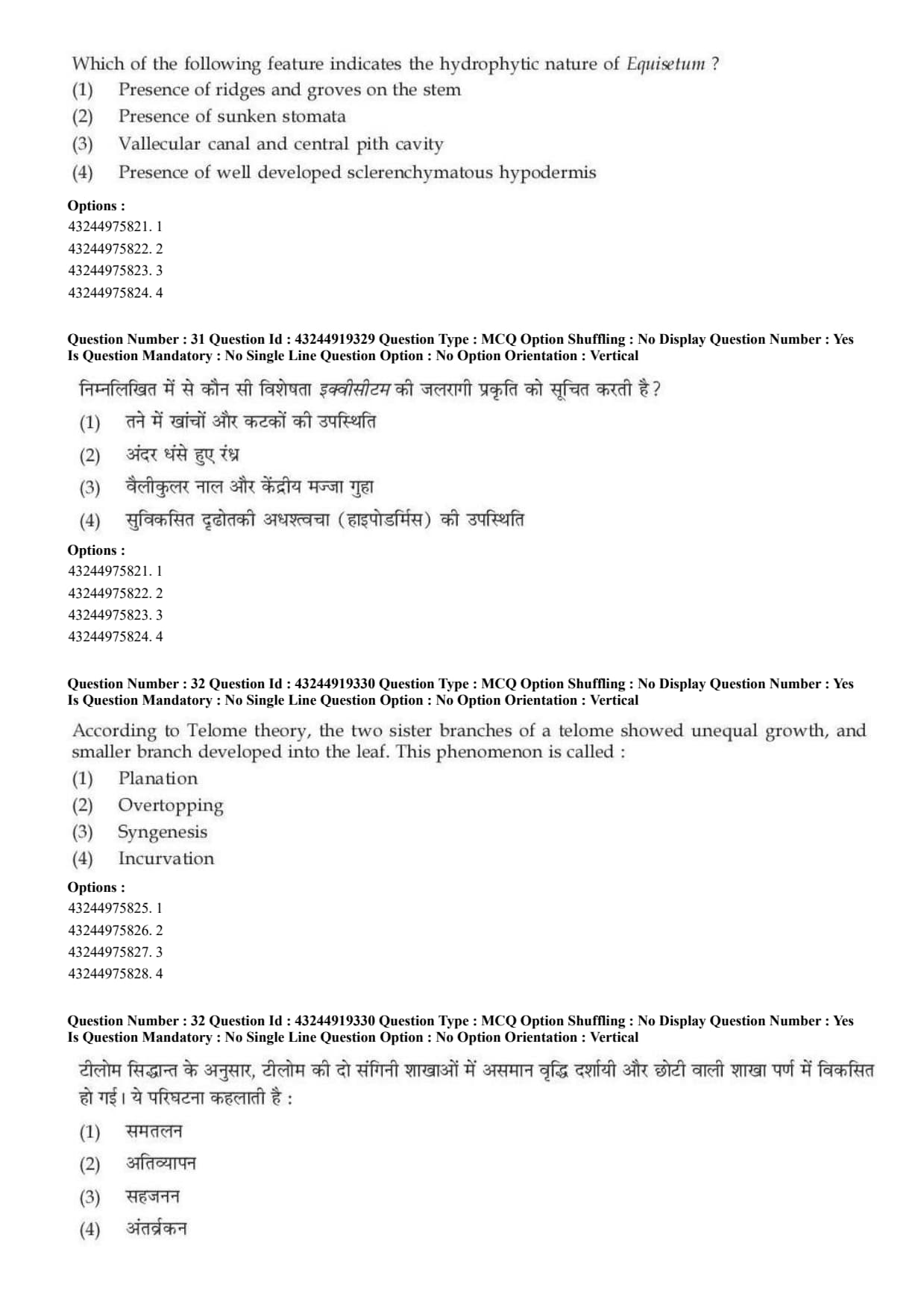
Which of the following feature indicates the hydrophytic nature of Equisetum ?
View Solution
Step 1: Understanding the Question:
The question asks to identify which anatomical feature among the options reflects the hydrophytic (adapted to wet/marshy environments) adaptation of the pteridophyte genus \textit{Equisetum (Horsetail).
Step 2: Key Formula or Approach:
\textit{Equisetum exhibits an amphibious/amphitrophic nature with a combination of xerophytic and hydrophytic anatomical features:
- Xerophytic features: Ridges and grooves, silica deposition in epidermal walls, sunken stomata, sclerenchymatous hypodermis.
- Hydrophytic features: Well-developed internal air passages including carinal canals, vallecular canals, and a large central pith cavity that facilitate internal gas exchange.
Step 3: Detailed Explanation:
Evaluation of Hydrophytic Feature (C):
The stem internode of \textit{Equisetum contains large longitudinal air channels:
1. Vallecular canals: Air cavities located beneath the grooves in the cortex.
2. Central pith cavity: Large central hollow cavity formed by breakdown of central parenchyma.
These air chambers function like aerenchyma, allowing continuous aeration and oxygen transport to subterranean rhizomes growing in waterlogged or anaerobic marshy soils.
Evaluation of Options (A, B, D):
- Ridges and grooves (A), sunken stomata (B), and sclerenchymatous hypodermis (D) are xerophytic features that prevent transpiration loss and provide mechanical rigidity.
Step 4: Final Answer:
Vallecular canal and central pith cavity indicate the hydrophytic nature, so option (C) is correct.
Quick Tip: Equisetum Adaptations:
- Hydrophytic = Air cavities (Vallecular canals, Carinal canals, Pith cavity).
- Xerophytic = Sunken stomata, Silica coating, Sclerenchyma, Ridges/Grooves.
According to Telome theory, the two sister branches of a telome showed unequal growth, and smaller branch developed into the leaf. This phenomenon is called :
View Solution
Step 1: Understanding the Question:
The question identifies the specific elementary morphogenetic process in Walter Zimmermann's Telome Theory where equal dichotomic branching evolves into unequal growth, forming a main axis and smaller lateral branches.
Step 2: Key Formula or Approach:
Zimmermann's Telome Theory (1930) explains the evolutionary origin of land plant vegetative and reproductive organs through five elementary processes:
1. Overtopping: Unequal growth of two dichotomous branches.
2. Planation: Spatial rearrangement of three-dimensional branching into a single two-dimensional flat plane.
3. Syngenesis (Webbing/Fusion): Lateral fusion of adjacent telomes by parenchymatous tissue to form flat leaf blades (lamina) or complex vascular steles.
4. Reduction: Simplification of telomes into unbranched structures.
5. Recurvation/Incurvation: Bending of telomes downward or inward.
Step 3: Detailed Explanation:
Mechanism of Overtopping:
Primitive vascular plants (e.g., Rhynia) exhibited equal dichotomous branching.
During evolution, one sister branch grew more vigorously, forming a dominant upright main axis (overtopping branch), while the slower-growing smaller sister branch was pushed laterally to become a lateral shoot or primitive leaf precursor.
Process Identification:
The transition from equal dichotomy to unequal growth where the smaller branch forms a leaf precursor is explicitly called Overtopping.
Step 4: Final Answer:
This evolutionary phenomenon is Overtopping, corresponding to option (B).
Quick Tip: Telome Theory Key Terms:
- \textbf{Overtopping = Unequal growth (Main stem vs lateral branch).
- \textbf{Planation} = 3D to 2D flat plane alignment.
- \textbf{Syngenesis} = Fusion/webbing between branches to form leaf lamina.
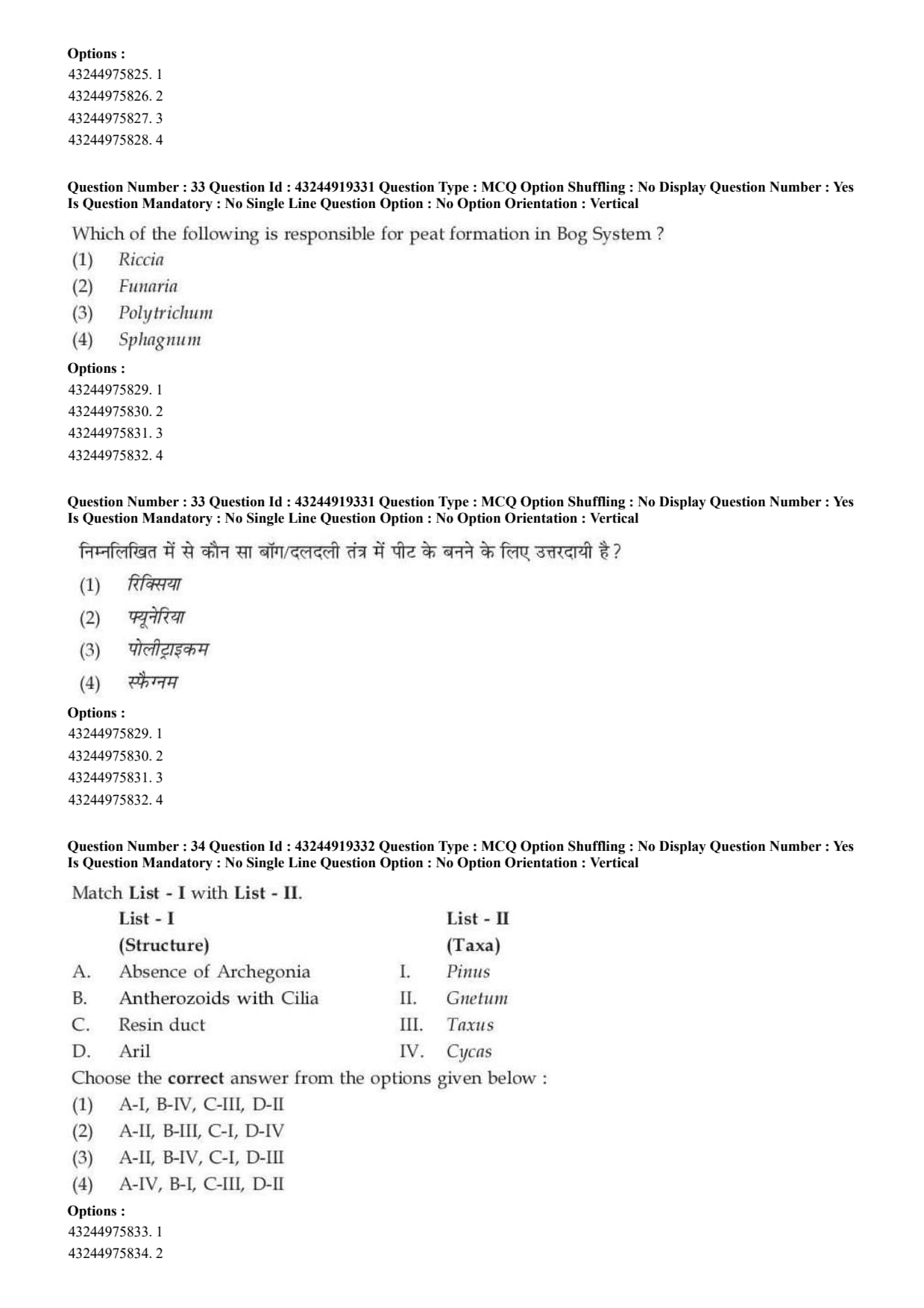
Which of the following is responsible for peat formation in Bog System ?
View Solution
Step 1: Understanding the Question:
The question asks to identify the bryophyte genus primarily responsible for the formation and accumulation of peat in acidic wetland/bog ecosystems.
Step 2: Key Formula or Approach:
- Peat Moss: Sphagnum is commonly known as peat moss or bog moss.
- Mechanism of Peat Formation: \textit{Sphagnum secretes organic acids (like sphagnum acid) and exchanges polyvalent cations for \(H^+\) ions, creating an acidic, nutrient-poor, anaerobic waterlogged environment.
Step 3: Detailed Explanation:
Role of Sphagnum in Bog Systems:
1. \textit{Sphagnum plants have extraordinary water-retention capacity due to large dead hyaline cells with spiral thickenings, holding up to 20 times their dry weight in water.
2. As old lower portions of \textit{Sphagnum die, the highly acidic (\(pH 3-4.5\)) and anaerobic conditions severely inhibit microbial decomposers (bacteria and fungi).
3. Consequently, dead plant matter undergoes incomplete decomposition and compresses over centuries to form thick deposits of dark organic matter known as Peat.
Ecological and Commercial Value:
Peat covers millions of hectares globally, serving as a vast global carbon sink, soil conditioner, and horticultural fuel source.
Step 4: Final Answer:
The genus responsible for peat formation is Sphagnum, given by option (D).
Quick Tip: \textit{Sphagnum = Peat Moss = Bog Moss.
It creates acidic, anaerobic conditions that prevent decay, leading to historical peat accumulation!
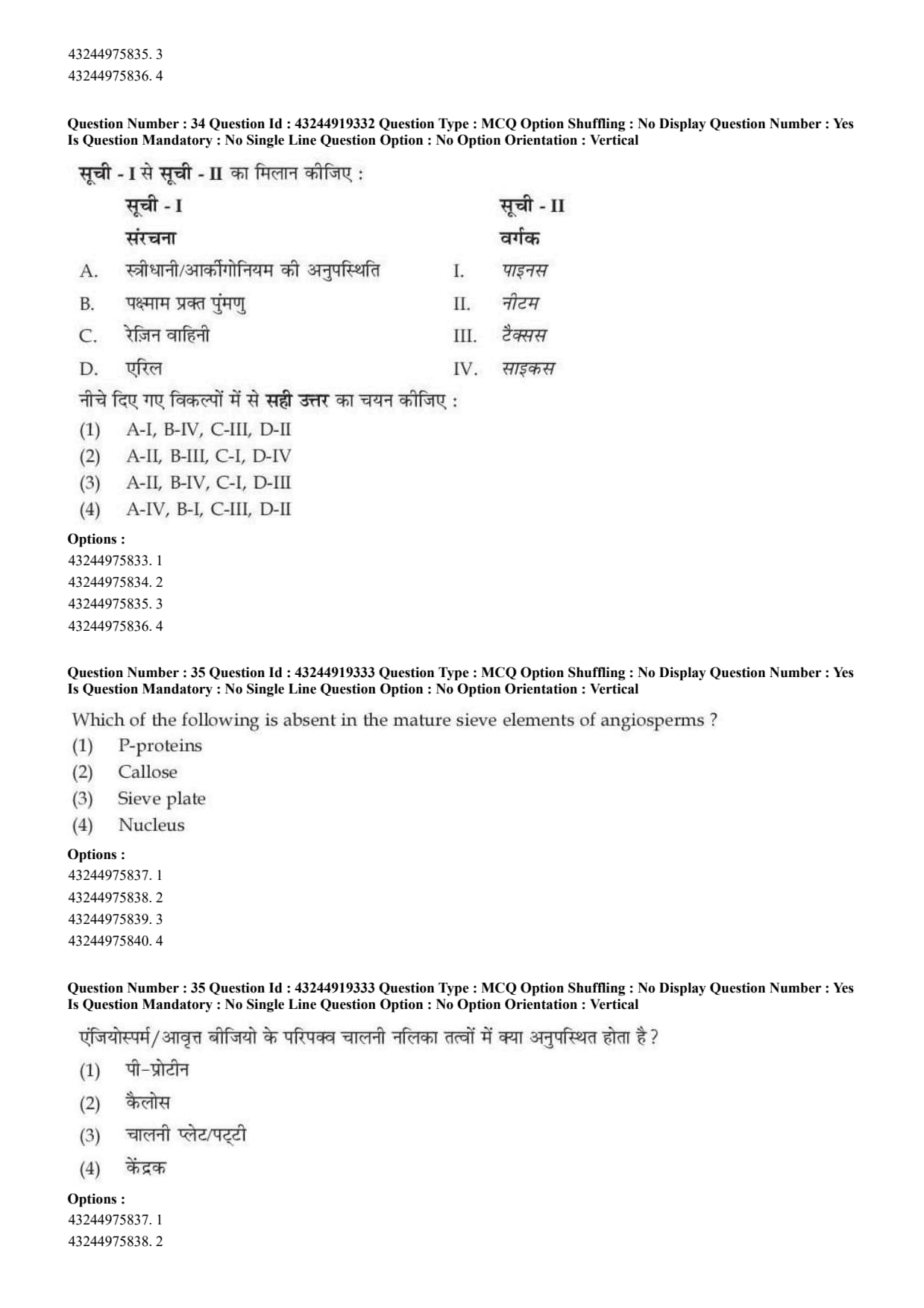
Match List - I with List - II.

Choose the correct answer from the options given below :
View Solution
Step 1: Understanding the Question:
The question requires matching anatomical/morphological structures with their corresponding gymnosperm taxa.
Step 2: Key Formula or Approach:
Analyze diagnostic features of major gymnosperm groups:
- Gnetum (Gnetales): Highly advanced gymnosperm lacking archegonia in female gametophyte.
- \textit{Cycas (Cycadales): Primitive gymnosperm possessing large, top-shaped multiciliated motile male gametes (antherozoids).
- \textit{Pinus (Coniferales): Characterized by schizogenous resin canals/ducts in leaves, cortex, and secondary xylem.
- \textit{Taxus (Taxales): Seed is surrounded by a brightly colored, fleshy outgrowth called an aril.
Step 3: Detailed Explanation:
A. Absence of Archegonia (II): In \textit{Gnetum, archegonia are completely absent in the female gametophyte, bridging gymnosperms with angiosperms.
B. Antherozoids with Cilia (IV): \textit{Cycas produces large multiciliated motile male gametes that swim in archegonial chamber liquid during fertilization.
C. Resin duct (I): \textit{Pinus possesses specialized schizogenous resin ducts that secrete protective oleoresin.
D. Aril (III): In \textit{Taxus (Yew), the seed is partially enclosed by a red, fleshy cuplike structure known as an aril.
Matching Summary:
A \(\rightarrow\) II, B \(\rightarrow\) IV, C \(\rightarrow\) I, D \(\rightarrow\) III.
Step 4: Final Answer:
The correct matching sequence corresponds to option (C).
Quick Tip: Gymnosperm Diagnostic Features:
- \textit{Cycas = Multiciliated motile sperm.
- Pinus = Resin ducts.
- Gnetum = Absence of archegonia + presence of vessels.
- Taxus = Red fleshy Aril!
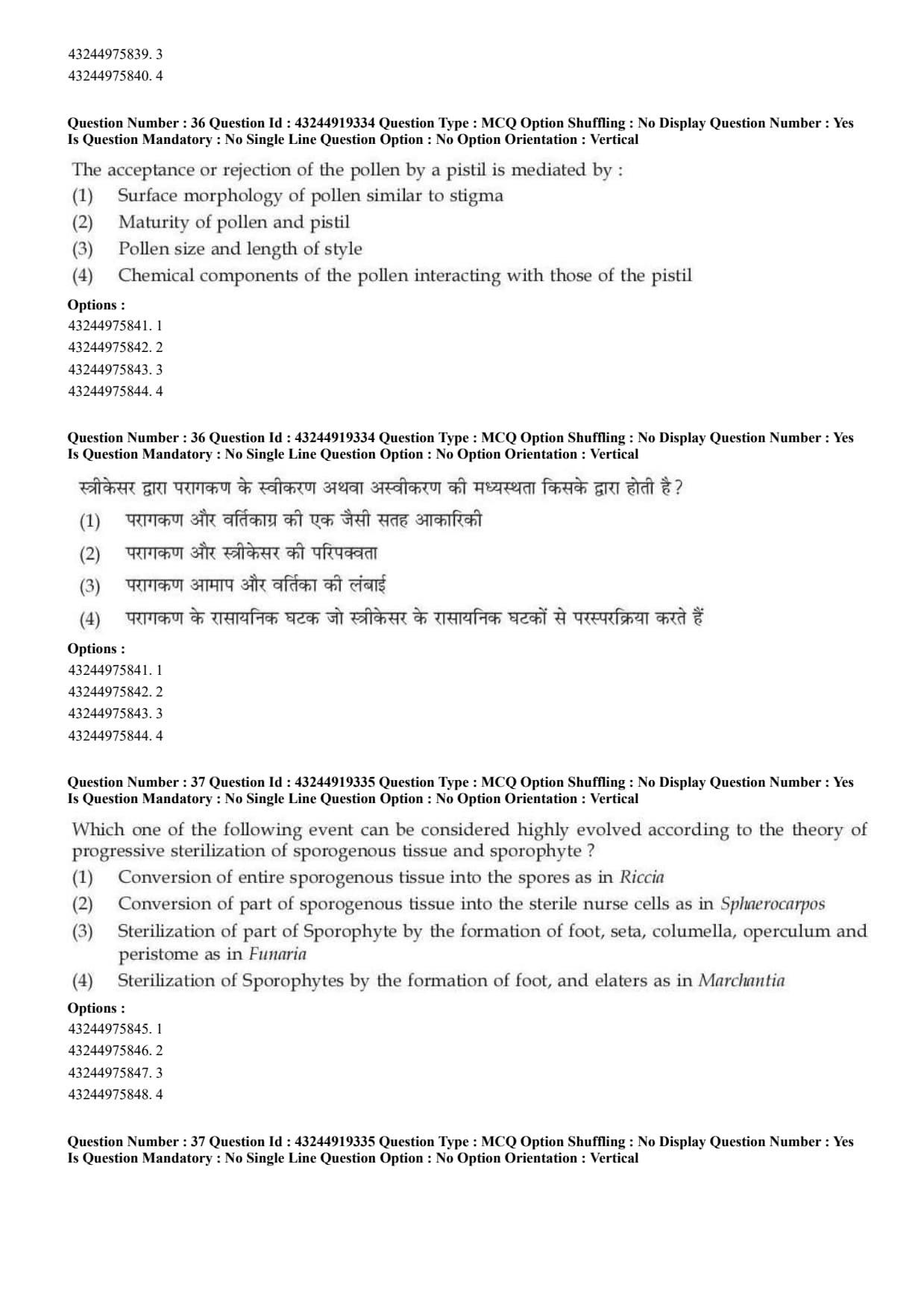
Which of the following is absent in the mature sieve elements of angiosperms ?
View Solution
Step 1: Understanding the Question:
The question asks to identify the cellular organelle that is lost (absent) during the maturation of sieve tube elements in angiosperm phloem.
Step 2: Key Formula or Approach:
Sieve tube elements undergo selective autolysis during maturation to maximize longitudinal sap flow:
- Retained components: Plasma membrane, cytoplasm (peripheral layer), mitochondria, plastids, smooth ER, P-protein, callose, and sieve plates with pores.
- Degraded/Lost components: Nucleus, vacuolar membrane (tonoplast), ribosomes, and Golgi apparatus.
Step 3: Detailed Explanation:
Structural Specialization of Sieve Tube Elements:
Mature sieve elements are living conducting cells lacking a nucleus (enucleate at functional maturity).
The loss of the nucleus reduces cytoplasmic resistance, enabling efficient bulk flow translocation of organic solutes (sucrose).
Metabolic Maintenance:
Because mature sieve tube elements lack a nucleus, their metabolic functions and nuclear control are entirely maintained by adjacent parenchymatous companion cells, which connect to sieve elements via abundant plasmodesmata.
Evaluation of Options (A, B, C):
- P-proteins (Phloem proteins) (A) seal wounded sieve tubes.
- Callose (B) deposits around sieve pores during stress/wounding.
- Sieve plates (C) contain pores for end-to-end continuous conduction.
All three are present in functional mature sieve elements.
Step 4: Final Answer:
The nucleus is absent in mature sieve elements, corresponding to option (D).
Quick Tip: Enucleated Living Cells in Mammals and Plants:
- Mammalian Red Blood Cells (\(RBCs\)).
- Angiosperm Mature Sieve Tube Elements.
Both lose their nucleus at maturity to optimize their primary transport function!
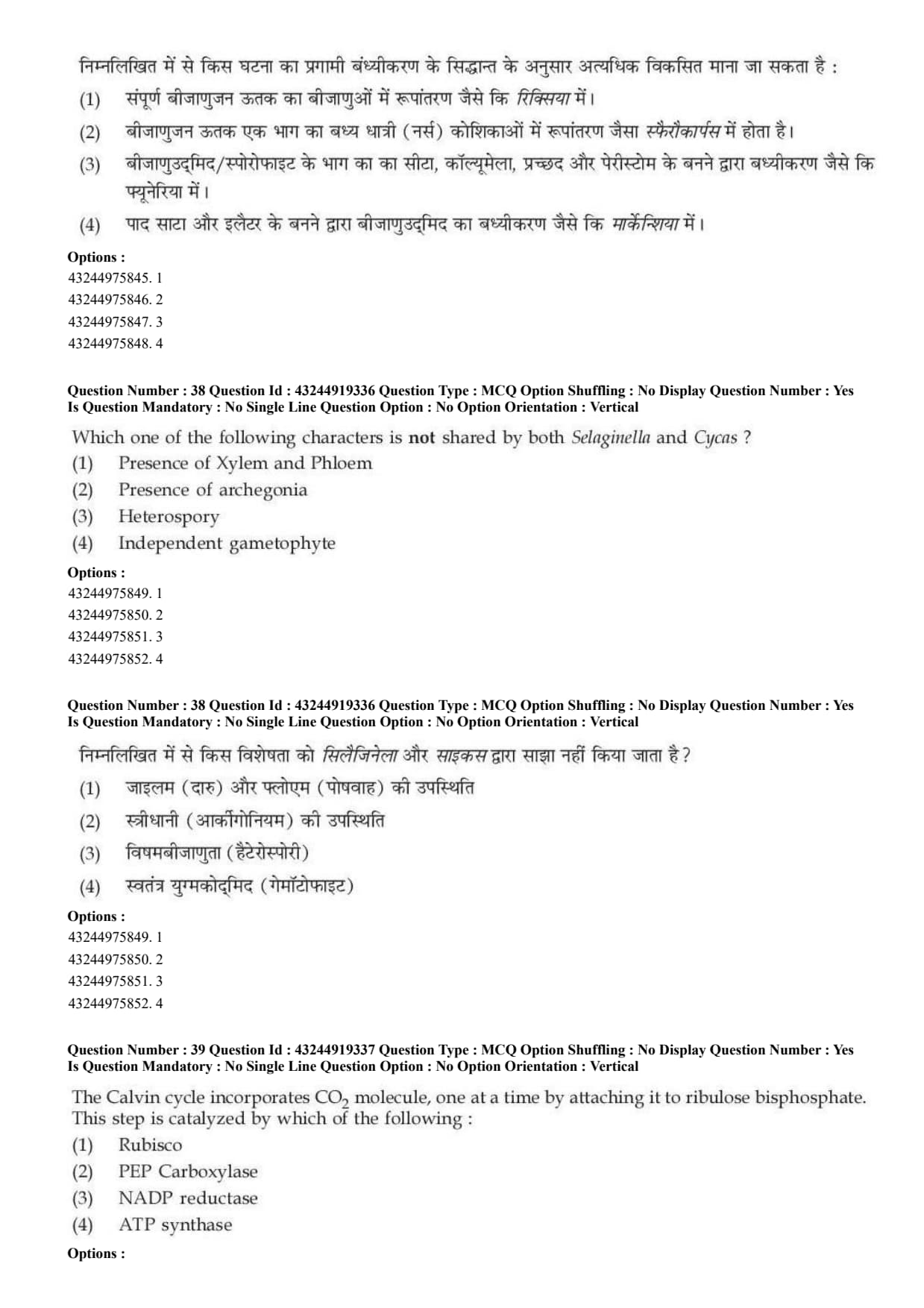
The acceptance or rejection of the pollen by a pistil is mediated by :
View Solution
Step 1: Understanding the Question:
The question asks for the physiological mechanism regulating pollen recognition and self-incompatibility/compatibility at the pistil surface.
Step 2: Key Formula or Approach:
- Pollen-Pistil Interaction: A continuous biochemical dialogue between pollen grains landing on the stigma and the carpel tissues.
- Mediated by specific chemical interactions involving proteins, glycoproteins, lipids, and signaling ligands embedded in the pollen wall (exine/intine) and stigmatic pellicle receptors.
Step 3: Detailed Explanation:
Biochemical Recognition Mechanism:
1. Landing of pollen triggers hydrated release of pollen wall proteins (exine/intine proteins) onto the stigmatic surface.
2. Stigmatic pellicle receptor kinases (e.g., S-receptor kinase in self-incompatibility) interact with specific pollen ligands (e.g., SCR/SP11 proteins).
3. If compatible, the pistil accepts the pollen, promoting hydration, germination, and pollen tube growth down the style.
4. If incompatible, chemical signaling blocks hydration or inhibits pollen tube growth.
Evaluation of Options:
Option (D) correctly identifies this chemical recognition dialogue between pollen and pistil components as the mediating factor.
Step 4: Final Answer:
Acceptance or rejection is mediated by chemical components interacting between pollen and pistil, matching option (D).
Quick Tip: Pollen recognition is NOT mechanical or physical! It is entirely a \textbf{biochemical dialogue} mediated by protein-protein and ligand-receptor interactions!
Which one of the following event can be considered highly evolved according to the theory of progressive sterilization of sporogenous tissue and sporophyte ?
View Solution
Step 1: Understanding the Question:
The question asks to identify the most advanced/highly evolved sporophytic state according to F.O. Bower's Theory of Progressive Sterilization of Sporogenous Tissue in bryophytes.
Step 2: Key Formula or Approach:
- Bower's Theory (1935): Traces bryophyte sporophyte evolution from simple to complex through progressive conversion of fertile sporogenous tissue into sterile vegetative tissue.
- Evolutionary Gradient:
\(Riccia (Simplest) \rightarrow Sphaerocarpos \rightarrow Marchantia \rightarrow Anthoceros \rightarrow Funaria/Mosses (Most Advanced)\).
Step 3: Detailed Explanation:
Riccia (A): Primitive state where almost \(100%\) of internal tissue is fertile sporogenous tissue; no foot, seta, or sterile structures exist.
Sphaerocarpos (B) \& Marchantia (D): Intermediate stages where sterile nurse cells or elaters evolve alongside a simple foot and short seta.
Funaria (C): Represents the highest evolutionary complexity in bryophytes.
Extensive sterilization reduces fertile tissue to a thin layer surrounding a central sterile columella.
Sterile structures include a photosynthetic capsule wall, apophysis with stomata, anchoring foot, conducting seta, protective operculum, and hygroscopic peristome teeth for regulated spore dispersal.
Step 4: Final Answer:
The event representing the most highly evolved state is option (C).
Quick Tip: Bower's Progressive Sterilization Trend:
\textbf{Riccia} (Minimal sterile tissue) \(\rightarrow\) \textbf{Marchantia} (Foot, Seta, Elaters) \(\rightarrow\) \textbf{Funaria} (Foot, Seta, Columella, Apophysis, Operculum, Peristome - Maximum sterile tissue!).
Which one of the following characters is not shared by both Selaginella and Cycas ?
View Solution
Step 1: Understanding the Question:
The question asks to identify the feature that is not common to both Selaginella (a heterosporous pteridophyte) and \textit{Cycas (a gymnosperm).
Step 2: Key Formula or Approach:
Compare traits across plant divisions:
- \textit{Selaginella: Pteridophyte with vascular tissue, archegonia, heterospory, and free-living or semi-independent gametophytes.
- \textit{Cycas: Gymnosperm with vascular tissue, archegonia, heterospory, but completely dependent, non-free-living gametophytes retained permanently within the ovule/sporophyte.
Step 3: Detailed Explanation:
Evaluation of Shared Traits (A, B, C):
- Presence of Xylem and Phloem (A): Both are vascular plants (tracheophytes) possessing conductive tissues.
- Presence of Archegonia (B): Both bear female gametangia (archegonia) on their female gametophytes.
- Heterospory (C): Both produce two distinct sizes of spores (microspores and megaspores).
Evaluation of Unshared Trait (D):
- In \textit{Selaginella, the gametophyte can develop independently outside the parent sporophyte.
- In \textit{Cycas (and all seed plants), the female gametophyte is entirely dependent on the sporophyte for nutrition and protection, remaining enclosed inside the megasporangium (ovule).
Therefore, an independent gametophyte is not shared by \textit{Cycas.
Step 4: Final Answer:
Independent gametophyte is not shared by both, making option (D) correct.
Quick Tip: Evolutionary Trend in Gametophytes:
- Bryophytes \(\rightarrow\) Dominant, independent gametophyte.
- Pteridophytes \(\rightarrow\) Small, free-living independent gametophyte (prothallus).
- Gymnosperms \& Angiosperms \(\rightarrow\) \textbf{Dependent, highly reduced gametophyte retained on sporophyte!
The Calvin cycle incorporates \(CO_2\) molecule, one at a time by attaching it to ribulose bisphosphate. This step is catalyzed by which of the following :
View Solution
Step 1: Understanding the Question:
The question asks to identify the enzyme that catalyzes the initial carbon carboxylation step of the Calvin cycle (\(C_3\) cycle) in photosynthetic organisms.
Step 2: Key Formula or Approach:
The primary carboxylation reaction in the Calvin cycle:
\[ RuBP (5C) + CO_2 + H_2O \xrightarrow{Rubisco} 2 \times 3-PGA (3C) \]
where RuBP is Ribulose-1,5-bisphosphate and 3-PGA is 3-phosphoglycerate.
Step 3: Detailed Explanation:
Role of Rubisco (Ribulose-1,5-bisphosphate carboxylase-oxygenase):
Rubisco is the primary enzyme responsible for carbon fixation in all photosynthetic organisms (\(C_3\), \(C_4\), and \(CAM\) plants).
It catalyzes the covalent attachment of atmospheric \(CO_2\) to the 5-carbon acceptor molecule RuBP, forming an unstable 6-carbon intermediate that immediately splits into two molecules of 3-phosphoglycerate (\(3-PGA\)).
Evaluation of Other Options:
- PEP Carboxylase (B) catalyzes initial \(CO_2\) fixation in \(C_4\) and \(CAM\) mesophyll cells.
- NADP reductase (C) catalyzes \(NADP^+\) reduction during light reactions.
- ATP synthase (D) catalyzes \(ATP\) synthesis via photophosphorylation.
Step 4: Final Answer:
The enzyme catalyzing this step is Rubisco, corresponding to option (A).
Quick Tip: Rubisco is the most abundant enzyme on Earth!
Primary \(CO_2\) acceptor in Calvin cycle = RuBP (5C).
Primary enzyme = Rubisco.
Arrange the following steps of photosynthesis in C4 plant in a correct sequence :
A. Conversion of Oxaloacetate to Malate
B. Malate releases \(CO_2\)
C. Adding of \(CO_2\) to phosphoenolpyruvate to form Oxaloacetate
D. \(CO_2\) reassimilated into organic material by rubisco in the Calvin cycle
E. Export of malate to bundle sheath cells through plasmodesmata
Choose the correct answer from the options given below :
View Solution
Step 1: Understanding the Question:
The question asks to arrange the biochemical steps of \(C_4\) photosynthesis (Hatch-Slack pathway) across mesophyll and bundle sheath cells in correct physiological sequence.
Step 2: Key Formula or Approach:
Outline the Hatch-Slack \(C_4\) Pathway:
1. Fixation in Mesophyll: \(PEP (3C) + HCO_3^- \xrightarrow{PEP Case} Oxaloacetate (OAA, 4C)\).
2. Reduction in Mesophyll: \(OAA \rightarrow Malate (4C)\).
3. Transport: Malate moves from mesophyll cells to bundle sheath cells via plasmodesmata.
4. Decarboxylation in Bundle Sheath: \(Malate \xrightarrow{Malic Enzyme} Pyruvate (3C) + CO_2\).
5. Refixation in Bundle Sheath: Released \(CO_2\) is fixed by Rubisco in the Calvin cycle.
Step 3: Detailed Explanation:
Step 1 (C): Carbon dioxide is added to Phosphoenolpyruvate (\(PEP\)) by PEP carboxylase in mesophyll cells to yield Oxaloacetate (\(OAA\)).
Step 2 (A): Oxaloacetate is reduced to Malate by malate dehydrogenase in mesophyll cells.
Step 3 (E): Malate is transported through vascular plasmodesmata into bundle sheath cells.
Step 4 (B): In bundle sheath cells, malate undergoes decarboxylation, releasing a concentrated stream of \(CO_2\).
Step 5 (D): The released \(CO_2\) is reassimilated by Rubisco in the Calvin cycle, preventing photorespiration.
Sequence Order: C \(\rightarrow\) A \(\rightarrow\) E \(\rightarrow\) B \(\rightarrow\) D.
Step 4: Final Answer:
The correct order is C, A, E, B, D, matching option (C).
Quick Tip: \(C_4\) Pathway Sequence:
\textbf{Mesophyll}: Carboxylation (\(PEP \rightarrow OAA\)) \(\rightarrow\) Reduction to Malate \(\rightarrow\) \textbf{Transport} to Bundle Sheath \(\rightarrow\) \textbf{Decarboxylation} (\(CO_2\) release) \(\rightarrow\) \textbf{Refixation} by Rubisco!
Which of the following is/are found in Leucocytes of human blood ?
A. Neutrophils
B. Eosinophils
C. Basophils
D. Lymphocytes
E. Monocytes
Choose the correct answer from the options given below :
View Solution
Step 1: Understanding the Question:
The question asks to identify which cell types among the listed choices belong to white blood cells (leucocytes) in human blood.
Step 2: Key Formula or Approach:
Classification of Human Leucocytes (WBCs):
- Granulocytes (possess cytoplasmic granules and lobed nuclei):
1. Neutrophils (\(60% - 65%\))
2. Eosinophils (\(2% - 3%\))
3. Basophils (\(0.5% - 1%\))
- Agranulocytes (lack distinct cytoplasmic granules):
4. Lymphocytes (\(20% - 25%\))
5. Monocytes (\(6% - 8%\))
Step 3: Detailed Explanation:
A. Neutrophils: Phagocytic granulocytes providing primary defense against bacterial infections. (Leucocyte)
B. Eosinophils: Granulocytes involved in allergic reactions and parasitic defenses. (Leucocyte)
C. Basophils: Granulocytes secreting histamine, heparin, and serotonin during inflammation. (Leucocyte)
D. Lymphocytes: Agranulocytes (B and T cells) responsible for adaptive immune responses. (Leucocyte)
E. Monocytes: Phagocytic agranulocytes that differentiate into tissue macrophages. (Leucocyte)
Conclusion:
All five options (A, B, C, D, E) represent the complete spectrum of human leucocytes.
Step 4: Final Answer:
The correct combination includes all five types, given by option (D).
Quick Tip: Remember WBC types and relative abundances:
"\textbf{N}ever \textbf{L}et \textbf{M}onkeys \textbf{E}at \textbf{B}ananas"
\textbf{N}eutrophils \(>\) \textbf{L}ymphocytes \(>\) \textbf{M}onocytes \(>\) \textbf{E}osinophils \(>\) \textbf{B}asophils!
Which of the following moderate the functions of the respiratory rhythm to suit the demands of the body tissue ?
View Solution
Step 1: Understanding the Question:
The question asks to identify the neural center in the human brain that moderates and fine-tunes the activity of the respiratory rhythm center according to metabolic body demands.
Step 2: Key Formula or Approach:
Neural regulation of respiration:
- Respiratory Rhythm Center: Located in the medulla oblongata, primarily responsible for generating basic respiratory rhythm.
- Pneumotaxic Center: Located in the dorsal pons region of the brainstem, moderates rhythm center signals to adjust breathing rate and depth.
Step 3: Detailed Explanation:
Function of the Pneumotaxic Center:
The pneumotaxic center sends inhibitory neural signals to the inspiratory area of the respiratory rhythm center in the medulla.
By limiting the duration of inspiration, it increases the overall breathing frequency to adapt to physical exercise, hypoxia, or metabolic demands.
Chemosensitive Control Interplay:
Central chemoreceptors in the medulla and peripheral chemoreceptors in aortic/carotid bodies detect changes in \(CO_2\) and \(H^+\) concentration, signaling the pneumotaxic and rhythm centers to fine-tune ventilation rate.
Step 4: Final Answer:
The neural structure moderating respiratory rhythm is the Pneumotaxic centre of pons region of brain, matching option (C).
Quick Tip: Respiratory Neural Control:
- \textbf{Rhythm Generation} \(\rightarrow\) Medulla Oblongata.
- \textbf{Rhythm Moderation / Fine-tuning} \(\rightarrow\) Pneumotaxic Center in Pons!
The viruses that possess oncogenes are mainly responsible for causing :
View Solution
Step 1: Understanding the Question:
The question asks for the pathological condition caused by viral infection with viruses carrying oncogenes (viral oncogenes or v-onc).
Step 2: Key Formula or Approach:
- Oncogenes: Mutated or viral genes capable of transforming normal host cells into malignant, uncontrollably proliferating cancer cells.
- Oncogenic Viruses: Viruses carrying oncogenes or inserting near cellular proto-oncogenes to induce oncogenesis (e.g., HPV, EBV, Hepatitis B/C, HTLV-1).
Step 3: Detailed Explanation:
Mechanism of Viral Oncogenesis:
Viral oncogenes encode abnormal growth factor receptors, signal transducers, or transcription factors that bypass host cell-cycle checkpoints.
Infection by tumor viruses disrupts cellular tumor suppressor genes (like \(p53\) or \(Rb\)), causing immortalization and malignant transformation into cancer.
Evaluation of Other Options:
- AIDS (B) is caused by Human Immunodeficiency Virus (HIV), which attacks \(CD4^+\) T-lymphocytes causing immunodeficiency, not direct oncogene-driven transformation.
- Cirrhosis (C) is chronic liver scarring caused by alcohol or long-term hepatitis.
- Cystic fibrosis (D) is a genetic disorder caused by mutations in the \(CFTR\) gene.
Step 4: Final Answer:
Viruses possessing oncogenes cause Cancer, matching option (A).
Quick Tip: \textbf{Proto-oncogenes} = Normal genes regulating cell growth.
\textbf{Oncogenes} / \textbf{Viral Oncogenes} = Mutated/viral genes causing \textbf{Cancer}!
Match List - I with List - II.

Choose the correct answer from the options given below :
View Solution
Step 1: Understanding the Question:
The question asks to match specialized morphological structures and body forms of Phylum Cnidaria (Coelenterata) with their corresponding biological functions.
Step 2: Key Formula or Approach:
Review Cnidarian features:
- Cnidoblasts (Cnidocytes): Stinging cells containing nematocysts used for offense, defense, and prey capture.
- Polyps: Sessile, cylindrical asexual body form that produces medusae asexually (metagenesis).
- Medusae: Free-swimming, umbrella-shaped sexual body form that produces polyps sexually.
- Hypostome: Elevated central oral cone bearing the mouth opening into the gastrovascular cavity.
Step 3: Detailed Explanation:
A. Cnidoblast (I): Specialized cell containing stinging capsule (nematocyst) used for defense, anchorage, and capturing prey.
B. Polyps (IV): Sessile morph producing free-swimming medusae via asexual budding (e.g., in Obelia).
C. Medusae (II): Free-swimming motile morph releasing gametes during sexual reproduction to produce polyps.
D. Hypostome (III): Central conical projection bearing the single opening (mouth) that leads into the gastrovascular cavity.
Matching Summary:
A \(\rightarrow\) I, B \(\rightarrow\) IV, C \(\rightarrow\) II, D \(\rightarrow\) III.
Step 4: Final Answer:
The correct matching sequence corresponds to option (A).
Quick Tip: Metagenesis in Cnidaria (\textit{Obelia):
- \textbf{Polyps} produce \textbf{Medusae} \textbf{ASEXUALLY}.
- \textbf{Medusae} produce \textbf{Polyps} \textbf{SEXUALLY}.
Given below are two statements : one is labelled as Assertion (A) and the other is labelled as Reason (R).
Assertion (A) : When alien species are introduced, some of them turn invasive and cause decline or extinction of indigenous species.
Reason (R) : When a species become extinct, the plant and animal species associated with it, in a obligatory way, also become extinct.
In the light of the above statements, choose the most appropriate answer from the options given below :
View Solution
Step 1: Understanding the Question:
The question evaluates two distinct drivers of biodiversity loss from the 'Evil Quartet' (Alien Species Invasions vs Co-extinction) and assesses their logical relationship.
Step 2: Key Formula or Approach:
Analyze both ecological statements independently and test if Reason (R) logically causes Assertion (A).
Step 3: Detailed Explanation:
Analysis of Assertion (A):
When non-native (alien) species are introduced into a new geographical area, some proliferate uncontrollably due to lack of natural predators, turning invasive.
Examples include the Nile perch in Lake Victoria or \textit{Lantana camara outcompeting native flora, driving indigenous species to decline or extinction.
Thus, Assertion (A) is correct.
Analysis of Reason (R):
When a host species goes extinct, any species obligately dependent on it (e.g., host-specific parasites or specialized plant-pollinator mutualists) also faces extinction, a phenomenon known as Co-extinction.
Thus, Reason (R) is correct.
Evaluation of Logical Connection:
Assertion (A) describes Alien Species Invasion, whereas Reason (R) describes Co-extinction.
Co-extinction is a separate mechanism of biodiversity loss and does not explain why alien species turn invasive or outcompete native species.
Therefore, (R) is not the correct explanation of (A).
Step 4: Final Answer:
Both (A) and (R) are correct but (R) is not the correct explanation of (A), matching option (B).
Quick Tip: The 'Evil Quartet' of Biodiversity Loss:
1. Habitat Loss and Fragmentation.
2. Over-exploitation.
3. Alien Species Invasions.
4. Co-extinctions.
Make sure to distinguish between cause and effect when multiple statements from the Evil Quartet appear together!
What will be the energy level at tertiary consumer level, if total sunlight present is 1,000,000 J and 10% law of energy transfer at successive trophic level starting from primary producer is followed ?
View Solution
Step 1: Understanding the Question:
The question asks to calculate the energy available at the tertiary consumer trophic level starting from total incident solar energy (\(1,000,000\ J\)), applying ecological solar conversion efficiency and Lindeman's \(10%\) Law of Energy Transfer.
Step 2: Key Formula or Approach:
1. Solar Energy Capture by Primary Producers: Plants capture approximately \(1%\) of total incident solar energy as Net Primary Productivity (\(NPP\)).
2. Lindeman's 10% Law: Only \(10%\) of energy stored at one trophic level is transferred to the next higher trophic level:
\[ E_{n+1} = E_n \times 0.10 \]
Step 3: Detailed Explanation:
Step 1: Primary Producer Level (\(T_1\)):
Solar energy converted by green plants:
\[ E_{Producer} = 1% of 1,000,000\ J = \frac{1}{100} \times 1,000,000\ J = 10,000\ J \]
Step 2: Primary Consumer Level (\(T_2\) - Herbivores):
Applying \(10%\) energy transfer rule:
\[ E_{Primary Consumer} = 10% of 10,000\ J = 0.10 \times 10,000\ J = 1,000\ J \]
Step 3: Secondary Consumer Level (\(T_3\) - Primary Carnivores):
Applying \(10%\) energy transfer rule:
\[ E_{Secondary Consumer} = 10% of 1,000\ J = 0.10 \times 1,000\ J = 100\ J \]
Step 4: Tertiary Consumer Level (\(T_4\) - Secondary Carnivores):
Applying \(10%\) energy transfer rule:
\[ E_{Tertiary Consumer} = 10% of 100\ J = 0.10 \times 100\ J = 10\ J \]
Step 4: Final Answer:
The energy level at the tertiary consumer level is \(10\ J\), corresponding to option (A).
Quick Tip: Energy Flow Calculation Steps:
- Incident Sunlight = \(1,000,000\ J\)
- Producers (\(1%\)) = \(10,000\ J\)
- Primary Consumers (\(10%\)) = \(1,000\ J\)
- Secondary Consumers (\(10%\)) = \(100\ J\)
- Tertiary Consumers (\(10%\)) = \(10\ J\)!
Detritus food chain mainly consists of :
View Solution
Step 1: Understanding the Question:
The question asks to identify the primary biological components forming the base of a Detritus Food Chain (\(DFC\)).
Step 2: Key Formula or Approach:
Compare major ecosystem food chains:
- Grazing Food Chain (\(GFC\)): Begins with living green photosynthetic producers (algae, plants).
- Detritus Food Chain (\(DFC\)): Begins with dead organic matter (detritus), where primary consumers are heterotrophic decomposers / saprotrophs (fungi and bacteria).
Step 3: Detailed Explanation:
Structure of Detritus Food Chain:
The primary energy source for \(DFC\) is non-living organic matter (leaf litter, dead animal bodies, fecal matter).
Decomposers—primarily fungi and bacteria—act as primary consumers in \(DFC\) by secreting extracellular hydrolytic enzymes to digest complex organic matter into soluble inorganic nutrients.
Ecosystem Importance:
In terrestrial ecosystems, a much larger fraction of energy flows through the Detritus Food Chain than through the Grazing Food Chain, recycling essential nutrients back to plants.
Step 4: Final Answer:
Detritus food chain consists mainly of Fungi and Bacteria, matching option (A).
Quick Tip: Food Chain Primary Organisms:
- Grazing Food Chain (\(GFC\)) \(\rightarrow\) Starts with \textbf{Green Plants/Algae}.
- Detritus Food Chain (\(DFC\)) \(\rightarrow\) Starts with \textbf{Dead Organic Matter} consumed by \textbf{Bacteria \& Fungi}!
How ecological foot print of the entire human population can be estimated ?
View Solution
Step 1: Understanding the Question:
The question asks for the global methodological approach used to estimate the per capita ecological footprint / biocapacity budget for the human population.
Step 2: Key Formula or Approach:
- Ecological Footprint: Measures human demand on natural capital—the quantity of nature it takes to support a person or economy.
- Biocapacity Calculation: Represents the total productive area available to generate resources and absorb wastes:
\[ Per Capita Biocapacity = \frac{Total Ecologically Productive Land/Sea Area}{Total Human Population} \]
Step 3: Detailed Explanation:
Methodology for Global Estimation:
To determine the sustainable footprint allowance available per individual on Earth, total global biocapacity (summing all cropland, forest, pasture, fishing grounds, and built-up land) is calculated in global hectares (\(gha\)) and divided by the total global human population.
Evaluation of Options:
Option (C) correctly states this operational approach: summing all ecologically productive land area on Earth and dividing it by the population.
Step 4: Final Answer:
The estimation method corresponds to option (C).
Quick Tip: Per Capita Biocapacity = Total Global Productive Area / Population.
When Ecological Footprint \(>\) Biocapacity, a region experiences an \textbf{ecological deficit}!
What is the advantage of immobilisation of enzymes and whole cell for industrial production of products ?
View Solution
Step 1: Understanding the Question:
The question asks for the primary technological advantage of using immobilized enzymes or whole cells in industrial bioprocesses.
Step 2: Key Formula or Approach:
- Enzyme Immobilization: Physical confinement or attachment of soluble enzymes or cells to an insoluble matrix (e.g., alginate beads, silica gel, acrylamide).
Step 3: Detailed Explanation:
Advantages of Immobilization:
1. Reusability \& Cost Reduction: Soluble enzymes are expensive and difficult to recover from reaction mixtures. Immobilization allows easy separation and continuous re-use for multiple operational cycles.
2. Thermal \& Operational Stability: Matrix binding protects protein tertiary structure against extreme \(pH\), temperature fluctuations, and organic solvents.
3. Product Purity: The final product stream is free from enzyme contamination, downstream purification costs.
4. Continuous Operation: Enables continuous packed-bed bioreactor processing.
Evaluation of Option (A):
Option (A) accurately summarizes improved thermal/operational stability, enhanced catalytic efficiency, and simple enzyme recovery for repeated industrial use.
Step 4: Final Answer:
The primary advantage is given by option (A).
Quick Tip: Key benefits of Immobilized Enzymes:
- Easy recovery \& \textbf{Reusability}.
- High \textbf{Thermal Stability}.
- Contamination-free product stream!
Match List - I with List - II.

Choose the correct answer from the options given below :
View Solution
Step 1: Understanding the Question:
The question asks to match environmental microbiology terms and microbial phenomena with their precise definitions and biological characteristics.
Step 2: Key Formula or Approach:
Analyze the defining characteristics of each term:
- Biofilm: Structured community of bacterial cells enclosed in a self-produced polymeric matrix attached to an organic or inorganic surface.
- Glycocalyx: Outer extracellular polymeric capsule/slime layer secreted by bacteria.
- Red tides: Harmful algal blooms caused by rapid proliferation of marine dinoflagellates containing reddish photosynthetic pigments.
- Coliform bacteria: Gram-negative, non-spore-forming, rod-shaped (bacilli) facultative anaerobes that ferment lactose, inhabiting mammalian intestines.
Step 3: Detailed Explanation:
A. Biofilm (IV): A structured layer of organic matter and microorganisms created by initial attachment, extracellular matrix secretion, and proliferation of bacteria on surfaces.
B. Glycocalyx (I): Extracellular polymeric substance (\(EPS\)) secreted by bacteria that forms a sticky, slimy capsule or layer on solid surfaces.
C. Red tides (III): Dense marine algal blooms formed by rapid population growth of red-pigmented dinoflagellates (e.g., Gonyaulax), producing neurotoxins.
D. Coliform bacteria (II): Facultative anaerobic, Gram-negative, non-spore-forming bacilli (e.g., \textit{E. coli) serving as standard indicator organisms for fecal water contamination.
Matching Summary:
A \(\rightarrow\) IV, B \(\rightarrow\) I, C \(\rightarrow\) III, D \(\rightarrow\) II.
Step 4: Final Answer:
The correct matching sequence corresponds to option (D).
Quick Tip: Microbiology Indicators:
- \textbf{Coliforms = Gram-negative bacilli indicating fecal contamination.
- \textbf{Red Tide} = Dinoflagellate algal bloom.
- \textbf{Biofilm} = Surface-attached microbial matrix layer.
The lytic cycle in the transduction process refers to :
View Solution
Step 1: Understanding the Question:
The question asks for the definition and characteristic events occurring during the lytic cycle of bacteriophage infection involved in viral transduction.
Step 2: Key Formula or Approach:
Compare bacteriophage infection pathways:
- Lytic Cycle: Virulent infection where viral \(DNA\) hijacks host cell machinery, replicates viral genome, synthesizes capsids, packages progeny, and lyses (bursts) the host cell to release virions.
- Lysogenic Cycle: Temperate infection where viral genome integrates into host chromosome as a latent prophage and replicates passively alongside host cell division.
Step 3: Detailed Explanation:
Sequential Steps of the Lytic Cycle:
1. Attachment \& Injection: Bacteriophage attaches to bacterial surface receptors and injects its genomic nucleic acid into host cytoplasm.
2. Biosynthesis: Viral genome degrades host chromosome and directs bacterial ribosomes and enzymes to synthesize viral proteins and copy viral \(DNA\).
3. Assembly / Maturation: Viral nucleic acids and structural proteins assemble into complete daughter virion particles.
4. Lysis: Phage-encoded lysozyme breaks the peptidoglycan cell wall, causing cell lysis (bursting) and releasing progeny phages to infect surrounding bacteria.
Role in Transduction:
During generalized transduction, fragments of degraded bacterial host \(DNA\) are accidentally packaged into developing viral heads during the lytic cycle and transferred to new bacterial hosts.
Step 4: Final Answer:
The lytic cycle refers to viral direction of component synthesis followed by assembly and cell lysis, given by option (A).
Quick Tip: Viral Life Cycles:
- \textbf{Lytic Cycle} = Active multiplication \(\rightarrow\) Host cell destruction (Lysis).
- \textbf{Lysogenic Cycle} = Integration into chromosome \(\rightarrow\) Prophage dormancy!
Given below are two statements : one is labelled as Assertion (A) and the other is labelled as Reason (R).
Assertion (A) : Since DNA fragments are negatively charged molecules, they can be separated by forcing them to move towards the Anode under electric field through a medium in Gel Electrophoresis.
Reason (R) : The separated DNA fragments can be visualized only after staining in Ethidium bromide followed by exposure to UV radiation.
In the light of the above statements, choose the most appropriate answer from the options given below :
View Solution
Step 1: Understanding the Question:
The question evaluates two core technical principles underlying agarose gel electrophoresis: charge-based molecular migration and fluorescent staining visualization.
Step 2: Key Formula or Approach:
- Electrophoretic Mobility: Negatively charged nucleic acids migrate toward the positive electrode (anode) under an applied electromotive force through a porous agarose matrix.
- Visualization Technique: Ethidium bromide (\(EtBr\)) intercalates between stacked base pairs of \(DNA\) and fluoresces bright orange under ultraviolet (\(UV\)) light (\(302\ nm\)).
Step 3: Detailed Explanation:
Analysis of Assertion (A):
\(DNA\) molecules carry a uniform negative charge along their sugar-phosphate backbone due to ionizable phosphate groups (\(PO_4^{3-}\)).
When placed in an electric field during gel electrophoresis, \(DNA\) fragments migrate toward the positively charged electrode (anode).
The porous agarose gel separates fragments according to size (molecular weight). Thus, Assertion (A) is correct.
Analysis of Reason (R):
Pure \(DNA\) fragments are transparent and invisible in gel matrices under ambient visible light.
To visualize resolved bands, the gel is stained with Ethidium Bromide (\(EtBr\)), an intercalating dye that emits orange fluorescence (\(590\ nm\)) when excited by \(UV\) radiation. Thus, Reason (R) is correct.
Evaluation of Explanation:
Assertion (A) explains the physical principle of separation based on electrical charge, whereas Reason (R) describes the chemical visualization method.
Visualization with \(EtBr\) does not explain why \(DNA\) moves toward the anode during electrophoresis.
Therefore, (R) is not the correct explanation of (A).
Step 4: Final Answer:
Both (A) and (R) are correct, but (R) is not the correct explanation of (A), matching option (B).
Quick Tip: Gel Electrophoresis Essentials:
- \(DNA\) Charge = Negative (Phosphate backbone) \(\rightarrow\) Moves to \textbf{Anode} (+).
- Staining = \textbf{Ethidium Bromide} (\(EtBr\)) + \textbf{\(UV\) Light} \(\rightarrow\) Bright orange bands!
Arrange the following processes of recombinant DNA Technology in a correct sequence :
A. Amplification of Gene of Interest using PCR
B. Isolation of genetic material (DNA)
C. Obtaining foreign gene product
D. Insertion of Recombinant DNA into host cell/organism
E. Cutting of DNA at specific locations
Choose the correct answer from the options given below :
View Solution
Step 1: Understanding the Question:
The question asks to arrange the sequential steps involved in genetic engineering and recombinant \(DNA\) technology (\(rDNA\)) in proper logical order.
Step 2: Key Formula or Approach:
Standard steps in Recombinant \(DNA\) Technology:
1. Isolation of genomic \(DNA\) from source organism.
2. Cleavage of \(DNA\) at specific restriction sites using restriction endonucleases.
3. Amplification of the target gene of interest using Polymerase Chain Reaction (\(PCR\)).
4. Ligation into vector and transformation (insertion) of recombinant plasmid into host cell.
5. Culturing host cells in bioreactors to obtain the expressed foreign recombinant protein product.
Step 3: Detailed Explanation:
Step 1 (B): Isolation of genetic material (DNA): Cell lysis and enzymatic purification to extract pure high-molecular-weight genomic \(DNA\).
Step 2 (E): \textit{Cutting of DNA at specific locations: Digestion with restriction endonucleases to yield gene fragments with sticky or blunt ends.
Step 3 (A): \textit{Amplification of Gene of Interest using PCR: Thermal cycling to amplify millions of copies of the specific target gene sequence.
Step 4 (D): \textit{Insertion of Recombinant DNA into host cell/organism: Ligation into expression vector and transformation into competent bacterial, yeast, or mammalian host cells.
Step 5 (C): \textit{Obtaining foreign gene product: Culturing transformed cells in bioreactors and downstream processing to harvest expressed recombinant protein.
Sequence Order: B \(\rightarrow\) E \(\rightarrow\) A \(\rightarrow\) D \(\rightarrow\) C.
Step 4: Final Answer:
The correct chronological sequence is B, E, A, D, C, corresponding to option (B).
Quick Tip: Recombinant \(DNA\) Workflow:
\textbf{Isolate \(DNA\) \(\rightarrow\) \textbf{Cut} (Restriction Enzymes) \(\rightarrow\) \textbf{Amplify} (\(PCR\)) \(\rightarrow\) \textbf{Transform Host} \(\rightarrow\) \textbf{Harvest Product}!
Which of the following are the primary source of usable energy ?
A. Solar energy
B. Geothermal energy
C. Fossil fuels
D. Hydro/wind energy
E. Lunar energy
Choose the correct answer from the options given below :
View Solution
Step 1: Understanding the Question:
The question asks to identify which energy sources among the choices represent primary sources of energy directly harnessed or utilized in energy systems.
Step 2: Key Formula or Approach:
- Primary Energy Source: An energy form found in nature that has not been subjected to any human engineered conversion or transformation process.
Examples include solar radiation, geothermal heat, fossil fuels (coal, oil, natural gas), and hydro/wind power.
Step 3: Detailed Explanation:
A. Solar Energy: Primary renewable energy source derived directly from thermonuclear fusion in the Sun.
B. Geothermal Energy: Primary thermal energy originating from radioactive decay within Earth's core and mantle.
C. Fossil Fuels: Primary energy resources (coal, petroleum, natural gas) representing ancient solar energy stored chemically over geological timescales.
D. Hydro/wind Energy: Primary kinetic renewable energy driven by solar-powered atmospheric and hydrological circulations.
E. Lunar Energy: Tidal energy originates partly from gravitational interactions with the Moon, but "Lunar energy" is not classified as a major primary energy category in energy statistics.
Conclusion:
A, B, C, and D represent the major primary usable energy sources.
Step 4: Final Answer:
The correct combination is A, B, C and D only, given by option (B).
Quick Tip: Primary Energy Categories:
- Solar-derived (Direct Solar, Wind, Hydro, Biomass, Fossil fuels).
- Non-solar primary sources (Geothermal, Nuclear, Tidal).
Arrange the following coal types in decreasing order of their oxygen, hydrogen and moisture contents :
A. Lignite
B. Peat
C. Bituminous
D. Anthracite
Choose the correct answer from the options given below :
View Solution
Step 1: Understanding the Question:
The question asks to arrange progressive ranks of coal in decreasing order based on their volatile matter, oxygen, hydrogen, and moisture contents.
Step 2: Key Formula or Approach:
Coalification Progression (increasing rank):
\(Peat \rightarrow Lignite \rightarrow Sub-bituminous \rightarrow Bituminous \rightarrow Anthracite\).
As coalification rank increases:
- Fixed Carbon content and Calorific Value increase.
- Moisture, Oxygen, Hydrogen, and Volatile matter contents decrease.
Step 3: Detailed Explanation:
Elemental Trends Across Coal Ranks:
- Peat (B): Earliest precursor to coal; possesses the highest moisture (\(75% - 90%\)), highest oxygen (\(30% - 40%\)), and highest hydrogen content.
- Lignite (A): Low-rank brown coal; contains high moisture (\(30% - 45%\)) and significant oxygen (\(20% - 30%\)).
- Bituminous (C): Medium-to-high rank coal; reduced moisture (\(2% - 15%\)) and lower oxygen (\(5% - 15%\)).
- Anthracite (D): Highest rank hard coal (\(> 90%\) fixed carbon); possesses the lowest moisture (\(< 5%\)), lowest oxygen (\(< 3%\)), and lowest hydrogen content.
Decreasing Order Sequence:
\[ Peat (B) > Lignite (A) > Bituminous (C) > Anthracite (D) \]
This corresponds to the order B, A, C, D.
Step 4: Final Answer:
The correct order of decreasing oxygen, hydrogen, and moisture content is B, A, C, D, matching option (A).
Quick Tip: Coalification Rules:
- \textbf{Low Rank (Peat/Lignite)} = High Moisture, High Oxygen, Low Carbon, Low Energy.
- \textbf{High Rank (Anthracite)} = Low Moisture, Low Oxygen, High Carbon, High Energy!
Match List - I with List - II.

Choose the correct answer from the options given below :
View Solution
Step 1: Understanding the Question:
The question requires matching major mineral groups based on anion chemistry with specific mineral examples.
Step 2: Key Formula or Approach:
Classify mineral formulas:
- Quartz (\(SiO_2\)): Oxide/Silica mineral group.
- Feldspar (\(KAlSi_3O_8\) / \(NaAlSi_3O_8\)): Framework silicate mineral group.
- Siderite (\(FeCO_3\)): Iron carbonate mineral group.
- Galena (\(PbS\)): Lead sulfide mineral group.
Step 3: Detailed Explanation:
A. Oxide Group (IV): Quartz (\(SiO_2\)) is chemically silicon dioxide, grouped under simple oxides / silica group.
B. Silicate Group (II): Feldspars represent the most abundant group of tectosilicate minerals forming Earth's crust.
C. Carbonate Group (I): Siderite (\(FeCO_3\)) is an iron carbonate mineral crystallizing in the trigonal system.
D. Sulphide Group (III): Galena (\(PbS\)) is the principal ore mineral of lead, belonging to the sulfide class.
Matching Summary:
A \(\rightarrow\) IV, B \(\rightarrow\) II, C \(\rightarrow\) I, D \(\rightarrow\) III.
Step 4: Final Answer:
The correct matching sequence is option (C).
Quick Tip: Mineral Chemical Formulas:
- Quartz = \(SiO_2\) (Oxide/Silica).
- Feldspar = Aluminosilicate.
- Siderite = \(FeCO_3\) (Carbonate).
- Galena = \(PbS\) (Sulfide).
Mission Life was introduced by India in Conference Of Parties (COP) \hspace{1cm} under UNFCCC in the year \hspace{1cm} at \hspace{1cm}.
View Solution
Step 1: Understanding the Question:
The question asks for the specific \(UNFCCC\) Conference of Parties (\(COP\)) number, year, and host city where India's Prime Minister introduced the global "Mission LiFE" (Lifestyle for Environment) movement.
Step 2: Key Formula or Approach:
Recall key climate policy milestones:
- Mission LiFE (Lifestyle for Environment) was proposed by Prime Minister Narendra Modi at the \(26^{th}\) Conference of the Parties (\(COP26\)) held in Glasgow, United Kingdom, in November 2021.
Step 3: Detailed Explanation:
Core Objectives of Mission LiFE:
Mission LiFE promotes an environmentally conscious lifestyle that replaces mindless and destructive consumption with mindful and deliberate utilization of natural resources.
It aims to mobilize at least 1 billion individuals globally to adopt sustainable individual and collective actions ("Pro-Planet People" or \(P3\)) between 2022 and 2028.
Conference Details:
- COP Number: \(26\)
- Year: \(2021\)
- Location: Glasgow, Scotland (UK)
Step 4: Final Answer:
The correct blanks are filled by option (C): 26, 2021, Glasgow.
Quick Tip: Key UNFCCC COPs to remember:
- \textbf{COP21} (2015) \(\rightarrow\) Paris Agreement.
- \textbf{COP26} (2021) \(\rightarrow\) Glasgow (Mission LiFE introduced by India!).
- \textbf{COP27} (2022) \(\rightarrow\) Sharm El-Sheikh (Loss and Damage Fund).
Given below are two statements : one is labelled as Assertion (A) and the other is labelled as Reason (R).
Assertion (A) : Tropospheric ozone is an important ingredient of photochemical smog.
Reason (R) : London smog event was an example of oxidising smog formed by photochemical reaction in troposphere.
In the light of the above statements, choose the most appropriate answer from the options given below :
View Solution
Step 1: Understanding the Question:
The question tests knowledge regarding atmospheric chemistry, distinguishing between Photochemical Smog (Los Angeles smog) and Sulfurous Smog (London smog).
Step 2: Key Formula or Approach:
Compare Smog Types:
- Photochemical Smog (Oxidizing Smog): Formed in warm, sunny climates by reactions between \(NO_x\) and volatile organic compounds (\(VOCs\)). Major secondary oxidants include Ozone (\(O_3\)), \(PAN\), and aldehydes.
- Classical / London Smog (Reducing Smog): Formed in cool, humid climates by coal smoke containing high concentration of sulfur dioxide (\(SO_2\)), particulate soot, and fog. High \(SO_2\) gives it a reducing chemical character.
Step 3: Detailed Explanation:
Analysis of Assertion (A):
Tropospheric ground-level ozone (\(O_3\)) is generated via photolysis of \(NO_2\) in the presence of solar radiation and acts as the chief chemical ingredient and secondary pollutant in photochemical smog. Thus, Assertion (A) is correct.
Analysis of Reason (R):
The historical Great Smog of London (1952) was a classic sulfurous reducing smog driven by cold weather, coal burning emissions (\(SO_2\) and smoke particles), and high atmospheric humidity—not a photochemical oxidizing smog.
Thus, Reason (R) is incorrect.
Step 4: Final Answer:
Assertion (A) is correct, but Reason (R) is incorrect, making option (C) the correct choice.
Quick Tip: Smog Comparison:
- \textbf{Photochemical Smog} = Warm/Sunny + \(NO_x\) + \(VOCs\) + \(O_3\) (\textbf{Oxidizing Smog}).
- \textbf{London Smog} = Cold/Humid + Coal smoke + \(SO_2\) (\textbf{Reducing Smog})!
Given below are two statements : one is labelled as Assertion (A) and the other is labelled as Reason (R).
Assertion (A) : Rainwater having a pH of less than 5.6 is considered as acidic rainwater.
Reason (R) : Dissolution of \(CO_2\) in rainwater brings down the pH of rainwater from 7 to 5.6 under natural environmental conditions.
In the light of the above statements, choose the most appropriate answer from the options given below :
View Solution
Step 1: Understanding the Question:
The question asks to evaluate the atmospheric chemistry definition of acid rain and the natural carbonic acid equilibrium that establishes baseline rainwater \(pH\).
Step 2: Key Formula or Approach:
Dissolution of atmospheric carbon dioxide in water droplets:
\[ CO_2(g) + H_2O(l) \rightleftharpoons H_2CO_3(aq) \rightleftharpoons H^+(aq) + HCO_3^-(aq) \]
At ambient atmospheric \(CO_2\) concentration (\(\sim 400\ ppm\)), Henry's law equilibrium yields \([H^+] \approx 2.5 \times 10^{-6}\ M\), corresponding to:
\[ pH = -\log_{10}(2.5 \times 10^{-6}) \approx 5.6 \]
Step 3: Detailed Explanation:
Analysis of Reason (R):
Unpolluted natural rainwater is naturally slightly acidic (\(pH 5.6\)) because ambient atmospheric \(CO_2\) dissolves into falling rain drops, forming weak carbonic acid (\(H_2CO_3\)) that lowers the \(pH\) from pure neutral water (\(pH 7.0\)) to \(5.6\). Thus, Reason (R) is correct.
Analysis of Assertion (A):
Because \(pH 5.6\) is the natural baseline established by atmospheric \(CO_2\), any additional drop in \(pH\) below \(5.6\) indicates pollution by strong mineral acids (\(H_2SO_4\) and \(HNO_3\) from \(SO_2\) and \(NO_x\) emissions).
Therefore, precipitation with \(pH < 5.6\) is defined as acid rain. Thus, Assertion (A) is correct.
Evaluation of Explanation:
Reason (R) provides the exact chemical baseline explanation for why the threshold value for defining acid rain in Assertion (A) is set precisely at \(5.6\).
Step 4: Final Answer:
Both (A) and (R) are correct, and (R) is the correct explanation of (A), corresponding to option (A).
Quick Tip: Baseline Rainwater \(pH = 5.6\) (due to dissolved \(CO_2\)).
\textbf{Acid Rain} Definition: Precipitation with \(pH < 5.6\) (caused by \(SO_2\) and \(NO_x\)).
Given below are two statements : one is labelled as Assertion (A) and the other is labelled as Reason (R).
Assertion (A) : Thinning of ozone layer due to catalytic destruction of stratospheric ozone is more prominent over north pole (Arctic) compared to south pole (Antarctica).
Reason (R) : The direct emission of CFC's ozone depleting substance in stratosphere, are more in northern hemisphere compared to those in southern hemisphere of the Earth.
In the light of the above statements, choose the most appropriate answer from the options given below :
View Solution
Step 1: Understanding the Question:
The question evaluates atmospheric dynamics regarding stratospheric ozone depletion over polar regions (Arctic vs Antarctica) and the geographical distribution of \(CFC\) emissions.
Step 2: Key Formula or Approach:
- Ozone Hole Formation Requirements: Extremely cold temperatures (\(< -80^\circC\)), strong isolated polar vortex, formation of Polar Stratospheric Clouds (\(PSCs\)), and solar radiation in polar spring.
Step 3: Detailed Explanation:
Analysis of Assertion (A):
Ozone depletion is significantly more severe over Antarctica (South Pole) than over the Arctic (North Pole).
Antarctica is an isolated continent surrounded by ocean, creating a very strong, stable polar vortex and much lower stratospheric temperatures that sustain widespread Polar Stratospheric Clouds (\(PSCs\)) required for heterogeneous chlorine activation.
In contrast, the Arctic has weaker polar vortex stability and higher temperatures, leading to less severe ozone thinning.
Therefore, Assertion (A) is incorrect.
Analysis of Reason (R):
The majority of human industrial activity and global population reside in the Northern Hemisphere, so direct surface emissions of Chlorofluorocarbons (\(CFCs\)) were historically concentrated in the Northern Hemisphere. Thus, Reason (R) is correct.
Step 4: Final Answer:
Assertion (A) is incorrect, but Reason (R) is correct, making option (D) the correct choice.
Quick Tip: Ozone Hole Location:
Severe Ozone Depletion happens over \textbf{Antarctica (South Pole)}, NOT the Arctic, because Antarctica has colder stratospheric temperatures and a much stronger \textbf{Polar Vortex}!
Which of the following are Green House Gases (GHGs) ?
A. Methane
B. Nitrogen dioxide
C. Sulphur hexafluoride
D. Water vapour
E. Ozone
Choose the correct answer from the options given below :
View Solution
Step 1: Understanding the Question:
The question asks to select the gases from the given list that act as direct Greenhouse Gases (\(GHGs\)) by absorbing infrared radiation in the troposphere.
Step 2: Key Formula or Approach:
- Greenhouse Gases (\(GHGs\)): Polyatomic gas molecules with dipole moment vibrations capable of absorbing outgoing longwave terrestrial infrared radiation (\(8 - 15\ \mum\)).
Primary \(GHGs\): Water vapour (\(H_2O\)), Carbon dioxide (\(CO_2\)), Methane (\(CH_4\)), Nitrous oxide (\(N_2O\)), Ozone (\(O_3\)), Hydrofluorocarbons (\(HFCs\)), Perfluorocarbons (\(PFCs\)), and Sulphur hexafluoride (\(SF_6\)).
Step 3: Detailed Explanation:
A. Methane (\(CH_4\)): Major direct greenhouse gas with global warming potential (\(GWP\)) 28-36 times greater than \(CO_2\) over 100 years. (\(GHG\))
B. Nitrogen dioxide (\(NO_2\)): A reactive criteria air pollutant involved in smog and acid rain formation; it is not a direct major greenhouse gas (unlike Nitrous Oxide, \(N_2O\)). (Not a major GHG)
C. Sulphur hexafluoride (\(SF_6\)): Extremely potent fluorinated greenhouse gas with a \(GWP\) of \(\sim 23,500\) over 100 years. (\(GHG\))
D. Water vapour (\(H_2O\)): The most abundant natural greenhouse gas in Earth's atmosphere, contributing \(60% - 70%\) of the natural greenhouse effect. (\(GHG\))
E. Ozone (\(O_3\)): Tropospheric ozone acts as a powerful direct greenhouse gas absorbing thermal infrared radiation. (\(GHG\))
Conclusion:
A, C, D, and E are direct greenhouse gases.
Step 4: Final Answer:
The correct combination is A, C, D and E only, corresponding to option (B).
Quick Tip: Do not confuse Nitrogen Dioxide (\(NO_2\)) with Nitrous Oxide (\(N_2O\))!
- \(N_2O\) (Laughing gas) = Major Greenhouse Gas (\(GWP \approx 273\)).
- \(NO_2\) = Criteria Air Pollutant (Smog precursor).
The process by which organism take up and retain a contaminant through multiple exposure routes, that depend on rate of intake and elimination of the contaminant, is best referred to as :
View Solution
Step 1: Understanding the Question:
The question asks for the specific ecotoxicological term defining the net buildup of a chemical contaminant in an organism resulting from all combined environmental exposure pathways over time.
Step 2: Key Formula or Approach:
Distinguish between Ecotoxicological Terms:
- Bioaccumulation: Net accumulation of a toxic chemical over time in an organism from all environmental sources (diet, water, air, soil, sediment).
- Bioconcentration: Uptake of a chemical in an aquatic organism solely from water via respiratory or skin surfaces.
- Biomagnification: Progressive increase in contaminant concentration across successive trophic levels in a food chain.
Step 3: Detailed Explanation:
Mechanism of Bioaccumulation:
Bioaccumulation occurs whenever the rate of contaminant intake via all exposure routes (ingestion, inhalation, dermal contact) exceeds the organism's metabolic elimination, excretion, or detoxification rate (\(Intake Rate > Elimination Rate\)).
It represents a steady-state balance between uptake and clearance kinetics.
Option Comparison:
Because the question explicitly specifies uptake and retention from multiple exposure routes, the correct term is Bioaccumulation.
Step 4: Final Answer:
The process described is Bioaccumulation, matching option (C).
Quick Tip: Ecotoxicology Terminology:
- \textbf{Bioaccumulation} = Uptake from ALL routes (diet + water + air).
- \textbf{Bioconcentration} = Uptake from WATER ONLY.
- \textbf{Biomagnification} = Concentration increase UP the food chain!
BOD, demand of dissolved oxygen by microbes to disintegrate biologically degradable waste in water, follows :
View Solution
Step 1: Understanding the Question:
The question asks for the kinetic order governing the rate of Biochemical Oxygen Demand (\(BOD\)) exerting reaction during organic matter decomposition in water.
Step 2: Key Formula or Approach:
First-order kinetic model for \(BOD\) exertion:
\[ \frac{dL}{dt} = -k L \]
where:
- \(L\) is the amount of unexerted biodegradable organic matter remaining at time \(t\).
- \(k\) is the reaction rate constant (\(day^{-1}\)).
Integrating this gives:
\[ L_t = L_0 e^{-k t} \] \[ BOD_t = L_0 (1 - e^{-k t}) \]
Step 3: Detailed Explanation:
Kinetic Behavior of BOD:
The rate at which microorganisms consume dissolved oxygen to oxidize organic matter is directly proportional to the concentration of remaining biodegradable organic matter (\(L\)).
Because the reaction rate is proportional to the first power of remaining organic substrate concentration (\(-dL/dt \propto L^1\)), the exertion of \(BOD\) strictly follows first-order reaction kinetics.
Environmental Significance:
This first-order model allows environmental engineers to calculate standard 5-day \(BOD\) (\(BOD_5\)) at \(20^\circC\) and determine ultimate carbonaceous \(BOD\) (\(BOD_u\)).
Step 4: Final Answer:
\(BOD\) exertion follows \(1^{st}\) order kinetics, corresponding to option (B).
Quick Tip: \(BOD\) Reaction Kinetics Formula:
\(BOD_t = L_0 (1 - 10^{-k t})\) or \(L_0 (1 - e^{-k t})\).
Decomposition rate depends linearly on remaining waste concentration \(\rightarrow\) \textbf{First Order Kinetics}!
Two Stage Catalytic Convertors are used in vehicles for \hspace{2cm} in tail end emissions.
View Solution
Step 1: Understanding the Question:
The question asks to identify the specific chemical reaction roles assigned to each stage of a two-stage vehicle catalytic converter.
Step 2: Key Formula or Approach:
Operational stages of a catalytic converter:
1. Stage 1 (Reduction Catalyst): Uses Platinum (\(Pt\)) and Rhodium (\(Rh\)) to reduce toxic nitrogen oxides (\(NO_x / NO\)) into elemental nitrogen (\(N_2\)):
\[ 2NO \rightarrow N_2 + O_2 \]
2. Stage 2 (Oxidation Catalyst): Uses Platinum (\(Pt\)) and Palladium (\(Pd\)) to oxidize unburnt carbon monoxide (\(CO\)) and hydrocarbons (\(HC\)) into carbon dioxide (\(CO_2\)) and water (\(H_2O\)):
\[ 2CO + O_2 \rightarrow 2CO_2 \]
Step 3: Detailed Explanation:
Reduction Stage (Stage 1): Converts harmful nitric oxide (\(NO\)) emissions into non-toxic \(N_2\) gas by removing oxygen atoms.
Oxidation Stage (Stage 2): Adds oxygen to poisonously toxic carbon monoxide (\(CO\)) to produce \(CO_2\).
Combined Purpose: Therefore, a two-stage converter is designed for the Reduction of \(NO\) and Oxidation of \(CO\).
Step 4: Final Answer:
The correct choice is option (C).
Quick Tip: Two-Stage Catalytic Converter Functions:
- \textbf{Stage 1} (Rhodium) = \textbf{Reduction} of \(NO_x \rightarrow N_2\).
- \textbf{Stage 2} (Platinum/Palladium) = \textbf{Oxidation} of \(CO \rightarrow CO_2\) and \(HC \rightarrow H_2O\).
Match List - I with List - II.

Choose the correct answer from the options given below :
View Solution
Step 1: Understanding the Question:
The question asks to match parasitic pathogens (helminths and protozoa) with their corresponding clinical diseases in human health.
Step 2: Key Formula or Approach:
Match scientific pathogen names and common names to diseases:
- Threadworm (\textit{Strongyloides stercoralis): Causes Strongyloidiasis.
- \textit{Cryptosporidium parvum: Waterborne protozoan pathogen causing acute gastroenteritis and Diarrhea.
- Roundworm (\textit{Ascaris lumbricoides): Causes Ascariasis.
- Whipworm (\textit{Trichuris trichiura): Causes Trichuriasis.
Step 3: Detailed Explanation:
A. Threadworm (III): Commonly refers to \textit{Strongyloides threadworms, causing the intestinal infection Strongyloidiasis.
B. Cryptosporidium species (IV): Waterborne protozoan parasite resistant to chlorination that infects epithelial cells of the small intestine, triggering severe waterborne Diarrhea.
C. Roundworm (I): Large intestinal nematode parasite \textit{Ascaris lumbricoides that causes Ascariasis.
D. Whipworm (II): Nematode parasite \textit{Trichuris trichiura possessing a whip-like anterior end that causes Trichuriasis.
Matching Summary:
A \(\rightarrow\) III, B \(\rightarrow\) IV, C \(\rightarrow\) I, D \(\rightarrow\) II.
Step 4: Final Answer:
The correct matching sequence corresponds to option (C).
Quick Tip: Pathogen-Disease Pairs:
- Roundworm = Ascariasis.
- Whipworm = Trichuriasis.
- Cryptosporidium = Waterborne Diarrhea.
- Threadworm = Strongyloidiasis.
Average salinity of sea water is approximately \hspace{2cm}.
View Solution
Step 1: Understanding the Question:
The question asks for the average concentration of dissolved salts in open ocean seawater expressed as a percentage.
Step 2: Key Formula or Approach:
- Salinity Definition: Total mass of dissolved inorganic salts in grams contained in 1 kilogram (\(1000\ g\)) of seawater.
- Standard ocean salinity \(= 35\ parts per thousand (ppt)\) \(= 35\ g/kg = 35\ psu\) (practical salinity units).
Step 3: Detailed Explanation:
Percentage Unit Conversion:
Convert \(35\ ppt\) (parts per thousand) to percentage (parts per hundred):
\[ Salinity (%) = \frac{35\ g}{1000\ g} \times 100% = 3.5% \]
Chemical Composition of Sea Salt:
The \(3.5%\) dissolved mass consists primarily of Sodium (\(Na^+\), \(30.6%\)), Chloride (\(Cl^-\), \(55.0%\)), Sulfate (\(SO_4^{2-}\), \(7.7%\)), Magnesium (\(Mg^{2+}\), \(3.7%\)), Calcium (\(Ca^{2+}\), \(1.2%\)), and Potassium (\(K^+\), \(1.1%\)).
Step 4: Final Answer:
The average salinity of seawater is \(3.5%\), corresponding to option (C).
Quick Tip: Salinity Unit Equivalences:
\(35\ ppt (parts per thousand) = 35\ g/kg = 3.5%\ (parts per hundred)\).
Watch out for unit traps between \(ppt\) and \(%\)!
Which of the following are not criteria pollutants under NAAQS in India ?
A. \(CO_2\)
B. \(O_3\)
C. CFC
D. CO
E. \(NH_3\)
Choose the correct answer from the options given below :
View Solution
Step 1: Understanding the Question:
The question asks to identify which substances in the list are not classified as criteria air pollutants under the National Ambient Air Quality Standards (\(NAAQS\)) framework in India.
Step 2: Key Formula or Approach:
- NAAQS India (12 Criteria Pollutants):
1. Particulate Matter (\(PM_{10}\))
2. Particulate Matter (\(PM_{2.5}\))
3. Sulphur Dioxide (\(SO_2\))
4. Nitrogen Dioxide (\(NO_2\))
5. Ozone (\(O_3\))
6. Carbon Monoxide (\(CO\))
7. Ammonia (\(NH_3\))
8. Lead (\(Pb\))
9. Benzene (\(C_6H_6\))
10. Benzo(a)pyrene (\(BaP\))
11. Arsenic (\(As\))
12. Nickel (\(Ni\))
Step 3: Detailed Explanation:
Evaluation of Criteria Pollutants:
- Ozone (\(O_3\), B) and Carbon Monoxide (\(CO\), D) are regulated criteria pollutants under \(NAAQS\).
- Ammonia (\(NH_3\), E) is also regulated as a criteria pollutant in India (unlike US \(EPA\)).
Evaluation of Non-Criteria Pollutants:
- \(CO_2\) (A): Carbon dioxide is a primary greenhouse gas, not listed under \(NAAQS\) criteria pollutants.
- \(CFC\) (C): Chlorofluorocarbons are stratospheric ozone-depleting substances regulated under the Montreal Protocol, not \(NAAQS\) ambient criteria pollutants.
- Considering option combinations, option (D) selecting A, C and E only represents non-criteria pollutants.
Step 4: Final Answer:
The non-criteria pollutants selection corresponds to option (D).
Quick Tip: India \(NAAQS\) regulates 12 pollutants!
Greenhouse gases like \(CO_2\) and ozone-depleting chemicals like \(CFCs\) are NOT ambient criteria air pollutants under \(NAAQS\)!
Given below are two statements : one is labelled as Assertion (A) and the other is labelled as Reason (R).
Assertion (A) : A sound of very low intensity, even it is not causing any physiological harm to individual, can be a case of noise pollution.
Reason (R) : Any sound, irrespective of loudness, which causes psychological effects in individuals is considered as case of noise pollution.
In the light of the above statements, choose the most appropriate answer from the options given below :
View Solution
Step 1: Understanding the Question:
The question examines the subjective and psychological definition of noise pollution beyond high decibel sound intensity thresholds.
Step 2: Key Formula or Approach:
- Definition of Noise: "Noise is defined as unwanted, unpleasant, or objectionable sound."
- Impact Categories: Noise affects humans via physiological mechanisms (hearing damage, elevated blood pressure) AND psychological mechanisms (annoyance, sleep disturbance, loss of concentration, stress).
Step 3: Detailed Explanation:
Analysis of Assertion (A):
Noise pollution is not restricted exclusively to high decibel levels (\(> 85\ dB\)) that cause structural or physiological inner ear damage.
Low-intensity persistent sounds (e.g., a dripping tap, a low-frequency hum, or ticking clock at night) that do not cause direct physiological injury can still constitute noise pollution if they disturb peace and sleep. Thus, Assertion (A) is correct.
Analysis of Reason (R):
Sound becomes noise when it causes negative subjective or psychological reactions (annoyance, mental fatigue, emotional stress) in exposed individuals, regardless of its decibel loudness. Thus, Reason (R) is correct.
Evaluation of Explanation:
Reason (R) provides the exact psychological definition that justifies why low-intensity sound in Assertion (A) qualifies as noise pollution.
Step 4: Final Answer:
Both (A) and (R) are correct, and (R) is the correct explanation of (A), matching option (A).
Quick Tip: Definition of Noise:
Noise is fundamentally defined by human subjective perception ("Unwanted Sound"), which includes both physical loudness AND psychological distress!
Which of the following affect composting of organic materials ?
A. Presence of Bacteria
B. Moisture Content
C. Presence of Fungi
D. Presence of Viruses
E. Availability of Oxygen
Choose the correct answer from the options given below :
View Solution
Step 1: Understanding the Question:
The question asks to identify the biological agents and environmental factors that govern the aerobic composting process of solid organic waste.
Step 2: Key Formula or Approach:
- Composting: Aerobic biological decomposition of organic waste into nutrient-rich humus (compost) by thermophilic and mesophilic microorganisms.
- Key Controlling Parameters: Microflora (Bacteria and Fungi), Moisture content (\(40% - 60%\)), Carbon to Nitrogen ratio (\(C:N \approx 30:1\)), Aeration (Oxygen availability), and Temperature.
Step 3: Detailed Explanation:
A. Presence of Bacteria: Primary decomposers responsible for initial rapid breakdown of simple carbohydrates and proteins, generating thermophilic heat (\(50^\circC - 65^\circC\)). (Essential)
B. Moisture Content: Essential for microbial physiological transport; optimal moisture is \(40% - 60%\). Below \(30%\), microbial activity stops. (Essential)
C. Presence of Fungi: Decompose complex recalcitrant polymers like cellulose and lignin during mesophilic and maturation phases. (Essential)
E. Availability of Oxygen: Composting is an aerobic process requiring continuous oxygen (\(> 10%\) \(O_2\)) to prevent anaerobic odor generation. (Essential)
D. Presence of Viruses: Viruses are obligate intracellular parasites that do not participate in saprophytic organic matter decomposition. (Insignificant)
Step 4: Final Answer:
Factors A, B, C, and E affect composting, corresponding to option (C).
Quick Tip: Key Composting Requirements:
- \textbf{Decomposers}: Bacteria \& Fungi (Saprophytes).
- \textbf{Conditions}: Oxygen (\(> 10%\)), Moisture (\(40-60%\)), \(C:N\) ratio (\(30:1\)).
Viruses play NO role in organic waste composting!
Arrange the following waste/material in increasing order of their energy content in terms of Higher Heat Value (HHV) in Kj/Kg units :
A. Natural Gas
B. Rubber
C. Plastics (mixed)
D. Mixed paper
E. Mixed / Waste food
Choose the correct answer from the options given below :
View Solution
Step 1: Understanding the Question:
The question asks to arrange various waste materials and fuels in increasing order of their Higher Heating Value (\(HHV\)) expressed in \(kJ/kg\).
Step 2: Key Formula or Approach:
Recall typical Higher Heating Values (\(HHV\)) for waste fractions and gaseous fuels:
- Mixed Waste Food (\(E\)): \(\sim 4,000 - 6,000\ kJ/kg\) (Low due to \(70% - 80%\) moisture content)
- Mixed Paper (\(D\)): \(\sim 15,000 - 18,000\ kJ/kg\)
- Rubber (\(B\)): \(\sim 30,000 - 32,000\ kJ/kg\)
- Mixed Plastics (\(C\)): \(\sim 32,000 - 40,000\ kJ/kg\) (Petroleum-derived synthetic polymers)
- Natural Gas (\(A\)): \(\sim 50,000 - 55,000\ kJ/kg\) (Methane gas)
Step 3: Detailed Explanation:
Heat Value Analysis:
1. Mixed / Waste Food (E): Lowest \(HHV\) (\(\sim 5\ MJ/kg\)) due to high moisture latent heat losses.
2. Mixed Paper (D): Cellulosic organic matter with moderate calorific value (\(\sim 16\ MJ/kg\)).
3. Rubber (B): Vulcanized hydrocarbon polymer possessing high heat content (\(\sim 31\ MJ/kg\)).
4. Plastics (C): Hydrocarbon-rich synthetic polymers (polyethylene, polypropylene) with very high calorific density (\(\sim 35\ MJ/kg\)).
5. Natural Gas (A): Clean gaseous hydrocarbon fuel with maximum heating value (\(\sim 52\ MJ/kg\)).
Increasing Order Sequence:
\[ Food Waste (E) < Mixed Paper (D) < Rubber (B) < Plastics (C) < Natural Gas (A) \]
This corresponds to the sequence E, D, B, C, A.
Step 4: Final Answer:
The correct order of increasing energy content is E, D, B, C, A, matching option (B).
Quick Tip: Heating Value (\(HHV\)) Trends in Waste:
High Moisture Food (\(5\ MJ/kg\)) \(<\) Paper (\(16\ MJ/kg\)) \(<\) Rubber (\(31\ MJ/kg\)) \(<\) Plastics (\(35\ MJ/kg\)) \(<\) Natural Gas (\(52\ MJ/kg\))!
Which of the following methods of separation are applicable to Liquid Chromatography (LC) ?
A. Liquid-liquid
B. Size exclusion
C. Gas-solid
D. Ion exchange
E. Affinity
Choose the correct answer from the options given below :
View Solution
Step 1: Understanding the Question:
The question asks to identify which chromatographic separation modes operate using a liquid mobile phase (Liquid Chromatography, \(LC\)).
Step 2: Key Formula or Approach:
Classification of Liquid Chromatography (\(LC\)) modes based on stationary phase interaction:
- Liquid-Liquid Partition Chromatography (\(L-L\)): Partitioning between liquid stationary phase and liquid mobile phase.
- Size Exclusion Chromatography (\(SEC\)): Molecular sieve separation based on hydrodynamic volume.
- Ion Exchange Chromatography (\(IEC\)): Electrostatic binding of charged ionic solutes to solid ion-exchange resins.
- Affinity Chromatography: Specific biospecific binding interactions (e.g., enzyme-substrate or antibody-antigen).
Step 3: Detailed Explanation:
\begin{itemize>
Applicable LC Modes:
- Liquid-liquid (A): Applicable to normal and reverse-phase partition \(LC\).
- Size exclusion (B): Applicable to gel filtration and gel permeation \(LC\).
- Ion exchange (D): Applicable to ion chromatography (\(IC\)).
- Affinity (E): Applicable to bio-affinity liquid chromatography.
Non-applicable Mode:
- Gas-solid (C): Involves a gaseous mobile phase (\(Gas Chromatography, GC\)), not Liquid Chromatography.
Conclusion:
A, B, D, and E are valid modes of Liquid Chromatography.
Step 4: Final Answer:
The correct combination is A, B, D and E only, matching option (C).
Quick Tip: Mobile Phase Classification:
- \textbf{Liquid Chromatography} (\(LC\)) includes Partition (\(L-L\)), Size Exclusion, Ion Exchange, and Affinity.
- Gas-Solid (\(G-S\)) is strictly a \textbf{Gas Chromatography} (\(GC\)) technique!
Match List - I with List - II.

Choose the correct answer from the options given below :
View Solution
Step 1: Understanding the Question:
The question asks to match analytical instruments used in environmental analysis with their fundamental principles and working applications.
Step 2: Key Formula or Approach:
Review analytical instrumentation principles:
- X-Ray Diffraction (\(XRD\)): Bragg's Law (\(n \lambda = 2d \sin\theta\)) used for crystalline mineral identification.
- \(ICP-OES\): High-temperature argon plasma (\(6000-10000\ K\)) for rapid simultaneous multi-element trace analysis.
- \(UV-Vis\) Spectrophotometer: Quantitative molecular absorption based on Beer-Lambert Law (\(A = \epsilon b C\)).
- Flame Photometer: Atomic emission intensity of low-excitation alkali and alkaline earth metals (\(Na^+\), \(K^+\), \(Ca^{2+}\), \(Li^+\)).
Step 3: Detailed Explanation:
A. X-ray Diffractometer (III): Measures diffraction angles of \(X\)-rays off crystal planes to identify crystalline mineral structures using Bragg's equation.
B. Inductively Coupled Plasma Optical Emission Spectrometer (IV): High-throughput excitation source permitting simultaneous determination of multiple trace metal elements.
C. UV-Vis Spectrophotometer (II): Colorimetric technique measuring light absorbance at specific wavelengths following Beer-Lambert law (\(A = \epsilon b C\)).
D. Flame Photometer (I): Simple atomic emission technique suitable primarily for easily excited alkali and alkaline earth metals (\(Na\), \(K\), \(Ca\)).
Matching Summary:
A \(\rightarrow\) III, B \(\rightarrow\) IV, C \(\rightarrow\) II, D \(\rightarrow\) I.
Step 4: Final Answer:
The correct matching corresponds to option (C).
Quick Tip: Instrumental Analysis Pairing:
- \(XRD\) = Bragg's Law (\(n\lambda = 2d\sin\theta\)) / Minerals.
- \(ICP-OES\) = Multi-element simultaneous trace metal analysis.
- \(UV-Vis\) = Beer-Lambert Law (\(A = \epsilon b C\)).
- Flame Photometer = Alkali metals (\(Na\), \(K\)).
Suppose that \(0.50\ mg\) of precipitate is lost as a result of being washed with \(200\ mL\) liquid. What would be the relative error due to solubility loss if precipitate weighs \(50\ mg\) ?
View Solution
Step 1: Understanding the Question:
The question requires calculating the percent relative quantitative error in a gravimetric analysis resulting from the solubility loss of a precipitate during washing.
Step 2: Key Formula or Approach:
Percent Relative Error is calculated using the formula:
\[ Percent Relative Error (%) = \left( \frac{Absolute Error (Mass Lost)}{Total Mass of Precipitate} \right) \times 100% \]
Step 3: Detailed Explanation:
Given Data:
- Mass of precipitate lost (\(Absolute Error\)) \(= 0.50\ mg\)
- Mass of total recovered precipitate \(= 50\ mg\)
Calculation:
Substitute the values into the relative error expression:
\[ Relative Error (%) = \frac{0.50\ mg}{50\ mg} \times 100% \]
\[ Relative Error (%) = 0.010 \times 100% = 1.0% \]
Gravimetric Context:
A \(1.0%\) relative error indicates a significant negative systematic error caused by excessive washing or high solubility of the precipitate in the wash liquid.
Step 4: Final Answer:
The relative error due to solubility loss is \(1.0%\), corresponding to option (C).
Quick Tip: Gravimetric Error Formula:
\(Relative Error (%) = \frac{Mass Lost}{Total Precipitate Mass} \times 100%\).
Notice that volume (\(200\ mL\)) is extra information not needed for direct percentage calculation!
In Capillary electrophoresis, for a representative \(50\ cm\) capillary column operated at \(30,000\ V\), typical net mobility for a \(10\ min\) migration time is about \(2 \times 10^{-8}\ m^2s^{-1}V^{-1}\). Calculate number of plates for an ion having diffusion coefficient D equal to \(1 \times 10^{-9}\ m^2s^{-1}\).
View Solution
Step 1: Understanding the Question:
The question asks to calculate the theoretical plate number (\(N\)) quantifying separation efficiency in Capillary Electrophoresis (\(CE\)) given net electrophoretic mobility, applied voltage, and solute diffusion coefficient.
Step 2: Key Formula or Approach:
In Capillary Electrophoresis, when longitudinal diffusion is the primary band-broadening mechanism, the total number of theoretical plates (\(N\)) is given by Jorgenson and Lukacs' equation:
\[ N = \frac{\mu_{net} \cdot V}{2 D} \]
where:
- \(\mu_{net}\) is net apparent mobility (\(m^2s^{-1}V^{-1}\)).
- \(V\) is applied electric potential (\(Volts\)).
- \(D\) is solute diffusion coefficient (\(m^2s^{-1}\)).
Step 3: Detailed Explanation:
Given Parameters:
- Net mobility (\(\mu_{net}\)) \(= 2 \times 10^{-8}\ m^2s^{-1}V^{-1}\)
- Applied Voltage (\(V\)) \(= 30,000\ V = 3 \times 10^4\ V\)
- Diffusion coefficient (\(D\)) \(= 1 \times 10^{-9}\ m^2s^{-1}\)
Substitution and Calculation:
\[ N = \frac{(2 \times 10^{-8}\ m^2s^{-1}V^{-1}) \times (30,000\ V)}{2 \times (1 \times 10^{-9}\ m^2s^{-1})} \]
\[ N = \frac{6 \times 10^{-4}}{2 \times 10^{-9}} = 3 \times 10^5 = 3,00,000 \]
Analytical Significance:
Capillary electrophoresis yields extremely high plate numbers (\(N > 10^5\)) because there is no stationary phase packing to cause eddy diffusion (\(A\)-term = 0).
Step 4: Final Answer:
The calculated number of theoretical plates is \(3,00,000\), matching option (C).
Quick Tip: Capillary Electrophoresis Plate Number Formula:
\[ N = \frac{\mu_{net} V}{2 D} \] Notice that column length (\(L\)) and time (\(t\)) cancel out! \(N\) depends directly on applied voltage \(V\) and mobility \(\mu\), and inversely on diffusion coefficient \(D\).
In mass spectrometry, Resolution power R that is ability to differentiate between two mass is best represented as :
\(m = nominal mass at which peak occurs\)
\(\Delta m = mass difference between two resolved peaks\)
View Solution
Step 1: Understanding the Question:
The question asks for the mathematical formula defining Mass Resolution / Resolving Power (\(R\)) in Mass Spectrometry.
Step 2: Key Formula or Approach:
- Mass Resolving Power (\(R\)): A dimensionless measure of a mass spectrometer's ability to separate two adjacent ions of slightly different mass-to-charge ratios.
\[ R = \frac{m}{\Delta m} \]
where \(m\) is the nominal mass (or \(m/z\) ratio) of the peak, and \(\Delta m\) is the peak width (at \(50%\) peak height, \(FWHM\)) or the mass difference between two just-resolved adjacent peaks.
Step 3: Detailed Explanation:
Mathematical Definition:
Mass resolution \(R\) quantifies how sharply a mass analyzer can distinguish between \(m\) and \(m + \Delta m\).
For example, if a high-resolution mass spectrometer can resolve two ions at \(m/z = 1000.00\) and \(m/z = 1000.01\), \(\Delta m = 0.01\), giving:
\[ R = \frac{1000.00}{0.01} = 100,000 \]
Comparison of Options:
Option (C) correctly states \(R = \frac{m}{\Delta m}\).
Step 4: Final Answer:
Mass resolving power is represented by \(R = \frac{m}{\Delta m}\), corresponding to option (C).
Quick Tip: Mass Spectrometry Resolving Power:
\[ R = \frac{m}{\Delta m} \] Higher \(R\) values mean the mass spectrometer can resolve very small mass differences (\(\Delta m\)) between complex organic molecules!



Comments